[The following interview was conducted for the Forum section of the Berlinale, where the filmmaker’s second feature Kottukkaali had its world premiere in February 2024.]
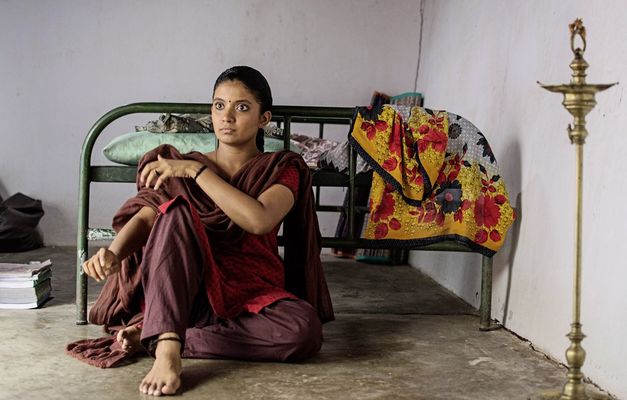
Berlinale Forum: As far as I know, the starting point for your film was an incident in your own family. Could you speak a bit about how you developed this into a script and a film?

PS Vinothraj: Yes, such occurrences were very common in my childhood, and I just internalized them growing up: “that’s how things are.” But once I became a filmmaker, there was another event in our extended family. That’s when I started exploring this idea, of how these foolish beliefs are fed into people when growing up. Doing so, I realized that it’s not an isolated incident in one village in the south of India. Rather, it happens all across the country. And women are usually the centre of such rituals and practices. This is when I felt it deserved to be made into a film.

Even as we speak, people are either making plans to visit seers for this ritual of exorcism, or they’re on their way back. It’s happening every minute.

The protagonist Meena is silent for most of the film. How did that develop?

In situations such as these in real life, the girl is usually silent and hardly allowed to express herself. It’s everyone around the girl who constantly speaks about her. And this is one of the reasons why I tried to portray Meena as a silent character. But I also think silence can convey adamance, more than overt arguments or fights. Meena has made up her mind, and no matter what the people around her do or say, she is steadfast in her thoughts and desires. I wanted to visually convey her grit and resolve, and that’s why I wrote her that way. Her silence is a defiant, adamant kind of silence.

We were wondering if the English title The Adamant Girl is the literal translation of Kottukkaali, or there’s some other meaning to the word.

In Southern Tamil Nadu, the word ‘kottukkaali’ is a dismissive term used to describe women, young and old, who do or say what they want. It’s very much related to the sense of an adamant girl.

Speaking about the form of the film, our selection committee liked that it is a road movie, and that you don’t exploit the more melodramatic aspects of it. How did you make this decision?

The intention was to closely follow people who have a certain belief system. And the goal was not to demonize or falsify them. The violence that they cause is an unwitting, innocent kind of violence. And the idea was to follow the characters in their world and observe their behaviour and beliefs, before finally arriving at a statement. That’s what led to the form of the film, which basically follows the characters in their everyday behaviour, speech and rituals.


[Read the full interview here]
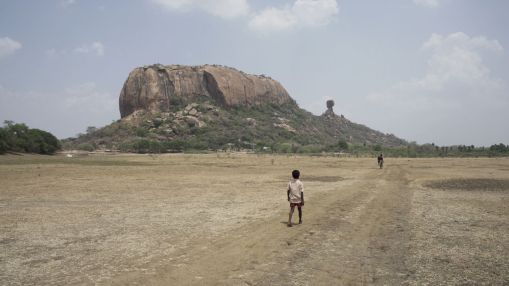
pebbles

There is a scene early on in P.S. Vinothraj’s first feature Pebbles that takes place in a town bus. Diverging from the story at hand, the director fixates on a series of objects that accompany the passengers: a marapachi doll, a yellow cloth bag, a new set of brass lamps, a CRT television, plastic water carriers. It’s the sort of sentimental detail, each item conveying a world of stories, that gives the film its lived-in quality. As the bus plods along the narrow road, someone smokes one beedi too much. A scuffle ensues, waking up a sleeping baby at the back and bringing the shuttle to a halt.

If these sensations of small-town transit are ostensibly wrought from experience, Pebbles supplements them with material ripped from the headlines. The film unfolds in parched stretches in the outskirts of Madurai in Tamil Nadu. Once there were rivers in in these lands, but all that remain today are signs: empty water canals, drought-resistant vegetation, dying springs. And pebbles. The possibility of agriculture having collapsed, some families have resorted to hunting and consuming rats.

Amid this bleak picture is the story of a father and a son. The man, an alcoholic, seethes with uncontrollable rage at his wife who has left him. The internal movement of the film is closely coupled with the rhythms of this man’s quivering body. Despite the bottle, he walks briskly, his chest heaving, as his child follows him far behind in a mix of fear and concern. For the most part, Pebbles is a horizontal film made of characters traversing the frame from left to right. As the man heads towards his in-laws’ place to find his wife, we also get a tapestry of scenes from the village in the background.

The child, in contrast, is a mute receptacle to his old man’s violence whose muteness is also a force tempering this violence. He wants his family to stay together. When his father sets out to board a bus back to his village to take it out on his wife, he tears up the wad of cash entrusted to him, forcing both of them to walk back home. As a collector of pebbles, the boy knows that this unforgiving landscape has a way of smoothening rough things. Sure enough, the long pedestrian voyage under the scorching summer sun does things to the man’s head, even if it doesn’t entirely cool it down. By the time he reaches home to down some water and food, the film too has settled into a sedate rhythm. Pebbles, then, isn’t as much a story of the terrain as a story by the terrain.

Even when it goes through familiar emotional beats, Pebbles manages to remain fresh, an important quality for a debut work. Vinothraj executes bravura sequences with serpentine camera movements, but he is also concerned with capturing a child’s confusion within a conflict situation. His film is about survival, about life in its barest details, but it doesn’t rule out the capacity for aesthetic experience: waving a balloon out the bus window, transforming dry leaves into a simulated rain shower, collecting feathers and pieces of a broken mirror. And pebbles.


[Originally written for the International Film Festival Rotterdam]