[An edited version of the following text was originally published in Pardo, the Locarno Film Festival’s official daily magazine.]
What are conscientious artists to do, especially those dependent on state support for their work, when their country is waging a lopsided, genocidal war? Challenging the state, if it is possible at all, could invite reprisals. Dramatizing one’s personal anxieties risks producing narcissistic exercises in self-flagellation. Trying to find nuance might amount to little more than well-intentioned handwringing, while dodging the political altogether would smack of cynicism.
In Some Notes on the Current Situation, Israeli filmmaker Eran Kolirin gestures at one possible way out of this impasse, crafting a work where politics exists as a substructure, as a kind of collective unconscious that rises to the surface in all its nastiness every now and then. Bearing the subtitle “a film set before World War 3”, Kolirin’s 79-minute feature is divided into half-a-dozen loosely connected chapters, several of them set in nondescript countryside, devoid of all signs of the ongoing war. In fact, if not for its title, one could hardly say that the film deals with “the current situation” at all.
Kolirin, though, is no stranger to tackling politics head-on. His last feature, Let It Be Morning (2021), was an Arabic-language adaptation of Palestinian author Sayed Kashua’s Hebrew-language novel of the same name. It featured an all-Palestinian cast that boycotted, with Kolirin’s approval, the Cannes premiere of the film in protest against what they perceived as the Israeli state’s appropriation of their work. Like Morning, Notes is backed by the Israel Film Fund, but it’s a much smaller project with a cast of Jewish actors donning multiple roles.
Each chapter of Notes is something of an absurdist sketch, centring on rituals or interactions that defy rational explanation. In the film’s overture, for instance, a woman pushes against a concrete building with all her might, in the zealous belief that it is collapsing. She demands a passerby to lend her a hand. The man is confused, but obliges nonetheless. With the help of two others, they manage to prevent the impending catastrophe and, in the process, restore colour to their monochrome world. What begins as an individual delusion snowballs into a collective psychosis.
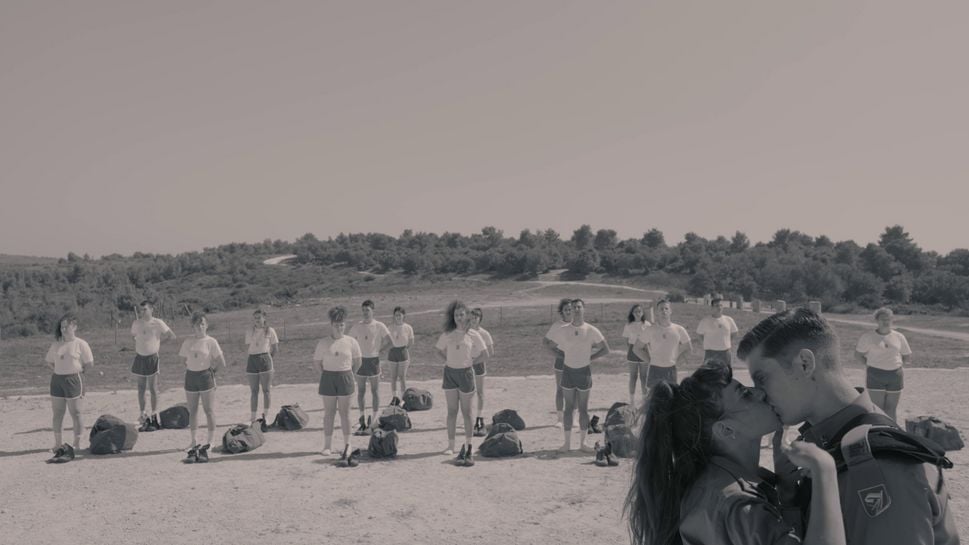
In another segment, a couple drives endlessly around the desert, their delivery truck loaded with snow, looking for the set of Theo Angelopoulos’ new movie. It turns out that the pair are time travellers from the past who have teleported themselves to a country they don’t recognize anymore. Elsewhere in the film, a sadistic military drill becomes the occasion for a return of the repressed.
This mosaic of humorously bizarre vignettes, a little reminiscent of the work of Roy Andersson, doesn’t yield easily to interpretation. The pleasure, on the contrary, is in their thought-provoking elusiveness. In the film’s Coen brothers-like coda, an elderly rabbi encounters a wayward husband and tells him the tale of a young Jewish scholar who meets his Inuit fiancée’s family. Suffice to say, the story ends with broken teeth and a tear-filled feast.
What moral lesson the husband, or we, are to draw from this outlandish parable is not immediately clear. But the inchoate, oppressive feeling of meaninglessness that it leaves behind is undeniable. Faced with film’s many Kafkaesque situations, we find ourselves in a state of fugue, just like the characters. Coursing through Notes is a strong sense of confusion and dislocation, the sentiment of finding oneself profoundly out of step with the logic of the world. In that, the film is perhaps entirely emblematic of “the current situation”.
 The Seventh Art