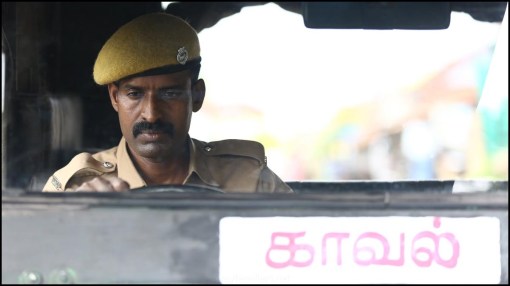
“Don’t use your powers to feed your perversions,” police officer Suresh Menon (Gautam V. Menon) tells off his subordinate Raghavendar (Chetan), who has stripped his detainees in an effort to extract vital information. It’s probably too telling a comment, for Viduthalai Part 1 (“Freedom”) offers director Vetrimaaran one more occasion to anthologize his fantasies of sadistic, retributive and occasionally poetic violence. Set in the 1980s, the film follows the efforts of the police in eradicating armed rebellion in a mineral-rich corner of rural Tamil Nadu in order to make way for mining corporations to set up shop. Newly appointed as a driver to a unit working deep in the forest, constable Kumaresan (Soori) runs up against his superior Raghavendar after he develops affection for the local population, who support the rebellion and distrust the law enforcers.
Manifesting variously in allegorical (2011’s Aadukalam), legal (2016’s Visaranai) and historical (2018’s Vada Chennai and 2019’s Asuran) forms, violence has been the idee fixe, the central subject of Vetrimaaran’s body of work. Yet, barring perhaps Visaranai, his films have proven themselves increasingly unwilling to transform it artistically, to relate the viewer to on-screen violence in any other terms than voyeuristic.
The problem is that Vetrimaaran is so committed to a form of seamy, immersive realism that the only way he can depict violence is in terms of its real-world plausibility; the primary effect he aims at is moral outrage. The problem is also that Vetrimaaran has now been overtaken by hacks who have perfected his original method and rendered it highly conventional. You can’t help but laugh or wince when the police in Viduthalai wrest away adults from a hut to leave behind a crying infant. Or when Raghavendar, having stripped a group of women, asks his deputy for chilli powder, kindling the sordid parts of our imagination. With Viduthalai, Vetrimaaran may have voluntarily turned himself into a meme.
Like Asuran, Viduthalai applies a jittery editing to the most basic of conversation scenes, never lingering on the actors for more than a couple of seconds. When, for instance, protagonist Kumaresan and his sweetheart Tamizharasi (Bhavani Sre) are talking at a shrine in the woods, the camera keeps switching perspectives, suggesting inexistent threats. This CCTV-adjacent aesthetic is generalized in Viduthalai, which, while nominally told in Kumaresan’s epistolary voiceover, keeps shifting perspectives for the sake of furnishing additional narrative information. The film treats its actors like non-professionals, rarely providing them close-ups or extended shots outside of kitschy montage songs, because Vetrimaaran seeks to neutralize their performance with heavy dubbing — the same kind of asynchronous mush that made Asuran so jarring — which undermines his otherwise realist approach.
The longer shots in the film, on the other hand, are devoted to passages of extreme physicality. We see Soori running in from deep inside the frame, out of breath, or doing squat walks as part of punishment in unbroken shots. It is plain by now that Vetrimaaran is excited at the prospect of choreographing such convincing scenes of exertion and torture, compared to the simple, mundane presence of bodies talking to one another. It’s as though Vetrimaaran the filmmaker is bored to death by Vetrimaaran the screenwriter, who can’t help but insert political lectures into the mouths of characters or flatter us with snappy, jargon-laden insider talk among top-level police officers.
A number of things nonetheless ensure Viduthalai is never less than absorbing. The inspired casting, for one; to see a tragic hero in the perennial comic Soori not only imparts a dialectical streak to the protagonist, it also affords Vetrimaaran to work out a nurturing, vastly different kind of masculinity than the avenging, star-driven model of Asuran. Flabbier than usual, the middle-aged Soori can hardly pass for a rookie cop, but his naivete and professional disenchantment are never in question. It’s touching to see his unprepared body slip on rocks, jump across rooftops or trudge through a difficult, rocky terrain — a terrain that is transformed into a garden through the power of his love. Despite his omnipresence in Tamil cinema these days, Gautam Menon is excellent as a ruthless officer who is persuaded that winning hearts and minds is the first step to defeating terror (although his character undergoes an inexplicable corruption that gives mixed signals which are never resolved).
Among the most articulate, committed filmmakers of his generation, Vetrimaaran takes obvious pleasure in elucidating ideological processes shaping his narrative. To this end, we have the superintendent of police, played by cinematographer Rajeev Menon (the third director in the cast after Gautam Menon and Tamizh, who plays another policeman), expounding on political strategies such as party-led protests that act as democratic safety valves against armed insurgency, poster campaigns to instil hope in doubtful investors or having decoy militants surrender in a ploy for the police to take moral high ground. If these details don’t make you laugh, they are bound to leave you impressed — just like the flashy, one-shot train wreck that opens the film.
The most compelling aspect of Viduthalai is, however, its final (and only) set-piece which intercuts between the aforesaid scene of Raghavendar humiliating the women and an ununiformed, unarmed Kumaresan running through a maze-like town chasing the rebel leader Perumal (Vijay Sethupathi, who appears after an hour into the film). The sequence intriguingly casts Kumaresan’s courage as a product of desperation, an act of “fleeing forward.” The scene is also rather surprising in the manner in which it pits Kumaresan’s romance not against his allegiance to the police force, as we are led to expect, but against his newfound sympathy for Perumal. In doing so, it approximates the paradox of identification that Visaranai posed insofar as we are caught between a desire to see the cops succeed in capturing Perumal and a profound hatred for them for what they are doing to the captive women.
Viduthalai is, to be sure, an improvement over the slapdash production that was Asuran. It certainly isn’t made with an eye on the box-office, and if it does bomb, which is a likely development, Vetrimaaran would still go to bed a happy man. But the film doesn’t seem to me like an inflection point in his career, for it doesn’t evolve Vetrimaaran’s style as much as harden it, set it in stone. And that’s too unfortunate for a filmmaker who has just begun.

 The Seventh Art