[An edited version of the following text was originally published in Pardo, the Locarno Film Festival’s official daily magazine.]
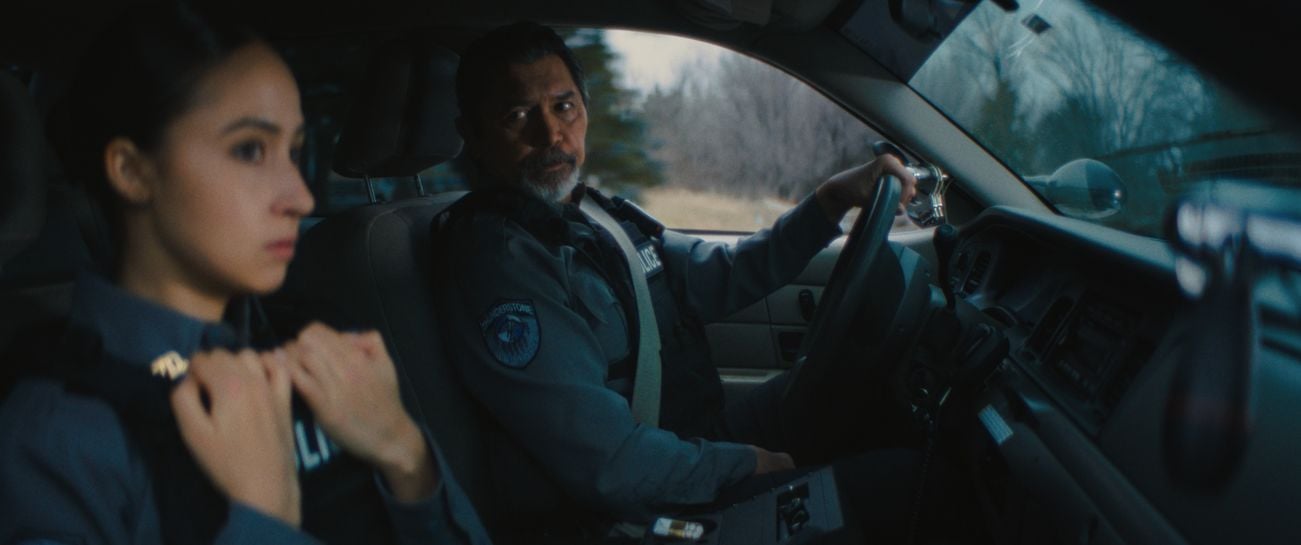
“We are all squatters here, Toto”, quips officer Teddy Sharpe (Lou Diamond Phillips) to his rookie beat partner Sandra Scala (Dana Namerode). A half-Filipino working for the tribal police in Thunderstone indigenous reservation, Teddy is an ethnic outsider. But as someone who has grown up among the Native Indian community, he is intimately familiar with the ways of the reservation, now under the sway of drug cartels and warring gangs. “We have our laws and punishment, the streets have theirs”, goes another of Teddy’s nuggets to Sandra.
In Keep Quiet, Vincent Grashaw (Bang Bang, Locarno Film Festival 2024) offers a gritty, long–fused crime drama that puts the conventions of the genre at the service of a complex sociological reality. The reservation, in Zach Montague’s close-grained screenplay, is host to competing moral codes and regimes of authority: indigenous gangs who fashion themselves as a brotherhood above American law, the district police who only view them as anti-social elements to be clamped down, and the tribal police who perform an interstitial peacekeeping role.
At the centre of this vortex is Teddy, who uses his official power to curb delinquency in the reservation, but who is also mindful of the larger needs of the community. Having possibly wronged the community in the past, he is desperate to keep children away from both the streets and the law. But when Richie (Elisha Pratt), a reckless ex-convict, returns to the reservation with vengeful motivations, Teddy’s hopes of stemming the cycle of crime and violence are severely tested.
Shot by Brandon Waddell with an acute feeling for shadows, Keep Quiet offers a shining example of lean, no-frills genre filmmaking: invisible craft deployed to draw us into a believable, realistic world. Despite the richly detailed backstories to the characters, Grashaw succeeds in imparting immediacy and momentum to the narrative, never allowing the film to wallow in psychology. In that, he is aided by convincing performers such as Namerode and Pratt, who bring to life, with admirable economy, individuals fighting their own demons.
But the beating heart of the film is Phillips, who distils classical Hollywood models of middle-aged masculinity into Teddy: wise, sardonic, measured in action and word, with occasional touches of irascibility that only reveals an impatience with empty niceties. His moral sense is derived from a spontaneous, practical intelligence rather than theory or self-analysis. Yet he can be lucid when necessary, evoking a knotty, painful past with razor-sharp clarity and concision. Phillip’s Teddy is John Wayne and James Stewart rolled into one.
 The Seventh Art