April 2021
Monthly Archive
April 7, 2021
[From Luc Moullet’s monograph Cecil B. DeMille: The Emperor of Mauve (2012, Capricci). See Table of Contents]
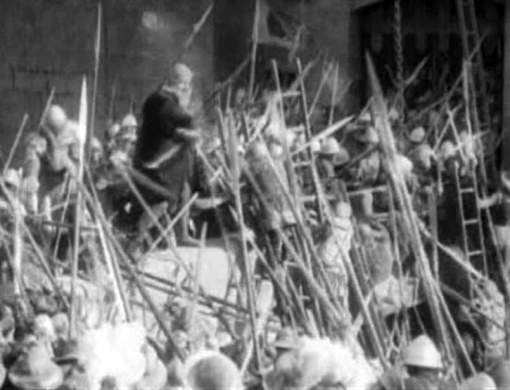
Joan the Woman: the Siege of Orléans, a beautiful disorder.
This title is a bit inaccurate, because there aren’t just films with Geraldine Farrar during this period, but these are his most ambitious and expensive films of the time, though not necessarily the best ones.
The collaboration with Farrar (who resembles the filmmaker Danièle Huillet a bit, but is less pretty of course) lasted five films. Curiously, he called upon her to play Carmen, obviously a silent version: the year was 1915. He chose her because she was the most famous soprano in America. It was a stupid choice: it’s as if Callas was asked to play Aida in pantomime. DeMille probably thought that a disc of Bizet could accompany the visuals in the theatres. It wasn’t to be: Bizet’s descendants were uncooperative when it came to rights, as was proven by their later opposition to Preminger’s all-Black Carmen, which was banned in France for some twenty years. The challenge for DeMille, a small-time, failed, hung-up playwright, was to bring the greatest Opera singer to Hollywood for the first time ever, just like he had got the famous stage actor Dustin Farnum to the West Coast to play The Squaw Man.
A prestigious affair…
Geraldine Farrar again played an opera singer, still a silent one, in Temptation (1915). Farrar was then thirty-four. It may have been believable on stage, with its distance, for her to play a nineteen-year-old Joan of Arc [in Joan the Woman, 1916], but not in cinema with its close-ups. Moreover, Farrar was something of a tank: you need a solid pair of lungs to sing. It was therefore the opposite of the traditional image of Joan of Arc, the frail young maiden who, with her faith and enthusiasm, defeated the powerful soldiers of the English army. So the spice, the paradox of the Joan of Arc story had vanished.
The film is worthy for the sequence showing the Siege of Orléans, the best battle scene shot by DeMille: a beautiful, chaotic and inventive wave of soldiers in action, with multiple arms under the fortifications, on the rampart walls and in the city. Carmen, in contrast, is interesting only for a brief sequence realistically showing the work of cigarette makers and was rightly sent up in [Chaplin’s] Burlesque on Carmen.
Farrar was followed by America’s sweetheart, Mary Pickford; or the triumph of the star system. Pickford’s salary came up to 71% of the final cost of A Romance of the Redwoods, a rather ordinary Western (in fact, a “Northern” since DeMille always preferred adventure films set near his native Massachusetts). In contrast, Pickford is remarkable in her spontaneity in The Little American, a contribution to the war effort (along with Joan the Woman, a film indirectly campaigning for entry into conflict, and Till I Come Back to You). DeMille hedges his bets: before the war in France, Pickford was seen trapped in the sinking Lusitania, which has a bit of Titanic about it. It’s all on the nose: Pickford, a young American girl above the fray, becomes, without wanting to, a heroine who saves the good French soldiers at the risk of her life… There are some rather melodramatic images here, with the trenches, the ruins, a Christ statue standing alone in the middle of rubble, and Pickford in a tearful pietà pose at its foot. Even so, the result is impressive. The scene may even have influenced Gance in J’accuse, made shortly after.
Coming in the line of “great spectacles”, the last Geraldine Farrar film, The Woman God Forgot, is disappointing, offering us only a phoney Mexico from the time of the Aztecs.
Finally, this period is more interesting for its naturalist films and its low-budget melodramas.

Charlotte Walker, Raymond Hatton in Kindling (1915): a high point of naturalism.
On naturalism: going through DeMille’s work chronologically, it’s shocking to come across an almost neorealist film like Kindling, a pure gem that follows a series of uninteresting movies. What could have happened for DeMille to rise to the peak of his craft in one go? To be frank, the transition from the preceding period isn’t as clear-cut, which doesn’t make the critic’s job any easier. Later films like Maria Rosa or Chimmie Fadden Out West are just as disappointing as early attempts such as The Unafraid or Rose of the Rancho. There’s an element of chance shaping the choice of projects at any given point. I’ll come back to this naturalist period.
The melodramatic section includes very diverse films: the perfect outline of The Cheat (1915) contrasts with the complex and tormented itinerary of The Whispering Chorus (1917). The first part [of the latter film] is a realistic depiction of the life of accountant John Tremble and his family. When he is forced to flee following a forgery he has committed, the film becomes a wildly imaginative soap opera: he disguises himself, changes his physical appearance completely, assuming the identity of a dead body he finds by chance and which he passes off as his own. After a wide variety of episodes—a beautiful Chinese festival, a serious accident at work—he returns home. We learn that the police are after him for the murder of… John Tremble. Fortunately, his mother recognizes him and sets out to resolve the matter. But, alas, she dies two minutes later. He is arrested and lets himself be sentenced to death, not wanting to jeopardize the future of his wife, who is now married to a bigwig. The extraordinary nature of the story works very well, since it appears only slowly, halfway through the film, after an initial anchoring in everyday reality. We manage to understand everything of this extremely complicated story. A triumph of great melodrama, as is underlined by the film’s French title, The Supreme Redemption. The French titles of the films that follow reinforce their affiliation to the genre: Price of a Throne, Whirlwind of Souls, The Damned of the Heart.
April 6, 2021

Liberal imagination tends to consider translation as an act of building bridges between cultures. But if the history of colonialism and nationalist hegemony has any lesson to offer, it’s that building bridges isn’t necessarily a guarantor of mutual respect. Translation is an act of faith, and as someone who cannot produce new discourse, only affirm existing ones, the translator is essentially a powerless figure, even when his/her own existence is at stake.
This powerlessness is front and square in the superbly-edited first scene of Jasmila Žbanić’s Quo Vadis, Aida?, nominated for the Academy Award for Best International Feature this year. Seated amid clouds of cigarette smoke, a tense but focused interpreter, Aida (Jasna Đuričić), translates between a group of civilians from Srebrenica, Bosnia, and a unit of UN peacekeepers. The locals are worried about the advance of the Serb army into their city, supposedly a UN-protected “safe area”, while the Blue Berets assure them that the NATO has their back.
As the camera pans back and forth between the two camps, in a meditative manner that belies the tension of the situation, Aida translates words, but the essential part of the communication succeeds without her intervention: rising and falling pitches, quivering voices, defiant stares and denied handshakes. Aida is personally implicated in the standoff, but her emotional state has little bearing on either the tenor of the negotiation or its outcome. Hers is not to reason why, but to smoothen a process, even if the process is to dispatch a group of people to certain death.
Quo Vadis dramatizes the days preceding the Srebrenica massacre, in which over eight thousand Bosniak Muslims were slaughtered. It weaves a factual account of how the genocide was allowed to happen with a fictional story told from Aida’s point of view. A host of factors are summoned to court: the deep-seated ethnophobia of the Serb soldiers, the cunning media manipulation of General Mladić (Boris Isaković), who orchestrated the massacre, the indifference of the NATO for whom Bosniaks were simply pawns on a political chessboard, the failure of the UN command to stand up to Mladić and their ignoble capitulation to him.
All this clear-eyed analysis would have been formally unwieldly were it not for the character of Aida, who binds these diverging perspectives together. Her unique position between the Bosniaks and the UN forces helps the film to never deviate too far away from her own story. Aida tries, with every means at her disposal, to rescue her husband and two sons from the fate reserved to the other members of her community. Part of Žbanić’s accomplishment is the way she manages to open up the film from this narrow narrative perspective to larger political questions in a fairly organic manner.
This tactic isn’t without considerable limitations. Though a Bosniak herself, Aida is a quasi-outsider who shares little with the huddled masses that make up the refugees at the UN camp. No Bosniak outside of Aida’s family has any individuality to speak of, and the only two characters to be singled out during negotiations with Mladić exist solely in order to be humiliated. Refugees are marshalled, instead, into a series of vignettes depicting the injustice and violence they are subject to — images that recall Hollywood’s recreations of historical atrocities in their unsettling virtuosity. The absence of any reference to armed resistance by Bosniak soldiers or civilians is, moreover, a political convenience that weakens the film’s argument.
Quo Vadis is at its strongest, though, when it sticks close to Aida, whom it follows with a handheld camera whenever it isn’t allowing us a moment of repose with static or slowly panning shots. Jasna Đuričić’s turn as Aida is formidable, and director Žbanić composes her shots around the character’s nervous physicality. Wearing trousers and an unbuttoned blue shirt over her blouse, the middle-aged Aida briskly moves through numerous obstacles at the UN facility, climbing up and down containers, and snaking in and out of its makeshift offices. The frame can barely contain her energy. Associated all through the film with two objects — cigarettes and loudspeakers — she becomes a powerful visual anchor for the viewer.
War films have a tendency to lionize their protagonists, turning them into heroes who shape or defy the course of history. Quo Vadis, however, takes pains to underscore that Aida is not a hero. Her character has little by way of ideals or even work ethic; she is willing to translate patent lies and she is willing to not translate uncomfortable truths. She is an accidental interpreter and would rather be rescuing her family than arranging toilet facilities or delivering babies at the camp. Aida is determined to save her husband and two sons, even if it means passively shepherding the other refugees to their grave, and she has no compunction about this. For her, it isn’t about justice or community rights, it’s about familial survival. And this relative moral complexity holds the character at a healthy distance from the viewer.
But the real human complexity arrives with the film’s extended coda in which Aida comes back to Srebrenica years after the war. She is a foreigner in her own neighbourhood, which is now occupied by Serbs. In her class at school are children of the genocide victims, but also those of the perpetrators and enablers. Could Aida ever love teaching again, given that it was one of her former students who helped deport her husband and sons? With victims now expected to put their past behind and be part of the same civil society with war criminals, the notions of truth and reconciliation ring hollow. Performing together on a single stage for a school programme, the ethnically diverse kids look alright. That would, at least, be Aida’s hope.
[Originally published at Firstpost]
April 5, 2021
A burly guitarist stands at the corner of a street trying to master the notes of “Twinkle, Twinkle Little Star”. A man passing by listens to him intently and drops a coin in appreciation of the effort. The passer-by knows a thing or two about starting from scratch, for he is one of the thousands in the city to be diagnosed with amnesia, an epidemic that seems to have neither cause nor cure. A lucky few have family members who come to pick them up from the hospital, countless others are simply labelled “unidentified”: individuals with no identity or social network to speak of.
The passer-by is the unnamed protagonist of Apples, Greek filmmaker Christos Nikou’s compelling if somewhat mannered directorial debut, currently screening in the Viewing Room of the Dharamshala Film Festival. One of the “unidentified”, he is convinced by the doctors at a neurological hospital to sign up for their “New Identity” programme, which aims to help these blank slates start life anew. Installed in a sparsely furnished apartment, the man receives regular “tasks” from the chief doctor via audio cassettes that he must complete and furnish proof of with photos. The tasks are increasingly convoluted and psychotic, instructing the protagonist to crash a car, jump from heights and worm his way into the household of a recently deceased.
The element that fuels the narrative of Apples, and sustains our curiosity, is the mystery around the man’s relationship to his past and the uncertainly about the direction of his future. The character wanders across playgrounds, theatres, discotheques, strip clubs, pubs and parking lots, completing eccentric assignments that take him vaguely through the signposts of childhood, adolescence and adulthood. There is a sense that he is undertaking these tasks with the sole purpose of converting them into polaroid souvenirs. A pointedly millennial condition, this obligation to create a new album of life events, to prove that he has lived these moments, supplants the experience of these events itself.
The pathos of the lead character’s attempts to narrativize his life is undercut by hints that he may not entirely be the tabula rasa that we take him to be. From early on into the film, we are made privy to incidents that reveal that the man might be consciously running away from a past and is, in fact, not amnesiac. His resistance to being identified at the hospital, his “stealing” of symptoms from other patients and the rare instants where he lets his guard down suggest that what the man may be suffering from is not forgetfulness but memory.
Part of what is admirable about Apples is that, far from intending to cheat the audience as to the truth about the protagonist’s condition, it proposes the character’s dual being as authentic in itself. Nikou’s film is about grief and its repression, and it submits that the desire for a spotless mind is as inextricable a part of human existence as the will to forge a personal history. To this end, the director refuses to let us into the protagonist’s mind and plays instead on his inscrutability. The character, who understandably dresses up as an astronomer at a costume party, is never quite anywhere.
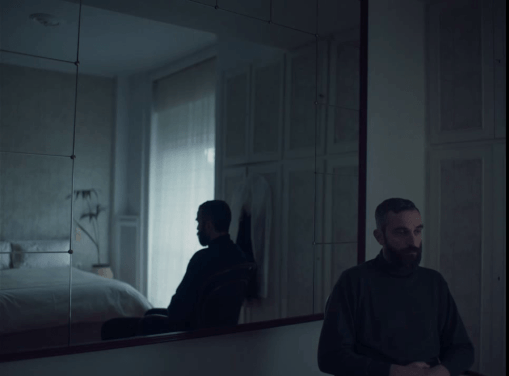
Played by a bearded Aris Servetalis, who cuts the figure of a stoic philosopher parachuted into modern Athens, the protagonist says very little, expresses even lesser. Even when he sings or dances, he looks like he’s executing an idea of song and dance. Nikou, who dedicates the film to the memory of his father, instead fixates on shots of the actor eating, sitting or staring into the distance. Looking at him biting into one apple after another, we wonder if anything at all lies behind his cryptic, silent stare.
Apples is thin on narrative incident or exposition, and fashions itself above all as the study of a cipher. As is de rigueur in cinema of this kind, Nikou shoots in shallow-focus, pivoting his compositions on Servetalis’s sculptural face and upper body. The actor is consistently decentred in the frame, reflecting the character’s loss of centre and the feeling of being never blending into the landscape. Outside of another “unidentified” woman (Sofia Georgovassili), whom the protagonist meets during one of his tasks, there are few full-fledged characters, which encourages Nikou to stay away from shot-reverse shot patterns.
Contemporary Greek filmmakers operating in this narrative mode can barely escape comparisons to Yorgos Lanthimos, with whose idiosyncratic, high-concept works Apples has considerably in common. Besides borrowing his lead actor from Alps (2011), Nikou channels his compatriot in his taste for absurd plot developments, unorthodox shot composition, clinical indoor settings and handling of secondary characters, who are suitably caricatured in voice and gesture to the benefit of the protagonist.
Nikou, though, pitches his film at a level above realism—the viewer is simply expected go along with the premise, which may not stand logical scrutiny—but several notches below Lanthimos-like parable. He accentuates the incongruence by a calculated anachronism: his film looks by turns contemporary and futuristic, but is strewn with props that are forty years old. While such preconceived quirks as the film’s 4:3 aspect ratio have by now become veritably academic, Apples keeps it light and avoids being overwhelmed by its film-awareness.
[Originally published at Firstpost]
April 4, 2021
[From Luc Moullet’s monograph Cecil B. DeMille: The Emperor of Mauve (2012, Capricci). See Table of Contents]
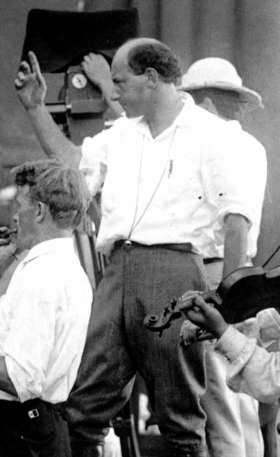
Cecil DeMille at work.
The first film was both an artistic success and a commercial triumph, achieved at the age of thirty-two (DeMille was born in 1881), which suddenly made Hollywood the capital of cinema. The Squaw Man (1914) is often misunderstood: it is not “the man who was a squaw”, but “the husband of the Indian woman”, which is the film’s French title. The strength of this production is its rapid pace centred on a story with twists and turns, since it is about an Englishman wrongly accused of fraud, who is forced to leave the country of his birth, before emigrating to New York and then to the Rocky Mountains, where he has an affair with an Indian woman, who is soon driven to suicide. He is exonerated and returns to England with his half-breed son to find the woman he loved. It’s actually much more complicated than that. There is here not only the interest generated by complete changes of place and milieu (the London gentry and the Wild West), but also the complexity of the various plots. In short, it was to become a model for more than fifty years of film history. No time to get bored.
It’s surprising to note that none of the twelve films that follow is at the level of this striking debut. There’s at times a certain observational humour in the life of the husband of a stage star, a real prince consort (What’s His Name?), and in the vaguely Henry James-like quality of a cosmopolitan affair (The Man from Home). And I love the gag from The Captive conceived by DeMille’s favourite screenwriter, Jeanie MacPherson: a prisoner of war is placed in a farm to work the fields, with a harness on his back. But once the war ends, it is he who places the harness on the shoulders of his boss, whom he has married. There’s an almost identical gag in Male and Female four years later. It’s not much. There are minor comedies in this period featuring a mediocre but successful comic, Victor Moore, midway between Fernand Raynaud and Jean Lefebvre (the two Chimmie Fadden films, Wild Goose Chase), and Westerns or adventure films (The Girl of the Golden West, The Virginian), but DeMille will learn to use the Western to his advantage only twenty years later.
Seen today one after the other, these movies disappoint in their casualness: whether they are set in Turkey, the Rocky Mountains, Andalusia, Montenegro, near Naples or Mexico, they have all been shot in the same Californian landscapes, with their small arid hills. There are the same houses and the same actors, who reflect very little of the physical characteristics of the local people.
This decline could be explained by the fact that The Squaw Man was co-directed by Oscar Apfel, who was more experienced than Cecil, who was going to be left to his own devices on the following films and was going to learn his lessons, which were honestly a bit laborious.
And then DeMille didn’t expect such a success. He may have been caught unawares, without a project close to his heart. It’s because everyone, attracted by such a triumph, asked him for more films…
1915: thirteen films in the year. A record! Some have said that this profusion was somewhat imposed on him by Lasky, his producer. He served as an example for other directors under contract. He showed them that he wasn’t one to laze around. He ensured excellent returns. But at this rate—more than one film a month—it’s hard to make anything good.
It should be noted that these films, shot on location for the most part, were, however, mostly adapted from plays, a cultural sphere that DeMille knew well since he was a playwright and an actor. It seems that he wanted to restore a certain prestige to cinema, then considered minor entertainment by the people of Boston, by bringing to it what he thought was the best in theatre, including plays by Booth Tarkington (future Pulitzer Prize winner and the author of The Magnificent Ambersons) and David Belasco, the numero uno of the stage around 1915, with whom Cecil and his father had already collaborated. This was enough to overcome the reticence of his older brother, William DeMille, who vigorously criticized him for getting mixed up in a kind of show business that was totally unworthy of their family.
April 1, 2021
« Previous Page

 The Seventh Art