All Posts


The White Ribbon

At Loose Ends 
(Image courtesy: Empire Online)

Michael Haneke’s The White Ribbon had to fight it out with quite a few heavyweights this year at Cannes for the Golden Palm including Ang Lee, Pedro Almodovar, Jim Jarmusch, Jane Campion, Lars von Trier and Quentin Tarantino. It has also been selected, but not without some controversy, as Germany’s official entry for the Oscars. All I can say is that Austria must be happy. Since the end of the Second World War, fascism has been studied and dissected on film many times over with varying degrees of success. With a veteran such as Haneke at the helm, writing an original script for the movie, I did expect more than what The White Ribbon presents here. Some reviewers have pointed out that being familiar to Haneke’s body of work will help one appreciate this film more. I had only seen his The Piano Teacher (2001) before this one and felt that The White Ribbon does not really succeed because Haneke undoes everything that he did right in the former film. Even his subtle, cerebral and gently commenting mise en scène is not able to heal the film from the blows dealt to it by its script. Sure, it is an ambitious film that many directors would not have been able to pull off, but it falls way too short of standard for a director who has established himself as one of the most important directors working.

The White Ribbon brings to us a chain of mysterious and violent events that occur in a village in Germany prior to the First World War as narrated by a teacher (Christian Friedel) who worked in that village during that period. We are presented with a host of characters from various walks of life – the Baron (Ulrich Tukur) and his wife (Ursina Lardi) who provide employment to majority of the village, the Fender family of peasants who have just lost the lady of the house in an accident at the Baron’s workplace, the village doctor (Rainer Bock), who has recently had an accident riding a horse, and his mistress and the midwife of the village (Maria-Victoria Dragus), the village priest (Burghart Klaußner) and his family and the narrators own love interest – the new nanny at the Baron’s – the seventeen year old Eva (Leonie Benesch). We are made privy to the happenings of each household and the dirty underbelly hiding behind the flawless exterior of the quiet and secluded village. Mishaps pile up one after the other, progressively violent, and suspicion soars in the village as the culprit is nowhere to be found. All these characters and events are held together on a single clothesline that consists of the children of the village. They are the witnesses and victims of the events that unfold. They are also the documents that would define the course of history – of the village, of the country and of the world – that is to come.

Primarily, Haneke’s film proposes political, social, religious and sexual repressions exhibited on a young generation by its predecessors as the roots of fascism and places this argument in the context of pre-war Germany. Although these forms of repressions have been studied individually and in considerable detail in many other films of the past, The White Ribbon attempts to integrate all these influences into a monolithic attitude that defines the course of a society. As observed by many reviewers, The White Ribbon bears remarkable resemblance to Clouzot’s wartime classic The Raven (1943), which scathingly exposes the changes in mentality of a collective during uncertain times and the hypocrisy and hate that such a political climate brings to surface, in its study of a group as a whole wherein disparaging threads eventually converge to draw out a single, coherent portrait of the group at a particular time. The class system is tangible, with the aristocracy, intelligentsia, the middle class and the peasantry being represented with clear demarcation.  The Baron and his wife – the upper class – have only their personal relationship and their property to worry about. The bourgeoisie is content in sticking to a set of middle-brow principles (there is way too much formality going on in the film) and maintaining status quo. The peasants can only worry about everyday survival. The apolitical intelligentsia – typified by the doctor and the teacher – is busy with its own romantic encounters and perversions. Cinematographed by Christian Berger, this isolation of the clerisy is summed up in two stunning shots in the film – one during the dance at the village fest (reminiscent of Ophüls’ magical Madame De… (1953)) and one on a horse carriage (reminiscent of Werckmeister Harmonies (2000), one of the best explorations of fascism on film) – in which the teacher and his love interest Eva are alienated from the village events. And whenever a member of any class tries to digress from these functions, they are berated and made to return to their position by either the class divide or the generation divide.

The White Ribbon presents us a seemingly pacific society which thrives on domestic bureaucracy for survival and maintains hierarchies to perpetuate that status. Haneke presents these power games not as a ping-pong rally, as we have seen in so many films, but as a chain of dominoes. In his world, there is no such thing as retaliation. Everybody has to conform to and perform specific roles in society – willingly or otherwise. The elder Fender has to play the role of a helpless farmer whereas his son, the radial, has to play the part of an obedient child irrespective of him being an adult. There is an obligation placed on everyone in the hierarchy by ones above them to conform to certain rules and to get punished upon transgressing those boundaries. The priest ties a white ribbon – another stereotype which symbolizes innocence (as defined by Protestant morals) – on his adolescent son’s arm to remind him of his duty to ward off worldly temptations and lays down an unwarranted responsibility upon him to play the role of a moral Christian. This seems to be the plight of every child and young adult in the village who can’t seem to counter their “masters” and are forced to channelize their reactionary violence through other means. Like Estike (Erica Bók) in Satan’s Tango (1994) and Isabel (Isabel Telleria) in The Spirit of the Beehive (1973), both of whose forced passivity and oppression translates into graphic violence on powerless creatures (I can imagine a restless Chris Marker tossing around in his seat), these children, too, exercise their power on those lower down the hierarchy (The White Ribbon could also be titled “The slap fest” for domestic violence in the film is commonplace).

[The White Ribbon trailer]

Moreover, this kind of contrived passivity that we observe within the village is reflected in the larger picture of Germany. The White Ribbon is set in a time just before the assassination of Archduke Ferdinand that triggered the Great War. History stands witness to the fact that Germany also went through such cycles of passivity followed by misguided violence like the children in the movie (the film is subtitled “A German Children’s Story”). If Germany’s army was curtailed after the first war and Alsace and Lorraine confiscated, it would give birth to a patriotic movement that would go on to mutate into a fascist force. If the second war resulted in a greater chastisement and imposition of eternal guilt on its citizens by the western world, it would explode into a misdirected “terrorist” movement – the RAF (“…punishing the children for the sins of their parents to the third and fourth generations” reads a note dropped at the scene of one of the crimes). Although Haneke shoots in black and white and has the narrator recite the story in the past tense, his film resonates in the contemporary world too. At one point in the film, the priest tells the doctor’s son, who asks his permission to shelter an injured bird, that the bird in his room is used to captivity while the one in the kid’s hand is used to freedom. The upper class in The White Ribbon flourishes by keeping the rest of the village engaged in the economic clockwork that it has setup and by ensuring that any subversion will only result in despair and struggle for livelihood for the insurgents. The elder Fender, although aware that the Baron is responsible for his wife’s death, cannot do anything about it for any action on his part will put the future of his kids in question. This situation isn’t much unlike those in today’s capitalistic societies which have a strong religious backbone.

Evidently, the film’s scope is large. Haneke attempts to study and integrate the very many factors responsible for the rise of fascist movements by actually having many threads in the narrative to illustrate each of these factors. And this seems to be one of the biggest drawbacks of the film. Haneke has way too many characters to have depth in each of them. What begins as an incisive study of a few characters goes on to become a document of the society at large, in which individual characters are sacrificed to drive forth Haneke’s idea. His work here turns out to be a film that is built on a set of judgments made by the writer-director rather than a keen exploration of issues. Compare it to the film that it pipped at Cannes this year for the Golden Palm – Jacques Audiard’s A Prophet (2009). Audiard’s film, which I think is one of the few brilliant films of the year, is sufficiently ambiguous and presents us with sketches from the protagonist’s life. Audiard does not give us an “idea” or a “message”. He lets us form any possible meaning out of the film’s observations. Haneke, on the other hand, sacrifices truth for meaning. He cuts from one vignette to another in a deterministic fashion to serve a set of preconceived ideas. His hop-step-and-jump approach works wonders in the initial part of the movie, when we find ourselves struggling to sort out an overarching theme, but it goes on to over-determine the central idea of the film, just falling short of being didactic. Eric Hynes’ review sums up with ease my complaints about the movie. It is true that the film, to a good extent, explores fascism as a phenomenon of the masses rather than that of a single evil soul, but Haneke dwells a bit too much on kindred events to remove any scope for thematic enrichment.

I do not intend to say that Haneke bites off much more than he can chew, but just that the way he goes about chewing seems inefficient. It seems to me that the film would have been better off had Haneke pruned down many of its narrative elements in order to provide depth instead of attempting to crystallize a meaning. By pruning down, I do not mean simplification of its themes or trivializing of the issues at hand, but that the number of characters could have been held at a bare minimum. One fatal blow for The White Ribbon is that, although there is a narrator who provides the basic “facts” about the film before Haneke illustrates the in-between events visually, the film lacks a constant perspective using which all the disparaging ideas could be integrated. It is true that Haneke denies emotional identification in the movie, but the problem is that he does not even provide a reference against which the audience can interpret the events. Haneke’s script, in essence, is a consolidation of the themes Bertolucci explored in detail in individual films. The White Ribbon shares with The Conformist (1970) the idea that sexual repression and social conformism may be the prime instigators of fascist drive. More importantly, the depiction of fascism as being perpetuated by religion and its minion unit – the family – is also that of the masterful The Last Tango in Paris (1972). And the master-slave relationship between the Baron and the Fenders is but a miniature version of 1900 (1976) – an ambitious film that strays off and moves into self-parody. In all the above cases, Bertolucci provides us with a constant perspective, even if he has multiple protagonists, so that we are able to clearly assimilate and make judgment. On the other hand, The White Ribbon lacks a single coherent perspective (or has only one perspective – Haneke’s) and individual scenes, although possessing enough ambiguity of their own to be called virtuoso, exist only to conform to Haneke’s meaning and judgment.

Because of this over-emphasis on the central theme, The White Ribbon eats up many of the other possibilities which the first half of the film puts forth.  Even at the end of the film, we do not know who commits these atrocities. It could well be some of the repressed members of one of the social classes and there are enough evidences to actually find a one-to-one matching. Haneke does not implicate them and finishes the movie with an open ending (“open” as far as the genre is concerned). Sure, it makes it clear that it is the whole society that is to blame. But Haneke’s writing prefers to lean towards and to underscore endlessly the idea of a repressed childhood and forced conformism to such an extent that it almost obscures the other dimensions of the movie. The film begins with the narrator confessing that many of the elements in the story he is gong to narrate are hearsay, preparing us for the narrative ambiguity in the film, but the film promptly repudiates that statement and removes any thematic ambiguity the first half may have offered. Scenes like the violent outbreak of one of the village boys on the Baron’s son and the priest’s daughter ripping apart her father’s pet bird are inserted into the narrative in a contrived and unsubtle fashion to be regarded as worthy. So are the scenes of the parents’ behaviour towards their children that end up seeming only like filler materials which aid to fatten a shallow analysis based on a single new idea. But even with a wafer-thin idea on text, the director has enough freedom to explore it cinematically. Bertolucci did it in The Conformist with its dynamic mise en scène, which took over the job of providing meaning and emphasizing the central idea, however simplistic it was on paper, unlike Haneke who relies here on his script to do that. That does not mean that Haneke’s film is technically unsound.  Right from the first shot, where a peaceful horse ride in a serene countryside is suddenly interrupted by a jolting moment, Haneke announces the soberness of his gaze. He keeps alienating us from the movie with his choice of B&W, the detached distance of the largely stationery camera, the painting-like stasis of the images and his restrictive framing (his indebtedness to Bertolt Brecht is discussed in detail here). Sure, he does very effectively disengage us from the narrative to make us reflect on the events rather than identify emotionally, but he also goes to the extent of denying omnipresence to the narrator for this purpose. And that hurts the film.

 
Verdict:

The Spirit of the Beehive (1973)

The Spirit of the Beehive (1973)

Pregnant with so many allusions, the shot above from Victor Erice’s masterwork The Spirit of the Beehive (1973) that isn’t just the greatest one in this film, but one of the greatest shots in cinema I’ve ever seen.

In the early part of the film, little Ana (Ana Torrent, astounding) watches James Whale’s Frankenstein (1931) in the town hall, only to be obsessed by its images. Later in the film, as she wanders off into the woods after she comes to know that the partisan soldier has been killed, she has this vision of Frankenstein meeting her by the lake – the shot in consideration. Erice captures both of them in profile, composing with perfect symmetry. There are two trees resembling vertical lines that chop of margins from each side of the frame. By using these, Erice creates a frame within the frame – the double framing device – and presents a reference (and a tribute) to a similar shot from Whale’s Frankenstein that Ana watches earlier (screenshot below). The double framing also allows him to distance us from the film and to remind that we are watching only a movie and that we shouldn’t take what we see too seriously – the same message that we are given prior to the screening of the James Whale film. Erice achieves the first kind of reflection by making life (the horror of the Franco regime that Ana discovers) imitate art (the horror film within the film), employing an art form that tries to imitate life. The reflection of the moon on water replaces the projector beam and the darkness of the night replaces that of the cinema hall.

Many times throughout the film, Erice compares Ana to Frankenstein, for they are both marginal beings oblivious to the fascist laws of the beehive – the society – that do not tolerate any form of anomaly, opposition or subversion. By locating Ana and Frankenstein on either side of the frame’s median, Erice brings in one more element of reflection to compare (and contrast) Ana and Frankenstein. Furthermore, the director provides to the shot a third form of reflection by placing the audience in Ana’s shoes. When Ana watches Frankenstein, she asks her sister, during the movie, why Frankenstein kills the little girl and why is he killed by the people. Following this, Erice introduces another Frankenstein figure into the film – the wounded partisan soldier – only to have him killed by the police. With this shot, we are forced to recall why the soldier (whose murder, possibly, brings to life this Frankenstein that Ana sees) was killed and why this little girl is haunted by all these images that she sees – almost the same question that Ana asks her sister in the film. Don’t they say that life imitates art?

Frankenstein (1931)

Frankenstein (1931)

Dokfa Nai Meuman  (2000) (aka Mysterious Object At Noon)
Apichatpong Weerasethakul
Thai

“Now, do you have any other stories to tell us? It can be real or fiction.
 

Thai filmmaker Apichatpong Weerasethakul’s maiden feature Mysterious Object at Noon (2000) is an instant success. Loosely based on the game Exquisite Corpse, originally conceived by the surrealists, wherein the participants of the game take turns to advance a storyline, Weerasethakul’s film shows us the director and his crew traveling throughout rural and urban Thailand, picking people at random, presenting them with an audio tape that contains the narrative of a story as told by its previous bearers and asking them to further the tale in whatever way they like. The “story” in the film begins with a physically challenged kid, taught at home by a visiting teacher, who notices a strange, round object roll down from his teacher’s skirt one day, which later transforms into a mystic boy with superpowers! Wait till you see what this already bizarre setup mutates into. The “characters”, who narrate the story, almost run the gamut and include a sober tuna fish seller who, she believes, has been “sold” to her uncle, a talky old lady whose cheerfulness seems to conceal a tragedy, a gang of timid teenage mahouts who seem straight out of a Jarmusch movie, a troupe of exuberant traveling players, each of whom would have a quirk or two if probed, a bunch of TV show participants, two deaf and mute girls who seem to be the most excited of the lot and a bevy of primary school kids whose imagination would, literally, leave one speechless.

The original Thai title of the film, apparently, translates to “Heavenly Flower in Devils’ Hands”, evidently, calling attention to the film itself. It is undeniably true that what starts as a beautiful emotional drama is unfortunately mutilated and metamorphosed into a tale of fantasy, then, mystery, horror and romance. But, surely, this “heavenly flower” is not of much interest compared to the devils which hold it. Mysterious Object at Noon is, perhaps, closest in style and intent to Abbas Kiarostami’s Homework (1989), in which the director brings down a whole nation sitting in a stuffy room with a bunch of first graders (Actually, Weerasethakul’s whole body of work tempts one to equate him to Kiarostami, especially given his penchant for cars and roads!). Here, as in Homework, the initial objective of the filmmaker, eventually, turns out to be one big MacGuffin. The ultimate point of the movies is not to investigate whether the kids complete their homework promptly or if the story streamlines into a smooth narrative ready for Hollywood, but to draw out a portrait of a society derived from these first hand accounts. Weerasethakul’s movie may be a joke derived out of a simple afternoon game, but what it does, in effect, is to draw the cultural landscape of a country, not by taking a didactic top-down approach but by examining the most basic fears, desires, anxieties and interests of common folk who form its social structure.

Essentially, Mysterious Object at Noon examines the function and power of stories as cultural artifacts and explores how stories preserve and reflect the spirit of the age they originate in, much like every art form – major and minor. Additionally, Weerasethakul’s film acknowledges the tendency of these stories to undergo transformation through the years as they pass from one social class, age group, ethnicity and way of life to the other. These stories may get corrupt along the way, may absorb elements from real life and even end up losing their original meaning, but, in any case, they serve to perpetuate culture and build links between generations (One kid in the final segment recites a story about an uncle who recites to his nephew a story about an uncle and a nephew. Presumably, this story was told to him by his uncle). These stories may be passed on in the form of books, paintings, photographs, modern recording media (a la audio tapes, which are used in this film to record the story) and word-of-mouth, as Weerasethakul’s film indicates by turning on and off sounds, images and texts in an incoherent fashion. But, whatever the form, each version of these stories carries an imprint of the narrator’s sensibility and world view. With some effort, from each story, one should be able to reconstruct the realities of the world the narrator lives in and vice versa. Like the image of the railway tracks, which are parallel but seem to be converging at infinity, that punctuates the film, these stories, although appearing to be all over the place on the surface, have one point of convergence – they all help out in sketching the collective consciousness and the collective unconscious of a particular culture at a given point in time.

Moreover, by actually making a film out of the concocted story, Weerasethakul concludes that cinema, too, is one such medium that could well function as a sociological document and which the posterity can use to understand their own history from very many perspectives. By merely filming in black and white, Weerasethakul takes his film one step away from reality and makes it seem like an antiquated object that is being preserved for a long time. And like these stories that shape-shift with time, Weerasethakul, call it a running gag, makes certain folk tales and myths repeat themselves across his filmography, albeit in different avatars – another one of his many similarities to Kiarostami. The humourous father-daughter duo, who talk to the doctor about the old man’s hearing problem, reincarnate in the director’s next movie Blissfully Yours (2002). The story about the two greedy farmers and the young monk, which makes an appearance in the hypnotic Tropical Malady (2004), resurfaces with a more violent outcome in Syndromes and a Century (2006). And the tale about the shape-shifting “Witch Tiger” that the young boy begins to narrate at the end of Mysterious Object at Noon forms the entire second half of Tropical Malady, needless to say, in a completely transformed tone. For a writer-director who has consistently soaked his films in the themes of permanence of history and mythology, recycling of human memories and behaviour and the existence of a common binding spirit across generations, this gesture just can’t be considered as a mere prank.

Mysterious Object at Noon consistently reinforces and reminds of Weerasethakul’s preoccupation with juxtaposition of cultural extremes. Often in the director’s films, aptly highlighted by the “traveling shots” filmed from the car’s front and rear windows, we find ourselves wondering whether we are going forward in time or backwards. The very first shot of this film presents us everything that would become the director’s trademark in the following years. This single four minute point of view shot from inside a car presents us a host of extremes placed alongside each other. The car starts out on a broad highway, amidst tall buildings of the city, and takes a serpentine route to gradually arrive at a sparse and quieter suburban locale. The vehicle is that of an incense and tuna fish seller. He is broadcasting an advertisement using loudspeakers attached to the car, endorsing his brand of incense sticks, citing its virtues, and asking people to use only this brand while worshiping Buddha. This blatant lie on the soundtrack counterpoints the truth of the photographic image, which is also much more banal and undramatic compared to the fictional stories we hear on the car radio. Furthermore, by using an advertisement marked by scientific terminologies and latest capitalistic strategies to endorse a product used in a religious ritual, Weerasethakul brings total modernity and total antiquity – the future and the past – together to provide a broad outline of a country in transition (Tokens of American influence on contemporary Thai culture are abound in Weerasethakul’s films). Later, the director goes on to further explore the volatile boundary between reality and fiction and the object-mirror image relationship that they share with each other – using both the film within the film and its making-of. As it turns out in Panahi’s The Mirror (1997), reality deviates as significantly from fiction as it resembles it (The mystic kid seems, in actuality, far from being mystical and is more interested in KFC and comics).

Weerasethakul prefers to be called a conceptual artist rather than a film director (He cites Andy Warhol as a major inspiration). This tendency of his is most manifest in Mysterious Object at Noon, wherein he is content is merely triggering a chain of events and persevering to see what evolves. There is no manipulation of the mise en scène, the plasticity of the image is never harnessed and the camera is employed at a purely functional level. Weerasethakul does not even polish the gathered fragments and simply joins them, leaving all the interpretation to us. Shot in digital, cinéma vérité style, using handheld, and no with predetermined script, Mysterious Object at Noon oozes with documentary realism. Like he does in most of his films, Weerasethakul keeps exposing the tools of his trade in an attempt to disillusion us from the belief of watching an alternate reality and to reinforce the fact that this movie indeed takes place in our world. At one point in the film, the director himself enters the frame to adjust the lighting for the film within the film he is shooting. As a result, he lets us see both the creation and the creator – the image and the process behind its construction – much like he does with his script and its authors in Mysterious Object at Noon. However, Weerasethakul’s self-reflexive moves do not end here.

The film’s title should, appropriately, be cleaved into “Mysterious Object” and “At Noon”. Weerasethakul, after presenting us the major part of film dealing with the “mysterious object”, adds an epilogue titled “At Noon” shot in the director’s hometown of Panyi, whose quiet nighttime images we are already acquainted with thanks to the director’s earlier film Thirdworld (1998). This one is a completely freewheeling, heavenly segment in which we witness a group of boys playing soccer in the afternoon, kicking the ball into a nearby pond and taking a bath in the process of retrieving it. This is followed by vignettes of people having lunch and a bunch of younger kids, before being called by their mother for lunch, tying an empty tin can to a dog’s neck and watching the poor animal go berserk due to the noise the can produces. They say that the essence of life lies in boredom. Likewise, Weerasethakul seems to be of the opinion that the most interesting things in life arise out of these dead times in the afternoon (one needs to just look at the director’s next film for proof). And like these kids who seem conjure up fascinating things from the most commonplace of objects, Weerasethakul, too, realizes a movie completely out of the “dead time” of his characters’ lives, creating something magical that only cinema could have brought to life. In a way, Mysterious Object at Noon is an elegy for the stretches of time we’ve lost in planning ahead, the times we’ve cast off in the pursuit of “higher” goals and the dead times we’ve killed in order to move into lifeless ones.

Also published at Unspoken Cinema

Apichatpong Weerasethakul
Thai

What Is Cinema? Volume II
André Bazin (Translated by Hugh Gray)
University of California Press, 1971


What is Cinema - Volume 2The second part of Hugh Gray’s translation of Andre Bazin’s essays is, evidently, more coherent and wholesome and better compiled than its predecessor. It may be either because Bazin has sorted out the ambiguity discernible earlier in his theory, which he presented in the previous book, or because one gets accustomed to Bazin’s style of writing and his huge canvas of references that range from philosophy to science. Whatever the case, those who have persevered to read the second volume will only have a richly rewarding experience and get to know why Bazin was so enthusiastically supporting realism in cinema.  The anthology begins, fittingly, with a foreword by Truffaut where he recollects, through many interesting anecdotes about Bazin, how his life was enriched by his godfather and “the most unforgettable character” he has met. He closes the essay with a paragraph from Bazin’s letter that sums up his unassuming and open-minded attitude towards the whole of cinema:

“I’m sorry I couldn’t see Mizoguchi’s films again with you at the Cinémathéque. I rate him as highly as you people do and I claim to love him the more because I love Kurosawa too, who is the other side of the coin: would we know the day any better if there was no night? To dislike Kurosawa because one likes Mizoguchi is only the first step towards understanding. Unquestionably anyone who prefers Kurosawa must be incurably blind but anyone who loves only Mizoguchi is one-eyed. Throughout the arts there runs a vein of the contemplative and the mystical as well as an expressionist vein”

The first essay of the book is the legendary “An Aesthetic of Reality: Neorealism” in which Bazin traces out the characteristics of this New Italian School in contrast to the existing forms of cinema in Italy and elsewhere (including his views on the use of non-professionals, its advantages and shortcomings). He illustrates why he thinks that realism in cinema more an aesthetic choice than an ontological byproduct and how this “realism” can be controlled to present a world view of the director without being instructive (“But realism in art can only be achieved in one way – through artifice.”).  He then proceeds, taking Citizen Kane (1941) and Farrebique (1946) as examples, to elucidate the conflict between using deep focus (which could then be achieved perfectly only in a studio setting) and using real locations (which are cumbersome from the point of view of cinematography) and, hence, proves why every technological advancement that helps bringing cinema closer to reality must be embraced. This is followed by an analysis of Rossellini’s Paisa (1946), arguably the greatest neo-realist film, which studies the episodic narrative of the film, the elliptical nature of its editing and the ambiguity of reality that it offers.

This grand opening is followed by extremely insightful, individual essays on key neorealist films such as Visconti’s The Earth Trembles (1948, “La Terra Trema lacks inner fire… no moving eloquence to bolster its documentary vigor”), Fellini’s The Nights of Cabiria (1957, “I even tend to view Fellini as the director who goes the farthest of any to date in this neorealist aesthetic”) and De Sica’s The Bicycle Thief (1947, “Ladri di Bicyclette is one of the first examples of pure cinema. No more actors, no more story, no more sets, which is to say that in the perfect aesthetic illusion of reality there is no more cinema.”) and Umberto D. (1952 “De Sica and Zavattini are concerned to make cinema the asymptote of reality”), wherein Bazin, step by step, clarifies his championing of realism in cinema and his stance that realism in cinema must be concerned only with appearance and not meaning (“Realism is to be defined not in terms of ends but of means, and neorealism by a specific relation of the means to the ends”). Together, these sets of essays make so much meaning, even today, that one is able to see why the photographic property of cinema (and hence its ability to resort to absolute realism) makes it all the more powerful by providing it with the power to reveal the most abstract of philosophical ideas using the most commonplace of images.

Interspersed between these critiques of neorealist films are two essays that deal with the entire filmographies of two neorealist directors – De Sica and Rossellini. In the first of these, Bazin examines the attitude of De Sica towards the reality of the world in his films (“…in not betraying the essence of things, in allowing them first of all to exist for their own sakes, freely…in loving them in their singular individuality.”). He notes that although De Sica’s cinema is primarily based on love and compassion, his construction of the film’s universe is nevertheless rigorous and meticulous.  The second essay is actually a letter that Bazin wrote to Guido Aristarco, the Editor-in-Chief of the Italian film journal Cinema Nuovo, in defense of Rossellini against the claims of Italian critics who slammed the director for betraying his neo-realist roots. This essay is perhaps the central piece of his set of essays on neorealism and illustrates what kind of realism Bazin was looking for and what value it adds to cinema as a medium (“The traditional realist artist – Zola, for example analyzes reality into parts which he then reassembles in a synthesis the final determinant of which is his moral conception of the world, whereas the conciousness of the neorealist director filters the reality.”)

But what’s really the killer piece of the book is the essay called “The Myth of Monsieur Verdoux”. In this section that runs over 20 pages, Bazin explains why he thinks Monsieur Verdoux (1947) is Chaplin’s greatest work by deconstructing the film part by part and taking it into various levels of discussion. He argues that, in Monsieur Verdoux, Chaplin absorbs from the myth of the tramp, which was developed by him and lapped up instantly by the world, in order to contrast the mute being with Verdoux. He examines how society has, in fact, killed Charlie and how Verdoux is a revenge of sorts for Chaplin. Bazin takes into consideration the whole of Chaplin’s filmography to explore the significance of Monsieur Verdoux, both to Chaplin and to Hollywood. He makes note of the Chaplin’s casting, which seeks out faces that can not only represent and portray the character in this movie but those which carry with themselves their own cinematic histories and mythologies. In the subsequent two essays on Limelight (1952), in one of which he speaks about the emotional impact that Chaplin’s presence in Paris had on critics during the film’s premiere, he examines how Limelight, in fact, takes the myth of Charlie into the realm of Chaplin, by integrating into itself facets from both Charlie’s persona and Chaplin’s life, and pushes the boundaries of authorship to a point beyond with it is impossible to separate the artist from the person.

Then there are also some pleasant surprises in the form of shorter essays, two of which deal with the Western genre, its evolution, its cinematic and historical exploration, its transformation following World War 2 and authorship of a director within norms of this genre. There is also one about the birth of the “Pin-up girl” wherein Bazin discusses the philosophy between the ways these posters are designed and later reflects on its relation to cinema. This is followed by two articles on eroticism in cinema and censorship, in one of which Bazin, taking up Howard Hughes’ notorious The Outlaw (1943) as the centerpiece, elaborates on the type of censorship that contained within the cinematic image and argues that it is because of Hays that Hughes was able to take cinematic eroticism to the next level by kindling the audience’s imagination using mere hints, unlike his European counterparts. There’s a lot of humour to be found in these essays (and the earlier ones too) that just adds to the effortlessness and confidence that is palpable in Bazin’s arguments. But, in the final analysis, it is Bazin’s inclination to realism in cinema that is the USP of the book and serves to explain why cinema can transcend other arts in some ways. Although this support of Bazin for realism seems to need a revision with the advent of modernist, postmodernist and animation filmmaking, his theories  still  seem very pertinent and precise as far as conventional narrative cinema is concerned, especially considering the tendency of today’s mainstream filmmakers to move away from realism by imposing a single meaning on the realities of their worlds.


Verdict:

P.S: You can read some part of the book here

The Curious Case of Crazy Cartoons

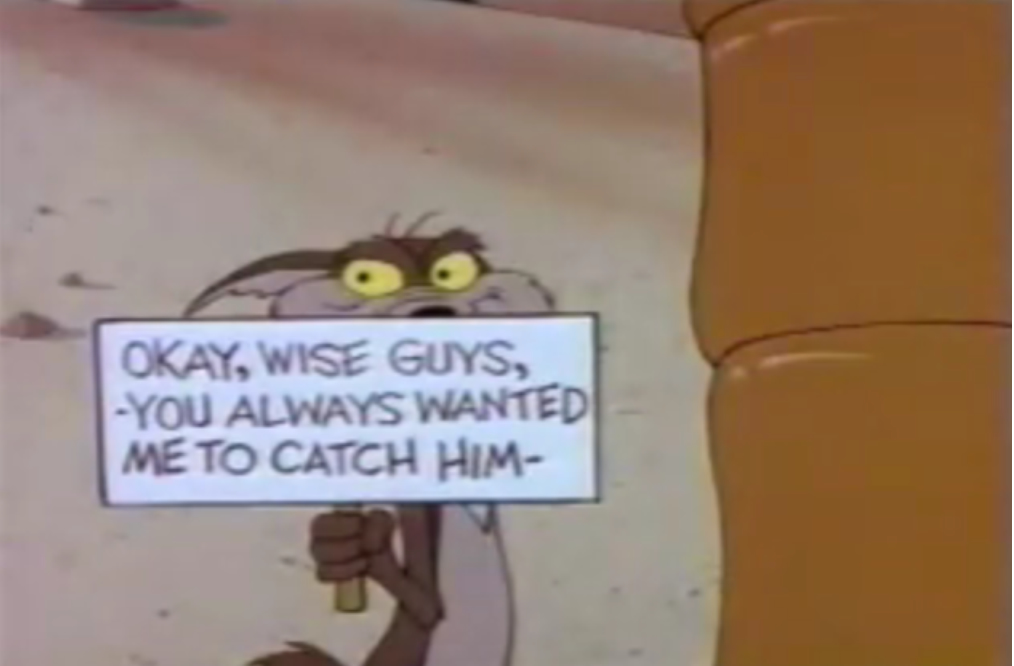
RoadrunnerCartoons are the closest approximation to Tarantino’s movies. They start out as a simple ideas inspired by real-life objects/characters/situations and go on to evolve into completely new universes with their own sets of mythologies and histories. Although controlled to the last pixel by their creators, these cartoon characters take up a life of their own and, in the process, have the creators conform to their characteristics. A sub-art form by itself, the cartoon provides so much scope for exploration of both the animation medium and of cinema itself (by exclusion of reality). When Émile Cohl created Fantasmagorie (1908), now accepted as the first ever animation movie, he had given a mile of head start for the genre with the film’s no-holds-barred repudiation of real space and time. Since then, sadly, animation seems to have been moving in the opposite direction, trying to imitate “normal” cinema with its gargantuan technological expertise,  in the same way the latter tries to imitate life. These CG devils do not seem to understand that animation is both an adversary and a complement to photographic cinema – an extreme form of wish fulfillment that wears its manipulation on its sleeve – rather than a clone. Like all genres, the clichés have remained, the spirit and meaning buried. Premiering almost six decades ago, the Wile E. Coyote vs. The Roadrunner cartoon series is one that takes these clichés to the most extreme and, by doing so, digs into the most basic and pertinent of all questions about the medium – What does it mean to be a cartoon?

Honey, I Dehumanized the Kids

The Roadrunner series was conceived by Chuck Jones and Michael Maltese.  And Chuck Jones is as true an auteur that one can find in cartoon filmmaking. One can almost immediately tell a Jones cartoon from the others. His toons are characterized by hard edged drawings with jittery motion that lacks real continuity. His characters are true caricatures, deliberately far from reality, with justifiably no depth at all. These characters somehow appear to know that they are in a cartoon. Consider his stint as the director of the famed Tom and Jerry show. Till then, Hanna and Barbera had been presenting us cutesy, smooth lined and lovable characters (This still remains my favorite era in the Tom and Jerry series) who call out for empathy. With the arrival of Jones, however, things take a dark turn as we see a frenzied Tom chasing a Jerry who seems to be perennially on crack. Jones removes any trace of cuteness from these characters, providing features like vicious teeth and pointed whiskers, and disallows any sympathy for them from us, at least by the virtue of their appearances. It is as if Jones believes that we should know that these are just cartoons and their lives are not going to be altered by our sympathy. That does not mean that he doesn’t give us emotional anchors to hold on to in his cartoons, but just that he consistently avoids the threat of realism – of appearance and of emotions – that plagues the cartoon world so often.

Although it never really upped the ante for the Tom and Jerry series, his style sure does work wonders here. In the Roadrunner series, too, there are no attempts at unwarranted emotional bonding even though one does end up rooting for Wile E. within minutes into each episode. For a comparison, these cartoons of Jones are like the early short films of Chaplin that relied purely on slapstick, without ever concentrating on the Tramp’s relationship to us like the later Chaplin films do. Jones relies on Woody Allen kind of humour – throw them all and see what sticks – with his relentless series of gags. His humour does not depend on what happens (which, by the very virtue of the Roadrunner series, is known to every one), but how does it happen and how long does it take to happen. Part of the fun in watching the Roadrunner cartoons arises from this surprise element of time that comes into picture in these skirmishes. Consider this random episode called Hip Hip-Hurry! (1958) that Jones directed. The episode consists of 8 gags of lengths 58, 30, 26, 8, 28, 35, 25 and 106 seconds respectively. The numbers are enough of a witness that Jones revels in writing both gotcha gags and wait-wait-almost-there-boom set pieces (which were a characteristic of his Tom and Jerry cartoons too) equally. And that is the only kind of unpredictability that he allows in the world of Roadrunner.

[Hip Hip-Hurry! (1958)]

Once More Upon a Time in the West

The idea of the Roadrunner show resembles a western (The fact that the coyote is a symbol of the Native American makes this notion all the more interesting!). Like the western genre, it originates as a piece of history – a shred of fact that a coyote is trying to get his hands on a roadrunner – and then develops itself as a myth that is derived from that piece of history (that the coyote always goes after the bird). Two primary characters facing each other off in a vast, cruel and blazing environment is one of the biggest stereotypes of the now-extinct genre. In Roadrunner, too, the geography is sparse, torrid and lifeless and painted with mostly brown and deep yellow colours. Furthermore, the western has always been a playground for writers to tease our moral standings and to tantalize us with notions we try to take for granted. Usually, the “morally good” according to law and social institutions for justice, in the form of police and the sheriff, is pitted against the morally good according to personal conscience and intuition, in the form of the noble outlaw and the lone ranger. Scenarios are written in such a way that our empathy goes against the justice system, which seems to be blinded by its own rules, and the audience is made to unconciously question the way laws are made. In the case of Roadrunner, this sense of balance between “good” according to public opinion and right-wing morality and “good” according to personal experience and emotional connection is maintained in the form of the roadrunner and Wile E. respectively. The cerebral part of us tells us that the roadrunner is never the instigator of trouble and it is plainly wrong to try to kill the harmless being. On the other hand, by virtue of the script, we end up supporting the coyote’s efforts and even want him to get the bird for once. The result is the deletion of human morality – the notion of heroes and villains and good and bad – from the Roadrunner universe.

No Man’s Land

One observation that one immediately makes when watching the Roadrunner cartoons is the strange absence of humans in the toons. There are no human “characters” in the series as such, even though they make their presence in the world felt indirectly now and then. Even when they do, in the form of the regular afternoon trains that run over Wile E., the random trucks that get him at the tunnels and the friendly neighbourhood highway chases, they merely act as deus ex machinas that make sure that Wile E. does not catch roadrunner and that he always chases him.  Same is the case with the ACME Corporation, from where Wile E. obtains all his bizarre gadgets. He always gets what he wants from them although one is not sure how the economy allows for this. ACME is not very unlike our capitalistic companies that benefit from people’s internecine quest for climbing the social ladder as fast as possible and which try to rake money even at the  cost of deterioration of people‘s ways of life (and history has made sure that this policy of ACME holds good for Certain Intelligence Agencies too!). Both humans and institutions perpetuate the myth of the roadrunner and Wile E by their non-intrusion and occasional intrusion. Furthermore, there are no laws in the Roadrunner world.  Unlike in movies like Toy Story (1995), where the toys had to obey the rules of the human world and come into true existence only when they are far removed from observation, Wile E. need not be ever conscious of his actions. He knows that he is being observed by the humans and he would always be made to chase the roadrunner. Even science, with its selective application of its laws, seems to want to keep the myth alive.  All Wile E. can do is to conform to this “fascist conspiracy” of the external world.

The Cartoon with(out) a Difference

In the case of The Roadrunner series, one is safe in saying that if you’ve seen one, you’ve seen them all. Far from being wrong, it is the very truth of the world of Roadrunner. The stories of all the episodes of the series are so identical to one another, that it would only be a miracle if one can identify individual episodes. You have this lanky, brown coyote – about 45 years of age, one would say, if Jim Carrey were to play him – who tries, in every which way possible, to get his hands on this clever, thin roadrunner bird. Predictably (I mean predictably), he fails, only to get up again and repeat the process. Each of these vignettes starts out and ends in the same way – with Wile E. concocting some new plan to get hold of the Roadrunner and with him getting caught in his own trap respectively. The only difference between each of these encounters lies in the way Wile E. fails in his mission. In fact, the whole universe of Roadrunner relies on repetition – repetition of situations (what would Roadrunner be without the top view of Wile E. falling into the cliff?), repetition of geography (more than in any other cartoon, the scenery in these cartoons repeats very often, especially noticeable in the background during the chases) and repetition of structure (to the point that the relative ordering of the vignettes and the episodes is ultimately immaterial). Heck, even the single piece of speech in the series comes in the form of a repetition – “Beep Beep”.

But then, there are traits that are also shared by every other cartoon (Garfield often speaks to us out of context of the cartoon about these clichés) and also perhaps the easiest ones to devise. But, the real success of the Roadrunner series lies not in using these clichés, but retaining them forever, even at the cost of being unfunny and redundant. Jones takes the practice to the breaking point (and beyond) by bombarding us with the same elements over and over. And, through this monotony, he achieves something much more than instant chuckles. Harold Ramis’ brilliant Groundhog Day (1993) examines, albeit in photographic reality, what it takes to live in a completely predictable world – a world that is mathematically derivable, geographically utopian and emotionally unresponsive. Its protagonist, Phil Connors (who is worthy of Bill Murray), after some days of rejoicing over the unlimited power that he has been given, finds himself completely alienated from his people and then, gradually, comes to accept his situation. Beyond that point, he stops attempting to break the loop of time and decides to enrich his own life and that of the others. Now that it is neither possible for him to pursue any goal in life that he may have had nor take his own life, he realizes that the only difference that he can make in this world is to make the people around him happy, even if it is just for a couple of hours. Phil Connors isn’t very unlike our hero Wile E.

Deconstructing Wile E.

RoadrunnerThe world of Roadrunner is the perfect cartoon world. It is a world devoid of the notions of hunger, injury and death. Even though Wile E. believes that he chases the bird in order to eat it, that can never be his actual motive. The very fact that he keeps chasing the bird for years in vain suggests that food is never a point of concern for him. His role in life is to chase the roadrunner and nothing else at all. In this regard, he shares a very ironical relationship with the bird. For one, he cannot and will not catch roadrunner ever because, if he did, he would not have anything else to do in his life. In that case, he would lose his identity and turn from being a cartoon ‘character’ with unique characteristics to being a mere ink stain on a sheet of coloured paper. He would then be wandering the wilderness for eternity. Nor can he renounce the chase altogether for that would tantamount to him catching the bird and subsequently losing his identity. On the other hand, the roadrunner’s role is to be chased. Since Wile E. knows that his only option is to chase the bird, roadrunner needn’t ever instigate him. But if ever, Wile E. digresses from his job, it would be the roadrunner’s duty to pull him back into the loop since he has his identity to retain. The whole of fabric of Roadrunner is based on this paradoxical relationship that the two characters share.

Now, this is not the foundation that shows like Tom and Jerry are raised on, although they, too, are reduced to no more than a bunch of futile chases. The kinship between Tom and Jerry is built around the human world, unlike in Roadrunner, like a refrigerator loaded with food, a stray canary or a runaway bear. At any point, Tom and Jerry could make a pact and go on with their lives independently – which means that Tom can laze around forever and Jerry can pinch cheese whenever he wants. But, in the case of Wile E., there are no such easy alternatives. His world is defined solely by his chases and contains no other dimension. Tom or Jerry need not be in every scene in an episode, but Wile E. has to be present in every setup of every vignette and, if needed, in every frame. Like Barry Lyndon, the coyote’s life is sealed in the two dimensions he lives in (The ideal sequel, if you can call that, to the Roadrunner show will not be in 3-D, but rather in 1-D, with the two characters represented as two dots that never meet). Even though the initial motive for Wile E. is to catch roadrunner and that for the roadrunner is to evade the claws of Wile E., in the long run, they would inevitably reverse their roles. That is, the coyote. will, eventually, make sure that he doesn’t catch the bird and the roadrunner will make sure that he is chased. This is almost exactly the kind of relationship that Batman and the Joker share in The Dark Knight (2008).

One is tempted to compare the fate of Wile E. to that of Sisyphus, the Greek king who is made to roll a mammoth boulder over a steep hill slope forever, only to find it roll back down (Is it just a coincidence that Wile E. is seen shoving huge rocks time and again?). The coyote’s life, too, goes around in such pointless loops with no end in sight. In fact, Wile E. is the quintessential Absurd Hero, like Sisyphus, who realizes the pointlessness of his life and nevertheless continues. I’m a philosopher only as much as Barack Obama is a ballet dancer, but from what little I have heard about Camus, he draws three possible responses to this realization of the absurdity of the world – Faith, Suicide and Existence. He seems to reject the first two ideas, denouncing them as tricks to repudiate the truth about the meaninglessness of life. In the third option he proposes that life be lived for-the-moment and enjoyed to the fullest, without any hope or ambition and with the constant knowledge of the absurdity of it all, and thus have complete freedom over our actions. This way, the refusal of suicide becomes the very token of acceptance of absurdity and the freedom of choice that it provides. Now, this is where Roadrunner really takes its medium seriously. Unlike Sisyphus, Wile E. (and Phil Connors) does not even have the choice of suicide, so that he can refuse it. His world knows no death. Nor can he make a leap of faith, for he has nothing to hope for, except maintaining status quo. Thus, Wile E. can only take up the third option of living life for what it is. Wile E., like most Chuck Jones characters, knows that he is in a cartoon, that he has to carry on his chase act for ever and that there is no meaning to his life. So all he can do is keep chasing roadrunner – keep pushing the rock – in an attempt to keep both of them happy. Camus sums up the Sisyphus situation fittingly: “The struggle itself towards the heights is enough to fill a man’s heart. One must imagine Sisyphus happy.”. The same should be said about Wile E.

(pic courtesy: The Yerton Dreamhouse)

Repulsion (1965)

Repulsion (1965)

Cul-de-sac (1966)

Cul-de-sac (1966)

The Fearless Vampire Killers (1967)

The Fearless Vampire Killers (1967)

Rosemary's Baby (1968)

Rosemary's Baby (1968)

The Tragedy of Macbeth (1971)

The Tragedy of Macbeth (1971)

Chinatown (1974)

Chinatown (1974)

The Tenant (1976)

The Tenant (1976)

Tess (1979)

Tess (1979)

Pirates (1986)

Pirates (1986)

Frantic (1988)

Frantic (1988)

Bitter Moon (1992)

Bitter Moon (1992)

Death and the Maiden (1994)

Death and the Maiden (1994)

The Pianist (2002)

The Pianist (2002)

Repulsion (1965)
Roman Polanski
English

“We must get this crack mended.


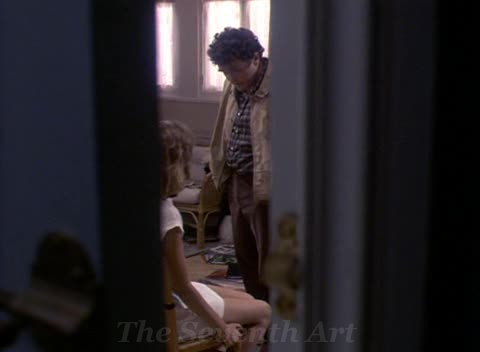
RepulsionRepulsion (1965), Roman Polanski’s second feature following Knife in the Water (1962) and the first one made in the UK is perhaps one of the few horror movies that have really aged well. The reason for that is probably because Polanski manages to avoid all the flashy temptations and pitfalls of the genre and the era and sticks to minimalism. Enchantingly shot in black and white, Repulsion presents to us the events that unfold in a span of two weeks in the life of Carol Ledoux (Catherine Deneuve), a foreigner who lives in London in an apartment with her sister Hélène (Yvonne Furneaux) and works at a local beauty parlour as a manicurist. Carol is aloof from her colleagues and seems to be living in her own world. Hélène has a boyfriend Michael (Ian Hendry) who appears to be eyeing Carol too and whose presence seems to infuriate Carol for no apparent reason at first. Meanwhile, a young man called Colin (John Fraser) tries to win Carol over in vain. Soon, we witness Carol descending into some form of a trance and then into a (self) destructive mode as she shuns herself from everyone. With a storyline that can’t be, by any measure, called meaty, Polanski weaves magic as he performs a quantum leap with his innovation and resourcefulness in translating the text to the screen.

Repulsion fittingly begins with a zoom out of Carol’s eye and ends with a zoom into it, preparing us for the purely subjective tale that takes place between these two shots (and also paying homage to the surreal masterpiece Un Chien Andalou (1929) which, too, slit the human eye to look beyond its retina). The movie is entirely seen through Carol’s eyes and faithful reproduction of reality is flushed down the drain. Anything is possible within these two goal posts. None of the events that we witness might have happened in reality, but they sure do in Carol’s mind. Her colleague even talks about the chicken scene in The Gold Rush (1925). Clearly, Repulsion stands as a direct manifestation of Polanski’s ideas about normalcy and abnormality. Right from the early short films, Polanski has always questioned the popular definitions of these two terms. With him, it isn’t easy to incriminate or vindicate any character for their acts. With him, one is never sure who is in the cage and who is out. One could say, in Repulsion, that the old lady next door was unethical when she listens to the conversation between Colin and Carol, but is it her mistake that the door is open to all? Same is the case with his very first film Toothy Smile (1957). In The Lamp (1959), we see broken toys separated from the new ones that are manufactured to perfection – perfection as defined by the society. In Repulsion, characters are presented to us as they appear to Carol. They conform to or deviate from what she sees as normal.

Repulsion also resonates with the most dominant Polanski theme of them all, which is that of violation of boundaries. Right from Toothy Smile, where a man stares at a naked woman through the open window that he notices by chance, the director has been preoccupied with characters who breach some form of limits that are imposed on them by the society. Although it is highly likely that this vision of Polanski, who had had to put up with a lot during his stay in communist Poland, was politically motivated it has trickled down into every kind of scenario, refining itself and exploring various manifestations of this notion of infringement of limits (Looking at the events that have transpired in Polanski’s life – the murder of Sharon Tate, his arrest in Switzerland recently and the weight of his celebrity status – one can only conclude that life has a morbid sense of humour). It is no mere coincidence that he chose the well known tale of Macbeth, where too the sacrosanct border between the ruler and the loyal warlord is breached with miserable consequences, to make a film. Be the violation interpersonal in nature, as in the case of voyeurism, break-ins and conquests, or individual, arriving in the form of agnosticism, impotence and alienation, it seems to be only detrimental to all its participants.

RepulsionMoreover, in this film, this motif of violation manifests itself in social, psychological, sexual and even religious terms. Carol is the symbol of complete purity in the film (Dressed in white, Deneuve is nothing short of a divine angel). She keeps warding off every kind of threat to that purity. A foreigner, now living in a completely alien city, she not only has to adapt to the new conventions, but also has to put up with every kind of oppression that the place may impose on her. There are enough indications in the film that Carol is homosexual (or, at least, unsure of her orientation). Now living in London, a city that must be far more conservative and, I daresay, homophobic than the place that she comes from, Carol is, clearly, far from freedom of choice (The anonymous phone call in which a female threatens Carol just goes to show how concrete this hostility is, as perceived by her, of course). It isn’t just sexual penetration that she is fighting against, but also those of conventions – political, social and religious– upheld strongly by the right wing. Carol is battling all the models presented by the society through its oppressive structures as the “right” way to live. But eventually, starting with the shaving knife – the first trace of a man in her apartment – that seems to have a disturbing presence, she is persuaded to give into all these forces.

Evidently, Polanski draws a lot of inspiration from Hitchcock, especially from Rear Window (1954) and Psycho (1960). Both Jeff (James Stewart) in Rear Window and Carol in Repulsion are alienated individuals living in an urban setting who look at their world through their skewed vision with a preconceived opinion about it. The only difference between them is that while Jeff becomes the aggressor, trying to find a deeper meaning to the world around him in order to add depth to his own life, Carol becomes the victim as she turns paranoid about her surroundings and pushes herself into a shell further away from the society. But the film is perhaps closest to Psycho, when it comes to genre elements, as it constructs a similar lonely, claustrophobic atmosphere where trespassers will be punished irrespective of their importance in the narrative thus far. My only gripe with Psycho is that it tries to explain Norman Bates’ (Anthony Perkins) behaviour scientifically till the last detail. By attributing his behaviour to a psychological disorder, it isolates him as a stray case and hence fails to aim higher and explore why each one of us is a potential Norman Bates (Hitch corrects this slip stylishly in The Birds (1963)). However, Polanski, like Akerman did in her Jeanne Dielman (1976), which, also, dealt with an alienated woman taking to violence, carefully keeps all the ambiguity generated in the film intact, thus providing ample space for discussion and interpretation.

Given the subjective and mostly surreal nature of the movie and the advantages of the genre, there is a lot of scope to employ warranted symbolism in the film and Polanski does just that. Phallic and penetration symbols galore, Repulsion is a gold mine for any student of Freud (The postcard showing the Leaning Tower of Pisa from Carol’s sister is the closest the film gets to being humourous). During the course of the movie, Carol’s apartment becomes the embodiment of her psyche and her virginity. What was initially well lit, neatly arranged, spacious and unblemished becomes, by the end of the film, a ruptured, dark, ramshackle mess overcrowded with neighbours, much like Carol herself. But, like it was done in Psycho, these symbols never become necessary elements for the film to be successful. They merely impart an additional layer to the film without ever having to reveal their presence. The object that she slams Colin with may be the symbol of the very thing she is hostile to, but, first of all, it is a weapon. The cracks on the wall may signify the cracking of her own psyche and resistance, but, primarily, they are elements of horror. The head of the rabbit in her handbag may allude to something deeper, but, again, it is first a shock factor. Furthermore, the film itself, notably, remains faithful to its genre instead of digressing into needless discourses or trying to be too clever for itself. It is, in the first place, a solid horror film and, only secondarily, a film that is a satire against the mores of our society and the baseless tenets that it proposes to everybody.

More so than the masterful Rosemary’s Baby (1968), which, too, spoke in subjective terms and satirized religion within the framework of a conventional horror movie, Repulsion is Polanski’s version of Lars Von Trier’s Antichrist (2009). When, in Antichrist, She (Charlotte Gainsbourg) does the unthinkable after knocking Him (William Dafoe) out, what she is actually doing is the exact opposite of what religion has taught us through the years – to be fruitful and to multiply. So does Carol as she slays – the icon of reproduction – a rabbit, destroys all the phallic symbols in the movie and, essentially, combats the obligation placed on everyone by religion to get a family and reproduce. Only that Trier isn’t content with just employing symbols for this purpose! Early on, Michael, upon observing a catholic procession, jokes that the church perhaps has wild parties at night. Soon, this notion of religion and sex being the two sides of the same coin takes shape in the movie as the soundtrack consistently replaces sounds of sexual moaning with those of the church bells. For Carol, who has been so far standing in opposition to this unfair responsibility of perpetuating the human race, this hypocrisy of organized religion is too just much to take and she, sadly, succumbs to it.

Repulsion

Repulsion

Even technically, despite being the director’s second feature, Repulsion reveals itself as an auteur’s work. One has to just look at a few of those early short films to see the consistency of directorial choices that Polanski makes. The pan shots that stray from the central object of attention, the ground-level deep focus shots and the spectacular interplay of light and darkness confirm the signature of Polanski. Furthermore, Polanski uses the camera (maneuvered magically by Gilbert Taylor) to provide contextual meaning using the pans and the zooms. His camera often starts out at the sunlit window and gradually makes its way to the darker interiors where Carol is sitting as if penetrating the resistive apartment. But what is truly the high point of Repulsion is the way it prunes down details to the most basics leaving the rest to our imagination – the most important factor as far as this particular genre is concerned, for horror never concerns itself with what’s out there, but with the uncertainty about something being out there at all. There is rarely a B-movie moment in the film that goes for cheap shock. For almost the whole movie, Polanski’s camera lingers entirely on Deneuve’s face. Every other information that we require is provided by the meticulously assembled soundtrack that not just evokes the creeps that it should, but also provides meaning to the visuals that we see.

One just can’t abstain from mentioning the role of Catherine Deneuve in the movie for Repulsion flourishes upon her very presence. More than her performance, which is indeed pretty commendable, it is her very image that provides depth to the film’s text. With looks that could puncture any man’s heart, Deneuve as Carol is the angel herself. In Repulsion, Polanski lets his probing script collide with the cherubic image of Deneuve and comments on what mass hysteria could do to even a goddess. Polanski gives feline mannerisms to Carol (cats being the cleanest of all animals), who is seen fiddling with her nose and purging herself like a cat now and then. After watching Repulsion, the casting of Deneuve as a bored urban housewife who takes to casual prostitution in Luis Buñuel’s Belle De Jour (1967), another superb film that examined the consequences of sexual conformism and oppression albeit in a hilarious fashion, looks all the more virtuoso since it absorbs the image of Deneuve distorted and updated by Polanski’s film and further subverts it in ways that only a master could have thought of. Employing Deneuve, Polanski, like Buñuel, has successfully turned the Cinderella story inside out (Michael calls Carol “Cinderella” early in the film), with escapism giving way to confinement, hope giving way to despair and fantasy giving way to paranoia.

Katok I Skripka (1960) (aka The Steamroller And The Violin)
Andrei Tarkovsky
Russian

“He’s a musician.”


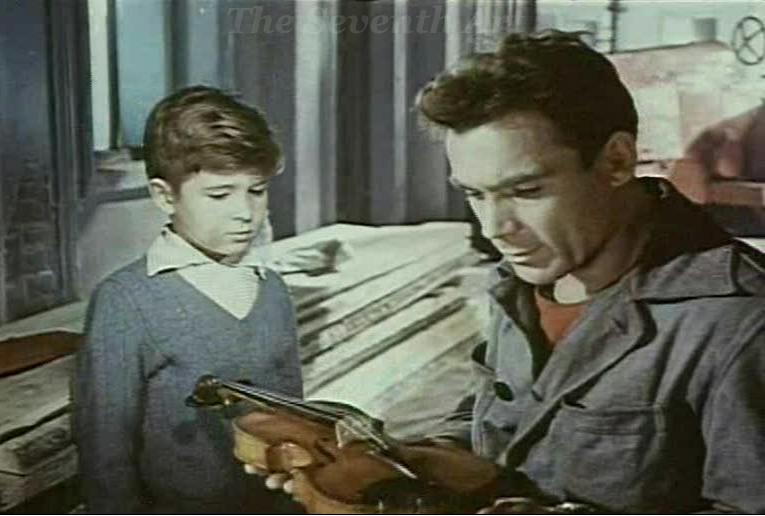
The Steamroller and the ViolinThere is no other way of seeing Andrei Tarkovsky’s diploma film Katok I Skripka (The Steamroller and the Violin, 1960) at VGIK other than as a scratchpad for a would-be master of cinema. As a result, one is only preoccupied with filtering out the Tarkovskian elements of the film from the rest and somehow hammering it to conform to his/her understanding of the director’s oeuvre. However, it must also be acknowledged that the movie is more rewarding if you are indeed familiar with the director’s work. Shot in no less than the prestigious Mosfilm studio, The Steamroller and the Violin is a little gem that is at times prophetic, at times contradictory and at times surprising, when one considers the films of Tarkovsky that were to follow. But one just cannot fail to note the unmistakable signature of the hand that made works such as Ivan’s Childhood (1962) and Andrei Rublev (1966) in this film.

The Steamroller and the Violin follows a day in the life of young Sasha (Igor Fomchenko) who learns violin at the local music school. Everyday, he has to sneak past the gang of local bullies that tries to rip him apart. On this fortunate day, he is, however, saved even after being caught by them, by a young worker named Sergei (Vladmir Zamansky), who is working at a construction site nearby. Sasha, then, proceeds towards the music school, stopping once at the window of a curio shop where he witnesses the city through images gathered on the mirrors placed there for sale. After getting berated during a music test for playing the violin according to his imagination and not sticking to the notes provided, Sasha returns to the streets to meet Sergei once more. Following this, Sasha embarks on a little adventure of sorts where he operates the steamroller, roams around the city with Sergei, witnesses an old building being razed down, plays violin for Sergei and even gets into a small fist with a boy bigger than him. Sergei, meanwhile, keeps ignoring a girl who tries to flirt with him. Sergei and Sasha also make plans to go to the movies that evening, but, alas, Sasha’s mother won’t let him go.

Despite the romantic nature of its script, The Steamroller and the Violin remains a neo-realist film. But its neo-realism is not of the confrontational kind driven forth dogmatically by the Italian theorists and filmmakers, but of the stylistic one championed by Bazin in his essays. The film’s realism lies in not committing itself to the study of the society (which it never does), but, rather, in the respect it has for the integrity of time and space of its world. Tarkovsky extensively employs deeply focused shots so that large chunks of action can unfold in a single, undivided unit of film. For Tarkovsky, this meant a step away from montage and hence, automatically, from the founding stones laid by film pioneers of his country. Although, later, he would master the art of non-division of a shot even if it called for Herculean perfection and risk, deep focus proves to be a very viable option for Tarkovsky, here, to let the audience choose key actions of a sequence without having to direct their attention artificially. Furthermore, with this freedom that he gives to his audience, a la Orson Welles, Tarkovsky is able to bathe the film with ambiguity, thus turning upside down both the technique and the intention of the dominant Soviet cinema of yesteryear.

The Steamroller and the ViolinI might be giving the impression that the film is far more revolutionary than it actually is, but it is difficult not to applaud Tarkovsky’s ideology of taking art away from political exploitation. His vision couldn’t possibly have crystallized if Stalin, who insisted that art be used only for activist purposes, with no margin for ambiguity in its message, was still ruling the USSR. For Stalin, the artist existed for the worker and never as an independent entity in the society. Everyone had to stick to the positions in the society they were given irrespective of what their choice was. In Tarkovsky’s film, Sasha is conditioned by his teacher to play his violin in the way she wants. His mother prevents him from going to the movie. Instead, he has to stay home to meet some guests (and probably play some classical piece for them). Sasha wants to drive the steamroller, he wants to play the violin like he wants it and he wants to go to the movie whenever he wants. But, unfortunately, he has to assume the role of an artist that he never wants to be.  Also, conversely, Sasha will never be able to replace the worker (and vise-versa). Nor will he be able to parry off his bullies like Sergei wants him to. All he can do, and with much satisfaction, is to play the violin for Sergei to make him happy for a few minutes.

Although Tarkovsky’s stance, here, regarding the role of the artist in a worker-oriented society remains open to interpretation, it is clear that he is appealing for an environment where art can stand on its own legs and eventually finds an independent voice. In other words, Tarkovsky seems to be wanting the evolution of an art form of whose universe the artist is the centre and in which his “inner demands” propel the work of art rather than socio-political policies – art to exist for its own sake. He succinctly puts it in his book Sculpting in Time:

“How wonderfully apposite is Tolstoy’s remark in his diary on March 21, 1858: ‘The political is not compatible with the artistic, because the former, in order to prove, has to be one-sided.’ Indeed! The artistic image cannot be one-sided: in order justly to be called truthful, it has to unite within itself dialectically contradictory phenomena.”

“It is obvious that art cannot teach anyone anything, since in four thousand years humanity has learnt nothing at all. We should long ago have become angels had we been capable of paying attention to the experience of art, and allowing ourselves to be changed in accordance with the ideals it expresses. It’s ridiculous to imagine that people can be taught to be good; any more than they can learn how to be faithful wives by following the ‘positive’ example of Pushkin’s Tatiana Larina. Art can only give food—a jolt—the occasion—for psychical experience.”

More so than the neo-realist films of Italy, Tarkovsky’s film is reluctant to succumb to the needs of a drama. For most part, The Steamroller and the Violin is a plotless film. There is no dramatic epicenter to the events that unfold in it. Causality vanishes and we merely witness episodic encounters between Sergei and Sasha taking place at various geographic locations. Events happen in the film not to progress a preformatted story line but because they, well, “happen”. Furthermore, unlike the neo-realist movies, there isn’t even an objective for our protagonists. All that Sasha and Sergei want are to spend the day together. There are no hurdles, no conflicts and no turning points or threats to this wish. And the camera (handled by director of photography Vadim Yusov, who would go on to film the next three Tarkovsky features) obliges them by simply documenting them along with their surroundings. What is nowadays cornered into terms like “dead time” is the very thing that Tarkovsky calls “life”. Again, he elucidates his staunch position against artificial standards of theatrical drama (even if backed by naturalism) in his book:

“I wanted to demonstrate how cinema is able to observe life, without interfering, crudely or obviously, with its continuity. For that is where I see the true poetic essence of cinema.”

“I find poetic links, the logic of poetry in cinema, extraordinarily pleasing. They seem to me perfectly appropriate to the potential of cinema as the most truthful and poetic of art forms. Certainly I am more at home with them than with traditional theatrical writing which links images through the linear, rigidly logical development of the plot.

That sort of fussily correct way of linking events usually involves arbitrarily forcing them into sequence in obedience to some abstract notion of order. And even when this is not so, even when the plot is governed by the characters, one finds that the links which hold it together rest on a facile interpretation of life’s complexities. But film material can be joined together in another way, which works above all to lay open the logic of a person’s thought. This is the rationale that will dictate the sequence of events, and the editing which forms them into a whole. The birth and development of thought are subject to laws of their own, and sometimes demand forms of expression which are quite different from the patterns of logical speculation. In my view poetic reasoning is closer to the laws by which thought develops, and thus to life itself, than is the logic of traditional drama. And yet it is the methods of classical drama which have been regarded as the only models, and which for years have defined the form in which dramatic conflict is expressed.”

Apart from the cinematography, what stands out technically in Tarkovsky’s film is the production design (by Savet Agoyan) which helps Tarkovsky, though being unusual for him, to use a slightly expressionistic mise en scène which should perhaps be deemed academically remarkable. The conservatory and Sasha’s house – the centers of restriction in the film – are allotted dark colours and are populated by rigid, oppressive furniture that seem to choke the frame, Even the cat at the conservatory is black and ominous. The only sign of life at that place seems to be the little girl.  On the other hand, the exteriors – where Sasha seems really happy to be – are unusually bright, with vibrant coloured vehicles (The red tractor seems to have become the Soviet symbol of sorts), clear skies and people with cheerfully coloured clothes. The interiors at Sasha’s and at the music school, again, are lit by small isolated beams of sunlight whereas the sun is up and shining whenever Sasha is out with Sergei. Even though Tarkovsky would never again make such cerebral use of his mise en scène (and also a few flashy techniques like the ones utilized during the building-demolition and the final dream scenes), it still remains praiseworthy for a student film – the kind of cinema that almost always retains its jittery and attention-gathering qualities.

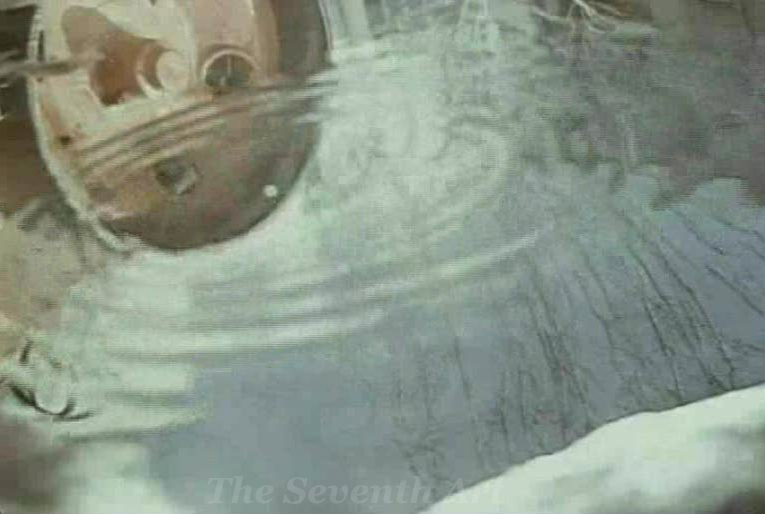
The Steamroller and the ViolinPerhaps the most striking Tarkovsky trait apparent in The Steamroller and the Violin is the director’s use of water throughout the film. For a very large part, water seems to be present in every frame of the film. Tarkovsky floods the movie with images of water found in one form or the other in everyday life. For him, water wasn’t just a symbol or a token of life, it was life. For Tarkovsky, water’s reflective, meditative, serene, cleansing, cathartic and mystic qualities were nothing short of the magic of life itself. In this movie, however, his use of water, unusually, takes up the job of indicating free life, rather than being present for just what it is. Although one can argue that this strategy is close to becoming symbolism that Tarkovsky would later oppose, it is to be accepted that he has used it very efficiently. Throughout the film, we see water being employed to make a commentary on life in that particular environment. Water is seen flowing smoothly on the streets when Sasha and Sergei bond. The same water is forced and confined into water jugs in the conservatory and at Sasha’s home. Water appears in the purgative form of a rain during the quintessentially Soviet sequence in the film, where a building is brought down with a soundtrack marked by expressionist music. And water is seen in its softest form in a puddle gently continuing to reflect its surroundings, like it would in the director’s later movies, as Sasha and Sergei descend into a free-flowing small talk.

Additionally, there are many images and facets in The Steamroller and the Violin that one would also see in Tarkovsky’s films that were to follow. The basket of apples that the woman in the city drops takes us directly to the cart of apples in Ivan’s Childhood. The contemplative interior where Sergei and Sasha sit for lunch shows up in almost every subsequent Tarkovsky film.  The autobiographical aspect of the absence of the father figure and the presence of a strong and demanding mother in the movie is unmistakably Tarkovskian. The question about the role of the artist is a clear precursor to his masterwork Andrei Rublev. Although not blown to full scale, Tarkovsky’s elliptical editing, which would be stretched to the limits later, makes sure that superfluous actions are weeded out and the audience is left with the bare minimum to hold on to and develop into a whole. We see the bullies approach the violin with awe. But it would become our responsibility shortly to understand that these kids never actually wanted to harm the violin, but just to taunt the artist. We see Sasha give an apple to the little girl at the conservatory and that she eats it by the time Sasha leaves, but it is up to us to decide why she was reluctant in the first place.

“The method whereby the artist obliges the audience to build the separate parts into a whole, and to think on, further than has been stated, is the only one that puts the audience on a par with the artist in their perception of the film. And indeed from the point of view of mutual respect only that kind of reciprocity is worthy of artistic practice.”

After watching Inglourious Basterds last week, I skimmed through a few films I was referring to in my review and felt that Tarantino’s movie, its last chapter in particular, refers to them in a manner slightly deeper than mentioned. What I present here may be plainly speculative, but the very fact that Tarantino’s film retains enough ambiguity to generate such arguments makes the film one to be celebrated. Inglourious Basterds, more than any other movie, seems to be closest to Jean Luc Godard’s History of Cinema (1988-98). If one considers Godard’s film as a classroom lesson in cinema (Why not? The movie even resembles an office presentation!), then Tarantino’s movie is a student project (that would easily get an A+) based on that lesson. It seems that everything that the French discusses in his video anthology is absorbed and blended cleverly into a mainstream flick by Tarantino. For the sake of simplicity, I lift and reproduce the same lines from my post on Godard’s film to compare it with Inglourious Basterds.

“If we had to single out Godard’s most favorite quote it has to be the misattributed Bazin one: “The cinema, substitutes for our gaze a world that corresponds to our desires”. And this is where the series kicks off. Cinema as a substitute for our dreams – the dream factory. Godard explores the meaning of “dream” as interpreted by the two functioning extremes of cinema then. He presents the occident interpretation as one that had converted cinema into a portal offering an alternate reality, a second life, to the audience whose “dreams” were the fodder for the larger-than-life images that the films projected -one that continues till date.”

Tarantino’s film, on a basic level, as the director himself confesses, is a form of wish fulfillment. As with his other films, Inglourious Basterds unfolds as a revenge saga. But by situating his plot amidst real life events, unlike its predecessors, Tarantino is able to involve his audience more and provide better justification to the characters’ actions, rather than dealing with simple morality.

“[Godard] argues that cinema could have prevented unfortunate tragedies and averted genocides rather than merely crying over damages dealt and observing helplessly the misery of its subjects.”

Here, Tarantino seems to deviate. He seems to be of the opinion that cinema, perhaps all art, can’t ever change the world (unless, of course, you consider the way he uses it in the movie!). Proof? Take a look around. What it can do is to change the image of the world when it is passed onto a new generation.

“And in resonance with this ideology, instead of bemoaning what is lost and what could have been, Godard anticipates the death of cinema (He apparently asked Henri Langlois to burn the archives). Death, so that it can rise again from the ashes. “Art is like fire. Born from what it burns.” says Godard and that is precisely what he desires – Cinema to go down with all its exploitations and restrictions and rise in its purest form. Back to infancy, so that it can learn everything out of free will, without rules and without vanity.”

This is exactly what Marcel does when he burns the films – destroying those exploitative propagandist films of the Nazis and perhaps also those WW2 films that insist upon being loyal to reality and hence impotent. With the fire at the cinema hall that flips conventional reality, Tarantino places us at the beginning of a new history – of cinema (courtesy Tarantino) and of the world (courtesy Marcel).

“Godard attempts to reconstruct history as seen in retrospect. He utilizes existing film fragments to fabricate various histories of film – the one that was and the ones that weren’t but could have been. He examines how cinema could have been made independent of historical accounts and even made to influence them.”

This theory seems to form the core of Inglourious Basterds. Why should art ever trail history? As Bazin would say, Realism in cinema should just be the means, not the end itself. Tarantino, like Godard, sure can’t change history, but, at least, he can examine the history – again, of cinema and of the world – that could have been.

“Godard elucidates this servile relation that cinema bears to history using images of dictators and authoritarians. He highlights how the visual medium itself is being manipulated by a few people in power and how in turn, modern cinema manipulates the audience. Godard reproaches this moral policing and expresses his disapproval of the hypnosis that the TV-driven audience is subjected to. He appeals for a cinema that provokes but doesn’t direct, a cinema that gives you options but doesn’t select one, a cinema that makes you think and doesn’t think for you and a cinema that is only complete with its audience. As he quotes in one of the segments, “Cinema does not cry. Cinema does not comfort us. It is with us. It is us”.”

Tarantino, also, fills the film with fascists who seem to be exploiting the medium for questionable purposes. Goebbels’ film, like many a mainstream film that are made by another kind of fascists, has manipulated reality and wants its audience to buy that as truth. And Shoshanna’s film (like Tarantino’s) is what Godard seems to be wanting in place of Goebbels’.

“There is an intriguing recurrence of the image of human hands in the film. Godard urges artists to think with their hands – their real tools that have the potency to both create and destroy, to beautify and to horrify, to document and to change. He argues that these are the instruments capable of changing and redefining history and it is the weakness of the mind that hinders the possibility.”

Marcel, who had ‘created’ the small film with Shoshanna, is the one who would be setting fire to the pile of nitrate films. Tarantino, too, highlights his hand as he flicks the cigarette on to the heap – the hand that went from mere documentation of reality to direction of reality.

Brandon Colvin is of the opinion that Inglourious Basterds is primarily a comedy. I’m going to take a diametrically opposite path and say that this movie, when reduced to its human elements, stripped of all its film references and modernist facets, is a tragedy with a martyr called Shoshanna at its heart. The word ‘tragedy’ is often used loosely and seems to denote every tale that has a pathetic, miserable and depressing outcome. But, surely, Tragedy does not base itself upon emotions. In fact, it is quite the opposite. A tale is said to be tragic when two morally unquestionable and righteous forces are made to clash and a situation evolves when one of them has to let go of its stance, despite all convictions and emotions for the greater good. Tragedy is always the result of a choice that calls for a great sacrifice to go with it. As they say, it is our choices that define us. And a tragic choice defines us for life – either as a hero or as a coward (“merely human” would be the euphemism). Sansho the Bailiff (1954), even with its heavy pathos, is a melodrama whereas The Dark Knight (2008), despite its uplifting upshot, remains a tragedy. Shoshanna could well have married Zoller and led a very content life. Instead, she repudiates that path and takes up the task of liberating the Jews at the cost of her own life. Tarantino, apart from using Ennio Morricone’s moving piece Un Amico, employs mythological and historical iconographies to underline the magnitude of this tragedy.

The final chapter of Inglourious Basterds has got to be the densest that Tarantino has ever filmed. The chapter is ambiguously titled “Revenge of the Giant Face” as if recalling some B-movie from the 50s. But more than that, it seems to me now, it tries to allude to two of the most iconic “giant faces” of women that we know. The first would be that of Maria Falconetti in Carl Dreyer’s The Passion of Joan of Arc (1928) – a film that is constructed out of hundreds of such giant faces. The tale of Joan of Arc by itself is a tragedy in which Joan sacrifices a normal life for the good of her people, much like Shoshanna, who, too, goes down in flames at the end of her journey. Only that Shoshanna doesn’t just suffer and prefers to take all of them down along with her. And then there is the most dreaded giant head in Greek mythology – that of Medusa the Gorgon – a mere gaze into whose eyes is supposed to petrify you. Daniel Ogden (source: Wikipedia) describes this stare of Medusa’s as “seemingly looking out from its own iconographical context and directly challenging the viewer”. Now, the Nazi officers in the final chapter are watching a fictional film, seated safely away from real life action, without any apparent threat from the images on the screen. When Shoshanna slips in her own film, with her gaze directed towards the Nazis, she essentially “looks out of context of the movie”, challenging, literally, the viewers, in a manner in which the modernist director used their actors, and petrifying them by dragging them out of their passive state.

The Passion of Joan of Arc - Dreyer

Medusa - Franz von Stuck

Inglourious Basterds - Tarantino

But then, our ideas about these two iconic characters are derived only through images and shadows – through paintings, through Dreyer’s film and through textual accounts. As George Steiner put it, “It is not the literal past that rules us. It is images of the past.” With the passage of time, history and mythology mingle to such an extent that it becomes virtually impossible to separate them. In Chris Marker’s magnum opus The Owl’s Legacy (1989), Jean-Pierre Vernant illustrates the mythos behind this practice of image (which is a word that referred to doubles, miniatures, copies and ghosts in general in Ancient Greece, the land of tragedies) creation. He tells us that images, for Ancient Greeks, were a means of facing man’s worst fears by reducing them down to caricatures. In Medusa’s case, this meant that they could see her directly in the eyes (a la Perseus who used a mirror – an image creating device – to slay her) and subsequently use these images to intimidate enemies. In Vernant’s own words: “So there is a way, though images and through stories of disarming the horror of death that the monstrous face expresses and which the image carries out so that what can’t be seen can be depicted in many ways” (recalling Godard’s quote about movies in History of Cinema: “How marvelous to be able to look at what we cannot see.”)

In the final chapter of Inglourious Basterds, Tarantino absorbs these images of dead characters from tragedies in mythology and history, blends it with the “image” of the tragic Shoshanna, who too is now dead, and, in essence, creates a mythology (Shoshanna the martyr) and history (Shoshanna the WW2 hero) of his own. Now, this is not far from what he does with his other characters in his movies, wherein he imbibes mythos and facts from within cinematic history to create new ones for his own characters. Only that, in Inglourious Basterds, his canvas seems to have expanded, with his universe transgressing boundaries defined by the history of cinema.  Furthermore, Tarantino uses the images of the movie – his Medusa mask – to “look at what he cannot see” in reality. Throughout the movie, he keeps attacking Hitler’s “image”. He depicts Hitler as a weak and paranoid individual with vermin like attributes. When he kills him in the final shootout, it is the “image” of Hitler that he wants to kill (much like the mentality behind voodoo and effigy-burning practices), for he can’t kill him in reality – exactly the same thing that Florya (Aleksei Kravchenko) does in Come and See (1985) when he fires at a photograph of Hitler in an attempt to undo the images of history, if not history itself.

In The Conformist (1970), Bertolucci equates the fascists with Plato’s prisoners of the cave, suggesting that they are blinded by fake ideologies fuelled by personal insecurities. In The Owl’s Legacy, Marker equates the audience in the cinema hall (citing Simone Weil) to those prisoners, proposing that they are blinded by images they see on screen and take them for reality. In Inglourious Basterds, Tarantino combines both these notions and presents us Nazis watching movies in a cinema hall. These “blind” Nazis enjoy the massacre that Zoller is doing on the screen, assuming that this is how it was. Zoller, on the other hand, is the only person there who knows it wasn’t so and leaves the cinema hall, breaking free from one of the captive caves he is occupying. Additionally, Tarantino does not forget to free his audience from the chains of their cave. Like it was done in Bertolucci’s film, he keeps reminding us that we are watching a movie and whatever we are seeing is a mere paining on a plastic canvas (contrary to what other films on historical subjects want us to believe). In chapter two, Raine, seated at the centre of an arrangement that resembles a Greek theater, tells the captured Nazi officer that “watching Danny beat the Nazis to death is the closest we ever get to going to the movies”. Raine seems to know that he is just the shadow of a man placed on a simple image. And because he regularly attempts to remind us of the fakery of it all, Tarantino’s violence also helps to serve the same purpose – to try to disengage us from whatever is depicted on cinema screen even when it is unmitigated and concrete. As the movie’s title confesses, its all a fraud and a very beautiful one at that.

[The Conformist (1970)]

[The Owl’s Legacy (1989)]

(Images Courtesy: Imaginary Year, Hellenica)

Talk about shooting a picture. Is this what they mean when they say  Cinema can be used as a weapon? Who knows, this may just make its way into the next Tarantino movie!

“This may be the only working example of Medvedkin’s camera which he invented while working at the front. He’d had this extraordinary idea. He needed soldiers who’d agree to serve as cameramen. He chose volunteers from the disciplinary battalions. Choosing these battalions was a shrewd move since, like Stalin’s camps, they recruited mostly educated people: Civil engineers, teachers, lecturers… people who already had the basics of technical knowledge. Teaming up in twos or threes, they would sneak up the rear of the German lines and achieve some incredible feats: Two men would capture a German as the third would film the operation.”

– Nikolai Izvolov explaining Medvedkin’s wartime invention in The Last Bolshevik (1992).

« Previous PageNext Page »