All Posts


After watching Inglourious Basterds last week, I skimmed through a few films I was referring to in my review and felt that Tarantino’s movie, its last chapter in particular, refers to them in a manner slightly deeper than mentioned. What I present here may be plainly speculative, but the very fact that Tarantino’s film retains enough ambiguity to generate such arguments makes the film one to be celebrated. Inglourious Basterds, more than any other movie, seems to be closest to Jean Luc Godard’s History of Cinema (1988-98). If one considers Godard’s film as a classroom lesson in cinema (Why not? The movie even resembles an office presentation!), then Tarantino’s movie is a student project (that would easily get an A+) based on that lesson. It seems that everything that the French discusses in his video anthology is absorbed and blended cleverly into a mainstream flick by Tarantino. For the sake of simplicity, I lift and reproduce the same lines from my post on Godard’s film to compare it with Inglourious Basterds.

“If we had to single out Godard’s most favorite quote it has to be the misattributed Bazin one: “The cinema, substitutes for our gaze a world that corresponds to our desires”. And this is where the series kicks off. Cinema as a substitute for our dreams – the dream factory. Godard explores the meaning of “dream” as interpreted by the two functioning extremes of cinema then. He presents the occident interpretation as one that had converted cinema into a portal offering an alternate reality, a second life, to the audience whose “dreams” were the fodder for the larger-than-life images that the films projected -one that continues till date.”

Tarantino’s film, on a basic level, as the director himself confesses, is a form of wish fulfillment. As with his other films, Inglourious Basterds unfolds as a revenge saga. But by situating his plot amidst real life events, unlike its predecessors, Tarantino is able to involve his audience more and provide better justification to the characters’ actions, rather than dealing with simple morality.

“[Godard] argues that cinema could have prevented unfortunate tragedies and averted genocides rather than merely crying over damages dealt and observing helplessly the misery of its subjects.”

Here, Tarantino seems to deviate. He seems to be of the opinion that cinema, perhaps all art, can’t ever change the world (unless, of course, you consider the way he uses it in the movie!). Proof? Take a look around. What it can do is to change the image of the world when it is passed onto a new generation.

“And in resonance with this ideology, instead of bemoaning what is lost and what could have been, Godard anticipates the death of cinema (He apparently asked Henri Langlois to burn the archives). Death, so that it can rise again from the ashes. “Art is like fire. Born from what it burns.” says Godard and that is precisely what he desires – Cinema to go down with all its exploitations and restrictions and rise in its purest form. Back to infancy, so that it can learn everything out of free will, without rules and without vanity.”

This is exactly what Marcel does when he burns the films – destroying those exploitative propagandist films of the Nazis and perhaps also those WW2 films that insist upon being loyal to reality and hence impotent. With the fire at the cinema hall that flips conventional reality, Tarantino places us at the beginning of a new history – of cinema (courtesy Tarantino) and of the world (courtesy Marcel).

“Godard attempts to reconstruct history as seen in retrospect. He utilizes existing film fragments to fabricate various histories of film – the one that was and the ones that weren’t but could have been. He examines how cinema could have been made independent of historical accounts and even made to influence them.”

This theory seems to form the core of Inglourious Basterds. Why should art ever trail history? As Bazin would say, Realism in cinema should just be the means, not the end itself. Tarantino, like Godard, sure can’t change history, but, at least, he can examine the history – again, of cinema and of the world – that could have been.

“Godard elucidates this servile relation that cinema bears to history using images of dictators and authoritarians. He highlights how the visual medium itself is being manipulated by a few people in power and how in turn, modern cinema manipulates the audience. Godard reproaches this moral policing and expresses his disapproval of the hypnosis that the TV-driven audience is subjected to. He appeals for a cinema that provokes but doesn’t direct, a cinema that gives you options but doesn’t select one, a cinema that makes you think and doesn’t think for you and a cinema that is only complete with its audience. As he quotes in one of the segments, “Cinema does not cry. Cinema does not comfort us. It is with us. It is us”.”

Tarantino, also, fills the film with fascists who seem to be exploiting the medium for questionable purposes. Goebbels’ film, like many a mainstream film that are made by another kind of fascists, has manipulated reality and wants its audience to buy that as truth. And Shoshanna’s film (like Tarantino’s) is what Godard seems to be wanting in place of Goebbels’.

“There is an intriguing recurrence of the image of human hands in the film. Godard urges artists to think with their hands – their real tools that have the potency to both create and destroy, to beautify and to horrify, to document and to change. He argues that these are the instruments capable of changing and redefining history and it is the weakness of the mind that hinders the possibility.”

Marcel, who had ‘created’ the small film with Shoshanna, is the one who would be setting fire to the pile of nitrate films. Tarantino, too, highlights his hand as he flicks the cigarette on to the heap – the hand that went from mere documentation of reality to direction of reality.

Brandon Colvin is of the opinion that Inglourious Basterds is primarily a comedy. I’m going to take a diametrically opposite path and say that this movie, when reduced to its human elements, stripped of all its film references and modernist facets, is a tragedy with a martyr called Shoshanna at its heart. The word ‘tragedy’ is often used loosely and seems to denote every tale that has a pathetic, miserable and depressing outcome. But, surely, Tragedy does not base itself upon emotions. In fact, it is quite the opposite. A tale is said to be tragic when two morally unquestionable and righteous forces are made to clash and a situation evolves when one of them has to let go of its stance, despite all convictions and emotions for the greater good. Tragedy is always the result of a choice that calls for a great sacrifice to go with it. As they say, it is our choices that define us. And a tragic choice defines us for life – either as a hero or as a coward (“merely human” would be the euphemism). Sansho the Bailiff (1954), even with its heavy pathos, is a melodrama whereas The Dark Knight (2008), despite its uplifting upshot, remains a tragedy. Shoshanna could well have married Zoller and led a very content life. Instead, she repudiates that path and takes up the task of liberating the Jews at the cost of her own life. Tarantino, apart from using Ennio Morricone’s moving piece Un Amico, employs mythological and historical iconographies to underline the magnitude of this tragedy.

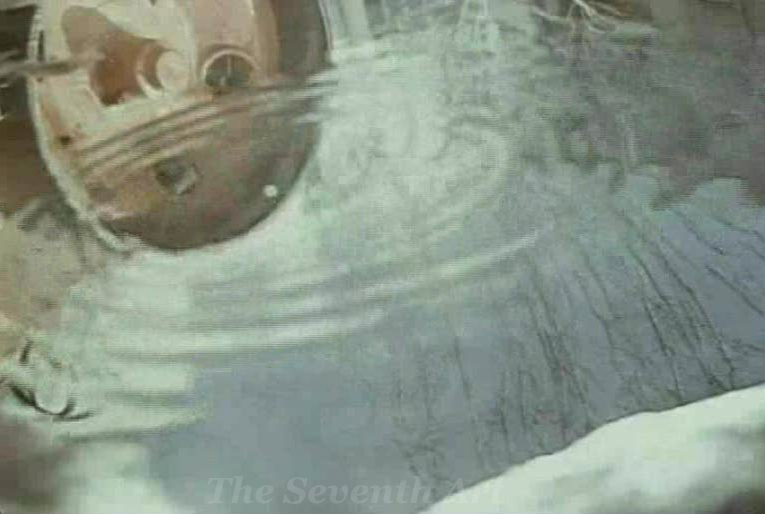
The final chapter of Inglourious Basterds has got to be the densest that Tarantino has ever filmed. The chapter is ambiguously titled “Revenge of the Giant Face” as if recalling some B-movie from the 50s. But more than that, it seems to me now, it tries to allude to two of the most iconic “giant faces” of women that we know. The first would be that of Maria Falconetti in Carl Dreyer’s The Passion of Joan of Arc (1928) – a film that is constructed out of hundreds of such giant faces. The tale of Joan of Arc by itself is a tragedy in which Joan sacrifices a normal life for the good of her people, much like Shoshanna, who, too, goes down in flames at the end of her journey. Only that Shoshanna doesn’t just suffer and prefers to take all of them down along with her. And then there is the most dreaded giant head in Greek mythology – that of Medusa the Gorgon – a mere gaze into whose eyes is supposed to petrify you. Daniel Ogden (source: Wikipedia) describes this stare of Medusa’s as “seemingly looking out from its own iconographical context and directly challenging the viewer”. Now, the Nazi officers in the final chapter are watching a fictional film, seated safely away from real life action, without any apparent threat from the images on the screen. When Shoshanna slips in her own film, with her gaze directed towards the Nazis, she essentially “looks out of context of the movie”, challenging, literally, the viewers, in a manner in which the modernist director used their actors, and petrifying them by dragging them out of their passive state.

The Passion of Joan of Arc - Dreyer

Medusa - Franz von Stuck

Inglourious Basterds - Tarantino

But then, our ideas about these two iconic characters are derived only through images and shadows – through paintings, through Dreyer’s film and through textual accounts. As George Steiner put it, “It is not the literal past that rules us. It is images of the past.” With the passage of time, history and mythology mingle to such an extent that it becomes virtually impossible to separate them. In Chris Marker’s magnum opus The Owl’s Legacy (1989), Jean-Pierre Vernant illustrates the mythos behind this practice of image (which is a word that referred to doubles, miniatures, copies and ghosts in general in Ancient Greece, the land of tragedies) creation. He tells us that images, for Ancient Greeks, were a means of facing man’s worst fears by reducing them down to caricatures. In Medusa’s case, this meant that they could see her directly in the eyes (a la Perseus who used a mirror – an image creating device – to slay her) and subsequently use these images to intimidate enemies. In Vernant’s own words: “So there is a way, though images and through stories of disarming the horror of death that the monstrous face expresses and which the image carries out so that what can’t be seen can be depicted in many ways” (recalling Godard’s quote about movies in History of Cinema: “How marvelous to be able to look at what we cannot see.”)

In the final chapter of Inglourious Basterds, Tarantino absorbs these images of dead characters from tragedies in mythology and history, blends it with the “image” of the tragic Shoshanna, who too is now dead, and, in essence, creates a mythology (Shoshanna the martyr) and history (Shoshanna the WW2 hero) of his own. Now, this is not far from what he does with his other characters in his movies, wherein he imbibes mythos and facts from within cinematic history to create new ones for his own characters. Only that, in Inglourious Basterds, his canvas seems to have expanded, with his universe transgressing boundaries defined by the history of cinema.  Furthermore, Tarantino uses the images of the movie – his Medusa mask – to “look at what he cannot see” in reality. Throughout the movie, he keeps attacking Hitler’s “image”. He depicts Hitler as a weak and paranoid individual with vermin like attributes. When he kills him in the final shootout, it is the “image” of Hitler that he wants to kill (much like the mentality behind voodoo and effigy-burning practices), for he can’t kill him in reality – exactly the same thing that Florya (Aleksei Kravchenko) does in Come and See (1985) when he fires at a photograph of Hitler in an attempt to undo the images of history, if not history itself.

In The Conformist (1970), Bertolucci equates the fascists with Plato’s prisoners of the cave, suggesting that they are blinded by fake ideologies fuelled by personal insecurities. In The Owl’s Legacy, Marker equates the audience in the cinema hall (citing Simone Weil) to those prisoners, proposing that they are blinded by images they see on screen and take them for reality. In Inglourious Basterds, Tarantino combines both these notions and presents us Nazis watching movies in a cinema hall. These “blind” Nazis enjoy the massacre that Zoller is doing on the screen, assuming that this is how it was. Zoller, on the other hand, is the only person there who knows it wasn’t so and leaves the cinema hall, breaking free from one of the captive caves he is occupying. Additionally, Tarantino does not forget to free his audience from the chains of their cave. Like it was done in Bertolucci’s film, he keeps reminding us that we are watching a movie and whatever we are seeing is a mere paining on a plastic canvas (contrary to what other films on historical subjects want us to believe). In chapter two, Raine, seated at the centre of an arrangement that resembles a Greek theater, tells the captured Nazi officer that “watching Danny beat the Nazis to death is the closest we ever get to going to the movies”. Raine seems to know that he is just the shadow of a man placed on a simple image. And because he regularly attempts to remind us of the fakery of it all, Tarantino’s violence also helps to serve the same purpose – to try to disengage us from whatever is depicted on cinema screen even when it is unmitigated and concrete. As the movie’s title confesses, its all a fraud and a very beautiful one at that.

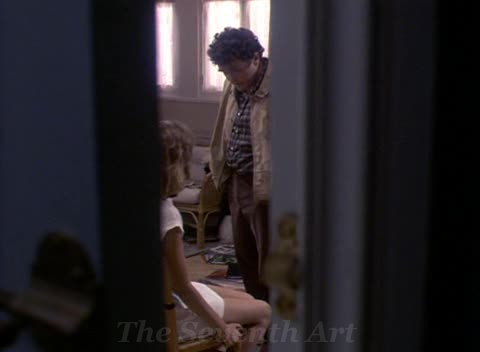
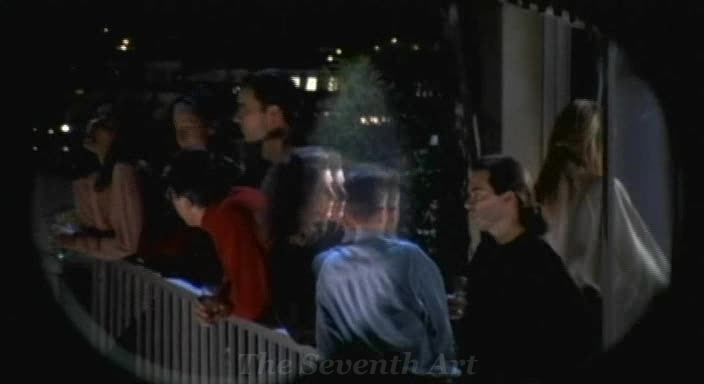
[The Conformist (1970)]

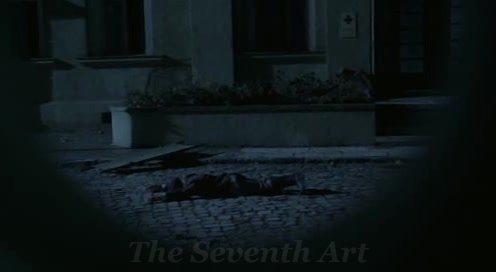
[The Owl’s Legacy (1989)]

(Images Courtesy: Imaginary Year, Hellenica)

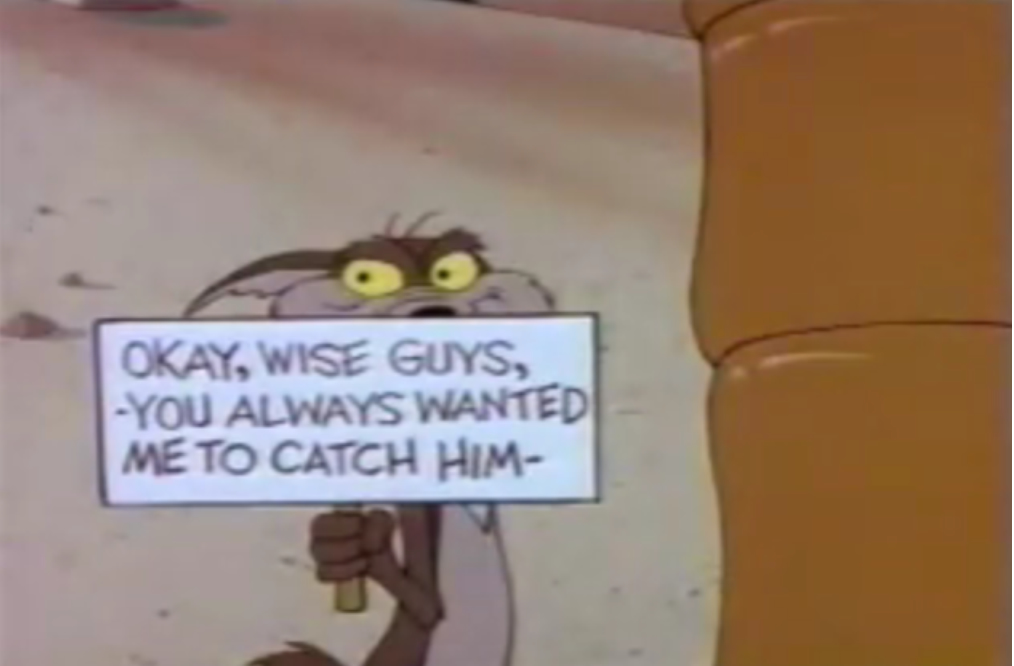
Talk about shooting a picture. Is this what they mean when they say  Cinema can be used as a weapon? Who knows, this may just make its way into the next Tarantino movie!

“This may be the only working example of Medvedkin’s camera which he invented while working at the front. He’d had this extraordinary idea. He needed soldiers who’d agree to serve as cameramen. He chose volunteers from the disciplinary battalions. Choosing these battalions was a shrewd move since, like Stalin’s camps, they recruited mostly educated people: Civil engineers, teachers, lecturers… people who already had the basics of technical knowledge. Teaming up in twos or threes, they would sneak up the rear of the German lines and achieve some incredible feats: Two men would capture a German as the third would film the operation.”

– Nikolai Izvolov explaining Medvedkin’s wartime invention in The Last Bolshevik (1992).

Never mind the Schindlers, here come the Inglourious Basterds

Never mind the Schindlers, here come the Inglourious Basterds
(Image Courtesy: Scanners)

If there is any filmmaker whose single film could evoke comparisons ranging from Happy Gilmore (1996) to La Dolce Vita (1960), it would have to be Quentin Tarantino. But why not? Here is a director who has made a name with his unique style that more or less marries the crassest and the classiest of film elements. It almost seems like no matter what film you name, you can always find a connection to Tarantino’s. Here he is, with his ultra-violent WW2 epic Inglourious Basterds, releasing in India on the birthday of a person who has become an icon of non-violence. An unimaginably large number of essays, analyses, critiques, blog posts and reviews have cropped up within weeks of its release, with opinions running the gamut, and that just goes to show how provocative this one is. It has even raised questions about creative licenses and the unlimited freedom it has given artists through the years. With Inglourious Basterds, Tarantino strays out of what many people would have till now called his comfort zone and has proven once and for all his status as an pop auteur. Inglourious Basterds may not be the film of the year, it may not even be the director’s best film, but it sure is the most important film of the decade.

For the uninitiated, here is the central premise of the film. Nazi propaganda minister Joseph Goebbels (Sylvester Groth) has just produced a film titled Nation’s Pride involving the real-life exploits of a Nazi Private Frederick Zoller (Daniel Brühl), who plays himself in the movie and which is going to be screened a cozy little theatre in Paris owned by a Jewish woman Emmanuelle aka Shoshanna (Mélanie Laurent). A group of American Jewish soldiers now called The Basterds, led by Lieutenant Aldo “The Apache” Raine (Brad Pitt), along with inputs from the allied forces plans to blow up the theatre in order to get the leading Nazi men including Hitler (Martin Wuttke). However, to complete their mission they have to get through the cunning and powerful Colonel Hans Landa (Christopher Waltz) who is in charge of the security at the grand event and who never leaves any stones unturned to trace out the Jews that the Nazis are in search of. Meanwhile, Shoshanna, whose family was murdered four years ago by Landa plans for her own revenge by blowing up the cinema hall using inflammable nitrate films that she has stocked through the years. Of course, as always with Tarantino, this summary is completely unimportant in comparison to what he achieves in the film.

With Inglourious Basterds, gone are the romantic days of Renoir when a couple of gentlemanly officers could end the war over a cup of tea. Now, deals are meant to be broken, enemies are meant to be stabbed from behind their backs and friends are supposed to be ratted on. Enemy corpses aren’t supposed to be given a proper burial, but should have their scalps removed. Instead of receiving a gentle kiss on their hands, ladies have their necks wrung. “I respectfully disagree” makes way for a “*bleep* you”. “Nat-zi ain’t got no humanity” replaces universal brotherhood. And scheduled duels are substituted by under-the-table gunfights. Everything in Inglourious Basterds is guerilla-esque, everyone in the film remains true to the title of the movie.  Nothing is sacrosanct, everything is to be questioned. Tarantino’s army is one that lives and moves in the shadows. What you see most definitely isn’t what it is. Like the film hints in the card game that the officers play in the tavern in the fourth chapter, the inhabitants of Tarantino’s new universe wear so many masks one over the other that it almost reduces to a Scooby Doo adventure. One isn’t supposed to believe what one sees, even if it’s all written out there.

The idea is simple. Inglourious Basterds is a 5-set tennis match. The Jews win it 3-2. For every Nazi set, there is a Jew set that follows. Throughout the film we see characters trying to get the upper hand and stay on top in whatever way possible. Even within individual chapters small scale power games are at work and one isn’t always sure how it is all going to turn out. The final images of these chapters alternate between images of the Nazis and those of the Jewish characters – Landa kissing Shoshanna goodbye, Raine carving out a swastika on a Nazi soldier, Shoshanna planning the film, Landa digging out Hammersmark’s shoe and Raine, again, with his masterpiece – much like a close tennis match. Each sequence, each shot and each dialog seems and feels like a tennis rally. The director regularly places his actors on either side of the widescreen and the audience’s eyeballs are made to go left and right throughout each conversation. Tarantino’s editing pattern could well apply to a Wimbledon telecast, for it mixes over-the-shoulder shots and two shots effectively as if providing both the audience’s and the camera’s viewpoints of the “match”. And of course, Tarantino’s writing ensures that we get the reward for the tense stretch of time he puts us through during each conversation.

The mere skeleton of the plot would reveal that Tarantino is reversing conventions here. For once, he is allowing the Jews to kill Hitler. But Tarantino keeps underlining, hinting, presaging and highlighting this reversal of roles between the Jews and the Nazis throughout the film. There is some sort of reversal going on within each structure and substructure of the film. Take the magnificent first chapter of the film wherein Tarantino throws at us everything that the film will offer us in the rest of the chapters. As Landa sits at the table, surrounded by the farmer’s family, it looks as if it is Landa who is being questioned. We are soon proven wrong and Tarantino’s majestic train of role-reversals kicks off once Landa starts digging. In a Bertoluccian touch, Tarantino keeps breaking the 180 rule without any hesitation, allowing his camera (helmed by ace cinematographer Robert Richardson) to wander into both sides of the two-shot setup to suggest the inversion of the hunter-prey relationship that adorns the whole conversation. Even his dialogues are decorated with such rhetorical clauses like “If I were in your position…” and “If you were in my shoes…”. Or consider the way he writes the first and final chapters such that they mirror each other entirely. If the Nazis kill a few Jews hiding below them during the first chapter, the Basterds will similarly gun down hundred times that number of Nazis in the last one. If Landa lights up his pipe to create a small smoke cloud in the farm house, a whole cinema hall will be burnt by the Jews. If LaPadite (Denis Menochet) is the betrayer of Jews in the opening chapter, Landa will become the traitor among the Nazis in the final chapter. Both Tarantino’s camera angles and his actor placements locate and relocate the relative positions of the Jews and Nazis throughout the film in a manner that recalls the way young Bertolucci handled his mise en scène in The Conformist (1970), which too revolved around faked identities and interchangeable personas and which Tarantino seems to be alluding to in the final few minutes of the movie.

Inglourious Basterds - Landa

Inglourious Basterds - Raine

Tarantino really puts his audience in a dicey situation here. Inglourious Basterds has been called a revenge fantasy. But never does a character in the film mention that it is a mission of revenge. The Holocaust hasn’t yet happened in the movie time and there are only hints of the Nazi’s plans for the Jews. It is only in hindsight, with the knowledge of what happened in reality, that we are able to call the film a revenge saga. If there is someone in the audience who is oblivious to Holocaust, the film might just appear otherwise. Tarantino teases us with the notion that revenge is the same kind of crime as the one that instigates it, but aided and justified by the passage of time – an idea that was ineffectively explored in Gaspar Noé’s positively disturbing Irreversible (2002). Tarantino lets the two worlds – the “real” reality and the film’s reality – collide and one’s response just depends on how much of a balance one wants to maintain between “what happened” and “what happens”. We can choose to either draw the line between “what-might-have-happened” fiction and “what-couldn’t-have-happened” fiction early on in the film or wait till Tarantino draws it for us in the last chapter.

Some commentators have suggested that Inglourious Basterds tries to humanize the Nazis and gain sympathy for them. But, surely, it isn’t the fault of the movie that we pity the SS officer when the Bear Jew prepares for the homerun or when the Nazis turn to ashes in the theatre. It is simply the ways movies work. Given a pattern of narrative, we seem to generally tend to support the weak, the suffering and the oppressed, thanks to our morality. Be it aliens of sci-fi flicks, tribes of exotic countries or mute animals of the jungles, we tend to patronize them, putting them on our moral scales. When, in A Clockwork Orange (1971), Alex de Large (Malcom McDowell) is trained to respond in a predictable fashion to certain impulses at the reformatory, Kubrick, in some ways, is speaking in a self-reflexive fashion. Alex is pure evil and there can be no other justification for his acts other than the fact that he is an evil-doer. Even so, Kubrick makes us accomplices to his acts and eventually makes us root for him. It is Kubrick who is manipulating his audience as a cosmic joke. And it has taken around four decades for some filmmaker to stimulate us in such equally provocative fashion and, in the process, make us evaluate our own moral standing and the way we tend to judge characters – on and off-screen. Speaking of A Clockwork Orange, Hans Landa drinking his glass of milk is reminiscent of and as chilling as Alex holding it in Korova Milkbar

Tarantino adorns the movie with a slew of sight gags, much like the ones we see in the Bugs Bunny cartoons, almost none of which actually fails. During Landa’s interrogation of LaPadite, at one point, he unveils his gigantic, almost unreal, smoking pipe dwarfing that of LaPadite. In the fourth chapter, when the Gestapo officer comes from within the tavern to question the officers about their accent, we see a huge whisky glass in front of him that’s unlike anything we’ve seen in the scene. Even in the last scene, when Landa hands over his knife to Raine, we are shown that Raine’s knife is the bigger one!  Furthermore, during the second chapter, as we are introduced to Hitler, he is posing for a gigantic portrait, indicating that his image is much more formidable than the man himself, whom Tarantino is happy to caricature. In fact, all these in-jokes would have fell flat if Inglourious Basterds had indeed played out as a straightforward drama. Thankfully, Tarantino’s characters are themselves cartoon-ish in nature, hence justifying whatever deformation Tarantino does to them and his attempts to reduce intense and delicate power games to petty mine-is-bigger arguments.

Tarantino doesn’t just bend and blend genres here, he takes them along the movie. His characters don’t simply absorb from genres, they are the genres. Inglourious Basterds is the kind of movie that will happen if a filmmaker casts non-actor cinephiles to act in a WW2 movie. Tarantino’s history is not a history given to him by text books (which by itself is a corrupt version), but one given to him by cinema. His characters aren’t those defined by the WW2 setting of the film, but ones from our age that have strayed into a WW2 movie. These aren’t characters have evolved from the film, but ones that have been pushed into it. What Tarantino does here is that he picks stereotypes from every genre of popular cinema and cooks them up in his WW2 broth.  In Godard’s Pierrot Le Fou (1965), the titular character tries to chew more than he can bite by jumping from one genre of cinema to another and trying to pirate the film away from the director to places only he wants to be (Early in the film, director Samuel Fuller tells us that movies are all about emotions). Continuing the tradition of Godard’s influence on Tarantino, Inglourious Basterds too absorbs quite a bit from the French, especially Pierrot. In Tarantino’s film, too, each character tries to hijack the movie from the genre it is supposed to be, as if protesting the director’s decision of forcefully situating them out of place.

[Inglourious Basterds Trailer]

Almost every character in the film tries to own a sub-genre. With his ultra neat conversational ethics and table manners, not to mention the tinge of narcissism, Landa is the quintessential smooth-talking secret agent (Landa himself insists that he is a detective later on). Aldo Raine is the leader of the men who are on a mission type, with his I-don’t-give-a-damn attitude. Shoshanna thinks she is the next Beatrix Kiddo, with her all-red femme fatale act. Poor little Zoller tries to be the romantic hero despite his designation in the film. Bridget von Hammersmark (Diane Kruger), already an actress, wants to be the deadly female spy (someone mentions Mata Hari as she talks during the tavern scene). Lt. Hicox (Michael Fassbender) is altogether from a different country’s cinema, with all his ethnic and lingual idiosyncrasies intact (“Well, if this is it, old boy, I hope you don’t mind I go out speaking the king’s?” ha!).  Even Herr Goebbels seems to think that he is in a B-grade sci-fi flick (“I have created a monster” he says). Much has been said about the corny celebratory ritual that Donny Donowicz (Eli Roth) performs at the end of his “innings”, but that only conforms to the genre that he is – the B-Comedy subgenre (Apparently, Adam Sandler was to play this part – who else?). You’ll either love his lines (and his bizarre nasal accent) or hate them, depending on how much you appreciate such type of comedy.

Apart from playing out their genres in the movie, the characters in Inglourious Basterds keep assuming different nationalities and ethnicities. Faking accents, speaking multiple languages, feigning papers and changing appearances seems to be order of the day. Characters are recognized using ethic slurs and covers are blown with the minutest of faux pas (which sort of brings back the scintillating experience of watching last year’s treasure In Bruges, which got everything right when it tried to marry the most serious of genre elements with the most absurd of situations). “I am a slave to appearances” confesses Aldo Raine as he handcuffs Landa in the final scene. Everyone in the film is. The multilingual Landa wants the Italian names to have a ring to them. The “little man” is unhappy about the unfair nickname that the Germans have given him. Hitler is convinced that the Bear Jew is a golem. Shoshanna goes to the extent of performing a full fledged ritual for this purpose. Right from the misspelt title you are told that what it looks or sounds like isn’t what it is. Tarantino pulls our legs as he switches the subtitles on and off throughout the movie, giving us only the most basic of information and leaving the rest to our ‘expertise’.

Tarantino’s complete disregard for the content of his film and his prankster attitude towards it are characteristic of Jean-Luc Godard too. But even with all the influence Tarantino has managed to kill his “father” with a distinct style that borrows from Godard’s yet deviates starkly. The greatest asset that Tarantino seems to possess is the ability to maintain a consistent tone in the movie. Even when he marries genres as wide and fatal as melodrama and thriller, he maintains a certain kind of detachment from it that lends these sequences a tongue-in-cheek flavour which unites them under a single stylistic umbrella despite their vast disparity. One deadly flaw that Vishal Bhardwaj’s Kaminey (2009) had was that, in an attempt to marry genres, he ended up marrying styles too, which made the film be nothing more than a surface imitation. On the other hand, even when he cuts to cheesy in-movie documentaries (narrated by Samuel L. Jackson), again reminding us of Godard’s My Life To Live (1962) where the director seamlessly includes a mini documentary that lists down statistics and factoids about prostitution in Paris, Tarantino maintains a strong grip on the filmmaker’s gaze towards his subject, never allowing us to mistake him for inconsistency of style.

Tarantino’s idea of filmmaking is akin to blowing a balloon. He blows and blows, till the onlookers cringe and then he allows it to pop. The mantra, for him, seems to be not “if it bends its funny, if it breaks it’s not funny”, but “if it bends its funny, if it breaks it’s funnier”. This way, I guess one could call him anti-Hitchcockian. Hitchcock’s sums up his legendary theory of suspense thus:

There is a distinct difference between ‘suspense’ and ‘surprise’, and yet many pictures continually confuse the two. I’ll explain what I mean.

We are now having a very innocent little chat. Let us suppose that there is a bomb underneath this table between us. Nothing happens, and then all of a sudden, ‘Boom!’ There is an explosion. The public is surprised, but prior to this surprise, it has seen an absolutely ordinary scene, of no special consequence. Now, let us take a suspense situation. The bomb is underneath the table, and the public knows it, probably because they have seen the anarchist place it there. The public is aware that the bomb is going to explode at one o’clock and there is a clock in the décor. The public can see that it is a quarter to one. In these conditions this same innocuous conversation becomes fascinating because the public is participating in the scene.

The audience is longing to warn the characters on the screen: ‘You shouldn’t be talking about such trivial matters. There’s a bomb underneath you and it’s about to explode!’

In the first case we have given the public fifteen seconds of surprise at the moment of the explosion. In the second case we have provided them with fifteen minutes of suspense. The conclusion is that whenever possible the public must be informed. Except when the surprise is a twist, that is, when the unexpected ending is, in itself, the highlight of the story.

Take the case of Tarantino. The audience always knows the outcome of his set pieces – that the balloon is going to pop one way or the other. Additionally, he doesn’t inform his audience of the popping time. Instead of making us ask questions like what will happen, he makes us ask when will it happen (and here, Tarantino likes to stretch the audience’s patience). Furthermore, Hitchcock preferred not to make that bomb of suspense explode, for he believed that it will make the audience uncomfortable, whereas one can bet that Tarantino will relish in showing what you expect (Not only will the Hitchcockian bomb explode, but limbs will fly, heads will roll and blood will flow). In fact, in Inglourious Basterds, not only do the Basterds’ bombs explode, but the theatre burns as per Shoshanna’s plans, Landa’s “private” bomb goes off and Donowitz and Ulmer (Omar Doom) manage to machine gun down the Nazis. Talk about beating a dead horse. But, on the other hand, Tarantino also uses a lot of the master’s techniques in Inglourious Basterds as he builds the film with the aid of a series of Red Herrings and Macguffins (One could have sworn that Landa had Shoshanna when he orders the milk). I am, however, undecided about the violence that the director depicts since it doesn’t work just on a purely cartoon level as in the Kill Bill movies. Here, the violence is closer to reality and one only wonders if Tarantino would have lost anything at all if he had cut away before the moment of gore.

But Tarantino’s film, like all his other works, is at heart about cinema. His streak of film references and tributes continue as he recalls a number of films from the past that he has grown up with. He pays homage to German cinema throughout Inglourious Basterds with a large number of Dutch angles that never once feel forced or out of context. In the final chapter, which begins with images recalling Fassbinder’s The Marriage of Maria Braun (1979, complete with the 360 degree Ballhaus shot), Tarantino takes this fetish to a whole new level. The film within the film, Nation’s Pride (actually directed by the Bear Jew), presents to us a German propaganda movie made in the style of a Soviet propaganda movie, Battleship Potemkin (1925) in particular, forming an unusual alliance between two countries that could have only been possible in cinema. This whole set-piece works on multiple levels of realities. If Goebbels is making a fiction within the fiction based on a distorted form of reality within the fiction, Tarantino too is making a fantastical fiction that relies on betraying reality. Only that Tarantino’s ethics are far from Goebbels’ (which is actually the way Hollywood tells it). It’s certainly less exploitative to heavily exaggerate a reality that never was than to mildly dress up a reality that was.

Early this year, Tarantino called Woody Allen’s widely and undeservedly trashed Anything Else (2003) one of the 20 best films made after he entered the industry. And not surprisingly, much is common between these two films despite their stylistic differences. In Anything Else, David Dobel (Woody Allen) tries to break out of the schlemiel image that the director had created for himself through the 70s and the 80s. “The issue is always fascism” he says in the film and he smashes the car windows of two thugs who bully him out of a parking space. What Woody was trying here is to undo history – both personal and collective – as he guides his younger self, Jerry Falk (Jason Biggs), who prefers “writing a biting satire in the quiet and safety of some delicatessen”, away from what he has become. Tarantino realizes that the only way to undo history, if not in reality, is through art and that art, in many ways, does not owe anything to political and historical “reality”. When Shoshanna switches from one projector to another during the screening, she is actually shifting the movie from one reality onto another – from a history we all know to a history that could have been.

[Tarantino interview]

Tarantino’s mission of trying to carve out a fantastical alternate reality isn’t really a unique one. In Godard’s magnum opus History of Cinema (1988-98), he keeps talking about two kinds of histories – the history that was and history that could have been – of cinema and that of the world. He argues that cinema could have indeed prevented large scale mishaps and put an end to Nazism once and for all. Tarantino realizes that this is nothing more than an elegiac fantasy and makes a joke out of it all telling us that the only way cinema could have brought about a political change was physically – by blowing itself up. And that the only way it could have ended Nazism was by putting them all into a large room and burning it down. In a scene that echoes the final few minutes of The Cameraman’s Revenge (1912), which was a film that reflected our tendency to believe that if it is cinema it must be true, Marcel (Jacky Ido) burns the pile of nitrate films to blow up the theatre as a huge heap of bullets piles up on the screen resembling it. With that, Tarantino is happy to plainly flesh out his idea of history that could (should) have been.

His attempt, like Allen’s in Anything Else, is to shatter the image that, especially popular cinema, has bestowed upon minorities of America through its incessant ethnic stereotyping – the suffering Jew, the benign black and the noble Native American. Let’s face it; it would only be a miracle if we ever see a black/Native villain in a summer blockbuster. So in a way, the revenge, led by Aldo-Shoshanna-Marcel, isn’t merely a fantastical Jewish revenge for the Holocaust, but a revenge for all the minorities and nonconformists of a cinema (industry) whose fascist producers insist upon maintaining status quo and sticking to a “final solution” (No wonder Marcel burns the movie reels). For Tarantino, who has been a popular nonconformist throughout his career in Hollywood, this is surely the sweetest revenge fantasy possible. It is his fairy tale and he is telling it the way he wants it to be. When Landa finds a single shoe in the tavern following the shoot out he must have realized he is in someone’s Cinderella story. The truth is that it’s Tarantino’s.


Verdict:

P.S: Christopher Landa delivers the performance of the year. His scene with Hammersmark is one to worship.


Essential Reading:

Jim Emerson’s series of articles on the movie at Scanners

David Bordwell’s take on the film at Observations on film art and Film Art

The Auteur’s Round-up of articles in their Notebook

Mark Baker, Adrian Martin, Jan Epstein and Nathan Wolski discuss the film’s wider aspects at The Monthly

Ed Howard and Jason Bellamy in conversation at The House Next Door

Sounds From A Town I Love (2001)
Woody Allen
USA
3 Min.


Long before young directors started professing their love for their hometowns through segment films, we have had directors whose relationship with their city has been more than a mere proposal. I mean, what would Fellini be without Rome, Scorsese without New York or Truffaut without Paris? And how can one ever forget to add the love affair between Manhattan and Woody Allen to that list? Sounds From A Town I Love (2001) was made as a part of the New York Concert that was held following the 9/11 attacks and presents us snippets from phone conversations of random individuals walking on the streets of the city. When the Academy decides to hand the life time achievement to Allen, they might very well go with this clip for the introduction because Sounds, in a way, helps to sum up the whole career of Woody Allen and, in particular, his style of script writing. The throw-them-all-you’ve-got attitude that is so consistently manifest across his filmography and also within each film is very evident in this short too. Most of the one liners work, big time, and some don’t. The camera tracks, in a way that seals the authorship of the film, along with the actors who deliver these lines the same way that Woody the actor himself would have done. Extremely neurotic and utterly funny at once, these characters are all blasts from the past for anyone who has relished the director’s films. The neighbourhood, which is the raison d’etre of this short, is quite familiar to all of us now and only adds to the nostalgic trip. And that introduction message by the director, where he promises his fans that he would make up for it if they felt that this short film was bad, just goes to show how his relationship with his audience has changed post-Deconstructing Harry (1997)

Block-notes Di Un Regista (1969) (aka Fellini: A Director’s Notebook)
Federico Fellini
Italian/English

“To me, the subway is like a catacomb which goes right through the bowels of Rome.


Fellini - A Director's NotebookIf there ever was something called personal cinema, it had to come in the form of Fellini’s masterpiece (1963). With had come a new kind of cinematic artist, standing in front of an unlimited canvas woven in time, dipping his hands in colours called memory, fantasy and magic, painting it without giving a damn about what a world would think about it. Placing himself at the centre of his fictional world, Fellini had indeed made it clear what the director of a film can do to it – as a manager, as an artist and as a personality himself. But to see that a film that he made half a dozen years later, Fellini: A Director’s Notebook (1969) that is as ambitious in its scope and as groundbreaking in its impact as , is much less discussed is both surprising and disheartening especially considering the way Fellini transforms a mere, unappealing making-of-movie into something that is as profound and as personal as his acclaimed movies. Made as a part of a series titled NBC Experiment in Television (1967-71), A Director’s Notebook is a precursor to his next film Satyricon (1969) and traces the groundwork that Fellini laid before the shooting of this film.

A Director’s Notebook presents us Federico Fellini setting out in search of locations, sets and character inspirations for the period drama  within modern day Rome. The narrator tells us that he is trying to affirm his belief that there is a strong link between the ancient and the modern and that the Rome of history text books is still alive and kicking. This idea forms the backbone for the hunt as Fellini hops from night-time streets of Rome to the countryside, from the city’s subways to world renowned monuments and from abandoned sets to active slaughterhouses. We meet a range of characters and also get to see them through Fellini’s eyes. Soon we start to sense what Mr. Fellini is arriving at. We see the Coliseum alongside defunct movie sets, we see images of Nero’s debauched army along side the street birds of Rome, and we see brave gladiators alongside butchers of slaughterhouses. Fellini, as usual, has fun transforming his situation as he wants. He seamlessly switches between images of the past and those happening now. We even get to see the iconic Marcello Mastroianni, whom Fellini likes to call a true Roman (“has all the virtues and all the faults of the ancient Romans”), and his subsequent conversations with Fellini beyond which the film really digs deep.

Throughout the film, Fellini sets up a channel between the two Roman civilizations – the present and the ancient – in a way that, primarily, serves as an inspiration for his next movie but also as a personal journey towards the director’s own roots. Be it the virtues – especially the warm and hospitable nature of the people – or the vices – the notorious debauchery of Nero and Caligula – Fellini seems to believe that the culture and the spirit has persisted through the years in the Romans. Towards the end of the A Director’s Notebook, Fellini even has the townsfolk who work at the slaughterhouse enact sequences from ancient Rome, complete with costumes and wreaths, in order to validate them for his next film (In the sequence’s hilarious end, one of the gladiator almost cries because he gets a scratch on his ear). In some ways, A Director’s Notebook is Fellini’s version of the wonderful Tarkovsky documentary Voyage in Time (1983), which too unfolds as a nostalgic trip set in Italy, wherein the director uses geography extensively to invoke memories and emotions. In one scene, Fellini and company travel in the subway train and we notice ancient Romans standing outside the train at many places, upon which the director himself notes that this must be a journey in time and not space.

Fellini - A Director's NotebookA Director’s Notebook is to what Woody Allen’s Deconstructing Harry (1997) is to his Stardust Memories (1980). Allen’s admiration for Fellini has been largely overshadowed by the influence of Bergman on him. In fact, Allen’s career closely follows that of Fellini’s even though the philosophical questions that Allen revisits is that of the Swedish. Stardust Memories (which, in a way, happens to be Woody’s 8½th movie), like Fellini’s , is all about the director. Both movies are exercises in narcissism as many have pointed out. In both, the director treats himself as if he is the centre of the universe while the world around seems to exploit him despite his turmoil. In Deconstructing Harry, Allen comes full circle and, once and for all, accepts the fact that it is he who has been exploitative and that he has to let go of his balancing act between his fictional world and the real world. Likewise, in A Director’s Notebook, Fellini studies his own self and, in an act of purging himself of the ego, reflects on how his relation has been with his actors and everyone else who has helped him gain the international reputation. Towards the end, when many actors and players try to impress the director with their skill set, Fellini tells us in the voice over:

“Yes, it might seem very cynical, very cruel. But no, I am very fond of all these characters who are always chasing after me, following me from one thing to another. They are all a little mad, I know that. They say they need me, but the truth is that I need them more.”

In one section in A Director’s Notebook, Fellini visits his long time friend and movie star Marcello Mastroianni to audition him for the leading role in his unfinished film The Journey of G. Mastorna. Fellini tries a lot – adding make up, setting up wigs, going for multiple takes – to somehow get a shade of the cellist Mastorna out of Mastroianni, but finally resigns. When he turns down Mastroianni telling him that he wasn’t into it at all, the actor quips back: “No Fellini, it’s because now you have no faith. It’s as if you are scared. If you could believe that I am Mastorna, I would automatically become Mastorna”. Throughout the movie, Fellini examines the cost that he has to pay for conforming to his reputation, the cost to that has to be paid for him to remain the Fellini that the world knows him as (Fellini is notorious for rarely using the same actor more than once), the cost for imitating oneself just for the heck of it. Fellini’s situation remains true for any filmmaker who tries to construct his fictional world the way he wants it, even at the cost of the real one – issues that both Woody Allen and his idol Bergman have explored time and again.

Fellini really pushes the boundaries of filmmaking over here. Unfolding as a tone poem in typical Markerian style, A Director’s Notebook soon goes on to blend documentary and fiction to create a truly personal form of expression that seems to be way ahead of its time. Far from the assured and fluid camera work of and rightly so, the cinematography in A Director’s Notebook is self-conscious, largely handheld, seemingly offhand and purely functional all the way. Closer to a series of essays than a complete film, the movie seems to be one of the earliest examples of the kind of cinema that would later be explored deeply by filmmakers such as Werner Herzog and Jean-Luc Godard. What part of the film was scripted, what was improvised and what was plainly documented will remain a mystery, but what matters is the unique concoction that the director achieves by this mixture. Stacking various levels of reality over one another like , but also taking it further, this stunning little gem from Fellini may just be the golden key required to unlock all his films that were to follow.

Fellini - A Director's NotebookA Director’s Notebook, true to its title, also serves as a nostalgia trip for both the director and fans of his work. There are throwbacks of his earlier films throughout A Director’s Notebook. When Fellini visits Mastroianni, the latter is in an interview where the reporters ask him inane questions, much reminiscent of the irritating paparazzi of La Dolce Vita (1960). Early in the film when Fellini is scouting for locations during the night, we cut to a little interview of his wife Giulietta Masina who recalls the (then) edited scene in The Nights of Cabiria (1957) where a strange man delivers goodies to the people living on the fringes of Rome. The hilarious audition section where we have all kinds of people, including a boy who claims he can whistle like a blackbird, a charlatan who seems to know painters more important than Raphael, a lady who thinks her music conveys the same thing as Fellini’s films and even a man whose life depends on his wig, seems straight out of . Even the sequences in the film where the director hunts for life in the streets of Rome during the night time has a lot in common with the positively eerie and Lynchian atmosphere that he created in his segment Toby Dammit in the portmanteau film Spirits of the Dead (1968).

But even without the references, A Director’s Notebook remains an auteur’s work. Even if one doesn’t see any connections of this film to his other movies, one can say with conviction that it is a “Fellini movie”. No one other than the ringmaster called Fellini could have assembled the army of characters that appears at various places in the film. At one point in the film, Fellini takes a mini nostalgic trip where he recounts the people of his childhood watching a movie at the theatre, hinting at the kind of films he would be making henceforth. The clairvoyant who can talk to the people of the past, the professor who studies the connection between historical Rome and its present version and the crewmen who turn into Nero’s soldiers are all characters who have the Fellini tag stuck on their forehead. The lonely yet lyrical, dark yet alluring, beautiful yet decaying streets of Rome, the array of immensely human characters who keep flooding the screen with enthusiasm and women with exaggerated make-up and strikingly extreme expressions – now, where else can one see such images other than at Fellini’s circus?

Tabiat-e Bijan (1974) (aka Still Life)
Sohrab Shahid Saless
Persian

“It means that you’re retired now.”


Still LifeSohrab Shahid Saless’ Still Life (1974) is, barring Kiarostami’s Homework (1989), the greatest Iranian film that I’ve seen. To see that even during the pre-revolution era, when the escapist cinema of Hollywood and its imitations were much more popular, such uncompromising and quality films were being made is both surprising and hope-instilling. Typically European in its form but uniquely Iranian in its content, Still Life is the kind of movie that contemporary contemplative cinema takes off from. Produced by a newly formed group called Kanun-e Sinemagaran-e Pishro (Centre for Avant-Garde Filmmakers), that also produced some of Mehrjui’s early features, the film was one of the many films that were discontented with the existing way of governance. Although never overtly political, Still Life not only manages to critique deeply the disparity that existed between villages and cities of the country during the Shah’s regime, but also remains one of the best works from the country till date. Let’s wait and see what the present-day Iran brings in reply to this masterwork.

Still Life documents a period in the life of Mohammad Sardari (Bonyadi), a veteran employee of the railway services living in a rural part of the country and whose sole job is to close and open a railway crossing few times a day. He is waiting for a festival bonus from the department that is long pending. He is married and his wife (Zahra Yazdini) supplements his income by weaving carpets and carrying out minor tailoring jobs. We are only given such utterly quotidian details from his everyday life – he operates the railway gates in the morning, he rests at his accommodation near the crossing, he returns home for lunch, he goes back to operate the crossing for the evening train, he returns home for dinner and he sleeps – but that is all there is to Sardari. We are also given a few glimpses of his son who returns home for a day from the military service and a bunch of customers who exploit Sardari by underpaying him for the carpets his wife has woven. One day he receives a letter from the railway department that intimates him of his retirement from service. Sardari is unable to comprehend the meaning of the letter and starts to believe that he has been unreasonably given the sack. Heartbroken, he decides to go to the department headquarters located in the city and find out the reason.

Saless’ style is remarkable here. Almost throughout the entire film, he presents us long, uninterrupted extreme long shots of Sardari going about doing his routine at the railway crossing. Even when the old man is home, Saless and cinematographer Hushang Baharlu give us mostly medium and long shots that are filmed with the camera placed at the ground level, sometimes reminiscent of Ozu.  In either case, Saless’ eye is that of an ethnological documentarian – interested in what his protagonist is doing, but never wanting more than that. The mise en scène is spare, stripped down to bare essentials, with a chunk of space between the characters and the camera. Even gestures, dialogues and movements are reduced to an absolute minimum. Watching the indoor scenes in Still Life is like gazing at an aquarium in which the fishes indifferently perform the same mundane activities over and over again. Halfway into the film one is acquainted with the routines of the old man and his wife. He comes home, rolls his cigarette, and starts smoking and she continues to stitch clothes and weave carpets. Even when their son returns home after a long time, conversations are perfunctory and the character functions are unhampered.

Still LifeBut what is singular about Still Life is the way it handles cinematic time. Saless, while letting us witness individual scenes unfold in real time – be it entire dinner sessions or railway transitions – without hindrance, shuffles the order of these scenes in a way that disregards chronology. In one scene in the film we see the couple’s son return home and in the next one, he is missing. And then he’s back in the subsequent one. Soon one notices that most of the scenes could have taken place in any arbitrary order in real time and each of those orders is essentially irrelevant, given the idea of the film. What’s the use of chronology when time repeats itself by going in cycles? In Jeanne Dielman (1976), Chantal Akerman used each day of the protagonist life’s to illustrate its microscopic deviation from the previous. She seemed to be essentially constructing a spiral out of Jeanne’s life – a structure that made her life seem to go in circles but which, in actuality, ends only in annihilation. Saless, on the other hand, treats time as some form of stray deadlock that could only be resolved by an alien intervention. Within this loop, all time is one and each day is virtually indistinguishable from the other.

In one scene that comes towards the end of the film, Sardari visits the railway headquarters to seek an explanation for the retirement notice. In the building, he notices a pair of officers scanning through old photographs reminiscing about the past and talking about plans for the weekend, And just there, Saless provides the most overt and powerful contrast between the life in rural and urban Iran. The officers with a lush past and a busy future stand directly in opposition to Sardari, whose past is almost non-extant and whose future promises nothing different. Still Life would definitely form an interesting companion piece to Antonioni’s Blowup (1966), which seems to resonate more and more with the years. Both Thomas (played by David Jennings) and Sardari are perfectly alienated creatures who pass through life without an iota of an idea about their place in the world. Only that their geographical locations are poles apart. Thomas is one of cinema’s many alienated urbanites trying to impart a meaning to their lives. On the other hand, Sardari is the rare villager who believes that life will go on as it is and who is nudged to action only when that belief is shattered. But in essence, both of them are individuals wallowing in their own world unable to snap out of it.

Still LifeEven with all its serious themes, Still Life isn’t entirely humourless. There is a constant undercurrent of dark comedy throughout the film (In a masterstroke of black humour, Saless has Sardari regularly tune the alarm clock!), but, like all the other elements of the film, it remains extremely subtle and never thrusts itself upon us. Instead, Saless builds one stretch of time upon another, elevating the film from the territory of mere narrative cinema to the realm of the philosophical, the experiential and the contemplative. In the shattering last scene of the film, we see Sardari, who is now forced to accept the reality that he can no longer work at the railway crossing, vacating his quarters. After he loads the cart with his possessions, he decides to check the house one last time for any object he may have forgotten. As he stands in the middle of the now-empty house, gazing at the room of whose inanimate furniture he had become a part of through the years, Sardari notices the final remnant of his life at this place – a piece of mirror hanging on the wall. He reaches out to collect it and, in the process, looks at himself for the first time in the film. Mohammad Sardari has indeed become old.


Also published at Unspoken Cinema

Schastye (1934) (aka Happiness)
Aleksandr Medvedkin
Russian/French

“Go and find happiness.


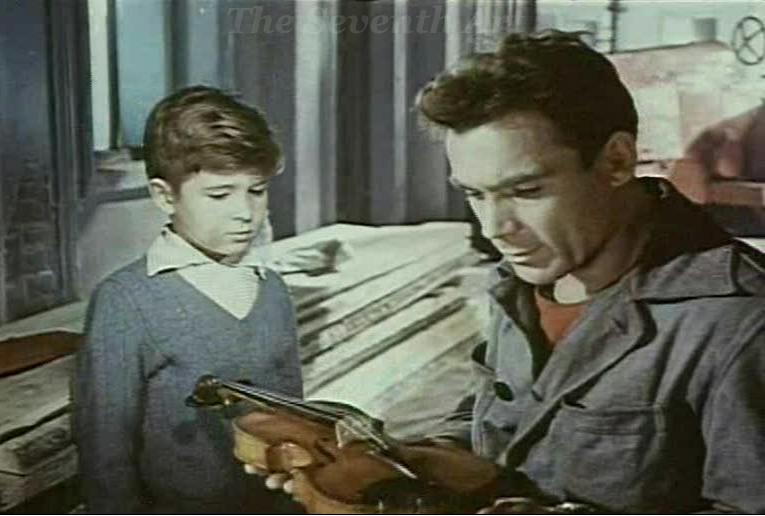
HappinessIt is now generally accepted that if not for the efforts of another less talked about filmmaker Chris Marker, the world may not have come to know about his mentor Alexandr Medvedkin and his work. Standing somewhere between the films of Dovzhenko and those of Pudovkin, Medvedkin’s most famous movie Happiness (1934) offers a radically different perspective to the political and cinematic developments in Stalinist Russia. The discussions about Soviet cinema have been dominated by the films and theories of major figures like Eisenstein and Vertov, and perhaps rightly so, obscuring inevitably other stalwarts who may have been. Much less a theoretician than his contemporaries, Medvedkin produces a film that may never make it into classrooms. But one thing can’t be denied and that is the fact that Happiness is a film with a heart. Happiness does work very well as a stand alone piece, but the fact that it is a culmination of a larger and a nobler mission makes it all the more special.

Happiness follows the life of a poor Soviet farmer Khmyr (Piotr Zinoviev) and his “horse-wife” Anna (Elena Egorova) before and after the October Revolution. During the Tsar’s rule, we see Khmyr struggling for existence and envying his wealthy neighbour Foka, who also happens to be the loan shark of the village. So he goes in search of happiness and gets it in the form of a sum of money. He buys a horse for farming but the animal goes on a strike. He manages to harvest by substituting Anna for his horse and gathers a rich output. His celebrations don’t last long as Foka and the Church figures are quick to grab it back from him. He contemplates suicide, but the Church prevents him from doing this “sin”. Now, it decides to punish him by whipping him but not allowing him to die. Years pass by and the country is now in the hands of the communists. The collective farming system has been implemented. Anna seems to have adapted to the system and seems to be doing exceptionally well, becoming the breadwinner of the family. Khmyr, on the other hand, lazes around, making one blunder after the other, desperately tries to become an honest farmer. But the disinvested Foka plans revenge.

Happiness would seem like a very directionless film, if one does not take a look at Medvedkin’s modus operandi outside of the film. Medvedkin was one of the founders of the famous Cine Train of Bolshevik Russia that aimed to travel into the hinterlands of Russia, document the lives of peasants and workers and show it back to them in order to make them understand their strengths and weaknesses. The country had just entered the Bolshevik regime and the common folk, it seems, found it difficult to adapt to most of the improvement measures. Medvedkin and group understood this problem and used the cinema as a medium of introspection to illustrate the situation clearly to the people. Be it public service messages like the importance of hygiene (as in the film Watch Your Health), critical documents about absenteeism, inefficiency and negligence (as in Journal Number 4 and The Conveyor Belt) or queries for betterment of living and working conditions (How Do You Live Comrade Miner?), the Cine Train seems to have never hesitated in putting everything that is right and everything that is questionable about a system on the same plane. And that is very true about Happiness too.

HappinessJoseph Stalin banned the movie apparently because he thought that Happiness was mocking his collective farming system – the Kolkhoz – but spared Medvedkin knowing his service for the state. But surely, what Medvedkin was doing was neither a satire on the state of affairs nor a propaganda movie that the Soviet cinema was famous for. What he was presenting was merely an honest view of the newly born farming system, without any form of prejudice or support. For this, Medvedkin pays equal attention to both the positive and the negative ramifications of the collective farming. Through a largely objective eye – a common eye called cinema – Medvedkin makes a transparent reading of the Kolkhoz, its strong points and its limitations. If Stalin is pleased by Medvedkin’s attack on the exploitative and irrational nature of the church in the Tsar’s regime, he would be turned off by the vignettes of the Kolkhoz, where there are a bunch of goons waiting to ruin it all for themselves. If he would be laughing at the director’s depiction of the Tsarist army as a bunch of men wearing the same grumpy plastic masks, he would be annoyed by the possibly individualistic upshot of the film. But by no means is Medvedkin taking a centrist stance, for his stance is that of the people. As confirmed by Happiness, his interest is not the upholding of a political ideology, but a desire for people to have better lives.

“Every man is seeking happiness. Some see it in wealth, but the Russian peasant who struggled in poverty dreamt of it in his own way. Anton Pavlovich Chekhov noted in his diary: “What is a Russian peasant’s dream? If I were tsar, I’d steal 100 roubles and run away!” A Russian proverb says that the peasant’s reply is: “If I were tsar I’d eat the fat of the bacon and I’d go to sleep.” What an idea of happiness! Just having a piece of bread, not being hungry, having a horse, a barn, having a few possessions, a sack of wheat… Such an idea of happiness, so little, but linked to the age-old harshness of a Russian peasant’s life, that’s the basis of my comedy Happiness. I tried to show the tragedy of such a man, and the effort he makes to find his ideal life. His dreams couldn’t be very elaborate, of course, they were on his own scale, but in his own way he was looking for happiness. And in this film I tried to tell a story that’s funny, sad and tragic, the story of a peasant like him, Khmyr, for whom nothing goes right. His life is a struggle, just as his grandfather’s and great-grandfather’s had been, just as his father’s had been. And, totally unexpected to him, at the end of the film he finds that there are others who care about him, friends, neighbours, the government too. And in a collective farm he comes close to happiness. That’s the story of the film. Throughout my life the film train has been a wealth of ideas and themes. It made me love themes linked to the people, it made me love the life of the people, their dreams, hopes, joys and pain.”

As he says above, Medvedkin fascination lies with the people of his country. Instead of making his film into a moral tale about the truth about happiness, he is content is depicting the struggles, aspirations and triumphs of a common man – a simple man whom he has seen throughout his life in the Cine Train. That is why, I believe, it is not fair to call Happiness as a politically charged film even though it provides a good indication of the politics of Russia at that time. His Khmyr is not an icon of satire or propaganda, but of the Russian peasant himself. Khmyr is like Chaplin’s Tramp, not fitting easily into preformatted social structures, only that Khmyr is not the happy-go-lucky type like his American twin. Medvedkin seems to be of the opinion that, however strong and simple a system is, there will always be anomalies who will take time to settle down. This idea is reinforced by his other films The Story of Tit (1933) and Stop Thief! (1931), where too we have lazy or incompetent peasants trying to malinger and wriggle their way out of duties at the Kolkhoz.

HappinessIn Chris Marker’s brilliant film The Train Rolls On (1971), he recounts the rise and fall of the Cine Train, employing meditative voiceovers, stock photographs and interviews of Medvedkin himself. The Train Rolls On starts (and ends) with the image of a moving train, denoting at once the beginning of this film, the beginning of cinema and the beginning of revolutionary cinema heralded by the Cine Train. Marker, not without a tinge of sadness, documents the activities of the Train, from its inception to its death, and attempts to bring to light how revolutionary the vision of the group was. In the interviews, Medvedkin recalls the experience of traveling in the train, stopping at villages, carrying out the mission’s objective and working against all odds to give to people what he had taken from them. Marker’s work is a documentation of a (lost) documentation of history, of revolution and of change. Marker tells us that although most of the Cine Train’s work has gone into oblivion, the spirit of the undertaking has lived on. As he puts it: “The biggest mistake one could make would be to believe that [the Train] had come to a halt”.

What is perhaps most unique about the Cine Train is its conviction that cinema is a medium that is of the people, for the people and by the people. That it can indeed bring a change in the lives of common people. That it is the only art which can create a revolution for good. This view is remarkably similar to Medvedkin’s contemporary and fellow Russian Dziga Vertov’s Kino Pravda theory. Nikolaï Izvolov, who headed the restoration of Happiness, narrates the strange phenomenon that Medvedkin and Vertov shared. Even though both lived in Moscow and were even next door neighbours for some time, they seem to have never met each other officially. And just before they had an opportunity to work together in the 50s, Vertov passed away. One only wonders what course cinema would have taken if they had joined hands. Herzog’s belief that cinema is the art form of the illiterates seems so true when watching the films of these pioneers. Somehow, it feels like cinema has moved backwards from where it started. One should at least be glad that their followers – the Dziga Vertov Group (Godard et al) and the Alexandr Medvedkin Group (Marker et al) – have tried to sustain the vision of their mentors, if not achieving the desired results.

HappinessIn Happiness, Medvedkin sets up a hilarious contrast between Khmyr and his wife Anna by reversing the conventional notions of masculine and feminine. As Khmyr goes out in search of “happiness”, Anna grabs him by the collar and kisses him goodbye.  She defends him against Foka’s exploitation. She steals a horse from thieves and rescues Khmyr from execution. She drives a tractor and runs the house. Heck, she even carries the horse down from the top of their hut! Medvedkin almost always frames her above the feeble Khmyr producing an amusing effect. Sergei Eisenstein called Medvedkin a “Bolshevik Chaplin”. Although I’m sure many will be surprised by that statement since the slapstick in Happiness seems to have aged a bit (but only as much as many of its American counterparts), there is much dark humour in Happiness to make up for that. I haven’t seen any Russian comedy of this period, except Pudovkin’s magnificent Chess Fever (1925), so I am not sure how this film stands out as a comedy among its contemporaries. But where the success of Happiness (and Medvedkin’s work in general) really lies, in hindsight, is in the fact that it offers us an alternate prism to view a country’s cinema, which has been reduced by text books to mere political messages and then a few cutting techniques.

Scorsese On Scorsese
Martin Scorsese (Edited by: David Thompson and Ian Christie)
Faber and Faber, 1979
 

“But prayer is really dealing with what you have in the home, dealing with the family, how you raise your children, how you relate to your wife. May be that’s what prayer really is in the modern world”


–    Martin Scorsese (Scorsese on Scorsese, 1979)


Scorsese on ScorseseAmazingly, last night I had the most memorable dream of my life and the best part is that I remember all of it in detail. I was at Scorsese’s house and talking to the man himself about the cinema in India and the deteriorating state of old regional films. How about that?! Dr. Freud would immediately remind me that I had finished reading Scorsese on Scorsese just the day before. Whatever the case is, reading Scorsese on Scorsese is best approximated as an extended conversation with the director. In fact, editors David Thompson and Ian Christie have done a splendid job by keeping factual autobiographical details to the minimum, presenting them as small italicized snippets between Scorsese’s talks, hence removing any hindrance for us to speak with Scorsese the man and Scorsese the director. Though compiled from a set of lectures and interviews the director had given around the world, Scorsese on Scorsese never gives you the feel of an authoritative person directing you towards what you have to know. Instead, Scorsese recollects events, almost from the top of his mind, lets us interpret and thus get to know the man and his films more.

Divided into six chapters, the first of which details his childhood and teenage memories and the rest taking us virtually through the making of each one of his movies, Scorsese on Scorsese is a joy ride for any film buff. There is much humour throughout the book and at times you almost hear Scorsese break out with his characteristic and infectious laughter. Many would agree if I say that Scorsese is one of the biggest film buffs of the world and this opinion is established as a fact in these texts. There is almost no line in the book where you don’t hear the man come up with a movie comparison or a simile that is related to the movies. Even in the most commonplace of statements, like feeling sick on the sets (“…I was coughing on the floor and sounding like a character from The Magic Mountain”), recalling parking problems (“…but destroying things as in a Godzilla movie”) or describing the streets of New York during summer nights (…reminds me of the scene in The Ten Commandments, portraying the killing of the first born, where a cloud of green smoke seeps along the palace floor…), Scorsese’s never flagging enthusiasm for the cinema surfaces.

Scorsese on Scorsese is a must-read for anyone who doubts Scorsese’s status as a genuine auteur. As one moves along in the book, one sees that all of Scorsese’s characters have a bit of Scorsese in them and could be seen as extensions of his personality in a fictional world (Be the screenplay officially by Schrader, Price or Minion, Scorsese invariably seems to have had a hand in their final versions). Although the book covers the directors career only till New York Stories (1989), one can see the same phenomenon carry on in his later films too. As Scorsese goes on explaining how each movie, each scene and each set piece came about one can actually see the deep influence that his childhood and teenage has had on his thought process and his vision of the world. He elaborates on what made him take to priesthood and then the transition to cinema (He says: “In my neighbourhood, the people in power were the tough guys on the street, and the Church. The organized crime figures would tip their hats to a priest and watch their language, an they would have their cars and pets blessed”).

This book was compiled just after The Last Temptation of Christ (1988) hit the screens and it is evident that the whole book centers itself on this event. Right from the unusual introduction chapter, which recounts the events that preceded the release of the controversial movie, one can see that the authors intend to take a look back at the director’s career standing at this historical point. The concept of religion is also manifest in Scorsese’s talks throughout the book as he subtly reveals how his experience during the days as a young priest, away from the meanness of the streets, shows itself in almost all his early films. Be it overt as in Mean Streets (1973) or underneath as in Taxi Driver (1976), the idea of God and religion, Catholicism in specific, seems to be always present, mostly in the form of a hope for redemption, in his movies. In hindsight, The Last Temptation of Christ almost looks like a confrontation of sorts with his own inability to reconcile between what he learnt in the Church and what he saw in the streets.

Another interesting thing is that even though he has had to put up with a lot, Scorsese never dwells on the difficulties much. Yes, he does talk about them in detail, but he makes all his travails sound like simple trivia and things of distant past. It is remarkable how he has earned the title of a major Hollywood director (in spite of his legendary association with New York), especially after his near ostracism by the studios after The King of Comedy (1982). He makes the trouble he had shooting After Hours (1985) and The Color of Money (1983) sound so amusing that one tends to overlook how appallingly tough it must have all been. The book complements these accounts with loads of rare, behind-the-scenes photographs from his movies, the complete story board of the final scene in Taxi Driver drawn by the director himself and other stills from famous movies, including the ones he cites as inspirations, placed side by side as if the director himself is showing us what went through his mind when he made those compositions. There is even a still of Michael Jackson and Martin Scorsese in discussion during the shoot of Bad (1986)!

During the course of all this recollection, Scorsese talks about some abandoned scripts and some ideas for future that now seem so fascinating. He talks about a script called “Gangs of New York” that couldn’t be realized (and which eventually got made in 2002 perhaps with much change), he mentions that he doesn’t really want to do remakes (he made Cape Fear (1991) almost immediately!) and that he was immensely influenced by the music in the Moroccan film Transes (1981) (which has now got restored by the World Cinema Foundation headed by him and shown online for free!). Those who still think that Scorsese has sold his soul to Hollywood of late, I think, would see that The Aviator (2004) is as personal a movie as Taxi Driver or Raging Bull (1980) once they read this book, or rather this memorable evening of reminiscing with Scorsese. At the end of it all, it feels like if Scorsese had indeed taken up priesthood as a profession, which seems to have seemed very likely, the world would have got one good priest more but one great director less. Now, what kind of an unfair exchange is that!


Verdict:

P.S: Scorsese on Scorsese contains one of the greatest forewords that I have read. I type it down for you here:

What’s Hecuba to Him?

The first Martin Scorsese film that I saw – or that saw me – was Alice Doesn’t Live Here Anymore. The actors were directed with assurance. There was not a frame wasted. I said to myself: Michael Powell, you’re going to have a good time – this man knows where he’s going and you’re going with him. On the screen we were entering a fast food emporium, with two splendid actresses volleying words and phrases at one another. It was like watching a singles match on centre court at Wimbledon, between two champions. I hadn’t seen match play like this since I saw Pat and Mike.

We screened Taxi Driver. ‘Stop! Stop!’ I said. ‘Who’s that devilish actor who plays the Devil in the scene with Robert De Niro?’
‘That’s Scorsese.’ Said my friend, who had arranged the screening.
‘What! Can he act too?!’
He smiled, ‘want more?’
‘Is there more?’
He nodded vigorously. ‘Much, much more.’

He arranged a screening of Mean Streets. It was in a little projection theatre off Wardour Street, London WI. There were four of us and the projectionist. When the screening ended, we looked at each other, stunned. The five of us crossed a narrow street and went into a pub that was just on the verge of closing. Nobody else was there. Still we said nothing. There was nothing to say.

All art is one, and every artist owes a duty to his art. We can’t all be masters, but we can know a master when we see him, because he has something to say to us, and sooner or later imparts it. The difference between these films of Martin Scorsese’s is that with Alice and Taxi Driver he handles the materials like a master; with Mean Streets he is in direct contact with the audience, from the beginning to the end. This is the rarest gift given to a movie director. Most directors, however wise, however experienced, however resourceful, however bold, don’t have it and never will have it. Marty always had it.

He has this great, generous gift of creating a situation for an audience, and sharing it with them. He is the ventriloquist and his doll, the singer and the song. In his latest film, Life Lessons, Marty performs the same miracle, he is the painter and his palette, he is the pupil and the master, he is the cunning of the fox and the innocence of the child, he is the voice of the tape deck screaming ‘A Whiter Shade of Pale’.

When Hamlet sees the tears in the Player’s eyes, and asks Horatio:

What’s Hecuba to him or he to Hecuba
That he should weep for her?

he is asking the same question that we ask of ourselves when Scorsese, in The Last Temptation of Christ, gives us our first glimpse of that hill called Golgotha. For, as the tears spring to our eyes, we know that we shall see that hill again, and then it will be our last sight on earth – and his.


Michael Powell
March 1989

Mouse Heaven (2004)
Kenneth Anger
USA
11 Min.


I don’t think there’ll be anyone who would not be disarmed by Kenneth Anger’s Mouse Heaven (2004), unless that person is allergic to the world’s most famous mouse – Mortimer aka Mickey. We can never have enough of Mickey Mouse, can we? And that is exactly what Anger in underscoring in this fabulous little short. Mouse Heaven begins with a shot of creepy lab rats (in negative, to make it worse) followed by a drawing of Mickey on paper. We are then shown shots of an animated Mickey mouse, then two of them, then a few of them and, soon, then an army of them. And before you know it, Mickey Mouse is on your underwear. Anger floods the screen with all types of Mickey Mouse merchandise – food items, clothes, toys, and tattoos, Mickey in clay, Mickey in metal and even a Mickey in diamond. Although many modern filmmakers have adopted a similar style, Mouse Heaven, clearly, is an auteur’s work. When such quirky songs like “I’m your puppet” and “If I had a million dollars” play on the soundtrack while the visuals give you hundreds of Mickeys dancing and singing, you know it is Anger at the cutting table. Unlike many of his earlier films, which used barely comprehensible imagery, Anger presents us with neat and instantly lovable visuals to show us what our fetishes have brought us to. Thematically close to the director’s unfinished film Kustom Kar Kommandos (1965) but based on a zeitgeist of this age, Mouse Heaven is Anger at his sarcastic peak as he takes a massive jab at this exploitative economy of ours, whose free agents are just waiting to stuff the next cute thing.

Hey, who flicked my Spongebob coffee mug?

What Is Cinema? Volume I
André Bazin (Translated by Hugh Gray)
University of California Press, 1967


What is CinemaYes, I know this is the “inferior” translation. But hey, this is all I could get my hands on. But surely, the translation isn’t the bottleneck in understanding what the author is saying, for Bazin himself makes things tough with his analogies and references! Taking examples from almost every field of science and arts – from chemistry to Comédie Française, from geology to Christianity – he stacks one argument upon another, turning down existing critical principles and builds a vision of cinema that does not care as much about the artist’s vision as it does about faithfulness to reality. Presented as an anthology of selected essays from the author’s original four-volume work Que-est-se que le Cinéma? (1958-65), this translation by Hugh Gray has received a lot of flak after the release of the Caboose edition. But the historical importance of this translation remains unquestionable and the book still remains an immensely insightful introduction to the work of arguably the world’s most revered critic.

The anthology begins with the small chapter titled “The Ontology of the Photographic Image” where Bazin traces the need for plastic arts, especially cinema way back to the time of the kings. He argues that it is mankind’s ambitious need to preserve the living and hence achieve immortality that has caused the arts to associate themselves to the reality of the world. He pins down the origin of this practice to the Egyptian craft of mummification and then gradually draws out the evolution of the other arts right down to cinema and photography.  He illustrates how photography indeed freed painting from its ambivalence by allowing it to retain artistic abstraction and leave faithfulness to reality to photography (“…for photography does not create eternity, as art does, it embalms time, rescuing it simply from its proper corruption.“). This chapter, in fact, becomes the base for all of Bazin’s theory in the rest of the book, establishing his unshakeable faith that the power of cinema lies in its property to reproduce reality without any form of human interference.

In the subsequent few chapters, he builds on the first chapter and analyzes what reality and cinema mean to each other. In an interesting section, he puts forth the argument the introduction in sound in cinema was not actually the biggest turning point. He says that the dichotomy that existed was not between the talkies and the silent movies, but between films that relied on reality, like the films of Erich von Stroheim and the ones that were trying to do precisely the opposite, like the Expressionist cinema. He further points out that the introduction of sound was a mere technical triumph that enabled cinema to move one step closer to absolute realism. Carrying the argument forward and considering both extremes – spectacles concocted purely in reality that is faithfully filmed by the camera and spectacles concocted by montage which cuts out facets of reality that may hamper the truth of its world – he examines the advantages and limitations of montage where he exemplifies how montage and its avoidance alter cinematic reality and how montage should be used depending on the context of the sequence filmed.

But what the book primarily concerns itself with is the relation that cinema bears to contemporary arts like literature, theatre and paining. Almost half the book is devoted to studying how cinema absorbs and contributes to literature and theatre and how this phenomenon is just a symbiosis among the arts. He argues that although the relatively infantile cinema plunders themes and tales from literature, it is literature that gains audience. Furthermore, he lashes out against dogmatic purists who readily shrug off theatrical and literary adaptations that are faithful to their source. Bazin stands in support of adaptations that are faithful to the source and whose concerns are not merely providing a mutation through cinema. Using a separate chapter titled “The Stylistics of Robert Bresson”, which is more concerned with exploring the relation between Bresson’s Diary of a Country Priest (1950) and Bernanos’ novel than with Bresson’s mise en scène and ideology, Bazin establishes the invalidity of existing comparisons between literature and their cinematic adaptations. To quote the author himself:

“But Le Journal has just proved to us that it is more fruitful to speculate on their differences rather than resemblances, that is, for the existence of the novel to be affirmed by the film and not dissolved into it. It is hardly enough to say of this work, once removed, that it is in essence faithful to the original because, to begin with, it is the novel. But most of all the resulting work is not, certainly, better (this kind of judgment is meaningless…) but “more” than the book. The aesthetic pleasures we derive from Bresson’s film, while the acknowledgement for it goes, essentially, to the genius of Bernanos, includes all that the novel has to offer plus, in addition, its refraction in the cinema”

A third of the book is taken up by a chapter titled “Theater and Cinema”, which inquiries in detail what precisely is the difference between the two media is. Strongly supporting Laurence Olivier’s Henry V (1945) and Jean Cocteau’s Les Parents Terribles (1948), Bazin slams the overused critical term “Filmed Theater” and elaborates on the features that separate theater from cinema and why the films that he supports are indeed true to the cinematic medium. He does not agree that it is the mere presence of the actor that makes theater unique, as proposed by earlier theorists. Instead, he postulates that it is the knowledge of being watched – for both the performer and the audience – that forms the basis of classical theater and the one facet that makes it distinct from cinema. A lot of arguments in this chapter went over my head, for Bazin frequently throws in examples from contemporary and ancient French theater to underscore his point. But it is clear that Bazin’s discussion boils down to his theory that that theater space is essentially a showcase of unreality (or a different reality) while that of cinema is true reality.

There is a minuscule yet extremely insightful essay on Charlie Chaplin where Bazin deconstruct the tramp and throws light on the social, cultural, comic and cinematic aspects the iconic figure. He stresses that Chaplin would have been a great theatre actor, but his stint in cinema wasn’t, in any way, less brilliant. He illustrates how Chaplin used the medium to not merely photograph a theater act, but to overcome the limitations of theater and derive maximum comic effect out of film editing. That said, one must also acknowledge that the selection of essays from the original French anthology could have been better or at least arranged in a more streamlined fashion. Since Bazin’s canvas of references is huge, spanning several centuries and fields, it is difficult for me to assess the exact outcome of this reading experience. At the end of it, one feels like having read more about other arts than cinema. It is as if Bazin is pruning down all that is not cinema, but usually associated with it, to bring to surface the real meaning and power of the most popular medium – exhausting what is not cinema to derive what is cinema.


Verdict:

P.S: You can read some part of the book here

« Previous PageNext Page »