So, for the second time, the Pharisees
summoned the man who had been blind and said:
“Speak the truth before God.
We know this fellow is a sinner.”
“Whether or not he is a sinner, I do not know,”
The man replied.
“All I know is this:
Once I was blind and now I can see.”
Right after I posted my epic fail review of Ishqiya, bits and pieces of the film started to sink in. Many of the film’s odd choices seemed to gain a significance of their own and, before I knew it, like those clichéd second act endings, they all fell in place, presenting a whole new perspective to the film. Out of the dozen reviews I’ve read of the film, only my friend Satish Naidu’s review seemed to hit the right notes. I strongly recommend reading his review if you’ve seen the film. And yes, spoilers here too (Well, there isn’t really much in the movie that you can’t guess beforehand).
There is a post script, in Ishqiya, to the kidnap set piece where Krishna, amidst a serious argument between Babban and Khalujaan, drives the car away leaving them gaping. She might well be driving away the film there, for Ishqiya, more than anything, is about the resistance to a male view of a world by a female perspective. Ishqiya is a Western alright, with its war-torn landscape leaving no other philosophy to exist other than “might is right”. But that really doesn’t give anyone a license to call it a man’s world. The story unfolds, primarily, in the point of view of the two men, but, rather than being protagonists with clear cut objectives, they are frames of reference – a telescope – using which we view and, unfortunately, try to ‘solve’ Krishna, that obscure object of desire. Yes, they are characters of considerable depth, but they are also, ultimately, peripheral. A quick note, to begin with, about the casting of the film which seems to me like a stroke of brilliance. We have here Naseeruddin Shah and Arshad Warsi, men who have rarely been the flawless heroes, who have made a career out of bumbling and imperfect protagonists. They automatically bring into the movie with them flawed male visions that belong to two different generations. Krishna is played by Vidya Balan, who has had a popular image that could well pass off as an icon of the chaste Indian female. This incongruity between what appears and what is, which defines the whole of Ishqiya, is only furthered by this distance between Balan’s image and Krishna.
Babban and Khalujaan are closer to Truffaut’s Antoine Doinel (Jean-Pierre Léaud) than any other film character I can think of. These men are (con-) artists too, like Doinel, as exemplified in their introduction scene, where Babban tricks Mushtaq with his story and flees with the money. Like Truffaut’s character, who spent a lifetime wondering if women were magic, these men can understand the opposite sex only in terms of art or, in this case, popular cinema (where Krishna is aptly photographed like being frozen in a film frame). It is only through popular film songs that these characters are able to even express their emotions. Khalujaan may make numerous mistakes in his real life, but never does he get the composer of a song wrong. Babban believes dressing up as a movie star will help him woo the girl. As noted earlier, these are men of flesh and blood. They are deeply flawed and they realize their limitations. Babban drags back Khalujaan from his macho, decidedly Western romanticism of taking Mushtaq head-on, as if reminding him that this genre movie is no place for them. In Leone’s Once Upon A Time in the West (1968), Frank (Henry Fonda), upon being asked if he is a businessman, says: “Just a man”. Like Frank, these two crooks understand every shade of men and their behavioral patterns, no matter what age group they belong to. However, for these men, like Frank, women just can’t fall in any category other than in the binary setup of the mother and the whore (Khalujaan tells Krishna that he can’t tell whether she is an angel or a courtesan) that popular cinema has given them.
But Chaubey doesn’t give a comic tinge to his characters as much Truffaut does. Yes, they do deliver those funny lines, but they are serious men. They have their own issues. Babban, also true to Bollywood morality, does not want Khalujaan to sully his mother’s name. Khalujaan, on the other hand, takes his past seriously too, through his possibly deceased (possibly non-extant) sweetheart. He really does believe that he can settle down in life. But these are not their mistakes. They are, after all, real men with real emotions and problems. These are not caricatures that we can disregard easily. In any other film, they could have been the backbone of fine drama. Their real mistake, however, is in believing that they are the only ones with problems, that they are the film. The sin of these flawed men is in believing that the woman they fall for would be unflawed. Krishna driving away the car should have given them a clue. But, products of a patriarchal society and cinema that they are, they never realize that. In fact, the whole film is built upon such male perspectives that see nothing more than what they want to see. Krishna’s husband chooses a male-dominated caste war over his wife’s love. Mushtaq prefers to keep his wife as a mere voice heard over a telephone like a horoscope (announced by a Bollywood ring tone, of course). For KK, the fidelity of the male is nothing more than a small joke. Even we, the children fed on the stereotypes of Bollywood, attempt only to classify Krishna into rigid adjectives – femme fatale, all-powerful, resilient, gutsy, seductive – whereas she may be as vulnerable as the men around her.
The key is the scene where Krishna meets her husband once again. She breaks down, for the first time in the movie, revealing her vulnerability. She stands there, with her motives exposed, being emotionally hit. All this while she had been toying along with the two conmen, for she was far assured of her modus operandi. She offers tea for the man who gives her a better kidnap plan, only to deliberately fire the other one up. Krishna, in the scene in which she sleeps with Babban, clearly reveals that she is only exploiting this lucky situation that has come her way for her own good and with the assurance that and that the plan is on track. Not now. The petty goons are all down now. It’s now man on man, so to speak. It’s the only showdown this revisionist Western will have (My genre-addicted mind would have liked a couple more extreme close-ups). Film critic Baradwaj Rangan, perceptive as always, notes that Krishna is essentially an updated version of Jill (Claudia Cardinale) in Once Upon a Time in the West. That, I guess, is the only kind of classification that Krishna can be subjected to. The strongest point of the movie is that it does not try to define her or push her into a single zone of existence in which she may be only be moral, immoral or amoral. She, like many of us, could well be straddling all three. What we may be having here, far from being a character study, is personal cinema in which the writer and director are sharing our own inability to understand Krishna, and by the fact that she is the only woman in the film (not considering the old woman, who might well be an aged Krishna), women in general.
We, the audience, on the other hand, are frustrated like Khalujaan because of this inability to break her down into stereotypes. When she sucks the blood out of Babban’s thumb, one is tempted to jump the gun and label her a vamp. But she might just be using another lucky opportunity there, to strengthen her chances of pulling off the kidnap. Or may be not. Krishna defies identification, which we have all been accustomed to, through standard templates reserved for women in Bollywood which, in turn, are derived from popular mythological figures. She might be sharing herself with many men, taking turns, but she is far from the ultra-faithful Draupadi that her name means. She might appear to be pining for her beloved, a la Meera, as she sings, but that pining is for something else altogether. She is like Savitri too, but she prefers dragging back her husband to death (Death and Krishna being the two people he tricked) rather than the usual way. In the final scene, she merely attempts to restore back a reality that wasn’t. When she faces her husband again, she might well have paraphrased that legendary Bresson line: “I’d rather prefer you leaving me for the love of another woman than for what you call your intellectual life“. And when Babban watches her undress, there is not only the distance of voyeuristic cinema between them, but also this literal wound of Krishna’s past, which only breaks out during the final confrontation, that adds one more layer of enigma for Babban, and consequently us.
It is the opening and closing scenes, or even shots, that really tie the movie together. The film opens with a male perspective, fading out of black, with Krishna on the bed in a reclining, arguably sexist pose. She appears nothing short of a magical being, which is an opinion only the male could have here (Let’s stick to straight orientations for now). And it is a pose that typifies the attractive woman in Bollywood cinema. From this point on, the film’s male perspective, our own “male” perspective and the Bollywood perspective get tied together. And the film closes, literally, with another male point-of-view. Here, Mushtaq watches the three walk away through the lens of his sniper gun. Khalujaan and Babban walk happily, perhaps with the idea that they’ve understood Krishna and one of them will “get the girl”. What they don’t understand is that the real trouble begins after this (This real-drama-begins-after-the-end-credits-roll facet of Ishqiya is one of the reasons why I was reminded of that Almodóvar film whose title I borrowed for the review). Their belief that they will return to a more conventional cinema zone, in which women are easily deconstructed, may well be shattered the next minute by Krishna. As the film presents a POV shot of Mushtaq watching them through the lens, the black circle closes in on the three, thereby ending the film simultaneously through our perspective, Mushtaq’s and in a manner unique to classical feel-good cinema. Chaubey’s film is cynical in a way. It breaks into a new world from within a undoubtedly male world of Bollywood and, at the end, restores that new world back to its obscured state. It unveils the groundbreaking Krishna through a male vision and, then, locks her back using the same, as if suggesting that popular cinema, itself included, will never understand “the woman“. Well, that acknowledgment is a start.


 “I don’t know whether it’s a comedy or a tragedy, but in any case it’s a masterpiece”, says one of the characters, self-referentially, in Godard’s
 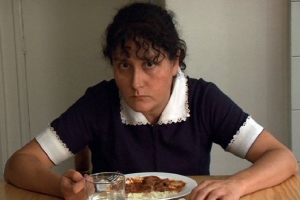 A sister film, in some ways, to Jonathan Demme’s brilliant Rachel Getting Married (2008), Sebastián Silva’s The Maid is nothing short of a spiritual revelation at the movies. What could have been an one-note leftist tirade about Chile’s class system is instead elevated into the realm of human where one facial twitch, one stretch of silence and one impulsive word can speak much more than any expository monologue or contrived subplot. There is no simplification of human behaviour here, no easily classifiable moral categories and no overarching statement to which truth is sacrificed. Nor does Silva suspend his study of the classes to observe his characters. He merely lets the obvious stay in the background. And just when you think that Silva’s vision of the world is getting all too romantic, he delivers a fatal blow to shatter your smugness – a single, deceptively simple shot during the final birthday party that masterfully sums up everything from the irreconcilable, repressed tension that exists between classes in capitalistic societies to our adaptability as humans to live peacefully with each other despite socio-economic disparities.
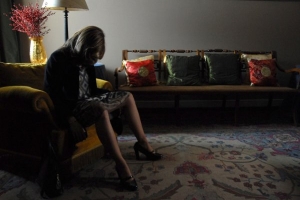 Rigorous but oh-so-tender, centenarian Manoel de Oliveira’s one-hour wonder Eccentricities of a Blonde-haired Girl is a film in one and a half acts. Oliveira translates the work of Eça de Queiroz to the screen, running the 19th century tale of romance through the current economic landscape and harnessing the resultant anachronism to paint an achingly beautiful picture about the inability to transcend class, escape reality and lose oneself in art. Despite its decidedly Brechtian and ceaselessly self reflexive nature, Oliveira’s film is rife with moments of poignancy and touches of humour. Using double, triple and quadruple framing and achieving a mise-en-abyme of art and reality, Oliveira writes a ruminative essay on the impossibility of art and reality to merge, the confusion that exists between them and the classism that exists within and with respect to art. Flooded with references to art and art forms, Eccentricities is such a dense and intricate fabric of the arts that even the past is treated in a detached manner like a piece of art, where each image looks like a painting, each sound feels like a melody and each movement cries out: “cinema!”.
 Of all the recent movies that have attempted to acknowledge dark chapters in national histories and advocated looking forward to the future instead of crying over what is lost, perhaps, none is as sober, ethical and uncompromising as Claudia Llosa’s Golden Bear winner. Llosa inherits her tale from the terrorist atrocities that plagued Peru two decades ago (Inheritance being the prime motif of the film) but, subsequently, discards every possible opportunity for sensationalism or propaganda. Tightly framing the lead character, Fausta (Magaly Solier), within and against claustrophobic structures, doorways, photographs, windows, paintings, mirrors and walls, gradually varying the depth of focus along the movie to detach the protagonist and integrate her with her surroundings and using extremely long shots to dwarf her in vast opens spaces of the tranquil town, Llosa concocts a film of utmost narrative austerity and aesthetic rigor. Punctuating and contrasting these downbeat images of Fausta’s life are slice-of-life sequences from the town depicting various wedding rituals and parties which tenderly highlight Peruvian people’s open-hearted embracing of capitalism and their resolve to come out of the trauma of the past and move on with life.
 If Inglourious Basterds was a coup from within the system, Jim Jarmusch’s The Limits of Control is an out-and-out war against the machine. The essential piece of cinema of resistance, The Limits of Control eschews simple genre classification and flips every ingredient of Hollywood’s conveyor belt products to surprise, appall, irritate and provoke us with each one of its moves. The complete absence of Jarmuschian brand of deadpan humour announces the film’s seriousness of intent. It is as if Jarmusch wants to establish once and for all that Hollywood does not equal American cinema and that the cinema that the former school marginalizes is truly alive and kicking. The Limits of Control is a film that can easily get on your nerves but, eventually, it succeeds in getting under your skin and evolving gradually to reveal how meticulously crafted it is. Using Cinematographer Christopher Doyle, production designer Eugenio Caballero and editor Jay Rabinowitz masterfully, Jarmusch creates a movie so meditative and relaxing that one feels exactly how William Blake (Johnny Depp) would have at the end of Dead Man (1995).
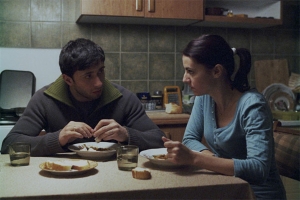 Porumboiu’s follow-up to one of the most hilarious comedies of the decade, 12:08 East of Bucharest (2006), is a companion of sorts to Jarmusch’s film not only in the sense that both of them negate the function of the genre they are supposed to belong to, by completely de-dramatizing their narratives, but also because Porumboiu’s film, too, is a conflict between two types of cinema – the cinema of analytical contemplation represented by the detective-protagonist of the film (Dragos Bucur) and the cinema of thoughtless action represented by his ready-for-ambush boss (Vlad Ivanov). However, more concretely, Police, Adjective is an examination of how our own political and social systems, partly due to the rigidity of our written languages, end up dominating us and how individual conscience and social anomalies are effaced clinically in order to have the bureaucratic clockwork running smoothly. Like Bucharest, Porumboiu, often self-reflexively, sketches the portrait of a bland and pacific city that tries to ape the far west and project itself as more dynamic than it actually is. The film’s disparate themes crystallize deliciously in the final, side-splitting, Tarantino-esque set piece where we witness the police chief urging his subordinates to act by the book, literally.
 Tetro is a beautiful film. Not just in the way it looks, but in the sheer romance it has for a lost world. The only worthy B&W film of this year out of the four I saw (the other three being Haneke’s
 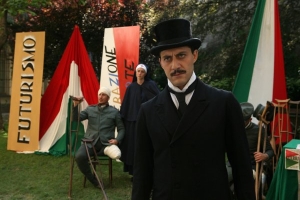 Writer-director Marco Bellocchio’s ballad, based on a nebulous part of fascist leader Benito Mussolini’s life, can teach those so-called historical dramas a thing or two about locating personal ideologies within collective history without being exploitative or pandering to pop demands. Bellocchio’s film is far from a detailed recreation of Mussolini’s political life. It is, in fact, a commentary upon such “detailed recreations” of history based on documents written by winners. Bellocchio’s formidable script and mise en scène keep probing and remarking upon the tendency of fascist systems to suppress histories – personal and national – and exploit popular media, especially the relatively young and emotionally powerful cinema, to blind people of truth and forge a faux reality – a theme underscored in Tarantino’s film too. What more? Bellocchio constructs the film exactly like one of those Soviet agitprop films – not by easy spoofing, but by retaining their spirit and rhythm – using rapid montage, expressionistic performances and operatic sounds. Be it common folk fighting in a cinema hall over a news reel or a bereaved mother breaking down during the screening of The Kid (1921), cinema registers its omnipresence and omnipotence in Bellocchio’s film.
 The perfect antidote to the summer blockbuster, Warwick Thornton’s Samson and Delilah is an extremely assured and undeniably moving piece of cinema that arrives, appositely, as the golden jubilee reboot to Herzog’s thematically kindred movie, Where the Green Ants Dream (1984). Cleverly relegating specific issues such as the Australian government’s intervention and relocation policies for the Aborigines to the background, Thornton frees his films of broad, propagandist political agendas, without ever making the film lack social exploration. With an extraordinary sound design, Thornton keeps the word count in the film to an absolute minimum, letting the stretches of silence shared by his lead characters speak for themselves. The film’s observations about banality of racism in contemporary Australia, exploitation of tribal art and its consequences, the effect of colonialism, especially due to Christian missionaries, on the Aboriginal culture and the ever growing chasm between the tribal and white life styles themselves are fittingly subordinated to the beautiful, unspoken love story that, essentially, forms the heart of the film.
 Let me dare to say this: Jacques Audiard’s A Prophet is either the most profound or the most pretentious movie of the year. For now, I choose the former. Audiard’s decidedly unflinching feature breaks free from the limitations of a generic prison drama and takes on multiple dimensions as the apolitical and irreligious protagonist of the film, Malik (played by Tahar Rahim), finds himself irreversibly entangled in ethnic gang wars within and outside the prison. A trenchant examination of religion as both a tool of oppression and a vehicle for political escalation, A Prophet is an audacious exploration of Muslim identity in the western world post-9/11. Although the plot developments may leave the viewer dizzy, it is easy to acknowledge how Audiard confronts the issues instead of working his way around it or making cheeky and superficial political statements. Strikingly juxtaposing and counterpointing Sufism and Darwinism in Malik’s search for identity, Audiard creates an immensely confident and nonjudgmental film that trusts its audience to work with the rich ambiguity it offers.

