All Posts


Bande À Part
(Band Of Outsiders)
1964

Godard proves that Breathless was not a fluke with his next film Band of Outsiders (1964). Band of Outsiders was the first Godard movie I saw and I had mixed reactions about it. And having watched quite a few of his films now, I understand that my perplexity was warranted in every way and that’s the way probably Godard would have wanted his audience to react. For sure, I will be revisiting it shortly and know for certain that I will gain more out of it now. Godard’s most lovingly directed work works on many levels and is perhaps his best take (or homage) on the genre.

Band Of Outsiders (1964)

Band Of Outsiders (1964)

I won’t be surprised if people rate it higher than Breathless for Band of Outsiders remains warmer and mellower today than at its time and would most probably elicit more “aaaws” than “huhs” unlike Breathless that still remains iconoclastic. A special mention for the DVD edition by Criterion – ranks among their best releases. Loaded with fantastic features including great interviews with Karina and Coutard, a gallery where Godard’s film is deconstructed stylishly and a short film Les Fiances du Pont Mac Donald (wanna bet Godard decided the title?) by Agnes Varda that is as charming as the main movie itself. A definitely great addition to your DVD collection.

With Band of Outsiders, Godard obtains a kind of inherent copyright for his work in the sense that a remake of the film is near impossible. Godard has already made a universally acceptable film with just the backdrop of Paris, literally. The gang of three is an anomaly in the relatively conservative city of Paris much like the Nouvelle Vague itself. The minute long silence (embodying Godard’s style of working), the impromptu dance (his theory of fluidity of the genre), the race through the L’ouvre (tribute to Truffaut’s Jules and Jim and a poke at the American cinema and its way of life) and the English class (well, er…, see for yourself) remain pieces of cinema to be cherished for ever. More than anything, the film is a celebration of unbridled youth, unsupervised freedom and unconventional cinema.

Le Mépris
(Contempt)
1963

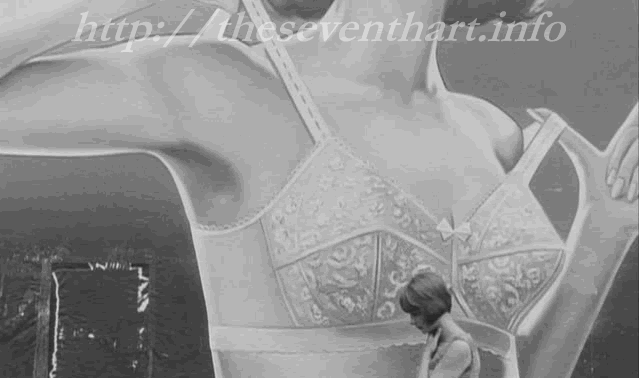
Godard does not keep films and life dissimilar. His films influence his life and his life influences his films. This is manifest to the maximum extent in Contempt (1963). Godard’s divorce with Anna Karina can be directly seen from the film as Godard retains even the lines spoken by Karina during the period. And it’s probably because of this intensely personal nature of the film that the film forms a perpetual conversation in any Godard discussion. And needless to say, Godard’s incessant love for cinema shows and he pays homage to his idols with references all the way – naturally, for the film is about the filmdom itself.

Contempt (1963)

Contempt (1963)

Godard’s immense control of the medium is at its peak perhaps in Contempt. Remarkable use of room space as Godard employs empty and decaying structures that mirror the central characters’ lives. The film works on multiple levels and this genuinely multi-layered attempt gets better on repeated viewings. At one of those levels, Godard captures what men and women expect from relationships. Paul follows Camille wherever she goes but only late. Here again, with extended shots, Godard uses the screen space so effectively that one gets the taste of what mise en scène really is, not to mention his singular use of red and blue to convey deeper meanings than meets the eye.

Watching the film, I was so much reminded of Federico Fellini‘s masterpiece 8½. Both films are made by geniuses of cinema in the most troubled phase of their lives. Both films feature artists having trouble making their films, primarily due to fractured personal lives. The central scene where Paul, dressed in a toga-like costume, trying to control his wife is so strikingly similar to the surreal scene in 8½ where Guido tames women while dressed in a toga!. Both are films about making of films that are the films themselves (think over that!). Also, both of them contain one of the best film openings and endings ever. Additionally, both are intensely personal films that get better with knowledge of the situations in which they were made. And the whacker of a trivia being that they were both made in the same year!… Wierd.

Les Carabiniers
(The Riflemen)
1963

Godard first real failure looks much funnier today than it would have been at its time. Perhaps because we have realized the futility of war or perhaps because we enjoy it more. Whatever the case, Godard’s light-hearted satire on war, cinema and society remains one of his most accessible films of his early years. The film follows two simpletons who are lured by the idea of unbound wealth and drafted to serve in the war. Sure enough, they fall for the trick and go places committing the entire sanctioned massacre according to their whims, only to become the victims in the end

The Riflemen (1963)

The Riflemen (1963)

Godard’s stand against commodification of life shows its clear roots in Les Carabiniers. Also, Godard’s concerns for the position of women in the society and in the way they are treated especially as portrayed by the cinema of the west is established in a very comical way. One of the lead character asks what all he can steal without punishment during a war and keeps going “Cars? Cigarette Lighters? Chocolates? Women? Diamonds? Casinos?…” . And there is this extremely extended scene where the men show their women hundreds and hundreds of photographs of various vehicles, places and animals (and women) from across the world one after the other. It feels like Godard is cherishing (or ridiculing) the idea that cinema is photographs in rapid succession.

Made in an oddly fascinating way, that is as Keatonesque as it is Godardian, the whole film feels like a warmly delivered tribute to the masters of the past especially the silent gems of the 20’s. In probably the funniest scene in the film, Michelangelo tries to get a follow a woman who goes off-screen to undress on screen and also tries to evade a train that seems to come towards him. Given that such incidents did take place after the Lumiére revolution, it is quite possible that Godard is portraying what may be the lost innocence of cinema.

Vivre Sa Vie: Film En Douze Tableaux
(My Life To Live)
1962

After three decidedly crazy ventures, Godard shuts the mouths of critics with his next film My Life to Live (1962). More sober than all of his previous ventures, Vivre Sa Vie follows the life of a wannabe-actress who takes up casual prostitution to make ends meet. With significantly long shots that are as intriguing as his jump cuts, Godard organically captures the quotidian and empty life of his protagonist. My Life to Live is probably one of the few Godard films to get universal acclaim. Supposedly one of the most distressing shoot for the crew, especially for Anna, because of Godard’s sporadic fits of anger and frustration.

My Life To Live (1962)

My Life To Live (1962)

The film is divided into 12 segments each of which consists of an encounter that Nana has with the people she meets. Godard employs a range of film techniques – Drama, cinema vérité, newsreel and documentary – without relinquishing the staple film references along the way. Probably the most famous scene in the film, Nana’s rendezvous with Dreyer’s hypnotic classic The Passion of Joan of Arc (1928) encompasses everything the film stands for. We see a shattered Nana breakdown at the trial of Joan of Arc as Godard replicates the extreme close-up, definitely as homage to Dreyer too, as if suggesting that Nana herself is like Joan of Arc – tried by the cruel society forcing her to recant her belief of a respectable life.

Godard studies his main character with religious focus. I don’t know what was running through his mind while filming Anna at various distances and angles, but I’m guessing that whatever is presented in the film is a manifestation of their personal relationship and how Godard perceived Karina. Godard’s fascination with prostitution begins here and would go on to take up multiple meanings in his future films, especially the political ones. And there is also the typically self-indulgent Godard’s philosophy that occupies a whole chapter towards the end of the film.

Une Femme Est Une Femme
(A Woman Is A Woman)
1961

Godard has a field day in A Woman is a Woman. What better genre to employ Godard’s influence of Brechtian theory than a musical! The sheer rhythm of the movie is enough to give it the instant classic status and the quirky humor just adds to the effect. More than being a novel attempt, the film seems like a celebration of the New Wave with references and homage to the biggies of the 50’s. And the wild child he is, Godard doesn’t miss out on opportunities to glorify himself too! (Émile says at one point, “I don’t know if this is a comedy or a tragedy, but it’s a masterpiece“)

A Woman Is A Woman (1961)

A Woman Is A Woman (1961)

The film flows like a dew drop on a leaf with each moment topping the previous. “Expect the unexpected” would make a great tagline for the film as Godard intentionally disorients us from any predictions. And the effect works for sure. We see Angela tossing up an omelet and gathering it after a small talk. She enters a magic chamber and gets her costume changed like that. Godard seems to elicit the craziness, or rather the magic of the medium employing such moments that not only break movie traditions as we know them but also add to the radiance of the film. Godard uses blue and red colours aptly but is nowhere close to what he would do with them in his later films.

Godard, at times, interrupts key conversations with sounds and at others, interrupts sound with conversations. So, one doesn’t follow the story line closely which is precisely what Godard wants. As a result, you can’t help but enjoy the individual and “present” moments of the film for what they are rather than connecting their relevance with the past or analyzing the direction towards the future. Anna Karina at her charming best and one can see why Godard was so smitten. It is a treat watching her dance and a restrained Belmondo accompanying her.

——————————–——–————————————

HAPPY BIRTHDAY MONSIEUR GODARD!

——————————–——————————————–

Le Petit Soldat
(The Little Soldier)
1960

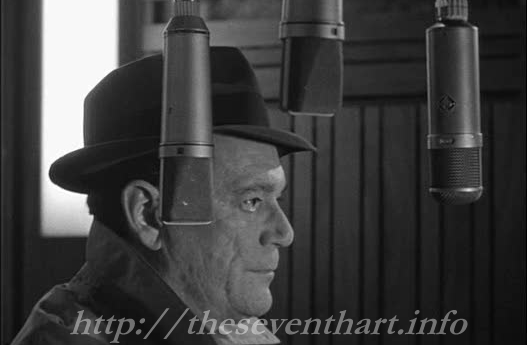
Godard ran into controversy with the very second film he made. Le Petit Soldat got banned for graphic depiction of torture of its protagonist by both parties involved in the war against colonialism. Though very mellow and even fantastic when viewed today, it would most definitely have raised a few eyebrows especially because of the cinéma vérité style the scenes adopt. And as an interesting point, for Godard, is that he surprisingly does not take a stand at all. His focus remains his central character whose freedom and happiness have become functions of factors beyond his control.

The Little Soldier (1959)

The Little Soldier (1960)

Though a typical Godard character, I felt like watching a Truffaut written one at times. A chap full of ironies. He says that he won’t describe his torture and follows it up by exactly that. He says he will not commit a murder and flips to the other side in no time. Michel Subor’s quirky portrayal goes down as another underrated performance in the director driven New Wave. The narrative’s fluidity and emphasis on the mundane stays intact and Godard seems to assert his control over the medium with ease as he happily weaves his ideologies in the form of daring monologues.

Le Petit Soldat remains Godard first and most superficially personal statement made on film. It is not incidental that Godard himself had a childhood that was divided between Switzerland and France like the little soldier. But the film is, more importantly, of interest for its romantic significance that would define Godard’s first phase of filmmaking. Godard employs Anna Karina in the lead role for the first time and Coutard’s camera seems like Godard’s own eyes, never once stepping off her in the photo-shoot scene. According to fellow technicians, there was clearly a chemistry developing between them from the first few days of shoot. Godard’s least talked about film of his early years retains its power to charm.

À Bout De Souffle
(Breathless)
1959

Start of Breathless – End of Cinema. Infinity has been written about the film and any further writing on the film is just a formality – a formality that every film buff must perform. At a time when Alain Resnais had made the intense drama Hiroshima, Mon Amour (1959) and when Truffaut was riding high on the success of The 400 Blows (1959), fellow Cahiers du Cinéma critic Jean-Luc Godard hit the filmmaking world with Breathless.

Breathless (1959)

Breathless (1959)

The story is as simple as it gets, which is perfect for Godard’s loosely but meticulously constructed style. A man on the run, a woman on the road, a kiss before death. It is near impossible to tell anything about the film without romanticizing it. Godard’s love for cinema shows in every moment of the film as he places charming cameos of fellow New Wave filmmakers here and there. Jean-Paul Belmondo is an instant hit with his Bogart-loving borderline-misogynistic attitude and it is no surprise that he went on to become one of the most famous French actors ever. And poor Coutard’s groundbreaking techniques are overloaded to the point of nausea nowadays. And Godard’s own contribution lies in his avoidance of being analyzed by traditional methods of film criticism as he reconstructs film grammar using the alphabets created by his own predecessors. No wonder he said retorted “Yes, A film must have a starting middle and an end, but not necessarily in that order”. He, in effect, disorients traditionally trained minds by speaking in a commonplace oral language, but in an entirely different cinematic one.

I wouldn’t hesitate to say that Breathless is the coolest thing that ever happened to cinema. And most wouldn’t deny. But that isn’t what it is all about. It revolutionized the way movies were made and more importantly, the way movies were watched. Things that we now take for granted in films – the outdoor shoot, the jump cuts (incidentally begot by a runtime crisis), the fluidity of narrative and the hand held camera work – show their roots in Breathless. No one makes movies like them any more and any close attempts seem like nothing more than cheeky use of camera and scissors. To plagiarize a quote on The Lord of the Rings book, “The movie-watching world is divided into two – ones that have seen Breathless and the ones yet to see them.”

31 Days of Godard

31 Days of Godard

It’s December and guess who’s birthday’s around. Yes, you guessed it right. Jean-Luc Godard! Being a fellow Saggitarius, I am honoured to try out the next marathon of the blog – For Ever Godard. Through it, I will be trying to write on 31 films of Godard – one for each day of December, the birth month of the director. With next month going to be the most hectic month of my “other” life, it is going to be a real challenge to update the blog daily. Let’s see where it goes…

The intention of these posts remains simple – Learning about Godard’s work never stops for me and I would like to convert this opportunity into a venture for knowing the man and his work – for it is evident that knowing the master’s films definitely requires good knowledge about Godard himself. I would also like to briefly tell what I got from each of the film that will be presented here. I hope this one is a fairly interactive one.

Love,

Le Petit Soldat

Ratatouille (2007)
English
Brad Bird, Jan Pinkava

It doesn’t take a genius to figure out that Pixar is the king of the animation industry in Hollywood. Right from its first full length feature Toy Story (1995), Pixar has almost single-handedly charted out the roadmap for the industry and has inspired hundreds to take up a profession in the field of animation. Its movies have been universally identified as witty, funny, amazingly detailed and ultimate fun. But it is the final sequence of Ratatouille that takes them onto a whole new level.

The scene I’m talking about begins just after the hilarious moment where the notorious food critic Anton Ego is reminded of his mother’s cooking right after he tastes the little chef’s masterpiece – Ratatouille. He walks off from the restaurant and delivers a monologue (narrated by the formidable voice of Peter O’Toole) that may just be Pixar’s best piece of writing ever. Here is the transcript followed by the scene itself.

In many ways, the work of a critic is easy. We risk very little yet enjoy a position over those who offer up their work and their selves to our judgment. We thrive on negative criticism, which is fun to write and to read. But the bitter truth we critics must face, is that in the grand scheme of things, the average piece of junk is more meaningful than our criticism designating it so. But there are times when a critic truly risks something, and that is in the discovery and defense of the new. The world is often unkind to new talent, new creations, the new needs friends. Last night, I experienced something new, an extraordinary meal from a singularly unexpected source. To say that both the meal and its maker have challenged my preconceptions about fine cooking is a gross understatement. They have rocked me to my core. In the past, I have made no secret of my disdain for Chef Gusteau’s famous motto: Anyone can cook. But I realize, only now do I truly understand what he meant. Not everyone can become a great artist, but a great artist can come from anywhere. It is difficult to imagine more humble origins than those of the genius now cooking at Gusteau’s, who is, in this critic’s opinion, nothing less than the finest chef in France. I will be returning to Gusteau’s soon, hungry for more.

What Anton says about food criticism is so applicable to film criticism and art criticism, in general.  Anton beautifully expresses how critics assume attitudes and turn down lifelong dreams with the scribble of a pen. He learns to acknowledge the effort behind every piece of work – both the inspiring and the insipid – and learns, in his own words, not everyone can become a great artist, but a great artist can come from anywhere. He learns to enjoy first and judge later, be open to novelty and ultimately accept every piece of work as it is. And finally when Linguni asks what Anton would like for dinner, the latter glances at Remy and says “Surprise me”. And that is exactly what critics like Roger Ebert seem to be doing – basking in the sheer joy of cinema.

Berlin Alexanderplatz (1980)
Rainer Werner Fassbinder
German

“A chicken consists of the outside and the inside. Remove the outside, and the inside remains. Remove the inside, and the soul remains.”

Berlin Alexanderplatz

The prolific career of German wunderkind Rainer Werner Fassbinder has been marked by decidedly minimal and vital films that have almost single-handedly defined German cinema during that period, with no credits taken away from Schlöndorff and Herzog. His mastery over the melodrama genre and understanding of the medium have consistently placed him at par with world cinema giants. But Berlin Alexanderplatz (1980) forms the core of his cinematic achievements with the sheer length of the film capable of accommodating ten of his other films. Pulling off a film with a mammoth runtime of 931 minutes by itself is a landmark that only a few gifted souls can dream of.

Adapted from Alfred Doblin’s novel of the same name, Berlin Alexanderplatz was originally made as a 14 part television mini-series but is widely accepted as a monolithic piece. The film follows the life of Franz Biberkopf (played to perfection by Gunter Lamprecht), a visibly tormented man, right after he steps out from Tegel prison after serving for four long years. He tries gradually to return to normal life and meets his old acquaintances in the process. He is determined to turn over a new leaf and sets a strict moral code for himself that forbids him from taking to violence in even the most testing of times. He attempts to get a permanent and legal job but the city turns him down because of the prevalent social, political and economic conditions. He sells sleazy magazines, takes in women and dumps them later and takes up a fake political stand in order to earn but strictly adheres to his questionable code of conduct. His policy gains him more foes than friends and he is soon left with one arm amputated. In these testing times, his source of support comes from the various women he takes into his house. They are strangely attracted to him and believe Franz can really give a reboot to everything. He takes to alcoholism and casts off his policies. He continues to exist.

One will be tempted to think in the first scene as Biberkopf steps out of the jail that Fassbinder is going to show us what the cruel city is going to mete out to him and its consequences on his life. But Fassbinder adopts a totally different path. It isn’t the city that has brought Biberkopf to where he is, but his personal policies and principles that have got the better of him and have made him virtually devoid of any firm footing in life. Biberkopf is neither able to adopt himself to the changing times and its corruption of daily life nor is he able to fight it out in order to stay true to his resolution. As a result, he remains willingly passive to all the changes around him and hence becomes a victim of these very changes. He shuts himself from the world and immerses himself in excessive alcohol helplessly observing the world as it moves past him.

I’ve not read Alfred Doblin’s novel but Fassbinder’s visual version reminds me of Dostoyevsky’s Crime and Punishment. Both are set in tumultuous times where revolution is but evident and follow a simple individual battling his own troubles that are near independent of the socio-political conditions. Crime and Punishment is set when socialism was to take over the Russian elite administration whereas Berlin Alexanderplatz is set when “Fascism” was to oust the Socialistic regime in Germany. Both Raskolnikov and Biberkopf are individuals who have set high moral standards for themselves and get into deeper morass just because of that. Raskolnikov’s resolution is of utmost purity that he sticks to till the very end. On the other hand, Biberkopf’s fickle resolve is a product of his fear and is broken even before halfway. Also, Raskolnikov’s character is a mystery that grows more so as we progress whereas Fassbinder strips Biberkopf off all symptoms of a complex personality and leaves him as unsophisticated as an infant.

With such a huge runtime, one would naturally expect a meticulously etched character arc that takes a remorseful soul such as Franz Biberkopf and gradually portrays his transformation and ultimate attainment of redemption. Fassbinder, or perhaps Doblin, exactly shatters that presumption. Fassbinder carefully intersperses Biberkopf’s present with his moment of sin at multiple places. At one point in the film you feel bad for what the city has done to the man and appreciate his yearning for transformation and his mettle to put up with all this mess. In another, you loathe him for his reversion to crime and his attitude of acting upon impulses. This way, Biberkopf naturally becomes a multi-dimensional character and ultimately we come to know that he is as ordinary as a man can be with his own ideas of morality, with his own earthy human instincts and with his own set of flaws.

The two most critical factors for sustaining the film’s atmosphere are evidently its cinematography and production design. Xaver Schwarzenberger replaces long time collaborator Michael Ballhaus and does an equally impressive job. His organic camera movement sometimes cowers behind obstructions and at other times, accosts the characters aptly reflecting the mood of the scene. The masterful cinematography is enhanced by the haunting score by Fassbinder regular Peer Raben whose theme track is the X-factor the epic needed for its melodramatic completeness. For most part of the film, Fassbinder uses a brown tinge for his images which are supported by the excessive yellow lighting that provide the images the melodramatic quality it requires. Schwarzenberger employs the lens flare to the maximum extent with even the pupils of the characters looking like micro light sources. As a result, each image looks like an impressionist painting and the quality of the production shows in each frame.

The most and perhaps the only debated aspect of the film is its out and out surreal epilogue that sums up Fassbinder’s understanding of Doblin’s novel. Fassbinder sheds reality and shows us Biberkopf’s tour of the limbo using the most bizarre of images that include a torture factory and a human slaughterhouse. It is this chapter that will either increase the vitality of the film manifold or will pull it down to a wasted effort depending on your inclination to accept it as it is. We interestingly see Biberkopf being crucified with all his kith praying before him. Indeed, Biberkopf is like the messiah himself but his suffering has brought more sorrow to others than salvation. The epilogue by itself can concoct a full length film that forms an intensely personal chapter in Fassbinder’s life.

Berlin Alexanderplatz forms the central showpiece in Fassbinder’s glorious career. It effortlessly obscures his other brilliant films and perhaps even sums up his whole style of working. Performances of a lifetime, brilliant direction, gorgeous camera work and a memorable score are but some of the reasons that the film is of perpetual interest. Agreed that it is depressing and unconventionally uninspiring but that is precisely the reason why it must be seen. Till date it remains the best representation of an ordinary life of an ordinary person entangled in extraordinary situations.

« Previous PageNext Page »