All Posts


Vanaja (2006)
Rajnesh Domalpalli
Telugu

“Can you believe it? Your own mother used you. Disgusting. ”

Vanaja

Browsing through Rajnesh Domalpalli’s cine résumé, we see more than two dozen awards from various film festivals across the world, against just one film. The sole bullet point in his filmography reads Vanaja (2006), a quiet little film that has conquered its own domain, won its own set of hearts with its sheer brilliance in thematic and visual execution and perhaps gained an entry to the list of best films of that year.

Vanaja opens with a Pulp Fiction like definition of its title – “(a) Water Lily (b) Wild at Heart | Sludge Born, Struggling | Rising | You Bloom So True”. And that is what the screenplay reveals as it measuredly blooms out. Vanaja is a girl untethered by the notions of class, caste, gender and age. Though it shouldn’t be said that she shoots her mouth off, she does express herself firmly when required and restrains herself when it is not. Born in a fisherman family, Vanaja (Mamatha Bhukya) loses her mother at a very young age and her only memory of her mother remains not so sweet. We come to know from the first minute that she loves dance and it is the only driving force to her otherwise ordinary (and even depressive) life.

She agrees to work as a maid at the village head’s house where she wins a chance to learn Kuchipudi. She shines, needless to say, and hopes to make it big one day. All is well until the village head’s son returns from the US for contesting in a local election. He is quick to take advantage of Vanaja’s sexual awakening and vulnerability and she becomes pregnant. After evading the criticizing eyes of the society, Vanaja gives birth to a boy who is immediately given shelter at the village head’s house where Vanaja’s father is forced to relinquish claims on the boy. However, Vanaja’s interest in dance never wanes and she continues to learn, while acting as a nanny to her own son. Troubles increase for her when her father dies of drinking and she is left helpless.

The film is probably summed up in the fleeting dream that Vanaja has towards the end of the movie in which her father is buried neck deep in sand as she tries to free him. However, she is being pulled by the local brats using a fishing net as the village head and her son try to put a garland around her neck while glorifying his political victory. This is the point where Domalpalli surreally stresses on the caste system that plagues the nation. Ironically, it is the same diversity (that makes the country so wholesome and tolerant) that plagues it with ideas of caste system and social superiority. Neither is the so-called upper caste able to accept her with open arms because of her assigned caste, nor is Vanaja free to follow her dreams owing to the society that pulls her down time and again.

I am tempted to compare the film with another collaborative effort that released three years before this film – Manish Jha’s Matrubhoomi: A Nation without Women (2003) – for both are independent ventures that deal with exploitation of women in the arcane hinterlands of the country where women are apparently sacred. But what the latter venture shows us in a somber and positively depressing tone, Vanaja does in a very light and easy atmosphere. It is easy to note Domalpalli’s striking and daring use of colours that almost exhaust the visible spectrum. The wildness of Vanaja’s heart seems to be reflected in this fascinating colour festival.

Also worth contrasting with Vanaja is Jason Reitman’s Juno (2007). Both the films deal with similar issues of teen pregnancy and their responsibilities and morals, but are poles apart in their execution and are so culturally unique. True that neither Juno nor Vanaja knows the graveness of the act they are going to commit by relinquishing their claim on the child, but where Vanaja stands apart is the fact that her situation is a function of the uncontrollable factors that include the caste system and the servile mentality of the village’s residents. Juno, on the other hand, is solely responsible for her action and plight that she gladly accepts and so do her parents and the society, and this makes Vanaja’s situation all the more shattering.

Having said that, it is remarkable that Domalpalli never begs for sympathy for Vanaja. It was so easy for him to tilt the audience’s support towards her but he never does that. Even more striking is that he doesn’t even appeal for antipathy towards any of the other characters. The complete absence of a soundtrack reinforces Domalpalli’s stand in handling his characters. The primary reason for this neutrality arises from the grey characters that Domalpalli has meticulously sketched. He never typecasts any of them and [deliberately] draws out the multi-dimensional nature within each character, thereby leaving the audience assessing their various actions and not the characters as a whole. Viewed with any fixed set of morals, all characters appear equally sympathetic and flawed.

Clearly, dance is a vital part in the narrative and Domalpalli employs stretches of complete dance sequences that highlight Vanaja’s state of mind. The songs move from Radha’s pining for Krishna’s attention to the slaying of the demon Mahishasura. It is also interesting to note that Vanaja never goes down after the child birth. All she wants is to take care of her child as its mother and continue her strides in dance. But once she takes her final beating when none of her old friend Radhamma’s predictions come true, she slays her inner demon of servility and moves towards true independence – one that has been hard fought and has demanded a larger than life sacrifice. Discussing the morality of Vanaja’s decisions are out of the scope of this article for it requires more than a knowledge of two hours, but what is sure is that these are choices of immense practicality and rationality.

It will be a crime if I don’t mention the stellar performance of Mamatha Bhukya who can teach any so-called-veteran mainstream actresses a thing or two. Independent films usually suffer from bad non-professional performances but it his essentially Bhukya’s work that takes the film out of that pitfall and elevates it into extraordinary levels. Now, here is a killer of a trivia – Vanaja was made as the final project to a master’s degree in film studies at the Columbia University! And perhaps this is the reason, Vanaja could not make it into the Oscar race (not that the selection panel passes only great films!). If this is the kind of cinema that we get from a student, I am thrilled to imagine what we can expect of him when he is an established filmmaker. Perhaps Domalpalli is the Indian reply to Florian Donnersmarck.


Of Interconnected Lives

Of Interconnected Lives

Every now and then, when people start saying “Indie is dead”, there comes a filmmaker, who contradicts them and redefines the course of cinema – both mainstream and parallel. John Cassavetes had ridiculed the American mainstream cinema and its incessant thriving on extravagance with his Shadows (1959) and went on to become one of the pioneers of American underground cinema. Cut to the 1980’s when gangsters were ruling Hollywood. Enter Jim Jarmusch with the short film Stranger Than Paradise (1982) which humiliated Hollywood with its normal characters and simple situations. Independent cinema was never the same again.

One can easily note that Jarmusch makes films about people. He films their lives, how they are inevitably interconnected, how their lives get impacted due to others’ all the time and how characters interchange characteristics and opinions all through their lives. What Alejandro González Iñárritu does with the most extravagant and devastating of situations, Jarmusch does using the most banal of happenings, most of them as simple as coffee table conversations and cab rides. Like Godard and Cassavetes, Jarmusch films life’s most normal moments that usually occur in between events. What the mainstream considers implicit and skips with an ellipsis, Jarmusch considers central and interesting. Indeed, his theory that the most fascinating things arise out of the most mundane events proves bang on when one watches even one of his films. The apathetic characters, their interaction (sometimes, the lack of it) and their idiosyncrasies concoct a truly riveting picture of human life.

Jarmusch puts forth his ideas right from his first film Permanent Vacation (1980) which follows the life of Aloysious Parker, a youth without a grip on life. He has lost his father and has an institutionalized mother. Afraid of being sucked into the quagmire of everyday struggle and a textbook life, he does everything in order create an atmosphere of restlessness that mirrors his own inner emotions. This is effectively put forth in the first scene where he starts an impromptu dance in the middle of a serious conversation  He interacts with various kinds of people (including a Parisian lad just like him) on his way and hears the most bizarre yet fascinating stories. Possibly the only “self-indulgent” film by Jarmusch, Permanent Vacation still resonates for its handling of a theme most popular among the youth of that time – the quest for meaning of life.  Jarmusch’s style shows its roots with its long takes and minimal speech placed over pedestrian events.

Jarmusch’s characters come as stark contrast to the ones that occur in conventional scripts. The latter are first provided a major objective that they achieve at the end of the film. The characters are then expanded and given minor objectives that they complete within each scene or sequence in order to achieve the major one. Jarmusch’s characters, on the other hand, do not possess permanent or long term objectives. They set out on of-the-moment objectives and act on impulses that may or may not be justified by their milieu. They live life as if it were not under their control. This unpredictability is another ingredient that makes Jarmuschian so unique and off the beaten track.

Stranger Than Paradise was extended into a full length film of the same name in 1984 and followed the American way of living of a young man from Hungary, his American friend and his teenage cousin who has just arrived from Hungary. The three of them spend some time in Florida where they lose all their money in a dog race and gain it back in another. Any other director would have made the race and its denouement as the central event driving the lives of the three. But Jarmusch keeps the race off screen and thrives on the petty talk and arguments of the friends with long, single shot scenes. In another similar scene at a cinema hall, the camera focuses on the characters’ faces as they watch an action film, instead of the screen. Amazingly, these usually-hidden images feel more absorbing than their driving events themselves and one feels the immediate power of the mundane that Jarmusch captures effectively.

Another intriguing aspect of Jarmusch’s style is that he loves characters that exist outside the framework of the social world. He takes up people who are outcast, outlawed and totally alien to the environment they are living in. They appear usually as foreigners, convicts and disoriented individuals. These characters seem to be anomalies in the society and their high reactivity towards their amicable yet strange world churns out the most amusing moments. These marginal characters are often filmed along the edges of the frame highlighting that they are out-of-place yet always in the picture. Although Stranger Than Paradise and Permanent Vacation had put that into execution, it was Down By Law (1986) that would take it one step further.

Down By Law follows the life of three convicts who have been framed for all the wrong reasons. They plan a simple escape technique and succeed. But what is more difficult is finding civilization after they have broken out. Typical Jarmuschian characters, they don’t seem to have any aim in life. They live for the moment and leave it to time to decide their future course. Roberto Benigni has an uncanny ability to induce energy into any kind of situations and he tops himself in this film. Again, Jarmusch keeps the escape off screen and makes the characters take the podium. Down By Law is beautifully shot in black and white by Jarmusch regular Robby Müller and out of this seemingly bland monochrome arises a stream of energy that couples itself with the amusing journey of the trio and provides such a colour to the film that no colour film could have provided.

Mystery Train (1989) would take the idea to the extreme as Jarmusch follows the lives of three sets of people staying in adjacent rooms in a hotel in Memphis – A pair of Japanese teenagers who have come to see their music idols’ starting places, a naïve Italian lady who is forced to share a room with a loquacious woman after her flight is delayed, and three natives who have committed a crime out of control.  These three situations are visibly so disparate if not for Jarmusch who starts his game of connecting the dots. He places a talkative character and a totally opposite one in each set and once again reminds us of the universality of emotions and dependence of lives. To top this, he places the soul of the city, Elvis Presley, in all their lives as they reflect upon their opinions on the legend.

Jarmusch would expand his integration of world culture in Night on Earth (1991) that documents the lives of five taxi drivers for a period of half an hour each spanning 5 different nations, languages, mentalities and emotions. With each episode lasting hardly twenty five minutes, Jarmusch examines how life offers different choices based on trivial interactions and how distinct yet similar each of their lives are. Once again, Jarmusch employs people out of the ordinary – foreigners, physically challenged, mentally challenged and the seemingly normal. He shatters our prejudices and questions the notions of sympathy and happiness using the tritest conversations. Almost the whole of the film is inside vehicles but the film never once feels claustrophobic or overly long.

It is not only in the characters that Jarmusch captures the spirit of the era, but also in the settings and locales where he places his quirky characters. Almost all of his films are shot in shot in warm little towns in the USA and the quiet neighbourhood is invariably captured by a tracking shot, perhaps his favorite, which reveals the shops, houses, people and atmosphere of the area instantly. Additionally, Jarmusch uses the mellowest of sounds in his soundtrack prominently featuring R&B, jazz and rap that typifies the locales and age in which the film is made. Needless to say, these sounds blend with the deliberately paced imagery to produce the apt atmosphere for the characters to develop.

The tracking shot features strikingly in Jarmusch’s next and most popular film Dead Man (1995) that employs all of Jarmusch’s themes but transcends into a whole new dimension and takes metaphysical meanings. Johnny Depp plays William Blake who has come into a weird little town called Machine and soon gets outlawed for murder. He meets Nobody (Gary Farmer), another pariah who seems to believe that Depp is indeed the reincarnated version of the late English poet and gets him out of the limbo that he is stuck in, the one between the hell called Machine where bigoted “philistines“ chase foreigners away and the heaven called death. Although set in a remote time and age, Dead Man’s characters still have all the characteristics as those of other Jarmusch’s. Both Blake and Nobody are outcast characters that meet up to produce engrossing results. They do not know what each other is saying but still entertain each other.

Similar themes and style is carried onto his next film Ghost Dog: The Way of the Samurai (1999) that follows the life of a modern samurai/hit man Ghost Dog played by Forest Whitaker. He reads ancient Japanese text and lives by the samurai code of honour. He speaks sparsely and his only friends seem to be the little girl with whom he discusses books and the Haitian ice-cream vendor Raymond who can only speak French. Ghost Dog may first seem like an atypical Jarmusch film for it is more narrative-driven than any of his previous films. But Ghost Dog himself is very much like his predecessors created by Jarmusch. He too is a man without a worry for the future who lives for the moment, for the book says so. Like Nobody and Blake of Dead Man, Ghost Dog and Raymond do not understand each other a bit, but still are the best of friends and lick their ice creams over one way conversations.

Interestingly, his most trashed film Coffee and Cigarettes (2003) forms the central point of exhibition of most of Jarmusch’s themes. Made from discrete pieces of shorts that Jarmusch had made as early as 1986, Coffee and Cigarettes comes as a collection of vignettes each involving not more than three people over a cup of coffee and a pack of cigarettes. The black coffee is accompanied with the white cigarettes placed on the alternating black and white pattern on the tablecloths. These adversarial colours are woven together with the gray of the cinematography. Similar to the colours, these seemingly contrasting and independent people’s lives seem connected and influenced forever by the petty conversations over the coffee table that they indulge in.

Consider the sweeping first segment of the film called “Strange to meet you” where Roberto Benigni meets Steven Wright. Wright tells Benigni that he has to rush as he has an appointment with a dentist. But he does not want to go. Benigni tells him that he has got a toothache and he can go instead. So Wright gives him the address and Benigni hurries off informing Wright that he has an appointment with a dentist and has to rush. And that’s it – two lives have interchanged just like that! Not only within segments, but even across segments, Jarmusch ties his theory of interconnected lives and questions the episodic nature of the film.

Jarmusch arguably reaches the peak of his creative prowess in Broken Flowers (2005). Bill Murray (magnificently) plays Don Johnston (with a‘t’!), a quintessential Jarmuschian character with total passivity to the world around. He lives life for the sake of living and his wife jilts him for the same. One great day, he receives a letter from supposedly one of his old flames about his son that he never knew about. He does not care, but upon a nudge from his nosey spy/neighbour, he goes on a trip to find out who had sent the mail, but only as a perfunctory activity. Nothing much happens but at the end of the film he feels an urge to find out the identity of his true son. Jarmusch does the unthinkable here by pushing the inert Jarmuschian character into the clockwork of the daily world and providing him a direction in life. The camera fades to black as the hitherto impassive Johnston shows traces of emotional fatigue.

Some may consider it a running gag that Jarmusch loves, but most of his films have some kind of strange entity running through them like a mysterious train. Dead Man had the tobacco gag, Mystery Train had Elvis Presley and the number 22, Broken Flowers had the Don Johnston confusion and Ghost Dog: The Way of the Samurai had the cartoons. In Coffee and Cigarettes many character across various segments utter the same line to our amusement. “Nikola Tesla perceived the earth to be a conductor of acoustical resonance” they say and that is exactly what Jarmusch emphasizes. Not only do the characters seem connected by the strange statement, but the earth itself seems to conduct their thoughts and acts, stressing on the continuous interaction of lives and characters, independent of geography.

Fascinatingly, this kind of integrating thread that Jarmusch weaves runs across multiple films and even more bafflingly, in his life itself. For instance, the heavily accented Benigni in Down by Law tells his cell mates that he had killed a man with a number 8 snooker ball and we see the equally crazy Benigni with the same accent in Night on Earth where he is using a number 8 snooker ball as the head of the gear of his vehicle! Broken Flowers has Bill Murray asking for only coffee whereas the same Murray had played the coffee addict in Coffee and Cigarettes. The Elvis Presley mystery carries over form Mystery Train into Coffee and Cigarettes. And the Nobody character from Dead Man appears in Ghost Dog: The Way of the Samurai too.

Ghost Dog: The Way of the Samurai and Jean-Pierre Melville’s Le Samourai (1967) bear one such remarkable relationship between them. Both films deal with men, assassins to be precise, who live the life of samurais, but in cities. They are loners and adhere to the moral code defined by the book of samurai. When Melville approached Alain Delon for the lead role, he found out that Delon was immensely into Japanese culture and had his bedroom decorated with antiques related to Samurai Culture. Similarly, when Jarmusch approached Forest Whitaker for the role, he discovered that Whitaker was very much interested in the Eastern culture and martial arts! Now that’s what I call interconnected lives!

Self-indulgence or Sheer Elegance?

Self-indulgence or Sheer Elegance?

Independent cinema has always been the unsung power behind the ever changing face of cinema. Every time the industry feels stale with the flood of “formula” films, some gifted soul pulls off something extraordinary that keeps the river flowing. Although these films polarize the film goers into love-hate relationships on their arrival, looking back at them years later reveals their vitality and contribution to the present state of affairs. However, ones who fall into either the love or hate category seem to perpetually remain in their domain and seldom find themselves feel otherwise.

The year was 1959. And an utterly low key film without any particular banner associated with had released. It was director by a relatively new actor in the industry. 50 years later, the film continues to amaze and charm audiences with the same power as it did at that time.  The actor was John Cassavetes and the film, Shadows. Months later, came Jean Luc Godard’s similar structured film Breathless (1960). Celebrated as the renaissance of cinema, Godard’s piece was an instant entrant into film school lessons.

Like the independent invention of calculus by Newton and Leibnitz, both Godard and Cassavetes had simultaneously come up with something peculiar, something hitherto unseen, something so fluid in its execution and hence something great. Both Godard’s and Cassavetes pieces have become chapters in film history. And when one watches Shadows, one is reminded of its concomitant film . However, the similarity ends here and the directors went in different directions.  Godard continued to amaze the world with his flashy cuts and out-of-the-blue petty events whereas Cassavetes went on with his improvisational style and serious notes, though their attention towards the relatively banal moments of life persisted. However, Godard was relatively more successful with the critics with his films than Cassavetes who was panned regularly and labeled “self-indulgent”.

Here is a sampling of critic-historian Leonard Maltin’s reviews of Cassavetes films:

  • “Cassavetes aficionados will probably like it; for others only marginally bearable.” (Love Streams)
  • “Strange, self-indulgent (even for Cassavetes) home movie” (Killing of a Chinese Bookie)
  • “Typically overlong, over-indulgent Cassavetes film” (A Woman under The Influence)
  • “…plagued by Cassavetes’ habitual self-indulgence.” (Husbands)
  • “Fascinating if you appreciate Cassavetes’ style, interminable if you don’t.” (Opening Night)

That brings us to the question: What is self- indulgence? For some, it is the thin line that separates La Dolce Vita from . And like the latter, Cassavetes’ audience is also split into ones who love his films and those who despise them. Films, and art in general, has always been about how the artist views the world he (or she) lives in (and sometimes about the world only he lives in), his choice of the medium he wishes to express his ideas in and how well he has been able to translate it onto the medium he works. On the other hand, appreciation of the film depends on how much the viewer accepts (not necessarily empathizes with) the world that is synthesized based on the whims of one person alone. And more comfortable the viewer feels in the director’s vision, louder is the viewer’s applause for it. Hence, the question whether a work is self-indulgent or not is strictly a matter of experience, social conditions and the era in which the film is watched. Having said that, Cassavetes films have definitely got more acceptance now than at their release and his work is getting universally recognized as one of the truest portrayal of the American society.

Shadows provides the perfect launch pad to get acquainted with Cassavetes’ style. It is often called an improvisation film and misunderstood that the whole plot was played out as the shooting went on. But, as with all of Cassavetes’ films, he wrote the plot, rehearsed it but let the characters cook up their emotions based on the events as the film was being shot. Hence the improvisation part sustains as far as the reactions are concerned not the actions. And this improvisation is what provides Cassavetes’ films their fluidity, credibility and unfortunately the tag of self-indulgence.

Take for instance, Husbands (1970), the most “self-indulgent” of all Cassavetes in my opinion. Three married friends are shattered by their pal’s death and lose faith in life and the meaning of it. They get away to a foreign country without their wives’ knowledge and engage in debauchery and lots of pointless chatter. This is where Cassavetes’ improvisational style seems to make the difference. He lets his on-the-verge-of-a-nervous-breakdown trio, played by the formidable threesome of Ben Gazzara, Peter Falk and Cassavetes himself, shape up the moments on their own. As a result their idle talk and unwarranted activities seem no more than acts of drunken revelry and are hence forgettable.

This is in stark contrast with the situation in Faces (1968), considered his masterpiece by some. The notable early scene where John Marley and Lynn Carlin talk over the dinner table about their friends and the one where Marley and Gena Rowlands meet for the first time serve as the contrasting points. The situation is all jocular and the humour that it exudes is natural all the way. Everyone must have experienced such simple, magical moments and one loses any hostility and gets involved in the merriment. Contrary to this is Husbands whose primary premise alienates you from any significant experience and makes you question the leads’ motivations and actions. As a result you feel that Cassavetes is trying to universalize something very unique to him suiting his tastes.

Even the most riveting of all Cassavetes films, A Woman Under The Influence (1974), is called self-indulgent by many. With one of the best pair of performances that can challenge the Josephson-Ullmann duo of Scenes From A Marriage (1973) or the Hoffman-Streep duo from Kramer Vs. Kramer (1979), A Woman Under The Influence carves out one of the best portraits of the working-class immigrant family in America. The film might have well been called A Man Under The Influence for it is not only Gena Rowlands who is crumbling under her syndrome, but also Peter Falk, who is trying to establish respectability among  the small section of his Italian friends and struggles to juggle the love for his wife and his yearning for honour among his friends. Again, perhaps, because of the bizarreness of the plot or because of the actions of the leads (In one notable scene, Falk allows his kids to booze), the ones not acquainted (and some who are) feel the film is drenched in Cassavetes’ perspective alone.

However, it is surprising to see even Opening Night, probably his most accessible film, being condemned. Opening Night, my favorite Cassavetes, follows the life of stage actress Rowlands and her inability to accept her aging and lost opportunities. It has the quintessential ingredients of a Cassavetes film – the constrained relationship with her husband Cassavetes (who happens to be her real life husband as well), a yearning to re-enter youth and the gravity of loneliness. The stage plays within the film play as vital a part as the plot itself just like later films such as Truffaut’s The Last Metro (1980) and Almodovar’s All About My Mother (1998) (Both of which are unanimously appreciated, though deservedly so). Long and testing agreed, it is still puzzling to see why such a character oriented film fell on the “other side of the line”.

Interestingly, some of his other works that are made in the same tradition as above films are accepted with open arms. Minnie And Moskowitz (1971) opens up to the audience like a regular Cassavetes film as far as his techniques are concerned – the extreme close-ups, the harsh city noise and between-the-crowd cameras et al. However, instead of a marital pair that starts out happy and gradually disintegrates – perhaps Cassavetes’ favorite theme – Minnie and Moskowitz plays as a romantic comedy with the ruffian Seymour Cassel and Gena Rowlands in search of love. Though Cassavetes yet again allows his cast to improvise upon the situations, they are pretty much within the “predictable” context and norms of a rom-com. Hence instead of being called a self-indulgent film, it was hailed as a quirky and uniquely refreshing portrait of love.

Another example of the same situation is Gloria (1980). Remembered for the veteran performance by Rowlands, the film follows the titular character who, reluctant at first, decides to defend an orphaned boy against a huge crowd of mafia led by her ex-lover.  Cassavetes wrote this for a mainstream movie without the intention of directing it and he eventually took it up for himself. Virtually, all of his idiosyncrasies are absent and it can be easily taken for any feel good film. Cassavetes’ take on the gangster genre was instantly lapped up by audience and even remade with Sharon Stone in the lead in 1999.  Now, that yet again proves that the notion of self-indulgence is more an experiential opinion than an absolute one.

And there is a nice adversarial relationship with two of his films The Killing Of A Chinese Bookie (1976) and Love Streams (1984), both of which involve leads that have their way with the women but yet are thorough loners. Both of them don’t seem to believe much in life except for a thing or two. The Killing Of A Chinese Bookie unfolds as a straightforward story of a straightforward man who is willing to do things he can in order to save one thing he likes – his business. He believes that one’s happiness lies in one’s acceptance of his/her position and not what the society thinks, like the lead of Love Streams. Whatever happens, the show must go on, literally. The Killing Of A Chinese Bookie is grilled by some critics whereas Love Streams is generally considered one of his best films even though it is more mysterious and alien than the former. Perhaps, the somber country atmosphere, the lovely Gena Rowlands and the fact that it became virtually his last film disarmed even the most skeptical, with the film’s final image lingering in the minds of everyone who knew this man and his works.

B for Vendetta

B for Vendetta

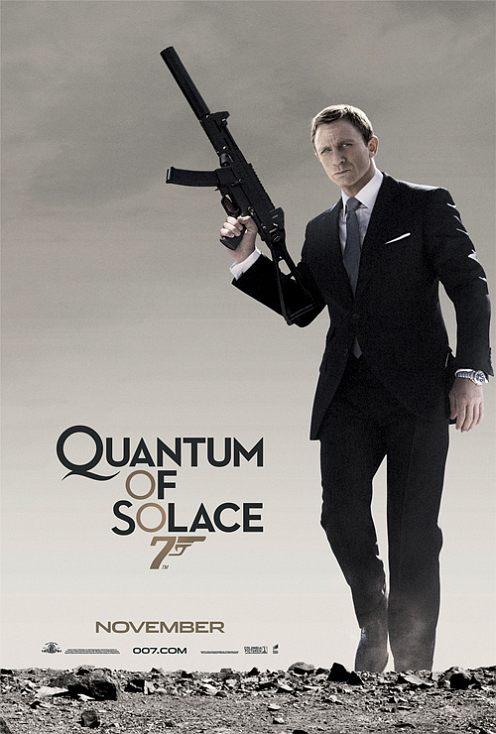
I didn’t want to start with this cliché, but Bond is back. This time, loaded with wrath in his heart, distrust in his mind and ammo in his gun. Instant hit Daniel Craig returns for his second performance in the first ever sequel to a bond film. And intriguingly Marc Forster takes the control of the Titanic, much to the concerns of the fans. And to negate the anxiety, the film has been shot in more locations than ever. So, does Quantum of Solace bring back the sheer fun of Goldfinger or does it bring the dreaded minutes of Die Another Day? Or plainly, does it have the licence to thrill?

Quantum of Solace takes off from where Casino Royale (2006) left us with the most stylish Bond ending ever. Bond has just learned his first lesson – one of intense mistrust and callousness. He is shattered by Vasper’s (Eva Green) death and is sets out on a roaring rampage of revenge (sorry Kiddo!). With the help of Eva’s endnote (not another Bond pun!) and Britain’s own forensic service, he traces the whereabouts of Vasper’s extortioner which brings him to Haiti. Almost immediately, he meets Camille (Olga Kurylenko), a borderline femme fatale who herself is on a venture of personal vendetta and intends to avenge the death of her father. Bond finds out that she has close relations with an environmental activist Dominic Greene (Mathieu Amalric) and employs her to get to him.

Greene says to Bond in one scene: “You make a fine couple – you are both, what is the expression? Damaged goods.” and that is what it is. Camille is Bond’s female counterpart in all sense of the term and equipoised as far as emotional state and instability is concerned. Both of them have lost the ones that they loved the most and both of them are determined to kill for personal relief. They feel tangled in a game they desperately want to finish. Bond helps alleviate Camille’s anxiety but she is unable to reciprocate, in spite of her wishes to free him from the vicious circle of survival and death. With the help of Camille, bond comes to realize that there is more to Greene’s plans than meets the eye. He tracks down Greene’s contacts, which reveals his unimaginable reach only affirming Bond’s now-natural suspicion.

Almost as a generalization, it is the megalomaniacs in Bond films that make them most interesting. Of course, there have been genius inventions such as Goldfinger and Scaramanga and gross mishaps such as Dr. Kananga and Gustav Graves. But it becomes their unwritten duty to make the films quirky, perhaps even lovably cheesy and essentially make them disparate from contemporary franchises such as Indiana Jones or Die Hard. Though the character of Greene is grossly underwritten (like Renard of The World is Not Enough (1999)), it is a very interesting one. He is not a man with steel teeth or huge underground lairs. For heaven’s sake, he does not even carry a gun. But his short stature, the slight hunch and mafia-like charm has enough to make him seem formidable. But as they say in the business world, it is the result that matters. And Greene’s character remains underdeveloped and green (I’m really sorry for that one!).

It is fascinating to see how the franchise has grown in the 46 years of its cinematic existence. From the incessant thriving on cold war and relationship with the Soviets in the Connery era, to chemical warfare and the space race in the Moore era, moving on to the post-Soviet world and the media’s intrusion in world affairs in the Brosnan era and the contemporary issues of terrorism and ecological threats with Craig, the humungous series has reinvented itself time and again to suit and sometimes succumb to the changing face of world culture and politics. The sexist tag on Bond has been discussed, M, a person with immense political power, has been made a woman, and Felix Leiter is now an African American, for crying out loud. All this is evidently a response to the gradual opening up of social outlooks of this mercurial world.

In Quantum of Solace, Greene doesn’t even care about the exhaustive oil race, but for something more rooted in the future and something more dreadful to the human race as a whole – a global issue that has been getting worthy attention in a lot of films off late – although the plot isn’t even relished explicitly by the baddie and not even its consequences stressed upon (another uncharacteristic quality of a Bond film, where the evil plot is usually the driving force for the narrative). Bond finds out Greene’s plans which he executes with the help of the legal privileges of Medrano (Joaquin Cosio), a general who has been trying to overthrow the Bolivian government and the watchful eyes (or rather the absence of it) of the CIA. And like the narrative, Bond does not care much about it and his sole intention is propelled by his need for vengeance.

The film’s basic premise reminds us of the Timothy Dalton starrer Licence To Kill (1989). Both follow Bond’s adventures as he sets out on a personal revenge in order to avenge the death of a beloved. And in both, the grim Bond is considered out of control and his licence to kill is revoked. However, in the older film, Bond never tries to kill almost throughout the whole film. Licence to Kill maintains a kind of tense atmosphere where the upper hand is gained by deceit and espionage and brutal action is but a luxury. And this is where Quantum of Solace itself goes out of control. Mr. Bond thinks by his gun and his primary objective remains dodging the next bullet.

Much talk is going on about how this film is so uncharacteristic of Bond and how un-Bond the franchise has become (yes, I know. No “Bond, James Bond”. No Q, No Moneypenny. No “Shaken, Not Stirred”, No puns…). So has Bond lost his suavity and panache? Yes and No. One should see that the age of Connery thrived on the elegance of the lead and his funny but daring escapades. The style part of the film arose because of the way the character was written and the uninterrupted shots that filmed him. The franchise was more of a spy series than an action till the age of Brosnan after which there has been a marked difference in the way Bond has been catered to the audience. Probably, fuelled by the financial debacle of Licence to Kill, Eon productions was hesitant to perpetuate the series and it was not until 1995 (GoldenEye) that they realized that the character should be marketed differently, perhaps as an influence of the CG wave. And now, the style aspect of the film rises from the progressive technology and the way it is utilized to furnish the high mojo quotient to the series. So it is true that Bond now isn’t what Ian Fleming imagined him to be, but only as a inevitable necessity owing to the changing times. But having said that, there is definitely a scope for marriage of the two eras and decidedly a possibility of restoration of Bond’s lost magic.

With a filmography that is highlighted by films such as Finding Neverland (2004) and The Kite Runner (2007), one wouldn’t place the odds in favour of the debutant Bond director Marc Forster. Perhaps, Forster himself was out on a mission – to prove that he is capable of experimenting with genres. The film seems Coppola-esque in a couple of scenes and Inarittu-ish in another, but maintains a Michael Bay-ian mindlessness almost throughout. High on action, with almost every alternate scene being a high octane automobile chase or a hand to hand combat, the average shot length for most part of the film is perhaps less than half a second and is at times (actually, many times) distracting. It feels like having no space to think or even breathe and of course, no quantum of solace. All of it seems acceptable when one is introduced to the third act. It looks as if the director has chopped off a good twenty minuets off the last act and as a result the whole showdown at the Bolivian desert feels abrupt and hurried.

All said, what is the bottom line? Another high-flying action extravaganza in this year’s tryingly long queue is satisfactory. Not as refreshing as Casino Royale and definitely not as pathetic as Die Another Day (2004), Quantum of Solace is a good film to watch for people who are new to Bond and they wouldn’t have any reason to complain (By the way, the film has a snazzy title track by Jack White and Alicia Keys). But for guys who have been boasting about Bond countdowns and ranting about the best and the worst of Bond, better stick to Connery!

Verdict:

P.S: This brings me to the end of the long and mostly enjoyable Bond marathon. Hope you enjoyed it too.

-FILE CLOSED-

007

So, With Quantum of Solace hitting the theaters today, here is a list of the best and worst aspects of the world’s most famous spy spanning his long yet youthful career of 21 films.

Best Bond Film

Goldfinger (1964)

Worst Bond Film

For Your Eyes Only (1981)

Best Bond Villain

Auric Goldfinger (Goldfinger)

Worst Bond Villain

Dr. Kananga (Live And Let Die)

Best Bond Girl

Pussy Galore (Goldfinger)

Worst Bond Girl

Melina Havelock (For Your Eyes Only)

Best Bond Thug

Jaws (The Spy Who Loved Me/Moonraker)

Worst Bond Thug

Bambi and Thumper (Diamonds Are Forever)

Best Bond Line

Bond, James Bond” (What else?)

Worst Bond Line

I’ve always wanted to have Christmas in Turkey” (The World Is Not Enough)

Best Bond Gadget

Little Nellie (You Only Live Twice)

Worst Bond Gadget

The Gas Pellet (Live And Let Die)

Best Bond Title Sequence

Casino Royale (2006)

Worst Bond Title Sequence

Die Another Day (2002)

Best Bond Repartee

Bond (being subjected to laser torture): “Do you expect me to talk?

Auric Goldfinger: “No, Mr. Bond. I expect you to die.

(Goldfinger)

Worst Bond Repartee

Hugo Drax (after Bond kills his Python): “Why did you break up the encounter with my pet python?

Bond: “I discovered it had a crush on me

(Moonraker)

Best Bond Moment

Q getting into the action in Octopussy (1983)

Worst Bond Moment

Death of Kananga in Live And Let Die (1973)

Best (!) Bond Disguise

best-bond-disguise

Octopussy (1983)

Worst Bond Disguise

worst-bond-disguise

You Only Live Twice (1967)

So, Here is the rank list of the Bond Films so far.

01. Goldfinger (1964)
02. From Russia With Love (1963)
03. The Living Daylights (1987)
04. Dr. No (1962)
05. Licence to Kill (1989)
06. The Man With The Golden Gun (1974)
07. Casino Royale (2006)
08. On Her Majesty’s Secret Service (1969)
09. Tomorrow Never Dies (1997)
10. Moonraker (1979)
11. The Spy Who Loved Me (1977)
12. Octopussy (1983)
13. You Only Live Twice (1967)
14. Diamonds Are Forever (1971)
15. A View To A Kill (1985)
16. GoldenEye (1995)
17. The World Is Not Enough (1999)
18. Thunderball (1965)
19. Live And Let Die (1973)
20. Die Another Day (2002)
21. For Your Eyes Only (1981)

Let’s wait for a day to see if Quantum of Solace infiltrates into the left side column or if it slips into the right.

Casino Royale (2006)
Martin Campbell
Bond, James Bond: Daniel Craig
Arch Rival: Le Chiffre (Mads Mikkelsen)
Bond Girl: Vesper Lynd (Eva Green)

Casino Royale (2006)

Casino Royale (2006)

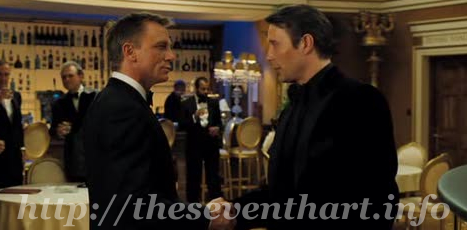
Daniel Craig becomes the sixth man to don the role of the British secret agent in Casino Royale. The film follows the early professional life of Bond, just after he has been elevated to the 00 status. He is naïve and trusts women he sees. In this installment he follows Le Chiffre, the investment giant who deals with the money lent to him by the leading terrorist organizations and multiplies it using Poker matches. Bond is sent to play him fair and square and turn him bankrupt, forcing himself to run out of business. He is aided by Vesper Lynd, responsible for handling the huge sum of money sent along with Bond, and Mathis, the local agent for MI6. Sure enough, the ordeal becomes one involving more than Bond’s brawns. Meanwhile, it is revealed that the match is not just between Le Chiffre and Bond, but a third hand too.

Bond is no more (or not yet!) the smooth talking, ever punning, suave gentleman. He is a mean killing machine and lives by his code of duty. Daniel Craig is an instant hit unlike someone like Roger Moore who had to convince us for a couple of movies or three. His USP remains his barely legible accent and I-mean-business attitude. Immensely stylish and high on production value, Casino Royale is still a bit unconvincing perhaps because of the nature of Bond himself. The opening stunt scene easily features in the best of Bond and one only wonders what they will come up with in the next one.

Die Another Day (2002)
Lee Tamahori
Bond, James Bond: Pierce Brosnan
Arch Rival: Gustav Graves (Toby Stephens)
Bond Girl: Jinx Johnson (Halle Berry)

Die Another Day (2002)

Die Another Day (2002)

Brosnan’s final film as Bond is a mess, to say the least. Strong contender for the title “1001 bad puns”, this installment follows James Bond after he is captured in North Korea following a betrayal by a fellow agent. He is exchanged for a notorious terrorist Zao, but not after being tortured like hell. He gets out of the confinement imposed on him by M and goes on a journey of personal vendetta and tries to get back Zao, in the process discovering an Icelandic diamond giant’s connections with Zao. Bond now travels to Iceland to meet this man, Gustav Graves and his assistant Miranda. He is also aided by another agent Jinx, as he tries to hunt down the person who betrayed him.

Perhaps the worst Bond film ever, Die Another Day goes on and on without even noting that nobody cares beyond the 70 minute point (and that is for the patient viewer). Toby Stephens as the villain seems like a high school kid who has stolen his father’s pistol and is threatening his fellow school kids. And what were they thinking when they put in the invisible car? A monumental showcase of characteristic Bond puns and double entendres, Die Another Day feels like His Girl Friday for its judicious use of runtime, only that it isn’t even half as funny. It feels like the dreaded days of Roger Moore again, for the bond between the films is so evident (oops!).

The World Is Not Enough (1999)
Michael Apted
Bond, James Bond: Pierce Brosnan
Arch Rival: Renard (Robert Carlyle)
Bond Girl: Christmas Jones (Denise Richards)

The World Is Not Enough (1999)

The World Is Not Enough (1999)

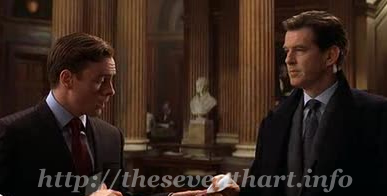
The next piece in the huge series would be The World Is Not Enough and follows Bond’s mission to Europe to investigate the rat in the family of Richard King, the wealthy oil giant with a project of a lifetime on the anvil, after his murder at the MI6 headquarters itself. Bond tracks down the person responsible to be Renard, a terrorist whose accident has rendered him incapable of any physical feeling. As Bond tries to restore the hurt pride of both M and the organization, he stumbles across the truth about King’s murder. Bond, in the process, meets an obviously and phenomenally miscast Denise Richards as Christmas Jones (Get ready for the cheesy gags), the nuclear physicist (cough, cough) who tugs along. Like GoldenEye (1995) Bond is caught in another moral conflict as he has to choose between cold formalities of duty and warmth of relationships.

This version scores on the action sequences with lots of eye-candy involving both incredible computer graphics and genuine stunts. However, Renard’s character, which could have been converted into one of the best Bond villains, is wasted primarily to share his screen space with his sweet heart.  One of the best soundtracks of the series features a spectacular title track by Garbage (!).This one definitely shows that Bond is not an anachronism and is inching towards the new generation.

Tomorrow Never Dies (1997)
Roger Spottiswoode
Bond, James Bond: Pierce Brosnan
Arch Rival: Elliot Carver (Jonathan Pryce)
Bond Girl: Wai Lin (Michelle Yeoh)

Tomorrow Never Dies (1997)

Tomorrow Never Dies (1997)

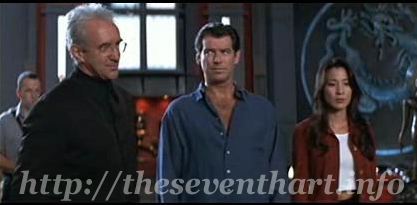
Pierce Brosnan would don the role of James Bond for the second time in Tomorrow Never Dies. In this part of the series, A Media Mogul named Elliot Carver, whose wife had been one of Bond’s many old flames, plans to induce war between the British and the Chinese governments in order to win the exclusive broadcasting rights of his satellite channel in China, the only country he hasn’t yet been able to get his hands on. He creates his news and executes them, thereby becoming the first one to publish and broadcast them. To gain advantage in China, he rigs up attacks on the defense forces on either country in order to trick them into believe that the other government had started the war. Enter Bond, who teams up with Chinese media official (?) Wai Lin to blow Carver’s cover and destroying his offshore operations and prevent war before things go out of hands.

There is a marked difference between Tomorrow Never Dies and the previous films in the series. Bond undergoes a much needed makeover and it works. The way issues and characters are handled is more refined (save Carver) and so is the suavity. The actions scenes are intact and issues handled are more pertinent to the age. It is refreshing to see no Soviet characters running all over. One of the better films of the series.

GoldenEye (1995)
Martin Campbell
Bond, James Bond: Pierce Brosnan
Arch Rival: Alec Trevelyan (Sean Bean)
Bond Girl: Natalya Simonova (Izabella Scorupco)

GoldenEye (1995)

GoldenEye (1995)

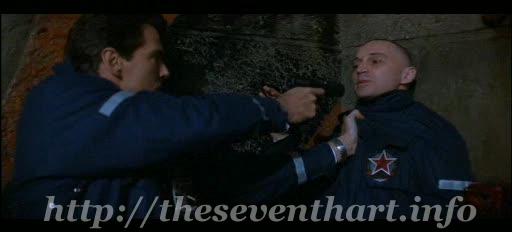
It is now time for the fifth actor to step into the shoes of the world’s greatest secret Agent. It is not just Pierce Brosnan who is new to the world of Bond, but even the new M is a lady, played by the no-nonsense Judy Dench. GoldenEye follows Bond’s adventures in Russia just after the collapse of Communism as he tries to dig into the mysterious character Janus, whose agents destroy the GoldenEye control center and steal its powering source. As the identity of Janus is revealed in the process of tracking down the criminals, Bond’s past is dug up. Bond meets up with Natalya, a programmer who luckily escapes n the massacre at the control centre, and both of them go to Cuba to trace out the other GoldenEye control centre. They have to stop Janus, who is planning the biggest bank robbery in history, from disrupting the computer systems of all the Banks in England. With Bond’s guilt plaguing him, can he act by the mind and not the heart?

Golden Eye remains the most delayed bond film ever, releasing six years after the previous installment. Yes, both Bond and M have changed, but the Russians still speak English among themselves with a Russian accent. Wittier and funnier than many bonds, GoldenEye tries to shed Bond’s macho image to an extent and delve into his personal life of harsh loneliness. Brosnan is good with his lover-boy looks and gives Bond a much required makeover in this otherwise regular Bond fodder.

« Previous PageNext Page »