Le Salaire De La Peur (1953) (aka The Wages Of Fear)
Henri-Georges Clouzot
French
“When someone else is driving, I’m scared.“

After his back to back successes with Le Salaire de la Peur (1953) and Les Diaboliques (1955), Henri-Georges Clouzot was considered a leading contender for the throne of “The Master of Suspense” and a force Hitchcock had to reckon with. Incidentally, Hitchcock himself was hot under the collar for having lost the filming rights of the above two films to Clouzot who had delivered them big time. Though not as prolific or consistent as Hitch, Clouzot is nevertheless placed in the same league as the former. His famous pair of films has spawned tens of remakes, both faithful and revamped. The Wages of Fear may arguably be the more potent of the two by a miniscule margin.
(Spoiler Alert)
Mario, Jo, Bimba and Luigi are the temporary residents of Las Piedras, a small town in South American. Each of them has a need to earn a tidy sum of money in a very short amount of time. Just then, they find out that one of the oil fields of Southern Oil Company (SOC), the drilling giant which owns a number of fields in the country, is on fire and two truckloads of nitroglycerine are required to put them out. However, a tiny jerk to these trucks could blow them to nonexistence. These four people volunteer to drive the truck to the oil field for a decent sum of money. The rest of the film follows their nasty ride to hell and beyond, literally.
No other film ending has been as much debated upon as the ending of The Wages of Fear. Clouzot, clearly making a statement against the Hollywood endings, did the unthinkable and totally shattered the perception about films of the audience then. Additionally, the ending sequence also raises questions about death, fate and their inevitability, that reach out to everyone irrespective of their age, situation or morality. Till date, the ending elicits mixed reactions, ranging from brilliant to silly.
In Richard Schickel’s documentary The Men Who Made the Movies: Alfred Hitchcock (1973), Hitchcock puts forth his idea of suspense as thus: “If two people are talking across a table and a bomb suddenly explodes from under it, the audience is excited for about 10 seconds. But if in the same situation, if you tell the audience that there is a bomb that will go in exactly 5 minutes, viewers are pushed the edge of their seats for the whole 5 minutes and will be praying for the men to get out of that place. You can’t make the bomb explode after that, for it will disrupt the comfort level of the audience”.
This is exactly the style used in The Wages of Fear too. Only that Clouzot does not care about the last clause. The best part about this theory regarding on-screen suspense is that it can never become obsolete. A bomb threat is as gripping now as 50 years earlier. This, perhaps, is the major reason for the slew of similar films from across the world. The audience knows what is going to happen in the next few minutes, but still finds the happenings irresistible. Don’t forget to check out Andrei Tarkovsky’s student film There Will Be No Leave Today (1959) for a different take on the same structure.
Clearly, the most prominent theme in the film is the capitalist exploitation and misuse of power over the developing and third world countries. The Southern Oil Company (SOC, obviously, representing the US oil giant) in the film is portrayed as a materialistic and ruthless firm that pays for the fear and lives of the men in terms of money. This provided the west yet another reason to boo down the film. However, the film had already been recognized as a classic and Clouzot became yet another French director to look out for.
 Traditionally, there have been two paths for animation filmmakers. One is to make the films as close to reality as possible. That is the path taken by Pixar and Sony Animation, which try to push animation technology to new extremes and squeeze out every bit of processing power and skill set they have. The other is the conventional path that tries to realize the creators’ most bizarre and outlandish fantasies and attempts to emulate the peaks attained by Disney and Miyazaki. The second path is what companies like Dreamworks Animation have adopted and, to an extent, succeeded. Their latest offering, Kung Fu Panda is a clever idea, but inefficiently harnessed.


 No, this is not a review of Nagesh Kukunoor’s box office bomb Bombay To Bangkok (2007) but of debutant director Abbas Tyrewala’s Jaane Tu Ya Jaane Na. Even before the film had got completed, the director had called it a typical Bollywood love story complete with its own quota of songs, fights and even the quintessential over-the-top airport climax. With that kind of a statement from a man who has some very successful scripts behind him, you can’t help but expect the film’s USP to be something completely fresh.
 For a large part of the world Majid Majidi’s filmography begins with the disarmingly charming Children of Heaven (1997). But the Iranian auteur had already struck gold a year before the first Oscar nomination from Iran. The themes, style and idiosyncrasies that were to mesmerize the world in the years following Children of Heaven clearly show their roots in Pedar (1996) (aka Father).
 Cut to the present. The video becomes full fledged colour, suggesting that all that has been hidden is now revealed. The walls are decorated with the photographs that were taken during the entire journey of Saket’s madness. Saket Ram describes the photographs to Tushar. Tushar then asks if he could take back his great grandfather’s sandals and spectacles back. Saket says that it indeed belongs to him and returns it. What Saket Ram Sr. took from Gandhi Sr., Saket Ram Jr. returns to Gandhi Jr. As he returns the grasses, Saket Ram tries to look through it, as if trying to look at the world through the eyes of Gandhi. Tushar follows suit and tries to look through the glasses too.
 The song that is being played in the back ground is “Ram Ram, Hey Ram” – A very vibrant and majestic tune that talks about non-violence, cultural tolerance, the future and need for resurrecting humanity. Ironically, without playing a somber tune on the death of Gandhi and Saket, a more motivating tune is being played hinting that past is past. We have to learn from it and move forward carefully. It is up to the new Gandhi and the new Saket, the youth of India, to lead the nation on a non-violent path. As the end credits roll on, Saket and Tushar open up the windowed wall that has a huge sketch of Gandhi, allowing sunlight to pierce the room for the first time metaphorically opening up Gandhiji’s mind to the world and appealing to the nation’s youth to expose themselves to the history of the nation and also gain an insight of Gandhiji. The song attains its crescendo at this point. The screen fades to black, the song continuing, as the future of India stand near the open door discussing the nations past, present and future.
 We cut back to the past even after Saket Ram is dead. The rest of the story is revealed to Tushar by Saket Ram’s grandson. We return again to colour. Saket is ready to renounce the animal inside once and for all. He looks at the animal for one last time in the mirror. He will not be the same person hereafter. He closes the gun case after placing the gun in it, metaphorically implying that he has put an end to his rage of violence which will be shut hereafter.
 Saket arrives at the Birla house. He notices the date on the calendar – 30th January. The day India would cry. He notices Gandhiji walking out with Sardar Patel and Moulana Azad after his daily prayer. Shruti Haasan appears as Sardar Patel’s daughter. Saket knows Gandhiji’s routine for he has been observing him every day for the whole month. He notices Gandhiji walking towards him as he tells his helpers about how punctuality is important in life. He is walking fast towards the main building. He interrupts Gandhiji and a conversation ensues:
 As Gandhiji proceeds, the crowd grows thicker. As he nears the building, a man, whom we had seen during the blast 10 days ago stalling Gandhiji and greeting him. As the helpers tell him that Gandhiji is late for the meeting, he reveals a pistol and shoots Gandhiji thrice who falls down helplessly. He does not cry “Hey Ram” as believed by many to be his last words. The man is Nathu Ram Godse, who had escaped the clutches of the police in the hotel. He drops his gun after making sure Gandhiji is dead. Everyone around is stunned but are quick to start thrashing Godse. Mr. Goyal stops them and tells them that this is the moment of truth. He asks them to follow Gandhiji’s doctrine of Ahimsa in the most testing time. He manages to stop the crowd beating Godse. Gandhiji, the Ravana is killed. The prophecy is complete, but not by our Ram. It is a Ram all right, Nathu Ram.
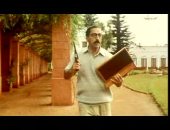 The mentality of Saket is most complex now. They say that you’ll know the value of things when they disappear. The same thing happens to Saket. As he sees Gandhiji being shot and killed, he is both furious that a man has done such a crime and frustrated that the mishap has occurred just when he had decided it should not. He is enraged at the murder and runs towards him taking out his gun. He is ready to kill the murderer as he runs. As he nears the scene, he is able to hear Mr. Goyal’s appeal for non-violence. Saket breaks down. He sees himself in Nathu Ram. He sees how he had wasted his life and even committed sin killing tens of men. Mr. Goyal’s appeal reminds him of how wrong he was in getting back at the murderers immediately after Aparna was killed. He realizes that this is indeed the moment of truth and holsters the gun back into the box. He learns that true masculinity is not avenging a loss, but much more non-violent and cerebral than that. He has decided that he will not commit the same folly as he did in Calcutta and closes the box. He has eschewed violence for good. But at the cost of what?
 As Godse is taken away from the police, Saket cries holding the box close to his heart, careful not to let it slip open, suggesting that he will not indulge in violence by the fall of the mind. As Saket stands crying alone in the vast grounds, we hear the haunting rendition of “Vaishnava Janato” by D. K. Pattammal, the same song that Mythili had sung during their first meeting. The song translates to:
 Saket Ram realizes the truth of the song with reference to Gandhiji. He realizes that, even though he was a Vaishnava by birth, he has not done enough to sustain the title. He does not deserve to be called a Vaishnava. As the corpse of Gandhiji is taken away by his followers, Saket watches on. The colour shifts back to black and white to indicate that nobody knew what followed.
 Saket traces back the path that the followers came. He sees the blood of the Mahatma on the way. He goes back to the scene of murder and notices Gandhiji’s slippers and spectacles on the floor. He picks them up takes them with him. The role of the mechanical and angry Rama is gone. He has become, instead, Bharata who brings back home, his beloved brother’s sandals with love but immense pain about his exile into forest.
 They decide to announce that it was a Hindu who murdered Gandhi. Saket cries. He considers himself to be that Hindu. As Saket falls to the ground, we hear the song “Raghupathy Raghav Rajaram”, as we did in the beginning, being played in the background completing and closing the circle of madness of Saket.
 Cut to the present. Back to black and white. Saket and the rest of them are still in the trench. Saket’s eyes are lit alone by the light from above, once again indicating his recollection of the past. The nurse informs the doctor Munawar that the oxygen supply, on which Saket is surviving, just got over. We can here the sound of gunfire from above. Dr. Munawar murmurs: “Ya Allah”. The oxygen mask on Saket’s face is removed and he is left alone to breathe his final few breaths. He looks at the nurse who appears to him as the young Mythili, in the form he had last spoken to. He smiles and tells her that he is not able to breathe. She asks him to wait a little till the gunfight above stops. He asks what the reason for the fight is. His grandson tells him that it is because of the Hindu-Muslim clashes. Saket cries out:
 It is said that some of your life’s moments flash through your eyes the moment before you die. As Saket’s breath becomes tougher and tougher to take, he is able to Mr. Wheeler of the first scene shouting “It’s pack up time”. Indeed, Saket Ram’s time had come. Saket says to “Mythili” what would be his final words.
 The shutter from above is removed as the police inspector comes. He says that the riots are over and they were lucky to survive. He asks the plight of the old man and learns that he is no more. He apologizes as the stretcher is taken onto an ambulance. We also see the TV reporter covering the riot and learn that these riots take place every year. Again the dissimilarity in times is being shown here.
 As the ambulance leaves, Saket Ram asks the inspector, who has saved their lives, his name. The inspector searches for the badge on his chest, only to find it is lost in the battle between him and the rioters, indicating that true heroes’ names go unnoticed during war times. He leaves it alone and tells Saket his name is Ibrahim. A beautiful parallel is struck here. Saket, a Hindu, had saved the life of Amjad, a Muslim, though momentarily. He had also saved Amjad’s family and friends in the trench inside the house. Similarly, Ibrahim, a Muslim, has saved the life of Saket Ram, though only for a while. But he has saved the lives of his family and friends, also, in the trench. It is as if Amjad was reborn to save Saket and pay back in kind for his support. Also, Dr. Munawar, a Muslim, tried to save Saket till the very end but fruitlessly. This is in agreement with Dr. Mani, a Hindu at the Chandni Chowk hospital, trying to save the life of Amjad till the very end, also fruitlessly. Evidently, this portrays the circle of life and the universal nature of humanity. The camera angles perfectly highlight the similarities (and dissimilarities) of the saviour and the saved in both cases.
 Again we see the double entendre that has been so consistent in the film. Mythili’s words mean that Saket has passed away before her. It also reveals her despair at Saket leaving her for Sanyasa. She did not speak one word immediately after he had left. So, as we see it, this is the first time Mythili is opening up her sorrow of Saket leaving the house. We also see another person placing on Saket’s chest. He greets Mythili and stands back. He is introduced to Saket Ram as Tushar Gandhi (Tushar Gandhi), the great grandson of Mahatma Gandhi.
 Saket switches on the lights of his grandfather’s room for the first time in years. After a very long time this is the first time anyone could see the objects in his room. Tushar and Saket see the things around with equal awe for they are both alien to this world. Tushar notices the three monkey skulls in front of the “three monkeys” statue. The statue, perhaps, indicates that the three monkeys, which Gandhiji had endorsed, are no more and people no more follow the principles behind the statue and Gandhi’s principles in general.
 Saket realizes that the stories that his grandfather had been telling are not tales of imagination but absolute truth as he claimed. It was the history of the country. Saket is shocked at the discovery and realizes the importance of this truth in history. As he reveals the story to Tushar, we are able to see the photographs of Saket Ram Sr.’s mother, his grandson and others in bright light.
 The Seventh Art