Bollywood


Rocket Singh: Salesman of the Year (2009)
Shimit Amin
Hindi


Rocket SInghDirector Shimit Amin’s instinctive love for the underdog and screenwriter Jaideep Sahni’s seeming distaste for Big Business come together in Rocket Singh – a movie that is as perceptive and entertaining as it is naïve and predictable. It’s Rocky for the Generation Sell that pits corporate rapacity against homespun entrepreneurship. Ranbir Kapoor plays Hapreet – a barely-adequate everyman who tries to make his way through modern professional landscape – with great intelligence, internalizing the character’s religious repression, his lack of parental identification and the subsequent absence of retributive masculinity. Amin’s cheesecake aesthetic, on the other hand, recalls Wes Anderson and Edgar Wright in equal measure, with its geometric mise en scène, affinity for strong horizontals, the easy-on-the-eye symmetric composition, shrewd visual detailing and, especially, the sprightly editing, which telescopes actions with split second shots while letting conversations take their own pace. The office and its peripheral spaces are moral zones in Rocket Singh that define and delimit character behaviour. The workplace here is a veritable battle field – a characteristically male playground – fraught with surveillance and territorial dispute. (The cubicles’ layout itself reminds us of trench warfare.) The film succeeds in conveying to a good extent the crushing power of concentrated capital. And Amin is capable of fine subtlety, as is clear from the honesty and pronounced everyday quality of some of the sequences. But he is equally prone to repetition and overemphasis. Rocket Singh is a film that wants to put a human face on commercial enterprise, and it’s unable to understand corporate ruthlessness without putting grimacing human faces on to it. It appears to be unaware that modern offices are exactly what it laments they aren’t – employee-friendly, customer-oriented and rewarding of new ideas. Perhaps it makes for better drama this way. But it also immunizes its object of critique by characterizing its fallibility as product of human misconduct – big businesses are corrupt because the people running them are. Hapreet advices his boss towards the end: “Business is not numbers, business is people.” Guess what, that’s what every CEO says too.

PS: I admit I had fun throughout trying to guess what colour turban Ranbir Kapoor will come wearing next.

Aamir (2008)
Raj Kumar Gupta
Hindi


AamirRaj Kumar Gupta’s breakout debut, an adaptation of the Filipino-American indie Cavite (2005), starts off like a post-9/11, Hitchcockian wrong man thriller about an expatriate physician, Aamir (Rajeev Khandelwal), who returns to Mumbai only to be swept into a terrorist enterprise. Like Ghanchakkar (2013), the film presents to us the pathetic spectacle of a self-identity progressively disappearing. Aamir is a liberal, middle-class, rather unmarked Muslim who believes that a man makes his own life through hard work, until he is shoved into a tour of underprivileged Mumbai and an acknowledgement of his privileged upbringing. Through a grim series of manipulated tasks, he is forced to see the society from the fringe, to acknowledge the existence of people who invisibly shape his existence and to be an outsider in his own country. Gupta constructs his sequences tautly, without injecting adrenaline too artificially and without any major blunder except Amit Trivedi’s score. His film’s aesthetic of surveillance resembles that of Kathryn Bigelow, with a number of POV shots of Aamir from the viewpoint of the city’s buildings and inhabitants, and broadcasts the precise feeling of being monitored. The slow-motion, too, is used very effectively, in providing the audience not only with a breather to absorb the moral gravity of a scene but also the protagonist’s experience of being in the interminable now. Gupta’s Mumbai – an infernal, indifferent piece of alienating machinery – is the abyss in which Aamir discovers faith and the film’s got one of the most uplifting images of faith in my memory: Aamir embracing a suitcase during a moment of beatitude, itself couched inside unspeakable despair. Aamir treads a very fine line between sickening moral parable and cynical portraiture and does a remarkable stunt of balancing social determinism with spiritual individualism. Its philosophical virtue almost solely lies in its ending – in the mere existence of an ending – that calls out the intellectual fraud of films like The Terrorist (1998) and Paradise Now (2005).

Maqbool (2003)
Vishal Bhardwaj
Hindi


MaqboolVishal Bhardwaj’s Maqbool is set in a strangely sparse and ruralized side of Mumbai and tells the story of the rise and fall of Maqbool (Irrfan Khan), the right hand man of underworld lynchpin Jahangir (Pankaj Kapoor, doing a Marlon Brando) and the secret lover of his wife Nimmi (Tabu). Tabu and Irrfan are at the top of their game in this sparkling adaptation of Macbeth, which spins Shakespeare’s portrait of the toxicity of power into a searing study of masculine insecurity. Unlike the will to power of his classical counterpart, Maqbool’s actions are brought about by a kind of necessity born out of amorous desire and sexual jealousy. He is moreover possessed by the idea of legacy and bloodline. To know whether the child from Nimmi is his or Jahangir’s is literally a question of life or death for him because, you know, parricide runs in the family. While Lady Macbeth’s sudden descent into guilt and madness seems quite at odds with the cold and calculated nature of her act, Nimmi’s gradual disintegration is grounded in her perceived failure as a mother, in a doubt that her carnal desire has possibly deprived her child of a father. Her character is a screenwriting coup, for what could easily have devolved into a Grand Scheming Woman archetype is instead made as fully human and conflicted as Maqbool. Bhardwaj builds his world at a leisurely but steady pace and elaborates on The Bard’s lean tale, providing backstories to the originally secondary characters, especially Jahangir whose ignominious prise de pouvoir is but one turn in an unceasing cycle of power struggle. The only witnesses to this eternal recurrence are the two greasy cops (Om Puri and Naseeruddin Shah) who, unlike Macbeth’s Greek chorus of neutral witches, are active participants in the fulfillment of their prophecies by dint of deliberate inaction. Maqbool’s characters live in a limbo between the sacred and the profane – a universe where the pious turn debauchers, loyalists turn traitors and lovers turn murderers. It’s a film of great directorial rigour. The microscopically-tuned cinematography, cutting and performances hit the precise values each scene demands. I’ve put up three of the many extraordinary sequences below. Check out how seamlessly it constructs complete spaces and with what economy and accuracy each gesture, edit and change in framing conveys key details.

 Maqbool - Meeting


Maqbool - Gifts


Maqbool - Engagement

Bombay Velvet (2015)
Anurag Kashyap
Hindi


Bombay VelvetWhat struck me most about Anurag Kashyap’s unanimously derided Bombay Velvet was how thoroughly unoriginal it is. Right from the history of Bombay-that-might-have-been to the black eye that Johnny (Ranbeer Kapoor) carries, the film builds a relentlessly artificial world far from the realist trappings of Gangs of Wasseypur (2012). The universe of Bombay Velvet is media-saturated, drowned in cinematic codes that paint a portrait of the city as a jarring mix of Boston, Chicago, Los Angeles and New York movies. So this reimagining of Bombay as a sort of Hollywoodized America has as a welcome and perhaps unintended consequence of defamiliarizing the city, giving it a new foundational myth akin to that of America at the turn of last century – a perennially rootless territory that actively erases traces of its past, a new world for those who wish to cast off their social identities and chase a new dream and a promised land of real estate rush and hedonist abandon. The lasting effect, however, is that of a simulacrum, a Disneyland. It all finally has the air of a cinephilic wish fulfillment project that imagines how great it would have been had Scorsese made a film on Bombay. Films as cinephilic navel-gazing is not new and there is nothing wrong about them either, but this one comes across less like a cinephile infusing his material with his movie loves than him incarnating his movie loves through indifferent material. When he cites Raoul Walsh, it feels less like a tribute to his formative movie experiences than a tribute to Scorsese paying tribute to his formative movie experiences. This kind of double quotation completely erases Kashyap’s authorship, but not in any subversive way. But this was to be expected of a generation of filmmakers fed on New Hollywood. The Movie Brats, thanks partly to the French New Wave, plundered classical cinema for personal use and emptied its signifiers of any meaning outside cinephilia. And films that tend to pillage these already pillaged films are very likely to come out the way Bombay Velvet has. One gets the feeling Kashyap would perhaps have liked to belong to Scorsese’s generation. The lament is understandable: it is desirable to have grown up on cinema than cinephilia.

The Attacks Of 26/11 (2013)
Ram Gopal Varma
Hindi


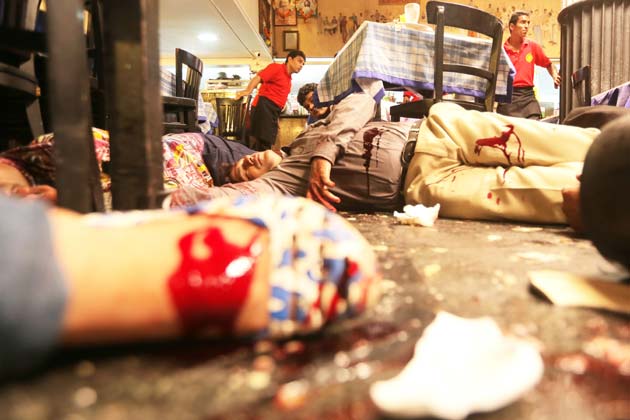
The Attacks Of 26-11Ram Gopal Varma’s latest exploitation venture, The Attacks of 26/11 (2013), which purports to illustrate what happened during that long night in Mumbai when 10 armed men entered the city via sea and carried out a series of assaults in key public locations, killing over 150 people, opens with a statement that only a certified cultural amnesiac like Varma could have made – that 9/11 is the most heinous crime to have occurred in the history of mankind. That it brings in an incident that happened 7 years ago in the US is not an analytical move that geopolitically links these two events, not even a naïve leveling of the two incidents as interchangeable acts of absolute Evil, but – bizarrely enough – a betrayal of the film’s ambition to emulate Hollywood-styled Realist-reportage pictures. However, Varma is too straight-shooting and tactless for employing questionable Hollywood screenwriting tricks and, unlike most successful Oscar darlings, Attacks does not refract its agenda through a protagonist in order to surreptitiously validate itself. It wears its ideology on its sleeve, telling us exactly what we want to hear. Sure enough, there is the account of Joint Commissioner (an indefatigable Nana Patekar), whose voice of reason (which is clearly Varma’s own unoriginal voice, as are all the other voices in the film) tries to pass off what were essentially stupid, haphazard attacks as a clear-eyed, exactingly-planned project, but, for most part, the narrative remains dispersed and free of character subjectivity, serving as illustrations of unshakeable truths – fictionalized Reality rather than Realist fiction. Inventive like a child, and just as intelligent, Varma’s film consists chiefly of a high-speed handheld digital camera sweeping the many enthusiastically arranged, corpse-ridden tableaus, with violins wailing in the background. Not artful by any stretch of imagination, of course, but it would do well to those complaining about the lack of subtlety (a currency that Varma doesn’t ever deal with) in the film to remember that the nation’s real-life response to the events of 26/11 itself had the subtlety of a shark in a bathtub, making Varma’s movie pale in comparison. Condemning the movie would only serve to conceal the fact that our response to the attack was no better than a tacky exploitation flick. Varma’s aesthetic has consistently celebrated Hindu belligerence, which was lapped up by the public when it was married to the ‘right’ subject, and it becomes especially problematic here, despite Varma’s vain attempts to undermine it with the film’s professed secularism and its tacked-up, self-defeating Gandhian ending. In an interesting gambit, Varma abstains from showing us how most of the attackers themselves were shot down, which keeps postponing gratification for the audience. This 90-minute-long-foreplay-without-a-release results in a special challenge for the film, with the sole possible means of retribution coming through the figure of Ajmal Kasab (Sanjeev Jaiswal), the only attacker captured alive, who is saved from graphic violence thanks to the film’s loyalty to reality. How the movie appeases the audience hereafter unfolds in two monologues that are better left undescribed. Besides its moviemaking aspirations, Varma’s film also has the obvious ambition to narrativize history, to resolve the necessary contradictions in our understanding of the events, to assure us that we have obtained closure, to simplify complex causalities of the real world and provide a ready-to-eat account of events that the audience can digest without trouble. It took America eleven confusing years to tell its story to itself. We took just five.

Agneepath

For film lovers who consider Bollywood cinema to be a blind spot in their cinephilia and wish to change that, there’s a curious entry from Karan Johar’s Dharma Productions that rolled out last week: a purported remake of their own 1990 production Agneepath. The curiosity, I think, arises from the tug-of-war between Dharma’s current reputation as makers of an “international” brand of Bollywood cinema targeted specifically at expatriates and nascent Indophiles and the highly indigenous, culturally and historically rooted nature of the movie they have chosen to remake. The result is exciting, to say almost nothing, and should serve as a good takeoff point for the adventurous.

A crucial detail about the original Agneepath, starring Amitabh Bachchan and directed by Mukul Anand: It’s insane. Made during the limbo between Amitabh Bachchan’s infamous career in politics and his equally unsuccessful foray into film production, the film is located at the fag end of that vague set of films that academicians have milked to death—the so-called Angry Young Man pictures, all featuring a generally tormented Bachchan trudging through the narrative. The film works on archetypal material redolent of classic Westerns, and fleshes it out into three hours with scenes both startling and superfluous (for a measure, imagine the Ranown cycle developed as a TV series): The righteous schoolmaster of Mandwa, an island village to the west of Mumbai, Dinanath Chauhan is cudgeled to death in front of his son Vijay by his villagers after having been misled by the scheming Kancha, who plans to appropriate the village for growing opium. Forced to bury his father by himself and move to Mumbai for a living, Vijay plans to reclaim his village and avenge his father. Anand cares little about redaction, tonal consistency or pacing and primarily works around self-styled iconic images which in turn have no scruples about their literariness and in-your-face symbolism. (The continuity between father Chauhan and son is illustrated by what the film takes to be as its central image: blood dripping from battered father’s face onto his son’s. I kid you not.)

Agneepath

Considering multiplex-bred audiences today have a little less patience for three hours of such excesses, it is not surprising that Karan Malhotra’s Agneepath (2012) is less a remake of Mukul Anand’s film and more a respin of it for a new generation of film goers from a new nation, half of whose populace is younger than Anand’s film. Nowhere is this more apparent than the scene in which we are introduced to the adult Vijay, 15 years after his father was lynched by the mindless mob of Mandwa. We see Hrithik Roshan, with his perfectly-chiseled body and Greek God features, sprinting forward like a stallion, climbing on to the top of the Dahi Handi pyramid, and seizing the jackpot at the top. Vijay is now 27, about a decade younger than his predecessor (who is, exactly, 36 years, 9 months, 8 days and 16 hours old when we see him for the first time) and as just as old as most of his audience. Anand’s 1990 film is an Amitabh Bachchan vehicle in more ways than one. It is the Bachchan persona struggling against an emaciating physique, the Angry Young Man trapped in a body that couldn’t be called so—an empty container in which his voice ricochets endlessly. Roshan’s unkempt yet obviously resplendent countenance is the direct opposite of Bachchan’s drooping, mascara-wearing face. “He looks normal, but he’s the one most disturbed,”Inspector Gaitonde (Om Puri) correctly characterizes. The glacial surface of Roshan’s face reveals nothing, not even the simmering wrath that is supposedly driving him, and isn’t helped by his barely visible blue pupils that vanish when he cries.

Agneepath

Malhotra’s film, perhaps as homage of which there is no shortage within and outside of the film, including its publicity, retains much of the original’s shamelessly literal approach to images and impressive use of long lenses, shallow fields and racking focus for dramatic impact. (In an adeptly realized and shot encounter early on between Vijay’s father and Kancha, Vijay and mother are frighteningly visible and out of focus, as seen from Kancha’s POV.) Equally discerning is the fine-tuned attention to landscapes that sets up a visceral contrast between the metallic-blue, horizontal wastelands of Mandwa and the radiant saffron-tinged, vertical settlements of Mumbai. Malhotra’s film finds itself constantly in dialogue with the older Agneepath, resolving a few of the latter’s contradictions (and adding a few), deftly pruning out its circuitous narrative threads and making prominent some of the latent themes and equivalences. If Anand’s film unabashedly works towards a near-surreal, graceful finale recalling The Searchers (“Let’s go home, mother”), the reboot keeps underscoring the parallel between Vijay and Kancha, much like what Ford’s film does with Ethan and Scar. For one, both Sanjay Dutt, who plays Kancha, and Hrithik Roshan have imposing statures and that stand in contrast with other portly figures in the film. Vijay uses the same means as Kancha to reclaim his hometown, including an ignoble murder of a man in front of his son. The seemingly ageless, Kurtz-like Kancha might be something of an essence that Vijay is reducing himself to: an asexual, amoral nihilist with no other function than to induct people like Vijay. This sustained emphasis, illustrated through blocking and editing, is why the deliciously classical scene of confrontation between the two is also the best one in the film.

Agneepath

But labeling Malhotra’s film as an ironic, movie-bratish throwback to the past, conscious of its own workings, is perhaps too lenient. The older film was made when the country was on the brink of opening up its markets and this was the time when satellite television and discos were becoming commonplace. While left-leaning filmmakers like Girish Kasaravalli were probing into the flipside of this proclaimed boon, Agneepath was making an argument for the right-wingers in the mainstream. Mukul Anand’s Vijay Dinanath Chauhan is a raving reactionary railing against all foreign intrusion and taking it upon himself to protect the sanctity of institutions like family, religion and community. Bachchan’s racist patriarch, who can not see women as anything other than his mother or bearers of children, is a far bolder, far more politically-incorrect and far more rounded character than Roshan’s generally unmarked, comparatively genteel, secular hero. What enrages the new Vijay is not alcohol and prostitution, which are but indulgences according to current moral standards of Bollywood, but more scandalizing taboos of today such as human trafficking and child molestation. The villain, too, is not some suave, tuxedo-wearing, sunglass-sporting non-resident, but a Hindu madman who, like Pulp Fiction‘s Jules Winnfield, misquotes the Gita to suit his own needs. Even the welcome elimination of the stereotyped South Indian character, portrayed by Mithun Chakraborty in the original, seems first a necessity of the times and only then an indicator of refined taste. The thematic stress in the new film is solely on revenge, instead of the salvage of Mandwa and its residents. Vijay’s agenda, as it were, is reduced to the purely familial, unlike his predecessor, for whom the familial becomes inextricably political. Between the two Agneepath films, we witness an India that has taken an abrupt about turn. Bachchan’s Vijay Chauhan is now an outcast in his own country.

Agneepath

[First published at the Mubi Notebook]

Gandhi To Hitler (2011)
Rakesh Kumar Ranjan
Hindi

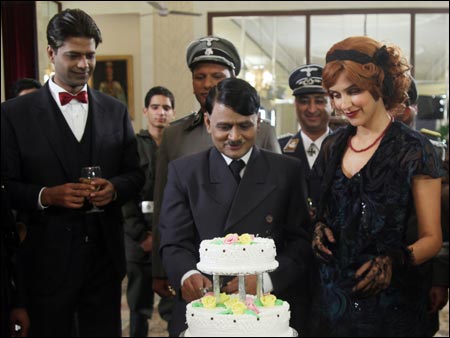
Gandhi to HitlerThere are three sets of letters written in Gandhi to Hitler (2011) – from Gandhi to Hitler just after the Blitzkrieg, from Hitler to his people just before his death and between a jingoist Indian army officer (Aman Verma) wandering war-torn European countryside and his Gandhian wife back home – none of which are ever read. This is only one of the hundred methods by which the film engages in there-are-no-winners-in-war philosophizing and attempts to establish a ‘universality’ of grief and suffering. The picture is an amalgam of wish fulfillments: a chance for the writer-director to remake both Saving Private Ryan (1998) and Downfall (2004), for the home audience to see their own WW2 movie and for Raghuvir Yadav (Adolf Hitler) to be paired with Neha Dhupia (Eva Braun). Only Mohandas Gandhi gets a raw deal, existing solely as a mirror image of the German chancellor. (This vehement contrast informs the organization and style of the first section of the movie: Hitler snaking through in his bunker cut to Gandhi walking through the corridors of his Ashram, the Führer belittling the officers around him with Gandhi preaching to his followers, the gradual disintegration of the Reich with the fortification of Gandhian movement). This split is also established within the third narrative track centering on the officer (and his Gandhian wife) leading group of Indian soldiers (under S. C. Bose, who sided with the German army), consisting of men of various religious persuasions. Not just the structure, but every shot in Gandhi to Hitler exists to present an idea, to illustrate a convenient thesis, while the direction, acting, editing and photography go into auto-pilot. But the film’s boldest move – which, I’m sure, reviewers would relish picking on – is to have an all-Indian cast, speaking Hindi throughout: a virtue born out of necessity that’s also a rebuttal of conventional wisdom about realistic storytelling, which is fixated on appearance, plausibility and imitation.

(Image Courtesy: GlamSham)

7 Khoon Maaf (2011) (7 Murders Forgiven)
Vishal Bhardwaj
Hindi


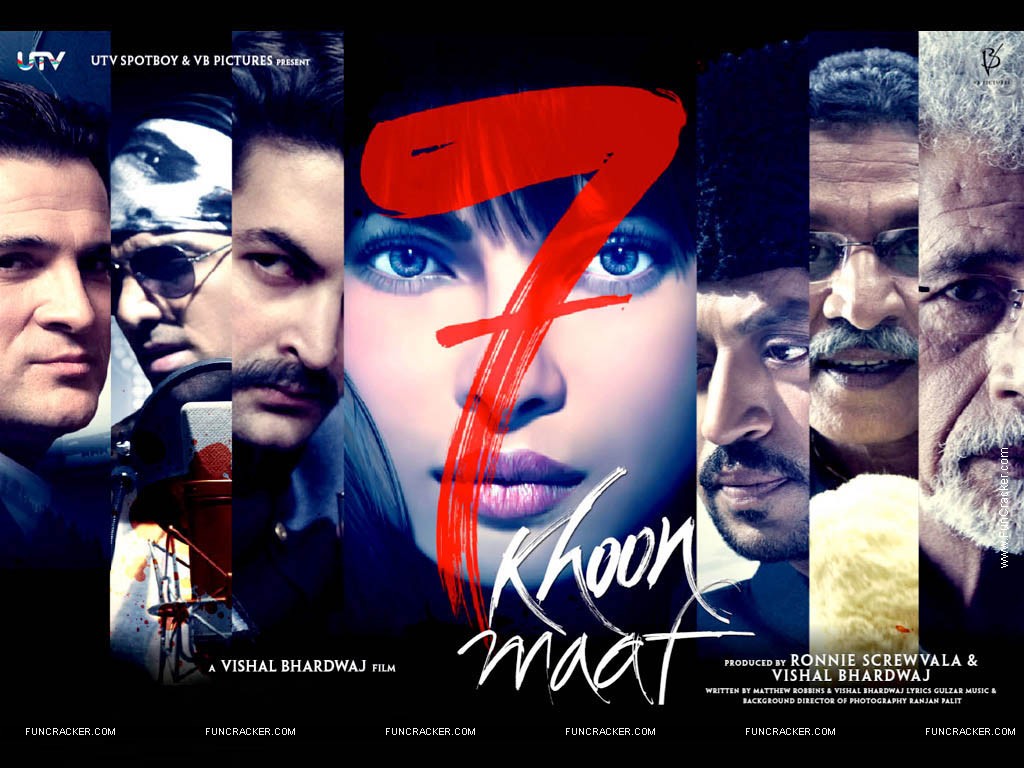
7 Khoon MaafSo we have two high-profile filmmakers releasing two remarkably symmetric films this weekend which wear their inspirations on their sleeves. Both these similarly structured films give us serial killers traumatized by childhood events. But, while Menon’s movie is like gazing into a fish bowl, Bhardwaj’s is akin to peeping through the door lens. It is not the protagonist, Susanna (who befittingly misses an emotional arc, played by Priyanka Chopra) but the world around her that is distorted in 7 Khoon Maaf. Right from the beginning, we are told, she is in search of father figures (through her six husbands) to replace her deceased biological father (which, of course, culminates with her marriage to the Son, her ordinance, which wittily distorts her line about drinking her husband’s blood). Along the way, she seems to see herself as a feminist twist on Christ (which goes well with Bhardwaj’s not-so-singular brand of militant feminism) who suffers for the sake of those who follow. She seeks forgiveness for her seven sins, her seventh sin being exactly this misinterpretation of Christ’s mission, to militarize Jesus, to bring him to earth, to replace forgiveness with retribution, to ‘kill’ him. However, where Bhardwaj’s film trumps Menon’s is that, although it lends itself to easy Lacanian reading like Naaygal, 7 Khoon never attempts to reduce characters to psychoanalytical toolboxes. Spanning several decades (Bhardwaj clumsily attempts to contextualize the narrative, using political events while, given the themes, he should have done precisely the opposite: collapse history and let anachronism reign), 7 Khoon hops across film subgenres of the west (costume drama, period film, concert picture etc.) all the while having a very ‘Indian’ heart (The commentary on Indian patriarchy almost swaps targets in the Russian segment), as if remarking upon Bollywood’s skin deep aping of Hollywood cinema. This masking of ‘Indian-ness’ by ‘European-ness’ and of (regressive) actualities by (progressive) surfaces and of the present seemingly repeating itself to eternity is, ultimately, is what 7 Khoon deals with. And it deals with pretty well, even if one gets the feeling that a rewrite would have done more good.


(Image Courtesy: Fun Cracker)

Raavan

Men On The Verge Of A Nervous Breakdown 
(Image courtesy: Raavan Official Site)

Towards the end of Mani Ratnam’s long-awaited Raavan (2010), one of the characters looks at the camera and says “You shouldn’t have turned back”. He might well have been talking to the person behind the camera. Raavan is a visual and narrative mess, with lots going for it and even more going against it. What seems to be a major hammering on a minor flash of brilliance has taken over three years to make. There is nothing much about the plot of Raavan that you already haven’t read in your schoolbooks and seen in your televisions. I suggest you read the Wikipedia entry on Ramayana and plug in the actors’ names beside the characters’ yourself. You wouldn’t be very wrong. There are, however, two major changes to the text that writer-director Mani Ratnam has done. One; the back story of Ram has been removed altogether and a new back story for Raavan has been added which attempts to put things in his perspective and to justify his acts. The second and the more important change is that Raavan has been relegated from a higher caste to a lower one. The second change opens up a number of new possibilities given the setting of the film.

Throughout his career, with a few exceptions, Mani Ratnam has been interested in writing stories in which personal drama plays out along and against national affairs and topical issues. Almost all these ‘issues’ that he deals with could be traced to newspaper articles or cover stories (communal riots in the city of Bombay, cross border terrorism in the far east and north, student protests down south, the LTTE, business scams etc.). It is true that there is seldom any rigor in these analyses, but where Mani really scores is in the other layer of these stories, in which he deals with people who are stuck in (or, less frequently, who help create) these social and political upheavals. He seems to be more interested in the lives of these ‘individuals’, without the trappings of any ideology, and the relationship between them. More often than not, these issues have been a pretext for exploring the fears, apprehensions and hopes of these individuals, who seem to be suddenly thrust into these agitations. As a result, the issues themselves stick out like a sore thumb even when they are handled with solemnity (Compare one of these with a film like Alaipayuthey (2000) where he completely de-politicizes the drama to break down the tale to human levels. The result is a completely bourgeois film, but also arguably the director’s most honest work to date).

Another facet of Mani Ratnam’s writing is his fascination with people working on the wrong side of the law. Right from Velu Nayakar, through Deva, Liaqat, Meghna, Inba/Lallan, Gurukanth Desai and up to Beera, all of Mani Ratnam’s central characters have been exploiting legal loopholes and even defying the legal system. All of them have a moral justification for their deeds and, with the probable exception of Inba (one of the director’s best characters, for he is the product of both an ideology and his free will), all these characters have their own definitions of what is objectively good and what is not. And this moral relativism is what they seem to consider as their redemption and it is what redeems them in the audience’s eyes (What makes the character of Velu Nayakar profound is his inability to morally assess this feature of his). Throughout, Mani’s attempt has always been to, if not construct a holistic and unbiased view of the world, recognize the ‘other’ as human and empathize with their situation. A fan might say that Mani is a silent rebel. But the truth remains that Mani Ratnam has always been an armchair liberal. In nearly every one of the cases above, he leaves the issues unresolved, as if they never existed in his film, and the audience unquestioned. He involves himself deep enough so as to raise questions and make us reflect about the state of the nation temporarily, but keeps himself aloof enough to avoid assuming or giving us responsibility.

But that is not to say that he should be resolving these issues and should propose a direction (which would be too much to ask and which runs the risk of making the films propagandistic – a fatal move for a director who works within the establishment), but the least he could do is test our own moral standings and elicit a complex response from us, as did the last Tarantino movie. Mani is a master of bad endings and even he can’t object to that complaint. Everywhere, he has resorted to either indifference or populist didacticism to restore the film to conventional pop-cinema trajectories. A special note must be made for the ending of Yuva/Aayitha Ezhuthu (2004), despite its crudeness, where, for once, the director throws away the armchair and retains the liberalism. That brings us back to Raavan, which sure does imbibe all these traits above. The villagers in the film are obviously based on the Maoist settlements of central and south-eastern India and their leader Beera is a resistance fighter combating the police and armed forces.  The plot points are heavily inspired by Operation Green Hunt, but the region of interest for the director, predictably, remains the triangle of characters at its heart. Oh, but there’s also something going on in the background of these characters. For the second time, after his reworking of the Mahabharata in Thalapathy (1991), Mani Ratnam resorts to an existing mythological text for a template.


[Raavan (2010) Trailer]

Mani Ratnam could have been faithful to the text, playing it out in its entirety and stressing and modulating key sections of it to reveal its inherent sexism and chauvinism and, subsequently, investigate how such a flawed text governs our behaviour. Or he could have stuck, as was his style so far, to the Maoist issue alone and examined the tensions underneath. Instead, Mani relocates the Ramayana into this politically charged narrative, making a few key changes for the sake of authenticity, and compromises both possibilities. Many of the characters in Raavan don’t exist for their own sake, but only to play other characters and to complete an existing narrative framework. Now, this isn’t the film’s biggest problem, but for viewers familiar with the text, it goes on to become monotonous and self-parodying. It is also a bit appalling to see a director like Mani Ratnam going for such banal character mapping. The film’s biggest problem is, however, its viewpoint. Now, the point that the film tries to be making is that there is a Ram and Raavan in every one and that it’s only a matter of context that one becomes the hero and the other the villain. But the whole film shows otherwise. There is not one virtue bestowed upon Dev or one vice assigned to Beera (Being an officer in the police force is the only positive thing about Dev, but Ratnam drains that position of any goodness). It’s all still black and white. The film never moves on to the grey area that it claims it is in. This lack of a moral complexity denies the film any real resonance. It is made clear from the very beginning that Beera is the one the audience needs to root for and Dev is the one to be cursed (The casting only worsens the problem, with Abhishek Bachchan being less easier to hate than the newcomer Vikram). Mani does not balance the sides, as is required, he merely swaps them.

However, the film’s redeeming factor lies in the way it sketches these decidedly good and decidedly bad characters. Dev (Vikram) is the icon of a perfect male god. He is macho, sporting a neatly trimmed moustache, well-built, determined and self-assured. But he also seems to be overconfident of his seemingly infallible masculinity to the point of being sexist. His egocentricity defines the world with respect to himself (the camera gyrates around him quite a few times). He considers his wife and his gun to be fairly interchangeable objects which could be used to demonstrate his power. Mani Ratnam floods the mise en scène with phallic symbols when dealing with Dev. Wielding razors, pistols, sunglasses and cigarettes throughout, Dev is the ultimate patriarch who can control the people around him at will. Or so he thinks. This vanity is his biggest vice. And the disillusionment of that masculine vanity is the cause of his fall. Dev seems to be more interested in killing the man who kidnapped his wife than rescuing her or finishing the mission he is assigned. It is the thought that his wife may have found a better man – that his wife’s fantasies might have outgrown his capacities – that frustrates him more than the fact that she is kidnapped. In that respect, Dev has a lot of counterparts in Hollywood including Dr. Harford of Eyes Wide Shut (1999). What Dev is fighting for is, then, his own potency that has been snatched away by this sociopolitical outcast. He can only do this by killing off any man whom his wife may have considered better. And that is what he sets out to do.

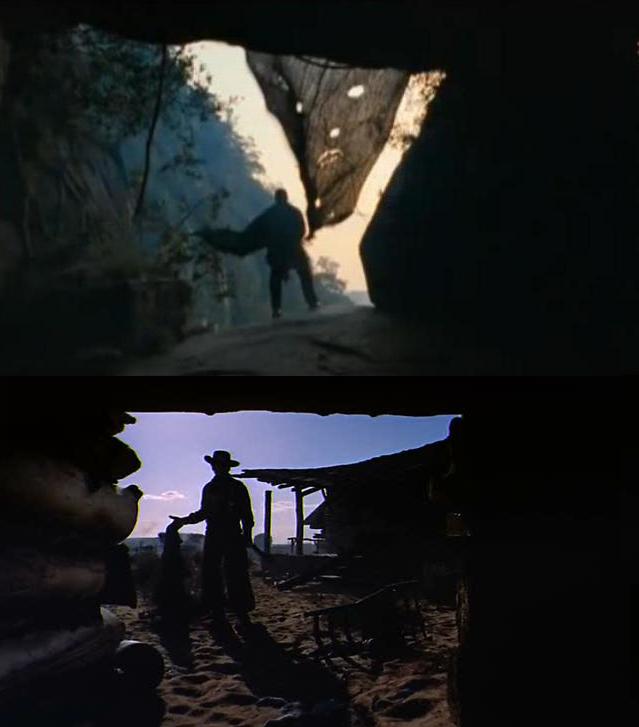
Beera (Abhishek Bachchan), on the other hand, lies exactly at the moral and physical midpoint between Ragini and Dev. He is a man who’s more self-aware and empathetic. He has already realized his own limitations as a ‘man’ the moment his sister was snatched away by the police force some time ago (“It was my fault” he says). Unlike Dev, he is a very progressively thinking person and believes in equality. And unlike that Ram, who can not see anything but lies on Ragini’s face, this Raavan trusts her with his life (and his phallic gun, if you will!). But he is also a man on the verge. He could flip over to the other moral side any time soon. His “jealousy” could turn out to be an obsession. Why, he teeters on the boundary between life and death every day. Each one of his ten imaginary heads might be saying a different thing every time. His temptation of avenging his sister by reciprocally violating Ragini is undone by the fact that both Ragini and his sister are merely variations of each other (This implicit aversion towards “miscegenation” in Raavan is but one of the very many narrative, visual and thematic elements that the film shares with The Searchers (1956), a film that is also set at the native frontier and the film that Raavan wants to emulate). These two people who leapt towards death without fear are the only persons who could stand up to Beera and speak. They are the only ones who prevent him from becoming a Dev. This idea of living on the edge is continually underscored by the film’s visual strategy that employs highly expressionistic landscapes. Beera is usually located on a dark cliff beyond which there are only the white waters of death (and redemption?). He is regularly seen straddling dark geographical structures and the white mist-like atmosphere. Even when he is a mysterious, dark, fearful figure, he is associated with harsh light. Samir Chanda’s production design is noteworthy in this regard. Beera’s idea of redemption is a very subjective one and his vindication seems to be in making Dev realize how morally integral he is, despite his caste, and how unethical Dev is, despite his social and legal standing. Of course, for this he throws his political objective to the wind, as does Mani Ratnam.

Ragini (Aishwarya Rai Bachchan) is the symbol of moral strength purity in the film. She’s the only character in the film who could safely be called “objectively good” (for one, Aishwarya Rai is significantly fairer than the other two men in the film. Politically incorrect? May be. Cliché? Definitely). In some ways, she is the mirror image of Dev, and surely the better half, and repudiates all that he stands for. She’s the only person in the film who gets to see the full picture. She acts fairly rationally and, unlike the men, knows no class, creed or ideology (Amusingly, she almost exclusively moves vertically within the frame throughout the film – plummeting and ascending, skidding and rising amidst the rocky mountains – as if transcending the rigid ‘horizontal’ notions of class). She knows no fear in front of Beera, for she has nothing to be afraid of, unlike Dev and his entourage. Beera is just an arbitrary terror for her. And this independence of hers is what brings Beera to earth from his demigod status. These are very interesting characters, no doubt, but our response to them remains highly one-dimensional. As a result, the film turns out to be as one-dimensional and biased as the text it wants to deconstruct. And yes, the film that Raavan wants to be has already been made ten years ago. And how!


Rating:

So, for the second time, the Pharisees
summoned the man who had been blind and said:
“Speak the truth before God.
We know this fellow is a sinner.”
“Whether or not he is a sinner, I do not know,”
The man replied.
“All I know is this:
Once I was blind and now I can see.”


Right after I posted my epic fail review of Ishqiya, bits and pieces of the film started to sink in. Many of the film’s odd choices seemed to gain a significance of their own and, before I knew it, like those clichéd second act endings, they all fell in place, presenting a whole new perspective to the film. Out of the dozen reviews I’ve read of the film, only my friend Satish Naidu’s review seemed to hit the right notes. I strongly recommend reading his review if you’ve seen the film. And yes, spoilers here too (Well, there isn’t really much in the movie that you can’t guess beforehand).

There is a post script, in Ishqiya, to the kidnap set piece where Krishna, amidst a serious argument between Babban and Khalujaan, drives the car away leaving them gaping. She might well be driving away the film there, for Ishqiya, more than anything, is about the resistance to a male view of a world by a female perspective. Ishqiya is a Western alright, with its war-torn landscape leaving no other philosophy to exist other than “might is right”. But that really doesn’t give anyone a license to call it a man’s world. The story unfolds, primarily, in the point of view of the two men, but, rather than being protagonists with clear cut objectives, they are frames of reference – a telescope – using which we view and, unfortunately, try to ‘solve’ Krishna, that obscure object of desire. Yes, they are characters of considerable depth, but they are also, ultimately, peripheral. A quick note, to begin with, about the casting of the film which seems to me like a stroke of brilliance. We have here Naseeruddin Shah and Arshad Warsi, men who have rarely been the flawless heroes, who have made a career out of bumbling and imperfect protagonists. They automatically bring into the movie with them flawed male visions that belong to two different generations. Krishna is played by Vidya Balan, who has had a popular image that could well pass off as an icon of the chaste Indian female. This incongruity between what appears and what is, which defines the whole of Ishqiya, is only furthered by this distance between Balan’s image and Krishna.

Babban and Khalujaan are closer to Truffaut’s Antoine Doinel (Jean-Pierre Léaud) than any other film character I can think of. These men are (con-) artists too, like Doinel, as exemplified in their introduction scene, where Babban tricks Mushtaq with his story and flees with the money. Like Truffaut’s character, who spent a lifetime wondering if women were magic, these men can understand the opposite sex only in terms of art or, in this case, popular cinema (where Krishna is aptly photographed like being frozen in a film frame). It is only through popular film songs that these characters are able to even express their emotions. Khalujaan may make numerous mistakes in his real life, but never does he get the composer of a song wrong. Babban believes dressing up as a movie star will help him woo the girl. As noted earlier, these are men of flesh and blood. They are deeply flawed and they realize their limitations. Babban drags back Khalujaan from his macho, decidedly Western romanticism of taking Mushtaq head-on, as if reminding him that this genre movie is no place for them. In Leone’s Once Upon A Time in the West (1968), Frank (Henry Fonda), upon being asked if he is a businessman, says: “Just a man”. Like Frank, these two crooks understand every shade of men and their behavioral patterns, no matter what age group they belong to. However, for these men, like Frank, women just can’t fall in any category other than in the binary setup of the mother and the whore (Khalujaan tells Krishna that he can’t tell whether she is an angel or a courtesan) that popular cinema has given them.

But Chaubey doesn’t give a comic tinge to his characters as much Truffaut does. Yes, they do deliver those funny lines, but they are serious men. They have their own issues. Babban, also true to Bollywood morality, does not want Khalujaan to sully his mother’s name. Khalujaan, on the other hand, takes his past seriously too, through his possibly deceased (possibly non-extant) sweetheart. He really does believe that he can settle down in life. But these are not their mistakes. They are, after all, real men with real emotions and problems. These are not caricatures that we can disregard easily. In any other film, they could have been the backbone of fine drama. Their real mistake, however, is in believing that they are the only ones with problems, that they are the film. The sin of these flawed men is in believing that the woman they fall for would be unflawed. Krishna driving away the car should have given them a clue. But, products of a patriarchal society and cinema that they are, they never realize that. In fact, the whole film is built upon such male perspectives that see nothing more than what they want to see. Krishna’s husband chooses a male-dominated caste war over his wife’s love. Mushtaq prefers to keep his wife as a mere voice heard over a telephone like a horoscope (announced by a Bollywood ring tone, of course). For KK, the fidelity of the male is nothing more than a small joke. Even we, the children fed on the stereotypes of Bollywood, attempt only to classify Krishna into rigid adjectives – femme fatale, all-powerful, resilient, gutsy, seductive – whereas she may be as vulnerable as the men around her.

The key is the scene where Krishna meets her husband once again. She breaks down, for the first time in the movie, revealing her vulnerability. She stands there, with her motives exposed, being emotionally hit. All this while she had been toying along with the two conmen, for she was far assured of her modus operandi. She offers tea for the man who gives her a better kidnap plan, only to deliberately fire the other one up. Krishna, in the scene in which she sleeps with Babban, clearly reveals that she is only exploiting this lucky situation that has come her way for her own good and with the assurance that and that the plan is on track. Not now. The petty goons are all down now. It’s now man on man, so to speak. It’s the only showdown this revisionist Western will have (My genre-addicted mind would have liked a couple more extreme close-ups). Film critic Baradwaj Rangan, perceptive as always, notes that Krishna is essentially an updated version of Jill (Claudia Cardinale) in Once Upon a Time in the West. That, I guess, is the only kind of classification that Krishna can be subjected to. The strongest point of the movie is that it does not try to define her or push her into a single zone of existence in which she may be only be moral, immoral or amoral. She, like many of us, could well be straddling all three. What we may be having here, far from being a character study, is personal cinema in which the writer and director are sharing our own inability to understand Krishna, and by the fact that she is the only woman in the film (not considering the old woman, who might well be an aged Krishna), women in general.

We, the audience, on the other hand, are frustrated like Khalujaan because of this inability to break her down into stereotypes. When she sucks the blood out of Babban’s thumb, one is tempted to jump the gun and label her a vamp. But she might just be using another lucky opportunity there, to strengthen her chances of pulling off the kidnap. Or may be not. Krishna defies identification, which we have all been accustomed to, through standard templates reserved for women in Bollywood which, in turn, are derived from popular mythological figures. She might be sharing herself with many men, taking turns, but she is far from the ultra-faithful Draupadi that her name means. She might appear to be pining for her beloved, a la Meera, as she sings, but that pining is for something else altogether. She is like Savitri too, but she prefers dragging back her husband to death (Death and Krishna being the two people he tricked) rather than the usual way. In the final scene, she merely attempts to restore back a reality that wasn’t. When she faces her husband again, she might well have paraphrased  that legendary Bresson line: “I’d rather prefer you leaving me for the love of another woman than for what you call your intellectual life“. And when Babban watches her undress, there is not only the distance of voyeuristic cinema between them, but also this literal wound of Krishna’s past, which only breaks out during the final confrontation, that adds one more layer of enigma for Babban, and consequently us.

It is the opening and closing scenes, or even shots, that really tie the movie together. The film opens with a male perspective, fading out of black, with Krishna on the bed in a reclining, arguably sexist pose. She appears nothing short of a magical being, which is an opinion only the male could have here (Let’s stick to straight orientations for now). And it is a pose that typifies the attractive woman in Bollywood cinema. From this point on, the film’s male perspective, our own “male” perspective and the Bollywood perspective get tied together. And the film closes, literally, with another male point-of-view. Here, Mushtaq watches the three walk away through the lens of his sniper gun. Khalujaan and Babban walk happily, perhaps with the idea that they’ve understood Krishna and one of them will “get the girl”. What they don’t understand is that the real trouble begins after this (This real-drama-begins-after-the-end-credits-roll facet of Ishqiya is one of the reasons why I was reminded of that Almodóvar film whose title I borrowed for the review). Their belief that they will return to a more conventional cinema zone, in which women are easily deconstructed, may well be shattered the next minute by Krishna. As the film presents a POV shot of Mushtaq watching them through the lens, the black circle closes in on the three, thereby ending the film simultaneously through our perspective, Mushtaq’s and in a manner unique to classical feel-good cinema. Chaubey’s film is cynical in a way. It breaks into a new world from within a undoubtedly male world of Bollywood and, at the end, restores that new world back to its obscured state. It unveils the groundbreaking Krishna through a male vision and, then, locks her back using the same, as if suggesting that popular cinema, itself included, will never understand “the woman“. Well, that acknowledgment is a start.

« Previous PageNext Page »