Books


A Serene Nihilism

Le Nouvel Adam no. 11; June 1967.

Antonioni bores me to death. But when a mediocre or overrated filmmaker makes a good film (or the opposite), I say so frankly. I practice fair-play, even when it comes to tennis.

Hence this article on Blow-Up, which, in my opinion, is one of the rare defensible Antonionis, along with The Red Desert and Identification of a Woman.

The reason for this amazing miracle: this filmmaker is really at ease only in colour film.

Blow-Up, Antonioni’s second English film after his sketch for I Vinti (1952) and his second great colour film, is a series of images, of moments, where a number of important things sometimes happen, but which don’t seem to have been chosen. We get the impression that they could’ve been different, that it could all take place as much in Buenos Aires or Paris as in London—like in Julio Cortázar’s Les Fils de la vierge, the original novella the film is based on—without much change. Blow-Up stretches the last ten minutes of Eclipse (1961), which came at the end of a story and forgot all about it, to over two hours.

What’s the connection? It’s a famous photographer from London—photography is a means of combatting nothingness, wrote Cortázar. Antonioni seems to have chanced upon his hero at the beginning of the film, but he accompanies him until the end. Then begins a semblance of a plot, first presented like one of the film’s many moments quickly abandoned for others, so as to not make us wary: he photographs a pair of lovers in a park. The woman tries to get the negatives from him by any means, without clearly-defined reasons. He makes blow-ups after blow-ups, observes them, seems to discover the traces of an attempted murder, comes back, finds a corpse, returns to the place, finds nothing. Every episode remains very chaotic, every blow-up a little fuzzier, every meaning is destroyed by the following one right away. Dream or reality? The answer seems—there are only semblances in this universe—to be of no importance. Visually, the film is bright, but its logical meaning slips irreversibly into obscurity. Every time a character does something, tries to love another, loves another, there is no rhyme or reason.

It’s the death blow to psychology, the perfect vegetative film. There is no certainty, not even that the previous certainty has been undone. It’s really a supreme disdain for meaning, quite like in Cortázar. Antonioni has borrowed only two ideas from him, the couple caught by surprise and the blow-up, but he takes his nihilist spirit along. The importance given to physical love could stir discussions about materialism. But materialism itself is a form of affirmation. It’s chance rather than desire that seems to drive relationships here. And dream and reality are always on the same footing, except at the end, which is more clearly unreal: masked characters play tennis without a ball while pretending to have one. The photographer agrees to play along, go collect the ball fallen outside the court and throw it back.

Nothing exists, but we must act as though something exists. At the end of this sequence that concludes and summarizes the film, this gesture, a little too meaningful, diminishes the general impression of absence. It short-changes the viewer and especially the critic too easily. Blow-up is a film that shouldn’t have ended and it was necessary for it to give the impression that it will not. But the film as a whole, following Borges and Cortázar, belongs to what I’d call the “Midi fantastique” as opposed to “Minuit fantastique”, a fantasy based on light and not on darkness, on the mundane and not on old tricks of the trade.

The difference from Antonioni’s previous films, from L’Avventura or The Red Desert, is the serenity. The characters in the earlier films were tormented and constantly spoke about being tormented. The hero of Blow-up is silent. He is overworked, he isn’t tormented by anything profound, and the filmmaker even less so. This is what distinguishes him from Godard, whose approach Blow-up evokes to an extent. Everything takes place calmly here.

The film is relaxing, pleasant to watch. Perhaps it’s an ablation of conscience or alienation, but if it’s alienation, it’s not so bad. What surprises us is that the hero and the filmmaker can remain indifferent and calm before so many oddities and enigmas, so much rage. The rhythm, the colours, the atmosphere contribute to give the impression of acceptance and appeasement. Antonioni makes us hear the wind in the forest like we never have. He brings out the multiple tints and settings of the most technical of modern lives through the photographer’s studio and apartment. These tints are so new to the screen that, under the shock, we aren’t able to decide whether Blow-Up is a beautiful film. It’s a film that’s evidently very rich on a plastic level and it’s this aspect, I think, that accounts for its enormous commercial success in the United States, with its picturesque, stereotypical images of contemporary England. London life in summarized in clichés worthy of a vulgar tourist.

But Antonioni seems to have wanted to say, most of all, that there’s nothing beneath it all, and to not crank up the commercial aspect of the film, in which the public can get caught even though they are not harnessed. Blow-Up’s visual style holds another pitfall: it’s likely to keep from those who admire it the most difficult and most important aspect of the film, contained in its approach and its meaninglessness. It would be a serious misinterpretation, a serious “mis-non-interpretation” rather, to believe that the film is an exercise in style.


[From Luc Moullet’s Piges choisies (2009, Capricci). See Table of Contents]

Nothing About My Mother

Unpublished

I am well-regarded by publications interested in cinema.

Even so, this article was rejected everywhere.

I already had a hard time getting my revaluations of Powell and Deleuze through.

There was a time Leenhardt could yell:

“Down with Ford!”

Truffaut took down Clouzot and the “tradition of quality”. Rivette insulted Pontecorvo. Positif dragged Hitchcock and Bazin through the mud.

And nonetheless, this frankness—well-founded or not—paved the way for a healthy dialectical reflection.

Impossible today: everyone sticks together.

Today, everyone’s so nice and kind. The result is that every filmmaker is face-lifted to the same level: the oblivion of the crowd… Impossible to discern who will be the great filmmakers of tomorrow, or even today!

Spain suffers from a handicap: it’s not cut out for cinematic mise en scène. It’s a handicap that it makes up for largely with the richness of its pictorial expression. Similarly, the Germanics are strong in the realm of music while they remain impermeable to comedy and humour.

This Hispanic deficiency is all the more manifest because its little neighbour, Portugal, demonstrates an exceptional cinematic verve.

A cruel paradox: a Spanish filmmaker is really interesting only when he moves out the country (Buñuel, Arrieta, Coixet), which recalls the case of Hitchcock and England. I know well that there was Franco, but it’s a lame excuse: he’s been dead for more than thirty years.

The problem is that in most countries with a production that’s limited or of reduced interest, there is always ONE flagbearer filmmaker, Bergman, Dreyer and then Von Trier, Moretti, Kaurismaki, Wajda, Jancso and then Tarr, Pintilie, Kusturica, Angelopoulos, Van Der Keuken, Oliveira, Ben Barka, Lakhdar-Hamina, Boughedir, Hondo, Sembène, Ouédraogo, Cissé, Cronenberg, Alea, Sanjines, Ripstein, Solanas, Gitai, Omirbaev, Kiarostami, Chahine, Satyajit Ray, Weerasethakul, Brocka etc. It’s very convenient: the bulk of state funds goes to a single film rather than twenty. Neat savings… National representation at festivals is always assured, the selectors needn’t waste time searching. And the cultivated viewer believes he’s seen everything a country has to offer when he savours the work of the Chosen One. A particularly questionable, elitist system, especially when the filmmaker in question heads the local Centre for Cinema himself—frequently the case in Africa—and doesn’t give a damn about others or the future.

It’s all fine when the lucky laureate is called Ingmar Bergman. But it borders on tragedy in Spain. This country has found nothing better than choosing its champions among the creators of a pretentious and empty body of work, earlier Bardem, then Saura, today Almodóvar1, to whom our Cinematheque has dared to dedicate a retrospective…

His roaring, blustering, warrior-like surname sounded good to my ears: the strangeness, the strong ending, like in Guadalquivir. I’d have wanted to like Almodóvar so much. Names matter. I’m convinced that it’s primarily because of his name that Apichatpong Weerasethakul became a hit.

My first contact with Almodóvar was thanks to Women on the Verge of a Nervous Breakdown. I was quite amused by the application of the laws of Hollywood screwball comedy to a modern, hip Madrid milieu, which was a first. The Screenplay Award at Venice seemed justified to me. But it didn’t go any further than a Blake Edwards comedy.

Then I started watching Tie Me Up! Tie Me Down! Even tied, I couldn’t have remained on my seat: an Almodóvar film is foremost a tedious litany of vaguely lewd lines, à la Michel Audiard, haphazardly assembled. It’s a catalogue of somewhat perverse sexual fantasies, spoken about more than shown. A catalogue of no great interest. It’s true that it’s funny for five minutes… It’s Russ Meyer lite, or more exactly a poor man’s John Waters. Waters’ superiority over Almodóvar is that he knows to remain within his natural limits, that of pure fun and play, while Almodóvar reaches vainly towards much loftier horizons.

Live Flesh is constructed mostly on oblique and unusual framing, pretty but gratuitous. We are midway between Vadim and Albicocco.

I then began understanding why the first six Almodóvars were systematically rejected by festivals. Nothing has changed since then in his films, if not for the birth of a certain snobbism. It’s the same with Guédiguian: first limited to a restricted circulation and then sought after by everyone, even though he hasn’t changed his refrain one bit, the difference being that the filmmaker from Marseille is on a much superior level than the man from La Mancha.

I systematically avoided Almodóvar’s productions after that. Out of curiosity, I went back to him when good things were being said about his two new films.

All About My Mother ostensibly quotes Mankiewicz’s All About Eve, while Almodóvar’s practice, as we will see later, is diametrically opposed to the psychological analysis so dear to Mankiewicz. It’s as dishonest for him to call his film that as for me to start naming my films The Genius Line or New Sunrise. There is a pile of gratuitous film references in Almodóvar (Night of the Hunter, Gena Rowlands, Fellini, Pasolini, Bergman etc.) that are present to attract the complicity of critics and cinephiles. Anyway, let’s forget the title. It’s enough that All About My Mother be named Manuel and Esteban for my criticisms to fall flat.

All About My Mother grabs our attention, as does the subsequent work, Talk to Her, through various colour choices within the image: a colour on the left, another on the right, a third one at the centre. But it remains purely decorative.

Special attention is devoted in this film, and in Talk to Her, to the ill and the handicapped, to the hospital setting, which Almodóvar’s friends—victims of AIDS, which he’s perhaps afraid of—must’ve gone through. Let’s note the film’s best moment (along with the nice verbal digression on the cost of plastic surgery). I mean the camera movement that runs along the tube of the drip. Still life in Almodóvar’s films is always more interesting than the characters (cf. the windmills of Volver). It’s true that it appears at the very beginning of the film. There are numerous filmmakers with a short-lived inspiration who put in some effort into the first shot of the film (such as the windswept graveyard with its choir of cleaning women in Volver), but are likely to disappoint in the next five hundred…

We can certainly give some credit to this film which seeks, through a stream of dialogue more mundane than usual, to bring to life and humanize characters of strange comportments, to say the least: there is a desire here to turn homosexuality—gay or lesbian—and bisexuality, often marked by transvestism, into majoritarian, universal and indispensable values. But this effort is contradicted by the caricatural, fantastic aspect of the paradox, more capable of being expressed in comedy—which allows for all fantasies—than in the drama presented here: two or three deaths.

The realist treatment of the film doesn’t make for a good choice.

It’s impossible to believe in it, to surrender to emotion, since none of the particular sexual attitudes repeated endlessly through the film, none of the considerable behavioural changes (why does Lola shuttle constantly between heterosexuality and transvestism? Why does the young woman sleep with “him”?) is deepened, harnessed or justified. All things considered, Nothing About My Mother would have been a more appropriate title for the film. What remains is the provocative and gratuitous bizarreness of the sexual acts.

Helped by a rather endearing Boccaccian flavour, Talk to Her marks a slight progress into an interesting trajectory. But it remains too long for a story that shouldn’t have moved beyond the short film stage. A male nurse in love with a comatose patient makes her pregnant. Besides the fact that we realize what’s happening much before Almodóvar explains it to us in great detail, Talk to Her disappoints us with its touristy, “Spain in ninety minutes” aspect, with bullfighting—a female matador, just to be fashionable—and a ballet show thrown in for free. Matarazzo (Il Tenente Giorgio), Kleist and Rohmer (The Marquise of O) were much more inspired on the subject of blind or lethargic coitus than this mediocre codicil.

Bad Education turns out to be even worse. It keeps ramming down our throats the idea that, under Franco, all priests were faggots. Which, made in 2004, seems to us to be appallingly banal, especially given that it’s drawn out to feature length. I couldn’t hold on till the end here too.

Besides, there is a contradiction between the systematic criticism of this paedophilia—a very universal attitude today and thus rather opportunistic—and the tolerance and sympathy that Almodóvar demonstrates towards all forms of homosexuality.

When all is said and done, it seems that Spanish cinema has held on only thanks to Francoism, by trying to undermine it from within until the death of Caudillo, or by denouncing it very explicitly later. Which, thirty years later, seriously limits our view of Spanish cinema, as though French cinema still revolved around Resistance or anti-Gaullism.

The beginning of Volver nicely surprised me. There is here a charming chronicle based on the observation of places and mores in La Mancha, which borders on caricature but remains pleasant.

Alas, returning to Madrid, Almodóvar lets himself be run over by the mechanics of a plot that’s at once banal and very complex, too farfetched to be able to bring out the pathos of the characters and their emotions. The choral aspect of the film breaks the emotion sustained by the melodrama, which generally relies on the viewer’s identification with the central character and thus on a not-too-unbelievable context. Note the enjoyable ease with which the protagonists move in an unusual, hardly believable universe. But that’s not enough to reverse the trend. Despite some good gags (the sounds of kissing, the winds of the mother from under the bed), the mechanical parade of plot twists leaves little place for humour, which would’ve been really valuable in such a storyline. The film is always midway between an umpteenth TV sitcom and its parody. Almodóvar juggles with all facets of a scene and loses every time in this little game. He is always caught between two stools and lands on his ass. It’s not good, especially in cinema, to begin on a high note and go downhill from there. The opposite would’ve been better. Almodóvar’s problem ultimately is that his films are badly conceived, badly organized, off-centre, unbalanced and half-assed.

All said, what’s positive about him is that he unwittingly enabled—thanks to the similarities of their surnames—the growth of Amenábar, a filmmaker more worthy of interest and who constitutes, with Coixet, Alvarez, Rocha, Serra, Rosales, Alvares2 and especially Victor Erice (from whom Almodóvar stole the title of Spain’s best), the true Hispanic cinema of today, much more certainly than the bon mots and Banderillas of the windbag from La Mancha3.


1Earlier, a comparable snobbism glorified Ken Russell, Jean Delannoy, Serge Bourguignon, Rex Ingram, all of very ephemeral value…

2These names prove that Iberian film art (cf. Buñuel, Arrieta, the Portuguese) necessarily involves the experimental.

3On the other hand, the success of our filmmaker has, alas, forced the majority of Spanish filmmakers to do Almodóvar.


[From Luc Moullet’s Piges choisies (2009, Capricci). See Table of Contents]

In Memory of Jean Douchet (1929-2019)

[The following is my translation of the interview with Jean Douchet that introduces his collection of DVD reviews, La Dvdéothèque de Jean Douchet (Cahiers du cinéma, 2006)]

Your first collection of articles, L’Art d’aimer1, was published in 1987. It’s almost been twenty years since. What was the context for this book, which has since become a reference work?

I moved away from Cahiers following a famous episode—the magazine’s opening up to modernity and to great thinkers of the sixties (Levi-Strauss, Barthes, etc.): to put it briefly, it seemed that the kind of criticism I encouraged and practiced wasn’t intellectual enough. This separation lasted a while, until Cahiers’ Maoist period of the seventies, when the magazine almost went into a turmoil. It was an interesting phase too, but that’s not the point: I remember being very worked up about the collective article on Ford’s Young Mr. Lincoln (No. 223).

I came back to Cahiers little by little, notably with the interview “Douchet dissects De Palma” (No. 326), on a filmmaker that the magazine didn’t like at that point in time, not enough to my taste at least. After this, certain critics, including Serge Daney and Jean Narboni, started to think that what I proposed was powerful. That’s when I got the idea of publishing my important articles for Cahiers, as well as a few rare ones from the Arts weekly, for which I wrote five to six lines as well as authentic reviews.

L’Art d’aimer allowed me to go back to the world of criticism—even if it would be an exaggeration to say that I’d been totally absent in the intervening years. Immediately afterwards, Serge Toubiana entrusted me with a column that I wrote for two or three years. But my real return to Cahiers was in 2000 when, during the launch of the website under your editorship, you both invited me to write a weekly DVD column. The column I write today in the magazine is a continuation of that. These articles for the site were numerous, “lost” for the most part since the site doesn’t exist in its original form anymore: that’s part of the interest of republishing them today.


(more…)

La Lettre du cinéma no. 31; Winter 2005.

La Lettre du cinéma shut shop after this piece.

What a strange case Michael Powell’s is!

He is attributed the exclusive paternity to his films, even though they are co-signed, for the most part, by Emeric Pressburger under the banner of their company, The Archers, or by Tim Whelan, William Cameron Menzies, Ludwig Berger (The Thief of Bagdad, 1940), Brian Desmond Hurst and Adrien Brunel (The Lion Has Wings) and sometimes directed by others. I’m thinking of the ballet in The Red Shoes (1948), the only portion of the film which can have its defenders and which is the work of Leopold Massine. It’s obvious that The Thief of Bagdad is more in the line of Korda (producer of The Jungle Book and The Four Feathers) than in the supposed line of Powell. The work on colour, in his major films, seems to owe predominantly to Jack Cardiff (I’ll come back to this); Kevin Brownlow cited editor David Lean as one of the strongest elements of 49th Parallel. Is Powell the “thief of London”? I think it is posterity that’s responsible for this aggressive exploitation (it’s like lauding Paolo Taviani while ignoring Vittorio). So is alphabetical order. If his name were “Towell” (which would suit him better) instead of “Powell”, he would’ve featured after “Pressburger” in the credits, and the latter perhaps would’ve won all the plaudits. We also know that it’s better to put a disyllabic name in front instead of a trisyllabic one. It sounds better, especially when the first sounds very national and the second very foreign. Powell’s gift of the gab matters too.

What also counts is the fact that, before the beginning of their collaboration, Powell had directed twenty-nine films whereas Pressburger was happy writing scripts. Finally, the existence of a fashionable—and, as it happens, highly overrated—film, Peeping Tom (1959), signed by him alone.

Powell could at best be one link in the production chain, and perhaps a useful one at that. It’s an image that fits well within the British tradition of collective or two-author films—Launder and Gilliat, the Boulting brothers, Lean and Coward, Laurence Olivier and Stuart Burge, Reisz and Richardson—and marks the limits of this cinema: an operation by an industrial group rather than a truly personal cinema, a little like the terrible Russian cinema of the years 1955-65 and its numerous couples.

Moreover, it’s impossible to define Powell’s themes, except for a predilection for ballet films (The Tales of Hoffmann, Oh… Rosalinda!!, Honeymoon) deriving from the commercial success of The Red Shoes, love in Scotland (The Edge of the World, I Know Where I’m Going, The Spy in Black), death achieved during artistic work (The Red Shoes, Peeping Tom), the red attires of fox-hunters (Black Narcissus, Gone to Earth).

We could suppose that Pressburger was the positive element of the couple, given that he was a scriptwriter by profession and that it’s the basic plot idea that gives the films of P&P their interest. The idea behind Colonel Blimp (the long saga of a disgruntled veteran) is solid, but the direction remains rather lacklustre. It’s the idea behind I Know Where I’m Going (1945)—a girl who knows where she wants to go and wanders around, just like the film—that makes the work charming, but this wandering soon becomes very boring. The same could be said of Peeping Tom. I rushed to the film on the first day at dawn, enticed by an unusual plotline: an amateur filmmaker who summons his acquaintances one by one, only to kill them with the pointed end of his tripod while filming them. Unfortunately, this solid idea, repeated endlessly through the film, only causes weariness. It would’ve been better had the exact cause of the crimes not been revealed right away. It wasn’t until the remarkable M-88 (Jacques Bral, 1972) that the idea finally materialized. A cinema of departures and no arrivals. Powell the director scuttles the possibilities of a basic idea. A weak-willed cinema. Powell is a misdirector (démetteur en scène).

The most surprising thing is that this spinelessness has found support among thematically-strong directors like Martin Scorsese and Bertrand Tavernier, twin filmmakers whose work uses the possibilities of film grammar to the maximum, while P. P. wander perpetually in their ill-dressed pictures. The support is understandable in the case of Tavernier, always in the Truffauldian search for forgotten genius (but it would’ve been better to laud—to stick with Albion—Jack Gold, Guy Green or Launder and Gilliat), but it’s less so with Scorsese, unless we make reference to American bad taste, which The Red Shoes gets close to.

P. P. are not actors’ directors: in Gone to Earth, Jennifer Jones plays a savage girl, like in Vidor’s Ruby Gentry and Duel in the Sun. But with Powell, her acting remains conventional, whereas she sets the screen on fire with Vidor. The comparison is overwhelming for P. P. We understand Selznick’s anger at the bad treatment meted out to his wife by the two Britishers.

The big question that arises about Powell is this: whodunit? Who is guilty? Who made Powell pass for a filmmaker? It’s probably the Portuguese who are responsible for this canard: in a publication collecting various lists of hundred best European films, Powell has as many votes as Hitchcock and Eisenstein and outclasses Gance, Becker, Barnet, Fassbinder, Cottafavi, Ferreri etc. In fact, I don’t think there’s anyone guilty. It’s like in Murder on the Orient Express: each one makes his little stab.

It’s incredible that someone whose first twenty-three and last ten films (except Peeping Tom, which has its fans) are universally deemed unworthy of interest could be taken seriously. P. P. could be classified among parenthetical filmmakers, an ambitious parenthesis that spans from 1940 to 1951 and which calls to mind the case of Yves Allégret and Vittorio De Sica.

What remains at the end of the day? The Edge of the World (1937) is a series of “arty” shots. The Spy in Black is highly banal. A Canterbury Tale (1944) has little going for it except the audacious darkness of the first reel (maybe it was a bad print). The collective film The Thief of Bagdad contains some ravishing special effects thanks to Menzies, 49th Parallel remains a decent action film based on a small, isolated group. But there’s nothing there that rises above the level of a Hathaway, an Andrew Stone or a Terence Young in form.

The Red Shoes pushes the myth of the egocentric and dictatorial artist to a repetitious and excessive degree, and offers, like The Tales of Hoffmann, an obvious, overstuffed, shape-shifting, gaudy pictorial composition without unity.

Black Narcissus (1947) presents an almost unique case. On the level of characters and plot, it’s one of the most idiotic films in the history of cinema and it’s a masterpiece of colour composition: the principle here is to look for a colour that’s always in movement, always changing. But the film is also a conventional and ridiculous melodrama in which P. P. seem to believe, though they are the only ones. The film can’t resort to irony as defence, as can Cecil B. DeMille’s Four Frightened People or Sirk’s Magnificent Obsession. There is such a disparity between the film and its photography that we are tempted to attribute the good parts and the bad parts of the film to different people, the latter to P. P and the former to Jack Cardiff, the magnificent cameraman of Boulting’s The Magic Box. Only Almendros’ and Malick’s Days of Heaven and Nutten’s and Fleisher’s Zoo Zero contain a comparable dichotomy. In all, the Archers always miss their target: if they were to film William Tell, his son would surely be dead…

Finally, the only P. P. which holds up is A Matter of Life and Death (1946). I’m all the more objective when I say that because it’s not at all my cup of tea, and because I hate the dainty brand of art so common to certain Britishers (Jarman, Ken Russell, Greenaway, Branagh, Lindsay Anderson or the Boorman of Excalibur) who think they are the shit, in contrast to the constipated British vein (Lean & Reed).

A Matter of Life and Death is as erratic as the other films of P. P. The central character is, in fact, a pretext, a sidekick, the real star being the setting, the limbo with the large staircase. But we can also appreciate its mockery of national idiosyncrasies and its cosmic introduction. The film really finds its feet only in the final trial, whose viewers are like puppets in a parade.

A film without a centre. But the centred films of P. P are often based on a very disappointing central character (Peeping Tom, Gone to Earth, Colonel Blimp), with P. P not being interested in humans, but only in the settings and the colour. Their films are better off without a centre (A Matter of Life and Death, I Know Where I’m Going).

Why criticize P. P. when I’m defending A Matter of Life and Death? You are likely to hold this contradiction against me. It’s simply that, when you turn out fifty films in your life, it’d be goddamn surprising if you don’t make at least one good one. Look at Schlöndorff and The Tin Drum, Cavani and The Skin, Cayatte and The Crossing of the Rhine.


[From Luc Moullet’s Piges choisies (2009, Capricci). See Table of Contents]

Missing the Small Picture

Radio Cinéma Télévision no. 458; 20 October 1958.

Carné has often been criticized for being only a director and not an auteur of films. Doesn’t matter, Carné is taking revenge on his critics today by tackling one of the most endearing problems of our time, that of unbalanced youth. Here, it’s rich or idle Parisian students who party all day and profess a pseudo-philosophy of anarchism, which in truth is only an exact negation of bourgeois philosophy. They cheat in this: their system constrains them to reject all emotion and all sincerity. Unavowed and unavowable, a love ends in suicide.

A very interesting subject, but whose handling seems as questionable sociologically as morally. To be sure, the milieu described really exists—although it belongs to the world of five or ten years ago—but the film needs to be a lot more organized or coherent. Even though it’s about intellectuals, it can’t be said, like Carné does, that their thought precedes and justifies their action. It’s perhaps true for some, but they constitute a minority within another minority. Their presence is out of place in a movie that claims to paint of picture of modern student mores, as the diversity of typical characters proves: a bourgeois boy and a daddy’s girl, a bohemian couple, a blackmailer, a cinematheque rat, a homosexual etc. This particularization reveals an outlook quite common to middle-aged people such as Carné: the young generation is, if not lost, at least astray because it has only known a disordered world since the war of 1939. It’s not surprising that the only lucid character in the story, played by R. Lesaffre, the director’s mouthpiece in some ways, is ten years older than his sister, the heroine of the film. Tradition of pessimism so dear to Carné, where man’s happiness is at loggerheads with the laws of the milieu he lives in (see the film’s terrible, tacked-on ending), that’s refuted by reality.

Contrary to the oldest generation, which condemns the excesses of these young ones irrevocably, Carné explains and excuses them: they are victims of events; one of them was abandoned by his mother at the age of five. How convenient is the determinism to which our cinema sacrifices so much! We don’t worry about present-day action anymore, but about the past that justifies it. And the film becomes a series of filmed dialogues. Written by a Jacques Sigurd jealous of Michel Audiard’s laurels, these dialogues are rich in facile effects and prefer a vulgarity completely foreign to the story’s hero over truth.

The rather repulsively paternalistic and bourgeois tone of Young Sinners is the same one we find in reports published by mainstream dailies and magazines on the subject, piles of commonplaces of no interest. Carné resolves a problem as delicate as youth according to his gentlemanly logic. When do we see a film by Carné resolving problems of the atomic bomb or of devaluation, topics evoked here in passing? What we needed was the testimony of a young person, a specialist or a friend of youth. Rebel Without a Cause, Rendezvous in July and Astruc’s Les mauvaises rencontres—even the laconic Une vie, dealing with a more burning reality than Young Sinners—were able to bring out the positive aspects of this apparently immoral way of life. Is there really a particular problem here? Isn’t it rather an eternal question, coined here in a new way in order to pull the wool over our eyes? Sad, emotional smooth-talking is a new theme.

Honest mise en scène, but not at all commensurate with the ambitions. Effects are fortunately fewer than in Carné’s previous film. Those that remain (close-ups and dramatic crescendos, a night-time chase constructed through editing) are totally ineffective. But it’s only the best of Clouzot here. The performances are disappointing: only Pascale Petit, the only seasoned actress of the film, discovered by Astruc, comes out unscathed; Laurent Terzieff, in particular, struggles to convincingly play the impossible character of the evil genius-philosopher, a new incarnation of Fate once personified by Le Vigan, Vilar, Lesaffre.


[From Luc Moullet’s Piges choisies (2009, Capricci). See Table of Contents]

Cynical

Arts no. 715; 25 March 1959.

Like Lucchini in Bonitzer’s Nothing about Robert, I probably didn’t see the film I’m talking about (or maybe one reel, or the trailer, I don’t know)

NB: Fess Parker was rechristened “Fier” Parker in France1.

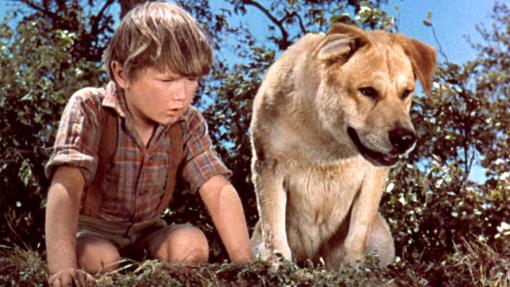
Alas, the censors are guilty of authorizing this execrably psychoanalytical, misanthropic and incurably zoophilic hagiography for mutts. Cinema is dogs, says Disney, in agreement with De Sica, painter of the bitchiness of life. The SPA2 must get such movies banned because if, coming out of Cinéma Avenue, I’d found some pup at my feet, I assure you that it would’ve gone through hell as a reward for such nonsense instead and in place of its fellow dogs, of Robert Stevenson, an usurper who has nothing to do with the master of adventure, of Dorothy McGuire, worse than the dog, of Fess Parker, a little too “Fier” in our country. Go for it, dogs and even cynephiles. But cinephiles, stay away.


1[Translator’s note] Presumably because Fess sounds like fesses (buttocks). Fier: proud.

2[Translator’s note] La Société protectrice des animaux, the society for animal protection.


[From Luc Moullet’s Piges choisies (2009, Capricci). See Table of Contents]


Doesnt Measure Up to the Subject

Radio Cinéma Télévision no. 436; 25 May 1958.

This article was written just for its last line. Radio Cinéma was a very catholic weekly. But the bigots didn’t know that an American shot inevitably framed Eve from head to thighs.

The triple interest of such a film faithful to the book of Genesis in all respects: attract a crowd of believers, lure in fans of Christiane Martel, ex-Miss Cinémonde and Miss Universe, and finally, cut rate production. There is no need whatsoever for several settings, extras or even sound: the subject lends itself particularly to budget cuts. That takes care of commercial interest.

The skill and hypocrisy of Alberto Gout, producer, writer and director, earlier the maker of the rather successful Saint François of Assisi and Adventuress (!)—a Mexican Maurice Cloche of kinds—prevail over sincerity and creativity. A subject with so much nudity should’ve forced the filmmaker to be creative: but no! Perhaps to please both his audiences, Gout has made a film of unbearable dryness. It’s with great difficulty that we find here and there some nice shots of Christiane Martel, our charming compatriot; but our director was much better inspired by Ninon Sevilla.

The only originality that breaks this naïve monotony midway: the passage from medium shots to American shots.


[From Luc Moullet’s Piges choisies (2009, Capricci). See Table of Contents]

Karl Valentin’s The New Writing Desk

Bref no. 71; March 2006

This film, Valentin’s third, runs for nine minutes and thirty-one seconds; six minutes and twenty seconds in the copy projected, not at the original speed, but at twenty-four frames/second. This makes our assessment difficult: the acceleration gives too much prominence to stylization. We notice an idea of acting rather than a body language rooted in reality. Impossible to know whether, at the normal speed, Valentin’s acting remains as rapid.

He plays a scribe, may be an accountant (Valentin also wrote the one-act play The New Accountant in 1937) or a transcriber of official documents, happily living through life’s ups and downs, who orders a new writing desk to be able to write on. He realizes the desk is much taller than his chair. He saws the legs of the desk, but imprecisely and a little too much since the desk soon turns out to be wobbly and shorter than the chair, which Valentin then shortens with blows of hammer before sawing the desk again, still too high, and using a drill to further lower the chair even though it’s on ground level. He ends up drilling through the floor and falls on the customer of a barbershop below.

It’s a very simple scenario, based on the logical and the absurd. We are reminded of Ferreri’s Break Up: all Valentin had to do was to take exact measurements so that the desk is at the correct height. But Karl Valentin (1882-1948) milks all imaginable possibilities of a thin scenario, complicating things to the maximum (he sits on the chair by stepping across) and playing ‘village idiots’ (in 1936, in The Chequered Jacket, he unintentionally sells the jacket in which his rent money was tucked away).

Valentin, or tragic misunderstanding, through the comic gloom of poverty and everyday minimalism.

Valentin’s film is based on three acts: outdoors with the delivery men, then indoors—a single long act—with the delivery men and then alone, and finally the “punchline”1 at the barbershop, where the barber is shaving his costumer with a snow-white shaving cream, both men wearing white aprons; proper white suddenly invaded by the dirty white of the dust that falls from the drilled ceiling.

You will have noticed here a theme proper to Mitteleuropa or to Eastern Europe: this scribe is the little cousin to the government officers described by Kafka and Gogol. We clearly see Germany’s mediocrity in the 1900s, reduced to the piddling existence of an impoverished petite bourgeoisie, which we will encounter notably in Murnau’s The Last Laugh. The inanity of the protagonist has to do with that of the slaves of the bureaucratic system.


The art of the fugue

But it’s especially Bruegel that the portrait of these physically-deformed beings evokes: the “too big/too small” dialectic that we will later find sublimated in a film made in 1936, The Inheritance (where a couple discards all its furniture before inhering those of distant relatives who turn out to be dwarfs, with beds, chairs and wardrobes of their height, which the couple have to make do with, being completely broke). Next to the tall and skinny Valentin, one of the delivery men is fat and strong, the other seems to be a midget or a kid—an alternation visible right from the first shot in the street, containing extras of similarly contrasting and extreme appearance.

The crux of the film is based on a comic succession of Valentin’s efforts to resolve problems of size. Notice that he’s almost always dressed up in a false or a clown’s nose, which tends to diminish the illusion of reality. He plays with his instruments—saw, measuring tape, hammer, drill—with an assured virtuosity in harnessing clumsiness. Valentin is a practical man, carpenter by training, who lived frugally from this profession in his last years. Objects carry a secondary meaning: crouched or perched on his chair, with a quill over his ear, he evokes an owl on a tree. He plays with his saw as though it were a lyre, a bow to launch arrows with, all of this in a record time that lets us fully appreciate the effect without it being obvious: the art of the fugue. As Isou would say, the chiselling here is as much worked on as the discrepant. All objects are off-screen. He looks for them with a gesture of the hand: this invisible and immediate proximity gives the scene a highly enjoyable, unreal dimension.

The central static shot here is, in fact, made of many successive, similar-looking takes: same axis, same lens and with the same single character. He becomes an indispensable entity, a straitjacket that we can’t escape from any more than from the rigid monotony of the empire of Wilhelm II. The character works his way at the edge of the frame, which doesn’t grow bigger or smaller with respect to him or follow his movements. There are small jumps in continuity, which makes us suspect a positive or a negative damaged over time. But now, these are normal jump cuts that play on contrasts—for example, a woman in evening dress cut to the same woman, now naked—noticeable thanks to the similarity in their contents.

It’s completely against the grammar: Breathless half a century before there was Breathless. The presence of this device can be explained by the fact that there was no cinematic tradition in Germany at that time. The first, mediocre films date from 1910. One could hence do whatever one wanted. Valentin, who started in 1912, is a pioneer and the first auteur of German cinema. And it works just fine. That encourages us to reflect on the value of classical American continuity editing: does it have an ontological value? Or does it turn out to be the simple reflection of a dominant style based on a superficial order and harmony. I lean towards the second hypothesis. We have as proof Japan, whose films constantly cut across the 180-degree line forbidden by the Yankees. Had Germany and Japan won the war, film technique would have been upside-down. Film education, also in the clutches of Wall Street, needs a complete overhaul.

It’s surprising to discover a film so dense and accomplished, so modern and revealing of its time, only four years after the beginning of German cinema. And to think that it must’ve been shot in a day or two. There is even an assistant who enters the frame for a split second; it only shows the amateurism of the shoot.


Clown from the cabaret

Valentin’s film art was forgotten or despised for a long time, especially by all the histories of cinema. Valentin is, in fact, one of the great German filmmakers along with Lubitsch, Murnau, Lang, Fassbinder, Syberberg and Schroeter, and better than Pabst, who made one good film out of eight, than Riefenstahl, too pompous, than Wenders, who hasn’t stopped declining in the last twenty years.

He was forgotten because he came from cabaret and theatre, where he had a crazy success. So for many, he wasn’t a real filmmaker, even if only a few of his films are based on his plays, fourteen out of fifty-one, if I’m not mistaken. The same judgment was pronounced on Pagnol and Guitry—Chapin escaped this criticism because there’s no trace of his activity in London. Notice, however, that there isn’t a word written or said in The New Writing Desk:  we just see Valentin opening his mouth frequently for inaudible monologues. The final appearance of the floor below proves that it wasn’t a sketch written for the theatre, where a collapse into another setting would’ve been ruled out. Valentin’s future work—his career extends from 1912 to 1941—certainly gives prominence to dialogue: one thinks of Beckett.

Specificity my ass. What matters is not that Valentin shuttles indifferently from cinema to theatre, with the latter preceding only by five years. What matters is the achievement of a body of work that makes us laugh, that touches us, moves us, overwhelms us, like that of Chaplin (whom he perhaps influenced), through its innovation in acting, its verve, its sense of the absurd and of repetition, its darkness and its bitter outlook towards the human condition and towards the average couple, which he created with his wife, Liesl Karlstadt. He was forgotten because he was “into” short films: fifty in all, of which twenty-nine seem to have been lost. He is the only cinema genius (outside of animation and documentary) to have limited himself to short films, with the exception of The Eccentric (1928).

His sketches for the theatre, à la Davos, à la Dubillard, à la Bedos-Robin, never cross forty pages (The Dance Hall remains the longest). Brevity is often the synonym of concision and perfection, like in poetry. The cinema often attains the highest summits (Puissance de la parole) since it frequently spans the shortest durations, which remains a form of respect towards the viewer, expressing the politeness and the humility that you mustn’t make him waste his time.

Valentin was forgotten because he worked not in noble drama, but in comedy. And the Germanics don’t have a sense of humour. Since Valentin’s retirement in 1941, there has only been one good German comedy, Satan’s Brew, made by Fassbinder. Excepting Lubitsch and Wilder, the defectors, who fall into the category of Jewish humour2, we notice the lack of humour among the “great” Germans. There is no comedy by Lang. Murnau failed with his The Finances of the Grand Duke. A country too cold for laughter, like Scandinavia, which turns out to be slightly better (Dreyer’s Once Upon a Time, Bergman’s All These Women). If the Germans had had a sense of humour, the laughable Hitler would’ve been a fiasco and there would’ve been fifty million fewer deaths.


1[Translator’s note] A play on two meanings of the word chute (referring to both a fall and the punchline of a story or a joke).

2Isn’t the Holocaust also the hatred towards laughter, towards a civilization based on life-sustaining humour?


[From Luc Moullet’s Piges choisies (2009, Capricci). See Table of Contents]


Cahiers du cinéma no. 483; September 1994

The telecast of Jean de Florette has helped draw attention to an original treatment of colour, whose seeds were already to be found in A Special Day, made in 1977 by Ettore Scola.

The novelty of this film stemmed from a colour very close to black and white, whose justification was given to us by the director’s statements. He wanted to capture the style of postcards of the era in which the story is set (the Mussolini years) and their reduced colour range propping up ultra-conformist subjects and attitudes. There was, for him, an amalgam between this antiquated two-colour palette and fascist moral rigidity. So it was fun, per Scola, to use this particular format in service of an ideology completely opposed to the one it usually emphasized and, more precisely, to tell, among other things, a short love story between a brave, prototypical Roman matron, wife of a militant fascist, and a homosexual facing deportation (a hardly credible story for Italy in the 1930s, stemming from a very anachronistic soixante-huitard liberalism, but the problem isn’t that). A little like porno on stained-glass windows or machinations of hooligans on Bach.

The hiccup is that the washing-out machine of Scola and his cameraman Santis can only work after reading these statements. Non-Italians are unaware of these old, transalpine postcards, just like Italians under forty who haven’t lived under fascism—an ignorance that will only increase in the years following the film’s release and which thus will affect a large majority of viewers. And I’m not sure if, without the help of this footnote that is the director’s interview, even older Italians can appreciate Scola’s tortured intellectualism and discover his ironic intentions. Even with the help of this key, appreciation for the film remained theoretical since it could correspond only very rarely to visual memory.

Unjustified for nearly everybody, this format contributed nonetheless to the film’s success as the reflection of a totally gratuitous fantasy, originality and mannerism. What interests a good number of cameramen is above all a chromatic and stylistic unity, a distinctive look, a personal stamp. You get the impression that, before shooting, they try to prepare their Kodak ad. I’m referring to those articles written by image masters, promoted by the monopoly in question since many years, that highlight the particularities of their art and their plastic orientation in pompous and esoteric terms.

To be sure, this very specific definition of their activity allows cameramen to recognize themselves through their work, but we are within our right to wonder if it really serves the films.

Consider Jean de Florette. The plot revolves around Jean, the poor man who will be completely ruined, and his house whose ambiance is characterized by washed-out, reduced colours, notably a rather dirty, obscure and soft yellow of the ‘dead leaves’ variety. So be it. But it’s the same for scenes set at the residence of Papet, the villain who destroys Jean, and which should be differentiated aesthetically from the house of the poor man. Perhaps this is a gesture of supreme daring: Papet is a rich Scrooge who lives in the same mediocrity as the man he ruins. Oppressors and oppressed reduced to the same condition, vanitas vanitatum… But we must disabuse ourselves: we realize that the houses in the village are also marked by an identical tone, whereas they should look wealthier and emphasize their contrast with the physical and moral poverty and isolation of the one or two principal houses.

This yellow jaundice1 has spread its wings. All villagers from the 1920s—rich, oppressed, clustered, isolated—are put in the same basket of a rather reprehensible colour. To be sure, we can appreciate the value of the yellow better when we consider that all papers from thirty or more years ago—newspapers and wall decorations—have become of this colour. What we are witnessing is an aesthetic logic based on print and thus already biased. Not everything that’s old is yellow: I’m thinking of faces, furniture, objects and stones2. And, of course, papers in 1920 or 1940 weren’t already of this colour. It’s moreover impossible today to film a real newspaper from the past, Pour vous or L’intransigeant, since we’ll immediately see from its colour that it cannot be a newspaper read by an actor in a period movie, but an antique copy that has survived generations. So you have to use expert photocopies. In a film about the past, yellowness can be justified only by an intrusion of the present, by a subjective and powerful contemporary gaze—the Carlos Saura principle—or by the sudden appearance of an abandoned house, in High Aragon for example, that has remained as it is over several decades, which is not at all the case in Claude Berri’s simplistic and unitemporal narrative.

With time, the viewer has completely assimilated this very convenient and absurd convention: when we press the yellow button, comrade Pavlov, it means we are at the beginning of the century and maybe in the countryside3. Apart from this flattening of differences, yellowness produces two other negative effects. First: the filmmaker could’ve gotten a very pretty visual effect, like the haricots of The East of Eden, or conveyed the tragedy of man without showing its face, when the little field withers due to a water shortage brought about by Papet’s Machiavellianism. But here, on the contrary, we don’t get the impression of a drought since everything was already yellow to begin with. We understand the disaster and the filmmakers’ intention through the context rather than the image. We strain to see the field as more decayed than it actually is and convince ourselves that we saw it radiant before.

Second limitation: the obscure yellow hardly allows us to see the hero’s face, which is all the more unusual since these are top-paid superstars (Depardieu, Montand). We can credit the film with this provocative, almost Godardian daring, but we clearly see that it has no place in a film of this kind based on a classical narrative and that it upsets the whole with no real benefit.

We could broadly state that the mistake lies in the sacralization of formal unity. This norm harks back to an academicism at least three centuries old. To be sure, this can be easily defended in a film with a single setting such as a prison. But unity of style doesn’t function as well when it’s not linked to a unity of place and time. It’s not just with Jean de Florette that we lament this excessive extension of a plastic universe linked to a single setting to all the settings of the film. It’s a recurrent feature today. Cameramen in comedies struggle to find their famous look since colour often comes in way of laughter. How does the grain and the sharp contrast of the remarkable Nobody Loves Me help the performance of the actors, which is the strength of the film? In Three Men and a Cradle (which I love), the central apartment is rather retro, not far from yellowness. We find it hard to see how this setting serves this comedy. Perhaps the director had an apartment like this. But we come to terms with it. What we accept less is the echo of this basic tone in most other locations of the film.

Yellowness, which we find so often today, even in Madame Butterfly, succeeds the booming fad for black in 1976-80—how far can we descend into darkness? (cf. the admirable opening sequence of Mais ou et donc Ornicar?)—and the more dubious fad for dirty, Fuji-Polar blue around 1982-85 (of the So Long, Stooge variety). In their own way, all these fashions witness a reaction against Technicolor fireworks. Aren’t they more the work of cameramen than directors? There doesn’t seem to be a real conflict in this regard. It’s hard to imagine a cameraman working against the director all through a film. But a number of filmmakers remain somewhat weak in this subject and are satisfied when a man of image proposes something. They don’t think of all the consequences of their plastic choices.

After the admirable India Song and before Jean de Florette, Nuytten was responsible for the magnificent, original photography of Zoo Zéro, which seems to come out of nothing, or from another world, and remains internally coherent contrary to Fleisher’s film, which seems to want to go somewhere but doesn’t get anywhere. Nuytten’s earnest initiatives seem to have driven him, logically enough, to become a director.


1[Translator’s note] Moullet plays on the word jaunisse (referring to jaundice but also evoking yellowness). The word has been translated either way depending on context.

2Without slipping into gaudy Technicolour or the then-recent neon lights, people nevertheless liked colours in the 1920s.

3Another related reflex has to do with the status of black and white: since the reality of the years roughly between 1914 and 1950 is known essentially through monochrome films, we tend to identify, rather excessively, this era and its neighbouring periods with black and white (often made necessary by the lack of newsreel footage in colour, especially for war movies). To make use of black and white in one of my films, I was compelled by the producer to dedicate my film to a comic filmmaker of the silent era, since silent cinema necessarily means absence of colour…  The funniest part is that colour is an absolute must for epics, films on the Renaissance or the Belle Époque. Typically, everything should be in colour before or after this gap of thirty-five or forty years.


[From Luc Moullet’s Piges choisies (2009, Capricci). See Table of Contents]


Unpublished

The striking feature of recent cinema is the scattering, disappearance even, of human presence, or at least the suppression of the individual, his dilution, his erosion, his erasure, his atomization, I don’t know what the right word is. In order not to compromise myself too much, I’ll speak of “rarefaction”.


The situation manifests itself in many forms.

Firstly, there is human erasure to the advantage of the animal. We have in this category some of our successful documentaries, Winged Migration, Microcosmos. But the phenomenon has expanded: the contagion also impacts fiction (The Bear, The Big Blue and its dolphin, Two Brothers and its tigers, Roselyne and the Lions¸ The Fox and the Child). We sense here a desire to seek “nature” in general, rather precious in an era marked by technology. Moreover, Jacques Perrin, the producer of the two aforenamed documentaries has also produced Himalaya, which shows life in a current-day society, but one untouched by civilization. Annaud, the man behind The Bear, also tackled Quest for Fire and His Majesty Minor, a prehistoric super-production, a nostalgia for barbarism that paradoxically requires the most sophisticated technical means.

The predominance of the animal over man already existed in Hollywood cinema in a more specific way through Rin Tin Tin, King Kong, the Disney factory and the products of MGM, which glorified the dog Lassie, the cervid of The Yearling, the nag of National Velvet, the MGM that was, by far, the most reactionary company in Hollywood.

We find a similar equation in France.

Brigitte Bardot, who admirably campaigns for seals, reveals herself through her Mémoires to be rather close to certain racist stances. It’s also true that there still exist canine competitions based on… the purity of breed. Love for animals and racist or right-wing behaviour (cf. François Nourissier) are often interrelated, just like how the love for sport or nature frequently coincides with a reactionary or pro-government ideology.

This massive animal intrusion in cinema is enabled by the very principle of the film exhibition system. Children often go to cinema with their loved ones, which makes for a large viewership. It’s thus a very, very profitable market, much more than that of children’s books, which only children read.

And what the child likes is animals. Many animals are of kids’ size, or even smaller (canaries, dogs, cats). The child can hence dominate them, whereas he is at the mercy of adults. He can even tame a large animal (there are ten-year old mahouts), generally and logically more stupid than the kid.

The infantilization of the entire cinema audience is hence a given, even though most animal films are made specifically for kids. The cream of the crop would be to make films for children that are not too stupid and which even adults can appreciate (Cocteau’s Beauty and the Beast, Demy’s Donkey Skin). Mind you, adults love showing their parental love by going to idiotic movies with their kids. It allows for quid pro quos like this: “You forced me to go see 101 Dalmatians. Now, you’ll help me by staying out of trouble.”

Animal and children’s movies have the advantage of lasting forever: a ten-year old child will go see Snow White in 2009 or in 2039 as much as in 1939. No need for expensive remakes, necessary on the other hand for fiction films, dependent as they are on new stars and modern costumes. Hence, colossal profits.

We see then that man’s erasure to the advantage of the animal, if it’s increasingly frequent in cinema, doesn’t offer much of interest. It’s pretty low-brow stuff.


On the other hand, there exists a temporary distancing of man, a distancing that I’d call “tactical”, which can turn out to be very productive. We find it in classical American cinema. It’s not a distancing of man in general, but an obscuration, a withholding of the hero, specifically at the beginning of a film. The hero doesn’t appear until several minutes, sometimes half-an-hour, into the film, and we find it hard to spot him. A good example would be the beginning of Sergeant York, where we don’t immediately recognize Gary Cooper, who appears at the end of the second reel, deep in the frame, somewhat hidden. The beginning of the film helps depict the ambiance. The other characters of the film, always blended into the story, seem to have been picked up on the spot, played as they are by less-known actors. The viewer hence has an impression of reality unfolding. A while later, there is the sudden entrance of the hero, who is not only the beloved star, but apparently also someone like the others whom we’ll have the pleasure of recognizing (we had paid to see him, we aren’t conned, phew!), someone who is close to you and anchored in the reality of a quasi-documentary. It’s the same device we find in Raoul Walsh, notably in A Lion is in the Streets.

This also corresponds to the structure of the classical novel: twenty or thirty pages of presenting the place, the milieu, the era, the secondary characters, before coming to the protagonists. It is, for example, Balzac’s approach in The Duchess of Langeais, whose main action starts very late.

We find this tactic in Tavernier’s films such as Captain Conan or Safe Conduct. The device doesn’t work as well in Conan given it’s not Gary Cooper, but less-famous actors, like Philippe Torreton or Didier Bezace, whom we don’t necessarily recognize. When it’s Gary Cooper, we at least understand right away that he’s the hero…

In every sequence of Safe Conduct, thanks to a colossal effort, Tavernier succeeds in making his hero, Gamblin, emerge after a few seconds in an ambiance that’s already carefully developed. Gamblin becomes part of the reality. His character becomes incontestable, irrefutable.

This initial erasure of the protagonist is a brilliant dramatic trick that glorifies his future presence all the more.

We find an even more modern approach that begins with Purple Noon (Réné Clément, 1959), where, in the middle of a police plot, the camera loses track of the story and lazily shows various stalls of a fish market—a nice diversion that Pierre Kast will repeat in 1978 with Le Soleil en face.

The principle will be amplified in Antonioni. In L’Avventura (1959), the heroine, Lea Massari, mysteriously disappears from a small island. The other characters will spend a good part of the film looking for her in vain (there will be a similar disappearance of the heroine mid-film in Hitchcock’s Psycho, made three months later, but it turns out better: we see right away that she is murdered).

And there’s the astounding ending of L’Éclipse (1961): Antonioni leaves the star couple Alain Delon-Monica Vitti once and for all to linger for about ten minutes on urban still life, roads, buildings, cars, trees etc., forgetting human beings altogether.

I confess that I don’t appreciate most of Antonioni’s films; they are boring, but I must acknowledge that he set a precedent, that he started something. He’s a precursor. In my opinion, he paid the price. But his influence, as well will see later, seems incontestable. He is singlehandedly responsible for the existence of more elaborate works his colleagues and imitators will produce.

Godard’s entire career seems to constitute a quest towards an increasingly provocative and radical erasure of man, of the individual, of the actor. Starting from the omnipresence of Anna Karina or Belmondo, he’ll proceed, step by step, to diminish the human being, to exclude him, forget him, to deny his identity. For a start, the dubbing of Belmondo by Godard himself in Charlotte et son Jules (1958) was prophetic. And later, there were the long theoretical speeches made by an invisible actor over the image of a silent worker in the middle of Week-end (1967). And even more drastically, the non-performance of the two superstars Yves Montand and Jane Fonda, often filmed from behind, in Tout va bien (1973): the presence of stars and their vacuity for the sake of the form; their fall from the pedestal… we can also wonder whether it’s the imposture of the star system or the minimalism proper to each human being, a simple atom lost in the world, that the film expresses. Or maybe both at once.

Godard will go farther with Nouvelle Vague (1990), where Alain Delon—decidedly destined for the suppression his personality seems to cry out for—occupies an insignificant place compared to the invasive trees, who will be the only stars of Germany Year Zero (1991).


Long live oaks, down with penguins. Such is the lesson of modern cinema1.

These films by Godard belong to his Maoist or post-Mao period, and so it wouldn’t be surprising to find a very similar perspective of man in Asian or Chinese filmmakers2.


To simplify things, I’ll take three examples (but there are many more): Goodbye South Goodbye (Hou Hsiao-Hsien, Taiwan, 1996), Syndromes and a Century (Apichatpong Weerasethakul, Thailand, 2006) and Still Life (Jia Zhang-ke, China, 2006). I’m certainly a little embarrassed to put in the same Asian bag filmmakers from distant places separated by three-thousand kilometres, different languages and belief systems. It reminds me of my guide in Peru, who clubbed the Spanish and the Finnish under the same word: “Europa” … But as we will see, there is nevertheless a number of commonalities.

Hou’s film certainly shows us human beings throughout its runtime. But our perspective of them is seriously disturbed by the mise en scène, which makes sure that we only see very little of them. They frequently remain in the shadows, they are filmed from behind, women’s faces remaining covered by their hair. And all this in vast, static group shots, in which humans appear lost. Characters have an important and animated discussion in the background, somewhat concealed and hardly visible, while in the foreground we clearly see a dog and a man who are simply eating. A while later, we see a rather dramatic scuffle deep in the frame. And there’s absolutely nothing in the foreground. Sequence-shots are often filmed from up high, which allows to pack more people into the frame and reduces human beings to puppets. Long sequences interrupt the story to show us a car or a motorbike in transit (line in Apichatpong Weerasethakul’s Blissfully Yours) or to present the city’s neon lights.

The image of the broken-down car with the protagonists in it is reduced to nothing by the darkness of the night. The petty intrigues of the principal characters are all the more diminished, minimized, revealed to be Lilliputian compared to the grand fresco of life, often centred on the car or the motorbike.

This is what surfaces from Apichatpong Weerasethakul’s film as well. Shots of green nature or of modern buildings break the fragile story containing two plots. The female character is only a stray reflection within the general image of the meadow. The unsettling, surrealist, round orifice of the airduct robs the actors of their star status. Perhaps to prevent the risk of our identification with the actor, the film changes its story midway, as is always the case with Weerasethakul. There are two vague centres of interest, one after the other. The relationship between them remains rather feeble, as in Still Life, which I’ll come back to. This predilection for the diptych or the triptych format is affirmed even more evidently in Hou’s Three Times, and the Singaporean Khoo’s Be with Me and Twelve Storeys. A single story would give too much importance to the individual, who must always be embedded in a collective fresco encompassing other humans and the universe.

We shouldn’t be surprised to find this importance of the collective and of unanimity in the China of Still Life, but it could seem more surprising in a Thai filmmaker and in the Taiwanese Hou, who, it is true, was born in continental China. It’s perhaps that communism has established itself all the more easily in these lands because the mental and religious ambiance of the Asian continent is inherently predisposed to facilitate this galloping collectivism. The suppression of man seen in films from the Far East can also be explained by the fact that Asian religions endure better than Christianity, torpedoed by triumphant individualism.

In Apichatpong Weerasethakul’s work, we find not only this scattering of the individual within the shot or the film (like in Hou), but also the increasing importance of the natural, temporal element, which make us forget about man a little. Syndromes is firstly the story of natural or artificial landscape, of the sun and the moon, just like how Blissfully Yours was the story of the Edenic forest and river, of their repetitive and haunting sonic ambiance. In Blissfully, characters exist through a part of their body—like in Bresson—and not through their face or their thoughts, rather mysteriously for us.

What counts especially is “time”. We might see an immobile character for eternity. What’s important is not the character, but the time that flows—a sprawl alien to the norms of film production.


Still Life makes this constant of Asian cinema even more evident. It involves, first and foremost, showing the relationship of man to the world3, his real, miniscule place within the universe. The two plots narrated here, which are finally the same despite their surface inversion (the search for the lost spouse is undertaken, in the first part, by a man and, in the second, by a woman), are a pretext to a quasi-documentary revelation of exterior world.

The word “pretext” is perhaps excessive since these plots are not uninteresting, nor devoid of meaning. But it’s that this expansion of romantic problems doesn’t last long since we feel that, beyond the temporal limits Jia sets them, it’s all likely to collapse into soap opera or melodrama.

Jia can thus end up, thanks to a discreet common thread represented by one character or another, with a “smooth-flowing” presentation, like the Yangtze River, of a cosmic whole that includes, among other things, light effects (the illumination on the bridge), the fascination of a new spectacle provided by the destruction and submersion of a city (a theme that Villier’s and Giono’s Girl and the River, Kazan’s Wild River and even Dovzhenko’s Poem of the Sea could exploit well), the customary plots, schemes and fights in contemporary China, a certain natural and artificial fantasy based on an astounding dialectic. I’m thinking of the building that collapses without warning in the background to the discussion between two protagonists and of the rocket that takes off while, in the same frame, a woman hangs her laundry on a cord. We have here, in the same shot, neorealism and Star Wars at once.

And the mutation of the city (thanks to a destruction that’s a nice change for us from the interminable, gigantic constructions offered by industrial, super-spectacular cinema) only reinforces the feeling of mutation of the characters during the time that has passed before the beginning of the film and which is invoked here.

Finally, in Jia’s work, the erasure of man, of the protagonist, is part of a general, cosmic plan for the film that requires that no single element—psychological, thematic, visual or aesthetic—be preponderant.

Of course, this rarefaction of the individual remains somewhat theoretical since each image is filmed by a team of invisible human beings, since the landscape of cities and fields has been elaborated by man. But let’s remember, on the other hand, that the films where we only see heroes talking in tight shots are often lazy and empty of humanity.

It’s clear that this insertion of the individual bit by bit into the film’s body, an uncommon sprinkling, is likely to unsettle western audience, used as it is to follow the hero’s journey from beginning to end, to whose eyes all shots without the protagonists or without humans are “longueurs”.

But our excessive glorification of individualism, beyond all ideological positions, opens up only limited and beaten paths in cinema in 2007, compared to all the perspectives that this new insertion into the filmic work offers: fragmentary, implicit and in outlines. The fixation on the individual has nothing do with a purported cinematic ontology, it was already brilliantly broached by some of our occidental filmmakers and by the loss, which I’d label Bressonian, of the fundamental role of the actor, doomed by Hollywood to cover up the shortcomings of a false, unbelievable and conventional American script through his art, his body language, his facial expression, his phrasing and his rhythm.


1Note the importance of trees in Straub and Serreau (Saint Jacques… La Mecque). Trees that outlive man.

2Antonioni was to make a long documentary on China himself. This new Sinophilia (cf. Ivens or Bertolucci) succeeds a return to India started from 1950 onwards by Renoir, Rossellini, Malle, even Lang and Cukor.

3Jia’s cinema, and Far Eastern cinema in general, make a more pertinent use of stereoscopy than Hollywood, too preoccupied with easy effects: man in the middle and, on the right and left of the screen, the rest of the world.


[From Luc Moullet’s Piges choisies (2009, Capricci). See Table of Contents]

« Previous PageNext Page »