Jeanne Dielman, 23 Quai Du Commerce, 1080 Bruxelles (1975) (aka Jeanne Dielman)
Chantal Akerman
French
“I used less water than last time, so it tastes better”
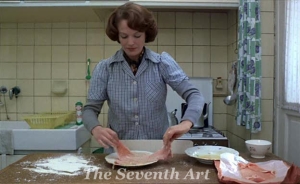 Chantal Akerman’s most famous film gives away all that is factual about it in its name itself. The rest of it follows what the titular Jeanne Dielman (Delphine Seyrig) does in this 23, Commerce Quay, 1080 Bruxelles house of hers, over a three day period in almost in its entirety. Using completely stationery cameras, Akerman creates a claustrophobic document of life in its most mundane form. Even with a screen time of over three hours, there isn’t much in the movie that could be fit into something called plot. That, precisely, is Akerman’s intention. Details are given with extreme reluctance and in exceedingly small measures (with hardly 10 minutes of spoken dialogue). On the first day, we witness Jeanne ritualistically moving about in her house, switching on and off the room lights, cooking potatoes for her obedient son, arranging tables, doing the dishes and making the bed. She earns by selling herself during the afternoons in her very house. All this is done by the book, if there ever was one.
It is precisely these systematic acts which become our reference for the next day. The next day follows almost the same pattern. Only that Jeanne drops a spoon and the polishing brush. Oh yes, she also goofs up the dinner! On the third day, the bank is closed, she reaches a shop before it opens, the coffee is spoilt and a button snaps off from her son’s blazer. This is all the change that Akerman allows Jeanne. What surfaces is a gradually progressive deviation from our “reference” and perhaps for the worse. Like the geometrically flawless décor and lighting of the film, which exude cheerfulness, contentment and sanity are only apparent. It is almost as if one can mathematically calculate, using these extremely small “mishaps”, when Jeanne will completely succumb to her condition. And this is the kind of gradual disintegration of sanity that many films fail to portray credibly (Revolutionary Road (2008) comes to mind first). What happens obscures how it all happens. Cinema becomes text. Although Jeanne Dielman is much more extreme in its form than the mainstream narrative cinema would require, it clearly shows that why a formal stance doesn’t merely justify the medium chosen but enhances its possibilities.
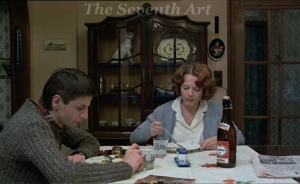 It wouldn’t be unfair to call Jeanne Dielman an experimental film. Where other films that deal with similar theme of urban alienation tend to bend towards the cerebral side, Jeanne Dielman is more experiential. At any point in the film, once the viewer gathers everything there is to an image, like Tarr’s movies, fatigue sets in. We start experiencing time as it is, undiluted. In other words, we begin taking part in Jeanne’s life by experiencing the savage inertia of time. The only difference is that she is oblivious to it while we, possessing knowledge of the artificial and transitory nature of cinema, are not. Jeanne doesn’t pass through life. She lets life pass through her. Not once does she show signs of emotional fatigue. She is insensitive to her condition much more than her cerebral counterparts. Except for one sequence at a button store, where she shows clear indications of mental derailment, there apparently is no outlet for her emotions at all. Apart from the perfunctory conversations with her son and the occasional visit by the neighbour, who asks Jeanne to take care of her baby (who could well be considered a miniature Jeanne) from time to time, Jeanne is completely cut off (at times literally, in the frame) from the world.
In his extraordinary article on Tarr, Kovács writes about the director’s style:
In Tarr’s world, deconstruction is slow but unstoppable and finds its way everywhere. The question, therefore, is not how to stop or avoid this process, but what we do in the meantime? Tarr asks this question of the audience, but if the audience wants to understand the question, it first has to understand the fatality of time. And in order to grasp that, it has to understand that there is no excuse in surviving the present moment: time is empty—an infinite and undivided dimension, in which everything repeats itself the same way.
Akerman’s own style does not seem far from this. Through repetitions, in gratuitous amounts, Akerman creates a film of high precision and low life quotient. In fact, everything in the film seems to exhaust itself the moment it takes birth. Akerman repeats every element of the film – time (Jeanne’s daily routine), space (the viewer is immediately acquainted with the couple of rooms that the almost the whole film takes place in), the actors’ movement and gestures (Jeanne act of switching off lights moves from interesting to an in-joke) and even camera angles (as if the actors are passing in front of stationery cameras installed at various locations in the house).
 The only hope for Jeanne to snap out of this vicious loop comes in the form of the final sequence in the film where she stabs to death an unsuspecting client of hers (Actually, it is never made clear if the scene takes place in Jeanne’s present or not. The man could well be her husband, whose death is talked about regularly in the film, thus, also, creating a narrative loop within the film. But considering the realities of the world, it is unlikely). This is where Akerman deviates from Tarr. Tarr seals his characters in their own existence until they fade into oblivion. His characters neither have history or hope. Akerman, on the other hand, gives her characters a past and a future. The circle in Jeanne’s life may just be a stray deadlock that had to be resolved by her action (rather, by ceasing her inaction). There is certainly a gaze at a different future throughout the film. Jeanne is expecting a gift from her aunt, which is revealed to be a dress later. She deposits money in the bank for future use. Her aunt even urges her to migrate to Canada. Even though, a large part of the movie is concerned with her empty life, it does offer a hope for renewal.
Obviously, Akerman is far from being a romantic. It is true that she does not choose to tread Tarr’s spiral, which seems to go in circles but ends only in decimation, and concocts an open ending, thus leaving margin for hope of escape. But why Akerman’s masterwork feels ultimately like an exercise in despair is that she generalizes Jeanne’s existence. As a matter of fact, we don’t even know if the lady we are watching is Jeanne or if the building is the one mentioned in the title. By not pinning down particulars, Akerman seems to speak for an entire generation and era. Of course, the whole film could be deconstructed to unveil political, social, sexual and cultural outlook of the age, but what makes Jeanne Dielman stand out from its contemporaries is not its keen study of lives in modern times, but its ability to make us experience what every Jeanne Dielman experiences and understand why we each of us, in a way, has become a Jeanne Dielman.
 Wang Bing’s The Ditch (2010), the filmmaker’s first full-length fictional feature, is a recreation of Jiabiangou Labour Camp located in the Gobi desert, where prisoners accused of belonging to the Right were sent in order to be “re-educated” through hard labour. We see prisoners being brutalized, living continuously in starvation and in pathetic trenches. We see them surviving on small critters, regurgitated food particles and even buried corpses. There are two kinds of landscapes that they inhabit – the seemingly-infinite plains of the desert where they toil during the day time and the cramped and under-lit trenches that they take refuge during the night – both of which Wang shoots characteristically in digital video on Steadicam and in long shots. The result has the hangover of Wang’s documentary features and each scene comes across less like illusionary fiction and more like the recording of a performance. The acting, likewise, is perched between the emotive and the expressionless. Consequently, Wang’s foray into the grammar of conventional fictional cinema – the occasional shot-reverse shot and close-ups – sticks out as high relief. No doubt, like Brutality Factory (2007), his first stab at fiction, he’s dealing with thin material here that concerns itself more with the need to remember than with the necessity of analytically dealing with history. This approach – the raison d’être of his best non-fiction works – reveals itself as a substitute for straightforward documentation and intentionally swaps prison dynamics for a survival sketch. However, there is one ironic detail that Wang seems to be arriving at here: that Mao’s re-education program at the camp for purported Rightist subversives only teaches them one thing: Every man for himself.

 The Seventh Art