Cinema of India


[The following is a translation of a set of letters between Raymond Bellour and Marie Redonnet on Satyajit Ray’s Days and Nights in the Forest (1970), originally written in 1993 and published in Bellour’s Pensées du cinéma (2016, P.O.L.)]

Days and Nights in the Forest

It’s always strange to walk out of a film with another person when we don’t know them well enough to be sure (a dangerous certainty) that they are thinking what you’re thinking. Especially when the film surprised you, took unexpected turns that you felt you followed well, and you don’t know if the other person, who might not have the same relation to cinema, reacted to the film in a similar way, or will at least use similar words to describe it.

Here, on the other hand, was a certainty, still a silent one: we liked the film. Terribly so: it left us speechless for a while, but we knew we’d have time to discuss it in the evening (a civilized ritual around the 8PM screening: have the dinner after the film in order to work on it slowly, privately, like an event that you don’t want to overload with other things, or digest at the wrong time).

Like all memories, of course, it later becomes something of a dream (I have always admired, with perhaps an excessive mistrust, those who are able to recount old conversations as if they had recorded them: are they so different from me, or do they implicitly embrace a mixture of truth and fiction? Or maybe they take notes immediately. But in that case, etc. etc.) I remember latching on to some references to articulate my surprise, to rationalize my amazement: this Satyajit Ray, who couldn’t apparently be more different, made me think, at least in his setup, of Rohmer (this was suggested to me by a friend of mine who loved the film and urged me to go see it right away), of early Fellini (I Vitelloni, for example), or even of Hawks (the fate of groups, the games of men and women, the transition from light to serious, the logic of plot reversals: the miraculous balance of “classical” cinema, modern though it is). In short, it’s still about the Rules of the Game between ethics and aesthetics (now that I’m writing (to you), I recall that Ray had assisted Renoir on The River).

I perhaps told you this, we thought it was really extraordinary that we could prepare for this transformation, that we could retain all the trivial elements of this story, as though suspended in a fishing net, in order to fully make use of them, in the form of a viewer memory, when the story veers, first slowly and then suddenly (that’s where the dexterity, the miracle lies), into the tragic, assuming a sweeping density by endowing its four merry men with a touch of fate.

We didn’t need to recount the film to each other at that point because we had just walked out of it, but we have to play that (minimal) game here. It’s not wholly true though: we did recount it in way, in order to pinpoint the moments in the film that had struck us and to arrive, unwittingly, at what had transfixed us.

So I’ll recall the crux here: four friends leave Calcutta to spend some time in the countryside. Two of them, familiar actors in Ray’s films, look like respectable executives; the third is a famous sportsman (he’s the only one with a backstory, presented through a really unexpected flashback that occurs during their journey, in the middle of their banter, signalling the future course of the film: his girlfriend has left him brutally following a mediocre, incriminating letter from him.); the fourth is the joker of the gang. They move into a forest guest house after bribing its watchman. There’s another house nearby, and the men get to know the family living there: father, daughter, daughter-in-law and her young boy. There are also women of the village, Duli being one of them. The film tells the story of these four bachelors who are out seeking adventure, going around these women towards whom their desire remains vague, only to turn concrete before their imminent departure: Sekhar, the jester, doesn’t get anyone; the sportsman Hari is committed to Duli; Asim to the daughter, Aparna; and Sanjoy to Jaya, the daughter-in-law (I checked these names in Charles Tesson’s book on Ray).

We were hardly interested in Hari, I think, except in order to notice what was extreme about the beautiful native (Duli) who sells herself, who is of a sensuality at once raw and perverse, mastered and uncontrolled, but very autonomous in any case, during the love scene in the forest, the only scene of lovemaking, of which the hero ends up being the victim (after the young woman leaves, he is assaulted by a villager whom he had unjustly accused of theft: the villager had observed the scene, which thus becomes more intense)

But the impression left by the scene fed into what we were constantly thinking about: that here was an extraordinary film on men and women, extraordinary because of the stance taken by a man to show the superiority of women when it comes to intelligence and behaviour in romantic relations.

We soon arrived at the great scene between Asim and Aparna, which could appear to be the most beautiful moment in the film. The groundwork for it is laid by two previous scenes thanks to which the film takes a turn and speeds ahead: a memory game in the forest in which Aparna crushes everyone, Asim in particular, the only one who puts up a fight; and a visit to the local fair, during which the group splits into three couples, with the sensual counterpoint of traditional dances to go with it—it’s audacious of Ray to film these female bodies so modestly and so sensually, to show them in harmony with the couples trying to find their feet.

We were amazed by how Aparna’s character, quite enigmatic so far, somewhat charming but sarcastic and rather removed, bursts out with a contained violence towards a half-flirtatious, half-romantic and mostly childish man, to whom she nevertheless imparts a consistency because she confides to him: her ability to memorize everything since early childhood, her brother who killed himself three years ago seemingly without reason, her mother who set herself on fire when Aparna was twelve. All this to explain her distance, her inability to enter the game of explicit seduction and her marked singularity (I thought so later, I think so now: is this Ray’s romanticism, an idealism that bestows the woman with an extra bit of aura and depth? Or as we originally thought: the naivete and vulgarity of men with their simplistic, dull desire—or, at least, the image they give of that—which rejects not only what is singular in a woman’s desire, but also the identity proper to a mutual desire, its only chance of being shared.)

But we hadn’t yet come to the scene that became, for us, the scene—that’s why we wanted to see the film together the next day, to freely write a few pages each to prolong the memory of what we discussed that evening, before, during and after the sad result of the elections (I’m looking at this obscene image on channel 2 again, enough to singlehandedly condemn television, which can never be cinema: between Madelin and Longuet, presentable forty and fifty somethings passably done up, stands a pulpy student of twenty-three years, fleshy lips and long hair, supposedly representing French youth and especially showing the desire they may have for her).

I think it was I who stopped suddenly at the scene that was hiding beneath what we had discussed before, like how one stops before an evidence: I told you that we’d just witnessed one of the most violent scenes of desire that cinema has ever offered. Until this scene, Jaya seemed, in contrast to her sister-in-law, a rather simple character: a sociable, cheerful woman (we have just learnt of the suicide of her husband from Aparna, but our attention doesn’t shift to her). Jaya returns home with Sanjoy from the fair to which he had accompanied her; she offers him coffee; they are alone in the house, where Ray has set up a muted but very charged lighting scheme that tightens the space. Jaya goes into her bedroom for a moment (there’s a fluctuation of memory here stemming from one of those loose ends characteristic of great mises en scène) and comes out of it transformed, covered with jewellery bought with Sanjoy at the fair. She offers herself with an absolute immodesty that reinforces what she recounts: the death of her husband, widowhood, the wife’s desire expected to vanish with her husband’s death. Sanjoy listens to her in silence, terrified. He is unable to take a single step towards her or make even one of the gestures he evidently imagined and looked forward to; he can only clam up. The more Jaya’s desire saturates the space the more thoroughly Ray’s sequencing withdraws into itself, so as to suddenly limit the whole world to what is happening—or rather, what is not happening—between this man and this woman.

That is where we began to feel differently. I was with Sanjoy, lost, understanding of his terror, projecting something of myself onto the character without knowing where each of us was, caught in a vague no man’s land. I told you how, when confronted with certain bodies, bodies that are too strange but whose strangeness is fascinating, a kind of imaginary madness opens up; I guess everyone has his own, which he recognizes the day it happens (this is amplified for me here by the evident otherness of the Indian woman that Jaya embodies so strongly: heavy, somewhat fleshy body of a glowing sensuality that doesn’t coincide really with the material body and induces a disorder, a dissociation between seeing and touching, or even between two modes of seeing, two modes of touching, which we’d prefer keeping apart). You seemed surprised by this male thing; and you spoke to me about the woman. You told me (I couldn’t think of it that way): a woman can offer herself like that only in order to want to not be taken. She remains in her mourning, which she bears tragically, which she exhibits, to the point of obscenity. This excess she indulges in is what protects her; this excess in which the other is nothing, can’t project himself into, for she desires him in a dead man’s place, as though to prove to him that he has no place there. Writing to you, I wonder if it’s this very intuition that Sanjoy has, considering that his terror mounts to such a degree: the fear of being denied, like the fear among women, as they say, when they can’t tolerate a pure, immediate physical desire. The harrowing magic of the scene, which we must see again to know more about, at least on the means of producing such a shock, could be in not letting either the man or the woman, who are trying to talk to about it like us, decide whether there’s a shade of comprehension or an opacity in what surfaces and dramatically stops between a man and a woman, whether either of them is aware of the horror they provoke in the other or whether these two horrors simply coexist in a space that has become, either way, unbearable.

R.B.
(more…)

[The following is a translation of an article by critic and filmmaker Pascale Bodet published in Trafic 95 (September 2015). I’m immensely grateful to Mr. Samuel Bréan for finding me a copy of the article and to Ms. Bodet for her permission and generous support.]

The Golden Bird

Let’s begin with two dreamlike, unsettling fictional films made by Amit Dutta at the Film and Television Institute of India at Pune, the film school he was trained at: Kramasha (To Be Continued, 2007, 22’) and Aadmi Ki Aurat Aur Anya Kahaniyan (The Man’s Woman and Other Stories, 2009, 78’)[1].

Here’s one of the three stories in Aadmi Ki Aurat Aur Anya Kahaniyan. Married man Jainath is obsessed with the tattoo of his wife Krishna Bai, who has her own name tattooed on the hand. Jainath wants to cut his wife’s hand off. He wanders around with his friend who jokes (“Till the wrist, or till the shoulder?”), then incites Jainath to scrape the tattoo with a blade, then to attack it with sulphuric acid. In this tale, there are no good spirits to suggest tattooing both names—Krishna Bai’s and Jainath’s—on the same hand. The friend makes increasingly evil suggestions until the moment where Krishna Bai’s name appears, not just on her hand, but on the marital pillow. Noticing this new inscription, we understand that Jainath has let go of his evil spirit (who withdraws out of bitterness) to become his own good spirit. Jainath has another obsession now: he loves his wife; he forces her into embroidery. Independently of its sonic and visual (35mm) beauty, of the charm of its sound effects and of the tropical, diurnal, nocturnal dampness, I remember that the character of the friend/evil spirit renders this tale at once more prosaic (two friends wander about, talk, meet again and separate) and more fantastic (the friend is the evil double of an already malevolent hero).

Now, can we review the viability of cinema as an instrument for the search of truth? Money and human relationships always intervene in filmmaking but technology minimizes their necessity, giving more space and time to the inner journey. Filmmaking becomes more personal, almost intimate. It happens outside the purview of an audience, at least a real audience. No money to be earned, nor much fame. Then what is the reward left to the filmmaker? The answer for me could be: ‘the process’*. The possibility now to live one’s film more profoundly and intimately than ever. The kind of subject one chooses, the reading, learning and thoughts one lives through the making of a film become the most important reason for making it. Cinema becomes a way of searching and learning through culture, history, music, beauty, and eventually truth (?).

*In Kashmir Saivism, some scriptures have the concept of prakriya denoting a prescribed practice (of ritual or meditation), which is the same as the highest knowledge; the path therein is one with the destination. [2]

(more…)

Modernism by Other Means: The Films of Amit Dutta

I’m elated to announce that my book on Indian independent filmmaker Amit Dutta, titled Modernism by Other Means, has now been published by Lightcube! The book is a critical study of Dutta’s work, from his earliest diploma films to his recent digital production, as well as his three books. It devotes special attention to formal qualities of the films and attempts to locate them within a broader national and international artmaking context. I’m very hopeful this book will fill an important gap in the literature on experimental cinema in India.

The volume has been published independently and with modest means. Its life will depend entirely on the backing of kind readers and generous patrons. I request anyone interested in supporting this book to share this information in their personal and professional networks. Please buy the book, yes, but more importantly, please review. That will help give the book some crucial momentum. If you represent a publication and would like a review copy of the book, please drop me a message at justanotheremailid@gmail.com.

Description

Since the mid-2000s, Indian experimental filmmaker Amit Dutta has been producing work that defies easy categorization. His sensual, stimulating films are as removed from national mainstream cinema(s) as from the international arthouse tradition. They are, instead, incarnations of a personal quest, a lifelong project of research and self-cultivation. They propose newer forms of cinematographic expression through their constant, ongoing dialogue with ancient Indian artistic thought. Taken together, these films constitute a cinema of aesthetic introspection. Despite universal acclaim, including awards and retrospectives across the world, critical commentary on Dutta’s oeuvre has remained scarce.

Modernism by Other Means is the first book-length consideration of the output of one of the most compelling film practitioners active today. Through close-grained critical analysis of each of his films, it examines how Dutta’s work strives towards an authentic conception of modernism, one that bypasses Eurocentric rites of passage, inviting us to reframe our ideas of what being modern in art means.

Links

Hardcover book (India only)

Hardcover book (international)

Kindle e-book (international)

PDF e-book (international)


Reviews

“A magnificent work, as complete as it is precise, analyzing in depth each of Amit Dutta’s films, intended to be a reference. Congratulations to Srikanth Srinivasan and his publisher, Lightcube. I would like every contemporary experimental filmmaker to find their Srikanth!”

– Dr. Nicole Brenez, Professor at the Sorbonne Nouvelle

Srikanth Srinivasan’s book on Amit Dutta is an invaluable foundational text for anyone wanting to explore the rich contours of Indian experimental film and is also an indispensable authorial study that opens up a far reaching interrogation and critical awareness of modernity and its relationship with contemporary filmmaking in India today.

– Dr. Omar Ahmed, UK-based Film Scholar and Curator

Amit Dutta might possibly be my favorite filmmaker to have emerged in the 21st century. His mix of playfulness, inquisitiveness, respect for his subjects, his devotion to numerous forms of beauty—all make him a rare and deep talent… I recommend the e-book [of Modernism by Other Means], which is inexpensive, and which is proving to be a really valuable document on a great body of work.”

– Zach Campbell, Independent Scholar

“Modernism by Other Means is structured chronologically, but Srinivasan’s prose flows between influences, memories, and Dutta’s visions of the future of his cinema, invoking Dutta’s style and perspective; he makes the proposition that we are reading about a filmmaker and artist who matters.

– Soham Gadre, Los Angeles Review of Books

With rugged clarity and verve, Srinivasan walks us through an extensive portrait of an elastic artist… Modernism by Other Means is nothing short of an essential aid not only in contextualizing Dutta’s films, but in some cases understanding the absolute basics of what each film communicates, the existing register it is working within or developing upon.”

Maximilien Luc Proctor, photogénie

Helping the director return to cultural circulation is already a remarkable merit for the book dedicated to his work, but not being involved in the cultural economy gives value to both it and Amit Dutta’s films.

– Maksim KarpitskyCineticle

[The following is a translation of Serge Daney’s interview with Satyajit Ray published in Libération on 9 February 1982 and reprinted in Daney’s Ciné Journal Vol. 1 (1998, Cahiers du cinéma). With kind help from Laurent Kretzschmar of the indispensable Serge Daney in English blog.]

Satyajit Ray by Nemai Ghosh

February 1982, Calcutta

In which we go meet Satyajit Ray at his home in the city that he never stopped loving.

At any rate, he’s stands tall. Heads and shoulders above the rest. He just celebrated sixty years of life and twenty years of cinema. To the rest of the world, he is “Satyajit Ray”, the symbol of Indian cinema. But in his country, where films are made on an assembly line (743 films in 14 languages in 1981) and dreams are ruthlessly manufactured, he’s the first one to have left the factory. It happened between 1952 and 1956, here in Calcutta, and the film was called Pather Panchali. Since then, with his baritone voice and his impeccable English, Ray has never yielded on the most important thing: to shoot at home in his language (Bengali). A little less than thirty films in twenty-five years. But Indian cinema, the “all India film”, hasn’t yielded to him either. The struggle has been long. When you leave Bengal and ask the man in the street, no one knows Ray anymore. When you remain in Bengal and talk to any kid coming your way: he knows the names of stars, of cricket players and of Ray.

He’s at home in Calcutta. This inconceivable city, where it seems so easy to live and so easy to die, oozes with culture. Ray writes, produces drawings, composes music, and one day, in 1947, the year of independence, he starts the first film club in Calcutta. Ever since, this old capital of colonial India (from 1773 to 1912), this “premature metropolis” that has become a giant village, remains the conscience of Indian cinema. The film festival (called “filmotsav” here) is a genuinely popular event. The theatres—New Empire, Metro, Jamuna, Society, Jyoti, Paradise, Elite and Glove—are full. A ticket is a precious commodity. Tickets for second-class seats are sold on the black market.

Reaching Satyajit Ray’s house isn’t hard. Bishop Lefroy Road isn’t far from Chowringhee, the aberrant centre of this decentred city. Overcrowded arcades face an empty stretch of land where, amusingly, the Russians and Hungarians have been pretending for years to construct a metro that, all of Calcutta likes to think, will collapse with the first train (they still have ten years to go, says Ray who finds the idea funny). The filmmaker’s house is located in a central district of Calcutta, in a rather calm and posh neighbourhood. The houses, their windows and balconies have been fittingly corroded by humidity. Their ochre is turning into black. Ray lives on the top floor of a mansion barely older than him. I notice the spacious office where he receives me. I make out the rest: slow domestic helps, plants, film reels piled up, a diorama of greeting cards on a small table (it’s January, and the winter weather is wonderful), books of course, an old radio, two windows overlooking two streets, folded newspapers and, in an armchair, Satyajit Ray, very relaxed and even cheerful. Ray expects admiration from a visiting Westerner. He knows he deserves it. This respect pleases him but doesn’t surprise him anymore.

That’s for the image. As for the sound, the pitch is set by crows that caw with as much repressed hate as on the soundtrack of India Song. Traffic jams, human cries, honking automobiles, street vendors and assorted birds make for the rest. It’s simple: the city enters by the window.

(more…)

[For its 45th “anniversary”, I wrote the following article on the Internal Emergency as seen by the short films produced by the state-owned Films Division of India]

It’s obvious today to anyone who watches them that the documentaries and newsreels produced by the Films Division of India (FD) conceal as much as they reveal. Set up as India’s official film production unit under the Ministry of Information & Broadcasting (MIB) in 1948, FD had for mission to inform the people of a new democracy about what their government is doing for them, and what the government in turn expects from them as responsible citizens. In short, propaganda. Even so, as Peter Sutoris illuminates in his book Visions of Development (2016), the various organs involved in the making of the films had a margin of creative autonomy that helped usher in some degree of artistry.

This was especially the case after the protean artist Jean Bhownagary took charge of the organization when Indira Gandhi was heading the MIB. FD works of the late sixties and the early seventies are among the most innovative films ever created in the country. When the Emergency was declared on 25th June 1975, however, FD was forced back into its straitjacket and its resources marshalled to defend the clampdown and to sing praise of the PM and her Twenty Point Programme. To be sure, apolitical work such as documentaries on art and culture were still produced, but the films made during 1975-77 that did deal with the political situation had to toe the official line more strictly than ever.

While a straight-up hagiography like The Prime Minister (1976), which follows the dear leader’s everyday routine, still has currency in our political discourse, many FD films about the Emergency remain odd historical curios. One recurring theme was the futility of violence and militant protest. In shorts such as Kidhar Ja Rahe Ho (1975) and Kaisa Andhera (1975), decontextualized, stock images of violence are cut to a Hindi-movie-like song expressing dismay at the damage to public property being caused. In Maa Ki Pukar (1975), an errant young man is convinced by his mother, who bears a resemblance to the PM, that violence isn’t the solution to the nation’s problems.

But propaganda wasn’t limited to purveyors of kitsch alone. Even original voices like S. N. S. Sastry were recruited into smoke and mirrors exercises. In a characteristic fashion, We Have Promises To Keep (1975) mixes approving street interviews, old-style documentary and violent contrasts to develop an impressionistic picture of a country where forces of order are at war with those of anarchy. Though not without some irreverent ambiguity (the film opens with a shot of a skull cut to one of Indira Gandhi’s eyes), Promises offers robust proof that the avant-garde can be put in service of pretty much any ideology.

The career of one particular filmmaker encapsulates the complex, conflicted public response to the Emergency. Sukhdev was a fierce independent who kept his distance from FD, finding real artistic footing in the organization only after Bhownagary took over. In their righteous anger and their rejection of all-knowing voiceovers, Sukhdev’s earliest films, such as And Miles to Go… (1965) and India ’67 (1967), are a far cry from the patronizing, didactic quality of the typical FD production. The years that followed, however, saw the filmmaker taking increasingly pro-government stances. For instance, in Voice of the People and A Few More Questions (both 1974), Sukhdev interviewed common people across social strata about their opinion on the impending all-India railway strike. Focusing on its potentially catastrophic effects rather than the demands driving it, these films present the strike as a selfish action of a few at the cost of many.

Compared to Sukhdev’s first films, Thunder of Freedom (1976) represents a volte-face both ideologically and stylistically. Though made of interviews of people opining on the political situation, the film is held together by the filmmaker’s authoritative voiceover, which interprets public unrest as an abuse of freedom. It walks us through the benefits of the Emergency using the same ‘before’ and ‘after’ model of the FD factory that Sukhdev’s early works violently rejected. With few exceptions, subjects talk to us about the welfare of slum resettlements, crackdown on profiteering and worker exploitation, quality control in ration shops, increased industrial productivity, and vast improvements in women’s safety and civic sense. All those interviewed express a concern that these changes might be reversed once the Emergency is removed.

One of Sukhdev’s last films, After the Silence (1976), presents arguably his most compelling case for the state’s iron fist. Politics remains out of the picture for the most part, the film probing into the horrific effects of legal and illegal bonded labour. The filmmaker is typically brash, even offensive, as he gathers testimonies from rural women sold into Delhi’s brothels, but the film retains a poetic, polemical force thanks to its stark photography and humanist conviction. Having established the urgency of problem, Sukhdev describes how the government has been able to abolish this practice and save thousands from unspeakable misery. It’s a wrenching film, disturbing in its methods but also empathetic in its exploration of intersectional poverty. It also demonstrates that Sukhdev’s relation to the state was more complex than it appears, that people were always at the focal point of his work.

A publication titled “White Paper on the Misuse of Mass Media During the Internal Emergency”, published under the new JP government in 1977, details the way the preceding regime abused the media, including FD, to glorify the Emergency and stoke a personality cult around its leader. This included commissioning a four-hour documentary on Indira Gandhi for an exorbitant sum of 11.9 lakh rupees. The document also hints at the special favours Sukhdev enjoyed, receiving projects directly from the MIB, without having to go through FD. At the same time, he wasn’t indispensable to the state, as no individual is. The MIB rejected one of his films, and he wouldn’t get any commissions from the JP government, which saw him as a collaborator in the Emergency.

An FD film made under the new government indirectly reveals what was, historically speaking, at stake during those 20 months. Directed by Sai Paranjpye, Freedom from Fear (1977) is a powerful account of the horrors of the Emergency: stories of torture, detention and disappearance, accounts of journalistic resistance and statements by students who had no choice but to become politicized. Unsurprisingly, the film promotes the new government as a champion of free speech that not only allows artists and reporters to criticize the state, but even offers a space on national television for the opposition to express itself. The film ends on an uplifting note, with images of children at school cut to a voiceover reading “Where the mind is without fear”.

What is most curious about the film is that we barely see images from the Emergency itself. When it wants to show public unrest, it employs footage from before the period, drawn from the FD archives as usual, like that of the railway strike of 1974—footage that, ironically, Sukhdev had shot. This absence suggests that the Emergency is really a black hole in our cinematic historiography, which makes the oral testimonies in Paranjpye’s film, stilted and preciously few in number though they are, all the more valuable.


[Originally published at Firstpost]

[Disclaimer: I know the filmmaker Arun Karthick on Facebook. In principle, I don’t write about films by people I’m acquainted with. But since Nasir had a worldwide screening on YouTube as part of the We Are One festival, I thought it okay to write about it. Take it with a pinch of salt all the same.]

Arun Karthick’s Nasir is built on a series of refusals. As a non-Muslim filmmaker telling the story of a poor Muslim man, Arun seems to have felt that the only way he can negotiate this dilemma is by refusing to give in to objectifying characterizations of Muslims typical of a whole lot of non-Muslim cinema. So very little about Nasir (Koumarane Valavane) marks him as a Muslim in the viewer’s eyes. He doesn’t wear a kurta, doesn’t have a skullcap and doesn’t shave his moustache. We never see him eat meat or biryani. He doesn’t live in a Muslim ghetto, his impoverished neighbourhood accommodating poor of all stripes. His speech is plain, largely untouched either by Dakhni Urdu or the prevalent Kongu accent of Tamil. His household isn’t teeming with children; in fact, Nasir doesn’t have a child of his own, and he takes care of an orphaned, developmentally challenged teenager at home. This considered refusal of artificiality must not be confused with authenticity.

This extends to the dramatic construction as well. Right at the outset, we learn that poor Nasir needs money: he has an ailing mother and a memorial ceremony is around the corner. It’s the most melodramatic of all premises. But the film refuses to take Nasir through a parade of frustrations, disappointments and humiliations. The drama is constantly deferred, relegated to the margins, until late into the film. The filmmaker is mostly content in observing Nasir’s workaday over 24 hours, starting from his morning routine until his walk back home from work late in the evening. Nasir works at a clothing outlet, and the film captures his interaction with colleagues, customers, his boss and his family at length, interspersing it with pensive moments of Nasir smoking beedi.

Nasir is a relic from another time, something of a poet adrift in a commercial world. He listens to music on a tape recorder, writes loving letters to his wife who’s away from home for just three days. Like his poetry, his understated but distinctly innocent romanticism are at odds with a universe of short-term relationships and teenage affairs. His long letter to his wife—doubling as an elaborate expository device read out as voiceover—is interrupted thrice by instances of violence. But Nasir is out of pace with the world in other ways as well. As an unmarked Muslim unbound by his community and uninvolved in debates surrounding Islam, he mentally lives in a time and place in which he could survive behind the general anonymity of the city and the marketplace.

Echoing this isolation, the film hems close to Nasir’s perspective of things. The viewer experiences only what the protagonist experiences. Nasir is the centre of the cosmos on whose margins tumultuous things unfold, things that he keeps at bay unwittingly or not: signs of anti-Muslim sentiment and political mobilization in the city. A shorter sequence at his shop transposes Nasir’s condition temporarily onto a female co-worker. As the men at the outlet discuss porn, sex and adultery, the camera leaves Nasir to follow the young woman around the store as she tries unsuccessfully to ignore this ostensibly uncomfortable discussion.

Nasir’s observational approach isn’t new, and it plants itself firmly in the Hubert Bals-sponsored tradition of meditative fiction filmmaking. The film starts out with extreme close-ups of scenes from Nasir’s household, partially blocked or obscured images offered through layers of fabric or grills so that the viewer squints to perceive what’s happening. This formal scheme loosens up as Nasir sets out for the day, the scenes at the clothing shop serving both as visual and comic relief. The filmmaker often fixates on minute details of décor, setting or actors’ bodies, with one afternoon sequence around Nasir’s nap turning into an abstract vision of a state between dream and waking life. While this fetishization of the ordinary remains eccentric and tasteful for most part, it sometimes tips over into the exotic, such as when we see Nasir’s prayer at the mosque—a rare sign of his Islamic affiliation—at great, almost voyeuristic detail that goes against the general principle of the film.

On the other hand, the film’s treatment of the city of Coimbatore in Tamil Nadu, where the story is set, is quite refreshing. My recent memory of the city on screen is in the noxious Suttu Pidikka Utharavu (2018), where it’s a contested town filled with treacherous North Indian immigrants and Muslims to be strictly policed and surveyed from apartment rooftops. In Nasir, in contrast, we witness the city almost exclusively from the eye level on the street.

To be sure, the film does not purport to offer an objective, value-neutral glimpse of the city. For instance, we hardly see any political or film posters on its walls, or hear Dravidian political rhetoric—sights and sounds that are integral to public experience in Tamil Nadu. And the same could be said of the deep-seated caste and ethnic fault lines of the city. In Nasir, it would seem that these details have been supplanted by a pan-national communal discourse: Jamaats and Mahasabhas announce themselves on the walls as Nasir walks from his neighbourhood to the larger city—sequences whose lengths seem determined by the soundbites from mosques or BJP speeches we hear on the soundtrack. And a vaguely suspicious North Indian presence is still felt on the narrative periphery, most notably in the ubiquity of Ganesha idols during the Ganesha festival, which here becomes an occasion for Hindu assertion and mob violence.

Even so, Nasir does a good job of capturing the unique visual culture of the state, the sensory overload it imposes on the public, vying for its attention akin to the shop worker who calls out to potential customers: flashy private vehicles at a mofussil bus depot, serpentine chains of stores selling the same wares, coloured decorations cutting across roads like wires, etc. More importantly, it touches on the fragile cosmopolitanism of the city, easily upset by politically-motivated communal polarization.

Critics have hailed Nasir for its reserve, its abstinence from grandstanding, its relegation of the political to its margins and its refusal to give a message. While some of it is true, I think this profoundly mischaracterizes the film. For one, the rejection of messaging is new only as far as one compares it to mainstream Indian cinema, a comparison with little possible ground. Nasir is as far from mainstream Indian cinema as it is from Hollywood; its lineage is different and specific. Considered in light of other Rotterdam-funded films of the past two decades, its minimization of the political and its refusal to preach is wholly in line with that tradition.

Moreover, it isn’t to the film credit to say that it focuses on some fuzzy humanism, keeping the political and the communal out of its scope. Nasir’s indifference is a virtue only as far as there’s the threat of political and religious violence about him. The marginalization of the political is part of the film’s emotive substructure and not some independent artistic choice outside of its desire to follow Nasir’s life. One collapses without the other. Finally, it seems plain as day to me that Nasir has a message and one it wishes to convey ardently. It isn’t an ambiguous film by any measure, and there are no dozen ways of reading it. It isn’t any less message-oriented than many liberal-minded mainstream pictures, and to acknowledge that doesn’t take anything away from the film’s accomplishment.

[Spoiler alert]

Which brings me to the film’s ending. As Nasir walks home at night, reciting the letter to his wife on the voiceover, a Hindu mob confronts and kills him. Where arthouse filmmaking would typically omit this graphic event, presenting vignettes of its aftermath alone, Arun chooses to depict the violence. The camera unhinges from the tripod, frenetically following the men pouncing on Nasir. The shaky camera abstracts the lynching such that that the mass of men is reduced to an indistinct blob of low-def colours, with a face or a snatch of dialogue emerging from time to time to pin down the meaning of the event.

It is a bold choice that finds a novel (and morally defensible) midpoint between the iniquity of representing such violence and potential perversion (not to mention the aesthetic staleness) involved in artfully eliding the event. But I do wonder whether it isn’t a superfluous ending that could’ve been done away with altogether. I understand that it’s intended to inscribe homicidal violence within the everyday experience of the poor Indian Muslim. But I also think that it topples the affair by suggesting that the travails of Indian Muslims could only make sense within the optic of murderous communal violence. In other words, the low-key struggles born of structural problems—lack of state support, the dearth of economic opportunities, the obligation to ply one’s trade under neutral names, the pressure to move to the Gulf, the intersectional violence on women and the disabled—that are the focus of the most part of the film risk being relativized by what is evidently a coup de théâtre. It reduces the admirable qualities of the film to the setup for a dramatic punchline.

Somi wears a broad smile. She’s in her late twenties—or early thirties, she doesn’t know—and pregnant with her second child. “I think it’s a girl”, she tells her husband Sukhram, five years her junior. Somi cooks, washes their clothes and takes care of their first child, while Sukhram is about the house doing nondescript work. They have a pet parrot and raise poultry in their plot of land. It might be the picture of a modest but ordinary family, except for the fact that both Somi and Sukhram are renegades from the Naxal movement who surrendered to the Indian state, got an amnesty, and were resettled under the country’s rehabilitation policy for ex-Naxals. Their “second-life”, in a colony in rural Maharashtra comprising of refugees like themselves, is the subject of a compelling new documentary titled A Rifle and a Bag, which screened online at the Visions du Réel film festival last week.

In long, fixed shots, the opening passage of the film gives us a sense of the couple’s everyday reality: scenes from domestic life, Somi’s visit to the pregnancy clinic, the couple’s conversation about their to-be-born second child. These images of quotidian life are, however, soon punctured as we learn about Somi’s past as a Naxal commander, the deadly reprisals the couple have risked in their surrender, their lingering feeling of deracination. Somi’s role as a wife and a mother is in stark contrast with her older role as a Naxal higher-up. But Somi makes no remark about this conventional distribution of labour, content instead to secure a future for her children.

A large part of A Rifle and a Bag presents the couple’s interaction with the Indian state and civil society on a day-to-day basis as part of their rehabilitation. Somi runs from pillar to post to unsuccessfully obtain a caste certificate for Sukhram, who can’t safely go back home to Chhatisgarh to get one. Without this certificate, they can’t admit their son into a school. The film develops around the central irony that Somi and Sukhram, of a tribal origin, have to identify themselves in terms the Indian state understands. The state and the civil society, though, aren’t malevolent forces. In fact, the officers, teachers and doctors whom we only hear interacting with Somi could hardly be more understanding and sympathetic. It’s the system they help function, faceless just like them, that holds Somi and Sukhram like a vice.

Earlier in the film, a self-congratulatory meeting organized by the local Rotary chapter, and blessed by the army, reinforces the new-fangled national identity of the ex-Naxals, pointing out that Naxalism is truly a national problem, affects as it does twenty-two states. Somi and Sukhram manage to find a place for their son at the boarding school, however briefly. In a scene at the school that puts too fine a point on it, the children are made to perform morning prayers, taught violently patriotic slogans and are, quite plainly, indoctrinated into the nationalist ideology. Somi, on the other hand, hardly has any national consciousness. Asked why she joined the Naxals, she says she wanted to get back at the local landlord who let the police harass her kin.

Through these contrasts, A Rifle and a Bag brings to surface the losses involved in the family’s integration into society. In their new colony, Somi and Sukhram don’t get a land to farm on—their primary occupation—but simply a plot large enough for a house. They are not only alienated from the world around their settlement, which still associates them with Naxalism, but also their relatives in Naxal-dominated areas. That we seldom see them outside their house or within a community only exacerbates the impression of their isolation. Owing to their situation, they can only send their child to a boarding school, where the boy acquires a body of knowledge vastly different from their own, in a language not their own. In a poignant exchange towards the end, Somi recounts her Naxal background to her son, as though restoring his ties to the family history, against the narrative he will soon be taught.

Not surprisingly, Somi appears to persistently doubt whether they have made right decision in surrendering, whether their new life is indeed better. To be sure, her family is objectively “making progress”. There’s a new bike, there are new clothes, the poultry makes way for cattle. Their colony has electricity and there’s cable television at home—material comforts contrasted with her past life in the jungle. But we never fully know why Somi or Sukhram left the Naxal organization, or what they are hoping for through their rehabilitation. Somi continues to maintain that the ideology behind the movement is righteous, even though its ways may be wrong. It’s to the film’s success that its loyalty lies with Somi’s unavowed incertitude than with any ideological certainties.

A Rifle and a Bag was produced and directed by Cristina Hanes, Isabella Rinaldi, and Arya Rothe, a trio known as the NoCut Film Collective. They adapt a non-interventional style—familiar in international documentary practice—in which Somi and Sukhram play themselves, their reality fictionalized just enough to constitute the narrative structure. They punctuate the film with repeated compositions—the house gate, Somi across an office desk, the changing phases of the moon—to impart a sense of place. This restrained form, marked by large ellipses, nevertheless makes space for considerable feeling, allowing us to recognize the tragedy behind Somi’s perennial smile.


[First published at Silverscreen]

[A report on Mirza’s masterclass at the Bangalore International Centre in February]

Saeed Akhtar Mirza in conversation with Aakar Patel.

“Don’t try to be good, try to understand”, remarks filmmaker Saeed Akhtar Mirza, reflecting on a hideous story idea proposed by two well-meaning acquaintances of his. To understand: that might be the verb Mirza most used at the masterclass organized by the Bangalore International Centre in February. In conversations with different hosts, Mirza talked about his childhood, his turn to filmmaking, the blossoming of his political awareness and various aspects of his filmmaking and writing practice, including the circumstances of production of the three films screened at the event. Together, the films and the conversations evoke the image of an artist for whom practice is an extension of one’s intellectual relation to the world, a transcription of one’s ‘understanding’ of it.

As the child of noted screenwriter Akhtar Mirza (Naya Daur, Waqt), Mirza found cinema and cinema-related discussions an integral part of growing up. But it wasn’t until his 14th birthday, when his father projected a copy of the Soviet film Battleship Potemkin, that the medium took firm root in his consciousness. The image construction, he says, was shocking. He’d subsequently have one classic of world cinema screened at home every month. The realization that cinema could accommodate ideas, conversations, polemics as well as narratives enthralled him.

Adult life, however, had different plans, and Mirza found himself working in an advertising firm. He experienced an internal crisis eight years into the job. Encouraged by his wife, he applied for a course at the Film and Television Institute of India (FTII), coming back to the road he had left behind in his adolescence.

At the institute, then under the direction of Girish Karnad, Mirza set out to document protests against slum evictions in Bombay. The sheer imbalance in clearing thousands of residents to make way for a few hundred government officials struck him, instilling an abiding desire to speak to people and hear what they have to say. Emergency was declared shortly after he finished editing the documentary, simply titled Slum Eviction.

How is it that a cosmopolitan—“internationalist”, in Mirza’s description—unmarked Muslim from west Bombay became a committed, politicized filmmaker producing work attuned to realities that had little bearing on his social situation? Mirza traces the transformation to an incident from childhood. At the age of ten, he refused to enter the Bandra mosque with his father to offer prayers on the day of Id. He didn’t believe in god anymore, he told his father, who asked him to remain seated at the steps outside the mosque. This original doubt paved way for others, taking him on a journey of progressive ‘declassification’ of the mind.

Mirza relates this opening up of the mind to diverse ideas, especially at the film institute, to the predicament of the protagonist in Arvind Desai Ki Ajeeb Dastaan (1978). One of the two films produced by the quasi-legendary Yukt Film Cooperative Society (the other being Mani Kaul and K. Hariharan’s Ghashiram Kotwal (1976), in which Mirza also worked), Arvind Desai, says Mirza, is about being young and hailing from a particular social milieu. He adds that Arvind’s predicament, of rationalizing the gap between acquired ideas and lived experience, of harmonizing the two, was his own. “Our school education is status quo-ist”, notes Mirza, “we need outside ideas to shake it up”. Arvind Desai thus became this “journey of guilt”, tracing the chasm between received education and political action.

His subsequent film, Albert Pinto Ko Gussa Kyun Aata Hai (1980), set around mill strikes in Bombay, is the story of the politicization of a bourgeois businessman. It came at the end of a significant personal change, says Mirza, the result of “being swept into a vortex of ideas”. “It was an age of questioning at a mass level”, he adds, referring to the international protests against the Vietnam war in the seventies. And Albert Pinto was another step towards engaging with the other, in this case with one of the largest organized workforces in the country.

Mohan Joshi Hazir Ho! (1984) adopts a sophisticated expositional framework that combines the tamasha form of theatre, a middle-class melodrama and a documentary. Even though the decrepit chawl we see in the film seems like a real slice of Mumbai, the film itself has only tenuous links to realism, weaves as it does in and out of a burlesque mode of narration. Bhisham Sahni’s dignified face, representing for Mirza ‘civility in an uncivilized world’, is pitted against the machinations of a caricatural Naseeruddin Shah, whose career rises just as the chawl continues to crumble.

On being asked about the long, revealing titles of his films, Mirza speaks of a democratic dialogue with the audience, of not wanting to deceive them. When the viewer buys a ticket, he says, he has an idea of the film he’s walking into. “It’s not some Khandaan or Jurm.

In no other film is the title as illuminating as in Salim Langde Pe Mat Ro (1989). The instruction—don’t cry over Salim the cripple—positions the film as a tragedy, with the fate of its lead character sealed from the start. Salim, a low-level hustler with dreams of making it big as a gangster, gets a rude awakening when he’s showed his place by a system that views him differently. The Mumbai slang of Salim and those who abuse him are far from the Byron-quoting urbanity of Mirza, who had to undertake midnight trips to Dharavi to talk to real underworld figures as part of his preparation.

Mirza describes the last of his five major films, Naseem (1995), as the final nail on the coffin of the idea of India. Set in the months preceding the destruction of the Babri mosque, Naseem paints an elegiac portrait of a syncretic, tolerant nation, thrown into disarray by the events of and after December 1992. Like Salim, but on a lower, more heart-breaking key, the teenager Naseem (Mayuri Kango) is forced to confront her social identity as reflected in reaction of those around her. Naseem finds Mirza articulating space with greater surety, with the fluid camera stitching the rooms of Naseem’s middle-class household into long, unbroken shots.

Responding to why he didn’t direct films at the same clip after 1995, Mirza said that he felt he didn’t have anything more to say, that he needed to gather himself. Over the next few months, he travelled extensively through the country, meeting people of all stripes from across geographical regions, in order to “regain his faith in people”. “The Babri demolition”, he adds, “was an assault on what my mother stood far”. And this journey across the Indian heartland was necessary to restore his belief in the basic generosity and benevolence of ordinary Indians.

Mirza’s energy and effort after Naseem were directed towards writing: screenplay for a children’s film Choo Lenge Akash (2001), but also two books. In a conversation with Aakar Patel on his writing output, Mirza detailed the idea behind his first book, Ammi: Letter to a Democratic Mother (2008). Letter, he says, is a tribute to his mother as an individual, but also a remembrance of history, an act of unburdening. His mother’s deep thirst for information was often checked by an insecurity about herself in face of an erudite husband and English-speaking children. With conversations unfolding at home in English, reflects Mirza, language became a tool of distancing. Letter was a way to address this distance, to recognize the silent revolutionary gestures of his mother—a document, then, at once personal and political.

“It’s unforgivable if you’re over 50 and don’t have a sense of our history”, asserts Mirza, pointing to the collective amnesia the country has developed around the Babri demolition. Just after the events, in a workshop with students of direction of the batch of 1992 at FTII, he admittedly asked students to mull over three questions: whether India was (a) more intolerant (b) more violent and (c) more religious than any other country in the world. When the students came to the conclusion that India was no special case, he counselled the students then to cut out the clichés and understand the causes and effects of historical upheavals.

Cause and effect. Words crucial to both the inner workings of Mirza’s films and his view of history. Marxist in spirit, Mirza’s work never settles for easy simplifications of human behaviour, even when framed as melodramas as Mohan Joshi or Salim is. It’s also a Marxist term he coins to characterize the changes the nation has been subjected to in the past thirty years; a “lumpenization of aesthetics” has taken place, he says, and the globalization of the economy has but resulted in a “ghettoization of the mind”.

“Each film I’ve done is a journey of understanding myself and the world”, reflects Mirza. His work invites us to undertake the same journey, to leave the self-imposed ghettos of our mind.


[First published at SilverScreen]

Ottha Seruppu Size 7 (“Single Slipper Size 7”, 2019, R. Parthiban)

The claim that it’s a single-actor film is indeed a falsity, a gimmick. Sure, we see only one actor on screen (Parthiban himself), but we hear a dozen more on the soundtrack. Worse, it takes pains not to show any other actor even in scenes not featuring Parthiban. So the camera would look away from implied actors, whose exchanges we nevertheless hear. In its minimalist story that could’ve perhaps worked just as well without the conceit, a detained serial killer, interrogated by three or four high-level police officers, confesses liberally to his crimes, but walks out scot free. To avoid the monotony of looking at him speaking for a hundred minutes, actor-director-writer Parthiban cycles through a range of zany camera angles, playing with scales of objects at different distances from the camera. The framing is now partial, now distorted. Parthiban walks in and out of the view of the camera, both the film’s and of the one in the police station recording his testimony. For a major part of its runtime, we share the perspective of the police officers and never once that of Parthiban. This renders him less a character we identify with than a purely external being performing for the camera(s). On the other hand, in a theatrical gesture, we hear the voices that he hears in his head, which invites us to understand his psychology and also serves to insist that he’s not faking his way through the interrogation. I think the end result remains largely stage-bound, with concomitant light and sound effects. Be that as it may, there’s much pleasure to be had in watching the actor get so much manoeuvring space to showboat his unique personality. He forges a quintessential Parthiban character in his serial killer, a Socratic figure whose modesty, piety and powerlessness belie his wit, wisdom and wile. This fusing of Parthiban’s real life identity, his work as a writer and an actor turns him into an all-round film entertainer not unlike Jackie Chan or Takeshi Kitano.


Godhi Banna Sadharana Mykattu (“Wheatish Complexion, Average Build”, 2016, Hemanth M Rao)

Rao’s debut effort wedges together two stories. In the first, a 66-year-old Alzheimer’s patient, Venkob (Anant Nag), strays away from the home he’s admitted in, prompting his caretaker (Sruthi Hariharan) and his estranged, corporate rat of a son (Rakshit Shetty) to go look for him. In the second, two henchmen trying to hide a dead body end up taking shelter with Venkob at the home of a middle-class family. The twinning of stories has two advantages. First, it doubles as a showreel for Rao, who could demonstrate to future producers that he can handle a romantic melodrama as well as a crime thriller. (It apparently worked; his next was a police procedural produced by Puneeth Rajkumar’s new house.) But it also helps balance the film, which is otherwise a bland family drama or a tepid thriller developed in the broadest strokes possible. The characters are all are well-worn types with little inflection. The callousness of Venkob’s son, especially, is drummed up to an unsustainable pitch. It predictably breaks down with Venkob’s disappearance, and the character mellows down. As he searches for his father, he also discovers through oral testimonies his private habits, his romantic past, and his community influence, and realizes that his father wasn’t as generic and boring as the titular missing-person description suggests. In the process, he owns up to his own past, finding his roots and narrativizing his own life. Most of the search takes place through montages and song sequences, and the film itself is overly chopped up, far from the appreciable economy of Kavaludaari. If it’s still moving, it’s largely thanks to Anant Nag, who plays it light, not invoking every characteristic of Alzheimer’s patients. His essential simplicity bestows his character a basic dignity despite the ill-treatment meted-out to it by the script.


Taramani (2017, Ram)

Pray you don’t meet director Ram at a dinner. He is the kind of character who can’t pass the salt without giving you a five-minute lecture on the politics behind it. He might not be one to step inside pubs or to work at a call centre, but that doesn’t prevent him from pontificating with great authority on their social dynamics. A gay man in a hetero marriage? Ram knows exactly how he feels. A cuckolded husband? You got it. An adulterous North Indian housewife? Ram’s got you covered. The word pedantic doesn’t begin to describe this type. In Taramani, possibly the most reprehensible Tamil film of the past few years, this personality is given free rein as the director plays the wise prophet in an obnoxious, smart-ass voiceover. As he holds forth about the evils of globalization, employing preciously symbolic CGI birds realistically brought to life by an offshore VFX company, the viewer pictures a smug individual who has figured it all. The film’s ostensible story centres on the relation between a liberal, westernized, conveniently Anglo-Indian single mother (Andrea Jeremiah) and a nondescript, upwardly-mobile, resentful man (Vasanth Ravi). If the film sets their perspectives in parallel early on, it soon tilts the balance to establish a grand theory about the inadequate Indian male grappling with the sexual revolution of the past twenty years. Ram’s hand of judgment falls heavily on (straight) men—fair enough—but he proves himself utterly incapable of acknowledging the basic dignity of women without making martyrs out of them, without surrounding them with countless failed models of masculinity. This strategy also serves to acquit the filmmaker, who incriminates these broken men to conceal his own misogyny. The pat conservatism of a film like Maalai Nerathu Mayakkam, which deals with the same subject, is more honest than the pretend progressiveness of this sham. Taramani is a shameless piece of intellectual fraud.


Angamaly Diaries (2017, Lijo Jose Pellissery)

Angamaly Diaries is about gangs of young men from respectable social backgrounds flirting with lawlessness. The testosterone accumulates from frame one and, in an escalation of macho one-upmanship, blows up on their faces. There are shades of City of God here, but Pellissery doesn’t judge the community (on the contrary) and offers no higher moral ground. Instead, the filmmaker is paying tribute to the Christian-majority town of Angamaly in Kerala, whose meat trade and beef- and pork-dominated cuisine become primary motifs of the film. Diaries has formally very little to do with Pellissery’s next two films. While Ee.Ma.Yau and Jallikattu are explosives with a long fuse, building up to a crescendo through long, snake-like passages, Diaries is a serial firecracker proceeding at a breakneck pace from the get-go. Several episodes in the film have an average shot length of less than a second, the rapid edits and camera movements reflecting in their aggression the violence of the milieu portrayed. I was reminded on futurist-cubist superpositions in the way Pellissery chops up even brief actions into unrecognizable bits and stitches them back together to produce an impression rather than coherently describe events. So unlike in the later films, editing is the primary motive force and the creator of meaning here. Diaries is also decidedly a more commercial film, with its voiceover and music that reins in the otherwise chaotic proceedings, and without any of the philosophical pretensions of its successors. But if the film makes for such a crowd pleaser, it’s largely thanks to Pellissery’s work with his actors. His film is flooded with colourful characters, all of them played by debutant non-professionals. Even so, a majority of these actors leave a strong impression. The reason for this, I think, is that, in contrast to the use of non-professionals in other films in this roundup, the mostly male performances here are all set at a very high pitch, and they register with us principally through the actors’ physicality and bluster. To use the food metaphor so pervasive in the film, it’s like dousing all your dishes in the same spicy sauce. Leaves you excited one way or another.  


C/o Kancharapalem (2018, Venkatesh Maha)

The popular success of C/o Kancharapalem speaks to both the strengths and shortcomings of streaming giants like Netflix. On one hand, the fact that a modest, independent production such as this has found a sizeable audience speaks to the platform’s curatorial power and appetite for risk. But it also testifies to how easily public taste can be shaped. C/o Kancharapalem is practically a student film—a telefilm at best—whose natural home so far might have been Youtube or Sunday afternoon television. But it’s position on Netflix alongside super-productions, prestige pictures and auteur cinema does disservice to both the film and its more competent peers. The film interweaves four short stories, each involving a forbidden romance and all of them set in the titular neighbourhood of Vizag in India’s east coast. The female characters in all four stories hail from a conservative, caste-marked, patriarchal setup, which they are courageous enough to break out of through an affection for the other. This turns out to be an affront to family honour for the men gatekeeping their lives and leads to invariably sad consequences. Then there’s the question of religion, either as faith or practice, which modulates the four love stories. As can be guessed from that synopsis, the film pursues the parallels closely, even mechanically, resulting in an emphasis on the overarching concept (think Griffith’s Intolerance) at the expense of detail and texture. It cuts between the stories rather arbitrarily, sometimes forgetting an arc or two altogether for considerable stretches of time. This produces a curiously uneven emotional profile in which tensions in some sections are resolved while others remain. The film is, of course, not without endearing moments, especially in scenes involving the older pairs, but the actors are asked to do much more than they are capable of and the algorithmic quality of the scenario saps all surprise.


Merku Thodarchi Malai (“Western Ghats”, 2018, Lenin Bharathi)

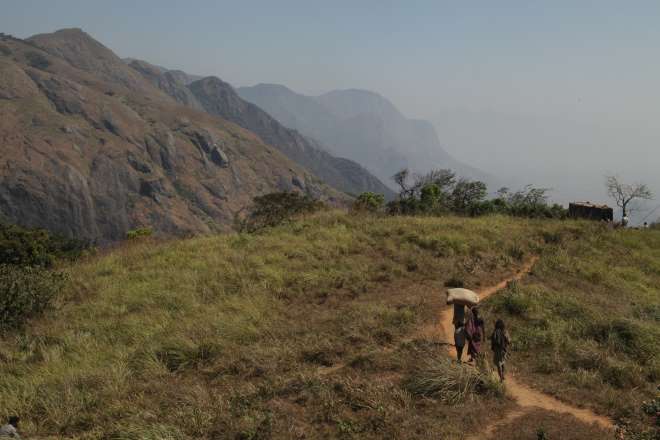
Aka Profit Motive and the Whispering Wind. For most of its runtime, Merku Thodarchi Malai is a low-key portrait of a specific-geographic location: the ghat section on the frontier between Tamil Nadu and Kerala. Nature, of course, is indifferent to state boundaries, and most of the people we see co-habit within a continuum of languages, customs, beliefs and worldviews. We witness life and work in the mountainous region through the eyes of porter Rangasamy (Antony). We get a sense of the local economy, the trade routes, the inhabitants’ relaxed attitude to money, and the near-total lack of a desire for profit. Business is important only so far as it sustains life. There are accidents and there’s a bit of drama, but for most part, Lenin develops a static, existential picture of lives lived at the mercy of nature, which knows nothing of human needs and sorrows. And then comes the coup de grace: a series of events that wrecks the film down in order to build it anew. Troublesome emotions like greed and wrath take on monstrous proportions through politics and come down on the region like an avalanche. Lenin rapidly, but rigorously, sketches the consequences of the breakdown of an agrarian society tenuously held from collapse by labour unions. GMO firms, land mafia, modern machinery and development projects quickly follow, corrupting the ecosystem beyond recognition. The filmmaker lingers on a shot of a shopkeeper noting down what Rangasamy owes him in a ledger—the incipient notion of debt marking the arrival of new economic relations. Like in Happy as Lazzaro, the brute force of modernity brings in newer forms of bonded labour. The community dissolves, and with it its faith and solidarity, forcing even its non-contributing members to take up jobs in the new economy. The last half hour of the film turns our perspective inside out, forcing us to recognize the landscape now as a bearer of grief at the mercy of a human order. Merku Thodarchi Malai is that rare film which is political without being sentimental. There’s a murder that happens, but it’s presented purely as an existential reaction devoid of moral connotations. Lenin concludes with an absurdist wallop in which a uniformed Rangasamy is hired to guard his own unfenced land—now a private property housing a windmill—and protect the free winds from… what exactly? As Lenin’s drone camera flies farther and farther backwards, we see all the surrounding plots of land—each one bearing a tragedy perhaps—occupied by more windmills, those shiny white icons of clean, green progress now looking like gravestones. If you want to know what Marxist cinema looks like today, this is the preeminent film for your consideration.

Gantumoote (“Baggage”, 2019, Roopa Rao)

That a coming-of-age tale told from a girl’s point of view seems exceedingly fresh partly points to cinema’s conditioning of the audience to the primacy of the male gaze. Rao’s film is the hidden half of a story we are intimately familiar with: a lively, popular boy loses his way in life because of his romance. Rao filters the story entirely through the perspective of her protagonist Meera (Teju Belawadi, daughter of filmmaker Prakash Belawadi), in whose voiceover the film unfolds. At times superfluous and overpowering, the anachronistic voiceover oscillates between the adult Meera, trying to make rational sense of her experience, and her teen self, living life as it presents itself, and nevertheless provides fruitful tensions with the image. From the outset, Rao portrays the movie buff Meera as someone who likes to see (the interaction of screen and spectator has generally been the prerogative of male cinephiles). Through countless shot-reverse shot constructions, she makes the viewer share Meera’s awakening of desire. All through, the emphasis is on Meera’s autonomy, her right to be alone, to want alone, to suffer alone. Rao plays off specific gestures (Meera pulling her boyfriend by his shirt sleeves, his preventing her from biting her nails) against a series of moods (the anxious wait for first kiss in monsoon, the languid summer vacation), specific memories of Meera’s against her lack of knowledge of events beyond her purview. Even when it goes in and out of student film territory, Gantumoote is carried forth by Belawadi’s incredible turn. Her frame drooping in harmony with her eyebrows, she looks over the shoulders, hers or her beloved’s, her eyes conveying her inner life with the directness of subtitles. She is an instant star.


Ee.Ma.Yau (“R.I.P”, 2018, Lijo Jose Pellissery)

Ee.Ma.Yau deepens the suspicion I had watching Jallikattu: that Pellissery works like a painter. First comes the underlying structure; in this case, the social machinery of a small-town Christian community that springs into action following the death of a member. Overseen by a trusted friend of the deceased’s son, a doctor, a priest, a policeman, an undertaker, a printer, a coffin maker, a gravedigger and a music band galvanize around the dead alcoholic. Overlaid on this impersonal societal analysis, like colours on a drawing, are human emotions and characteristics: desire (of an man wishing a grand farewell to his dead father), malice (of a man who is bent on arousing suspicion around death), self-righteousness (of a priest who makes it his mission to complicate things), greed (of a coffin maker trying to sell an expensive unit), generosity (of a friend willing to abase himself to alleviate his friend’s suffering) and compassion (of a rival battered by the dead man). Like Jallikattu, this is a film about how these individual qualities overwhelm and destroy the community from within, turning a complex collective calculus to see off a man with civility into a spectacle of uncivility. Despite the (sometimes unwatchable) sordidness of the happenings, the stress is on the basic dignity of individuals. Pellissery’s characteristic, long Steadicam shots bridge indoors and outdoors, connecting the perspectives of characters that were only pieces in a communal mosaic before the death. The uniformly caffeinated performances are pitched above everyday realism, but below cartoonishness. While his work on the image is still strong—the floodlight-bathed coastal town has a distinct character—Pellissery has no qualms dealing in the abstract or being literal-minded: a blunt coda resumes the film’s philosophical motivations. A potent shot of cheap liquor you don’t want to try again.


Suttu Pidikka Utharavu (“Shoot at Sight”, 2019, Ramprakash Rayappa)

An unmitigated disaster. All it takes is five minutes to figure that this is the work of a bona fide hack. It’s the director’s third film and he’s apparently never heard of a tripod. One could say that Rayappa really puts the motion in motion picture. Three men (or four, who cares, certainly not the filmmaker) rob a bank and hole up in a cramped residential colony of Coimbatore, Tamil Nadu. A hot-headed officer (Mysskin, paying his bills) is on their heels. It so happens that a group of terrorists are hatching a bombing plot in an apartment in the same colony. The specificity of location suggests that the writer-director has a personal connection to it. But all we learn about the area is that it’s overridden by ostentatious and treacherous North Indians, and so the good policemen of Tamil Nadu are obliged to carry out a clean-up job. A big twist at the end is intended to overhaul our understanding of the events. The director is clearly aware that he’s been cheating his audience so far, and tries to cover his tracks with no avail. The result is a cheap prank in the vein of The Usual Suspects. There’s a monumentally irritating constable character whose stupidity is amped up solely for the big twist to work. The sole point of interest is the final reveal montage: in maybe fifty shots in three or so minutes, we get to hear the whole backstory—an indication of Tamil film audience’s increasing capacity to absorb a great volume of sudden information, a capacity thoroughly abused here.


Kavaludaari (“Crossroads”, 2019, Hemanth M Rao)

A valuable archaeological find was robbed and the family of the archaeologist murdered in 1977 at the peak of emergency—the original moment of the Indian public’s disenchantment with politics and its practitioners. The case, thought to be a stub, is pursued by a traffic policeman (Rishi) after 40 years when unidentified bones of three individuals are found during a road-widening project. The cop collaborates with the original officer who investigated the case (Anant Nag) to complete the puzzle. Co-writer of Andhadhun, Rao renders the idea of the police officer living with his case literally, as the people involved in the murder materialize in his apartment with post-production effects. The film starts out as a more ambitious portrait of men and their obsessions, problematizing the investigators themselves, but eventually settles on a traditional whodunit arc. Rao loads the narrative with information after information, plot thread after plot thread, whether they serve to enrich it or not, whether they are indispensable or not. The surfeit of information in itself—mimicking the cognitive experience of navigating today’s mass and social media—sustains a feeling of mystery and importance. The film is generally a couple of steps ahead of the audience, but imagines it is taking them along. In a crucial montage, the suspense is taken to an artificial crescendo through an intercutting between three different spaces. It’s supposed to create an anticipation about the identity of the killer, but what it does instead is produce an anxiety that something grave is underfoot. This mechanistic approach to thrill aside, Rao exhibits an admirable economy of exposition. Several sequences are constructed out of the fewest possible shots, the camera craning across space to furnish additional details. There’s a charming shot of the two investigators waiting in a car in which Anant Nag tries to trap a CGI fly as Rishi observes with amusement from the back seat.


Thondimuthalum Driksakshiyum (“Evidence and Eyewitness”, 2017, Dileesh Pothan)

Having eloped, Prasad and Sreeja (Suraj Venjaramoodu and Nimisha Sajayan) are on their way to the north of Kerala when Sreeja’s matrimonial gold chain is stolen by a criminal (an ostentatiously self-effacing Fahadh Faasil) who swallows it when caught red-handed. The trio ends up at the police station of a tiny town to sort out the issue. It’s an open-and-shut case with no information withheld from the audience, and the film rejects novelistic suspense and epistemological mysteries. The director keeps riffing in scenes set in the police station by weaving in peripheral incidents of petty crime, which increases tension by delaying plot progression. This allows him to mix contrasting tones to great effect, visually (as in the shot of the devastated wife sitting next to colourful balloons), narratively (the triviality of the crime set against the seriousness of consequences) and conceptually (the sanctity of a marriage having to pass through a thief’s rectum). In an unusual characterization, he describes the police force as a rather transparent establishment where information trickles up and down with ease. The cops get comfortable with the plaintiffs on a first name basis, while the latter grow familiar with all the policemen. More sharply, the film spirals out of the story of small-time felony to weave a quasi-philosophical picture of individuals caught up in the whirlpool of impersonal institutional imperatives. The film’s Rashomon-like network of perspectives are centripetally held by the act of stealing a gold chain. The husband (seeking the stolen valuable), the wife (seeking honour and justice), the criminal (seeking liberty), the constable who lets him escape (seeking a closure to the case) are acting on a constant drive for self-preservation, but they are also capable of tremendous, sporadic grace. The equivalence between Prasad and the criminal—echo of another Kurosawa, Stray Dog—is perhaps overly stressed, but it doesn’t take away from the considerable accomplishment of this film.


Kirumi (“Germ”, 2015, Anucharan)

Anucharan wrote, edited and directed this debut feature. Kathir (Kathir) is an unemployed young man, offended by the disdain of his friends and family for his predicament. When he gets an opportunity to work for the police as one of their black-market mercenaries—employed to gather information, collect bribes and rough up suspects—he sees a way out of his impasse. He makes quick progress, soaring up the preferential ladder until he becomes too big for his shoes. There’s very little feeling for milieu here. We don’t get a sense of Kathir’s social situation. He seems to glide in and out of lower-middle class domesticity, rubbing shoulders with an unmarked pair of financially struggling friends, an underground police informer (Charlie, playing the kind of decent everyman that so well suits him), politically-enabled gambling lynchpins and, later, higher-up police officers. What it lacks in nuance and local colour, Kirumi makes up for with a smart structure. Taking the titular microbe as analogy, it sketches the tragedy of a disruptive agent that infects the corrupt body of the police institution—kept from total collapse by internal rivalries and mutual suspicions—only to end up strengthening its immunity and be rejected. Kathir is presented as someone resenting his lack of power and esteem, and his short-lived ambitiousness a product of his power trip. His horniness is regularly invoked, I suppose, as a reference to his compensatory, self-destructive masculinity. The filmmaking is cranked up for effect and the emotional peaks are somewhat misplaced. But the ending, with its perversely welcome cynicism in the mould of Chinatown, is refreshingly anti-climactic, understated and conceptually at home.

« Previous PageNext Page »