Cinema of Italy


[An edited version of the following text was originally published in Pardo, the Locarno Film Festival’s official daily magazine.]

“My whole trouble was that at no point was I able to lose my administrative and critical faculties,” remarks Judas in Paul Claudel’s short story The Death of Judas (1933). Claudel’s bracingly revisionist account makes a case for the twelfth apostle, recasting him as a sardonic, inquiring man who saw through the intellectual obfuscations of the miracles and the cowardice of his fellow disciples. This Judas celebrates his philosophical freedom even in death, suspended from a tree, unbound by the constraints of the cross that consumed his master.

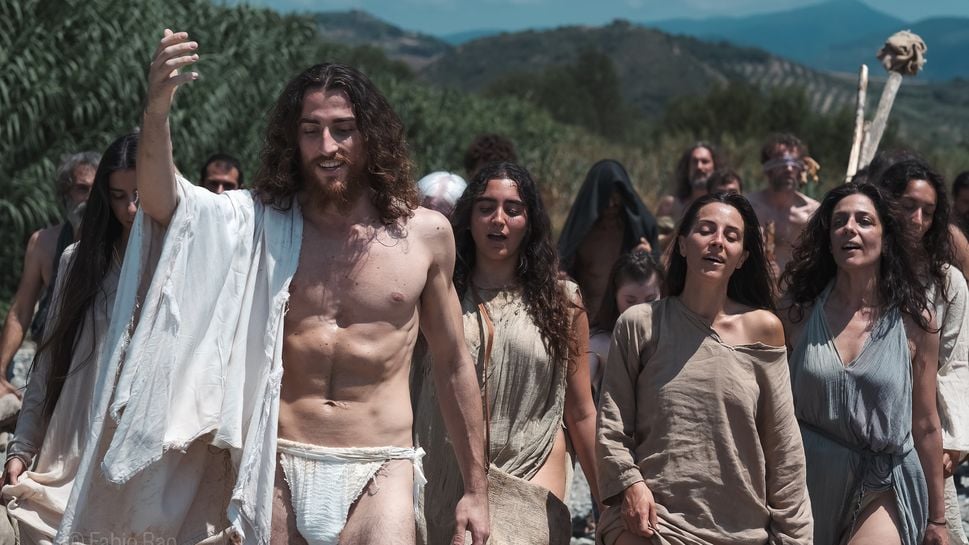
Taking over the baton from Claudel, writer-director Giulio Base gives the devil its due in Judas’ Gospel, fully humanizing the treacherous figure and dramatizing his tussle with reason and faith. In Base’s retelling, born under a cursed star, Judas endures a harrowing childhood in a brothel. Wielding a bloody dagger, he rises to power and fortune, only to give it all away when Jesus (Vincenzo Galluzzo) summons him. Wise in the ways of the world, Judas is moved not so much by the Prophet’s supposed miracles, but by His simplicity and capacity for grace.

Base presents Jesus as a radical egalitarian, a proto-hippie whose following comprises men and women alike, without authority or hierarchy. With a forgiving smile, He condones the libertine goings-on in the group, which He leads from place to place over three years. In a subversion of the injunction against idolatry, Jesus is visible, front and centre, throughout the film, anchoring the image with His radiant presence. Even so, we don’t hear His voice except at choice moments, as when He beckons Judas or eulogizes Joseph at his funeral.

Judas, on the other hand, is simply a cloaked figure whose face never once shown to us. Yet it is his lucid, layered monologue that propels the narrative. Drawing us into an entirely subjective space, this voiceover (delivered by the gravel baritone of Giancarlo Giannini) accompanies us through the maze of Judas’ mind, his confusions about Jesus’ plans for him, his sense of superiority over his unlettered peers, and his messiah complex undone by his human failings.

As one’s image complements the other’s voice, Jesus and Judas become inextricable entities bound by prophesy. “Everything in the world exists thanks to its opposite,” Judas notes, implying that his treachery and Jesus’ ascension are mandates of the same divine will. Judas’ labyrinthine reasoning brings him to the conclusion that he was the only apostle faithful enough to carry out the betrayal, yet he succumbs to human logic at the moment of Crucifixion. Thematically and formally thought-provoking, Base’s film unveils Judas in all his fascinating contradictions. Ecce homo.

With only a handful of posts published, the blog pretty much went into hibernation this year. While 2024 was full of opportunities, encounters and discoveries that I am immensely grateful for, it was also, personally, a year of greater flight from the world, including the world of cinema in some ways. I cut myself off more and more from the news cycle and social media for sanity’s sake, which has meant that I’m woefully unaware of, among other things, what’s making waves in the awards circuit and what the “important” films of this year are. At a glance, I don’t recognize most of the titles featured on major year-end lists.

At the same time, I find myself more embedded than ever in the professional world of cinema, working with different film festivals in various capacities, minor or otherwise. While I haven’t been able to write and translate as much as I would love to, I’ve found myself increasingly involved in programming and selecting films. This has had, I think, considerable consequence on the way I watch and write about cinema.

Firstly, the majority of the titles I saw this year were works-in-progress (WIP): projects in post-production, without CGI, colour grading, sound-mix, and even some shots or subplots. Such a ‘pre-natal’ view of films tends to put the viewer in a state of disenchantment in which one becomes too aware of the strings being pulled: actors simulating shock, disgust or joy in front of blank screens, interacting with inexistant elements of the décor, suspended on ropes, drowned in ambient noise or struggling to convey an emotion, hoping that the music will do that rest.

Over time, watching such volumes of unfinished films could also make a year-end list like this a hassle, since it I have to constantly check whether a particular WIP that I liked last year has released this year or is still waiting for a premiere. More crucially, such lists will likely be even more aleatory and subject to the vagaries of my viewing assignments rather than, as in the past, seeking to take into consideration, even if nominally, consensus titles and popular favourites.

The bulk of my writing this year has also been of a private nature, tied to the programming work. Destined for a handful of known people within a festival, instead of a wider readership online, the texts have undergone a change in kind. If they have gained in freedom and concision, they have lost the rigour and rhetorical force that comes with public writing. I can’t yet imagine what kind of impact this might have on my instincts – and mental capacity to engage with films – in the long run.

All this preamble to say that this blog may continue to remain inactive in the coming year(s). While that is nothing new – it was already in cold storage along with my cinephilia from 2016 to 2019 – it does feel different not to be identifying primarily as a critic/translator anymore. Interesting times ahead.

Here’s wishing a happy new year.


1. The Adamant Girl (P.S. Vinothraj, India)

When Kottukkaali (The Adamant Girl) released in theatres, miraculously, in August in Tamil Nadu, it was accompanied by substantial popular backlash. Admittedly, Kottukkaali is a tough-minded work, one that is perhaps harder to instantly ‘like’ than Vinothraj’s debut Koozhangal (2021). Like the latter, it makes us intimate with the unbridled rage of its male lead, but it does so without the emotional cushion of a child’s perspective. Instead, the film performs a high-wire act, tensely balancing different, conflicting points of views towards its protagonist, Meena, a young lovelorn girl deemed possessed and taken to a local godman for exorcism by her extended family that includes Pandi, the hot-tempered cousin she is betrothed to. While the entourage constantly discusses what is to be done about the girl, Meena herself remains resolutely mute, her silence conveying both defiance and stoic resignation. Kottukkaali explores both the horrific dimensions of this pervasive practice and the subversive space of resistance it offers to the ‘possessed’, temporarily immune from secular violence. At once sophisticated and utterly simple, Kottukkaali respects its audience’s imagination and intelligence while withholding nothing from them. In its formal wit, its trenchant social portraiture and its uncompromising humanism, it represents a significant leap forward for Vinothraj. [World Premiere: Berlin International Film Festival]


2. Twilight of the Warriors – Walled In (Soi Cheang, Hong Kong)

Decades in the making, Twilight of the Warriors: Walled In, Soi Cheang’s supremely kinetic martial arts epic, forges a double legend linking the mythical past of the now-demolished Walled City and a vibrant, close-knit Hong Kong of the eighties before the island’s handover to China. In gargantuan sets of stunning detail, the film recreates the ramshackle complex, not just the densely packed mass of its buildings, but also the thriving economy and community of this dizzyingly vertical ghetto. Desperate to evade the police and gang members, scrappy refugee Lok enters the Kowloon Walled City, a seedy, crime-ridden slum complex exempt from the law and run under the benign authority of Cyclone. Lok’s diligence and fighting spirit attract the paternal Cyclone, but when the young man’s past comes to light, the very existence of the Walled City is endangered. A masterclass in modern cinematic action, the film conceives its astonishing martial-arts sequences in a close co-choreography of camera movement, continuity editing, geometric décor and athletic performers, the whole presented at human scale and close to real-time speed. With every shot having the force of an abstract painting in its dynamic sight lines, Walled In delivers a sweeping, sensational spectacle. [WP: commercial release]


3. Who Cares? (Alexe Poukine, Belgium)

Kneel down, and you will believe, said Pascal. In That Which Does Not Kill (2019), Alexe Poukine had actors re-enact another person’s reason-defying testimony of sexual assault, allowing them to find pathways to empathy through text, performance and the spoken word. Deeping this line of inquiry, Who Cares? looks at a soft-skill course in Lausanne, Switzerland, in which trainee doctors and caregivers engage in simulated conversations with actors playing patients, with the goal of being more mindful of patients’ feelings during diagnosis. At the heart of this course aimed at humanising healthcare is the belief that empathy, like other qualities, can be learnt through performance, repetition and critical feedback. Even as it brings us close to this view, Poukine’s film qualifies it, presenting us another theatre-based training session in which real medical staff grapple with their professional frustrations born of difficult working conditions, revealing how individual goodwill finds its limits in institutional realities. Like Harun Farocki’s best work, Who Cares? zeroes in on the niche rituals of a highly specialized field, only to lay bare broader civilization and historical undercurrents; in this case, the contradictions generated by the high premium placed on individual wellbeing in western societies. [WP: Cinéma du Réel]


4. The Damned (Roberto Minervini, Italy/USA)

In 1862, during the American Civil War, a troop of Union soldiers is sent to survey the uncharted territories of the West. The young men only have a vague understanding of the reasons for the war, but have their own motivations for donning the uniform. They bide their time, play cards and baseball, and engage in occasional skirmishes against a looming, largely invisible enemy. In his first fictional feature, Minervini forges a spare, brooding Western featuring the rural White southerners who populated his documentaries on backwoods America. Their dialect, diction and body language are modern, and this deliberate anachronism lends the film the texture of a filmed performance. In casting marginalized, stereotyped individuals as Union soldiers and placing them at the very origin of the creation of the United States, Minervini monumentalizes them in the vein of Straub-Huillet’s peasants-turned-gods. At the same time, the counter-casting obliges the non-actors to creatively participate in a founding myth that is very different from the “lost cause” narrative dear to the South. The result is a kind of Lehrstück for both the participants and the audience, a vital gesture of bridge-building in a house that finds itself divided once more. [WP: Cannes International Film Festival]


5. Kiss Wagon (Midhun Murali, India)

In a film culture where a project shepherded through half-a-dozen funding bodies, script labs, residencies and international co-producers is deemed ‘indie’, here is a film that obliges us to recalibrate our notions of what independent cinema could mean. The credit roll of Midhun Murali’s animated digital saga is entirely split between the filmmaker, his creative partner Greeshma Ramachandran and the voice actor Jicky Paul. Kiss Wagon charts the sprawling odyssey of Isla, a cocaine-addled courier girl, who leads a disengaged life in a police state under the sway of a powerful, puritanical cult. When she is entrusted by a mysterious client to deliver a kiss to an encrypted address, Isla finds herself on the wrong side of a massive military-theocratic conspiracy. Narrated in a mix of tongues real and invented, using a range of animation techniques classical and cutting-edge, Midhun’s film tells a mythical tale of the planetary struggle between the darkness of religious dogma and the light of cinema. A revisionist testament in four chapters, Kiss Wagon is an epic ballad of a paradise lost and regained; regained not through the force of institutionalized virtue, but through the agitations of outsiders, non-conformists, misfits and weirdos. A homemade cinematic A-bomb, delivered with a kiss. [WP: International Film Festival Rotterdam]


6. We Are Inside (Farah Kassem, Lebanon)

The family documentary may currently be the most shopworn, convention-ridden genre in non-fiction film. But Farah Kassem’s three-hour-long domestic epic We Are Inside represents a sweeping personal work that makes a strong case for its continued existence. Following the demise of her mother, thirty-something European resident Kassem returns home to Tripoli, Lebanon, after fifteen years of absence to live with her cantankerous octogenarian poet-father. She spends her time learning Arabic from him, cutting his hair, tending to his wounds, sorting his medicine, driving him around and, most entertainingly, participating in his old boys’ meetups. Poetry becomes both an heirloom the filmmaker inherits and the means through which she concretises the daughterly bond. As the world outside falls apart, with Lebanon experiencing one shock after another, the film turns into a rumination on the role of artmaking during times of political crises, the artist oscillating between the pursuit of beauty and the reflection of truth, between the personal and the political, between inside and the outside. An instructive companion piece to Abbas Fahdel’s Tales of the Purple House (2022), We Are Inside offers a rich, funny and moving work that deserves wider viewing.  [WP: Visions du Réel]


7. Wikiriders (Clara Winter, Mi(gu)el Ferràez, Megan Marsh, Mexico/Germany)

If you ever wondered where the missing Human Surge sequel was, here is a less punishing proposition. A super-chill hangout film, Wikiriders centres on a multilingual band of three friends – one speaking English, the other Spanish and the third German, interchangeably and out of lip sync – who undertake a road trip from Mexico to the USA in search of a powerful (fictional?) family that has had an outsized influence on the history of the two countries. The trio may be navigating the Mexican landscape, but they are also virtual surfers, following the rabbit hole of Wikipedia edits about/by the members of the family. Wikiriders takes the epistemological processes of the internet as inspiration for its structure, hopping from one narrative tab to another, featuring memes for characters and making maps of meaning out of digital babel, while also raising pertinent questions about the rewriting of popular history and the resistance to it through voluntary international collaboration. Imbibing the spirit of the Nouvelle Vague as well as the road movies of Monte Hellman, Ron Rice and Wim Wenders, Wikiriders embraces the fact that it’s largely discovered on the editing table. Fun, experimental and very accessible. [WP: Berlin Critics’ Week]


8. Kajolrekha (Giasuddin Selim, Bangladesh)

Adapted from a medieval folk ballad from the Mymensingh region of present-day Bangladesh, Giasuddin Selim’s sumptuous, widescreen musical fairytale Kajolrekha is a melodrama in the etymological sense of the word: music + drama. The film employs nearly twenty songs, sung by characters and narrators alike, to advance the plot, deepen emotions, comment on actions and, at points, critically distance the viewer from the story. Bankrupted by his gambling addiction, merchant Dhwaneshwer is given a second chance when a mysterious monk gifts him a soothsaying bird. The bird restores Dhwaneshwer’s lost glory, but also instructs him to exile his 13-year-old daughter Kajolrekha. Forced to lead a life of anonymity and hardship, Kajolrekha perseveres until the tides turn, even if it means paying a heavy price. Selim’s actors adopt a precisely stylized repertoire of theatrical gestures, postures and voice tones to express the essence of their roles, be they slaves, merchants or aristocrats. This conscious revival of a classical narrative tradition isn’t carried out ironically, but with a modernist sense of the latent possibilities of a lost artform. Moving tragically flawed characters across a perfectly orchestrated chessboard of fate and destiny, Kajolrekha reaffirms the inevitability of a just and benevolent world. [WP: commercial release]


9. Sleep #2 (Radu Jude, Romania)

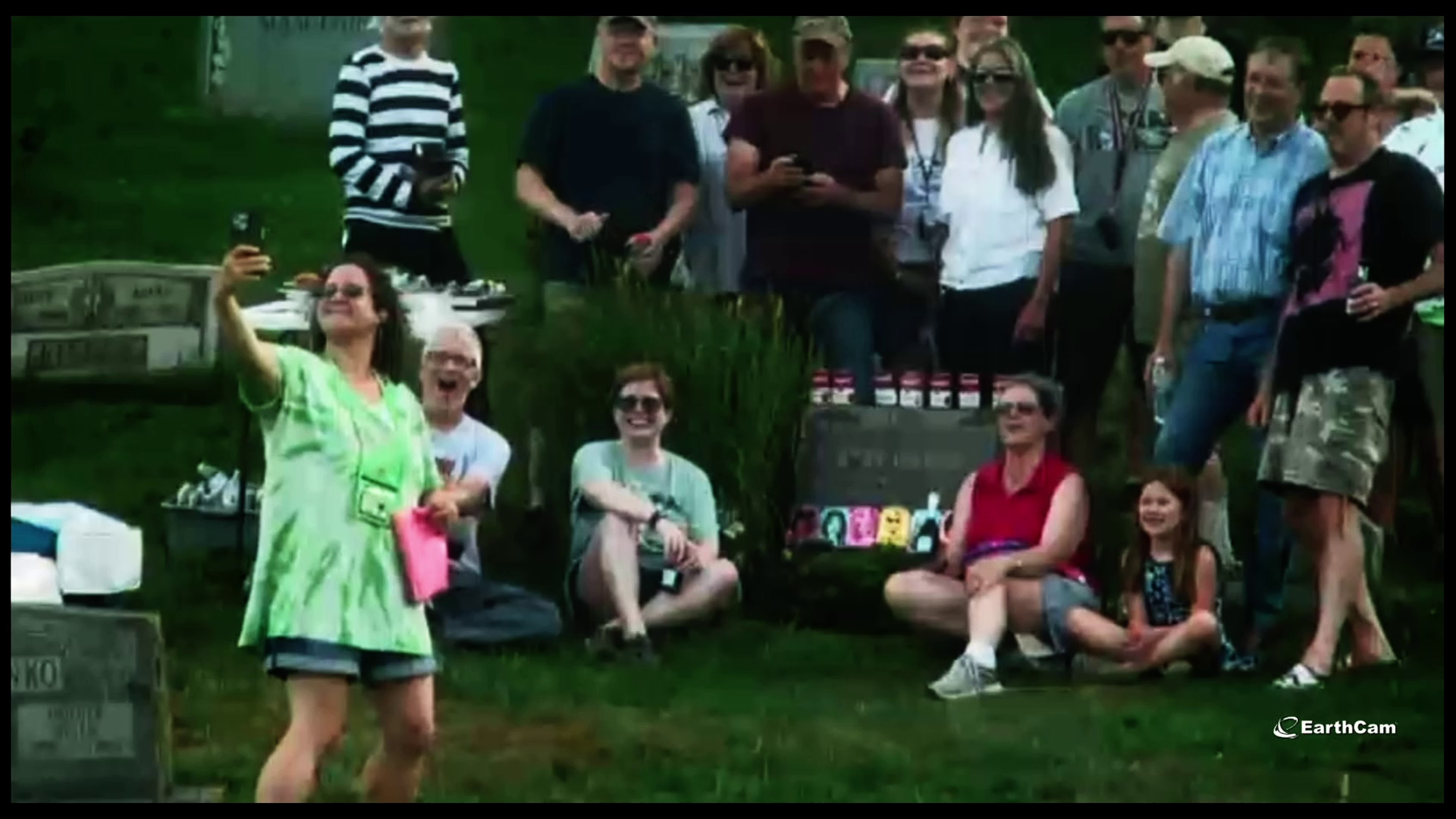
Culling from four seasons’ worth of footage from EarthCam’s live-stream of Andy Warhol’s tomb in Pennsylvania, Radu Jude fashions a spiritual sequel to Warhol’s blockbuster of boredom, Sleep (1964). Where the older film turned the dormant body of Warhol’s lover into a monument comparable to the Empire State Building, Jude’s film, almost equally unwatchable, fixates on Warhol’s own body repurposed into a public monument. As fans and curious passersby click pictures, pose flowers, decorate it with Campbell soup cans and even organize parties around it, the artist’s tomb becomes something like a collective work of art, vested with a social signification. A modern cinematic readymade, Jude’s desktop documentary crafts an unassuming essay on celebrity and fame, entirely in line with Warhol’s work. What happens when television ceases to be the arbiter of mass taste and simply becomes the condition of everyday life? Not fifteen minutes, but the possibility of eternal fame? Just as the visitors bestow the grave with meanings it doesn’t possess in itself, the act of watching the live-stream turns out to be the means by which operational images become aesthetic objects. Critically interrogating spectatorship, Jude’s fascinating film affirms the triumph of life over eternal sleep. [WP: Locarno International Film Festival]


10. Journey of the Shadows (Yves Netzhammer, Switzerland)

Once living a life of harmony in a dystopian world, two bipedal figures – humanlike but featureless, genderless – fall out under the influence of a mystical pet fish. One of them perishes, and the other embarks on an odyssey across the seas, intermittently led by a book and a candle. After countless catastrophes, this wandering being washes ashore on a pristine island, where it tries to overcome its loneliness, alas in vain. This probably isn’t what happens in Swiss multimedia artist Yves Netzhammer’s wordless, mind-bending first feature, in which identities, relations and situations are in such a flux as to resist any kind of linear synopsis. Where traditional animation advances evermore towards a utopian combination of naturalism and expressivity, Journey operates at a zero degree of digital image-making, dealing in primitive figures, bald volumes, harsh lighting, rudimentary physics, sickeningly unmodulated colours, oneiric movements, and an oppressive clarity of visual field recalling Dali or Magritte. At its best, Netzhammer’s abstract film has the subversive, Kafkaesque quality of Central European animation from the 1960s and ‘70s. Defying binaries of nature/civilization, human/technology, organic/synthetic, Journey crafts a deeply disturbing meditation on freedom, creation and self-discovery whose brutality shocks all the more in a universe so unreal.  [WP: International Film Festival Rotterdam]


Special Mention: Dahomey (Mati Diop, Senegal/Benin/France)


Favourite Films of

2023 • 2022 • 2021 • 2020 • 2019 • 2015

2014 • 2013 • 2012 • 2011 • 2010 • 2009
The history of battle,” wrote Paul Virilio in 1984, “is primarily the history of radically changing fields of perception.” Examining the relationship between war and images, the French philosopher advanced that, through the ages, victory in an armed conflict has always been a matter of perceiving and representing enemies and enemy territories; that, in industrial warfare, “the representation of events outstripped the presentation of facts”. He continues: “Thus, alongside the army’s traditional ‘film department’ responsible for directing propaganda to the civilian population, a military ‘images department’ has sprung up to take charge of all tactical and strategic representations of warfare for the soldier, the tank or aircraft pilot, and above all the senior officer who engages combat forces.”

Virilio’s analysis has only become more accurate with time. A few years ago, MIT developed a camera that can look around corners — an invention that has obvious military application. In March this year, the U.S. Army publicized their goggles that allows soldiers to remain inside their armoured vehicles while being able to see everything happening outside. To be able to see the source of danger without exposing yourself to it — the Rear Window principle — is already a battle half-won. Photography and filmmaking have therefore increasingly been at the centre of contemporary military strategy.

The work of German filmmaker Harun Farocki (1944-2014) has, over decades, thrown light on the profound, multi-layered links between war, photography and cinema. His films echo Virilio in demonstrating how, in modern warfare, terrains are mapped out in extensive detail, combat tactics are thoroughly simulated in software and variables of battle are controlled to such a degree that the actual field operation simply becomes a logistical formality. In such an asymmetric war, the side that controls machine-filmed, amoral and objective images of a region is one that has already conquered it. To see is to capture.

Two films screened at the recently concluded Visions du Réel festival in Nyon imbibe the spirit of Farocki’s work and explore the intersection between images and war with great cogency and rigour.

Directed by Massimo D’Anolfi and Martina Parenti, the Italian feature War and Peace lives up to the ambitions of its lofty title. The opening part is set in a film archive, where researchers study footage from a “forgotten war”: the Italian invasion of (current-day) Libya in 1911. Perhaps the first war expressly filmed for public consumption back home, the clips show soldiers advancing in the desert and or assembled outside captured sites. These films, we are told, played a part in creating the fiction that was unified Libya. As it did elsewhere under various imperial film units, cinema here served as a colonizing force, with the power of writing history residing with those who wield the camera.

The second segment of the film parachutes us into a crisis unit in Italy that helps locate and repatriate civilians and military personnel stuck in war-torn areas around the world. More than a century since the Libya invasion, technology has now democratized image-making. Even the “enemies” have the means to fashion their own narrative through film. Thanks to global media and the internet, these images of war can now be produced, distributed and immediately seen across the world. We observe experts at the crisis unit investigating and interacting with these videos to navigate the chaos of the present. It’s effectively a battle for the control of future history.

Production and control of images of war is also the theme of the third part of the film, set at a French military academy. A new batch of recruits in what Virilio called the “images department” is being trained in the techniques of photography, visual composition, voiceover commentary, live telecast and filmmaking. At the end of the course, a whole combat operation is simulated in the campus for these trainees to shoot and edit into a wide-screen Hollywood-like movie, as though the primary goal of war was to fabricate images, “representation of events” outstripping “presentation of facts”.

War and Peace nevertheless concludes with a reflection on cinema’s power to prevent history from falling into oblivion. As footage of post-war devastation and testimonies of Holocaust survivors wash over reel cans, we realize that while cinema may not have been able to forestall historical tragedy, as Jean-Luc Godard lamented, its true mission may simply be to pick up the pieces, to preserve the memories of the victims of war. And that perhaps is the only way cinema could film peace.

Bellum – The Daemon of War deals with similar ideas as War and Peace, but weaves them into human interest stories. Made by David Herdies and Georg Götmark, the film follows three subjects living at different corners of the world: an engineer in Sweden, an American photographer working in Afghanistan and an Afghan war veteran in Nevada, USA. They don’t meet one another in the film, but their lives are all shaped by war and Western attitudes to war.

Fredrik Bruhn, the Swedish engineer, is involved in designing an AI-powered military drone that will take autonomous decisions on bombing a perceived target — a game-changing invention that will eliminate the need for any human intervention in combats. Bill Lyon, the war vet suffering from PTSD, has trouble reintegrating into civilian life and hopes to go back to the front, not just for the money, but also to regain some semblance of normalcy. Paula Bronstein is a photojournalist from the East Coast who covers the aftermath of the Afghan war. We see her directing her subjects with makeshift lighting, wandering the streets of Kabul coaxing children for a pose or signing photo-books at her exhibition back in the United States.

Bellum emphasizes that these are nice people. Bruhn is a doting father and a science enthusiast. Bronstein is empathetic and wants to put a human face to the fallout of the war. Despite his hatred for the conditions in Afghanistan, Lyon too is a loving husband. Well-meaning though they might be, it becomes apparent that their life and work are marked by a certain guilt surrounding the fact of war. This is evident in the case of Lyon, who has seen his friends and colleagues die in the field, but Bronstein’s own activity may not be untouched by a liberal sense of culpability about her country’s interventions in Afghanistan. Bruhn’s efforts to eliminate the human factor of war, too, is an attempt to eradicate feelings of guilt about liquidating an enemy, which, the film’s narrator notes, is the only real restraining force in an armed conflict.

Elsewhere, the narrator remarks that armies don’t use just cardboard silhouettes for target practice anymore, but well-defined human-like figures, such that soldiers find themselves in a situation as close to real life as possible. Lyon drives past a large military facility in Nevada, where a life-size replica of Kandahar was set up. Such hyper-realistic simulation environments, which were the subject of Farocki’s four-part Serious Games (2010), are ultimately designed to blur the boundary between reality and fiction and to have combatants take one for the other.

It’s judgment that defeats us,” says an embittered Colonel Kurtz (Marlon Brando) at the end of his famous monologue in Apocalypse Now (1979). What Bellum points to us is that this judgment, this human fallibility, is the variable that technology seeks to eliminate from the equation of war, seeking to forge amoral killing machines that will, somehow, do the “right thing”. In this mission, these two films show us, cinema will be always on the side of the powerful.


[Originally published at Firstpost]

Birds (Or How to Be One) (Babis Makridis)

Makridis’ peculiar third feature is inspired by Aristophanes’ comedy The Birds, but it exists between three narrative registers: a documentary about an ‘off’ production of the play by Nikos Karathanos and Onassis Stegi, a freewheeling screen adaptation of the play featuring the same actors in several exotic locales around the world and a poetic essay film about human beings’ relationship to their avian peers. Divided into nine thematic chapters answering the titular question, Birds teases out our eternal quest to emulate our feathered friends: the desire for flight, the yearning for lightness, the urge to escape gravity (literal and social), the impulse to rise to the skies through the construction skyscrapers, the fear of falling and the thrill we harness from it, the fantasy of crossing political borders, but also the need for community and for defending it against outsiders, manifesting ultimately through aerial warfare. Makridis does not emphasize or linger on these ideas, instead suggesting associations through fugitive but evocative images. It is the strength of his film that it does not attempt to ‘interpret’ or ‘modernize’ Aristophanes’ comedy. While it dips in and out of metaphor, Birds takes the outlandishness of the original premise at face value. As a result, the adaptation it offers is literal, one in which the human characters imitate bird cries and indeed audition to become birds, not unlike the two prospectors of Amit Dutta’s The Golden Bird (2011) who try to rise above the human form. In doing so, Birds offers another intriguing demonstration of the Greek taste for the absurd. (The equivalence between man and animal is, moreover, a significant motif in Lanthimos’ work.) This loose, opaque treatment produces results that are as funny as they are flummoxing.

This Is Paris Too (Lech Kowalski)

Kowalski’s freestyle documentary seeks to offer images of Paris not generally seen on screen: homeless immigrants on the outskirts of the city leading a nomadic, shadow existence under bridges, on abandoned sites and in urban interstices. It’s winter, and we watch them fight the cold with inadequate blankets and cheap anoraks, subsisting on community kitchen and standing huddled in the daytime without much to do. A few have built some form of shelter, but most just find a spot to sleep. We see them through the eyes of Ken Metoxen, a native American friend of the filmmaker’s, who wanders the breadth of the city on foot and in public transport. Sometimes Ken interacts with individuals such as Aman, an over-enthusiastic boxer from Afghanistan who cannot participate in ring fights because he lacks the necessary papers. The communication is awkward—Ken does not speak French; Aman doesn’t speak English—and is soon replaced by Aman fervently showing his boxing skills to a compliant Ken. The latter listens patiently as Aman pulls out his phone to show videos of Taliban bombings and tortures in Kabul. Ken empathizes with the suffering of the immigrants through a shared history of oppression. But Kowalski’s choice to refract these vignettes of Paris through a native American’s point of view has no theoretical underpinning. He simply wants to film Ken as a flaneur, experiencing (and revealing to us) a foreign city from an outsider perspective, which leads to an exceedingly long, final tracking shot on Ken spanning several blocks of Paris. Much of all this is impressionistic, and there’s very little that seems to have been thought through, the result coming across like outtakes from a larger project between Kowalski and Ken. In a surprising coda, the director discusses his experience as a child of immigrants to America and his relationship with Ken, who is revealed to be a cross-dresser—a gratuitous, inward-looking turn that hints at several unexplored possibilities.

The Last City (Heinz Emigholz)

Emigholz’s return to fiction opens with a reminiscence by the filmmaker about a dream city that keeps changing place and about people who keep changing shape. This personal statement gives way to five interconnected stories taking place in five different cities: a filmmaker and a weapons designer talk about war in the Israeli city of Beersheba; an elderly artist converses with his 30-year-old self in Athens, a mother finds contentment in her incestuous family in Berlin; in Hong Kong, a Chinese woman schools a Japanese woman on her country’s unspeakable war crimes; an art dealer and a cosmologist discuss the possibility of life outside earth in São Paulo. The Last City scans like a long pedagogical exercise demonstrating everything that shouldn’t be done in films: camera that is constantly canted and misaligned with the horizon, eyelines that never match, cuts that break the 180-degree rule, camera setups that keep changing, actors who play multiple roles of ethnicities different from their own, blatant discontinuities in makeup, costume and décor not just within scenes, but within a single line of dialogue. All this, of course, is part of the setup. Filming pieces of buildings through extreme angles, Emigholz is integrating the city space into the conversations. His ‘last city’ is an ever-changing, universal town that has been homogenized out of its history and identity, just like its people who seem to have no ethnic essence. A wild, entertaining speculative fiction, Emigholz’s film recalls Hiroshima Mon Amour (1959) in the way its characters work on each other’s memory and history in fraught urban encounters. Only that there is neither Hiroshima nor any social taboo conditioning the encounters anymore. Edited in a brisk rhythm, The Last City is also a very funny work in the way it pokes fun at its own ridiculous, disparate premises, which are tied together in some sort of a logic-defying hyperreality.

Undine (Christian Petzold)

If, in Transit (2018), Petzold drew on American film noir to create fruitful frictions with his basic realist style, in Undine, reportedly the first of a new trilogy based on elemental beings, he leans on the legend of the eponymous water nymph whose curse it is that her human lover will meet his death if he is ever unfaithful to her. In Petzold’s version though, it is Undine (Paula Beer) who appears to be cursed, unable to break the tragic mould of the legend. Jilted by her boyfriend, Undine finds an ideal love almost immediately in Christoph (Franz Rogowski), an industrial diver who seems to be as ethereal a creature as her, but fate plays a nasty hand. The film harks back to Yella (2007), firstly in its forked narrative in which the protagonist enters a new life just when everything closes in on her. More notably, like Yella, Undine transposes a supernatural reality onto the banal, hyperrealist surface of reunified Germany. Petzold offsets stretches of dead time showing characters doing everyday activities with evocative images of heightened intensity that signal the coexistence of a fantastic realm. Both Undine and Christoph experience each other as quasi-spectral beings, and because they take turns leading the narrative, we are never sure whose fantasy we are in. Petzold, moreover, imposes another layer of signification onto this composite: Undine is an urban historian dealing with the many narratives that impose themselves on Berlin. Professionally and personally, the past for her, as for Yella, is never dead and buried, but something to be always reckoned with. So the film offers a three-fold narrative, with the romantic story, the Undine legend and a political allegory finding echo in each other. If this layering allows Petzold a way to animate his clinical style with mystery, at times it also gives the impression that he is hedging his bets.

Glauber, Claro (César Meneghetti)

In 1975, Brazilian auteur Glauber Rocha made a film in Italy titled Claro in which he reimagined Rome as the historical centre of imperialism. Meneghetti’s documentary about the film—and about Rocha’s sojourn in Italy—assembles archival footage and interviews with surviving cast and crew members, film critics and the director’s Italian friends. The interviewees watch clips from Rocha’s film and recall how such and such scene was shot. The discussion blossoms outward to include the general social situation of the time: the cultural permissiveness that allowed Rocha and co. to live in apartments without paying rent, cohabit while blurring the boundary between friendship and love, and spike each other’s drinks before shoot. With interesting anecdotes about the Brazilian’s bluster and idiosyncrasy, the testimonies help locate Rocha within the intellectual landscape of Italy at the time. Throughout, Meneghetti cuts outdoor scenes from Rocha’s film with shots of the same places in current-day Rome, suggesting the demise of radical political dreams, but evoking certain continuities as well. Interestingly scored, these interludes also serve as spaces of reflection for the viewer, a respite from all the talking heads. In all, we get a sense of Rocha’s complex relationship to the European country: even as he was criticizing it as a ‘colonizing’ empire, the filmmaker saw in Italy a channel for distributing Cinema Novo works and, indirectly, a rampart against the growing authoritarianism back home. But there is hardly any rough edge to Rocha himself. His Latin American background gets little notice and he comes across as a mad prophet conjured into existence in Rome. Most collaborators describe him as an eccentric visionary who saw beyond his time, some others speak of their great love for him. But one piece of priceless archival clip at the end alone makes up for any deficiency: Rocha having a glorious public meltdown after the 1980 Venice Film Festival, where he destroys Louis Malle (‘second-rate filmmaker’), Cassavetes (‘commercial director under avant-garde garb’), Michel Ciment (‘takes American money’), Andrew Sarris (‘CIA-backed imperialist’) and other ‘Hitchcock lovers’.

Film About a Father Who (Lynne Sachs)

At first glance, Lynne Sachs’ latest documentary comes across as another iteration on the now all-too-common work of ‘personal archaeology’ in which filmmakers trace their roots through public and private archives, at times rending open the specific ways their unhappy families have been dysfunctional. Sachs, for one, employs home movies shot over half a century in half a dozen formats—8mm, 16mm, VHS, Hi8, Mini DV and digital—by herself, her father and her siblings, filmmakers Dana and Ira Sachs. The material turns around their father, Ira Sachs Sr., a ‘hippie businessman’ who sowed his wild oats across the world and virtually birthed a baseball team. Senior’s constant womanizing comes down heavily upon his children, some of whom have known the existence of the others only after decades, but also upon his mother, with whom he nevertheless shares a close but complicated relationship. Sachs weaves through years’ worth of footage and layers it carefully into a simple, direct account with a voiceover addressed at the audience. She takes what could’ve been a narrow family melodrama into much stickier territory. As she says, the film isn’t a portrait of her father, but a meditation on relationships with this man as the connecting element. Sachs and her siblings sit with their father, now infirm with age, and ask him to recollect episodes from the past. What do they expect? Confession? Reckoning? Simple testimony wrought from a gradually vanishing consciousness? Sachs goes beyond all gut responses to her father’s behaviour—disappointment, rage, disgust—towards a complex human reality that can elicit only inchoate sentiments, as suggested by the film’s incomplete title. She isn’t filming people or their stories, but the spaces between people, and how these spaces are always mediated by the actions of others. Senior’s wayward life, itself rooted perhaps in a traumatic childhood, profoundly shapes the way his children look at each other. Two living room discussions are intercut as though they are unfolding in the same space, the only way the filmmaker is able to bridge these invisible branches of the family tree. Sachs’ film is ostensibly a massive unburdening project for her; that she has been able to draw out its broader implications is a significant accomplishment.

Somi wears a broad smile. She’s in her late twenties—or early thirties, she doesn’t know—and pregnant with her second child. “I think it’s a girl”, she tells her husband Sukhram, five years her junior. Somi cooks, washes their clothes and takes care of their first child, while Sukhram is about the house doing nondescript work. They have a pet parrot and raise poultry in their plot of land. It might be the picture of a modest but ordinary family, except for the fact that both Somi and Sukhram are renegades from the Naxal movement who surrendered to the Indian state, got an amnesty, and were resettled under the country’s rehabilitation policy for ex-Naxals. Their “second-life”, in a colony in rural Maharashtra comprising of refugees like themselves, is the subject of a compelling new documentary titled A Rifle and a Bag, which screened online at the Visions du Réel film festival last week.

In long, fixed shots, the opening passage of the film gives us a sense of the couple’s everyday reality: scenes from domestic life, Somi’s visit to the pregnancy clinic, the couple’s conversation about their to-be-born second child. These images of quotidian life are, however, soon punctured as we learn about Somi’s past as a Naxal commander, the deadly reprisals the couple have risked in their surrender, their lingering feeling of deracination. Somi’s role as a wife and a mother is in stark contrast with her older role as a Naxal higher-up. But Somi makes no remark about this conventional distribution of labour, content instead to secure a future for her children.

A large part of A Rifle and a Bag presents the couple’s interaction with the Indian state and civil society on a day-to-day basis as part of their rehabilitation. Somi runs from pillar to post to unsuccessfully obtain a caste certificate for Sukhram, who can’t safely go back home to Chhatisgarh to get one. Without this certificate, they can’t admit their son into a school. The film develops around the central irony that Somi and Sukhram, of a tribal origin, have to identify themselves in terms the Indian state understands. The state and the civil society, though, aren’t malevolent forces. In fact, the officers, teachers and doctors whom we only hear interacting with Somi could hardly be more understanding and sympathetic. It’s the system they help function, faceless just like them, that holds Somi and Sukhram like a vice.

Earlier in the film, a self-congratulatory meeting organized by the local Rotary chapter, and blessed by the army, reinforces the new-fangled national identity of the ex-Naxals, pointing out that Naxalism is truly a national problem, affects as it does twenty-two states. Somi and Sukhram manage to find a place for their son at the boarding school, however briefly. In a scene at the school that puts too fine a point on it, the children are made to perform morning prayers, taught violently patriotic slogans and are, quite plainly, indoctrinated into the nationalist ideology. Somi, on the other hand, hardly has any national consciousness. Asked why she joined the Naxals, she says she wanted to get back at the local landlord who let the police harass her kin.

Through these contrasts, A Rifle and a Bag brings to surface the losses involved in the family’s integration into society. In their new colony, Somi and Sukhram don’t get a land to farm on—their primary occupation—but simply a plot large enough for a house. They are not only alienated from the world around their settlement, which still associates them with Naxalism, but also their relatives in Naxal-dominated areas. That we seldom see them outside their house or within a community only exacerbates the impression of their isolation. Owing to their situation, they can only send their child to a boarding school, where the boy acquires a body of knowledge vastly different from their own, in a language not their own. In a poignant exchange towards the end, Somi recounts her Naxal background to her son, as though restoring his ties to the family history, against the narrative he will soon be taught.

Not surprisingly, Somi appears to persistently doubt whether they have made right decision in surrendering, whether their new life is indeed better. To be sure, her family is objectively “making progress”. There’s a new bike, there are new clothes, the poultry makes way for cattle. Their colony has electricity and there’s cable television at home—material comforts contrasted with her past life in the jungle. But we never fully know why Somi or Sukhram left the Naxal organization, or what they are hoping for through their rehabilitation. Somi continues to maintain that the ideology behind the movement is righteous, even though its ways may be wrong. It’s to the film’s success that its loyalty lies with Somi’s unavowed incertitude than with any ideological certainties.

A Rifle and a Bag was produced and directed by Cristina Hanes, Isabella Rinaldi, and Arya Rothe, a trio known as the NoCut Film Collective. They adapt a non-interventional style—familiar in international documentary practice—in which Somi and Sukhram play themselves, their reality fictionalized just enough to constitute the narrative structure. They punctuate the film with repeated compositions—the house gate, Somi across an office desk, the changing phases of the moon—to impart a sense of place. This restrained form, marked by large ellipses, nevertheless makes space for considerable feeling, allowing us to recognize the tragedy behind Somi’s perennial smile.


[First published at Silverscreen]

Real Winner of the Tours Festival, Isn’t Among the Awardees

Arts no. 754; 23 December 1959.

Baldi told me later that I’d described his films exactly like the way he conceived them. He offered to produce a short film for me. It was Capito? (1962).

My first three films were produced at the initiative of filmmakers I had lauded. Do not see any craftiness on my part there.

Three films dominated the fifth international short film festival of Tours: Il Pianto delle zitelle (1958), La Vigilia di mezza estate (1958) and Via dei Cessati Spiriti (1959) are all the works of Gian Vittorio Baldi. A pilgrimage to Abruzzo at an altitude of thousand and eight hundred meters, the celebration of St. John’s Eve in a small village, prostitution in a specialized street in Rome—this diversity clearly shows that Baldi isn’t involved any more in religious propaganda than communist propaganda. He is a documentarian first and foremost, doesn’t exactly belong to any neorealist group and has more affinities with the Rossellini of India than with Zavattini-De Sica.

Critics at Tours sneered before the processions filmed by Baldi, who had a bone to pick with the censors for his film on prostitution. Unfortunately, it seems that very few people understand what a really documentary, objective and impartial cinema is. Baldi films reality and Il Pianto is a pitiless report on mystic madness as well as a hymn to God. […] Baldi shows what he sees: some sequences in his films are shot on the spot, with almost no preparation, as though they were news items. One can’t help but improvise while filming a real procession. But if we French are sensitive to the documentary value of Baldi’s work, the Italian Rouch, we are nevertheless less sensitive to its remarkable formal beauty, perhaps because some typically-Italian details go over our head.


Rediscovered simplicity

Baldi’s crew must’ve done an extraordinary work on colour—Baldi only shoots in colour. Normally so mediocre, Ferraniacolor produces stunning effects thanks to an expert colour matching. Even when there’s improvisation, it almost always gives the impression of an extremely rigorous and concerted composition. It’s Visconti, say some. But Baldi denies all influence. The blacks and the reds of Pianto are as beautiful as those of Minnelli’s Some Came Running; the yellows and the greens of La Vigilia, whose admirable final shot evokes Mizoguchi and Anthony Mann at once, are nearly as beautiful as those of Chabrol’s À double tour.

In the first shot of Via, we think we are dealing with black and white. Some seconds later, we think it’s a sepia or colour print. At the end of a minute, we realize, as we do during the river sequence of La Vigilia, that these are colours of the night, which slowly converge to an admirable pale green when a candle is lit. After the ceremony of the procession, we have the ceremony of the whore, who calmly takes out the tools of her trade one by one. Upon reflection, these gestures of an artisanal intelligence seem unbelievable in a prostitute, but the composition is remarkably balanced by the simplicity of improvisation. No matter, since the gestures, the gait of the girl have a beauty we will find only among the whores of Mizoguchi.

Comparing it to the great mediocrity of other films, I’m perhaps overestimating Baldi’s work. It’s nevertheless a cinema that I’m personally inclined to hate, a cinema based—regardless of Baldi’s intentions—on the notion of perfection foreign to the purest of arts, that of a Griffith, Fuller, Renoir. But perhaps the search for perfection is justified in the documentary, which shouldn’t rely on the vagaries of actors’ performance and should only strive to overcome technical difficulties of colour.


[From Luc Moullet’s Piges choisies (2009, Capricci). See Table of Contents]

A Serene Nihilism

Le Nouvel Adam no. 11; June 1967.

Antonioni bores me to death. But when a mediocre or overrated filmmaker makes a good film (or the opposite), I say so frankly. I practice fair-play, even when it comes to tennis.

Hence this article on Blow-Up, which, in my opinion, is one of the rare defensible Antonionis, along with The Red Desert and Identification of a Woman.

The reason for this amazing miracle: this filmmaker is really at ease only in colour film.

Blow-Up, Antonioni’s second English film after his sketch for I Vinti (1952) and his second great colour film, is a series of images, of moments, where a number of important things sometimes happen, but which don’t seem to have been chosen. We get the impression that they could’ve been different, that it could all take place as much in Buenos Aires or Paris as in London—like in Julio Cortázar’s Les Fils de la vierge, the original novella the film is based on—without much change. Blow-Up stretches the last ten minutes of Eclipse (1961), which came at the end of a story and forgot all about it, to over two hours.

What’s the connection? It’s a famous photographer from London—photography is a means of combatting nothingness, wrote Cortázar. Antonioni seems to have chanced upon his hero at the beginning of the film, but he accompanies him until the end. Then begins a semblance of a plot, first presented like one of the film’s many moments quickly abandoned for others, so as to not make us wary: he photographs a pair of lovers in a park. The woman tries to get the negatives from him by any means, without clearly-defined reasons. He makes blow-ups after blow-ups, observes them, seems to discover the traces of an attempted murder, comes back, finds a corpse, returns to the place, finds nothing. Every episode remains very chaotic, every blow-up a little fuzzier, every meaning is destroyed by the following one right away. Dream or reality? The answer seems—there are only semblances in this universe—to be of no importance. Visually, the film is bright, but its logical meaning slips irreversibly into obscurity. Every time a character does something, tries to love another, loves another, there is no rhyme or reason.

It’s the death blow to psychology, the perfect vegetative film. There is no certainty, not even that the previous certainty has been undone. It’s really a supreme disdain for meaning, quite like in Cortázar. Antonioni has borrowed only two ideas from him, the couple caught by surprise and the blow-up, but he takes his nihilist spirit along. The importance given to physical love could stir discussions about materialism. But materialism itself is a form of affirmation. It’s chance rather than desire that seems to drive relationships here. And dream and reality are always on the same footing, except at the end, which is more clearly unreal: masked characters play tennis without a ball while pretending to have one. The photographer agrees to play along, go collect the ball fallen outside the court and throw it back.

Nothing exists, but we must act as though something exists. At the end of this sequence that concludes and summarizes the film, this gesture, a little too meaningful, diminishes the general impression of absence. It short-changes the viewer and especially the critic too easily. Blow-up is a film that shouldn’t have ended and it was necessary for it to give the impression that it will not. But the film as a whole, following Borges and Cortázar, belongs to what I’d call the “Midi fantastique” as opposed to “Minuit fantastique”, a fantasy based on light and not on darkness, on the mundane and not on old tricks of the trade.

The difference from Antonioni’s previous films, from L’Avventura or The Red Desert, is the serenity. The characters in the earlier films were tormented and constantly spoke about being tormented. The hero of Blow-up is silent. He is overworked, he isn’t tormented by anything profound, and the filmmaker even less so. This is what distinguishes him from Godard, whose approach Blow-up evokes to an extent. Everything takes place calmly here.

The film is relaxing, pleasant to watch. Perhaps it’s an ablation of conscience or alienation, but if it’s alienation, it’s not so bad. What surprises us is that the hero and the filmmaker can remain indifferent and calm before so many oddities and enigmas, so much rage. The rhythm, the colours, the atmosphere contribute to give the impression of acceptance and appeasement. Antonioni makes us hear the wind in the forest like we never have. He brings out the multiple tints and settings of the most technical of modern lives through the photographer’s studio and apartment. These tints are so new to the screen that, under the shock, we aren’t able to decide whether Blow-Up is a beautiful film. It’s a film that’s evidently very rich on a plastic level and it’s this aspect, I think, that accounts for its enormous commercial success in the United States, with its picturesque, stereotypical images of contemporary England. London life in summarized in clichés worthy of a vulgar tourist.

But Antonioni seems to have wanted to say, most of all, that there’s nothing beneath it all, and to not crank up the commercial aspect of the film, in which the public can get caught even though they are not harnessed. Blow-Up’s visual style holds another pitfall: it’s likely to keep from those who admire it the most difficult and most important aspect of the film, contained in its approach and its meaninglessness. It would be a serious misinterpretation, a serious “mis-non-interpretation” rather, to believe that the film is an exercise in style.


[From Luc Moullet’s Piges choisies (2009, Capricci). See Table of Contents]

The Dead Don’t Die (Jim Jarmusch)

It must take a peculiar artistic temperament to follow up one of the decade’s best films with one of the year’s worst. Jim Jarmusch’s The Dead Don’t Die has no reason to exist except as the by-product of an old pals’ reunion. Adam Driver, Chloe Sevigny, Bill Groundhog Day Ghostbustin’ Ass Murray play cops Peterson (!), Morrison and Robertson respectively. They are the entire police force in charge of keeping order in Centerville, a town of less than 1000 inhabitants with an overpopulated juvenile penitentiary and cemetery. The officers don’t have much to do, except investigate missing chicken and keep an eye on Hermit Bob (Tom Waits), who lives in the woods. That’s only until the town is beset by strange incidents. A practice called polar fracking has reoriented the earth’s magnetic axis, resulting in exceptionally long days or nights. Animals go missing and the dead rise from their grave. Totally ill-equipped to handle the situation, the residents succumb to the zombies one by one. The linear simplicity of structure and composition that begins the film makes way for crippling hipster irony devoid of purpose or pleasure.

Besides this airless self-referencing, The Dead Don’t Die is also strewn with plugs to other films high and low. It’s clearly Jarmusch’s “take” on the now-buried B-movie tradition: the dialogue is expressly tacky (“Next to her dead body?”), the situations derivative, and the gore overdone. The actors are conscious of being in a Jarmusch movie—a stillborn idea that’s exhaustingly reiterated. But the film is invested in nothing, not even its own existence. The subtexts of Romero’s films are spelled out to intentionally keep them at arm’s length. Climate change is played out as a never-ending joke, as is a stilted redneck character played by Steve Buscemi. The zombies are of the most unimaginative kind, roaming around chanting ‘coffee’ (yes, coffee), ‘candy’, ‘drugs’, ‘wifi’ and other easy pickings like that. Jarmusch manages to make every element a grating presence, from the theme song to Swinton’s antics as a Japanophile mortician. Only Sevigny, with her completely misplaced sincerity and a subtle sense of self-deprecating comedy, livens things up in an otherwise dead undertaking.

The Traitor (Marco Bellocchio)

In The Traitor, Marco Bellocchio recreates the story of Tommaso Buscetta, a mafia boss from Palermo who turned government informant, leading to the arrest of hundreds of other members of the crime syndicate. The film opens in 1980, the year Buscetta was allowed to flee to Brazil where he’d be later picked up to be coerced into collaboration, and follows him through his “betrayal” over the next twenty years. Bellocchio and co-writers focus on the self-perception of the protagonist as an honourable man, whom Pierfrancesco Favino portrays with solemn dignity. While the mafioso and their workers take him to be a traitor, Buscetta sees himself as the true guardian of the Cosa Nostra tradition and the people he’s denouncing as the true traitors. This self-narrativization, the film underscores, is based on a notion of masculine honour above all else: Buscetta admittedly has a weakness for women (allowing the film to include gratuitous sex scenes); he resists aging and resents his wife supporting him financially in the US, where he’s put under witness protection. He spends his old age in the obscurity of suburban middle-class life, in constant fear of a retribution that never comes.

The 79-year-old filmmaker employs his characteristic, cocky style to dramatize mafia wars. A ticker of the body count flashes on the screen with every murder. Bold, brash texts filling the screen announce important dates and events. The arrest of a boss is rapidly intercut with a trapped hyena. An impressive bombing scene unfolds as a single shot from the back of the victim’s car. But Bellocchio is most attuned to scenes with a theatrical flourish: Buscetta’s deposition and subsequent cross-examinations that were televised. Unfolding in a vast courtroom with Buscetta at its centre and peripheral cells holding the denounced, the trials are filmed in wide-angle shots and echoing sound. Like the opening of Vincere, Buscetta’s composure is contrasted with the agitated, crazy reactions of his rivals. As the denunciations become a regular affair and the public interest vanes, the trials grow modest and the judges less scared of the accused. Despite its baroque touches, The Traitor remains a by-the-numbers biopic, choosing to tread close to history at the expense of insight. There’s another character whose collaboration runs parallel to Buscetta’s, and it is offered in elaborate detail for no other reason than to blink at the audience’s knowledge of the events.

The Golden Glove (Fatih Akin)

If Lars von Trier’s serial killer movie tempered the gratuity of its graphic descriptions with a dialectical organization, Fatih Akin’s The Golden Glove drops another layer from the wall separating art and snuff. Adapted from a novel of the same name, the film follows the exploits of Fritz Honka (Jonas Dassler) between 1970 and 1975, when he murdered and decapitated women in his Hamburg apartment. Unlike The House that Jack Built, The Golden Glove makes no claims to explaining Honka: barely any detail about his childhood, upbringing or inner life. Whatever we glean about this character comes from the faithful reconstruction of his apartment from photographs: the furniture and linen hint at a lived-in homeliness while posters of naked models coexist with chubby, matronly dolls. Instead, we are presented with shots of Honka binge drinking, forcing the women he picks up on street into violent sex, killing them and parcelling their bodies. Akin films the gruesome acts of rape and murder so that the architecture distances us from the events by partially blocking our view. This considered reserve, which sometimes increases the perversity of the crimes, vanishes as the film proceeds and we are treated to Honka’s fits of rage in full intimacy.

What takes the place of individual psychology is social description. Set in the seventies in West Germany, the film—likely following the book—portrays Honka as a product of his environment. Honka is at the bottom of the social pyramid: he works dead end jobs at malls and construction sites, lives in a cubbyhole and spends his money on alcohol. His face deformed after an accident, Honka is ruled out of the dating market as well. His only social life is at the Golden Glove, a seedy joint for freaks and outcasts (any of whom could be the protagonist of the story) whom Akin describes elaborately without affection. The corpulent, old women Honka lures with the promise of alcohol are also outliers of the free market economy with no social support or means of sustenance except through abject slavery. Seeing them showing no will to live and their old bodies being manipulated and mutilated like inanimate objects is the most distressing and repulsive aspect of The Golden Glove. Consequently, it’s liberating to witness the lucky few who escape this fate, thanks either to a Christian missionary trying to “save” the Golden Glove regulars or to sheer accident: a sentiment that the film structures itself around. The uplifting image of a blonde teen whom Honka idealizes unwittingly escaping Honka closes the film.


Pain and Glory (Pedro Almodóvar)

In Pain and Glory, Almodóvar lets go of the generic framework that imparted a sense of mystery and thrill to his narratives. The film is instead simply the story of a filmmaker reminiscing about his past, patching up broken friendships and coming to terms with his creative and corporeal disintegration. Weakened and frazzled, Antonio Banderas is exquisite in his role as Salvador, a successful movie director who has quit working and chooses to fritter away his time in his swanky apartment. Salvador suffers from a number of ailments stemming from his partially paralyzed back. On the occasion of the restoration of one of his older productions, he reaches out to the film’s lead actor from whom he’s been estranged for thirty years. This contact inducts him into a heroin addiction, which Salvador gladly chooses over resuming filmmaking. His heroin-induced stupor provokes memories of his pre-teen years: the suffering and hardship of his poor parents, his mother’s loneliness and resourcefulness faced with the absence of her husband and the precocious awakening of his sexuality in his relation with an older labourer he teaches. Back in the present, he meets an old lover, whom he unsuccessfully tried to save from drugs, and recounts to his doting secretary-friend his relation with his mother in her final years.

None of this information is offered as a revelation or a piece of a puzzle. Neither are they woven into a causal narrative. This lends the film a transparency and directness that critics, perhaps with justification, are quick to read as confession. The film is populated with references to the filmmaker’s life but also details so particular—his mother breaking a slab of chocolate to make a sandwich, mending a sock with an egg as support, Salvador placing a pillow on floor before bending down to access a safe—that they could’ve come from nowhere except experience. But Almodóvar avoids sentimentalism and undercuts the obvious emotions with counter-intuitive musical cues. When Salvador meets his old lover, there’s a cut across the 180° line that positions this film as a sequel of sorts to Tie Me Up! Tie Me Down!, heterosexual domesticity being the implied horror connecting both encounters. For the most part, though, the attention is on Salvador’s pain and physical degradation. The film opens with him suspended under water as though in a womb, and the presence of water bodies throughout the film suggests a time before birth. In that, it’s clearly an autumnal reflection on aging that appears to be favourite theme of the year.

The first half of Happy as Lazzaro, like Alice Rohrwacher’s previous work The Wonders, offers itself as a portrait of a community. The film opens at night time in the imaginary village of Inviolata. A group of men are serenading a young lady, but we see the scene from the point of view of the women in the balcony. There are about half a dozen of them of varying ages in the room—The Wonders prepares us to assume they are blood sisters. As the young man is asked into the house, we realize that this social ritual is a rite of passage for men and women alike. The women of the house offer drinks and snacks to the male visitors, sealing the relationship. Lit by a sole incandescent bulb, the scene is filmed like a home video and is chock-a-block with incident: grandma carried to her designated seat, a wine glass passed from hand to hand, a sleeping baby, an unexpected visit by a chicken. The specificity of these details makes it clear that they derive from Rohrwacher’s own memory, as is also evident a while later when a character from the city gives children candy after a tap on their forehead.

Inviolata, as the name suggests, is a commune untouched by time, geographically cut off as it was from the rest of the country following a flood in the seventies. There’s hardly any electricity, only a handful of light bulbs, no media and no technology save for one transport vehicle. The fifty-odd people of the village aren’t divided into families; they form a single social unit. They share accommodation and marry within themselves. Lording over them is the family of the marquise de Luna (Nicoletta Braschi), a tobacco baron who keeps Inviolata in the dark about the progress outside the commune. The villagers work as sharecroppers—a practice outlawed in Italy in the seventies—indebted to the marquise, who believes that exploitation is the way of the world. It’s not just the physical isolation of Inviolata sequestering the villagers; their fear and lack of curiosity turns them into sheep fenced in by legends and superstitions. Rohrwacher interweaves the oppression of the villagers with the barren landscape they inhabit, the juxtaposition producing metaphysical connotations about slavery.

One of the sheep in Inviolata’s womb is Lazzaro (Adriano Tardiolo), a cherub-faced, slack-armed, wide-eyed emblem of Doomed Innocence who is, in turn, exploited by the exploited villagers. Lazzaro is given the short shrift right from the first scene, where he’s the only one to get no drink and is sent out to guard the sheep while others celebrate. He is the village donkey, burdened with all chores, petty and heavy, of the villagers. Bullied by even babies, Lazzaro is at the very end of the oppression chain, abused by both the villagers and the young marquis, who manipulates him into a brotherly relationship as part of a kidnap ploy to extract money from his mother. Despite the string of disappointments that he faces, Lazzaro doesn’t show any emotion. He is, in fact, not human, floats as he does as a pure symbol amidst the physical reality of the film. At the midpoint, state authorities finally discover Inviolata and bring the villagers back to contemporary civilization. Lazzaro, as usual, is left out and remains in the deserted village for twenty years.

Part of the reason Happy as Lazzaro sustains interest is this intrusion of the fantastical into the realist tapestry of the film. In its first half, Rohrwacher’s film depicts the hardships of country life at what appears to be the turn of the nineteenth century in the vein of Olmi or Bertolucci. To be sure, there are anachronistic elements like the motor vehicles, but there’s no sense initially that the film is working against reality. We see the villagers at work, harvesting tobacco, tilling the fields and threshing hay. Their strongly Mediterranean faces, combined with the dazzling colour and light quality of 16mm film, recalls Pasolini, adding to the film’s lived-in aspect. But the magic-realist elements at the periphery—the rain of hay, Lazzaro’s catatonic spells—soon come to the fore, taking over the film once the villagers are rehabilitated. In the second half, when Antonia (a splendid Alba Rohrwacher) discovers that Lazzaro hasn’t aged a day unlike herself and the other villagers, she kneels in prayer to Lazzaro. Rohrwacher recognizes the comedy, but doesn’t undermine the piety the scene evokes. In a lovely shot coupling the profane and the sacred, she films Antonia and Lazzaro through a sheet in the back of a truck, making their profiles seem straight out of a religious painting.

Religion, as the opiate of the oppressed, is also at the crosshair of the film’s criticism: the hypocritical marquise gives Sunday classes to the folks of Inviolata, who are elated at the sight of a religious sticker. Rohrwacher’s sights, though, are on contemporary politics as well. Detailing the feudal relationship between the marquise and the villagers—and the villagers and Lazzaro—allows her to transpose these relations onto comparable power equations under capitalism. The first thing Lazzaro notices when he enters the city is a scene of immigrant workers bidding to get a fruit-picking contract. Lazzaro is the ideal worker: he doesn’t eat, sleep, shit or feel pain. Most importantly, he doesn’t question things. He is consequently at the bottom of the pyramid in either system. Despite the necessary progress it brings, modernity produces its own form of violence that one can’t put a face to. Happy as Lazzaro is a mannered but polyvalent work, with plenty of interesting details that can’t be reduced to a single idea. I look forward to Rohrwacher’s future films.

We see a man waiting at the beach, looking towards the sea. He is dressed in a purple frock coat, wields a sword and sports a tricorn. His left arm posed on the sword and his left knee bent, the man strikes a dignified pose. He’s filmed in profile, with the horizon bisecting the frame, like in a respectable oil painting. What is he waiting for? A ship to take him home perhaps. We don’t know yet, but waiting is what Argentinian filmmaker Lucrecia Martel’s fever dream Zama is about. The man, Don Diego de Zama (Daniel Giménez Cacho), is a small-time magistrate in a Spanish outpost in South America at the turn of the eighteenth century. He doesn’t have much to do in the village, except solve petty disputes between European-origin locals like himself and Indians, who have now come to terms with the new colonial order and its institutional violence. Zama longs to get back home to Argentina, where he claims to have a family. In order for that to happen, though, he needs his superior to write a letter to the Spanish throne.

Adapted from a novel by Antonio di Benedetto, Zama trains its attention on the less-explored intersection between the colonial project and sexual politics of the period. Zama is a single white man besieged by tropical malady and romantic frustration. It appears that process of his transfer back home could be expedited if he fathers a child. We learn this only later in the film, so Zama initially comes across as a loner looking to let off steam. He solicits the daughters of his landlord, a group of three white girls who turn down his advances, taking him instead to be their protector. He then warms up to the wife of the local treasury minister, Luciana (Lola Dueñas), whose mixed signals lead him down a dead end. He finally does produce a child, but with a native woman, which makes the case for his transfer weaker.

Zama is a man split between his European ancestry and his South-American birth—a fact that is brought up by Luciana and others to put him down. This anxiety of not being a “real” European translates initially in Zama into a fear of losing his racial purity. Just after the opening scene at the beach, he spies on a group of women bathing, covered in mud. At first, it’s not clear if they are white, black or native. When a black woman spots him and tries to nab him, he slaps her twice. There are also instances of the Europeans around him “going native”: a white doctor comes under the spell of a witch doctor and loses his moorings. There are legends about a ruthless European renegade, Vicuña Porto (Matheus Nachtergaele), who does unspeakable things to his captives à la Colonel Kurtz. On the other hand, as Zama’s professional situation grows bleaker, his romantic criteria become looser. He seeks only white women in the early part of the film, while his interest slowly shifts to mestizos and then to natives.

Zama details the disintegration of the pompous official of the first shot, looming large over the colonial landscape, into a hapless man at the mercy of natives. While he despairs about his transfer, which is always postponed for fickle reasons, Zama contracts the cholera spreading through the colonies. He loses his job, moves into a ramshackle hut where he’s taken care of by native women. He hallucinates, sees ghosts, his rational worldview now questioned, as was the case with the European tourist in Jan Zabeil’s The River used to be a Man. He does pull through, though, and the film jumps a couple of decades in time. Zama is now part of a mercenary outfit searching for Vicuña Porto. He’s grown a beard; his frock coat and tricorne are tarnished, but he blends better with the landscape than he did at the film’s opening. The search ends badly and concludes with Zama reduced to a shadow of his imperial self.

Martel treats this narrative obliquely, in a pronounced anti-realist style that allows for inexplicable incident to occupy the frame. As Zama and his peers are torturing a native into confessing a crime he didn’t do, the camera remains planted on the calm face of the white men. Later, when Zama is captured by a group of natives, there’s a frantic bit of editing that imparts a misleading feeling of danger. When he visits his landlord’s daughters, one of whom is raped by a subordinate who will also compete with Zama for Luciana’s attention, the ladies move about him like the Three Graces. A llama walks into the shot as Zama is discussing with his superior in his office. Martel imprisons Zama in nested frames and details of décor, and she accentuates the environmental aspects of scenes: the heat, barking dogs, buzzing insects, the clinking of distant bells that amplify Zama’s fever-induced perception of hopelessness. I’m not sure if all of Martel’s stylistic and narrative choices are successful, but there’s a sense that every shot and edit is thought over, giving Zama an artisanal quality comparable to Jauja.

The Cannes Congress (extract)

Cahiers du cinéma no. 213; July 1969

The three great films at Cannes, the Italian Carmelo Bene’s Capricci, and Nagisa Oshima’s (Japan) Death by Hanging and Diary of a Shinjuku Thief, devote themselves to exploring new planets in cinema.

The most daring of the three is the Bene: hardly any plot, even less psychology. It’s cinema at a state of purity never seen so far. There is nothing here other than cinema, other than ideas about cinema and without anything to do with tried and tested ideas of cinema. I don’t want to talk about technical ideas, even though there are technical ideas. It’s a hodgepodge of all kinds of ideas including technical ones. Until now, filmmakers who took off too directly from reality in order to arrive at the nonsensical, the absurd or the enlightening have fallen on their faces. I’m thinking especially of Richard Lester’s ill-fated Help. Bene is the first one to have succeeded without falling back on conventional references. It’s true that he resorts to parody, especially on the subject of gerontophilia. But this parody is too excessive to be effective as parody. It soon become lyrical and assets itself as a new value independent of what it caricatures. Bene’s success probably stems from a ceaseless descent into excess without hesitation or respite. Though there are moments stronger than others, it becomes almost impossible to remember all the elements, the viewer being overwhelmed by the whirlwind of the whole affair and the elements too far from reality to be readily absorbed by the mind.

Death by Hanging, too, has this quality of a compact monument. Oshima, however, doesn’t start off from the beyond. The film begins with a simple description of hanging and it is only slowly that we enter increasingly strange horizons. The viewer is captivated and carried away by this continuous progression. The fantastic acquires greater power as it is presented in a classical, sober and rigorous style that compels us to accept everything. At the same time, there is a constant exchange between these two contradictory elements. The film revolves around a death row convict who survives his hanging and must be hanged again immediately. But in Japan, you can be hanged only if you’re in a state of complete conscience, something that’s difficult to get after a first hanging. The officers of the prison mime the crimes he committed in order to bring back his memory, the prison director playing the role of the raped girl etc. This is only the starting point of a story which has infinitely more original events to follow, with a final return to social realism that assumes an extraordinary character by being situated after such narrative and thematic extravagance. It’s the most fantastic script in the history of cinema. And it’s hard to imagine how it could’ve been possible not to make a masterpiece out of it. I mean that, at this degree of ambition, it would’ve been impossible to shoot such sequences if they hadn’t been perfect. The actors couldn’t have been able to perform, the technicians couldn’t have been able to continue… That’s why I was doubtful about Oshima’s value. Perhaps he was a flash in the pan of The Brig kind. When he isn’t supported by a strong subject, Oshima would probably collapse. That’s why I wasn’t in a hurry to see his Diary of a Shinjuku Thief. I stayed through Biberman’s film and only saw the second half of Diary. Coming out of this other masterpiece, I was even more annoyed with Biberman, clearly made to look ridiculous in front of such films. Sex, theatre and social politics are indissolubly united here in a series of surprising confrontations of elements no less surprising. The film’s foundation might recall Godard, but the developments are absolutely personal. One is amazed to learn that this unknown filmmaker with a devouring personality is not a beginner, but has already made fifteen films in ten years. The law of averages guarantees that there are some more masterpieces in there in reserve. Forgotten masterpieces exist not only in the past, but also in our own time. The jury at Bergamo, where Hanging was in competition, refused even to give awards; all the films seemed mediocre to it. I’m perhaps slightly overrating Oshima’s work since I’m almost completely unaware of his context and this ignorance increases the impression of originality: there is a tradition of excess in Japan—which we admire in Yasuzo Masamura too—and a tradition of amalgamation, ghosts rubbing shoulders with social politics in Teshigahara for one thing. Be that as it may, Oshima towers over everything that we know of these traditions.


[From Luc Moullet’s Piges choisies (2009, Capricci). See Table of Contents]

Next Page »