Build the Wall (Joe Swanberg)
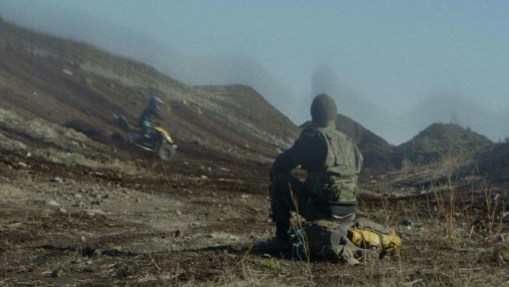
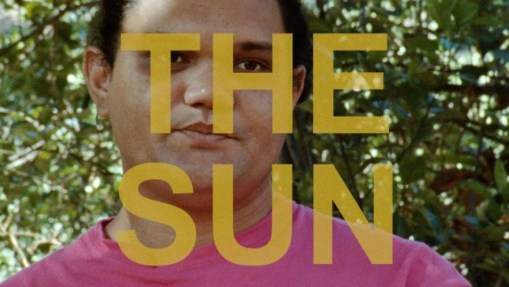
Why would Joe Swanberg, 39, feel the need to focus on the aging pangs of a fifty-year-old? Perhaps the precocious auteur, who had a body of work by the time he turned thirty, feels professionally, mentally much older than he actually is. Or perhaps forty is the new fifty. In any case, we are far from the interpersonal dynamics of Drinking Buddies (2015). Kent (Kent Osborne), who is the anchoring perspective of the film, is set in his ways. He is turning fifty, a fact he isn’t particularly fond of, and is having an old flame Sarah (Jane Adams) come over for his birthday. Unfortunately, another friend Kev (Kevin Bewersdorf) invites himself over at the same time, insisting that he will build the stone wall in Kent’s garden that he has long promised and that he will be as discreet as possible about it. Kent tries in vain to dissuade Kev because he has made romantic and work-related plans with Sarah that he doesn’t want to upset. But even Sarah occasions deviations from Kent’s routine; she gifts him a new vacuum cleaner he had made clear he doesn’t need. In a scene that’s literally a boner killer, he interrupts sex with Sarah only to get hung up on a shower curtain she keeps dislodging everyday. Kent’s mounting exasperation doesn’t derive as much from not ‘living in the moment’ as from the frustration of his wholly reasonable desire to keep his life simple and organized.
All of Kent’s expectations are thwarted: he falls out with Sarah, who ends up helping out Kev with the wall, around which a veritable community takes shape. The narrative partly hinges on the comic reversal that the over-serious, self-parodical, lone wolf Kev ends up forging a more wholesome relation with others than the sensitive, laid back Kent. But Swanberg doesn’t milk this scenario for its third-wheel comedy. (All the characteristically uncomfortable humour stems, instead, from Kent’s days out with Sarah.) He is rather interested in exploring the contours of romance at an age where you possibly expect to be accepted as you are. There is, equally, a simplification of form evident in the film, which runs for less than an hour. To be sure, scenes are still constructed around improvised acting and predominantly natural lighting, but there is an economy of exposition that feels positively mid-to-late career. With an exception of a pan shot here, a handheld shot there, most of the film unfolds in static shots, with the director occasionally drawing us in to the conversations using tighter setups. The more explicit flourishes, like cutting on sound cues, are muted by the overall austerity of the film. The film is set in a lush, wooded corner of Vermont and its meditative pace is redoubled by the natural expanse of the region. Swanberg also sets a series of formal counterpoints: intense, lone outdoor activities (wall building, axe throwing, woodcutting) that sublimate domestic frustrations, harsh sounds of sawing and stonework piercing the sylvan silence, and Kev’s DIY documentary sequences interspersed with Kent and Sarah’s fumbling. He perhaps forces the issue a little towards the end, but a shot of Kent in a jumpsuit sawing wood on his birthday is poignantly emblematic.

Coronation (Ai Weiwei)
A documentary on Wuhan’s COVID-19 outbreak made by Ai Weiwei: fair to expect that the artist’s iron fist will come down hard on China. It indeed does, but it’s the velvet glove that comes first. Coronation opens with overview shots of Wuhan’s impressive skyscrapers and advanced highways. Two people drive into the cordoned-off Hubei province and are interrogated by cops at the border. When they do manage to get in, the region registers like a ghost town from a modern horror movie, with no gas station open for hundreds of miles. They somehow make it to their home in Wuhan, only to find the fish in their aquarium dead. Ai constantly shuttles between such personal accounts of the lockdown and a macroscopic view of state-controlled healthcare and funeral activities in the province: treatment of patients on ventilators, extremely strict safety precautions followed at a hospital, song-and-dance exercises for patients that instruct them in best hygiene practices, construction of sprawling health facilities overnight, the equally rapid evacuation from the facility, package and delivery of the ashes of the cremated to the bereaved. A good part of the footage is slick, employing zany camera setups even in highly-restricted locations. Working from Cambridge, UK, Ai doesn’t reveal how he commissioned/obtained all this material (some of which were already circulating on the internet), nor does he get caught up with ethical questions such an approach raises. By all appearances, it’s a supremely efficient machinery that we witness in Wuhan. At times, Ai overlays these images with an 8-bit musical tune, as though to suggest the state’s video-game-like approach to problem solving. But the critique in these ‘macroscopic’ project remains muted as the sequences retain a Wiseman-like surface level neutrality.
The critical burden is, instead, placed on individual testimonies: a delivery man who is stuck in Hubei and is unable to return home, a lady who couldn’t see her father-in-law after he was diagnosed with the virus and died, patients at the hospital who claim they are being retained even after recovery just for image management purposes, a man who is prevented from collecting his father’s ashes without being accompanied by a ‘work unit’ in charge of his father’s case. A humorous sequence features an old woman, once a diligent middle-level executive in the Party, who fully trusts her government and refuses to consider information that might upset this faith. Earlier, workers at the hospital reception ask the cameraman to show only positive images of Hubei and to avoid emphasizing the outbreak. What emerges from this composite portrait is a sense that the source of China’s greatest strengths—executive efficacy, responsiveness, technological progress—is also the source of its more worrisome qualities—citizenry that lives in fear and denial, complete control over private data, an autonomous political will. Of course, none of this is news to anyone, but the personal testimonies introduce a grain of resistance that cuts down the stakes to human level. As the young man who is trying to recover his father’s ashes says, “one can’t just vanish silently in this world”.
A Shape of Things to Come (Lisa Malloy, J.P. Sniadecki)
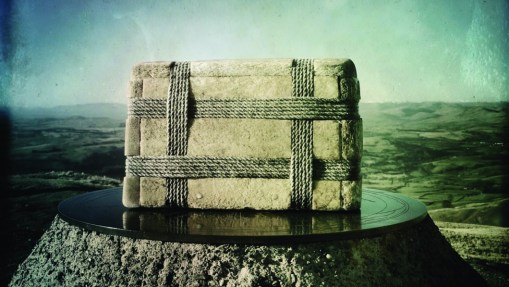
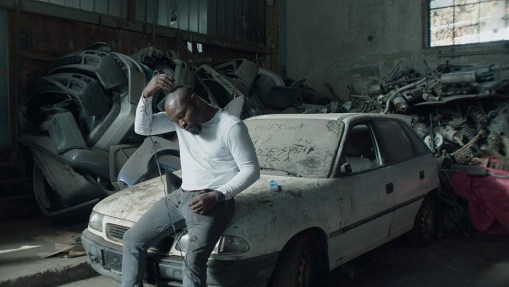
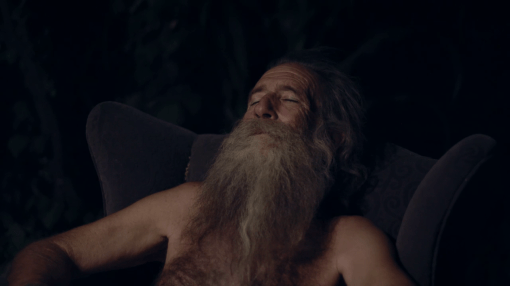
Sundog (an inspiration for McConaughey’s Moondog in The Beach Bum?) is an elderly white recluse who lives somewhere near the Mexican border in a desert stretch of Arizona. He resides in his barely recognizable trailer, around which a tiny ecosystem has sprouted. Several cats live with Sundog, who also rears a battalion of pigs with great care. With his rifle, he hunts boars to feed himself and the cats. At one point, we see him catch toads, wash them and extract glue from their feet, which serves as smoking material once it’s dry. Save for a series of grunts and chortles, he doesn’t speak to the camera. At times, we see him calling someone, presumably his son, asking him to come over for a visit or pontificating on the state of things. This stilted exposition device, combined with the filmmakers’ decision not to be seen or to interact with Sundog, reveals a slight fictionalization at work. Like wildlife photographers, Malloy and Sniadecki are discreet, content in filming the old man in his routine. Almost exclusively, they photograph him in very tight shots such that we hardly get to see his immediate surroundings or even his actions. This, combined with the shallow visual field, inhibits our vision and produces a sense of unwelcome, suffocating intimacy. This way, the film dislodges Sundog from his environment while also avoiding picturesque images of the desert.
The film naturally calls to mind another fly-on-the-wall portrait of a recluse, Wang Bing’s Man with No Name (2009). But unlike Wang’s film, A Shape of Things to Come has little anthropological or philosophical inclination. Its attention is more on the human-interest story offered by the person of Sundog. Moreover, in contrast to the hermit in Wang’s film, Sundog is not a ‘primitive’, ‘naturally’ independent of human communities. He is, in fact, a sophisticate, an emissary from the countercultural movements of the seventies, who has deliberately removed himself from society. He wears jeans, has a mobile phone, drives a pickup truck, purchases books at the nearest shop from time to time, and listens to music on the radio. He even goes to the local concert, where he dances. He doesn’t need to be on his own; it’s a choice. Interspersed with vignettes from Sundog’s routine are images of military presence: A10s flying over the desert, border patrol presumably monitoring illegal migration, incongruent surveillance towers scanning the desert. Increasingly bothered by this ‘encroachment’, Sundog decides to take out a couple of towers with a powerful sniper rifle, and becomes something of an eco-terrorist in the process. As its title indicates, the film proposes Sundog’s story as one possible sign of things to come. I am not entirely sure if there’s any significant ideological inference to be made from Sundog’s actions. They could as easily represent a form of redneck libertarianism as much as a militant environmentalist consciousness. This is where the filmmakers’ refusal to intervene, either within the film or through a framing commentary, arguably hurts the work.

A Night at the Opera (Sergei Loznitsa)
The protean, prolific Sergei Loznitsa makes his documentaries using one of two kinds of material: original footage shot on location or archival footage. Considering his recent projects, I find that films fashioned out of Loznitsa’s own stock tend to be markedly superior to his found footage work. In both cases, the filmmaker assembles his sequences without any voiceover commentary and with hardly any on-screen text. The construction has a tendency to be deliberately diffuse, with shots of extended lengths furnishing very little narrative material at first glance. This approach turns out to be quite productive in the “original footage” films such as Maidan (2014) and Austerlitz (2016) because the impression of a synthesis at work is more evident. What is possibly also helpful is that what we see in these films doesn’t come with a received narrative, which means that the viewer is expected to do more work in negotiating with them. On the other hand, Loznitsa’s found footage projects, like The Event (2015) and State Funeral (2019), by the weight of their subject matter, greatly limit the number of ways the viewer could approach them. For instance, the latter film consists of a veritable onslaught of state-sponsored pageantry at Stalin’s funeral whose meaning is exhausted even before we are through with the film. There’s hardly any ‘justification’ of why one shot was selected over another or why the film lasts as long as it does. With Loznitsa vehemently refusing any discursive framework, the viewer is no more enlightened or surprised than at the beginning of the film, save perhaps an admiration for the enviable access that the filmmaker has to archival material.
I won’t push this objection too far, for it can be made to almost any found footage work. Moreover, The Event demonstrates why even such an approach can be illuminating in light of current global crises such as the one featured in Maidan. On the other hand, Loznitsa’s new archival work, A Night at the Opera, is another baffler. For just under twenty minutes, we see the who’s who of international politics and culture trickle into the Garnier Opera in Paris. The timeline can be roughly pegged at the late fifties, or the early sixties, but it isn’t clear whether the footage is of one single event or many. The VIPs arrive at the entrance, greeted by teeming fans, pose for the press and enter the opera. A few stray, intimate moments capture a smiling guard or little girls anxiously waiting with bouquets, but for the most part, it’s a high-society affair. After the national anthem, we see a telephoto sequence of a prima donna performing to great applause. As the film ends with images of the Parisian public celebrating on the road, I wondered what to make of it. The sole emotion the work evoked was the pathos inherent to all archival footage: a sense of death at work, all the pomp and power leading to the grave. Like those aristocrats in Russian Ark (2002), indulging in one last flourish before the fall, the top bananas at the gala affair seem ready to be culled by time. It’s a melancholy feeling, but it’s hard to deny that it’s also the product of laziness. With the absence of any knowledge about the Garnier Opera during the fifties or any accompanying text to ‘pin down’ the context, the material we see seems no more special than what you might find in the Agence France-Presse vault. That may not be Loznitsa’s problem. But then, maybe it is.


 While multiple films this year about old age have presented it as a time of reckoning, Kore-eda’s European project The Truth offers an honest, rigorous and profoundly generous picture of life’s twilight. In a career-summarizing role, Catherine Deneuve plays a creature of surfaces, a vain actress who struts in leopard skin and surrounds herself with her own posters. Her Fabienne is a pure shell without a core who can never speak in the first person. She has written an autobiography, but it’s a sanitized account, a reflection of how her life would rather have been. “Truth is boring”, she declares. Responding to her daughter Lumir’s (Juliette Binoche) complaint that she ignored her children for work, she bluntly states that she prefers to be a good actress than a good person. Behaviour precedes intent in the mise en abyme of Kore-eda’s intricate monument to aging, as performance becomes a means of expiation and a way of relating to the world. A work overflowing with sensual pleasures as well as radical propositions, The Truth rejects the dichotomy between actor and role, both in the cinematic and the existential sense. In the end, Fabienne and her close ones come together as something resembling a family. That, assures Kore-eda’s film, is good enough.
 The across-the-board success of Parasite invites two possible inferences: either that the cynical logic of capital can steer a searing critique of itself to profitable ends or that this twisted tale of upward ascension appeals to widely-held anxiety and resentment. Whatever it is, Bong Joon-ho’s extraordinary, genre-bending work weds a compelling social parable to a vital, pulsating form that doesn’t speak to current times as much as activate something primal, mythical in the viewer. With a parodic bluntness reminiscent of the best of seventies cinema, Bong pits survivalist working-class resourcefulness with self-annihilating bourgeois prejudice and gullibility, the implied sexual anarchy never exactly coming to fruition. He orchestrates the narrative with the nimbleness and legerdemain of a seasoned magician, the viewer’s sympathy for any of the characters remaining contingent and constantly forced to realign itself from scene to scene. Parasite is foremost a masterclass in describing space, in the manner in which Bong synthesizes the bunker-like shanty of the working-class family with the high-modernist household of their upper-class employers, tracing direct metaphors for the film’s themes within its topology. It’s a work that progresses with the inevitability of a boulder running down a hill. And how spectacularly it comes crashing.
 Vitalina Varela is an emblem of mourning. In recreating a harrowing moment in her life for the film, the middle-aged Vitalina, who comes to Lisbon following her husband’s death, instils her loss with a meaning. It’s a film not of political justice but individual injustice, the promise to Vitalina the that men in their resignation and madness have forgotten. It’s also a bleak, relentless work of subtractions. What is shown is arrived at by chipping away what can’t/won’t be shown, this formal denuding reflective of the increasing dispossession of the Cova da Moura shantytown we see in the film. Costa’s Matisse-like delineation of figure only suggests humans, enacting the ethical problems of representation in its plastic scheme. The film is on a 4:3 aspect ratio, but the viewer hardly perceives that, the localized light reducing the visual field to small pockets of brightness. Vitalina is a film of and about objects, whose vanishing echoes the community’s dissolution and whose presence embodies Vitalina’s assertive spirit. Her voice has its own materiality, her speech becomes her means to survival. Costa’s film is a vision of utter despair, a cold monument with an uplifting, absolutely essential final shot. A dirge, in effect.
 The bird island of the title is a utopian place, a refuge for those wounded or cast aside by modernity. For sixty minutes, we are invited to look at five people working silently alongside each other in a bird shelter, tending to birds dazed by the airport next door. They don’t ask where these birds come from, nor do they expect them to leave soon. They simply treat the feathered creatures, re-habituate them into the wild and set them free. The reclusive Antonin, the new employee, is one such bird too, and his social healing at the shelter is at the heart of the film. Bird Island is full of violence, natural and man-made, all of which it treats with stoic acceptance, but it’s a work primarily about the curative power of community, the capacity for individuals to coexist in mutual recognition of each other’s frailties. In that, it’s the Catholic film par excellence, an allegory of the origin of religion. It’s also an exceptionally relaxing film to look at. Observing the participants absorbed like Carthusian monks in their individual tasks, even while working in a group, places the viewer on the same meditative state.
 Without question, Heimat is a Space in Time is the best 3½-hour film of the year. Heise’s sprawling experimental documentary uses largely personal documents—letters sent between family members, handed-down private documents—to evoke a broad history of 20th century Germany. As a narrator reads out the exchanges—Heise’s grandfather trying to reason with the Nazi state against his forced retirement, heart-rending accounts from his Jewish great grandparents describing their impending deportation, letters between his parents who were obliged to be in two different places in DDR—we see quotidian images from current day Germany and Austria, urban and rural. For Heise’s family, always made to justify their own place in the country and to never truly belong, the Germanic idea of Heimat seems positively a fantasy. While he reads out his great grandparents’ descriptions of their increasingly impossible conditions of living, Heise presents a scrolling list of Viennese deportees prepared. We try to look for the inevitable arrival of their names in the alphabetical list, our gaze forever deferred. When they do arrive, it feels arbitrary. In other words, what we hear could well be the story of any of the thousand preceding names. Perhaps all of them.
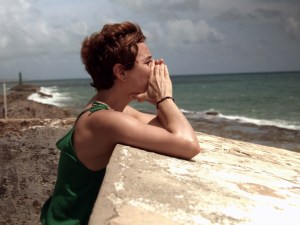 A worthy heir to Tarkovsky’s Solaris, Slits draws its inspiration from quantum physics to explore patently human concerns of loss, grief and memory. The uncertainly principle it offers is a choice between being in this world, awake to the problems of living, and finding meaning in the elsewhere. Physicist Catarina (Roberta Rangel) makes ‘sound-photos’ to study quantum the properties of light. She makes extreme zooms into a digital image to perceive the noise issuing from particular coordinates. These ‘dives’ enable her to listen to conversations from another space-time. Grieving from the loss of her child, Catarina unconsciously attempts to find closure through her research. But trying to inspect the surface of things from too close, she loses sight of her immediate reality; trying to find solace in the objectivity of science, she ends up rediscovering the great lesson of 20th century science (and cinema): that the observer influences the observation. Shot in high-definition digital video, Slits is to this new format what Blow-up was to photography. It locates in the trade-offs of the medium—between details and stability, between richness of palette and noise—visual correlatives to its key idea of quantum uncertainty. A brilliant, sophisticated work of politico-philosophical science fiction.
 Of all the recent classical Hollywood riffs in mind, none reinvigorates the B-movie tradition as intelligently or potently as Little Joe. Hausner’s modernist creature feature is a monster movie unlike any other: the dangers of the genetically-modified “happiness” plant that biologist Emily (Alice Woodard) develops is exposed early on, and there’s no triumphal reassertion of mankind to counter its menace. What we get instead is a protracted, total submission of individuality to a hegemony of happiness. Little Joe is many things at once: a multi-pronged attack on the wellness industry straight out of Lanthimosverse, the difficulty of being less than happy in an environment that demands you to be constantly upbeat, the fallout of women artists trying to expunge their maternal complexes in their work and of mothers having to lead double lives. Hausner’s camera appears to have a mind of its own, settling on the space between people, which is what the film is about: the culturally mediated relations between individuals. It’s notable that the titular plant reproduces not biologically but culturally. With its terrific score and work on colour, Hausner turns the cheesecake aesthetic of the film against itself. The result is a film of unusual intellectual density and formal frisson.
 In Status and Terrain, the German obsession with documentation and due process is called to testify to the dialectical process of historical remembrance. Adamczewski’s gently moving camera surveys the length and breath of public spaces in the Saxony region, once a Nazi stronghold, now seemingly anaesthetized under liberal democracy. Official communication, bureaucratic reports and private testimonies read on the voiceover incriminate the buildings and monuments we see on screen, revealing their role in power struggles through the ages. Just as the documents vie for a narrative on the soundtrack, ideologies once thought dead and buried surface to stake their claims on the urban landscape in the present. Adamczewski moves through 80 years of German history non-chronologically, the collage of information pointing to the living, breathing nature of political belief systems. Nazi detention of political opponents in concentration camps, Soviet retribution and blindness to victims of persecution, rise of neo-fascist groups post reunification and the historically indifferent, bulldozing force of current-day neoliberalism play out on the surface of seemingly sedate cities and towns. Status and Terrain is a sober, bracing examination of the manner in which prejudice becomes writ, which in turn becomes history, but also of the way in which this history is contested.
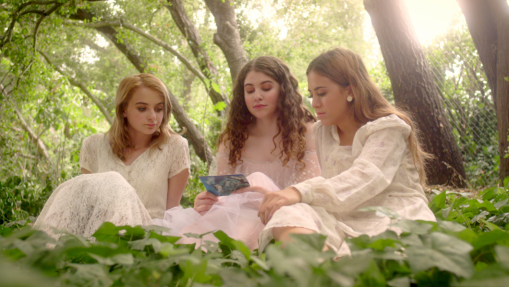
 The premise is a throwback to the clichés of the eighties: a group of teenagers at a suburban school prepare for their prom night. But in Taormina’s sure-handed treatment, this banal event assumes a spiritual dimension. In the film’s cubist first half, different groups of boys and girls make their way to the restaurant-turned-dance hall, where they will take part in rites of initiation into adulthood and experience something like a religious communion. And then, right after this VHS-ready high, a void descends over the film, turning its raptures into a mourning, not for those who have left this small-town existence but for those left behind: disaffected youth drift about the town or going through robotic social rituals, devoid of magic or warmth. It’s a work evidently deriving from personal experience, but one that’s refracted through a formalist lens. The strength of Ham on Rye is not the depth of its ideas, but the vigour of its prose. Taormina’s manifestly personal style emphasizes the surface of things, the idiosyncratic shot division focuses on gestures and minor physical details to construct scenes, and the eclectic sense of music imposes a global consciousness on a narrative that is otherwise extremely local.
 “Cinephiles are sick people”, said Truffaut. Frank Beauvais agrees. Following his father’s passing and a breakup, Beauvais shut himself up in his house in a trou perdu in Eastern France, and watched over 400 films in a period of seven months. Out of this glut, this sickness that Beauvais calls ‘cinéfolie’, came Just Don’t Think I’ll Scream, a film about looking, made wholly of clips from these 400 movies. Through a rapid, self-aware voiceover, the filmmaker reflects on his self-imposed isolation, his panic attacks, the poverty that prevents him from changing his lifestyle, his complicated feelings towards with political action, the conservatism of those around him and his relationship with his parents. Beauvais’s film is a record of his malady as well as its cure. In its very existence, it demonstrates what anyone sufficiently sickened by cultural gluttony must’ve felt: that the only way to give meaning to the void of indiscriminate consumption is to produce something out of it. Just Don’t Think I’ll Scream is not just a cinephile’s film, filled end to end with references, but the preeminent film about cinephilia, the solipsistic hall of mirrors that Beauvais breaks down and rebuilds inside out.