Noted British street artist Banksy’s Exit through the Gift Shop (2010) is a confounding beast in that it purports to be a documentary by Banksy on a man called Thierry Guetta who attempts to make a documentary on Banksy (along with other street artists). The first section of the film brings us the essence of street art, its intention to democratize art by bringing it out of arthouses and into the streets. (One of Banksy’s “guerilla installation” works depicts a lady wearing a gas mask). Gradually, the film’s focus shifts to Guetta himself. He is presented as an inarticulate, passionate camera buff fetishizing the recorded image (presaging his unrestrained fetishizing of pop culture later on), as a romantic who believes that recording every moment of one’s life increases the value of one’s gaze and, in a sense, as a Banksy-like artist working on the streets of life. Along the way, it takes a lot of potshots at the reception of avant-garde art centered on the grand debut of Guetta. The interesting thing here is that it doesn’t judge Guetta’s works till the very end, thereby toying with our perception of these works as well (some of them indeed seem praiseworthy and were probably made by Banksy himself). But then, Exit does have an agenda of its own. It evidently stands against celebrity culture and the commodification of street art. It seems to propose that street art has to be a physical endeavour more than a conceptual one and that the physical presence of the artist during creation is of utmost importance. Ironical it is that Banksy himself has held a number of exhibitions and is a revered name in art circles. This is perhaps the whole point of the film. Exit could be read – if not as a self-serving promotional campaign – as Banksy’s attempt to come to terms with his failed anonymity, as an effort to resolve the contradictions associated with his name (through the figure of Guetta) and as a form of self-criticism which recognizes that he has become a brand despite himself.
Sharon Lockhart was born in 1964 in Norwood, Massachusetts. The American artist and filmmaker studied at the Art Center College of Design in Pasadena, and at the San Francisco Art Institute. She lives and works in Los Angeles. Her work has been shown in numerous exhibitions and screenings in America, Europe and in Japan and has won many awards. Lockhart is the recipient of fellowships from the Guggenheim Foundation, the Rockefeller Foundation and the Asian Cultural Council. Her films NO and TEATRO AMAZONAS both screened at the Berlinale, Forum of New Cinema. In February 2006, her work, PINE FLAT, was shown at the Berlinale within the context of Forum expanded, the new platform for video art and installations, hosted by Forum and KW Institute for Contemporary Art. [Bio Courtesy: Split Film Festival, Image Courtesy: Walker Art Center]
Photographer and experimental filmmaker Sharon Lockhart’s cinema is one that straddles multiple realms. It has been noted that her film works attempt to explore the boundary between photography and cinema. For one, most of her films are composed with a static camera and with self-conscious framing that photographs actions head on. The compositions serve to remind us that the camera’s vision is highly restricted and there’s a world that lies beyond its four edges. This is also reinforced by the numerous activities that take place off-screen in the films. Since the prime distinguishing factor between cinematography and photography is time, these works are highly conscious of their temporal dimension. While Lockhart introduces the element of time in her photography by perturbing the order in which the photographs were taken, she chooses to preserve the linearity of time in her films. Instead, she invokes the sense of passing of time by retaining the photographed image for a long time – by using overly prolonged shots of largely unchanging actions. It is perhaps best to look at her films in relation to her photographs and vice versa. Another prominent aspect of her cinematographic work is the relationship between people and the spaces they inhabit. These surroundings may counterpoint (an opera house in the Amazon, a basketball court in Japan) or define (a labyrinthine industrial corridor, dusty Polish courtyards) the way of life of the people within them, but, in all cases, the kinship between the two remains of central interest.
Another dialectic that permeates Lockhart’s filmography is that between art and ethnography/anthropology – between straightforward documentation and authorial stylization. Lockhart seems to be conscious of the fact that such a tug-of-war always runs the risk of entering the territory of exploitation and unwarranted anesthetization (“I was well aware of the problems of filming in another culture and had begun to think about the way ethnographic film works within an art context.”). She overcomes this deadlock, as do other documentary filmmakers, by choreographing routines (there are dance trainers and movement advisors who work in Lockhart’s films), by making the subjects active participants in the filmmaking process and by not imposing preformed psychoanalytic notions on them. She cites Jean Rouch as a major inspiration (“I became even more fascinated with ethnographic film, especially Jean Rouch. He took ethnographic film to a whole new level. His ideas of collaboration and being a catalyst are especially interesting to me, like the way he lets his subjects choose fictional characters or roles, through which something very real comes out”). Consequently, the actions in her films are both spontaneous (the anthropological) and rigged (the aesthetic) wherein the participants both perform and behave. They are carrying out their daily tasks and, at the same time, executing the choreography they have practiced.
Goshogaoka (1998)
Lockhart’s debut project, Goshogaoka (1998), shot in 16mm in a basketball stadium in Japan, opens with the image of a theatre curtain, thereby setting up the motif of theatricality that pervades the rest of the film. The stillness of the image is interrupted as we witness almost two dozen high school girls in sports outfit running in and out of the frame – apparently in a circle – making the shot indicative of the cinematic system itself – the projector and the screen (In one segment, the “actors” run towards the camera, projecting themselves on us, as if mirroring the light particles that bombard the screen within the film). In fact, Goshogaoka, in its entirety, could pass of as a metaphor for filmmaking where seemingly random acts are shaped and stylized into a coherent whole (“everyday routines recontextualized and reinterpreted as dance”), where order is arrived at through disorder and where the banal moulds itself into the beautiful. The impeccably ritualized nature of the activities in the early part of the film – as one would associate with the Japanese-ness of the participants – gives way to more improvised individual tasks where the girls “perform” consciously in front of the camera, floundering at times, as if on the audience’s demand. The illusion of the work being a straightforward documentation of routines is also broken by Lockhart’s self-referential framing and utilization of off-screen space wherein we are made to acknowledge that all that we see is as much posed as it is improvised. This concept of the cinema space, by its very purpose, being a zone of contemplation would be explored further in Lockhart’s next film.
Teatro Amazonas (1999)
Teatro Amazonas (1999) is set in the eponymous opera house in Manaus, Brazil, which one might remember from Herzog’s Fitzcarraldo(1982), and consists of a single half-hour shot filmed in 35mm of a native audience listening to a piece of avant-garde music (scored by Becky Allen). As the film progresses, the voices of the audience completely overpower the vocals of the music in the same way our concentration is distracted by the length of the shot. The camera is on the stage and observes the audience head on, essentially making the film screen a portal of sorts through which cultural exchange – between two worlds, one might say – takes place. One is reminded of Kiarostami’s Shirin (2008) in the way the screen additionally acts as a mirror where one audience – watching Lockhart’s experimental work – resembles the other – listening to Allen’s experimental work. Being set in South America, the reversal of the subject-audience relationship here elicits other intriguing responses from us as well. Lockhart’s camera places us on the stage, with the Native American audience staring at us, and hence manages to reverse the colonial gaze (if one makes the fairly questionable assumption that the audience is predominantly European/North American). The “colony-wise” credits at the end only compound this revisionism. In that sense, each passing minute ratchets up the tension instead of accustoming us to the new space. Although Lockhart’s films don’t possess such overt political objectives, this particular film works on such an extreme Brechtian level that such a response doesn’t seem invalid.
NŌ (2003)
A companion piece to Goshogaoka in a number of ways, NŌ(2003) is a highly formalist work that attempts to study the properties of the film frame with the agricultural process of mulching as the backdrop (the ethnographic aspect of the film is very subdued). The film documents two Japanese farmers (Masa and Yoko Ito) amassing heaps of hay and later spreading them out on a field. We see that farther the farmers are from the camera, the longer they take to traverse the breadth of the frame. As the amount of hay gathered decreases with decreasing distance of the workers from the frame, we realize that the geographical and representational areas of a region are in inverse proportion to each other and that the field of vision of a camera is conical rather than cubical. Although NŌ is an examination of the relation between the XY plane and the Z-axis, it also functions as a painting unfolding in time. The screen is bisected by the horizon which separates the black soil from the reddish sky. As the farmers spread the hay over the soil, they end up coloring the lower half of the frame, literally assembling it. Coupled with ambient sounds of bird chirps, NŌ is like an impressionist painting on film in which both rapidly and gradually varying hues of light are registered (A little more plot and it could pass off as Jean Renoir). In that respect, the semi-static-semi-dynamic composition of the film largely resembles those of James Benning, where, too, quick changes in landscape are pitted against microscopic ones.
Pine Flat (2006)
Lockhart’s longest feature to date, Pine Flat (2006) is shot in the eponymous rural area in California where she apparently lived for four years. Consisting of twelve silent ten minute sketches – most of them presented through skewed compositions – all of which deal with kids and teenagers residing the locality, Pine Flat preoccupies itself with the study of cinematic time. The first six sketches deal with children who are alone and the next six with groups of teenagers and kids hanging out together. Lockhart reveals that she wanted to investigate the subjective experience of time in both these types of situations. In both cases, the kids seem to be somehow beating boredom by indulging themselves and each other (The viewer’s experience of these stretches of time also plays a part in the film’s exploration). Lockhart’s idea of disrupting chronology in her photo works translates to prolongation of the film image in this work. Consequently, the segments are reduced to their functional minimum and come across as little more than photographic – a girl reading a book, a boy playing the harmonica, a kid waiting for the school bus, a boy sleeping on the ground and so on. This return to cinematic zero (if one can approximate cinema as photography in time) is also mirrored in the implied return to zero of nature. The kids playing and carrying out their petty activities happily in the lush woods is the image of serenity itself. Alternately, this sort of persistence on mundane gestures defamiliarizes them, elevating the quotidian into the realm of art (similar to Walhol’s works) and eventually urging us to see them with fresh eyes.
Lunch Break (2008)
In Lunch Break (2008), Sharon Lockhart seems to have taken to heart the Douglas Adams quip that time is an illusion and lunchtime doubly so. Shot in Bath Iron Works, Maine during the titular break period on a typical day, the film consists of a single tracking shot through the central corridor of the factory slowed down digitally to 75 minutes (It is probably the only film I’ve seen that takes longer to see than to shoot!). The dolly moves along the Z-axis of the frame – reminiscent of Kubrick’s tracking shots in the WW1 trenches – as rusty lockers and other furniture trudge past us. The film almost entirely consists of vertical planes, straining and training our eyes to such an extent that we start recognizing the minutest of lateral movements that the camera undergoes. Beyond a point, our eyes start playing tricks on us. If we concentrate at the centre of the image, the edges seem to melt away and the camera seems to move pretty fast and if we choose to pay attention to the edges, the camera seems slower than ever (an illusion that might be very useful in genre filmmaking). At times, when there are only machines in our view, we are not sure if we are witnessing a tracking shot within a real space or a zoom into a photograph (The one Lockhart film that most resembles Wavelength (1967) is this). It is only when the humans enter the frame that we have reference for the camera’s motion. Likewise, it is only during the lunch break that the human elements, for once, triumph over their mechanical counterparts, which continue to drone even during this cherished recess time.
Exit (2008)
Over a 110 years after the Lumiére brothers photographed workers coming out of a factory, Sharon Lockhart embarks on a similar project, attempting to chronicle workers exiting a factory – Bath Iron Works again – over a time span of five days. Unlike in the earlier film, we don’t get to see the worker’s faces. Only a few of them even seem to notice the presence of a camera. Over the week, we see a number of workers walking into the frame, moving away from the camera and vanishing at a point near the centre. There is no strict pattern – in attendance, in attire or in mood – that is evident as we move from Monday to Friday. No insight into the psychology of the workers is given either. Instead we are left to speculate about the contents of the lunch boxes (which had made their debut in Lunch Break) and back packs (which many seem to be carrying), about the kind of work these workers are doing (not all seem to be involved in physical labor) and about the time of the day and season of the year (given the changes in the intensity of natural light). It’s kind of like guessing the contents of those mysterious trains in RR (2007). A man stops to chat with another. We barely hear their voices and are left wondering about the poetry of their lives. One striking thing that is evident is that the majority of the workers are wearing denim. This might give us an insight into the taste and economic standing of these people, but it is also suggestive of mass production of commodities, discrediting of human skill and homogenization of culture.
Podwórka (2009)
Podwórka (2009) is shot in Lodz, Poland and consists of six sketches depicting the kids of the neighbourhood playing with each other in the courtyards of the city. A miniature version of sorts of Pine Flat, this film, too, presents a string of vignettes from the lives of children of a particular city. But, unlike Lockhart’s earlier film which shot the kids from at eye level and from a close distance, the kids here are photographed with a detached perspective and in long shots as if integrating them with their environment. This, in effect, presents them as human elements maneuvering through industrial landscapes which are – a la Lunch Break – marked by rusted pipes and seemingly defunct structures. Like Pine Flat, Podwórka attempts to study a locality by viewing it from different angles and through different people and to synthesize a version of the region that stays true to the filmmaker’s experience of it (although I don’t understand the geo-specificity of Poland for this project) – as if trying to hold on to the fleeting memories of childhood, which is influenced only too deeply by one’s environment. If it was the green trees in Pine Flat, it is Lodz’s mellowed courtyards that seem to be engulfing the children in Podwórka. The soiled, dilapidated walls of the neighbourhood seem to be of no bother to the kids, who are gleefully engaged in playing with mud, bicycles, footballs and the surrounding buildings. In that sense, one could say that the film is, as is Weerasethakul’s debut feature, a paean to dead times of the afternoon and to the power of human imagination.
Ethiopian-born Haile Gerima, who was a part of the UCLA rebellion alongside the likes of Charles Burnett and Julie Dash, made Bush Mama (1976) as a part of his coursework at the university. The film follows a thirty-ish African-American woman named Dorothy (Barbara O. Jones) living with her daughter Luann (Susan Williams) and her new partner and Vietnam veteran T.C. (Johnny Weathers). Dorothy is unemployed, pregnant with T.C.’s child and lives on funds from a national welfare scheme intended for unemployed parents. T.C. is arrested one day on his way to a job interview and is imprisoned for a crime he apparently did not commit. Devastated, Dorothy vainly haunts the reception hall of the employment office. Meanwhile, the officials from the welfare department exhort Dorothy to abort her unborn in order to avoid giving her more funds. Decidedly, this is not what Hollywood, or any of the mainstream media, is willing to show us. For one, the protagonist is an African-American, a woman and a pauper, arguably the last combination the mainstream looks at. Then there is the plethora of volatile topics that the film alludes to or even confronts including Nixon, the Vietnam War, AFDC, Malcom X, the Watts riots and the legalization of abortion. Bush Mama’s function is to show that we sure might have seen all that in our mass media, but through the wrong words, wrong sounds and wrong images.
There is that very rare feeling of witnessing history being recorded as it is being made while watching Bush Mama. All the things it says and shows – all so detailed and so lived-in – seem so strongly hinged to the reality within which the film was made. You can sense how the welfare scheme was perceived by some sections as one of the causes of increase in crime rate, whereas Gerima’s film shows that the scheme was merely namesake and inconsequential (The echoes are felt even now when certain parties distort “from the rich to the poor” to “from those who earn to those who don’t”). Bush Mama clinically analyzes how the choices presented to this community of African-Americans (and also to other minorities, as Dorothy’s visit to the clinic indicates) are not really choices at all, exposing why the legalization of abortion and sterilization plans go hand-in-hand with the welfare scheme. Gerima adorns with film with all types of black people. People who believe that white folks have nothing to do with their problems and all the trouble is due to the blacks not behaving properly. There are those who think that it’s better to go on as it is. There are those who pretend that nothing’s wrong at all (There’s a sidesplitting vignette with a man whose experience limits his imagination). Then there are those, like T.C., who want to bring in a whole new order.
Bush Mama marries two distinct styles of filmmaking through its two narrative threads. The first section, which mostly follows Dorothy and her travail, is shot in text book cinema vérité format and is especially redolent of the early social films of Béla Tarr, which too deal with clear-cut issues like the national housing policy, unemployment and growing urban population. Like the Hungarian wunderkind, Gerima relies heavily on improvisation, draining the film of all theatricality and infusing each moment with utter spontaneity. He embraces ambient noise of the city and its streets, uses copious amount of handheld shots and effectively blurs the line between documentary and fiction (the ‘fiction’ here is only a thin veil over the truth anyway). If this first narrative thread hinges itself to melodramatic tradition, the second one flips it over, operating in a purely agitprop mode (a la early Makavejev and post-New Wave Godard) that attempts to drag back the film from the defeatism of the other segment towards activism. Characters talk to the camera, as if addressing the audience and provoking them to reassess and expand their sociopolitical view of the world. In a way, this dialectic between the two threads of the film – between passive acceptance and active resistance, between fatalism and existentialism – is the whole point of the film. Likewise, Dorothy herself stands somewhere between Joan of Arc and the militant African-American woman in the poster on her bedroom wall (During the final minutes, Gerima rhythmically cuts between the pregnant Dorothy, a masked Jesus Christ and the black man shot by the LAPD).
Gerima maintains a very dynamic aesthetic throughout in which the camera is rarely static, tracking, zooming and panning all the way (Burnett is credited as one of the DoPs). The director employs a range of camera angles and frame rates, cutting between them in a staccato fashion (also resembling Makavejev) that both reflects the protagonist’s kafkaesque view of events and provides a sense of immediacy to the proceedings. Gerima periodically cuts from reality to alternate reality, from objectivity to subjectivity, from the real to the surreal and from plot point to dead time. Shots of Dorothy wandering the bustling streets of the city (of which there are quite a few) are first shown in negative and only then are developed back to normal monochrome as if playfully flipping racial constructs and then drastically bringing the protagonist back to brutal reality. The production design accentuates the black and white colours of the mise en scène and the grainy 16mm stock provides a newsreel authenticity to the fiction that unfolds. But what is really striking about the visual design of the film is the director’s minimalist use of off-screen space in all the scenes. Be it scenes of comic relief, slice-of-life sequences in the African-American neighbourhood, dramatic episodes or sequences full of pathos, Gerima almost always fixates his camera on Dorothy’s face, capturing every gesture, contour and emotion on it. And through it, Gerima provides a comprehensive sketch of the African-American way of life.
The film’s real forte lies in its sound design. Gerima uses a potpourri of sounds, noise and music for his soundtrack that goes well with the collage-like nature of the film’s visuals. Right from the first minute of the film, certain sounds and lines dominate the soundtrack. One of them is the voice of a woman reading out the terms and conditions of the welfare scheme and the seemingly endless number of questions to be answered to be eligible for it. “Do you understand? Do you agree?” they voices keep asking, as if the answer is going to make any difference at all. As the film proceeds, we share Dorothy’s frustration at these irritating sounds that seem to be floating everywhere in the air. In fact, these are indeed TV and radio waves. Bush Mama also touches upon the representation of African-American culture in popular media (the older women in the film seem to believe in the authority of television). The music, mostly jazz, that supplements this clutter of voices is rendered commendably by Onaje Kareem Kenyatta and the lyrics, too, serve either to supplement the narrative or to comment on the sociopolitical situation. Speaking of music, Bush Mama could be considered as the cinematic equivalent of a certain genre of hip-hop music as far as its basic aesthetic and cultural conventions are concerned. Actions and gestures that are improvised, the rhythmic editing, the recycled shots and the depiction of racial and economic discrimination could be mapped to their direct counterparts in rap and hip-hop.
The prime motif of the film is, quite clearly, that of the prison. One of Gerima’s targets in the film is the police’s seemingly baseless and systematic imprisonment of African-American men. In fact, the film’s most impressive sequence is shot in the jail T.C. is put in. The extended monologue begins with T.C. talking to the camera about the injustice towards black men by the city’s police. Shortly afterwards, the camera tracks over the adjacent prison cells where, too, black prisoners are held. One of the cells contains what looks like just the shadow of a man. It is only after a while that we see that it is in fact a person in flesh and blood standing deep inside the cell. It’s a bravura sequence, with a power and honesty seldom seen in propagandist cinema. Dorothy, on the other hand, is put in a whole different form of social prison. She has to act as the welfare officers say or she’ll go nowhere. They decide if she can have her baby or not. The police can put her in jail on whim and rape her daughter in her house. In parallel, Gerima imprisons Dorothy in visual (through his use of décor, the frustratingly chopped framing, restrictive mise en scène and suffocating close-ups) and aural (the white noise of the soundtrack that she can’t seem to get rid of) prisons. In all the cases, the characters seem to be in jail for a deed they did not commit or for a reason they do not understand.
Bush Mama fits well as a companion film to the most acclaimed work of the movement, Charles Burnett’s Killer of Sheep (1977). While poetry oozed out from the edges of Burnett’s film, it is anger that emanates from the rough seams of Bush Mama. If that film was about conscious perseverance and the need to stick to one’s morality in the most troublesome times, this one is about doing away with such difficulties altogether. In other words, if Killer of Sheep was a romantic mini-spectacle about the indomitable nature of the human spirit, Bush Mama is the harsh behind-the-scenes making of that spectacle. Not that one is more inspiring or effective than the other. Dorothy speaking to T.C. at the end of Gerima’s film is as moving and affirmative as Stan waltzing with his wife in silence. Both are films that profess, albeit through radically different channels, that one can go on despite the adversities. However, unlike Killer of Sheep, Gerima’s film seriously questions if it could be done without a militant revolution and hence its agitprop mode of discourse. Consequently, the film ends with a call for revolution, explaining the need for “calculation” (perhaps a term which has found new meaning after 1968) and the necessity for the revolution to reach the grass roots. As Dorothy says: “I know you’re in jail, T.C., and angry. But most of the time I don’t understand your letters. Talk to me easy, T.C., coz I wanna understand.”
Los Angeles Plays Itself (2003)
Thom Andersen
English
“Los Angeles is where the relation between reality and representation gets muddled.”
Thom Andersen’s exceedingly engaging Los Angeles Plays Itself (2003) apparently began as a project to illustrate the representation of the city of Los Angeles in Hollywood cinema to the director’s students. But, luckily for us, it went on to become this 168 minutes of unadulterated, deceptively simple, video store joy that presents us with multiple levels of cinematic and sociopolitical discourse. Accumulating an enormous amount of footage from over two hundred films (the director himself is credited for the research), ranging from rare silent films to direct-to-video duds, splicing them with a high degree of meticulousness (Editor Yoo Seung-Hyun is the first technician to be credited on screen) and providing a deliberate, hilarious and nearly atonal voiceover by Encke King (simply brilliant), Andersen, armed with an formidable knowledge of the city’s history, geography, architecture and cinema, writes a dense and trenchant video essay on filmmakers’ perception of Los Angeles, audience’s perception of cinema and Los Angeles’ perception of itself. Los Angeles Plays Itself has to be one of the most entertaining films of last decade. Not only does it serve as a throwback to the very many noir, crime and action films of yesteryear, but it almost always points out the things that we have missed or overlooked in those films.
Los Angeles Plays Itself is divided into three parts that examine, in order, the way the city has been used as a backdrop for the plot, as a character in it and as the subject itself. Before that, Andersen establishes the reasons why he feels this study is justified and his criticism valid. Following this, he also gives a brief synopsis of present day Los Angeles, where permanent structures have become exclusive movie sets and makeshift film sets have become public offices. In the first part, Andersen presents numerous films that have tried to pass off Los Angeles as other American cities (two films even use it as China and Switzerland!), thanks to its seemingly malleable geography. Andersen discusses how action scenes eschew realistic continuity and cut from one place to another separated by tens of miles in actuality. Gone in 60 Seconds (1974) is probably the only film that emerges unscathed here (Andersen sees the film as a materialization of Dziga Vertov’s vision of a cinema that is purely made of mechanical objects). This section certainly throws one off balance with its complaints and it is here that the film comes close, if at all it does, to whining (Andersen openly declares that he dislikes geographic license, that the abbreviation, LA, is derisive and that artistic license is only a euphemism for laziness!).
However, there is another thread in this first part of the film that examines the use of the Los Angeles’ architecture in films. Andersen exemplifies that the modernist office and residential buildings, which were built as platforms for a healthier way of living, have almost always been used as the lairs of the villains and of madmen. The sleek, predominantly glassy, well-ventilated structures have somehow been associated with insidiousness and inhumanity. Perhaps this is a modern way of representing Transylvanian castles and haunted mansions. Andersen calls this “Hollywood’s war with modernist architecture”. In this section, he makes it almost seem like there’s an identity crisis experienced by his city. The second part of the Los Angeles Plays Itself explores films that have used Los Angeles as a character, as an integral part of the proceedings. It is here that he makes a distinction between “low-tourist” filmmakers (Hitchcock, for instance) and “high-tourist” ones (the avant-garde directors). Quite a few films are shown in a positive light here, most notable of them being Wilder’s Double Indemnity (1944), Aldrich’s Kiss Me Deadly (1955) and MacKenzie’s The Exiles (1961). The third and final part deals with films that have used Los Angeles as the subject itself. These are films that have confronted the darker passages of the city’s history head on. Andersen’s film is at its most “serious” here and talks about how films starting from Chinatown (1974) have increasingly been searching for scandalous events and eccentric public figures to tweak the rosy image of Los Angeles and create new ones that are equally flawed.
Perhaps the best thing about Andersen’s film is that it hints at new ways of watching and reading cinema. By ‘new ways’, I do not mean a radical realignment of our visual sense as Brakhage called for, but a more benign change in the way we receive and assimilate the cinematic image. In a typically Bazinian way, he says: “Movies bury their traces, choosing for us what to watch and moving on to something else. They do the work of our voluntary attention. So we must suppress that faculty as we watch. Our involuntary attention must come to the fore”. This may sound pretty intuitive, but it only goes on to show how submissive we have become to the totalitarianism of the pop-film image. Los Angeles Plays Itself strikingly and consistently segregates various planes of the film image for analysis and indirectly reveals how complacent we have become when it comes to observing an image. Almost always in Andersen’s film, our focus is made to shift from the plane of principal action – usually the foreground – towards the setting and backdrop of the action – the architecture for indoor scenes and geography for the ones shot outdoor. Moreover, Andersen presents us shot footage of the actual buildings and locations before unraveling their presence in older films. As a result, one feels a strange intimacy with these structures that enables one to identify as much with the film space as with the characters. The effect is noteworthy. By separating the foreground and the background of the shot and familiarizing us with the latter beforehand, Andersen’s film makes us notice the artifice underlying the shot’s construction and the sleight of hand behind its execution.
In many ways, as Jonathan Rosenbaum mentions too, Los Angeles Plays Itself is an extended piece of film criticism written in film form. Andersen stacks one insightful observation upon another, almost each of which transcends the particular context it is defined in and evolves into a starting point for discussion about cinema at large. Take the passage where he tangentially talks about the cinema of Robert Altman: “How can I say this politely? It’s hard to make a personal film based on your own experience when you’re absurdly over-privileged. You tend not to notice the less fortunate, and that’s almost everybody. If you ridicule your circle of friends, your film will seem sour and petty. If you turn their problems into melodrama, your film will seem pathetic and self-pitying”. What was made as an offhand comment about Altman’s films makes so much sense with respect to the works of many other filmmakers too. Lines such as these might give an impression that Andersen hates cinema. But a second look reveals that he makes these statements only in a descriptive sense and not a judgmental one (His qualms with Chinatown is more with its legend and its denouement than the quality of film itself). His stance is liberal (even socialist, one might say) and he seems to be championing films that reflect the realities of working-class lives in Los Angeles over ones that speculate about alternate histories and criminal underbellies.
The three parts of the film are not only arranged in an increasing order of importance given to the city by Hollywood cinema, but also in the decreasing order of attention the latter has given to the reality that makes up Los Angeles. By the time Andersen ends his film with a discussion of the UCLA gang of African-American filmmakers, the director’s resentment about the representation of his city in popular films becomes alarmingly clear. Not only have these films stripped the city of its identity to make way for a ‘vanilla city’, but they’ve also managed to overwrite its culture and history with a sensationalist view of the city that is far from the truth. Furthermore, as indicated by Andersen’s choice of closing his film with excerpts from the works of these African-American directors, this tendency has also sidelined personal, political, independent and honest cinema that genuinely cares for its subjects and the city. Hipster cynicism and conspiracy theories have replaced optimistic political discussions and concrete reality. It is only during these glorious final minutes of Los Angeles Plays Itself that it becomes evident that it is, first and foremost, an elegy for a lost world. Like Tsai’s Goodbye, Dragon Inn that released the same year, Andersen’s film is an elegy for the real people, the real buildings, the real locales and the real cinema of his city that have been virtually rendered nonextant by the tyranny of dominant forms of expression.
Capitalism: A Love Story (2009)
Michael Moore
English
Capitalism is an evil. So declares Michael Moore at the end of his latest film, Capitalism: A Love Story (2009), effectively negating its title. Even after having come to terms with the fact that Moore, as a filmmaker, is incorrigible, that he will use his images to multiply the effect of his voiceover and that he will carry on with his self-pitying, self-congratulatory brand of showmanship and provocation, Capitalism: A Love Story turned out to be a large disappoint for me (For the record, I do think that he had a strike with Bowling for Columbine (2002) and the temperature did soar with Fahrenheit 9/11 (2004)). Two facets of this work prove to be the prime nails in its coffin. First of them is Moore’s largely reductive analysis of capitalism. His treatment of religion as a force that is corrupted by capitalism, instead of one that perpetrates it, betrays naïveté, at best, and hypocrisy, at worst. Perhaps, conceiving the project as a mini-series would have helped Moore build a more detailed analysis of the various elements at work. The second: Moore’s temptation for moral simplification. Moore treats all the corporations as a single, monolithic entity driven by profit motive. Instead of illustrating the flaws in the logic of the system, he comfortably resolves its participants into good and evil. Although there may be some truth to that, it is only expected of a film that works on a human level, as Moore’s film most definitely does, to explore the human dimension of both sides and discover where exactly we are going wrong. However, Moore’s film has a lot going for it, especially in the later passages which exude much welcome optimism. Unlike his antiestablishmentarian ancestor Stanley Kubrick (whose Spartacus (1960) is echoed in the opening sequence), Moore is not a cynic by any measure. Fittingly, he tells us: “I refuse to live in a country like this. And I’m not leaving.”
“When I visited Plainfield, I couldn’t get a sense of the murder. But the feeling of a collective guilt still lingers.”
James Benning’s Landscape Suicide (1986) begins with a three minute sequence of a tennis player (Eve Ellis) practicing serves. Benning shows us just the player, standing at the edge of the court, doing her routine in a near-mechanical fashion. We do not see where the serves land or if the balls are being collected by someone off screen. After these three minutes, Benning cuts to the view of the other side of the court. The turf is full of tennis balls lying in a random pattern. Though only expected, it is an enigmatic moment in the film, for it is the first change of setup in the movie. This banal sequence does two things. One, it habituates us to the rhythm and the mode of discourse of Benning’s film. It announces to us that the major events the film deals with and their consequences will largely be kept off-screen. Two, it acts as an abstract to one of the major questions of the film – Does the sum of human actions, however insignificant individually, have an effect on the environment they live in? We are products of our environments, naturally, but is our environment a product of our actions too? Following this prologue, Landscape Suicide presents itself in two parts, each one investigating a homicide, connected by an unseen narrator who, having heard of the incidents through newspapers and magazines, presents the movie from the perspective of an outsider.
The first half of the film revolves around the murder of a teenager by her classmate Bernadette Protti in 1984 and unfolds primarily through an extended interrogation sequence, as would the second half of the film, of the accused teenager. This long sequence is shot using a static camera, with no shot-reverse shot structure, that fixates itself on Protti’s face for the whole sequence. She is visibly shell-shocked and trying hard to muster up words to answer the questions. Apparently, Benning constructed the sequence based actual courtroom transcripts and had Rhonda Bell, who plays Protti, bring them to life. David Bordwell describes here how sometimes telling, and not showing, can be much more rewarding in film. That is exactly the case here. What Protti tells here isn’t as important as how she tells it. The whole sequence is more significant as a collection of gestures than as a document of confession. This is great delivery we are taking about here. It is a part which requires you to shed your vocabulary, be completely inarticulate (even more than The Dude!) and, yet, describe everything in fine detail and Bell does a remarkable job. Even with this barely coherent piece of monologue, it becomes clear how Protti’s image, perhaps characteristic of her age group during that period of time, amidst her peers is more important to her than any morality and how petty peer pressure and the rat race for celebrity status can cause even the most sane to lose balance.
The second interrogation sequence is that of the infamous Ed Gein, who, as we all know, has been the inspiration for characters like Norman Bates and his successors. This conversation, in complete contrast to the Protti interrogation, is completely formal and well worded. Gein, played to perfection by Elion Sacker, looks like a very reasonable man. He sticks to the question and answers then with utmost poise and a clear, flat, fearless voice. The painstakingly detailed and often hilarious session tries to pin down Gein based on his self-confessed aversion for blood, but, with machine like passivity and utter soberness, he parries tricky questions and stays impermeable. One might even end up labeling him innocent were one to assess him based on this interrogation alone. Both the interrogations come attached to two “set pieces” that seem tangential to them. Each interrogation is either followed or preceded by a montage of landscapes from the hometown of the central protagonist – Orinda, California for Protti and Plainfield, Wisconsin for Gein – and a vignette from the private life of a resident, possibly the victim, from that town at that period time.
At first sight, the landscapes of these towns seem anything but indicative of the horrors that have taken place in them. The places we see, both Orinda and Plainfield, are as serene, unpolluted and quiet as towns and suburbs can ever be. But after a few minutes, the unanimous absence of people becomes a bit unnerving. It seems as if people are deliberately hiding from each other, trying to mind their own business and to distance themselves from anything that can potentially pop them out of their mundane routine. The narrator notes, strikingly, at one point: “When I visited Plainfield, I couldn’t get a sense of the murder. But the feeling of a collective guilt still lingers”. And there seems to lie the major weakness of most of our justice systems. These institutions have gotten used to “weed out” people such as Ed Gein and Bernadette Protti as anomalies in a flawless society, much like the way the narrator’s daughter tears out the pages describing the Protti murder from the Rolling Stones magazine in order to avoid reading depressing news, instead of tracing out and correcting the reasons behind the birth of all such Ed Geins and Bernadette Prottis. That is not to say that the reason behind the Gein murders and his penchant for “taxidermy” was only the animal violence he was exposed to everyday since childhood. But subjecting Bernadette Protti, who is clearly more a function of social status than of mental imbalance, to the same treatment as Ed Gein denotes nothing less than a complacent, if not irresponsible, justice system.
Landscape Suicide is a symmetric film. Between the five minute long prologue and epilogue, the last three “set pieces” of the film mirror the first three. While the Protti section is followed by the landscape montage and the household sequence, the Ed Gein section is preceded by them. In a way, Landscape Suicide also acts as an examination of the narrative property of cinema. We are first given Protti’s version of what happened verbally and then the images of the locations they took place in. One is thus able to situate the now-coherent account into its proper geographical location and conjure up, more concretely, the visual equivalent of Protti’s account. On the other hand, the locations of the incident are given before the oral account in the case of the Gein murder. In this case, one tries to reconstruct the incident by simulating the events being described within the locations already familiar. Benning resolves the “how” of the incident into “what” and “where” and asks us to put them back together to find out “why”. In essence, Benning divorces genre cinema from its exploitative nature by splitting up its action into words and locations. With some effort, one should be able to stitch up all the elements of Benning’s film to obtain a teen-slasher and a psychological thriller.
Additionally, Landscape Suicide is also about the act of remembering and reconstructing the past. It is an investigation about the possibility of retrieving the truth using every tool available. In both the interrogations, it becomes clear that the barrier to recovering one’s past is one’s own memory and, then, the language used to verbalize that sensory commodity. Throughout the Protti interrogation, there is a war between the sounds of her speech and the sounds of the typewriter that records her speech, with the latter seemingly trying to grab each one of her words and derive the literal meaning from it (this, somehow, reminds one of last year’s wonderful film Police, Adjective). Benning’s point may just be that our spoken and written media are incapable of translating actual experiences to words. It is evident that what Protti’s words mean are far from what she means. Throughout the two interrogations, Benning blacks out the screen regularly and adulterates the soundtrack with stray sounds, as if underscoring the incapability of the cinematic medium to capture or reproduce experiences and feelings in their entirety.
However, Benning does offer an alternative here. His use of a static camera throughout the courtroom scenes is noteworthy in this regard. Benning accustoms us to the space the camera stares at by eschewing conventional cinematic grammar for conversations and avoiding shuffling between setups anywhere in the film. At one point during the interrogation, Protti leaves for the bathroom. Instead of cutting to a new view point or providing an ellipsis, Benning lets the camera be as it was when Protti was there. It’s a moment that is reminiscent of the cut during the opening tennis sequence. The absence of a human figure before the camera is so unsettling that one can actually sense the change that the milieu before us has undergone. If history is indeed a study of changes through the ages, the only way to document it is to document the changes. In Benning’s film, this change is recorded in terms of changes in natural and man-made landscapes, which are also, perhaps, the closest in resembling the human memory in the sense that they, too, morph gradually over time owing to the cumulus of all human actions – both beneficial and detrimental. And it only follows logically that cinema should pay keen attention to landscapes and topographies if it ever wants to revive the past and reconstruct history as it was, free from corruption by conscious human intervention and oversimplification by the rigidity of our languages.
2009 has been one gold mine of a year for world cinema with so many great directors across the globe attempting, one last time, to register their name in the decades’ best list. Even if most of these films turn out to be minor works of major filmmakers, the sheer richness and variety it has brought within a small time span is remarkable. Here is the list of my favorite films of 2009 (in order of preference, with a tie at No. 10). Please note that the movies considered for this list were only the ones which had a world premiere in 2009. That means noteworthy films (some of which could have well made their way into this list) such as Denis’ 35 Shots of Rum (2008), Bigelow’s The Hurt Locker (2008) and Bahrani’s Goodbye Solo (2008) were not counted. Unfortunately, I have not seen films from some big names including Rivette’s Around A Small Mountain, Resnais’ Wild Grass, Campion’s Bright Star, Herzog’s My Son My Son, What Have Ye Done?, Farocki’s In Comparison, Noé’s Enter the Void, Denis’ White Material, Costa’s Ne Change Rien, Mendoza’s Lola and Kinatay, Reitman’s Up in the Air, Eastwood’s Invictus, Kashyap’s Gulaal, Anderson’s The Fantastic Mr. Fox and Coens’ A Serious Man. So, sadly, they would have to vie for this list later. And needless to say, the following list will most definitely shuffle and change with time.
“I don’t know whether it’s a comedy or a tragedy, but in any case it’s a masterpiece”, says one of the characters, self-referentially, in Godard’s A Woman is a Woman (1961). I’m tempted to say the same thing about Tarantino’s deceptively irreverent, endlessly enthralling and relentlessly inventive piece of bravura filmmaking. At once paying tribute to exploitative war movies and incriminating them, Tarantino’s swashbuckling “WW2-film film” is a war movie that ends all war movies. Absorbing as much from Truffaut as it does from Godard, Tarantino’s film is as potent and as personal as the “genre explosions” of the French directors. Essentially a mere medium of conversation between cinephiles on either sides of the film, Inglourious Basterds is the movie that seals the American auteur’s status as a contemporary giant of cinema and one that has the power to make its mark, deservedly, in our collective cultural vocabulary. With Inglourious Basterds, to steal from Michael Powell, Tarantino becomes the ventriloquist and his doll, the singer and the song, the painter and his palette, the pupil and the master.
2. The Maid (Sebastián Silva, Chile/Mexico)
A sister film, in some ways, to Jonathan Demme’s brilliant Rachel Getting Married (2008), Sebastián Silva’s The Maid is nothing short of a spiritual revelation at the movies. What could have been an one-note leftist tirade about Chile’s class system is instead elevated into the realm of human where one facial twitch, one stretch of silence and one impulsive word can speak much more than any expository monologue or contrived subplot. There is no simplification of human behaviour here, no easily classifiable moral categories and no overarching statement to which truth is sacrificed. Nor does Silva suspend his study of the classes to observe his characters. He merely lets the obvious stay in the background. And just when you think that Silva’s vision of the world is getting all too romantic, he delivers a fatal blow to shatter your smugness – a single, deceptively simple shot during the final birthday party that masterfully sums up everything from the irreconcilable, repressed tension that exists between classes in capitalistic societies to our adaptability as humans to live peacefully with each other despite socio-economic disparities.
3. Eccentricities of a Blonde-haired Girl (Manoel de Oliveira, Portugal/France/Spain)
Rigorous but oh-so-tender, centenarian Manoel de Oliveira’s one-hour wonder Eccentricities of a Blonde-haired Girl is a film in one and a half acts. Oliveira translates the work of Eça de Queiroz to the screen, running the 19th century tale of romance through the current economic landscape and harnessing the resultant anachronism to paint an achingly beautiful picture about the inability to transcend class, escape reality and lose oneself in art. Despite its decidedly Brechtian and ceaselessly self reflexive nature, Oliveira’s film is rife with moments of poignancy and touches of humour. Using double, triple and quadruple framing and achieving a mise-en-abyme of art and reality, Oliveira writes a ruminative essay on the impossibility of art and reality to merge, the confusion that exists between them and the classism that exists within and with respect to art. Flooded with references to art and art forms, Eccentricities is such a dense and intricate fabric of the arts that even the past is treated in a detached manner like a piece of art, where each image looks like a painting, each sound feels like a melody and each movement cries out: “cinema!”.
4. The Milk of Sorrow (Claudia Llosa, Peru/Spain)
Of all the recent movies that have attempted to acknowledge dark chapters in national histories and advocated looking forward to the future instead of crying over what is lost, perhaps, none is as sober, ethical and uncompromising as Claudia Llosa’s Golden Bear winner. Llosa inherits her tale from the terrorist atrocities that plagued Peru two decades ago (Inheritance being the prime motif of the film) but, subsequently, discards every possible opportunity for sensationalism or propaganda. Tightly framing the lead character, Fausta (Magaly Solier), within and against claustrophobic structures, doorways, photographs, windows, paintings, mirrors and walls, gradually varying the depth of focus along the movie to detach the protagonist and integrate her with her surroundings and using extremely long shots to dwarf her in vast opens spaces of the tranquil town, Llosa concocts a film of utmost narrative austerity and aesthetic rigor. Punctuating and contrasting these downbeat images of Fausta’s life are slice-of-life sequences from the town depicting various wedding rituals and parties which tenderly highlight Peruvian people’s open-hearted embracing of capitalism and their resolve to come out of the trauma of the past and move on with life.
If Inglourious Basterds was a coup from within the system, Jim Jarmusch’s The Limits of Control is an out-and-out war against the machine. The essential piece of cinema of resistance, The Limits of Control eschews simple genre classification and flips every ingredient of Hollywood’s conveyor belt products to surprise, appall, irritate and provoke us with each one of its moves. The complete absence of Jarmuschian brand of deadpan humour announces the film’s seriousness of intent. It is as if Jarmusch wants to establish once and for all that Hollywood does not equal American cinema and that the cinema that the former school marginalizes is truly alive and kicking. The Limits of Control is a film that can easily get on your nerves but, eventually, it succeeds in getting under your skin and evolving gradually to reveal how meticulously crafted it is. Using Cinematographer Christopher Doyle, production designer Eugenio Caballero and editor Jay Rabinowitz masterfully, Jarmusch creates a movie so meditative and relaxing that one feels exactly how William Blake (Johnny Depp) would have at the end of Dead Man (1995).
Porumboiu’s follow-up to one of the most hilarious comedies of the decade, 12:08 East of Bucharest (2006), is a companion of sorts to Jarmusch’s film not only in the sense that both of them negate the function of the genre they are supposed to belong to, by completely de-dramatizing their narratives, but also because Porumboiu’s film, too, is a conflict between two types of cinema – the cinema of analytical contemplation represented by the detective-protagonist of the film (Dragos Bucur) and the cinema of thoughtless action represented by his ready-for-ambush boss (Vlad Ivanov). However, more concretely, Police, Adjective is an examination of how our own political and social systems, partly due to the rigidity of our written languages, end up dominating us and how individual conscience and social anomalies are effaced clinically in order to have the bureaucratic clockwork running smoothly. Like Bucharest, Porumboiu, often self-reflexively, sketches the portrait of a bland and pacific city that tries to ape the far west and project itself as more dynamic than it actually is. The film’s disparate themes crystallize deliciously in the final, side-splitting, Tarantino-esque set piece where we witness the police chief urging his subordinates to act by the book, literally.
7. Tetro (Francis Ford Coppola, Italy/Argentina/USA/Spain)
Tetro is a beautiful film. Not just in the way it looks, but in the sheer romance it has for a lost world. The only worthy B&W film of this year out of the four I saw (the other three being Haneke’s The White Ribbon, Villeneuve’s Polytechnique and Lu’s City of Life and Death, the last one being my candidate for the worst film of the year), Tetro is a wonderful expressionistic melodrama in the vein of Powell and Pressburger – figures whose films form the thematic and narrative focal point of this movie. Like many of the films mentioned in this list, but with more optimism, Coppola investigates the possibility of revival of the past and revelation of the obscured using art – movies, theatre and literature, in this case – employing a number of experiments with the film’s aspect ratio, colour and sound. Coppola also comments upon, nostalgically, the filmic medium’s ability to influence people to see cinema as a reflection of personal histories. But most importantly, Tetro is Coppola’s ritual of killing his patron-turned-authoritarian father (like his mentor Bertolucci did in The Conformist (1970)) – Hollywood – as his decisive farewell to industrial cinema and an autobiographical allegory about the obliteration of artistic vision by the alluring yet dangerous, powerful yet ephemeral flash of light called fame.
8. Vincere (Marco Bellocchio, Italy/France)
Writer-director Marco Bellocchio’s ballad, based on a nebulous part of fascist leader Benito Mussolini’s life, can teach those so-called historical dramas a thing or two about locating personal ideologies within collective history without being exploitative or pandering to pop demands. Bellocchio’s film is far from a detailed recreation of Mussolini’s political life. It is, in fact, a commentary upon such “detailed recreations” of history based on documents written by winners. Bellocchio’s formidable script and mise en scène keep probing and remarking upon the tendency of fascist systems to suppress histories – personal and national – and exploit popular media, especially the relatively young and emotionally powerful cinema, to blind people of truth and forge a faux reality – a theme underscored in Tarantino’s film too. What more? Bellocchio constructs the film exactly like one of those Soviet agitprop films – not by easy spoofing, but by retaining their spirit and rhythm – using rapid montage, expressionistic performances and operatic sounds. Be it common folk fighting in a cinema hall over a news reel or a bereaved mother breaking down during the screening of The Kid (1921), cinema registers its omnipresence and omnipotence in Bellocchio’s film.
9. Samson and Delilah (Warwick Thornton, Australia)
The perfect antidote to the summer blockbuster, Warwick Thornton’s Samson and Delilah is an extremely assured and undeniably moving piece of cinema that arrives, appositely, as the golden jubilee reboot to Herzog’s thematically kindred movie, Where the Green Ants Dream (1984). Cleverly relegating specific issues such as the Australian government’s intervention and relocation policies for the Aborigines to the background, Thornton frees his films of broad, propagandist political agendas, without ever making the film lack social exploration. With an extraordinary sound design, Thornton keeps the word count in the film to an absolute minimum, letting the stretches of silence shared by his lead characters speak for themselves. The film’s observations about banality of racism in contemporary Australia, exploitation of tribal art and its consequences, the effect of colonialism, especially due to Christian missionaries, on the Aboriginal culture and the ever growing chasm between the tribal and white life styles themselves are fittingly subordinated to the beautiful, unspoken love story that, essentially, forms the heart of the film.
10. A Prophet (Jacques Audiard, France/Italy)
Let me dare to say this: Jacques Audiard’s A Prophet is either the most profound or the most pretentious movie of the year. For now, I choose the former. Audiard’s decidedly unflinching feature breaks free from the limitations of a generic prison drama and takes on multiple dimensions as the apolitical and irreligious protagonist of the film, Malik (played by Tahar Rahim), finds himself irreversibly entangled in ethnic gang wars within and outside the prison. A trenchant examination of religion as both a tool of oppression and a vehicle for political escalation, A Prophet is an audacious exploration of Muslim identity in the western world post-9/11. Although the plot developments may leave the viewer dizzy, it is easy to acknowledge how Audiard confronts the issues instead of working his way around it or making cheeky and superficial political statements. Strikingly juxtaposing and counterpointing Sufism and Darwinism in Malik’s search for identity, Audiard creates an immensely confident and nonjudgmental film that trusts its audience to work with the rich ambiguity it offers.
[EDIT: 7 Jan: Since it seems like The Beaches of Agnes had its premiere in 2008, I’m removing it from this list. That leaves exactly 10 movies on the list]
Last Year in Jarmuschabad (Image Courtesy: Impawards)
If I had to resort to one of those crude movie equations to describe Jim Jarmusch’s The Limits of Control (2009), it would have to be “Quentin Tarantino minus the hyperkinetics”. Studded with a plethora of movie references, Jarmusch’s movie is a film buff’s dream, literally. In some ways, Jarmusch is like Pedro Almodóvar, who has been consistently accused of being apolitical in his movies (Is it a mere coincidence that The Limits of Control is based and shot in Spain?). But a little investigation shows that the very nature of Almodóvar’s films – with their explicitness of ideas and visuals – reinforces the difference between contemporary Spain and Francoist Spain and, in the process, draws a portrait of a country that has come a long way since those oppressive years. Jarmusch’s cinema, too, does not exist in vacuum. With their plotless scripts and unhurried pacing, his movies are the perfect antidote to the summer blockbuster of Hollywood. These films have been relentlessly repudiating Hollywood’s ideas of filmmaking and its mantras for success through the years. However, with this movie, Jarmusch establishes himself as the absolute antithesis of the industry-driven cinema of America. It is almost as if Jarmusch believes that he exists only because an entity called Hollywood exists – a kinship like the one between The Joker and Batman. Hollywood and Jarmusch, it seems, complete each other. In that sense, not only is The Limits of Control Jarmusch’s most political movie, it is also his most personal and most complete film.
The Lone Man (Isaach De Bankolé) dresses in snazzy formal clothing and meets up with two men at an airport, one of whom speaks Spanish and the other translates. The conversation is completely tangential to the mission briefing, which seems like some illegal job, possibly an assassination. He listens to them keenly, gets up and leaves. Cut to Madrid. In the city, he visits art galleries daily before retiring for the day at the local restaurant, where he orders two espressos in separate cups. He is, of course, waiting for Violin (Luis Tosar), who, like all the other agents in the film, exchanges matchboxes with him. The Lone Man draws out a piece of paper from his matchbox, which has some kind of codes written on it. He memorizes them and eats the paper. A day or few later, he has a rendezvous with a blonde woman (Tilda Swinton). The matchbox routine is followed. This time the matchbox contains a bunch of diamonds, which the Lone Man hands over to the woman (Paz De La Huerta) who has been staying with him in his hotel room. He leaves Madrid and on the next train meets up with an oriental woman, Molecules (Youki Kudoh), who has her own scientific, religious and philosophical theories to tell him. After the matchbox ritual, he checks into the hotel at Seville. There, he attends a dance rehearsal and meets Guitar (John Hurt) who tries to derive the etymology of the word “Bohemian” and hands him over a priceless guitar. Lone Man leaves the town. On the way to his next destination, where he would meet a Mexican (Gael García Bernal), he snips off one of the guitar strings that he will soon use to assassinate an important man. Make what you will of this weird plot, but you can’t blame the film for what it does not have. Jarmusch has written and directed the movie exactly the way he wants it to be.
The Limits of Control continues to explore one of the director’s favorite questions – How aloof can a man be from his surroundings? Till this film, this idea was most manifest in Ghost Dog (1999) (which clearly takes off from Jean-Pierre Melville’ austere Le Samourai (1967)), wherein a Black American lone ranger living in Jersey City follows the code of the Samurai and, in effect, constructs his own moral and psychological world. In The Limits of Control, the Lone Man – an American who performs Tai Chi in dressing rooms, hotels and train compartments in Spain – is a blue whale in a baby carriage. The film opens with a quote by Arthur Rimbaud: “As I descended into impassable rivers I no longer felt guided by the ferrymen”, recalling the final scene of Dead Man (1995). This “impassable river” soon goes on to take multiple meanings in the film as Lone Man commutes from the labyrinthine western structures of Madrid to sparse and open locales of the Spanish countryside. This fitting quote is followed by the bizarre opening shot whose camera angle presents us the Lone Man in a seemingly reclining position, like that of William Blake (Johnny Depp) in Dead Man. The Lone Man has already entered the mystic river. Production Designer Eugenio Cabarello’s fabulous work gives us ominous vertical, horizontal, diagonal and spiral structures that attempt to devour the Lone Man. Christopher Doyle’s camera arcs and glides to trap the Lone Man within the convoluted architectures of the film, in vain. Evidently, the Lone Man is Jim Jarmusch himself, like a monk, relentlessly wading through from the corrupt, impassable and savage rapids of Hollywood.
The Limits of Control is an unabashed celebration of art, of its eccentricities and of losing oneself in it. The film is loaded with conversations about paintings, music, dance, films and books. In fact, Jarmusch’s film is closer to Last Year at Marienbad (1961) than any other. “It’s just a matter of perception”, says one of the characters in this movie. The world in The Limits of Control is one that exists solely in the mind of its protagonist. Like in Marienbad, Jarmusch uses parallel structures – hedgerows, pillars and hallways – to underscore the idea that what we see is not a physical world built out of concrete and cement but the labyrinths of the mind – memories and experiences, particularly, of art. If the surroundings, at times, seem highly artificial, it’s because that is how the Lone Man perceives it to be. It’s a world that is completely parallel to the real one, like Jarmusch’s cinema. It’s a world which is far more valid, uncorrupt, honest and truer than the real world for the Lone Man, very much like Jarmusch himself. One character quotes that “For me, sometimes the reflection is far more present than the thing being reflected” and that “La Vida No Vale Nada” (Life is worthless), as if believing that if at all there is some meaning to be found anywhere, it is in this world of art – the one which they live in. It is this alternate world that interests Jarmusch more than the real one. The film is parenthesized between shots of the Lone Man entering and leaving his dressing room –the portal to the film’s world. The first cut in to the movie signals, through the skewed camera angle, the other worldliness to come and the final cut out of the film, an unmistakable Jarmusch signature, segregates the film from squalor of the real world (This cut recalls the final one in Broken Flowers (2005), where the director nudges the hitherto Jarmuschian protagonist into the melodramatic clockwork of the pop cinema and cuts away to indicate the end point of his world).
Throughout The Limits of Control, there is the notion of interchangeability of art and life – of reality and memory. Representation becomes perception and vice versa. One character even believes that violins have a memory and can remember every note that is ever played on them. The Lone Man watches the paining of a nude woman, only to find a nude woman lying on his bed, in a similar position, a few minutes later. His point-of-view shot of the vast expanses of the city of Madrid is intercut with a similar paining of the city. Life becomes images and images come to life. The Limits of Control reinforces George Steiner’s theory that “it’s not the literal past that rules us, but the images of the past”, through works of art and through one’s own memory – the two carriers of history – that have preserved them from being destroyed completely. Jarmusch’s movie reflects on how these images of the past – our masters – are being rapidly corrupted and replaced by the ones from popular media in an attempt to forge false histories, destroy critical mythologies and homogenize world culture by influencing their past (art) and present (life), through endless stereotyping and manipulation of truth, to reflect kindred iconographies and system of beliefs (One can sense seething anger beneath the cool exterior of the film). The climax of the movie (that I, first, felt was crude and which, now, I feel is deliciously Lynchian) depicts the Lone Man in a remote region in Spain getting ready for a face off with his adversary, a typical Conservative, American executive (Bill Murray, top class), who does not understand or give a damn about these “bohemian” ideas of art and who has infiltrated the deepest of foreign regions on a mission, perhaps, to establish the biggest studios, worldwide.
[The Limits of Control Trailer]
The Limits of Control seals Jarmusch’s position as a reactive filmmaker. Each facet of the film seems like a move against the “industry norm”. The cast consists almost entirely of non-Hollywood actors. The film is shot on location in Spain, a world away from the cluttered studios of Fox or Universal. The average shot length is way too high compared to that of the blockbusters. The colour palette isn’t at all like anything we see on TV every day. On the surface, Jarmusch’s is the typical man-on-a-mission movie. His script, however, is made up entirely of in-between events that are taken for granted in such movies. There is a Bourne movie, a Bond movie and a McClane movie unfolding somewhere in the background. But that is not Jarmusch’s world. What Jarmusch did with cinematic time in his movies, so far, is applied to cinematic space in The Limits of Control. Jarmusch’s “dead time” has always complemented Hollywood’s “show time”. In The Limits of Control, he goes to the extent of dividing his protagonist’s world into Hollywood zones and non-Hollywood zones. The moment our man enters a “Hollywood infested zone”, the camera goes crazy, the editing becomes rapid and the soundtrack starts blaring, while at other times they remains sober. None of the “actions” of the mission are shown on screen. Like Le Samourai, which opens with an photograph-like shot of the protagonist, Jef Costello (Alain Delon), on his bed and goes on to show us a zombie-like detached figure walking through familiar checkpoints in a genre movie as if performing a ritual, Jarmusch’s Lone Man is seen, for most part, lying down on bed and walking towards his next strategic position. We come to know neither of the meaning of the codes that he gathers, not of his business with diamonds and matchboxes. Heck, we don’t even get to know his name.
Quentin Tarantino said about The Bride in Kill Bill (2003-04) that she was, in fact, fighting through all the exploitative cinemas from around the world. Tarantino’s movie both paid homage to and incriminated all the exploitative movies that the director had grown up on. Likewise, within his world of art, Jarmusch integrates cinemas from around the world in an attempt to illustrate that all art is one (Molecules tells us that Hindus believe the whole world to be one and that she thinks people are nothing but molecules rearranging themselves regularly). There are actors from almost every continent in the film. Like The Bride, the Lone Man wanders these empty corridors on a mission to keep art untainted. His arch nemesis seems to be the “art industry” that tries to infiltrate his perception (of the world, of art and of this art-world) and impose its own dynamics in it. The Limits of Control is a clash of these two perceptions where the title of the film refers to the ability of one to “think the right thing”, free from TV-driven emotional response systems. During the final scene, upon being inquired, not so politely, how he got into the heavily guarded building, the Lone Man says “I used my imagination” as if pointing out that one’s acceptance of rejection of popular beliefs is purely a question of the psychology. So the film also unfolds as one man’s journey into his own subconscious, to free himself from the chains that bind him to predictable ways of acting and thinking. It’s an odyssey to rid art of capitalistic models based on consumerism and marketability (The post credits sequence flashes a huge marquee that reads: “No Limits No Control”). The film is counteractive to every “formula” that pop cinema sticks to for keeping its “products” of art saleable (“No guns, no cell phone, no sex” quips someone in the film). Again, Resnais’ and Marker’s Statues Also Die (1953), an overt, one-sided but well-crafted bashing of the western world’s fetish for exotic art and its detrimental effects on lifestyles and cultures, comes to mind.
But, by no means is Jarmusch’s film a propagandist assault on this conveyor-belt mindset of ours. It is far too assured and composed for that kind of conversation. “I’m among no one”, claims the Lone Man. Jarmusch makes it clear that he does not have an agenda here. He just wants no other agenda to be made with respect to art. He is not against any particular system or a film industry, he is against the very notion of industries that try to regulate and quantize the quality of art. And justifiably, his movie is a celebration of all such films that have survived the concentration camps of major studios. Jarmusch adorns the movie with references to iconoclastic movies that have raised their voice against the oppressive, money-driven tendency of the studio systems. Early in the film, the Lone Man returns to his hotel room in Madrid to find a nude woman named, well, Nude on his bed. She asks him if he likes her posterior. This, of course, is the hyperlink to Godard’s polemical Contempt(1963), where the director bit not only the hand that fed him, but all such hands which feed only conditionally (Jarmusch even recreates the shots of Brigitte Bardot swimming). Later, Blonde, a film buff, talks about The Lady from Shanghai (1947), where Welles had to put up with a lot of meddling by the execs at Columbia Pictures. Jarmusch even sneaks in pointers to his own movies, effectively categorizing his movies under this kind of cinema of resistance, although he never takes sides. There are broken flowers, there are coffees and cigarettes everywhere in the film and the Lone Man, whose cousin lived by the Samurai code, travels in a mysterious train with that Japanese girl who we saw in Memphis a few years ago. There are also movies that Jarmusch loves and pays tribute to. There is Jean-Pierre Melville, there is Aki Kaurismaki and there is Andrei Tarkovsky, packed somewhere into this seemingly sparse and empty film.
Because of all this and more, watching The Limits of Control is like having a déjà vu marathon. Notwithstanding the fact that many lines in the movie, as is the case in other Jarmusch films, are recited over and over throughout, one gets the feeling of having seen these people, these objects and these setups somewhere, sometime ago – another Resnaisian trait of the film (specifically redolent of one of Marienbad’s powerful, enigmatic quotes “Conversation flowed in a void, apparently meaningless or, at any rate, not meant to mean anything. A phrase hung in midair, as though frozen, though doubtless taken up again later. No matter. The same conversations were always repeated, by the same colorless voices.”). It is the kind of experience some people have watching Vertigo (1958). “The best films are like dreams, you’re never sure you really had.” tells Blonde. Indeed. Like Allen’s Shadows and Fog (1992), The Limits of Control blossoms out as a dream in which you meet the most unexpected of movie stars in the most trivial of roles. Jarmusch’s self-referential tricks only add to this strange familiarity that we feel with the movie. Blonde likes movies where people just sit there, doing nothing. Ring a bell? She tells the Lone Man that Suspicion (1941) was the only film in which Rita Hayworth played a blonde. The Limits of Control must be the only film in which Swinton plays a blonde. Seemingly pointless lines such as “You don’t speak Spanish, right?”, “Life is a handful of dirt” and “The universe has no center and no edges” go on to become central to the ideas of the film (there is a strange little prank involving subtitles in the all important opening conversation of the film). The major attack against The Limits of Control, I imagine, would be regarding the self-indulgent nature of the film. Sure the film is self-indulgent, but it is also more than that. It is a self-indulgent movie that promotes self-indulgence. It is a movie that dares to almost profess that art can exist for only its own sake (what else can it exist for? World peace?). That there is nothing called “progress” or “superiority” in art. That all art is one and, to kill the most frequently uttered maxim in this movie and elsewhere, everything is subjective.
I don’t think there’ll be anyone who would not be disarmed by Kenneth Anger’s Mouse Heaven (2004), unless that person is allergic to the world’s most famous mouse – Mortimer aka Mickey. We can never have enough of Mickey Mouse, can we? And that is exactly what Anger in underscoring in this fabulous little short. Mouse Heaven begins with a shot of creepy lab rats (in negative, to make it worse) followed by a drawing of Mickey on paper. We are then shown shots of an animated Mickey mouse, then two of them, then a few of them and, soon, then an army of them. And before you know it, Mickey Mouse is on your underwear. Anger floods the screen with all types of Mickey Mouse merchandise – food items, clothes, toys, and tattoos, Mickey in clay, Mickey in metal and even a Mickey in diamond. Although many modern filmmakers have adopted a similar style, Mouse Heaven, clearly, is an auteur’s work. When such quirky songs like “I’m your puppet” and “If I had a million dollars” play on the soundtrack while the visuals give you hundreds of Mickeys dancing and singing, you know it is Anger at the cutting table. Unlike many of his earlier films, which used barely comprehensible imagery, Anger presents us with neat and instantly lovable visuals to show us what our fetishes have brought us to. Thematically close to the director’s unfinished film Kustom Kar Kommandos (1965) but based on a zeitgeist of this age, Mouse Heaven is Anger at his sarcastic peak as he takes a massive jab at this exploitative economy of ours, whose free agents are just waiting to stuff the next cute thing.
Stan Brakhage – the man without a movie camera – has adorned his filmography with some of the most bizarre films ever made, but Mothlight (1963), thankfully, remains one of the more accessible movies – visually and conceptually – among those. The quintessential garage work, Mothlight is an array of images made by gluing together pieces of dead insects and dry leaves on a film strip and projecting the product using a light source. The result is a fascinating viewing experience marked by a mixture of ambiguity and revelation. Like the work of a curious child, which oozes with innocence and imagination, Brakhage’s film (especially when seen with the hum of a projector) is one of the few films that truly capture the “magic of cinema”. Mothlight is a unique film in the sense that a digital copy (or any other recorded source) of it undermines its power because of the very intention of the film. If Andre Bazin traced the need for cinema, and all plastic arts, to the ancient Egyptian craft of mummification, Brakhage carries out precisely the reverse process – employing cinema to revive and preserve the dead for eternity. Mothlight could be seen just as a POV shot of a light bulb on which an army of moths has unleashed itself, only to get killed. But it is also the opposite. The artist’s desire to resurrect the dead and to eternalize the living in order to achieve an immortality of sorts is one of the very many motivations for art. Brakhage’s “actors”, although dead and dismantled, have now achieved life once more, thanks to the singular property of cinema to capture reality, in all its four dimensions.
[In this section, I’ll be posting brief write-ups about some impressive/interesting/frustrating/bizarre/whatever short films. And if possible the video too.]
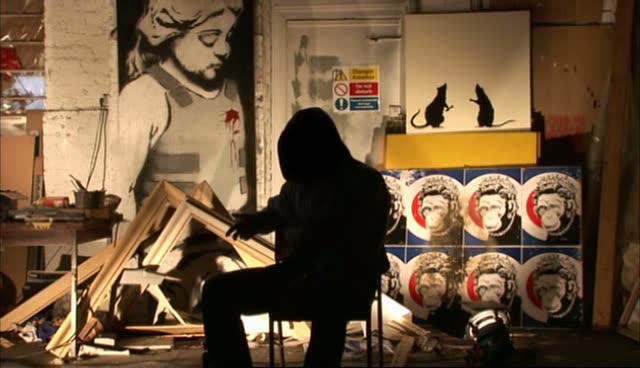 Noted British street artist Banksy’s Exit through the Gift Shop (2010) is a confounding beast in that it purports to be a documentary by Banksy on a man called Thierry Guetta who attempts to make a documentary on Banksy (along with other street artists). The first section of the film brings us the essence of street art, its intention to democratize art by bringing it out of arthouses and into the streets. (One of Banksy’s “guerilla installation” works depicts a lady wearing a gas mask). Gradually, the film’s focus shifts to Guetta himself. He is presented as an inarticulate, passionate camera buff fetishizing the recorded image (presaging his unrestrained fetishizing of pop culture later on), as a romantic who believes that recording every moment of one’s life increases the value of one’s gaze and, in a sense, as a Banksy-like artist working on the streets of life. Along the way, it takes a lot of potshots at the reception of avant-garde art centered on the grand debut of Guetta. The interesting thing here is that it doesn’t judge Guetta’s works till the very end, thereby toying with our perception of these works as well (some of them indeed seem praiseworthy and were probably made by Banksy himself). But then, Exit does have an agenda of its own. It evidently stands against celebrity culture and the commodification of street art. It seems to propose that street art has to be a physical endeavour more than a conceptual one and that the physical presence of the artist during creation is of utmost importance. Ironical it is that Banksy himself has held a number of exhibitions and is a revered name in art circles. This is perhaps the whole point of the film. Exit could be read – if not as a self-serving promotional campaign – as Banksy’s attempt to come to terms with his failed anonymity, as an effort to resolve the contradictions associated with his name (through the figure of Guetta) and as a form of self-criticism which recognizes that he has become a brand despite himself.


 “I don’t know whether it’s a comedy or a tragedy, but in any case it’s a masterpiece”, says one of the characters, self-referentially, in Godard’s
  A sister film, in some ways, to Jonathan Demme’s brilliant Rachel Getting Married (2008), Sebastián Silva’s The Maid is nothing short of a spiritual revelation at the movies. What could have been an one-note leftist tirade about Chile’s class system is instead elevated into the realm of human where one facial twitch, one stretch of silence and one impulsive word can speak much more than any expository monologue or contrived subplot. There is no simplification of human behaviour here, no easily classifiable moral categories and no overarching statement to which truth is sacrificed. Nor does Silva suspend his study of the classes to observe his characters. He merely lets the obvious stay in the background. And just when you think that Silva’s vision of the world is getting all too romantic, he delivers a fatal blow to shatter your smugness – a single, deceptively simple shot during the final birthday party that masterfully sums up everything from the irreconcilable, repressed tension that exists between classes in capitalistic societies to our adaptability as humans to live peacefully with each other despite socio-economic disparities.
 Rigorous but oh-so-tender, centenarian Manoel de Oliveira’s one-hour wonder Eccentricities of a Blonde-haired Girl is a film in one and a half acts. Oliveira translates the work of Eça de Queiroz to the screen, running the 19th century tale of romance through the current economic landscape and harnessing the resultant anachronism to paint an achingly beautiful picture about the inability to transcend class, escape reality and lose oneself in art. Despite its decidedly Brechtian and ceaselessly self reflexive nature, Oliveira’s film is rife with moments of poignancy and touches of humour. Using double, triple and quadruple framing and achieving a mise-en-abyme of art and reality, Oliveira writes a ruminative essay on the impossibility of art and reality to merge, the confusion that exists between them and the classism that exists within and with respect to art. Flooded with references to art and art forms, Eccentricities is such a dense and intricate fabric of the arts that even the past is treated in a detached manner like a piece of art, where each image looks like a painting, each sound feels like a melody and each movement cries out: “cinema!”.
 Of all the recent movies that have attempted to acknowledge dark chapters in national histories and advocated looking forward to the future instead of crying over what is lost, perhaps, none is as sober, ethical and uncompromising as Claudia Llosa’s Golden Bear winner. Llosa inherits her tale from the terrorist atrocities that plagued Peru two decades ago (Inheritance being the prime motif of the film) but, subsequently, discards every possible opportunity for sensationalism or propaganda. Tightly framing the lead character, Fausta (Magaly Solier), within and against claustrophobic structures, doorways, photographs, windows, paintings, mirrors and walls, gradually varying the depth of focus along the movie to detach the protagonist and integrate her with her surroundings and using extremely long shots to dwarf her in vast opens spaces of the tranquil town, Llosa concocts a film of utmost narrative austerity and aesthetic rigor. Punctuating and contrasting these downbeat images of Fausta’s life are slice-of-life sequences from the town depicting various wedding rituals and parties which tenderly highlight Peruvian people’s open-hearted embracing of capitalism and their resolve to come out of the trauma of the past and move on with life.
 If Inglourious Basterds was a coup from within the system, Jim Jarmusch’s The Limits of Control is an out-and-out war against the machine. The essential piece of cinema of resistance, The Limits of Control eschews simple genre classification and flips every ingredient of Hollywood’s conveyor belt products to surprise, appall, irritate and provoke us with each one of its moves. The complete absence of Jarmuschian brand of deadpan humour announces the film’s seriousness of intent. It is as if Jarmusch wants to establish once and for all that Hollywood does not equal American cinema and that the cinema that the former school marginalizes is truly alive and kicking. The Limits of Control is a film that can easily get on your nerves but, eventually, it succeeds in getting under your skin and evolving gradually to reveal how meticulously crafted it is. Using Cinematographer Christopher Doyle, production designer Eugenio Caballero and editor Jay Rabinowitz masterfully, Jarmusch creates a movie so meditative and relaxing that one feels exactly how William Blake (Johnny Depp) would have at the end of Dead Man (1995).
 Porumboiu’s follow-up to one of the most hilarious comedies of the decade, 12:08 East of Bucharest (2006), is a companion of sorts to Jarmusch’s film not only in the sense that both of them negate the function of the genre they are supposed to belong to, by completely de-dramatizing their narratives, but also because Porumboiu’s film, too, is a conflict between two types of cinema – the cinema of analytical contemplation represented by the detective-protagonist of the film (Dragos Bucur) and the cinema of thoughtless action represented by his ready-for-ambush boss (Vlad Ivanov). However, more concretely, Police, Adjective is an examination of how our own political and social systems, partly due to the rigidity of our written languages, end up dominating us and how individual conscience and social anomalies are effaced clinically in order to have the bureaucratic clockwork running smoothly. Like Bucharest, Porumboiu, often self-reflexively, sketches the portrait of a bland and pacific city that tries to ape the far west and project itself as more dynamic than it actually is. The film’s disparate themes crystallize deliciously in the final, side-splitting, Tarantino-esque set piece where we witness the police chief urging his subordinates to act by the book, literally.
 Tetro is a beautiful film. Not just in the way it looks, but in the sheer romance it has for a lost world. The only worthy B&W film of this year out of the four I saw (the other three being Haneke’s
 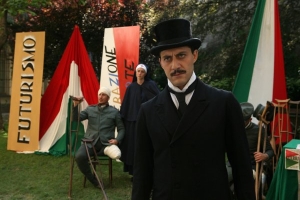 Writer-director Marco Bellocchio’s ballad, based on a nebulous part of fascist leader Benito Mussolini’s life, can teach those so-called historical dramas a thing or two about locating personal ideologies within collective history without being exploitative or pandering to pop demands. Bellocchio’s film is far from a detailed recreation of Mussolini’s political life. It is, in fact, a commentary upon such “detailed recreations” of history based on documents written by winners. Bellocchio’s formidable script and mise en scène keep probing and remarking upon the tendency of fascist systems to suppress histories – personal and national – and exploit popular media, especially the relatively young and emotionally powerful cinema, to blind people of truth and forge a faux reality – a theme underscored in Tarantino’s film too. What more? Bellocchio constructs the film exactly like one of those Soviet agitprop films – not by easy spoofing, but by retaining their spirit and rhythm – using rapid montage, expressionistic performances and operatic sounds. Be it common folk fighting in a cinema hall over a news reel or a bereaved mother breaking down during the screening of The Kid (1921), cinema registers its omnipresence and omnipotence in Bellocchio’s film.
 The perfect antidote to the summer blockbuster, Warwick Thornton’s Samson and Delilah is an extremely assured and undeniably moving piece of cinema that arrives, appositely, as the golden jubilee reboot to Herzog’s thematically kindred movie, Where the Green Ants Dream (1984). Cleverly relegating specific issues such as the Australian government’s intervention and relocation policies for the Aborigines to the background, Thornton frees his films of broad, propagandist political agendas, without ever making the film lack social exploration. With an extraordinary sound design, Thornton keeps the word count in the film to an absolute minimum, letting the stretches of silence shared by his lead characters speak for themselves. The film’s observations about banality of racism in contemporary Australia, exploitation of tribal art and its consequences, the effect of colonialism, especially due to Christian missionaries, on the Aboriginal culture and the ever growing chasm between the tribal and white life styles themselves are fittingly subordinated to the beautiful, unspoken love story that, essentially, forms the heart of the film.
 Let me dare to say this: Jacques Audiard’s A Prophet is either the most profound or the most pretentious movie of the year. For now, I choose the former. Audiard’s decidedly unflinching feature breaks free from the limitations of a generic prison drama and takes on multiple dimensions as the apolitical and irreligious protagonist of the film, Malik (played by Tahar Rahim), finds himself irreversibly entangled in ethnic gang wars within and outside the prison. A trenchant examination of religion as both a tool of oppression and a vehicle for political escalation, A Prophet is an audacious exploration of Muslim identity in the western world post-9/11. Although the plot developments may leave the viewer dizzy, it is easy to acknowledge how Audiard confronts the issues instead of working his way around it or making cheeky and superficial political statements. Strikingly juxtaposing and counterpointing Sufism and Darwinism in Malik’s search for identity, Audiard creates an immensely confident and nonjudgmental film that trusts its audience to work with the rich ambiguity it offers.


