Ellipsis


Tarang (1984) (Wages and Profit)
Kumar Shahani
Hindi
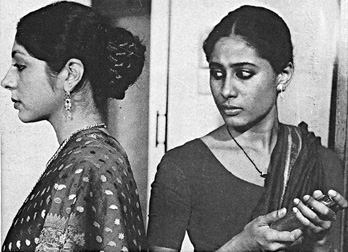
 

Kumar Shahani’s Tarang (1984) is located startlingly far from the intense stylization and abstraction of his previous feature Maya Darpan (1972), with its conventional, accessible, (overly?) fleshed out and faithfully realized story, generous score (including songs!), impressive cast and naturalistic acting. Taking off from the template narrative of class struggle, Tarang tells the tale of an internally fragmented family of industrialists and the equally divided body of workers at his factory, the link between them being the upwardly mobile wife of a dead worker (Smita Patil) who begins an affair with the manager of the factory (Amol Palekar). A staunch Marxist, Shahani examines the class struggle on multiple fronts: in the writing that nearly recites the labour theory of value, in the densely layered soundtrack where various voices vie for power and the casting, where the star value of the actors is in conflict with the characters they play. In fact, Tarang is presented as a film within a film and we are regularly shown that Patil and Palekar are famous actors who are playing these characters. Shahani realizes that his film is born of the same system that it rails against (Reporter: What do you think of this? Policeman: The crime or the film? Reporter: What’s the difference anyway?) and foresees the impossibility of any satisfactory resolution to the conflict. Like the films of Eisenstein, who no doubt influenced Shahani as is evident crowd scenes at the factory, there is so much happening – much power struggle – in the frames of the film, as it is in the deeply metaphorical text.


(Image Courtesy: The Case for Global Film)
Shaitan (2011) (Devil)
Bejoy Nambiar
Hindi


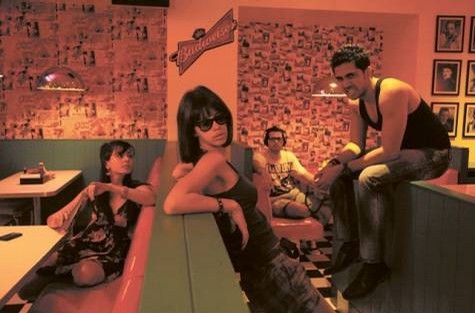
ShaitanBejoy Nambiar’s Shaitan (2011) deliberately starts off on the wrong foot, presenting a hackneyed bunch of carefree upper class youth inducting one more into the gang, with a scene that seems more like endorsement than condemnation. (This is the sole scene when the five leads are their most comfortable, with a slack, indulgent, food-in-the-mouth kind of acting epitomized by Brad Pitt). It is only when we follow them all over Mumbai as they indulge in all sorts of puckish activities including casual robbery and midnight races that we realize that our identification is being severed and a critical distance developed. And it is only when the pack rams into a scooter that it realizes that a whole world exists underneath its (literally: under their car’s tyres). Speaking in collective terms here is justified, since not one role in the film is a character; all are types, with minute variants at best. The film itself makes no claims otherwise. (In a way, it is a final girl flick, full of caricatures, without any external threat). Ostensibly a film wanting to examine mob mentality – the gang, bevies of reporters, religious masses – and tyrannical impulses within us – the leader of the gang, the various law enforcers and their activities – Shaitan finds its bunny-ear-donning child-adult protagonists, who are initially blind to notions of class and religion, gradually being pushed out of their comfort zones into a minority and attempting to blend into larger groups for survival. (You have kidnappers thrashing kidnapers, police chasing police and rich kids with a money crunch!) The film is defined by its major ellipses which swing between smart telescoping of action (e.g. the suspension of the officer) and incompetent shorthand (the news channels, which have usurped the role of the narrator in Hindi cinema off late). But it is the bravura action sequence at the lodge, with its off-kilter, everything-is-allowed, anything-goes, Hollywood movie brat-like aesthetic that takes the rest of the film’s banal TV and ad inspired stylistic to a whole new level. Nambiar, it seems to me, is a natural when directing music videos and this sublime, provocative, magical scene, which cross cuts between slo-mo bullet rains and the gang dropping from rooftops in fluttering black purdahs like fallen angels onto a truck full of feathers, alone is worth sitting till and beyond it. Also includes an in-joke among Kashyapians involving Rajat Barmecha and a wordless subplot (if not the ultimate ignoring of the gang’s original crime) dealing with a miffed couple that might impress Nambiar’s south side mentor.

(Image Courtesy: First Post)

Unknown (2011) 
Jaume Collet-Serra
English


UnknownJaume Collet-Serra’s Unknown (2011) is the kind of movie that typifies straightforward PG-13 Hollywood thriller – star-driven, homogenized visuals with a strong primary color scheme (with a dominance of metallic blue, as usual), elaborate set pieces that could be moved around within the film, a pulsating score that vies with the boisterous sound design, with allegros of action separated by adagios of emotion, unapologetic about its generic nature with a plot detailed enough to claim seriousness and sketchy enough to avoid offending anyone and, of course, the solitary cuss word. Liam Neeson, who looks aptly like an ex-secret agent coming out of retirement, with his haggard appearance, wrinkled skin and receding hairline, is an American professor whose identity is stolen during his trip to a bio-conference in Berlin. With the rug of reality pulled off his feet, he must find a way to get back into the original social order with the help of a gorgeous working class sidekick (Diane Kruger), who knows all the seedy localities in the city, and an ex-Stasi officer (Bruno Ganz, also serving as the home star), who believes that Germans are very forgetful about history. Unknown channels wrong-man thrillers such as North by Northwest (1959), as well as Polanski’s Frantic (1988), but strips them of their psychosexual dimension, presenting a work that is solely concerned with mechanics of the genre and craft of the profession (the central car chase is sort of inspired, with its heady interleaving of vertical, horizontal and deep-space movements). The bunch of passages that pique your interest (the ostentatious scene at the museum, the confrontation between Langella and Ganz, both of whose best-known roles are infamous historical characters) are also the ones entirely superfluous.

Ne Change Rien (2009) (Change Nothing)
Pedro Costa
French/English


Change NothingPedro Costa’s latest film Change Nothing (2009), at a visceral level, rekindles the experience of watching that stunning cinephile bait of his, O Sangue (1989). Like his debut work, Change Nothing is presented in monochrome (although apparently not shot that way) with a contrast ratio to kill for, in which the white appears whiter and black appears blacker. Consequently, Costa, who shot the film himself in DV, achieves a flat field which results in a number of eye-teasing compositions, such as the one in which actress and singer Jeanne Balibar – the subject and star of the film – seems to have grown a pair of angel wings. More than ever, Costa works with light like a painter who’s been given only a limited quantity of colour would, meticulously sculpting Balibar’s distinct visage out of darkness. This exacting precision required for an artistic endeavour is what Change Nothing is ostensibly ‘about’, as it goes about recording Balibar and co. rehearsing, improvising, recording and live-performing a variety of vocal pieces. (There are also a couple of off-track sequences involving a live choir and a pair of Japanese in a bar). The reference here is, of course, Godard’s Sympathy for the Devil (1968), which interpreted radical politics and art-creation as essentially incomplete ventures requiring audience participation. Costa’s film, however, seems more modest and self-sufficient, as it single-mindedly records Balibar’s relentless dedication to her work (and, implicitly, the director’s towards his as well). It undermines the illusion of a work of art being a smooth, finished product by situating it at the end of a long history of imperfections, goofs and possibilities. Ironically, Costa’s rigorous and ‘perfected’ film perpetuates this very illusion. In a way, then, the 100 minutes that we see is only a minor part of Costa’s project, the majority (the remaining 78 hours!) of which will, unfortunately, go unseen.

Rosetta (1999)
Luc Dardenne, Jean-Pierre Dardenne
French


RosettaDardenne brothers’ finest film Rosetta (1999) is what remains after you have run it through all possible theoretical discourses. (Funny as it sounds, for all its anti-psychological bent, Dardennes’ cinema lends itself best to psychoanalysis, with abounding mother-son, mother-daughter and father-son relationships across the films). A genuinely humanistic work that just can not be accommodated without conflict into a single, rigid world view, Rosetta finds the Dardennes’ hand-held, long-shot, “being there” realism at the peak of its prowess. There is a keen sense of space, of lived time and of felt experiences here. With an astonishing, naturalistic sound design that carries as much importance as the image (the irritating noise of the moped, for instance, virtually reveals the whole dynamics of specific scenes, without the help of a single image), There is no moral simplification or any sort of condescension that marks many otherwise empathetic films dealing with the working class. Through Rosetta’s actions, which cannot be easily classified into right and wrong, the Dardennes provoke a reassessment of the audience’s own political stance (especially the liberal one, wherein the just and the lawful are generally assumed to be at loggerheads with each other). More than any other of their films, it is here that we sense and feel the physicality of the Dardennes’ unvarnished world the most. When Rosetta (Émilie Dequenne) is pushed into the bog, we choke, when she finds her drunkard mother down at the doorstep, we let out a sigh of exhaustion and when she struggles to carry the gas cylinder home to do the unthinkable, we want to reach out and take it away from her hands. Harsh, harsh, harsh, harsh, harsh, just harsh.

The Neon Bible (1995)
Terence Davies
English


The Neon BibleTerence Davies’ The Neon Bible (1995) opens with a patently surreal, metallic-blue image of a steam engine coughing to a start. The landscape we see is uncannily alien not only because it is shrouded in steam, but also because it is Davies’ first film in a foreign country. Davies, possibly inspired by the horizontality of south side America, shoots in widescreen for the first time (and how!), departing from the cozy aspect ratios of his British films, with a healthy contempt for the shot-reverse shot grammar, squarely centre-framing his characters and providing a palpable sense of isolation marking them. Adapted from John Kennedy Toole’s debut novel (written when the author was just 16), The Neon Bible is ostensibly a transition work for Davies. One could have, in fact, seen this sort of a picture coming right after his previous film, given how it had exhaustively mined the British filmmaker’s interests, providing a magnificent summation of his career thus far. Consequently, The Neon Bible straddles not only the experimental, elliptical structures of all his earlier works and the more straightforward narrative of The House of Mirth (2000), but also the honest, affecting, personal expression that had so far been the hallmark of Davies’ work and genre conventions and tropes that seem to have tagged along with this American outing of his. Davies attempts to impart a personal dimension to the text by punctuating it with sequences involving church, cinema and classroom – the three most characteristic spaces in Davies’ cinema – and the indistinct borders between each of them. But then, he also designates a rank cliché borrowed from independent cinema as one of the two important characters of the film: the aging, washed-up artist played by Gena Rowlands (who reprises and recycles her work with Cassavetes). However, the scenes involving the lead David (Jacob Tierney) are much more authentic and moving, especially the Sokurov-like episodes with his mother.

The Dilapidated Dwelling (2000)
Patrick Keiller
English


The Dilapidated DwellingBritish helmer Patrick Keiller’s third feature, The Dilapidated Dwelling (2000), constructs its discourse around the housing industry in Britain. Examining how buying a house in England is becoming an increasingly expensive affair – at a time when capitalism, ironically, provides us with every facility to bring the world inside our homes – Dwelling presents an elaborate critique of modern British architecture, while branching off into other directions as well. Keiller seems to have found in the housing system some sort of blind spot in the economic logic of late capitalism, wherein its claims – apparent freedom of choice for the consumer, predictable demand-supply-price relationships and total automation – run into dead ends. Taking off from this, Keiller investigates the work of Buckminster Fuller, whose futuristic designs for mass-produced houses could never see the daylight, in order to find out why automated housing systems – such as in Japan – could never make it in the West. Unlike any of his other films, Keiller uses interviews and news reels in Dwelling, making the film more conventional and streamlined than his other works. But then, facets that pretty much define Keiller’s cinema, like the love-hate relationship between image and sound (Keiller’s images always seem to float feely underneath the tight textual fabric), moods and surfaces, the private and the public, the visible and the intangible, psychology and sociology (abandoned in the later works), the aesthetic and the ethical (the paradoxical narratives of his early short films), literature and cinema (his cinema is, in a way, about the corresponding advantages and shortcomings of both), also mark Dwelling, which explores the intertwined relationship between social and domestic formations and which attempts to rethink spaces – national, ideological and domestic.

Essential Killing (2010)
Jerzy Skolimowski
English/Polish/Arabic


Essential KillingJerzy Skolimowski’s Essential Killing (2010) opens with helicopter shots of a nearly otherworldly desert with dizzyingly abstract contours – more of a psychoscape than a landscape – through which Taliban (?) soldier and protagonist Mohammed (Vincent Gallo) maneuvers unsuccessfully. Maneuvering is what Mohammed does throughout the film, as he sneaks out of an American (?) facility and traverses the frozen geography of what seems like Russia (?), while his memories, fantasies, visions and reality coalesce to form an amorphous psychic force that drives him. (For a film that’s so keen on ‘observing without judgment, this sort of alternate psychoanalysis is threatening if not fatal). The irony here is that Mohammed, supposedly a brainwashed killing machine for whom death translates to martyrdom, is exhibiting the highest forms of survival instinct. And an assortment of this kind of contradictions – behaviour as a negation of ideology – is what Essential Killing aims for. While his ‘mission’ might propel unwaveringly him towards death, Mohammed – now that his imminent death is not entirely of his making as he might have liked it to be – is continuously moving towards a rebirth of sorts, as is suggested by behavioral details such as his inability to speak, walk properly and, well, his drinking of milk from a woman’s breast. While his mission dictates that America is his enemy, he tries virtually to make it his home, blending in with his landscape (as he did in his country in the opening segment), apparently moving ever close to a promised land. Skolimowski might have wanted to counterpoint the dominant image of the Taliban terrorist – like Laura Poitras – with a sober opposite which portrays him as a weakling clinging on to life, but his interminable bout of decontexualization, coupled with his tendency to reduce cinema to a denotative art form, removes any sting from his political stance.

O Estranho Caso de Angélica (2010) (The Strange Case of Angelica)
Manoel de Oliveira
Portugese


The Strange Case of AngelicaAndré Bazin famously remarked that the photographic image, by its very conception, seeks to ‘embalm’ dead objects and preserve them for posterity. Cinema, suggests Manoel de Oliveira’s wondrous new work The Strange Case of Angelica (2010), does one better in that it also resurrects these dead objects back to life. Quite literally here. At heart, it’s the story of amateur filmmaking and budding cinephilia – the joy of discovering the marvel of the moving image, which, like the discovery of sexuality, is a private ecstasy. Two well-read men in the film discuss how matter and anti-matter unite to form pure energy while our anachronistic lead man Isaac (Richard Trêpa) is still bewitched by how mise en scène – his profession – can meet montage to create pure magic. Like the director’s previous film, Angelica straddles two worlds – ‘contemporary’ and ‘classical’ periods – both of which tease and pull and push Isaac. Isaac, admittedly, is a man of old ways (he’s probably exactly 115 years old), marooned in the present economic landscape, who finds his romance thwarted not just by class (as in Eccentricities) but also by religion and by the fact that his love interest is dead. He, however, trusts that he can find love through the power of his art and escape his current predicament. (Alas, he has to die so that he can enter his art). Using unpolished CG that’s almost as old as the protagonist, Oliveira takes us back to (rather, attempts to recreate) the historical juncture at which we might snap out of our sensual numbness in order to start all over and, once again, discover the magic – of romance, of cinema.

Iran Zendan (2010) (Iran Prison)
Daryush Shokof
Farsi/English


Daryush Shokof, whose films have been my holy grail for a long time now, made Iran Prison (2010) at the wake of the 2009 presidential elections, which was marked by massive waves of public unrest. An open hate letter to the Ahmadinejad regime, the hour long film depicts the inhuman treatment of captured demonstrators in underground cells, which ranges from physical mutilation to murder. These scenes are shot mostly interior, in low-lit chiaroscuro arrangements with an earthy color tone, with handheld recorders and non-professional actors (Shokof casts himself as the supervisor of the facility). This thread of the film reminds one of Wang Bing’s Brutality Factory (2007), in the way it religiously narrows down its scope to merely recording the torture sessions. However, unlike Wang Bing’s movie, which situates itself in the past in order to open it up for contemporary analysis, Shokof’s film is almost totally anti-dialectical and it works upon a given set of firm beliefs and a clear cut ideology. But ‘objectivity’ or ‘nuanced’ synthesis is not its objective, in any case, and it is probably more fruitful to look at the film as a solidarity picture supporting the cause of the protestors against the Islamist regime than as an elaborate critique. Intercut with this fictional recreation of the torture sessions are amateur, low quality video clips (obtained from online video sites, I guess) of mass protests in the streets of Tehran, in which we see young men and women directly confronting the police, often with brutal consequences. This jarring (geographical, cinematic, political) contrast between the two narratives is, additionally, suggestive of Shokof’s own status as an outsider deeply involved with the situation in his home country.

(Posted as part of Sheila O’Malley’s Iranian Film Blogathon, 21st-27th February)


« Previous PageNext Page »