Ellipsis


Kiseye Berendj (1998) (Bag Of Rice)
Mohammad Ali-Talebi
Farsi


Bag of RiceMohammad Ali-Talebi’s (aptly) modestly titled Bag of Rice (1998) is the sort of film that is generally associated with Iranian cinema, thanks in no small part to the works of Majid Majidi: a drama of everyday events shot on location, with little or no music, usually involving children maneuvering through narrow bylanes in the outskirts of Tehran. These are, no doubt, conservative films that attempt to represent the country on a larger scale, perhaps even serve as a right-wing corrective to the ‘scandalous’ festival films. More than any other film of this ‘anti-movement’, it is Bag of Rice that appears the most unapologetic about its stance. Evil does not exist in Talebi’s film, at least as an active agent. Bad things happen not because of bad deeds, but just due to accidents. Even in films such as It’s a Wonderful Life (1946) or Rio Bravo (1959), there is at least a notion of evil (in the form of a social pervert or an outsider) which is utilized to build a case for conservatism. Not in Bag of Rice, a film that reveals itself as one of the most ethical and effective defences of that ideology. Every one in the city offers to help the old woman and the little girl who travel to the city to buy the titular sack of rice. One person’s task is distributed – like the rice in the bag – and executed willingly by a group. Both grandma and the kid have their own needs and (voluntary) responsibilities that play tug-of-war with each other, but the pair works through them amicably. Although the scenario keeps highlighting the financial crunch of its characters, conflict between classes is dissolved into an organic, throbbing, seamless and wholesome portrait of a community, in which clashes of interest, instead of rupturing relationships, are resolved through compassion and understanding. When the little girl wears the scarf for the first time towards the end, during a ceremony of communal good will, one wonders whether to read through the fissures of the film’s hardline, pro-revolution message or to appreciate the graciousness of what’s on the plate.

(Posted as part of the ongoing Iranian Film Blogathon at Sheila O’Malley‘s. Formidable collection of articles on Iranian cinema building up…)

Gozaresh (1977) (The Report)
Abbas Kiarostami
Farsi


The ReportThe Report is a typical example of the marriage-in-crisis film that many great filmmakers seem to have made during the early part of their careers. Such a gesture is usually channeled as critical reassessment, a personal confession, wish-fulfillment or even self-justification. But, for Kiarostami here, it becomes an opportunity to telescope the social situation of the country into a deceptively simple marital drama. In many ways, The Report reminds us of the remarkable vérité films of early Tarr, especially in its preoccupation with diminishing and often suffocating urban spaces. Kiarostami’s film is not about stasis, as many films of the subgenre are, but about disintegration. It situates itself at a narrative and historic point where institutions can no longer hold together. Corruption reigns supreme in the public sphere and money becomes the focal point of almost all discussions. The stuffy, noisy streets of Tehran seem as though they are already in a state of decay. It appears as if there can be no way out but downward – for the society and the family. Kiarostami rarely films his couple (Kurosh Afsharpanah and Shohreh Aghdashloo) together in the frame. Like Certified Copy (2010), which is the closest film to this one in terms of scenario, the director severs the protagonists from each other with his shot patterns and blocking, with the only holding force being their little girl child. Kiarostami also employs a large number of static, fixed compositions with judicious use of walls and doors so as to allow long chunks of action unfold within the same shot. This sense of mundanity is compounded by a soundtrack without any music and consisting of only direct sound, which would later become the director’s forte in the 90s.

(This is a small contribution to Sheila O’Malley’s Iranian Film Blogathon (Feb 21-27), which has already received a number of terrific entries)

7 Khoon Maaf (2011) (7 Murders Forgiven)
Vishal Bhardwaj
Hindi


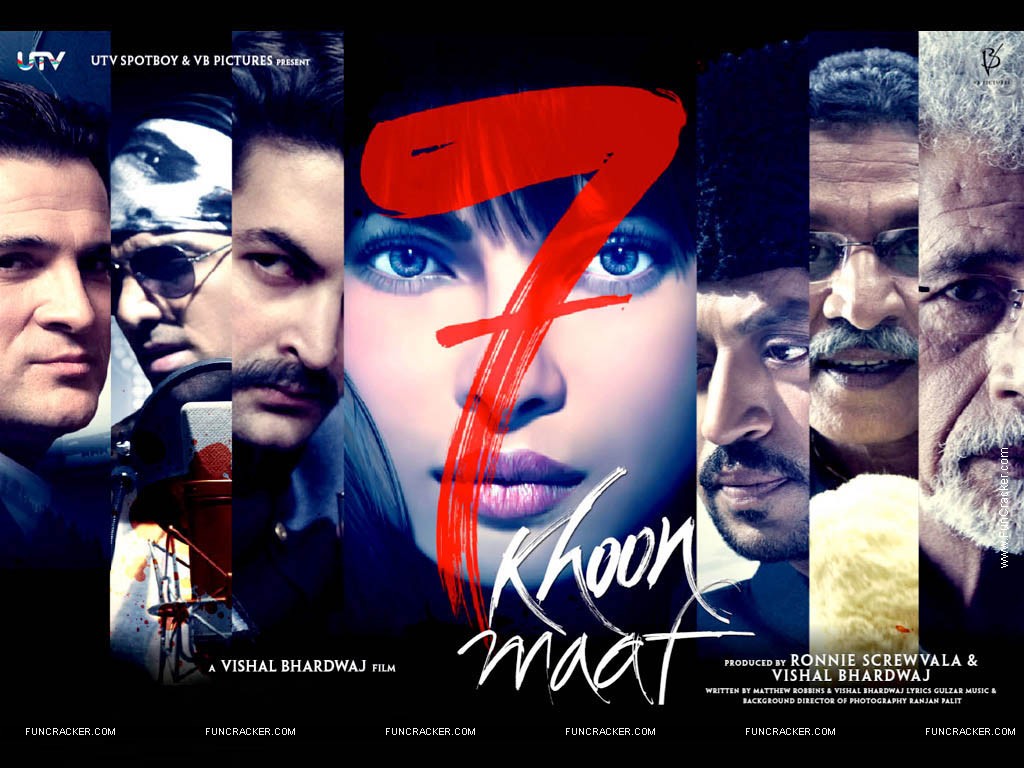
7 Khoon MaafSo we have two high-profile filmmakers releasing two remarkably symmetric films this weekend which wear their inspirations on their sleeves. Both these similarly structured films give us serial killers traumatized by childhood events. But, while Menon’s movie is like gazing into a fish bowl, Bhardwaj’s is akin to peeping through the door lens. It is not the protagonist, Susanna (who befittingly misses an emotional arc, played by Priyanka Chopra) but the world around her that is distorted in 7 Khoon Maaf. Right from the beginning, we are told, she is in search of father figures (through her six husbands) to replace her deceased biological father (which, of course, culminates with her marriage to the Son, her ordinance, which wittily distorts her line about drinking her husband’s blood). Along the way, she seems to see herself as a feminist twist on Christ (which goes well with Bhardwaj’s not-so-singular brand of militant feminism) who suffers for the sake of those who follow. She seeks forgiveness for her seven sins, her seventh sin being exactly this misinterpretation of Christ’s mission, to militarize Jesus, to bring him to earth, to replace forgiveness with retribution, to ‘kill’ him. However, where Bhardwaj’s film trumps Menon’s is that, although it lends itself to easy Lacanian reading like Naaygal, 7 Khoon never attempts to reduce characters to psychoanalytical toolboxes. Spanning several decades (Bhardwaj clumsily attempts to contextualize the narrative, using political events while, given the themes, he should have done precisely the opposite: collapse history and let anachronism reign), 7 Khoon hops across film subgenres of the west (costume drama, period film, concert picture etc.) all the while having a very ‘Indian’ heart (The commentary on Indian patriarchy almost swaps targets in the Russian segment), as if remarking upon Bollywood’s skin deep aping of Hollywood cinema. This masking of ‘Indian-ness’ by ‘European-ness’ and of (regressive) actualities by (progressive) surfaces and of the present seemingly repeating itself to eternity is, ultimately, is what 7 Khoon deals with. And it deals with pretty well, even if one gets the feeling that a rewrite would have done more good.


(Image Courtesy: Fun Cracker)

Nadunisi Naaygal (2011)
Gowtham Vasudev Menon
Tamil


Nadunisi NaaygalPart rip-off, part tribute to Psycho (1960) – right from the plot to the up-down movements of objects and the camera – Gowtham Vasudev Menon’s Nadunisi Naaygal (“Midnight Dogs”) charts the activities of a soft-speaking serial killer, Veera, who lives with his (surrogate) surrogate mother in a mansion consisting of, well, three floors. Menon’s film is nearly as much about transgression – of mores, of geographical boundaries, of industry idioms – as Hitchcock’s picture was about deviation – of the narrative, of normalcy, of sexuality. Menon has said elsewhere that this is a film based on a true story, while it’s actually a pseudo-horror based on the superficies of a pseudo-science (spare me the Oedipii and the Electras), where, unlike the finale of Psycho, it is the director who plays the shrink all along, deeming deviance as just a product of other deviant practices. (Naaygal has one of the ugliest directorial schemes of recent times, with subjective and objective reality clearly delineated by awkward POV patterns). Menon has also proclaimed that Nadunisi Naaygal is his middle-finger-to-all film. True. It is, in fact, the film in which he actually wants his audience to hate him, to consider him as an outlaw. (He succeeds by leaps and bounds: He’s written a character that invites unanimous derision). Evidently, the director recognizes himself in the central character – a psychotic woman-slayer – which is only partly acknowledged by the employment of POV shots for both the filmmaker-killer and the audience-victims. (Tarantino nods abound, starting with the title). This is a refreshingly skewed perspective from and of a director who has been routinely killing off his lead women in his films. With Naaygal, like Veera, he almost denies that he had anything to do with his previous blockbusters at all. May be he’ll deny later that he had nothing to do with Naaygal as well. May be this is a turning point in his career. May be it’s the end of it. May be he hears those dogs howl at midnight.


(Image Courtesy: Chennai 365)

Dhobi Ghat (2010) (Mumbai Diaries)
Kiran Rao
Hindi/English


Dhobi GhatKiran Rao’s Dhobi Ghat (2010) is a film about Mumbai (duh!). More precisely, it’s a film about the impossibility of making a film about Mumbai, an impressionistic look at the city which argues that it is the only possible way to look at the city at all. Everyone in Rao’s film is an artist. No, not just the four lead characters but everyone – even the myriad Jia-esque immigrant workers who literally build the city’s canvas – is an artist here, albeit removed from reality to varying degrees. If Rao’s Mumbai is the film crew, the sea at its end is the cinema screen, before whose stoic permanence social divisions vanish. (One character notes that the sea air smells of people’s desires). Everyone, and specifically the quartet at the centre, seems to attempt to find in art a subliminal hope of transcending class, of being on a level ground. Arun (Aamir Khan) – the film critic figure – can relate to the city space only through the arts. Shai (Monica Dogra) desires to level all spaces through her photography. Munna (Prateik Babbar) – ever at right angles to life – dreams of hitching to the mainstream through cinema. Yasmin (Kriti Malhotra) seeks to rationalize her condition through her art and hopes it will outlive her. Alas, right from the first scene, reality seeps in to foil such utopian plans. Rao, likewise, has a keen eye for urban and screen spaces, dividing and subletting the frame to emphasize the fragmentation that exists on multiple levels. This fragmentation is integral to Dhobi Ghat, for it is terrified of a complete view of the city, suggesting that a total understanding of the city – with its frightening disparities, unspoken calamities and tragicomic ironies – can only result in deep silence – of acknowledgement, of paralysis and of powerlessness. Like Arun’s last painting, like the old woman next door, like the sea.

Yuddham Sei (2011)
Myshkin
Tamil


Yuddham SeiMyshkin’s fourth feature, Yuddham Sei (“Make War”), is a film in reverse. The Jake Gittes-like protagonist of the film JK (a tribute to philosopher Jiddu Krishnamurthy, from whose idea of the individual as the means of social change the film seems to take off from) maneuvers through an inverted world, as is literalized in the numerous garish-yet-​impressive upside-​down compositions. This is a place where everything revolves around missing persons (rather, missing parts of body), where deaths are the most commonplace of events and where people are more living than dead. JK is played by director Cheran – a casting choice that might be the wisest by Myshkin so far – whose very countenance points to a man whose eyes have been plucked out and soul sucked off through the sockets. An undead hero – not a cold professional as other movies of the genre might indicate – like Melville’s last lead character, he sleepwalks through the narrative space, witnessing physical fragility with utmost equanimity, until his lost past resurrects him back to life, with all its emotional vulnerability and subjectivity. By presenting grotesque instances of violence before revealing them to be calculated acts of revenge against a much more diabolical scheme of things (the sort of  emotional swing that Mani Ratnam’s latest failed to achieve), Myshkin indulges in much what-is-justice kind of philosophizing – a la Irreversible (2002) without the flashy puckishness – calling into question the ways of the law (although he cops out by revealing the unjust elements to be merely aberrations in an otherwise healthy establishment). As if providing a corrective note to Anjathey (2008), which might have seemed like valorizing the police force – Myshkin keeps alienating his lead man from institutional justice, seemingly arguing for some abstract notion of individualized justice, even at the risk of glorifying violence. And yes, the legs are all there.

(Image Courtesy: The Cinema News)

Manzan Benigaki (2001) (Red Persimmons)
Shinsuke Ogawa, Xiaolian Peng
Japanese


Red PersimmonsRed Persimmons (2001) begins with a movie crew watching the fascinating A Visit To Ogawa Productions (1981), in which the late Shinsuke Ogawa, that Japanese filmmaker who pushed the limits of documentary filmmaking like no other, talks to Nagisa Oshima about his then current project A Japanese Village (1982), a work that is so oppressively modest that it turns out avant-garde. This absence of Ogawa haunts Red Persimmons, which Chinese filmmaker Xiaolian Peng helped complete, especially when it uses on-screen text instead of Ogawa’s usual, casual voiceover. Less digressive than the typical Ogawa picture but as sensitive and attentive to the rhythms of the countryside as any of his works, Red Persimmons attempts to trace the history of Kaminoyama with the science and commerce of persimmon farming, which forms the lifeline of the village, at its focal point. We see how personal and collective histories are tied to the production of this fruit, how persimmons have use, exchange and even symbolic value for the villagers and how the technology that develops alongside evolves primarily to address necessities and reduce effort than for expansion or multiplication of revenue. We observe, through the course of the film, that the persimmon itself becomes representative of ‘the Japanese village’ in the way it goes from being an organic part of a lifestyle, through being a commodity under simple capitalism and then a fiercely competitive economy, to gradually losing its ritualistic qualities and finally ending up as a low-demand produce. Beautiful, like a Dovzhenko film, humble, essential.

127 Hours (2010)
Danny Boyle
English


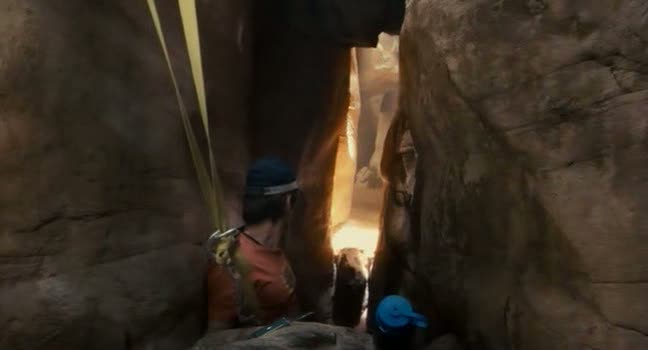
127 HoursLest we fail to notice that the time period mentioned in the title of Danny Boyle’s latest refers to the gestation period before the spiritual and quasi-physical rebirth of the protagonist Aron Ralston (James Franco), the director showcases him emerging out of the vaginal cave, in a diminished stature, with his representative umbilical cord severed, struggling to walk and talk and, hang on, suckling on a metallic hook affixed to the ground. That 127 Hours turns out to be a terrific film despite Boyle’s periodic middle brow tendencies is emblematic of the schizophrenic nature of his sensibility, which so wildly swings from adolescent camp and calculated profundity, wherein, surprisingly, even strained poetry soars. Opening portentously with staccato shots of Aron’s right hand, which becomes a MacGuffin later on, 127 Hours follows Ralston’s five-day encampment at nature’s existential purgatory, where realistic emotions become absurd and absurd emotions the only valid ones and where freedom of the mind compensates for physical imprisonment. Aron is like the audience in a film hall whose material reality casts no influence on their psychological state. Likewise, Boyle’s film startlingly segues midway into a heady reflection on digital culture, in which history, memory and even real people are replaced by pop images, in which identities are split in order to deny reality and in which death is but a smudge in the recording. The correct genre to classify Boyle’s film is Erotica – with Anthony Dod Mantle’s camera probing the tanned skin and caressing the sensual curves of the landscape – in which man’s ceaseless love affair with nature both humbles and inspires him. (Aron’s manoeuvres through the canyon and his first attempts to free himself themselves resemble copulation, making him the father of his new self). But aren’t all these philosophical games ultimately exploitative? I think the film’s eventual humanism answers that question.

Nachrichten Aus Der Ideologischen Antike – Marx/Eisenstein/Das Kapital (2010) (News From Ideological Antiquity – Marx/Eisenstein/Capital) – THE THEATRICAL VERSION
Alexander Kluge
German


News From Ideological AntiquityThe theatrical cut of Alexander Kluge’s epic length video work News from Ideological Antiquity – Marx/Eisenstein/Capital (2008) could be considered as notes from notes from notes on Das Kapital. This inheritance of texts, across media and languages, is what informs the central discourse of Kluge’s 83-minute collage work. After the completion of October (1928), which he mostly edited partially-blind and under the influence, Eisenstein set out to adapt Karl Marx’s Das Kapital as filtered through James Joyce’s Ulysses. The project was, of course, not realized and this is precisely the fact from which Kluge’s launches his investigation as to whether the book can be adapted at all. Using archival footage, (seemingly endless amount of) on-screen text, reading sessions accompanied by piano scores, interviews with historians, agit-poetry by Bert Brecht based on The Communist Manifesto and even an overstaying, outsourced short film directed by Tom Tykwer, Kluge examines the possible ways in which the gargantuan socioeconomic text can be realized in popular art forms. Such an effort, as Kluge illustrates, becomes especially challenging in film since it would mean attempting to capture the abstract nature of capital in the concrete events and things around us. Kluge, it appears, likes to see this as an ever evolving process, driven by the development of technology (At least, unlike Eisenstein, Kluge doesn’t have to worry about film stock), in which he is but only a connecting link. (His film is, after all, far removed from the source: Marx-Engels-Eisenstein-Kluge). But there is a more fundamental question if one is to believe in such long-ranged projects: How much of Marx is still relevant today? Was Marx, like Kluge, a part of a longer chain, the beginning or the end of it?  Kluge, like Godard, sums up the predicament in a poignant image: the debris of Karl Marx’s real tombstone in London being overshadowed by a lionizing token monument nearby.

You Will Meet A Tall Dark Stranger (2010)
Woody Allen
English


You Will Meet A Tall Dark StrangerIf you can get past its bone-deep cynicism, Woody Allen’s You Will Meet A Tall Dark Stranger (2010) is not half as terrible as it is made out to be. For those like me who’ve actually cared to follow Allen’s career in the noughts (or his career, in general), the message of Stranger shouldn’t come as a big surprise: The world is nondeterministic, completely random and morally neutral and those of us who’re lucky enough to have been caught in the right currents live happily, As for the less fortunate, we can always trick ourselves into believing that we are all special in our own way and we actually matter – in this life or the next. Or whatever else works. Given this unbridled pessimism, it is something of an achievement that Stranger is one of the most lighthearted films of the year. Of all his recent works, it is here that Allen makes the best use of voiceover. Where storytellers like Inarittu abstain from voice over to heighten the sense of haphazardness and unpredictability of the universe, Allen employs it to obtain a godlike ironic distance from the equally haphazard and unpredictable transactions. Allen keeps divorcing morality of actions from their consequences in such a systematic manner that even immorality is deemed pointless and left at the mercy of Lady Luck. With an effortless control over his expansive canvas of characters, he plays out every combination of attitudes and situations possible, all of which, as expected, dovetail into meaninglessness. (The film’s almost like a treatise on atoms and their various bonds. Someone even mentions Heisenberg). Stranger is additionally a meditation on spaces – private and pubic – and realms – art and reality – and the way their internal tensions influence the relationships between the people inhabiting them, as is underscored by the adept cinematography, editing and blocking. But then, what’s the point of it all?

« Previous PageNext Page »