Flashback


Katok I Skripka (1960) (aka The Steamroller And The Violin)
Andrei Tarkovsky
Russian

“He’s a musician.”
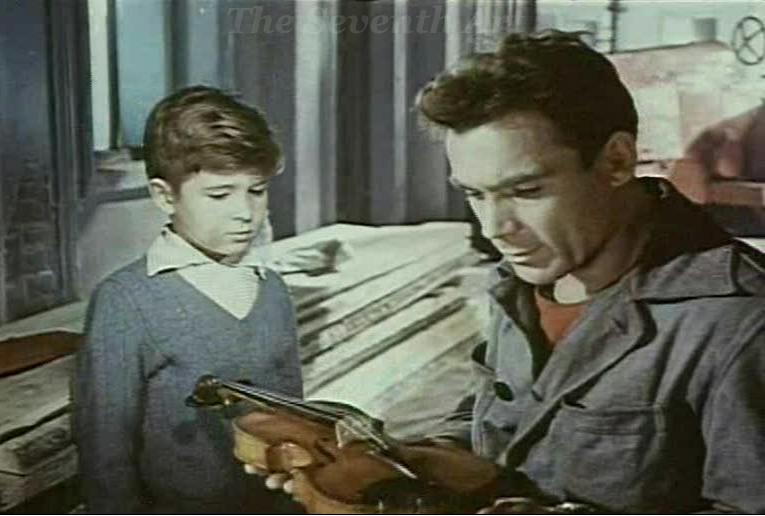
 

The Steamroller and the ViolinThere is no other way of seeing Andrei Tarkovsky’s diploma film Katok I Skripka (The Steamroller and the Violin, 1960) at VGIK other than as a scratchpad for a would-be master of cinema. As a result, one is only preoccupied with filtering out the Tarkovskian elements of the film from the rest and somehow hammering it to conform to his/her understanding of the director’s oeuvre. However, it must also be acknowledged that the movie is more rewarding if you are indeed familiar with the director’s work. Shot in no less than the prestigious Mosfilm studio, The Steamroller and the Violin is a little gem that is at times prophetic, at times contradictory and at times surprising, when one considers the films of Tarkovsky that were to follow. But one just cannot fail to note the unmistakable signature of the hand that made works such as Ivan’s Childhood (1962) and Andrei Rublev (1966) in this film.

The Steamroller and the Violin follows a day in the life of young Sasha (Igor Fomchenko) who learns violin at the local music school. Everyday, he has to sneak past the gang of local bullies that tries to rip him apart. On this fortunate day, he is, however, saved even after being caught by them, by a young worker named Sergei (Vladmir Zamansky), who is working at a construction site nearby. Sasha, then, proceeds towards the music school, stopping once at the window of a curio shop where he witnesses the city through images gathered on the mirrors placed there for sale. After getting berated during a music test for playing the violin according to his imagination and not sticking to the notes provided, Sasha returns to the streets to meet Sergei once more. Following this, Sasha embarks on a little adventure of sorts where he operates the steamroller, roams around the city with Sergei, witnesses an old building being razed down, plays violin for Sergei and even gets into a small fist with a boy bigger than him. Sergei, meanwhile, keeps ignoring a girl who tries to flirt with him. Sergei and Sasha also make plans to go to the movies that evening, but, alas, Sasha’s mother won’t let him go.

Despite the romantic nature of its script, The Steamroller and the Violin remains a neo-realist film. But its neo-realism is not of the confrontational kind driven forth dogmatically by the Italian theorists and filmmakers, but of the stylistic one championed by Bazin in his essays. The film’s realism lies in not committing itself to the study of the society (which it never does), but, rather, in the respect it has for the integrity of time and space of its world. Tarkovsky extensively employs deeply focused shots so that large chunks of action can unfold in a single, undivided unit of film. For Tarkovsky, this meant a step away from montage and hence, automatically, from the founding stones laid by film pioneers of his country. Although, later, he would master the art of non-division of a shot even if it called for Herculean perfection and risk, deep focus proves to be a very viable option for Tarkovsky, here, to let the audience choose key actions of a sequence without having to direct their attention artificially. Furthermore, with this freedom that he gives to his audience, a la Orson Welles, Tarkovsky is able to bathe the film with ambiguity, thus turning upside down both the technique and the intention of the dominant Soviet cinema of yesteryear.

The Steamroller and the ViolinI might be giving the impression that the film is far more revolutionary than it actually is, but it is difficult not to applaud Tarkovsky’s ideology of taking art away from political exploitation. His vision couldn’t possibly have crystallized if Stalin, who insisted that art be used only for activist purposes, with no margin for ambiguity in its message, was still ruling the USSR. For Stalin, the artist existed for the worker and never as an independent entity in the society. Everyone had to stick to the positions in the society they were given irrespective of what their choice was. In Tarkovsky’s film, Sasha is conditioned by his teacher to play his violin in the way she wants. His mother prevents him from going to the movie. Instead, he has to stay home to meet some guests (and probably play some classical piece for them). Sasha wants to drive the steamroller, he wants to play the violin like he wants it and he wants to go to the movie whenever he wants. But, unfortunately, he has to assume the role of an artist that he never wants to be.  Also, conversely, Sasha will never be able to replace the worker (and vise-versa). Nor will he be able to parry off his bullies like Sergei wants him to. All he can do, and with much satisfaction, is to play the violin for Sergei to make him happy for a few minutes.

Although Tarkovsky’s stance, here, regarding the role of the artist in a worker-oriented society remains open to interpretation, it is clear that he is appealing for an environment where art can stand on its own legs and eventually finds an independent voice. In other words, Tarkovsky seems to be wanting the evolution of an art form of whose universe the artist is the centre and in which his “inner demands” propel the work of art rather than socio-political policies – art to exist for its own sake. He succinctly puts it in his book Sculpting in Time:

“How wonderfully apposite is Tolstoy’s remark in his diary on March 21, 1858: ‘The political is not compatible with the artistic, because the former, in order to prove, has to be one-sided.’ Indeed! The artistic image cannot be one-sided: in order justly to be called truthful, it has to unite within itself dialectically contradictory phenomena.”

“It is obvious that art cannot teach anyone anything, since in four thousand years humanity has learnt nothing at all. We should long ago have become angels had we been capable of paying attention to the experience of art, and allowing ourselves to be changed in accordance with the ideals it expresses. It’s ridiculous to imagine that people can be taught to be good; any more than they can learn how to be faithful wives by following the ‘positive’ example of Pushkin’s Tatiana Larina. Art can only give food—a jolt—the occasion—for psychical experience.”

More so than the neo-realist films of Italy, Tarkovsky’s film is reluctant to succumb to the needs of a drama. For most part, The Steamroller and the Violin is a plotless film. There is no dramatic epicenter to the events that unfold in it. Causality vanishes and we merely witness episodic encounters between Sergei and Sasha taking place at various geographic locations. Events happen in the film not to progress a preformatted story line but because they, well, “happen”. Furthermore, unlike the neo-realist movies, there isn’t even an objective for our protagonists. All that Sasha and Sergei want are to spend the day together. There are no hurdles, no conflicts and no turning points or threats to this wish. And the camera (handled by director of photography Vadim Yusov, who would go on to film the next three Tarkovsky features) obliges them by simply documenting them along with their surroundings. What is nowadays cornered into terms like “dead time” is the very thing that Tarkovsky calls “life”. Again, he elucidates his staunch position against artificial standards of theatrical drama (even if backed by naturalism) in his book:

“I wanted to demonstrate how cinema is able to observe life, without interfering, crudely or obviously, with its continuity. For that is where I see the true poetic essence of cinema.”

“I find poetic links, the logic of poetry in cinema, extraordinarily pleasing. They seem to me perfectly appropriate to the potential of cinema as the most truthful and poetic of art forms. Certainly I am more at home with them than with traditional theatrical writing which links images through the linear, rigidly logical development of the plot.

That sort of fussily correct way of linking events usually involves arbitrarily forcing them into sequence in obedience to some abstract notion of order. And even when this is not so, even when the plot is governed by the characters, one finds that the links which hold it together rest on a facile interpretation of life’s complexities. But film material can be joined together in another way, which works above all to lay open the logic of a person’s thought. This is the rationale that will dictate the sequence of events, and the editing which forms them into a whole. The birth and development of thought are subject to laws of their own, and sometimes demand forms of expression which are quite different from the patterns of logical speculation. In my view poetic reasoning is closer to the laws by which thought develops, and thus to life itself, than is the logic of traditional drama. And yet it is the methods of classical drama which have been regarded as the only models, and which for years have defined the form in which dramatic conflict is expressed.”

Apart from the cinematography, what stands out technically in Tarkovsky’s film is the production design (by Savet Agoyan) which helps Tarkovsky, though being unusual for him, to use a slightly expressionistic mise en scène which should perhaps be deemed academically remarkable. The conservatory and Sasha’s house – the centers of restriction in the film – are allotted dark colours and are populated by rigid, oppressive furniture that seem to choke the frame, Even the cat at the conservatory is black and ominous. The only sign of life at that place seems to be the little girl.  On the other hand, the exteriors – where Sasha seems really happy to be – are unusually bright, with vibrant coloured vehicles (The red tractor seems to have become the Soviet symbol of sorts), clear skies and people with cheerfully coloured clothes. The interiors at Sasha’s and at the music school, again, are lit by small isolated beams of sunlight whereas the sun is up and shining whenever Sasha is out with Sergei. Even though Tarkovsky would never again make such cerebral use of his mise en scène (and also a few flashy techniques like the ones utilized during the building-demolition and the final dream scenes), it still remains praiseworthy for a student film – the kind of cinema that almost always retains its jittery and attention-gathering qualities.
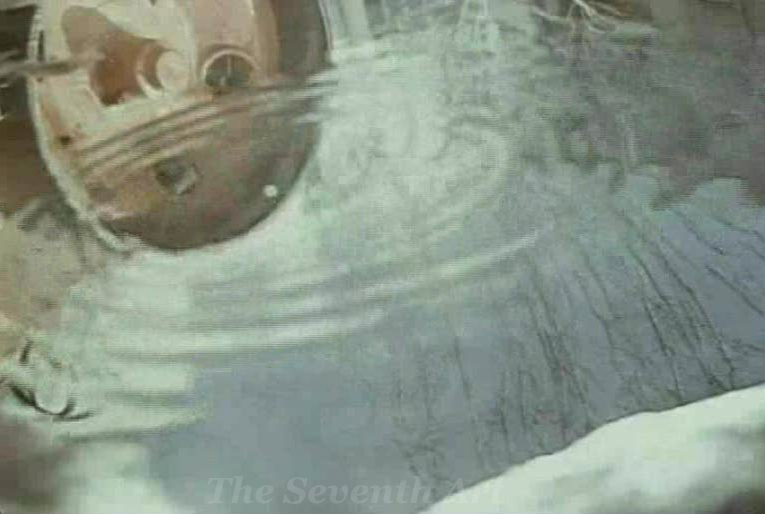
The Steamroller and the ViolinPerhaps the most striking Tarkovsky trait apparent in The Steamroller and the Violin is the director’s use of water throughout the film. For a very large part, water seems to be present in every frame of the film. Tarkovsky floods the movie with images of water found in one form or the other in everyday life. For him, water wasn’t just a symbol or a token of life, it was life. For Tarkovsky, water’s reflective, meditative, serene, cleansing, cathartic and mystic qualities were nothing short of the magic of life itself. In this movie, however, his use of water, unusually, takes up the job of indicating free life, rather than being present for just what it is. Although one can argue that this strategy is close to becoming symbolism that Tarkovsky would later oppose, it is to be accepted that he has used it very efficiently. Throughout the film, we see water being employed to make a commentary on life in that particular environment. Water is seen flowing smoothly on the streets when Sasha and Sergei bond. The same water is forced and confined into water jugs in the conservatory and at Sasha’s home. Water appears in the purgative form of a rain during the quintessentially Soviet sequence in the film, where a building is brought down with a soundtrack marked by expressionist music. And water is seen in its softest form in a puddle gently continuing to reflect its surroundings, like it would in the director’s later movies, as Sasha and Sergei descend into a free-flowing small talk.

Additionally, there are many images and facets in The Steamroller and the Violin that one would also see in Tarkovsky’s films that were to follow. The basket of apples that the woman in the city drops takes us directly to the cart of apples in Ivan’s Childhood. The contemplative interior where Sergei and Sasha sit for lunch shows up in almost every subsequent Tarkovsky film.  The autobiographical aspect of the absence of the father figure and the presence of a strong and demanding mother in the movie is unmistakably Tarkovskian. The question about the role of the artist is a clear precursor to his masterwork Andrei Rublev. Although not blown to full scale, Tarkovsky’s elliptical editing, which would be stretched to the limits later, makes sure that superfluous actions are weeded out and the audience is left with the bare minimum to hold on to and develop into a whole. We see the bullies approach the violin with awe. But it would become our responsibility shortly to understand that these kids never actually wanted to harm the violin, but just to taunt the artist. We see Sasha give an apple to the little girl at the conservatory and that she eats it by the time Sasha leaves, but it is up to us to decide why she was reluctant in the first place.

“The method whereby the artist obliges the audience to build the separate parts into a whole, and to think on, further than has been stated, is the only one that puts the audience on a par with the artist in their perception of the film. And indeed from the point of view of mutual respect only that kind of reciprocity is worthy of artistic practice.”
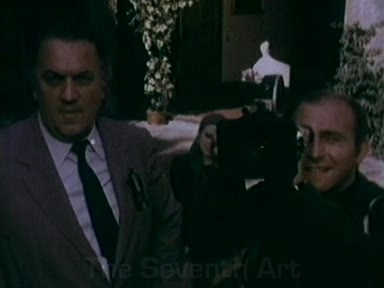
Block-notes Di Un Regista (1969) (aka Fellini: A Director’s Notebook)
Federico Fellini
Italian/English

“To me, the subway is like a catacomb which goes right through the bowels of Rome.


Fellini - A Director's NotebookIf there ever was something called personal cinema, it had to come in the form of Fellini’s masterpiece (1963). With had come a new kind of cinematic artist, standing in front of an unlimited canvas woven in time, dipping his hands in colours called memory, fantasy and magic, painting it without giving a damn about what a world would think about it. Placing himself at the centre of his fictional world, Fellini had indeed made it clear what the director of a film can do to it – as a manager, as an artist and as a personality himself. But to see that a film that he made half a dozen years later, Fellini: A Director’s Notebook (1969) that is as ambitious in its scope and as groundbreaking in its impact as , is much less discussed is both surprising and disheartening especially considering the way Fellini transforms a mere, unappealing making-of-movie into something that is as profound and as personal as his acclaimed movies. Made as a part of a series titled NBC Experiment in Television (1967-71), A Director’s Notebook is a precursor to his next film Satyricon (1969) and traces the groundwork that Fellini laid before the shooting of this film.

A Director’s Notebook presents us Federico Fellini setting out in search of locations, sets and character inspirations for the period drama  within modern day Rome. The narrator tells us that he is trying to affirm his belief that there is a strong link between the ancient and the modern and that the Rome of history text books is still alive and kicking. This idea forms the backbone for the hunt as Fellini hops from night-time streets of Rome to the countryside, from the city’s subways to world renowned monuments and from abandoned sets to active slaughterhouses. We meet a range of characters and also get to see them through Fellini’s eyes. Soon we start to sense what Mr. Fellini is arriving at. We see the Coliseum alongside defunct movie sets, we see images of Nero’s debauched army along side the street birds of Rome, and we see brave gladiators alongside butchers of slaughterhouses. Fellini, as usual, has fun transforming his situation as he wants. He seamlessly switches between images of the past and those happening now. We even get to see the iconic Marcello Mastroianni, whom Fellini likes to call a true Roman (“has all the virtues and all the faults of the ancient Romans”), and his subsequent conversations with Fellini beyond which the film really digs deep.

Throughout the film, Fellini sets up a channel between the two Roman civilizations – the present and the ancient – in a way that, primarily, serves as an inspiration for his next movie but also as a personal journey towards the director’s own roots. Be it the virtues – especially the warm and hospitable nature of the people – or the vices – the notorious debauchery of Nero and Caligula – Fellini seems to believe that the culture and the spirit has persisted through the years in the Romans. Towards the end of the A Director’s Notebook, Fellini even has the townsfolk who work at the slaughterhouse enact sequences from ancient Rome, complete with costumes and wreaths, in order to validate them for his next film (In the sequence’s hilarious end, one of the gladiator almost cries because he gets a scratch on his ear). In some ways, A Director’s Notebook is Fellini’s version of the wonderful Tarkovsky documentary Voyage in Time (1983), which too unfolds as a nostalgic trip set in Italy, wherein the director uses geography extensively to invoke memories and emotions. In one scene, Fellini and company travel in the subway train and we notice ancient Romans standing outside the train at many places, upon which the director himself notes that this must be a journey in time and not space.

Fellini - A Director's NotebookA Director’s Notebook is to what Woody Allen’s Deconstructing Harry (1997) is to his Stardust Memories (1980). Allen’s admiration for Fellini has been largely overshadowed by the influence of Bergman on him. In fact, Allen’s career closely follows that of Fellini’s even though the philosophical questions that Allen revisits is that of the Swedish. Stardust Memories (which, in a way, happens to be Woody’s 8½th movie), like Fellini’s , is all about the director. Both movies are exercises in narcissism as many have pointed out. In both, the director treats himself as if he is the centre of the universe while the world around seems to exploit him despite his turmoil. In Deconstructing Harry, Allen comes full circle and, once and for all, accepts the fact that it is he who has been exploitative and that he has to let go of his balancing act between his fictional world and the real world. Likewise, in A Director’s Notebook, Fellini studies his own self and, in an act of purging himself of the ego, reflects on how his relation has been with his actors and everyone else who has helped him gain the international reputation. Towards the end, when many actors and players try to impress the director with their skill set, Fellini tells us in the voice over:

“Yes, it might seem very cynical, very cruel. But no, I am very fond of all these characters who are always chasing after me, following me from one thing to another. They are all a little mad, I know that. They say they need me, but the truth is that I need them more.”

In one section in A Director’s Notebook, Fellini visits his long time friend and movie star Marcello Mastroianni to audition him for the leading role in his unfinished film The Journey of G. Mastorna. Fellini tries a lot – adding make up, setting up wigs, going for multiple takes – to somehow get a shade of the cellist Mastorna out of Mastroianni, but finally resigns. When he turns down Mastroianni telling him that he wasn’t into it at all, the actor quips back: “No Fellini, it’s because now you have no faith. It’s as if you are scared. If you could believe that I am Mastorna, I would automatically become Mastorna”. Throughout the movie, Fellini examines the cost that he has to pay for conforming to his reputation, the cost to that has to be paid for him to remain the Fellini that the world knows him as (Fellini is notorious for rarely using the same actor more than once), the cost for imitating oneself just for the heck of it. Fellini’s situation remains true for any filmmaker who tries to construct his fictional world the way he wants it, even at the cost of the real one – issues that both Woody Allen and his idol Bergman have explored time and again.

Fellini really pushes the boundaries of filmmaking over here. Unfolding as a tone poem in typical Markerian style, A Director’s Notebook soon goes on to blend documentary and fiction to create a truly personal form of expression that seems to be way ahead of its time. Far from the assured and fluid camera work of and rightly so, the cinematography in A Director’s Notebook is self-conscious, largely handheld, seemingly offhand and purely functional all the way. Closer to a series of essays than a complete film, the movie seems to be one of the earliest examples of the kind of cinema that would later be explored deeply by filmmakers such as Werner Herzog and Jean-Luc Godard. What part of the film was scripted, what was improvised and what was plainly documented will remain a mystery, but what matters is the unique concoction that the director achieves by this mixture. Stacking various levels of reality over one another like , but also taking it further, this stunning little gem from Fellini may just be the golden key required to unlock all his films that were to follow.

Fellini - A Director's NotebookA Director’s Notebook, true to its title, also serves as a nostalgia trip for both the director and fans of his work. There are throwbacks of his earlier films throughout A Director’s Notebook. When Fellini visits Mastroianni, the latter is in an interview where the reporters ask him inane questions, much reminiscent of the irritating paparazzi of La Dolce Vita (1960). Early in the film when Fellini is scouting for locations during the night, we cut to a little interview of his wife Giulietta Masina who recalls the (then) edited scene in The Nights of Cabiria (1957) where a strange man delivers goodies to the people living on the fringes of Rome. The hilarious audition section where we have all kinds of people, including a boy who claims he can whistle like a blackbird, a charlatan who seems to know painters more important than Raphael, a lady who thinks her music conveys the same thing as Fellini’s films and even a man whose life depends on his wig, seems straight out of . Even the sequences in the film where the director hunts for life in the streets of Rome during the night time has a lot in common with the positively eerie and Lynchian atmosphere that he created in his segment Toby Dammit in the portmanteau film Spirits of the Dead (1968).

But even without the references, A Director’s Notebook remains an auteur’s work. Even if one doesn’t see any connections of this film to his other movies, one can say with conviction that it is a “Fellini movie”. No one other than the ringmaster called Fellini could have assembled the army of characters that appears at various places in the film. At one point in the film, Fellini takes a mini nostalgic trip where he recounts the people of his childhood watching a movie at the theatre, hinting at the kind of films he would be making henceforth. The clairvoyant who can talk to the people of the past, the professor who studies the connection between historical Rome and its present version and the crewmen who turn into Nero’s soldiers are all characters who have the Fellini tag stuck on their forehead. The lonely yet lyrical, dark yet alluring, beautiful yet decaying streets of Rome, the array of immensely human characters who keep flooding the screen with enthusiasm and women with exaggerated make-up and strikingly extreme expressions – now, where else can one see such images other than at Fellini’s circus?

Tabiat-e Bijan (1974) (aka Still Life)
Sohrab Shahid Saless
Persian

“It means that you’re retired now.”


Still LifeSohrab Shahid Saless’ Still Life (1974) is, barring Kiarostami’s Homework (1989), the greatest Iranian film that I’ve seen. To see that even during the pre-revolution era, when the escapist cinema of Hollywood and its imitations were much more popular, such uncompromising and quality films were being made is both surprising and hope-instilling. Typically European in its form but uniquely Iranian in its content, Still Life is the kind of movie that contemporary contemplative cinema takes off from. Produced by a newly formed group called Kanun-e Sinemagaran-e Pishro (Centre for Avant-Garde Filmmakers), that also produced some of Mehrjui’s early features, the film was one of the many films that were discontented with the existing way of governance. Although never overtly political, Still Life not only manages to critique deeply the disparity that existed between villages and cities of the country during the Shah’s regime, but also remains one of the best works from the country till date. Let’s wait and see what the present-day Iran brings in reply to this masterwork.

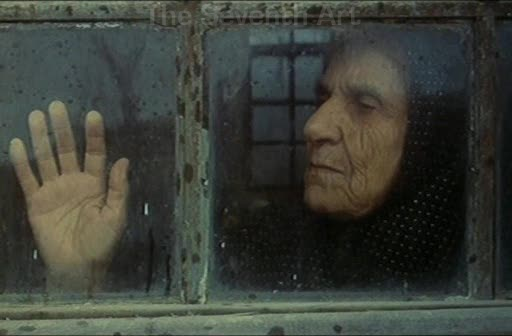
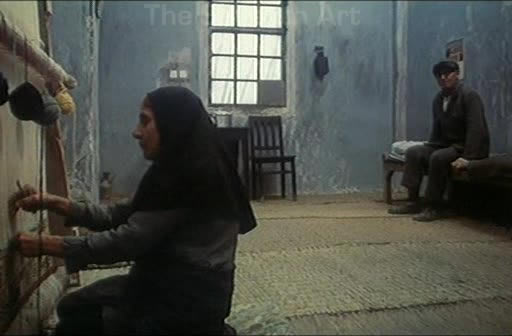
Still Life documents a period in the life of Mohammad Sardari (Bonyadi), a veteran employee of the railway services living in a rural part of the country and whose sole job is to close and open a railway crossing few times a day. He is waiting for a festival bonus from the department that is long pending. He is married and his wife (Zahra Yazdini) supplements his income by weaving carpets and carrying out minor tailoring jobs. We are only given such utterly quotidian details from his everyday life – he operates the railway gates in the morning, he rests at his accommodation near the crossing, he returns home for lunch, he goes back to operate the crossing for the evening train, he returns home for dinner and he sleeps – but that is all there is to Sardari. We are also given a few glimpses of his son who returns home for a day from the military service and a bunch of customers who exploit Sardari by underpaying him for the carpets his wife has woven. One day he receives a letter from the railway department that intimates him of his retirement from service. Sardari is unable to comprehend the meaning of the letter and starts to believe that he has been unreasonably given the sack. Heartbroken, he decides to go to the department headquarters located in the city and find out the reason.

Saless’ style is remarkable here. Almost throughout the entire film, he presents us long, uninterrupted extreme long shots of Sardari going about doing his routine at the railway crossing. Even when the old man is home, Saless and cinematographer Hushang Baharlu give us mostly medium and long shots that are filmed with the camera placed at the ground level, sometimes reminiscent of Ozu.  In either case, Saless’ eye is that of an ethnological documentarian – interested in what his protagonist is doing, but never wanting more than that. The mise en scène is spare, stripped down to bare essentials, with a chunk of space between the characters and the camera. Even gestures, dialogues and movements are reduced to an absolute minimum. Watching the indoor scenes in Still Life is like gazing at an aquarium in which the fishes indifferently perform the same mundane activities over and over again. Halfway into the film one is acquainted with the routines of the old man and his wife. He comes home, rolls his cigarette, and starts smoking and she continues to stitch clothes and weave carpets. Even when their son returns home after a long time, conversations are perfunctory and the character functions are unhampered.

Still LifeBut what is singular about Still Life is the way it handles cinematic time. Saless, while letting us witness individual scenes unfold in real time – be it entire dinner sessions or railway transitions – without hindrance, shuffles the order of these scenes in a way that disregards chronology. In one scene in the film we see the couple’s son return home and in the next one, he is missing. And then he’s back in the subsequent one. Soon one notices that most of the scenes could have taken place in any arbitrary order in real time and each of those orders is essentially irrelevant, given the idea of the film. What’s the use of chronology when time repeats itself by going in cycles? In Jeanne Dielman (1976), Chantal Akerman used each day of the protagonist life’s to illustrate its microscopic deviation from the previous. She seemed to be essentially constructing a spiral out of Jeanne’s life – a structure that made her life seem to go in circles but which, in actuality, ends only in annihilation. Saless, on the other hand, treats time as some form of stray deadlock that could only be resolved by an alien intervention. Within this loop, all time is one and each day is virtually indistinguishable from the other.

In one scene that comes towards the end of the film, Sardari visits the railway headquarters to seek an explanation for the retirement notice. In the building, he notices a pair of officers scanning through old photographs reminiscing about the past and talking about plans for the weekend, And just there, Saless provides the most overt and powerful contrast between the life in rural and urban Iran. The officers with a lush past and a busy future stand directly in opposition to Sardari, whose past is almost non-extant and whose future promises nothing different. Still Life would definitely form an interesting companion piece to Antonioni’s Blowup (1966), which seems to resonate more and more with the years. Both Thomas (played by David Jennings) and Sardari are perfectly alienated creatures who pass through life without an iota of an idea about their place in the world. Only that their geographical locations are poles apart. Thomas is one of cinema’s many alienated urbanites trying to impart a meaning to their lives. On the other hand, Sardari is the rare villager who believes that life will go on as it is and who is nudged to action only when that belief is shattered. But in essence, both of them are individuals wallowing in their own world unable to snap out of it.

Still LifeEven with all its serious themes, Still Life isn’t entirely humourless. There is a constant undercurrent of dark comedy throughout the film (In a masterstroke of black humour, Saless has Sardari regularly tune the alarm clock!), but, like all the other elements of the film, it remains extremely subtle and never thrusts itself upon us. Instead, Saless builds one stretch of time upon another, elevating the film from the territory of mere narrative cinema to the realm of the philosophical, the experiential and the contemplative. In the shattering last scene of the film, we see Sardari, who is now forced to accept the reality that he can no longer work at the railway crossing, vacating his quarters. After he loads the cart with his possessions, he decides to check the house one last time for any object he may have forgotten. As he stands in the middle of the now-empty house, gazing at the room of whose inanimate furniture he had become a part of through the years, Sardari notices the final remnant of his life at this place – a piece of mirror hanging on the wall. He reaches out to collect it and, in the process, looks at himself for the first time in the film. Mohammad Sardari has indeed become old.


Also published at Unspoken Cinema

Schastye (1934) (aka Happiness)
Aleksandr Medvedkin
Russian/French

“Go and find happiness.


HappinessIt is now generally accepted that if not for the efforts of another less talked about filmmaker Chris Marker, the world may not have come to know about his mentor Alexandr Medvedkin and his work. Standing somewhere between the films of Dovzhenko and those of Pudovkin, Medvedkin’s most famous movie Happiness (1934) offers a radically different perspective to the political and cinematic developments in Stalinist Russia. The discussions about Soviet cinema have been dominated by the films and theories of major figures like Eisenstein and Vertov, and perhaps rightly so, obscuring inevitably other stalwarts who may have been. Much less a theoretician than his contemporaries, Medvedkin produces a film that may never make it into classrooms. But one thing can’t be denied and that is the fact that Happiness is a film with a heart. Happiness does work very well as a stand alone piece, but the fact that it is a culmination of a larger and a nobler mission makes it all the more special.

Happiness follows the life of a poor Soviet farmer Khmyr (Piotr Zinoviev) and his “horse-wife” Anna (Elena Egorova) before and after the October Revolution. During the Tsar’s rule, we see Khmyr struggling for existence and envying his wealthy neighbour Foka, who also happens to be the loan shark of the village. So he goes in search of happiness and gets it in the form of a sum of money. He buys a horse for farming but the animal goes on a strike. He manages to harvest by substituting Anna for his horse and gathers a rich output. His celebrations don’t last long as Foka and the Church figures are quick to grab it back from him. He contemplates suicide, but the Church prevents him from doing this “sin”. Now, it decides to punish him by whipping him but not allowing him to die. Years pass by and the country is now in the hands of the communists. The collective farming system has been implemented. Anna seems to have adapted to the system and seems to be doing exceptionally well, becoming the breadwinner of the family. Khmyr, on the other hand, lazes around, making one blunder after the other, desperately tries to become an honest farmer. But the disinvested Foka plans revenge.

Happiness would seem like a very directionless film, if one does not take a look at Medvedkin’s modus operandi outside of the film. Medvedkin was one of the founders of the famous Cine Train of Bolshevik Russia that aimed to travel into the hinterlands of Russia, document the lives of peasants and workers and show it back to them in order to make them understand their strengths and weaknesses. The country had just entered the Bolshevik regime and the common folk, it seems, found it difficult to adapt to most of the improvement measures. Medvedkin and group understood this problem and used the cinema as a medium of introspection to illustrate the situation clearly to the people. Be it public service messages like the importance of hygiene (as in the film Watch Your Health), critical documents about absenteeism, inefficiency and negligence (as in Journal Number 4 and The Conveyor Belt) or queries for betterment of living and working conditions (How Do You Live Comrade Miner?), the Cine Train seems to have never hesitated in putting everything that is right and everything that is questionable about a system on the same plane. And that is very true about Happiness too.

HappinessJoseph Stalin banned the movie apparently because he thought that Happiness was mocking his collective farming system – the Kolkhoz – but spared Medvedkin knowing his service for the state. But surely, what Medvedkin was doing was neither a satire on the state of affairs nor a propaganda movie that the Soviet cinema was famous for. What he was presenting was merely an honest view of the newly born farming system, without any form of prejudice or support. For this, Medvedkin pays equal attention to both the positive and the negative ramifications of the collective farming. Through a largely objective eye – a common eye called cinema – Medvedkin makes a transparent reading of the Kolkhoz, its strong points and its limitations. If Stalin is pleased by Medvedkin’s attack on the exploitative and irrational nature of the church in the Tsar’s regime, he would be turned off by the vignettes of the Kolkhoz, where there are a bunch of goons waiting to ruin it all for themselves. If he would be laughing at the director’s depiction of the Tsarist army as a bunch of men wearing the same grumpy plastic masks, he would be annoyed by the possibly individualistic upshot of the film. But by no means is Medvedkin taking a centrist stance, for his stance is that of the people. As confirmed by Happiness, his interest is not the upholding of a political ideology, but a desire for people to have better lives.

“Every man is seeking happiness. Some see it in wealth, but the Russian peasant who struggled in poverty dreamt of it in his own way. Anton Pavlovich Chekhov noted in his diary: “What is a Russian peasant’s dream? If I were tsar, I’d steal 100 roubles and run away!” A Russian proverb says that the peasant’s reply is: “If I were tsar I’d eat the fat of the bacon and I’d go to sleep.” What an idea of happiness! Just having a piece of bread, not being hungry, having a horse, a barn, having a few possessions, a sack of wheat… Such an idea of happiness, so little, but linked to the age-old harshness of a Russian peasant’s life, that’s the basis of my comedy Happiness. I tried to show the tragedy of such a man, and the effort he makes to find his ideal life. His dreams couldn’t be very elaborate, of course, they were on his own scale, but in his own way he was looking for happiness. And in this film I tried to tell a story that’s funny, sad and tragic, the story of a peasant like him, Khmyr, for whom nothing goes right. His life is a struggle, just as his grandfather’s and great-grandfather’s had been, just as his father’s had been. And, totally unexpected to him, at the end of the film he finds that there are others who care about him, friends, neighbours, the government too. And in a collective farm he comes close to happiness. That’s the story of the film. Throughout my life the film train has been a wealth of ideas and themes. It made me love themes linked to the people, it made me love the life of the people, their dreams, hopes, joys and pain.”

As he says above, Medvedkin fascination lies with the people of his country. Instead of making his film into a moral tale about the truth about happiness, he is content is depicting the struggles, aspirations and triumphs of a common man – a simple man whom he has seen throughout his life in the Cine Train. That is why, I believe, it is not fair to call Happiness as a politically charged film even though it provides a good indication of the politics of Russia at that time. His Khmyr is not an icon of satire or propaganda, but of the Russian peasant himself. Khmyr is like Chaplin’s Tramp, not fitting easily into preformatted social structures, only that Khmyr is not the happy-go-lucky type like his American twin. Medvedkin seems to be of the opinion that, however strong and simple a system is, there will always be anomalies who will take time to settle down. This idea is reinforced by his other films The Story of Tit (1933) and Stop Thief! (1931), where too we have lazy or incompetent peasants trying to malinger and wriggle their way out of duties at the Kolkhoz.

HappinessIn Chris Marker’s brilliant film The Train Rolls On (1971), he recounts the rise and fall of the Cine Train, employing meditative voiceovers, stock photographs and interviews of Medvedkin himself. The Train Rolls On starts (and ends) with the image of a moving train, denoting at once the beginning of this film, the beginning of cinema and the beginning of revolutionary cinema heralded by the Cine Train. Marker, not without a tinge of sadness, documents the activities of the Train, from its inception to its death, and attempts to bring to light how revolutionary the vision of the group was. In the interviews, Medvedkin recalls the experience of traveling in the train, stopping at villages, carrying out the mission’s objective and working against all odds to give to people what he had taken from them. Marker’s work is a documentation of a (lost) documentation of history, of revolution and of change. Marker tells us that although most of the Cine Train’s work has gone into oblivion, the spirit of the undertaking has lived on. As he puts it: “The biggest mistake one could make would be to believe that [the Train] had come to a halt”.

What is perhaps most unique about the Cine Train is its conviction that cinema is a medium that is of the people, for the people and by the people. That it can indeed bring a change in the lives of common people. That it is the only art which can create a revolution for good. This view is remarkably similar to Medvedkin’s contemporary and fellow Russian Dziga Vertov’s Kino Pravda theory. Nikolaï Izvolov, who headed the restoration of Happiness, narrates the strange phenomenon that Medvedkin and Vertov shared. Even though both lived in Moscow and were even next door neighbours for some time, they seem to have never met each other officially. And just before they had an opportunity to work together in the 50s, Vertov passed away. One only wonders what course cinema would have taken if they had joined hands. Herzog’s belief that cinema is the art form of the illiterates seems so true when watching the films of these pioneers. Somehow, it feels like cinema has moved backwards from where it started. One should at least be glad that their followers – the Dziga Vertov Group (Godard et al) and the Alexandr Medvedkin Group (Marker et al) – have tried to sustain the vision of their mentors, if not achieving the desired results.

HappinessIn Happiness, Medvedkin sets up a hilarious contrast between Khmyr and his wife Anna by reversing the conventional notions of masculine and feminine. As Khmyr goes out in search of “happiness”, Anna grabs him by the collar and kisses him goodbye.  She defends him against Foka’s exploitation. She steals a horse from thieves and rescues Khmyr from execution. She drives a tractor and runs the house. Heck, she even carries the horse down from the top of their hut! Medvedkin almost always frames her above the feeble Khmyr producing an amusing effect. Sergei Eisenstein called Medvedkin a “Bolshevik Chaplin”. Although I’m sure many will be surprised by that statement since the slapstick in Happiness seems to have aged a bit (but only as much as many of its American counterparts), there is much dark humour in Happiness to make up for that. I haven’t seen any Russian comedy of this period, except Pudovkin’s magnificent Chess Fever (1925), so I am not sure how this film stands out as a comedy among its contemporaries. But where the success of Happiness (and Medvedkin’s work in general) really lies, in hindsight, is in the fact that it offers us an alternate prism to view a country’s cinema, which has been reduced by text books to mere political messages and then a few cutting techniques.

Agraharathil Kazhuthai (1978) (aka Donkey In The Elite Colony)
John Abraham
Tamil

“I felt a living thing had come to me for love and affection. I hadn’t the heart to drive it out.


Agraharathil KazhuthaiJohn Abraham’s Donkey in the Elite Colony (1978) begins before its imagery does, with the narrator passionately reciting a fiery poem by Subramanya Bharathi, in praise of fire, during the credits. The first visual of the film follows up the verbal worship of fire in the poem with an extended shot of a sunrise. The tone is set for a leftist kind of film with revolutionary overtones. The seventies was a notorious decade in Indian cinema – both parallel and mainstream – as the permissiveness of American cinema had started showing its influence. And fortunately, it was also the period when cinema was taken most seriously and for the good. Malayalam film director John Abraham’s second film, and his only film made in Tamil, is a controversial film from the era and continues to be rated as one of the most important non-mainstream movies from the country.

Professor of philosophy, Narayanaswamy (M. B. Sreenivasan) returns home one day to find a little donkey at his doorstep. He comes to know upon enquiry that its mother has been killed by a mindless mob and decides to provide refuge to the animal. But staunch opposition from college officials and his students forces him to transport Chinna (that’s what he has named his pet) to his native village, only to trigger a chain of apocalyptic events. The neighbourhood is an agraharam, the settlement of Brahmins (considered one of the higher social classes in ancient India), where the mere notion of a donkey (an icon of the working class) replacing the sacred cow as a domestic animal breeds hostility. Narayanaswamy is single and has a brother who is married but childless. Chinna is taken care of by the mute Uma (Swathi), who is as devoid of the notions of class and caste as Chinna  is and whose fate clearly mirrors the donkey’s.

Agraharathil KazhuthaiDirector John Abraham and scriptwriter Venkat Swaminathan evidently draw inspiration from Bresson’s Au Hasard Balthazar (1966, even overtly referenced early in this film), where too the protagonist’s fate was tied up with the donkey’s. I say fate because none of the central characters (the women and the animals) seem to be able to affect the direction of their lives. Both Chinna and Uma are mute creatures who end up being victims of insecurities and questionable intentions of certain individuals who take refuge under the cover of their social standing. But Abraham is far from being a Jansenist (that Bresson is often claimed to be). He is more interested in doing away with the oppressive forces than in contemplating about the harrowing state of affairs as his opening and closing sequences testify. Towards the end of the film, when the professor finally searches out the whereabouts of Uma, he finds her sitting listless among the ruins of a temple, amidst abandoned idols, subtly raising an intriguing question – Has God forsaken his subjects or is it the other way round?

It is so good to see an Indian film, after a long time, which respects the cinematic form and not just its scenario. Venkat Swaminathan’s script would have been just a hard hitting short story if not for what John Abraham does with it. Although Abraham’s style does become showy at places and the film feels like an uneven student film, the director’s conviction that form underscores and enhances content overwhelms. He draws inspiration from Eisenstein (montage is used regularly in the film), the neo-realists (location shoot and use of non-professionals) and, more extensively, Bresson (lot of detail is conveyed through off screen speech while the camera lingers on the characters’ actions). It is enough to witness just the opening few minutes of the film to see the formalist urge of the film. Following the prolonged shot of the sunrise, using simple cross cutting between the professor and the little donkey, Abraham starts presaging the intrusive and iconoclastic nature of both of them, which will be elaborated upon later in the film.

Agraharathil KazhuthaiBut most interesting is the central piece of the film, where Abraham achieves a unique effect through repetition and montage. It is a sequence where Narayanaswamy’s father is recounting the villager’s complaints about the donkey. Each scene of complaint begins with a villager shouting out his gripe, after which, Abraham cuts to what actually happened. It is revealed to us that in none of the cases, is the donkey guilty of what the villagers are accusing it for. In contrast to the verbose ranting of the villagers, these flashbacks are completely devoid of words, with only a soundtrack playing throughout each one of them, as if stressing the inherent dubiousness in human words. At the end of each scene, we see Chinna and Uma walking past the father-son pair almost in the same fashion every time. This is followed by a section that shows a working class man taking advantage of Uma’s condition, much like the villagers making use of the donkey’s inability to object. The whole sequence of events repeats three or four times and constantly calls attention to itself, making it a bit of an overkill by today’s standards.

Donkey in the Elite Colony has been called an attack on the Brahmin hegemony in rural Tamil Nadu. But Abraham’s film is much more than a simple tirade against a particular caste or class. It, in fact, talks against any system that tries to imitate itself for a reason it can’t understand and imposes upon itself, laws and practices that are either irrelevant to the present or plainly irrational (In one scene, Narayanaswamy tries drinking coffee without sipping – a practice considered a characteristic of the Brahmin household – in front of his mother, only to fail). Donkey in the Elite Colony presents one such social system which blindly attempts to sustain its oppressive structures like class, caste and family and goes any distance to weed out anomalies that may harm the setup. The class divide is as much perpetuated by the submissiveness of the working class as it is by the domination of the elite. The fact that Narayanaswamy is single and his brother’s family is childless seems to be a big taboo. Status quo is restored only when his brother’s wife bears a child. Even the college where Narayanswamy works insists that he get rid of his pet since it is “demoralizing” for the institution.

Agraharathil KazhuthaiThe final act of Donkey in the Elite Colony begins on an ambiguous note, which, in a way, feels like a weak link. We are first shown Brahmins who are repenting for their actions, haunted by the implications of their sins, and then the workers rising to revolt. Is Abraham suggesting that a change has to come from within, rather than through an organized movement (This is a plausible explanation, for Narayanaswamy himself is one of the Brahmins)? Or is he of the opinion that a revolution is the only way for progress? The climactic act, at times seeming indecisive, is brought to a final resolution with the help of another Subramanya Bharathi poem – Dance of Death. The penultimate image in the film is that of burning houses, rendering closure to the film’s first sequence (the opening poem is recited in the soundtrack once more) and providing us with a clear solution rather than an introspective question. Abraham’s leftist tendency overwhelms, taking the film with it into an agitprop mode reminiscent of the Soviet cinema of the twenties. The film closes with a shot of the setting sun – a rather unusual metaphor for a propagandist showdown, for the revolution has just begun.

Om Darbadar (1988) (aka Om-Dar-Ba-Dar)
Kamal Swaroop
Hindi

“To Prime Minister. Subject: The Googly. Dear Raju, Please ban googly in cricket and life in general. Thanks, A freedom fighter, Babuji B. Sankar.


Om DarbadarIf one is asked to describe briefly what Kamal Swaroop’s Om Darbadar (1988) is, some of the answers could be: carefully constructed non-sense, endless dream of a cinephile, a satire on everything, full stop to Indian parallel cinema, random footage, extremely challenging piece of filmmaking, the great Indian LSD trip, landmark Indian film that aims big. With all the ingredients required to make a cult classic, Om Darbadar is the kind of movie that can easily polarize critics and audiences alike. It is, in fact, surprising that the National Film Development Corporation consented to produce this film. Using image, sound and montage to the maximum extent (and often gratuitously) and dialog that seem like knitted from parts of different sentences, almost always making no meaning (written by Kuku, also the lyricist and the art director of the film), Swaroop’s film is an antithesis to whatever is recognized globally as Indian cinema – a reason good enough to make Om Darbadar a must-see movie.

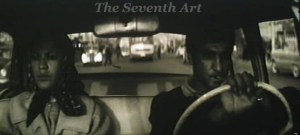
Here’s the plot of the film: Horoscope, dead frog, cloudy sky, the moon, radio program, caste reservation, bicycle, Mount Everest, women’s liberation, communism, sleeveless blouse, Yuri Gagarin, miniature book, Nitrogen fixation, man on moon, terrorist tadpoles, computer, biology class, turtles, Hema Malini, typewriter, sleazy magazines, hibernation, text inside nose, googly, James Bond, severed tongue, fish rain, shoes in a temple, World War, assassin creed, Gandhi, illicit trade, the lake, goggles, hopping currency, helium breath, counterfeit coins, underwater treasure, diamonds inside frogs, fireworks, the zoo, explosives, town at night, dead man, visit of God, the Panchsheel Pact, foreign tourists, Promise toothpaste, holy men, Fish keychain, Ram Rajya, food chain disruption, anti-cooperation movement, birth control, bagpipes, gecko, Jawaharlal Nehru, Aviation centers, Potassium Cyanide. And I guarantee you, this is as lucid as it can get.  

Om Darbadar

Om Darbadar is, hands down, the most confusing movie I have ever seen and not many movies can come close to dethroning it. Some might propose Buñuel’s first film, but one could at least find one pattern in that work – of anti-narration. This one regularly tantalizes us with a somewhat coherent narrative and just when it seems to get steady, snap! Or Last Year at Marienbad (1961), which is, in fact, an incisive study of the human memory. Om Darbadar, on the other hand, overwhelms us with its utter irreverence for integrity of reality, unity of content and consistency of form. Or the very many avant-garde films of Brakhage, Warhol, Anger, Snow or Smith, which, I believe, have always had a strong theoretical basis. No, this film does not have any single, central factor as its theme or motivation. Of course, one can find shreds here and there in the film that do make it seem like dealing with the idea of identity crisis in suburban India, but that’s strictly on a speculative level.

Often we witness directors claiming to show the world what real India is – a statement negated by the films themselves. Leave alone filming, it is to be accepted that even understanding the dynamics of such a largely diverse country is near impossibility. But, if there was ever a film that attempted to capture the workings of real India almost in its entirety, it has to be this one. Yes, it does bite much more than it can chew, but surely, digestion is not its intention. In a country where science, religion, mythology, arts, politics and philosophy seep into common lives trying to overpower each other, there is no single way to separate these threads so as to examine their influence on the way of life. This is a nation where the apparently inexplicable supernatural walks hand in hand with the most modern of scientific theories (In one scene in the film, Gayatri (Gopi Desai) asks Jagdish (Lalit Tiwari) if women can really climb Mount Everest without the help of men, he tells her: “Why not? After all, goddess Parvati did it”), a culture that is exposed to all the isms of western thinking yet revels in having its own interpretations of them (wearing a sleeveless blouse is equated to emancipation of women) and a country whose emotions are largely dictated by cinema, television and pop culture (Om Darbadar can be seen as a jab at just about every genre in Indian cinema).

Om Darbadar

Conventional (and good) cinema has relied on the fact that human psychology manifests itself in the form of their behaviour and speech and hence, an unhindered documentation of their lives would help us understand them better. But not many filmmakers seem to have embraced the reverse process – an entry into the real via the surreal. Kolker fittingly calls Buñuel “the neo-realist of the unconscious” and each one of his films testifies that. Likewise, the whole of Om Darbadar could well be the ultimate Freudian exercise that could help us (de)construct the actual world that Om lives in – a world that is as much fuelled by a love for pulp novels and thriller movies as it is by an aversion to zoology. But all is not so simple and the film is far from an extended dream sequence. Swaroop could have easily had Om (or his father, who begins the film’s narration) wake up at the end of the film, thereby taking us back to our comfort zones. Instead, he seamlessly blends present reality, past reality and fantastical reality to create an elusive work of cinema that defies literature, science and rationality.

Om Darbadar is an utterly frustrating, endlessly irritating and supremely hilarious film. Is it nonsensical? Yes, that is precisely its function. Is it pretentious? No, that can happen only when a film attempts to be something. Is it a one-of-a-kind movie viewing experience? You bet. Whatever one calls it, you cannot deny one fact – Om Darbadar is an indubitably addictive and thoroughly riveting piece of work that simultaneously repels a viewer by not pandering to his needs and yet, keeps him hooked on to the screen from frame one. Quarter hour into the film, I was completely disarmed and found myself laughing out loud through the rest of the film despite (rather, because of) the meaninglessness of it all. Om Darbadar is perhaps the kind of vision that flashes moments before one’s death. Call it the birth of Indian cinema, call it its death, call it Dadaist, call it anti-art, but be sure to bask in its absurdity while it lasts.

[Meri Jaan A A A…!]

Khesht Va Ayeneh (1965) (aka Brick And Mirror)
Ebrahim Golestan
Persian

“Do you see those panes, those windows? Behind each, there is an evil eye, a wicked tongue, a jealous black heart, each detesting the other and all unified to detest each other.


Ebrahim Golestan’s Brick and Mirror (1965) begins inside a taxi. The man at the wheel changes the radio station and a voice begins to narrate:

“The night had settled over the forest. The hunter trod through the thicket stealthily. Danger throbbed in the dark. Fear filled the forest. And terror sparked the night. The night was hard. The night seemed long. Nothing was reflected in the eye of the owl but anguish. And fear was life’s only sign. The hunter trod stealthily through the night. Beasts were staring. And the eyes of the thousand-eyed perils were wide. It was dark. And in the dark, there was no one to tell the hunter and the hunted who was the hunter and who was the hunted.”

The camera, meanwhile, gazes safely from behind the windshield, the vast city of Tehran. Night has well fallen and all the street lights are up. It seems like thousands of gigantic eyes staring at the camera, hiding behind the darkness, waiting to pounce on the unsuspecting taxi. After a couple of minutes, we cut to the face of the driver – a thirty-ish gentleman resembling De Niro during his prime. Golestan’s composition is immediately striking. The taxi driver, here and throughout the film, is placed at the margin of the frame, with the dark city pushing him to the boundaries. One gets the feeling that this one might just be the (premeditated) Iranian reply to Scorsese’s Taxi Driver (1976).

Brick and Mirror

Brick and Mirror is unlike anything I have seen from Iran, for it is my introduction to Iranian cinema before the revolution. With the world’s eyes keenly focused on Iran, – politically or otherwise – there prevails a risk of drawing a monolithic portrait of the country. Watching Brick and Mirror, one can see how starkly different the two ages are and how drastic a cultural shift its citizens were subject to after 1979. Golestan’s film, more or less, also testifies the strong relation between France and Iran that prevailed during the Shah’s regime. He, evidently and interestingly, draws inspiration from both Godard and Bresson, apart from incorporating tenets from other famous schools of filmmaking. With complete control over every aspect of the film (writing, directing, editing and producing it by himself), Golestan churns out a film that is clearly Iranian in content, yet could pass of as one of the French New Wave movies.

Brick and Mirror
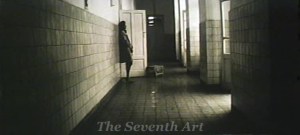
takes place over the course of 24 hours in the life of this taxi driver, whom we come to know as Hashemi (Zackaria Hashemi). That fateful night, a woman in a veil (apparently played by the iconic Forugh Farrokhzad) boards his taxi and leaves behind a baby. Unable to locate the woman, Hashemi is forced to provide shelter to the child for the night. He is helped by his love Taji (Taji Ahmadi), a woman who works at the local pub. But the most important of all characters in the film is the city of Tehran itself.  The city is also the most powerful of all characters, devouring mentally and physically one character after another. Never has a metropolis been filmed so beautifully yet menacingly. Using the cinemascope judiciously and employing camera movements that are seldom meaningless, Golestan and cinematographer Soleiman Minassian ensnare their characters, like the city itself, surrounding them and locking them to their environment. And how often do we see a tracking shot that is as pregnant with emotion and significance as the final shot of Taji standing at the end of the long, dark corridor of the hospital?

Hashemi and Taji are two well written characters, who complement each other emotionally and ideologically. He is a thorough fatalist, classifying every outcome as good or bad luck. He prefers to live in the dark, literally and figuratively, away from prying eyes of the society. She, on the other hand, is the quintessential existentialist (Again, a possible influence of contemporary French philosophy), believing strongly that we make our own lives and being too prude is no good. But she is also an extreme romantic, always giving Hashemi hope for a new beginning, who seems to shrug off her philosophies (At one point, Golestan even frames Taji in such a way that she appears as one of the photos on the walls of Hashemi’s house). In an explosive scene shot on the streets, both of them plunge into a heated discussion after he delivers the baby to an orphanage against her wishes. The camera tracks in front of them as they walk arguing with each other. And all of a sudden, in a humbling manner, they break into utter silence after a funeral procession cuts through them, reminding the about the futility of their words and the ever tangible presence of death.

Brick and Mirror

Hashemi does bear a striking resemblance to Schrader’s Travis Bickle, in the sense that both of them are marginal characters who are forced to witness a society that is vigorously dragging itself to doom. But the commonality stops at that. While Bickle is an alien frustrated by what he sees in the rear view mirror, Hashemi is the one in that mirror (In one scene, the driver of the taxi that Hashemi boards cribs about his profession and tells the latter that he is lucky not to be a taxi driver). Moreover, Bickle’s decision to do something about it all is exactly contrary to the borderline-agoraphobic Hashemi, who believes it is better to stay low and go through life unnoticed by anyone. True that he comes to know of all the rotten crevices of the city and the breakdown that it is leading to, but, being the determinist that he is, is satisfied with having posters of heroes in his room rather than becoming one. In fact, it is Taji who is closer to Bickle than Hashemi. Only that her search, here, is for inner peace.

Jonathan Rosenbaum describes the film as being Godardian. I doubt if there is any other way to describe it at all.  Take a look at the narrative structure of the film, whose episodic nature and style reminds us of My Life to Live (1962) than any other Godard film. Like the French director, Golestan lets his script freewheel all the way. Characters come and characters go. Their lines are seldom relevant to what is happening. But as always, what they speak is less important than why they speak so. The spirit of the 60s, especially of Paris, seems to show clearly in Tehran too. Intellectualism seems to have taken control over pragmatism and emotionality. People sit all day in pubs philosophizing and indulging themselves with tangential conversations. Consider the scene at the bar where Hashemi arrives, carrying the baby. One of the well dressed gentlemen, out of the blue, begins a monologue about the importance of alphabets in the search for truth and the relation of crossword puzzles to all that (Don’t ask me!). One is reminded immediately of the scene at the pub in Made in U.S.A. (1967), where, too, one of the characters goes on talking about the futility of words and sentences!

Brick and Mirror

Furthermore, Golestan never cares about the progressive coherence of these episodes. He generously shifts gears and tones throughout the film. Hopping regularly between vérité, expressionism, documentary and realism, he concocts something very fresh and unique, even by the New Wave standards. Yes, the jump cuts are there too.  Additionally, Golestan’s shot composition shows influence of Bresson also. Golestan breaks down action into atomic parts with no history or future, attaining the same effect that the French master achieved. Also Bressonian, and one that would go on to become the forte of directors like Kiarostami, is Golestan’s use of off-screen space through sounds. Often, we see that the camera is fixated on certain characters, even when they are not the ones talking. When Hashemi and Taji are out in the streets, their voices are regularly consumed by the noise of the city. One scene would perhaps sum up the entire attitude of the film. There is a sequence at an orphanage where Hashemi is trying to admit the child he is holding. There is also a middle-class woman in the room who, at one point, breaks down revealing that she has been feigning pregnancy all the time. This is an intensely melodramatic moment in the script and the natural reaction for a director’s camera would be to gradually zoom in to the crying lady’s face. Surprisingly, Golestan shows us the face of the receptionist of the orphanage, who turns teary-eyed for a reason that might not at all be related to the drama of the instant.

Almost the whole film, both formally and script-wise, never conforms to the popular law of cause and effect. Golestan refuses to explain everything and seems to want us to not understand the city, much like Hashemi himself.  Who is that crazy female at the hell-hole that Hashemi meets earlier? No answer. What is the guy, whom one might have called a charlatan earlier in the film, doing on the national channel talking about the ethics of living? No answer. Could that female, whom Hashemi sees the second night be the same lady who left the baby in his car the previous day? May be. But surely, all these aren’t merely confusing or distancing devices. Each of these scenes reveals something about the city and the era, in one way or the other. Each of them has indirectly managed to document history – cultural and cinematic. Consequently, now more than ever, it feels that these seemingly stray events are the very elements that can help us perceive better a country that has been unjustly homogenized using, what Brick and Mirror shows us, a faux identity.

Shoah (1985)
Claude Lanzmann
English/German/Hebrew/Polish/Yiddish/French

“So you want to die. But that’s senseless. Your death won’t give us back our lives. That’s no way. You must get out of here alive. You must bear witness to our suffering and to the injustice done to us.


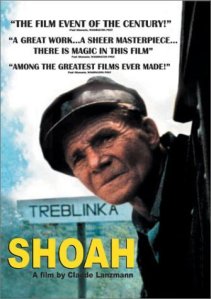
ShoahLet’s make a few things clear first. Shoah (1985) is an essential film. Essential not for us to see it, but for it to exist. Even if the world fails to take notice of it, even if audiences don’t see it, it will remain as glorious and as vital as any historical monument or religious document. It’s not a film that you merely watch, but one which you visit. Running for over nine hours, Shoah opens up at its own pace, never bothering about its destination or about its function as a film. Aided by a couple of cinematographers and a translator, Claude Lanzmann, a protégé of Jean-Paul Sartre and the director of the film, meets the survivors of the Holocaust, – of Auschwitz-Birkenau, of Treblinka, of Chelmno and of the Warsaw ghetto – neutral witnesses in rural Poland and even ex-Nazi officials and workers who were in some way related to the events at the camps, striking up conversations that seem utterly banal but which eventually develop the atmosphere of the film. Apparently, it took Lanzmann over a decade to complete the film and this determination shows. If you are looking for something close to courtroom transcripts or architectural details, look elsewhere. Lanzmann does not pretend to give a fair chance to the SS officers, nor does he try to tell us what actually happened out there. He takes a stand, for sure. Once you take its premise for granted, you realize that Shoah is more than a film. It’s a project – of preservation and of education.
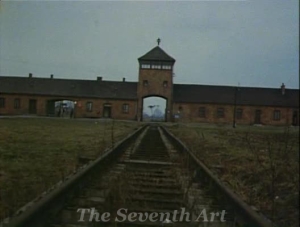
One can’t clearly assign a purpose to the film, for Shoah’s scope of research is far from limited. One moment you have a survivor passionately recalling those years whereas in the other, you see Lanzmann taking a tour of the idyllic Polish countryside. The film does not even raise questions, leave alone answering them. Lanzmann gives us ample time to reflect upon the film, to go beyond its written perimeters, to pose our own questions and to review our own political, moral and social stances. However, one thing that is certain is that Lanzmann, here, is attempting to tell the world once and for all that the Holocaust did take place. Every question, every conversation and every development seems like a reply to the claims of the Holocaust Revisionists. He seems more interested in establishing the verity of the notorious event than illustrating its horrors. And this is perhaps the reason why Revisionists are thoroughly critical of Lanzmann and his movie (Here is an elaborate Revisionist review of the film questioning it using its own testimonies).

The greatest problem that Shoah poses to its deniers is the fact that it deals with the Holocaust and not a holocaust. It is said that Lanzmann has fabricated and misrepresented certain details that would be oblivious to foreign eyes. That, I feel, is really an irrelevant issue over here. Shoah is essentially like a Werner Herzog film, only that the subject that the director is handling is too sensitive and researched upon to impose an artist’s vision. Surely, Shoah would not lose even an iota of its sheen even if it were to be declared as purely fictional. If what Lanzmann is trying is to arrive at a greater truth, unbound by the flow of time, by betraying reality to a minor extent, then I don’t see any reason why this film should be berated.  It is not as much important to know what exactly happened as it is to understand what is claimed to have happened should not happen. That is to say, it is not a question of our response to a historical truth as it is of our action to an eternal (and now imminent) possibility.

ShoahThe more I learn about the Holocaust, the more I tend to admire Salo (1975). I never could really digest Pasolini’s vision when I first watched the film, but especially after Shoah, I think I am able to see what Pasolini was arriving at. The conversations with the SS officers in Shoah indicate the sheer industrial nature of the whole operation. Prisoners are called “pieces”, gassing them is known as “processing” and the camp itself, dubbed as the “production line of death”. Everything here is commodified and reduced to dispassionate scientific terms. The extravagance of the entire process effaces any trace of individuality that the victims may have had. As the conversations regularly show us, the bigger problem for the SS was not the threat of a rebellion, but the logistics of the project that they had undertaken. Why Shoah (and also the work of the Shoah Foundation, with its 120,000 hours of footage) is special is partly because that it reviews a large-scale political issue in terms of personal tragedies. Its testimonies replace homogenized statistics and body count, which only serve to alienate us more from the event and hence be complacent about it, with intimate accounts that remind us of the value of each life.
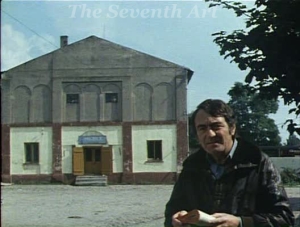
Shoah arises out of a series of critical choices that Lanzmann has taken. There is not one shot of historical footage or one real photograph of the camp form the World War years in the film. Instead, he builds his non-linear narrative purely out of first hand accounts and interrogations. For most time, Lanzmann is content with either showing us the faces of the witnesses in extreme close up as they talk or dwell on the now-serene landscape of Treblinka, Auschwitz and Birkenau. Those who have seen Resnais’ Night and Fog (1955), which is ironically, but without doubt, a big inspiration for this film, will see Lanzmann’s move as being cynical.  If Lanzmann’s suggesting anything at all in these dead times, it must be that this fascism is not a phantom that is dead and buried but one that lives and breathes among us in some form or the other. Lanzmann’s reinforces this idea through his small talks with the townsfolk in Poland, where (like in so many other countries) religion seems to be a clear standard of judgment. One resident sees Poles and Jews as mutually exclusive sects while some don’t seem to regret much about what transpired.

Having watched Shoah, one is only skeptical about the effectiveness of the work of the Shoah Visual History Foundation that Spielberg founded after the making of Schindler’s List (1993, which sometimes looks merely like the visual illustration of these testimonies despite the overall excellence of the film). You see, the camera has strange effects on the consciousness of the people in front of it. While Lanzmann captures these people while they are disarmed and engaged in their daily lives, hence tapping honest and unforced emotions (of the witnesses and ours), the Foundation’s work relies on consciously filmed interviews amidst a studio-like officious atmosphere.  As a result, there is bound to be considerable difference in these testimonies and emotional impacts that they will have. But having said that, one must also acknowledge the nobility of both the missions, despite their outcomes, keeping in mind the immense sociological impact that these documents will have in the decades to come, years after the death of the last survivor. As one of the witnesses in the Foundation’s video says: “It’s not a question of forgiving or forgetting, it is a question of education”.

Shoah

I don’t think there is not much that one could write about Shoah, for it is a film that is more experiential than cerebral. One would only end up talking about Holocaust if he were to talk about the film and miss the whole point of the film. It attempts to recreate the same atmosphere that persisted then, without resorting to meaningless photos and records, in order to make us feel the event rather than philosophize in hindsight. However, unlike many a movie made about the Holocaust, this one does not sell misery. Nor does it overload us with information as in history books. Instead, it tries to take us back to the dreadful period, ripping off our smug and comfortable perception of it acquired through scratchy B&W videos. There is much magic in Shoah that is as precious only when seen. This is manifest when you feel the air of uneasiness as Simon Srebnik, the miraculous survivor of Chelmno stands among Christians, who go on to subtly glorify themselves. Or when you notice the irony that the prison guards of the camps are now in a state of self-imposed exile. Or in the fact that Abraham Bomba, the barber who had to shave off the women’s hair at Treblinka, is still a barber, but by free will.

Il Conformista (1972) (aka The Conformist)
Bernardo Bertolucci
Italian

“That’s why a normal man is a true brother, a true citizen, a true patriot… A true fascist.


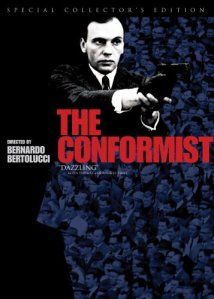
The ConformistBernardo Bertolucci’s The Conformist (1970) is everything that a viewer could ask for – a great story, interesting characters, stylish visuals and a purely cinematic language to convey them all. Using images that possess the judiciousness of a Tati, meaning of an Antonioni and elegance of an Ophuls, Bertolucci, not even 30 at that time, conjures up a film of both high mojo-quotient and long “shelf-life”. Evidently inspiring The Godfather series, The Conformist is the kind of film that persuades you to understand what the difference between direction and visual illustration is. The next time somebody kills you with that irritating “The book was better” act, hit them with this one. Not that The Conformist is better than its book version, but only that it makes such comparisons invalid.

Adapted from Alberto Moravia’s novel, Bertolucci’s script follows a young man, Marcello Clerici (Jean-Louis Trintignant), during the years just before the second big war. He is about to get married to a typical middle class woman, Giulia (Stefania Sandrelli), with “paltry, little ambitions – all bed and kitchen” in order to become a “normal” person in the society. He is also all set to be inducted into the Italian fascist party and has to carry out the assassination of an insurgent in Paris, Quadri (Enzo Tarascio), incidentally his professor during his college days. Employing ace cinematographer Vittorio Storaro’s hypnotic tracking shots and handhelds and seamless, highly-stylized, tense cutting between various timelines, Bertolucci attempts to illustrate the reason for the rise of fascism by delving into the psyche of one man with a troubled past and an uncertain future.

The Conformist is a difficult film, not because its themes are heavy or its form too radical, but because the statement it proposes is a tad indigestible. Once you get over its slight simplification of ideas and reasons, it is a sweeping masterwork that you are looking at. I probably haven’t seen any film that as clearly reveal how we have all confused sexuality with morality, morality with religion, religion with politics and politics with security. The tension is palpable in almost every shot of the film. Consider the central scene of sheer cinematic awesomeness where Quadri and Clerici recollect what actually went wrong. Using staggering interplay of light and shadow, gestures and movements and room space and sound, Bertolucci develops the central motif of the film in pure film language, without ever betraying the diegesis of the film. Bertolucci’s script takes up Plato’s Allegory of the Cave, which suggests that humans are all prisoners inside a dark cave unable to differentiate between real objects and the shadows that they cast on the walls, and adapts it so as to examine the dark history of the country. It is after this point that every element of the film cries out for attention and the ambivalence of the central character brought to light. Especially remarkable is the final shot of the film where, after Italo is swept away by a Rossellinian crowd, Clerici sits on a low platform near the fire, looking towards a homosexual street dweller through prison-like iron bars, still unsure of his political, sexual and moral footing.

The ConformistIn fact, all the major characters in the film tantamount to prisoners of Plato’s cave. None of them actually know what their principles actually mean or what they want from it all. Clerici is confused with both his sexual orientation and political ideology. His wife, Giulia, does not see beyond the two things that Clerici mentions. The professor seems to spend an idyllic life like that of the bourgeoisie –the very people whom he is fighting against. Anna Quadri (Dominique Sanda) is none but a female counterpart of Clerici. Only that the mass she is conforming to happens to be the resistance group. The tragedy about Manganiello (Gastone Moschin) is that the people he despises is the very group he works for (“Cowards. Perverts, Jews. They are all the same. If I had my way, I’d put them all up against the wall. They should all be eliminated at birth”, he says). Even the blind Italo (José Quaglio) joins the group not because of his political leanings, but for “normalcy” and hence safety. It’s almost as if the people who oppose passive acceptance of political philosophies are themselves creating another form of fascism by unanimously scandalizing it – an idea ambiguously explored in Daldry’s The Reader (2008), where it is as much a taboo to humanely understand the people associated en masse with the Holocaust as it is to carry out the inhuman acts of fascism without questioning it.
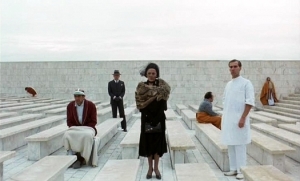
What is brilliant is the way Bertolucci brings to surface this ambivalence of his characters. He regularly captures Clerici in the frame along with his reflection on mirrors, glass panes and windows. He places him behind wind shields and transparent surfaces and cuts in tandem between the views from both sides. He softly blurs out of focus and then into it when recording Clerici. He breaks both continuity and the 180 rule (also serving as a distancing tool) to have his characters oriented in opposite directions. At one point, Clerici even assumes two quirky firing stances – one symmetrically away from the other. Furthermore, throughout the film, Bertolucci takes Clerici through regions of light and darkness – knowledge and ignorance – thus elevating the already expressionistic tone of the film. It is as if this duality of Clerici’s is as inseparable as his features, perhaps because he never completely believes he is doing the right thing by trying to fit into pre-fabricated structures of the society. As Bertolucci rightly says in an interview:

“Marcello is really a very complex character, searching to conform because of his great, violent anti-conformism. A true conformist is someone who has no wish to change: to wish to conform is really to say that the truth is the contrary.”

As a matter of fact, Clerici is swappable with any character in the film, for he imbibes something from each of them. He behaves like Giulia in order to become one of them. He gradually finds himself moving towards Quadri’s ideologies than the fascists’ (In the layered scene at the ballroom, Bertolucci cuts to a photograph of Laurel and Hardy, indicating the frivolous and merely superficial antagonism between them). Clerici sees himself in Anna. His craving to become an acclaimed fascist comes in the form of Manganiello. One could even say that he meets his own future self in the form of his conformist father (Giuseppe Addobbati) at the asylum, whose political and (alleged) sexual contradictions are not far from Clerici’s own. But he is actually the closest to his friend Italo – insecure and scared because of a difference but unable to see beyond immediate refuge (Bertolucci once superimposes their faces, when Italo is reading a piece of text in praise of Mussolini and Goebbels). Italo even says early on in the film that they are, in a way, similar, after which we notice that he is wearing an unmatched pair of shoes. The idea of physical and ideological blindness recurs throughout in the film to reinforce the Plato allegory.

The ConformistI have always considered Lina Wertmüller’s Seven Beauties (1975) as one of the greatest movies ever made and the best one about the Holocaust that I have seen. Watching The Conformist, one can clearly see where Wertmüller’s movie gets its inspiration from. Both films seem to complement each other thematically. While Seven Beauties examines how man’s fake principles fade into oblivion when it comes down to survival, Bertolucci’s film shows how man can assume false policies in order to survive. However, formally, both the films seem very similar in the sense that both of them exaggerate melodrama to the point of caricaturing it and consequently, derive meaning out of that absurdity. Both use oversaturated colour palettes and chromatic shifts generously to keep reminding us of the phony nature of it all. In fact, Bertolucci keeps prodding us with theatricality. As Clerici recites his father’s past, three women are performing a song in the background (Incidentally called “Who’s happier than me?” – another allusion to the prisoners of the cave). He meets Anna in a ballet class. There is even an edited scene that involves blind people dancing to a piece of music.

Bertolucci is one of the biggest New Wave fans and it shows in the host of movie references that he places in the film. It wouldn’t be a coincidence if you spot allusions to The Little Soldier (1960) or Alphaville (1965) in the film, for the director himself tells us so in an interview. Not counting the humourous nods to neo-realism and Buñuel, Bertolucci is continuously in conversation with his mentor Jean-Luc Godard throughout the film. With anecdotes about the film’s first screening and the influence of Godard on his style, he mentions here how Quadri was modeled with the French director in mind and his assassination, in a way, signified the film’s stylistic and ideological shift from Godard’s. But clearly, the relationship is one of reverence. When Clerici tells Manganiello at point: “What a strange dream I’ve had. I was blind and you took me to a Swiss clinic for an operation. And professor Quadri performed the operation. It was successful. I regained my sight and went off with his wife who had fallen in love with me”, one suspects that this is not just a token of his wavering political and sexual stance, but Bertolucci’s own gratitude towards Godard for his influence.

The ConformistHowever, Bertolucci deviates from Godard by making The Conformist a highly individual-oriented film. While Godard’s is a study of the effect of social and political structures on the individual, Bertolucci’s is the exploration of the effect the psychology of (a generalized) individual has on socio-political norms. His Clerici is a character tailor made for in-depth psychoanalysis and many facets of the film clearly remain subjective. For instance, why does he “see” the same woman thrice, at different places, in the film? Why does no one else stalking Manganiello? Does he even exist? Why does Clerici marry Giulia, even though he hates her typically bourgeois mentality? Bertolucci’s mise en scène suggests that the answers are functions of Clerici’s psyche, which is evidently affected by his childhood trauma and sexual “deviation” (Although every reading of The Conformist insists that it illustrates the role of sexual deviance in the rise of fascism, a case could be made for any kind of difference – sexual as with Clerici, physical as with Italo and even religious, as with the mystic Hanussen). This way, Bertolucci calls for a reassessment of fascism as a force that has grown bottom-up because of individual insecurities, fears, motivations and ignorance rather than a mass hysteria initiated by an arbitrary single man.
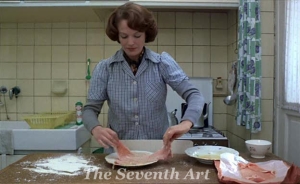
(Pics Courtesy: mcnblogs.com, brynmawrfilm.org, dvdactive.com)

Jeanne Dielman, 23 Quai Du Commerce, 1080 Bruxelles (1975) (aka Jeanne Dielman)
Chantal Akerman
French

“I used less water than last time, so it tastes better”


Jeanne DielmanChantal Akerman’s most famous film gives away all that is factual about it in its name itself. The rest of it follows what the titular Jeanne Dielman (Delphine Seyrig) does in this 23, Commerce Quay, 1080 Bruxelles house of hers, over a three day period in almost in its entirety. Using completely stationery cameras, Akerman creates a claustrophobic document of life in its most mundane form. Even with a screen time of over three hours, there isn’t much in the movie that could be fit into something called plot. That, precisely, is Akerman’s intention. Details are given with extreme reluctance and in exceedingly small measures (with hardly 10 minutes of spoken dialogue). On the first day, we witness Jeanne ritualistically moving about in her house, switching on and off the room lights, cooking potatoes for her obedient son, arranging tables, doing the dishes and making the bed. She earns by selling herself during the afternoons in her very house. All this is done by the book, if there ever was one.
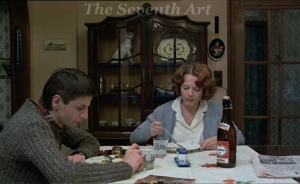
It is precisely these systematic acts which become our reference for the next day. The next day follows almost the same pattern. Only that Jeanne drops a spoon and the polishing brush. Oh yes, she also goofs up the dinner! On the third day, the bank is closed, she reaches a shop before it opens, the coffee is spoilt and a button snaps off from her son’s blazer. This is all the change that Akerman allows Jeanne. What surfaces is a gradually progressive deviation from our “reference” and perhaps for the worse. Like the geometrically flawless décor and lighting of the film, which exude cheerfulness, contentment and sanity are only apparent. It is almost as if one can mathematically calculate, using these extremely small “mishaps”, when Jeanne will completely succumb to her condition. And this is the kind of gradual disintegration of sanity that many films fail to portray credibly (Revolutionary Road (2008) comes to mind first). What happens obscures how it all happens. Cinema becomes text. Although Jeanne Dielman is much more extreme in its form than the mainstream narrative cinema would require, it clearly shows that why a formal stance doesn’t merely justify the medium chosen but enhances its possibilities.

Jeanne DielmanIt wouldn’t be unfair to call Jeanne Dielman an experimental film. Where other films that deal with similar theme of urban alienation tend to bend towards the cerebral side, Jeanne Dielman is more experiential. At any point in the film, once the viewer gathers everything there is to an image, like Tarr’s movies, fatigue sets in. We start experiencing time as it is, undiluted. In other words, we begin taking part in Jeanne’s life by experiencing the savage inertia of time. The only difference is that she is oblivious to it while we, possessing knowledge of the artificial and transitory nature of cinema, are not. Jeanne doesn’t pass through life. She lets life pass through her. Not once does she show signs of emotional fatigue. She is insensitive to her condition much more than her cerebral counterparts. Except for one sequence at a button store, where she shows clear indications of mental derailment, there apparently is no outlet for her emotions at all. Apart from the perfunctory conversations with her son and the occasional visit by the neighbour, who asks Jeanne to take care of her baby (who could well be considered a miniature Jeanne) from time to time, Jeanne is completely cut off (at times literally, in the frame) from the world.

In his extraordinary article on Tarr, Kovács writes about the director’s style:

In Tarr’s world, deconstruction is slow but unstoppable and finds its way everywhere. The question, therefore, is not how to stop or avoid this process, but what we do in the meantime? Tarr asks this question of the audience, but if the audience wants to understand the question, it first has to understand the fatality of time. And in order to grasp that, it has to understand that there is no excuse in surviving the present moment: time is empty—an infinite and undivided dimension, in which everything repeats itself the same way.

Akerman’s own style does not seem far from this. Through repetitions, in gratuitous amounts, Akerman creates a film of high precision and low life quotient. In fact, everything in the film seems to exhaust itself the moment it takes birth.  Akerman repeats every element of the film – time (Jeanne’s daily routine), space (the viewer is immediately acquainted with the couple of rooms that the almost the whole film takes place in), the actors’ movement and gestures (Jeanne act of switching off lights moves from interesting to an in-joke) and even camera angles (as if the actors are passing in front of stationery cameras installed at various locations in the house).

Jeanne DielmanThe only hope for Jeanne to snap out of this vicious loop comes in the form of the final sequence in the film where she stabs to death an unsuspecting client of hers (Actually, it is never made clear if the scene takes place in Jeanne’s present or not. The man could well be her husband, whose death is talked about regularly in the film, thus, also, creating a narrative loop within the film. But considering the realities of the world, it is unlikely). This is where Akerman deviates from Tarr. Tarr seals his characters in their own existence until they fade into oblivion. His characters neither have history or hope. Akerman, on the other hand, gives her characters a past and a future. The circle in Jeanne’s life may just be a stray deadlock that had to be resolved by her action (rather, by ceasing her inaction). There is certainly a gaze at a different future throughout the film. Jeanne is expecting a gift from her aunt, which is revealed to be a dress later.  She deposits money in the bank for future use. Her aunt even urges her to migrate to Canada. Even though, a large part of the movie is concerned with her empty life, it does offer a hope for renewal.

Obviously, Akerman is far from being a romantic. It is true that she does not choose to tread Tarr’s spiral, which seems to go in circles but ends only in decimation, and concocts an open ending, thus leaving margin for hope of escape. But why Akerman’s masterwork feels ultimately like an exercise in despair is that she generalizes Jeanne’s existence. As a matter of fact, we don’t even know if the lady we are watching is Jeanne or if the building is the one mentioned in the title. By not pinning down particulars, Akerman seems to speak for an entire generation and era. Of course, the whole film could be deconstructed to unveil political, social, sexual and cultural outlook of the age, but what makes Jeanne Dielman stand out from its contemporaries is not its keen study of lives in modern times, but its ability to make us experience what every Jeanne Dielman experiences and understand why we each of us, in a way, has become a Jeanne Dielman.

« Previous PageNext Page »