Review


Road to the Oscars?

Road to the Oscars?

The official entries for the Academy Award have been made and as many as 67 countries are vying for the coveted award this year. Among the leading contenders for the nominations are Germany’s The Baader Meinhof Complex, Italy’s Gomorra, France’s Palm D’Or winner The Class, Iran’s The Song of Sparrows directed by Majid Majidi and Israel’s Waltz with Bashir. And the Italian entry is already making waves and being termed as one of the best crime dramas from the country.

The film interweaves five stories of five individuals – all inhabitants of Camorra (the notorious society of Naples known for its criminal activities) – a designer who sells himself to the fake manufacturers of the underground, a kid who fascinates getting into one of the gangs, two teenagers who wish to tackle everything with their newfound arsenal, an illegal businessman who pays the land owners in order to dump industrial waste and a plumber who tries to earn by other means. The narrative crosscuts irregularly from one story to another and it would a miracle if one could remember all five threads during any point in the film. But all this only adds to the harshness that the film depicts.

The basic atmosphere of the clan resonates what goes on there. There is no law, no neutrality and no word called crime. Everyone seems to belong to a gang and the gang wars are the courts that decide the future of the inhabitants. Everyone assumes that they are on the right side and are fighting for a cause. If Meirelles gave us the City of God, Matteo Garrone gives us the City without God. Gomorrah apparently refers to an ancient city that was decimated by God for the immense depravity of its residents. Indeed, it feels like God has deserted the settlement and has left everyone on their own as we see the figure of the Good Shepherd being dismantled and suspended by ropes (a possible nod to La Dolce Vita) as a family moves out of one of the buildings.

As Roy Stafford notes at The Case for Global Film, the locality forms a vital part in the narrative as we see in a fleeting shot that the whole establishment is so geographically close to the rest of the world, yet is culturally isolated from it. And like these structures, the film is completely devoid of any decorations that we see in conventional storytelling. It never once shows the trappings of a tale of crime, punishment and redemption that one expects at the starting of the film. Though it becomes a bit difficult to digest, it does provide the sense of confinement that the characters feel and the absence of any effort to come out of the vicious circle.

Also remarkable is the film’s photography that uses the camera as an active entity rather than as a tool for documentation. Like a thug staring at an intruder or like a dog sniffing a stranger, the camera gets close to the character, almost intimidating him and carefully peruses each one of his moves as if supervising his activities. It chooses to see what it wants and leaves out what it thinks is unwanted. It effectively becomes one of the clan members, even looking over corners and hiding behind people. For most part, the cinematography feels like hand held work, but never becomes nauseating even in the most dramatic moments.

The film is in the news for all the wrong reasons as the author of the book on which the film is based is under a life threat from the gangs of Camorra and a couple of the actors have been arrested in connection to the Camorra case. All this only assure that the director has been successful in exposing the inner working of one of the most arcane societies of the world. With the Academy’s policy towards violent and brutal films drastically changing, Gomorra may well cruise through to the last five and one can be sure that the weak Indian entry Taare Zameen Par has one less slot to compete for.

Verdict:

B for Vendetta

B for Vendetta

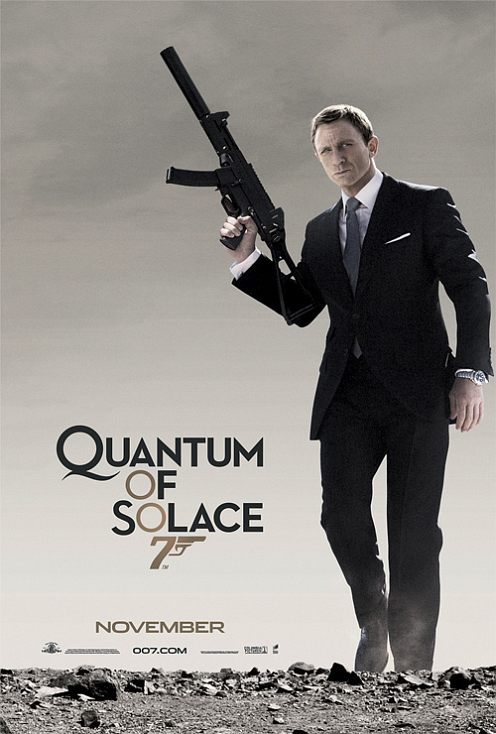
I didn’t want to start with this cliché, but Bond is back. This time, loaded with wrath in his heart, distrust in his mind and ammo in his gun. Instant hit Daniel Craig returns for his second performance in the first ever sequel to a bond film. And intriguingly Marc Forster takes the control of the Titanic, much to the concerns of the fans. And to negate the anxiety, the film has been shot in more locations than ever. So, does Quantum of Solace bring back the sheer fun of Goldfinger or does it bring the dreaded minutes of Die Another Day? Or plainly, does it have the licence to thrill?

Quantum of Solace takes off from where Casino Royale (2006) left us with the most stylish Bond ending ever. Bond has just learned his first lesson – one of intense mistrust and callousness. He is shattered by Vasper’s (Eva Green) death and is sets out on a roaring rampage of revenge (sorry Kiddo!). With the help of Eva’s endnote (not another Bond pun!) and Britain’s own forensic service, he traces the whereabouts of Vasper’s extortioner which brings him to Haiti. Almost immediately, he meets Camille (Olga Kurylenko), a borderline femme fatale who herself is on a venture of personal vendetta and intends to avenge the death of her father. Bond finds out that she has close relations with an environmental activist Dominic Greene (Mathieu Amalric) and employs her to get to him.

Greene says to Bond in one scene: “You make a fine couple – you are both, what is the expression? Damaged goods.” and that is what it is. Camille is Bond’s female counterpart in all sense of the term and equipoised as far as emotional state and instability is concerned. Both of them have lost the ones that they loved the most and both of them are determined to kill for personal relief. They feel tangled in a game they desperately want to finish. Bond helps alleviate Camille’s anxiety but she is unable to reciprocate, in spite of her wishes to free him from the vicious circle of survival and death. With the help of Camille, bond comes to realize that there is more to Greene’s plans than meets the eye. He tracks down Greene’s contacts, which reveals his unimaginable reach only affirming Bond’s now-natural suspicion.

Almost as a generalization, it is the megalomaniacs in Bond films that make them most interesting. Of course, there have been genius inventions such as Goldfinger and Scaramanga and gross mishaps such as Dr. Kananga and Gustav Graves. But it becomes their unwritten duty to make the films quirky, perhaps even lovably cheesy and essentially make them disparate from contemporary franchises such as Indiana Jones or Die Hard. Though the character of Greene is grossly underwritten (like Renard of The World is Not Enough (1999)), it is a very interesting one. He is not a man with steel teeth or huge underground lairs. For heaven’s sake, he does not even carry a gun. But his short stature, the slight hunch and mafia-like charm has enough to make him seem formidable. But as they say in the business world, it is the result that matters. And Greene’s character remains underdeveloped and green (I’m really sorry for that one!).

It is fascinating to see how the franchise has grown in the 46 years of its cinematic existence. From the incessant thriving on cold war and relationship with the Soviets in the Connery era, to chemical warfare and the space race in the Moore era, moving on to the post-Soviet world and the media’s intrusion in world affairs in the Brosnan era and the contemporary issues of terrorism and ecological threats with Craig, the humungous series has reinvented itself time and again to suit and sometimes succumb to the changing face of world culture and politics. The sexist tag on Bond has been discussed, M, a person with immense political power, has been made a woman, and Felix Leiter is now an African American, for crying out loud. All this is evidently a response to the gradual opening up of social outlooks of this mercurial world.

In Quantum of Solace, Greene doesn’t even care about the exhaustive oil race, but for something more rooted in the future and something more dreadful to the human race as a whole – a global issue that has been getting worthy attention in a lot of films off late – although the plot isn’t even relished explicitly by the baddie and not even its consequences stressed upon (another uncharacteristic quality of a Bond film, where the evil plot is usually the driving force for the narrative). Bond finds out Greene’s plans which he executes with the help of the legal privileges of Medrano (Joaquin Cosio), a general who has been trying to overthrow the Bolivian government and the watchful eyes (or rather the absence of it) of the CIA. And like the narrative, Bond does not care much about it and his sole intention is propelled by his need for vengeance.

The film’s basic premise reminds us of the Timothy Dalton starrer Licence To Kill (1989). Both follow Bond’s adventures as he sets out on a personal revenge in order to avenge the death of a beloved. And in both, the grim Bond is considered out of control and his licence to kill is revoked. However, in the older film, Bond never tries to kill almost throughout the whole film. Licence to Kill maintains a kind of tense atmosphere where the upper hand is gained by deceit and espionage and brutal action is but a luxury. And this is where Quantum of Solace itself goes out of control. Mr. Bond thinks by his gun and his primary objective remains dodging the next bullet.

Much talk is going on about how this film is so uncharacteristic of Bond and how un-Bond the franchise has become (yes, I know. No “Bond, James Bond”. No Q, No Moneypenny. No “Shaken, Not Stirred”, No puns…). So has Bond lost his suavity and panache? Yes and No. One should see that the age of Connery thrived on the elegance of the lead and his funny but daring escapades. The style part of the film arose because of the way the character was written and the uninterrupted shots that filmed him. The franchise was more of a spy series than an action till the age of Brosnan after which there has been a marked difference in the way Bond has been catered to the audience. Probably, fuelled by the financial debacle of Licence to Kill, Eon productions was hesitant to perpetuate the series and it was not until 1995 (GoldenEye) that they realized that the character should be marketed differently, perhaps as an influence of the CG wave. And now, the style aspect of the film rises from the progressive technology and the way it is utilized to furnish the high mojo quotient to the series. So it is true that Bond now isn’t what Ian Fleming imagined him to be, but only as a inevitable necessity owing to the changing times. But having said that, there is definitely a scope for marriage of the two eras and decidedly a possibility of restoration of Bond’s lost magic.

With a filmography that is highlighted by films such as Finding Neverland (2004) and The Kite Runner (2007), one wouldn’t place the odds in favour of the debutant Bond director Marc Forster. Perhaps, Forster himself was out on a mission – to prove that he is capable of experimenting with genres. The film seems Coppola-esque in a couple of scenes and Inarittu-ish in another, but maintains a Michael Bay-ian mindlessness almost throughout. High on action, with almost every alternate scene being a high octane automobile chase or a hand to hand combat, the average shot length for most part of the film is perhaps less than half a second and is at times (actually, many times) distracting. It feels like having no space to think or even breathe and of course, no quantum of solace. All of it seems acceptable when one is introduced to the third act. It looks as if the director has chopped off a good twenty minuets off the last act and as a result the whole showdown at the Bolivian desert feels abrupt and hurried.

All said, what is the bottom line? Another high-flying action extravaganza in this year’s tryingly long queue is satisfactory. Not as refreshing as Casino Royale and definitely not as pathetic as Die Another Day (2004), Quantum of Solace is a good film to watch for people who are new to Bond and they wouldn’t have any reason to complain (By the way, the film has a snazzy title track by Jack White and Alicia Keys). But for guys who have been boasting about Bond countdowns and ranting about the best and the worst of Bond, better stick to Connery!

Verdict:

P.S: This brings me to the end of the long and mostly enjoyable Bond marathon. Hope you enjoyed it too.

-FILE CLOSED-
When Information Technology is lethal

When Information Technology is lethal

Body of Lies is being promoted with the tagline “From the director of Black Hawk Down and American Gangster”.  It is a bit surprising that a director, who has given better films such as Alien (1979) and Blade Runner (1982), has selected two of his lesser films for promotion. But Ridley Scott has the special Knack of jumping from one genre to another genre but still making the film as entertaining as the others. He could well have promoted Kingdom of Heaven (2005) as “From the director of Gladiator and 1492: Conquest of Paradise” or boosted the ratings of the drama A Good Year (2006) as “From the creator of Thelma & Louise and Matchstick Men”.  This time he sticks to the action genre following the moderate success of American Gangster (2007).

Body of Lies follows the Middle Eastern operations of C.I.A as seen by Roger Ferris (Leonardo DiCaprio), an agent who is sent to Amman, Jordan to find clues to the location of Al Saleem (Alon Abutbul), the leader of one of the biggest terrorist organizations around. He is instructed by the higher official in US, Ed Hoffman (Russell Crowe). The whereabouts of Saleem is totally unknown, for the gang neither uses the wired medium nor the wireless one for communication. Ferris decides to take the help of Hani (Mark Strong), the head of the local intelligence who means business and believes that torture and punishment are different. But Hoffman seems to have higher plans, totally oblivious to Ferris, taking its own course based on the whims of the people in power. Trusts are breached, deception becomes the prime weapon and lying becomes the order of the day

In this age of advanced communication and enhanced methods of surveillance, it sounds too easy to detect or monitor a geographical area or even one single person. But Body of Lies reveals otherwise. It tells us that it is not about “In spite of” but about “because of”. Sometimes, it is the concealment of information that helps one gain upper hand and it is the very availability of information that makes one group vulnerable. Hani mentions in the film that America cannot keep a secret because it is democratic. Indeed, it is the ones with the most primitive methods of communication who maintain anonymity and ones like Sadiki fall prey to higher power in the domain.

Russell Crowe time and again comes out with these wonderful supporting roles that one wonders why he doesn’t act more often and in bigger films. His wry wit and over the phone elegance may just earn him a nomination this time too. But the pick, and naturally, is Leo DiCaprio. After his peak of performance in The Aviator (2004), one expects him to cruise through this one and he does. Although not a groundbreaking or fresh role for him, the energy and intensity he infuses into the Ferris character leaves one trembling at the end of the film.

A film that involves communication and, more than that, struggle for it naturally involves various media of conversation and correspondence and the sound department makes crystal clear distinction between, phone lines, walkie-talkies, rendezvous, TV telecasts and footage tapes with élan. And the rhythmic sound editing aids it big time. It is such a good experience watching it in the big screen with a good sound system. The score of the film also needs a special mention and though conventional, Marc Streitenfeld tries different sounds and tempos that separate it from other war scenes and chase sequences.

With a runtime of around two hours and a half, the film is a bit excruciating to watch especially with its incessant thriving on torture scenes, which in other ways do aid the film’s feel. But let’s face it, Ridley Scott’s biggest advantage is the script he churns out with his writers and that is a job half done. William Monahan (The Departed (2006) fame) adapts David Ignatius’ book well and maintains the pace of the film and does not corrupt it with unwanted twists and turns. Even some important plot details are suitably kept off-screen.

A break from the overdose of superheroes this year, it is good to see the normal ones struggling to live for a day. Body of Lies may not be the starting point of the sober films that usually hit the screens in the late part of the year, but definitely serves as the gateway to better films that are going to reap the awards.

Verdict:

"How long are we gonna do the same thing?"

"How long are we gonna do the same thing?"

Cigar. Cuban. Now you pissed me off!” says the protagonist of Guillermo Del Toro’s latest venture Hellboy II: The Golden Army as the baddie’s sidekick Wink, yields a blow to his face, making his favorite tool fall into water. With a face that looks like a cross of a samurai and X-Men mutant beast, Hellboy (Codename Hellboy) is a character right out of the pulp magazines.  And with a name like that and a storyline that aids the use of eye-candy incredibly, the producers would always rest assured. Plus one to the count of superhero films in 2008.

So we have here this bunch of four central ultra-cool mutants – The cigar chewing, beer boozing, borderline-colonel Hellboy (Ron Perlman), the earth element, The timid and brainy Abe (Doug Jones), the  water ingredient, the intensely anxious Liz (Selma Blair), the fire girl and Johann Krauss (James Dodd) the German intellectual forming the wind element of the group bound by (the absence of) the fifth element. All hell breaks loose when the exiled Prince Nuada (Luke Goss) of the mythical world decides to call it quits with the truce with the humans that called for peace and aided the banishment of their indestructible “Golden Army”. The film’s best moment, perhaps, comes around this point where we see the mythical prince practicing his sword in a fairly mythical milieu and just as he finishes, a high speed train whizzes past behind him! One feels that he is in for a great time. NO.

But for this, the prince has to unite the three pieces of the all-powerful golden crown that controls the army and hence break his bonds with his family that preserves two of the pieces. Meanwhile, Hellboy and Liz are trying to reconcile with the discerning eyes of the human world and form a happy little familial world for themselves. And when their paths cross, it’s the same thing all over again. Villain hurts hero, hero gets back big time. All this happens on a high-speed, immensely attractive vehicle called Computer Graphics that seems to never tire the audience. Year after year, be what the form, this boon (?) given by science has been regularly and faithfully exploited.

It is clear that Del Toro has the uncanny ability to blend elements of the ever enchanting world beyond the natural – the mythical – with the harsh realities of the existential one. But where Pan’s Labyrinth (2006) scored was in its treatment of the two worlds. Those worlds never saw each other, those worlds were never affected the clockwork of each other, those worlds were bliss. Here, Del Toro has let one world loose into another, arguably corrupting not only the integrity of the worlds but also of the plot itself. The Golden Army hence becomes no better than a CG-driven superhero flick that succumbs to market demand.

Of course, the film has its own charming moments where you tend to forget all the stereotype moments so far. Consider the scene where Hellboy and Abe retire in the library after a hard day’s work. They listen to “Popular Love Songs”, sipping loads and loads of beer, singing along unabashedly and cruising into a hilariously contemplative mood. One does forget that these guys aren’t humans and smiles all the way. Additionally, Hellboy is amusing with all his one liners and his thinking-with-his-knuckles attitude. But that’s just about everything that you take back from the two hours of runtime. Like Iron Man (2008), The Golden Army also seems to rely too much on these things.

Clichés galore, The Golden Army seems like an exercise in typical Hollywood film craft. The cool and funny gang of superheroes, check. The megalomaniac baddie who turns out to be the boss, check. A thin thread of romance between the good side and the bad one, check. Sacrifice of a lesser but lovable character for the greater good, check. CG flood, manipulative score, tilted camera angles, check, check and check. Once can go on and on, but somebody’s got to do the job. Every year, there seem to come a few films that offer what the audience wants but are so easy to be smashed. But if not for them, we would not be appreciating better ones, would we?

Verdict:

saroja

Saroja: From Class to Crass...

Riding on the huge success of Chennai 600028 and on huge expectations from the young crowd, Venkat Prabhu has set out on his new flick Saroja. Much has been spoken about the closely knit team and the boundless enthusiasm that they share. That is a good thing for with a good team comes a great working atmosphere. Unfortunately, Saroja seems to be caught between the choices of being so fascinatingly funny as in Chennai 600028 and the “need” to be different from its predecessor.

The plot spans one day in the lives of four laymen visibly heading towards their thirties, Ajay (Shiva), Ganesh (Premji) and the Babu Brothers (Charan and Vaibhav), who have planned to see a cricket match in Hyderabad. They set out on their bizarre vehicle on to the Hyderabad highway carrying along with them booze in hand and songs on lips. All is fresh and fun at this point and one can be hasty to label it the Indian reply to Easy Rider (1969) or more recently Little Miss Sunshine (2006). The group comes to a scene of accident and is forced to go through a different route. Thanks to the chutzpah of the lead, they take a wrong turn and so does the story.

There is also a parallel thread involving troubled businessman Viswanathan (Prakashraj) whose daughter, the nocturnal titular character, gets kidnapped and solicits the help of police officer Ravichandran (Jayaram) to save her. As events go from bad to worse, the four try to save their skin and return home, in the process meeting the hostage Saroja (Vega), at a pirate factory run by the hoodlum Sampath (Sampath). Additionally, there is a sub-plot involving Sampath and his lover Kalyani (Nikita) using which the filmmakers perhaps intended to portray the character’s depth. And that don’t work man! He is nothing but a textbook stereotype and a photocopy of himself from Polladhavan (2008) and Velli Thirai (2008).

After this point the film goes on. And goes on. And goes on. And goes on…And by the time the supposed-to-be all important scene nears, nobody cares. If you repeat a bad joke over and over, it eventually becomes hilarious. And if you repeat a good one over and over, it becomes sickening. Premji’s typically Kodambakkam attitude and surreal visions are amusing to begin with but as the film meanders, his lines are totally out of place and one feels that he should have had a “I’m just the token jackass required for comic relief” T-shirt on. The Dil Chahta Hai-esque magic that the friends shared in the first half hour is completely lost and one craves for those moments again.

I get the idea that a hand held camera enhances the restlessness and the thrill of a scene, but come on. Almost whole of the hour long showdown is presented in the headache inducing format and the clichéd rapid cuts are nothing but nauseating. And the editor’s scissors seem to be jammed at the most important places. On the positives, everything that takes place in daylight seems so close to heart and has the power to charm any audience. Only the end credits offer any consolation for the unwarranted kidnapping of those moments.

It is saddening to see a film that sets out as a fresh concept and ends up in the gutter of the bandwagon. In some ways, I am reminded of Chimbudevan’s decline after his charming debut in Pulikesi (2007). Venkat Prabhu looked consistent with his couple of films before this one and has ended up, fortunately, marginally better than the former. Let’s hope his penchant for depicting effortless ease among friends remains unmitigated and we get to see a real stunner next time around.

Verdict:

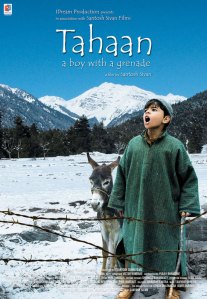
Tahaan

Tahaan: Disarmingly simple

Santosh Sivan is one of those very few DOP turned directors that are spoken of nowadays. In spite of their box office results, Santosh Sivan’s films always create expectations. It is not often that we see a wide release of his films. And when they do, it is wise to catch them up on the big screen. Watching Tahaan: A Boy With A Grenade, it is inevitable for one to be reminded of his staggering work Theeviravaathi: The Terrorist (1999), for both graze similar and contemporary themes.

Set and shot is the paradisal Indian (!) state of Kashmir, Tahaan (Purav Bhandare) is the story of a young boy of the same name and his friend/donkey Birbal. Situations change for the worse and Tahaan is forced to separate from Birbal. Tahaan is shattered and decides to get back Birbal at any expense. For this, Tahaan travels from one place to another, meeting one character to another and facing one peril to another, in the end being exploited in many ways, much like Birbal himself. Meanwhile, his mute mother (Sarika) is desperately is search for her husband, who went missing three years ago. Though in utter distress, her only hope is a miracle, which seems to be the only way out for all of the valley’s residents. Amidst the echoes of bombs and bullets in the serene valley, Tahaan’s objective, however, remains simple and straightforward – Get Birbal back. Unlike Malli of The Terrorist, Tahaan’s primary aim is utterly disjoint from the state of the affairs of the country.

Made in the same tradition as Iranian gems such as Marooned in Iraq (2002), Turtles Can Fly (2004) and a few others, Tahaan is tightly grounded in the culture of the state and also in the present political turmoil of the region. Unlike many of its Iranian counterparts that enthrall the audience with the sheer simplicity of their plot, Santosh Sivan’s script tries to bring in the larger issues into the picture, but never once changing perspective or taking a stand. Thus, Tahaan strictly remains a story of the titular character, without any pretense.

Few directors in India remain in the same cadre as Sivan when it comes to visual composition. If it was the haunting and dense jungles of coastline Lanka in The Terrorist, it is the vast and white snowy stretches of Kashmir in Tahaan. Sivan’s cinematography effectively uses the widescreen to capture the awe-inspiring peaks of Kashmir in its entirety. The sound design needs a definite mention for its remarkable ear for detail and naturalness with its borderline synchronized sound.

No complaints in the acting department of the film. Anupam Kher is at his easy best and churns out the best performance of the film. All his lines succeed, in spite of being very mediocre and deliberately inserted. Sarika’s self-assuring quietness and her countenance gel well with her character and makes it a very credible effort. Rahul Bose, after a series of debacles, shines as a dimwit in his earthy and lovable role. Purav Bhandare, who plays the title character, does a decent job too.

Like The Terrorist, Sivan goes totally minimalist, in spite of not being under financial constraints this time around. This particularly shows in the film’s near-zero depiction of on-screen violence and its stubbornness against visual extravaganza, reminding us again of its spectacular predecessor.  This not only reminds us that grandness does not necessitate lavishness but also shows how Tahaan is shielded from the trauma of war, which apparently is the need of the hour. However, Tahaan does differ from The Terrorist, unfortunately, for the worse. More verbose and noisier than the former, Tahaan tries hard to elucidate the protagonist’s charm and bring in calculated humour, which could have been made very self-sufficient considering the quality of the material at hand. As a result, Tahaan does not linger in the minds of the viewers permanently and fails to stalk them long after the movie is over.

Though more overtly dramatic and conventional than The Terrorist, Tahaan may, to an extent, serve as a companion piece to it. The Terrorist depicts how the basic human nature is interminable and unalterable be what the external situation whereas Tahaan shows how the innocence of childhood is unduly exploited by (anti) social elements, although it remains untainted by them.

Verdict:

WALL-E

Wall-E: Pixar... Well, Pixar!

Right from the inception of fully computerized animation in Toy Story (1995), Pixar has been the best in their domain, by and large (no puns intended, hope none taken!). Time and again, I have been swept away by each one of their films. How I wish every time that some other animation company in USA made such a good film. Dreamworks came close with Madagascar (2005), but posed no threat whatsoever to the throne held by Pixar. Here they are with WALL•E, coming to the country after creating waves in the US box office. Before the film started, how I wished Pixar would falter, just a bit for just one time, to at least testify the theory that even the mightiest are not infallible. But no, not yet.

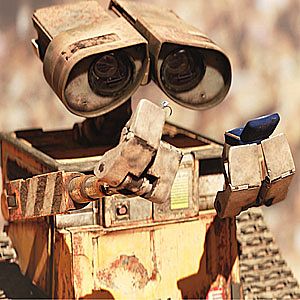
It is 29th century. Amidst the exanimate garbage wastelands, happily compacting the dump is WALL•E (Waste Allocation Load Lifter Earth-Class), a rusty little robot with notably large eyes. There are no traces of life in the whole area. Yes, there is earth, there is fire, there is wind and there is water, but not life. WALL•E’s only source of connection comes in the form of his friend the cockroach and the only place of warmth being his home, which he carefully assembles from the scrap materials he gathers. He examines every bit of junk with his reflective yet assimilative eyes, in search of excitement. He spends his nights watching romantic numbers from the (19)60’s and trying to imitate them. The sheer silence adds to the comic intensity, proving once again that neither comedy nor animation needs dialogue for success. One wishes that this spectacular act never ends.

One great day, WALL•E notices an elegant robot dislodging from a large spaceship that has landed. It is the Eve of this defunct Garden of Eden, the angel of death floating in air, the femme fatale from the future, EVE (Extraterrestrial Vegetation Evaluator). She’s like nothing he has ever seen and definitely better than him – Faster, stronger and smarter – but unaware of life. Instantly smitten, WALL•E tries to get closer to his subject of interest, only to find out that she has been sent by the humans residing in the spaceship Axiom, which had been installed 700 years ago to temporarily hold humans till the ecological problem on earth was solved. EVE is immediately called back to Axiom when she discovers that there is vegetation on earth again, after so many centuries. WALL•E decides to go after her and leaves earth.

WALL•E is introduced to a whole new species called humans. Though comically executed, it is with some solemnity that the humans are handled in the film. WALL•E notices that man has been pampered and made back into infants, refusing to even walk and eat on their own, ignorant of all the small joys of life. This is when its gets a bit dramatic and things seem to become a bit conventional. WALL•E, unintentionally, induces life into everyone there and they start realizing the vitality of life. It seems like the second dawn of man. Man learns to walk, again. He gets independent of all his machines. Thus Spoke Zarathustra. As the ship’s captain decides to return back to earth, he faces stern opposition. Can humanity be brought back to earth? Can man re-learn everything? Can earth feel the Fifth Element once more?

In a film about robots, it is difficult to make the audience empathize with the rigid geometrically built characters. But WALL•E’s large eyes are so full of life that one does not feel that he is a lifeless being right from the first glimpse. One is reminded of Scrat’s eyes from Ice Age (2002), but this is only better. So are EVE’s two dimensional eyes. The creators have generated so much emotion from just changing their shapes. And so has a lot of effort gone into the fabrication of the wasteland. The damp roads, the disposed plastics and the occasional gust of wind – everything here is a lunge forward for CG animation. Pixar regular Tom Newman has done a good job by introducing some 60’s and 70’s feel into the score that is, ironically, very suitable for such a futuristic film.

In A Bug’s Life (1998), there’s this scene where Manny the mantis performs his routine trick called the Chinese Cabinet of Metamorphosis and Molt the bumbling hopper is shocked and cries out “How did he do that!!!”. That is exactly what I ask myself every time Pixar churns out one of their creations. Producing around five minutes of animation every week, Pixar has once again proved all those clichéd maxims about hard work. Here they are now, with WALL•E, clearly another winner. May not be their best, but it does get the credit of being the best film of the year so far.

P.S: Stick till the quirky end credits which roll over as WALL•E and EVE dance over paintings ranging from the early man’s pagan art to Van Gogh.

P.P.S: Check out the Pixar short Presto that comes along with this film. It is up there with the likes of Geri’s Game and For The Birds. Absolutely hilarious.

Verdict:

The DC versus Marvel battle continues as Christopher Nolan’s The Dark Knight arrives along the wake of the success of Iron Man (2008). With almost all of the filmdom going gaga over the performance of Heath Ledger even before the film’s release, it was but naturally clever for Warner Brothers to leverage this mass curiosity and fabricate one dark power ride for the audience. The fans had already caught a glimpse of the sober Batman in the previous offering by Nolan in Batman Begins (2005), which changed the whole gravity of the franchise in contrast to the light-hearted prequels by Burton and Schumacher. The film does not disappoint, to say the least.

It is a time when Batman (Christian Bale) has become an integral part of Gotham City’s vocabulary and people have seriously started questioning his position as a saviour of the city. Meanwhile, the crime rate shoots up during the broad daylight. The Joker (Heath Ledger) concocts a series of crimes in the city and “introduces a little chaos into the system”. The district attorney Harvey Dent (Aaron Eckhart), his love interest Rachel (Maggie Gyllenhaal) and the Deputy Commissioner Gordon (Gary Oldman) join hands in order to track down the Joker, but find themselves unable to save their own skins, quite literally. The Joker demands Batman to bare his identity in order to save the people of the city. Though torn by the consequences of the choices, Batman decides to “endure” and hold his sanity.

Harvey says at a dinner that heroes either die or live long enough to see themselves become villains, quoting the corrupt emperors of Rome. Bruce decides that the people of Gotham City should need a superhero no more and it is their faith in their own laws, the citizens that abide them and the spirit of humanity which binds them all that would save them from the escalating crimes. Taking off from this, the film ends on a contemplative yet grand note, a la Yojimbo, as the masked crusader moves on towards the next stage of his life.  This way, the film raises questions about the need for heroes and dependence on a stranger for safety, opposed to the affirmative answer given by Clint Eastwood’s Flags of Our Fathers (2006).

Much has been talked about the performance of Heath Ledger and no review seems to be complete without the perfunctory statement about the posthumous Academy award. Is the performance that good, one is tempted to ask. The answer is a definite “Yo”. Right from the swaying of his tongue as if to widen his grotesque grin to the Jack Nicholson-esque preoccupation with contorting his facial muscles, you sense that such a performance does not come often. The performance would have lost no fraction of its intensity even if Ledger had been there today.

Christopher Nolan knows how to use his technicians and it shows. The brilliant cinematography is evident and needs no elaboration. The cross-cutting among multiple scenes, especially during key events in the film, tests one’s comfort and at the same time makes long scenes seem shorter. And there lies the success of The Dark Knight. No other superhero film could have gotten away with a excruciating runtime of over 150 minutes. This tautness in cutting is what that gives Nolan the breather to delve into the psychological part of the man behind the Batman, keeping the audience hooked all the while to the staple action scenes.

Though not a definitive statement about Hollywood, this year isn’t as productive as the last and there have been no real winners.  Let’s face it, most of the biggies (Read Indiana Jones and Iron Man) have been a letdown and the rest of them were just fillers. The Dark Knight has been the only film holding its head high amidst this slump. And just for that, “Let’s put a smile on that face!”.

Verdict:

KFPTraditionally, there have been two paths for animation filmmakers. One is to make the films as close to reality as possible. That is the path taken by Pixar and Sony Animation, which try to push animation technology to new extremes and squeeze out every bit of processing power and skill set they have. The other is the conventional path that tries to realize the creators’ most bizarre and outlandish fantasies and attempts to emulate the peaks attained by Disney and Miyazaki. The second path is what companies like Dreamworks Animation have adopted and, to an extent, succeeded. Their latest offering, Kung Fu Panda is a clever idea, but inefficiently harnessed.

Po (Jack Black) is a chubby panda working in a Chinese restaurant but dreams of making it big as a Kung Fu hero. He idolizes the biggest Kung Fu heroes of the village, namely, Tigress, Snake, Monkey, Mantis and Crane (Angelina Jolie, Lucy Liu, Jackie Chan, Seth Rogen and David Cross respectively). He, then, hears about the induction of the Dragon Master who will be selected by Master Oogway himself. By seemingly sheer luck (or bad luck), Po gets selected as the Dragon Master who is to protect the village from the claws of Tai Lung (Ian McShane). In his mission he is assisted by Master Shifu (Hoffman, unidentifiable) who first seeks to drive out Po, but turns over a new leaf after a while.

Po is as cute as an animation character can get, but it is a pity that the creators have not utilized Jack Black fully for Po and vice versa. A bit more dedicated reconstruction could have not only guaranteed a great character, but also a huge brand value for the character which could then be merchandised well. With a enviable cast for the Furious five, it is but natural to expect some big role for them. Unfortunately, the film spends most of its time bringing out Po’s vulnerability and innocence and hence, the characters are merely reduced to a bunch of creatures you will fascinate staring at a zoo. However, Shifu’s small stature (a red panda) and Hoffman’s efforts suit the etching of his character and makes his presence worthwhile. The depiction of Tai Lung is anything but novel.

One of the minor commendable points of the film is the choice of its fauna for the images of the characters. The monochromatic Po is totally out of place in the colourful world of Valley of Peace, the slow and steady tortoise is the intellectual master of the palace, subordinated by the relatively rash, hare-like Shifu and a black and white polar creature, Tai Lung is pitted against another. However, the writers are to blame for the biggest blow for the film, the utterly stale and predictable plot that has become a favorite of critics to pan down. No sir, we did not expect this from the creators of Shrek (2001) and Madagascar (2005).

Now there must be something in the film to counterbalance the wound created by the plot and there is. The fabulously rendered world of Valley of Peace and Chinese architecture, never once pretending to be realistic, vibrant and daring use of colours and Kung Fu action that can substitute many Hong Kong flicks are definitely noteworthy. The tone of imagery, which is now fast becoming the trademark of Dreamworks, is thankfully retained and this paves way for the future flicks from Dreamworks to add girth to the plot. Finally, there is a huge opportunity for a sequel with a lot of spaces to be filled from the first one. Hmm… I guess the image of the Furious five can be reinstated there.

Unlike Madagascar, which provided visual treat for the toddlers and also retained the adults with its hilarious one-liners, Kung Fu Panda is clearly for the children and hence focuses more on slapstick and juvenile verbal humour. This, without doubt, will entice the young ones, but grown ups (cinematically, that is) beware. With Madagascar’s sequel to hit in a few weeks, it is a good time for Dreamworks to recapture the adult market it may have lost with Kung Fu Panda.

Verdict:

Jaane Tu Ya Jaane NaNo, this is not a review of Nagesh Kukunoor’s box office bomb Bombay To Bangkok (2007) but of debutant director Abbas Tyrewala’s Jaane Tu Ya Jaane Na. Even before the film had got completed, the director had called it a typical Bollywood love story complete with its own quota of songs, fights and even the quintessential over-the-top airport climax. With that kind of a statement from a man who has some very successful scripts behind him, you can’t help but expect the film’s USP to be something completely fresh.

(Spoilers Ahead, yeah right!)

Jai (Imran Khan as a peace loving, meek yet mature guy) and Aditi (Genelia D’Souza in a zealous role) are two very close friends and are part of a small gang of youngsters who have their own share of pubbing, partying, cussing and fooling around. After their college gets over, they try to hook each other up with an apt partner. After they manage to find partners that they think are ideal, they slowly understand that this is not what they desired for. It is not soon when they realize that they have been with their best match all this time. As they struggle to reveal their love to each other, Aditi gets ready to leave for the USA. It is up to Jai to stop her at the airport and reveal his true love to her. Sounds familiar?

(End of already known spoilers)

The film’s almost effortless progress reminds us of the deluge of Korean rom-coms and the screwball comedies of the Clark Gable era. But that just shows how the international cultures have seeped into our own. Right from the generous dose of swearwords to the now-hackneyed dance floors, the movie would look totally outlandish for the village and town dwellers. The best part about the screenplay is that you know you have seen it all a thousand times, but are still attracted towards the film for some reason. That is where the director scores.

What separates Jaane Tu Ya Jaane Na from its predecessors is its grey treatment of characters, actions and emotions. There are no extraordinary monologues, fights, melodrama or reactions in the film. Unlike the bickering leads of yesteryear, Jai and Aditi realize each others’ persona and are mature enough to not quarrel with them for that. There is not one false note in the characterization of the cast and their relationships, with the possible exception of Sushant, Aditi’s fiancé, who is handled with a pinch of coldness. Parents who have closed in on the so-called generation gap, a brother who is more sensible than he looks, a protagonist who thinks everything has a non-violent solution, the characters ring true and are omnipresent in the cities. Be it the sibling relationship between Aditi and Amit or the miserable one between Meghna’s parents, there is honesty written all over.

Abbas Tyrewala seems to know that his target audience is miniscule and is unperturbed by that. He has deliberately let some things go over the head of the audience outside his reach and does not care about that. He is quite sure that the young metropolitan crowd, at whom the film is aimed at, will find a page out of their own lives in the film. This confidence is, perhaps, the director’s biggest success in the film. Imran Khan manages well with his small set of expressions and is overpowered by the more experienced Genelia who seems tailored for the role. Arbaaz and Sohail Khan steal the show in the few scenes they are in and the same can be said about veterans Paresh Rawal and Nasseeruddin Shah.

So when do you know it’s love? You do not realize the importance of a commonplace object until it becomes not-so-common. The film handles the same issue handled in Mani Ratnam’s successful flick Alaipayuthey (2000), but gives a totally urban look to the concept. What is more interesting than the film itself is the question that what a confident and clear writer and director, such as Abbas Tyrewala, is going to do in the future where not only would he have the funds to experiment, but also the opportunity to reach a universal crowd. Guess only time will tell. As for now, enjoy this fresh lease of energy amidst stale and pretentious multi-starrers while it lasts in theatres.

Verdict:

« Previous PageNext Page »