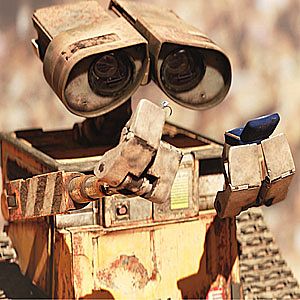
Wall-E: Pixar... Well, Pixar!
Right from the inception of fully computerized animation in Toy Story (1995), Pixar has been the best in their domain, by and large (no puns intended, hope none taken!). Time and again, I have been swept away by each one of their films. How I wish every time that some other animation company in USA made such a good film. Dreamworks came close with Madagascar (2005), but posed no threat whatsoever to the throne held by Pixar. Here they are with WALL•E, coming to the country after creating waves in the US box office. Before the film started, how I wished Pixar would falter, just a bit for just one time, to at least testify the theory that even the mightiest are not infallible. But no, not yet.
It is 29th century. Amidst the exanimate garbage wastelands, happily compacting the dump is WALL•E (Waste Allocation Load Lifter Earth-Class), a rusty little robot with notably large eyes. There are no traces of life in the whole area. Yes, there is earth, there is fire, there is wind and there is water, but not life. WALL•E’s only source of connection comes in the form of his friend the cockroach and the only place of warmth being his home, which he carefully assembles from the scrap materials he gathers. He examines every bit of junk with his reflective yet assimilative eyes, in search of excitement. He spends his nights watching romantic numbers from the (19)60’s and trying to imitate them. The sheer silence adds to the comic intensity, proving once again that neither comedy nor animation needs dialogue for success. One wishes that this spectacular act never ends.
One great day, WALL•E notices an elegant robot dislodging from a large spaceship that has landed. It is the Eve of this defunct Garden of Eden, the angel of death floating in air, the femme fatale from the future, EVE (Extraterrestrial Vegetation Evaluator). She’s like nothing he has ever seen and definitely better than him – Faster, stronger and smarter – but unaware of life. Instantly smitten, WALL•E tries to get closer to his subject of interest, only to find out that she has been sent by the humans residing in the spaceship Axiom, which had been installed 700 years ago to temporarily hold humans till the ecological problem on earth was solved. EVE is immediately called back to Axiom when she discovers that there is vegetation on earth again, after so many centuries. WALL•E decides to go after her and leaves earth.
WALL•E is introduced to a whole new species called humans. Though comically executed, it is with some solemnity that the humans are handled in the film. WALL•E notices that man has been pampered and made back into infants, refusing to even walk and eat on their own, ignorant of all the small joys of life. This is when its gets a bit dramatic and things seem to become a bit conventional. WALL•E, unintentionally, induces life into everyone there and they start realizing the vitality of life. It seems like the second dawn of man. Man learns to walk, again. He gets independent of all his machines. Thus Spoke Zarathustra. As the ship’s captain decides to return back to earth, he faces stern opposition. Can humanity be brought back to earth? Can man re-learn everything? Can earth feel the Fifth Element once more?
In a film about robots, it is difficult to make the audience empathize with the rigid geometrically built characters. But WALL•E’s large eyes are so full of life that one does not feel that he is a lifeless being right from the first glimpse. One is reminded of Scrat’s eyes from Ice Age (2002), but this is only better. So are EVE’s two dimensional eyes. The creators have generated so much emotion from just changing their shapes. And so has a lot of effort gone into the fabrication of the wasteland. The damp roads, the disposed plastics and the occasional gust of wind – everything here is a lunge forward for CG animation. Pixar regular Tom Newman has done a good job by introducing some 60’s and 70’s feel into the score that is, ironically, very suitable for such a futuristic film.
In A Bug’s Life (1998), there’s this scene where Manny the mantis performs his routine trick called the Chinese Cabinet of Metamorphosis and Molt the bumbling hopper is shocked and cries out “How did he do that!!!”. That is exactly what I ask myself every time Pixar churns out one of their creations. Producing around five minutes of animation every week, Pixar has once again proved all those clichéd maxims about hard work. Here they are now, with WALL•E, clearly another winner. May not be their best, but it does get the credit of being the best film of the year so far.
P.S: Stick till the quirky end credits which roll over as WALL•E and EVE dance over paintings ranging from the early man’s pagan art to Van Gogh.
P.P.S: Check out the Pixar short Presto that comes along with this film. It is up there with the likes of Geri’s Game and For The Birds. Absolutely hilarious.
Verdict: 

 The DC versus Marvel battle continues as Christopher Nolan’s The Dark Knight arrives along the wake of the success of
  Traditionally, there have been two paths for animation filmmakers. One is to make the films as close to reality as possible. That is the path taken by Pixar and Sony Animation, which try to push animation technology to new extremes and squeeze out every bit of processing power and skill set they have. The other is the conventional path that tries to realize the creators’ most bizarre and outlandish fantasies and attempts to emulate the peaks attained by Disney and Miyazaki. The second path is what companies like Dreamworks Animation have adopted and, to an extent, succeeded. Their latest offering, Kung Fu Panda is a clever idea, but inefficiently harnessed.
 No, this is not a review of Nagesh Kukunoor’s box office bomb Bombay To Bangkok (2007) but of debutant director Abbas Tyrewala’s Jaane Tu Ya Jaane Na. Even before the film had got completed, the director had called it a typical Bollywood love story complete with its own quota of songs, fights and even the quintessential over-the-top airport climax. With that kind of a statement from a man who has some very successful scripts behind him, you can’t help but expect the film’s USP to be something completely fresh.
 Finally here. Passing through its quota of controversies, production delay and legal attacks, Aascar Films’ Dasavatharam has finally made it to its destination. Dubbed as the most expensive movie made in India, the film has been in the making for over two years. If it was Sivaji – The Boss for 2007, it is very much Dasavatharam for this year. Apparently, the time between consecutive movies of Kamal Haasan has been larger than that of Superstar Rajnikanth‘s. The promos have been, surprisingly (for a Kamal movie), extremely low key. So, have the team’s efforts paid off? Let’s see.
 Spielberg has chosen a very simple plot in order to not distract the audience. Indiana Jones (Harrison Ford) escapes from of group of commies led by Irina Spalko (Cate Blanchett) who are in search of an artifact. Removed from his college for getting involved with the communists, Dr. Jones is called for action by Mutt (ShiaLaBeouf) , the godson of Prof. Oxley (John Hurt), a long time friend. Henry informs him that his mother Mary Williams (Karen Allen) and Prof. Oxley have been kidnapped in South America while in the hunt for a so-called crystal skull. It his up to Jones to hunt for the skull and return it to its proper place. In the journey, he finds that there are others vying for the skull too and discovers his true relationship with his family and friends.
 What do you get if you cross a Vijaykanth script with Vettaiyadu Vilayadu? Yes, You are right. Captain catching Kashmir-born Tamil terrorists (Theeviravadhinga) in Canada. That is exactly what happens in Captain’s 150th, “Arasangam“. After giving epics such as “Chocklet” and “Madurai”, R. Madhesh is back with this rib-tickler…oh sorry, nerve-wracker.
 This is it. One of the two movies I was looking forward this year is here (The other one OBVIOUSLY being “Dasavatharam”). After having seen V. Priya painful fall from “Kanda Naal Mudhal” to “Kannamoochi Yenada”, I did not want to see another successful debutant taking a hard second step. But “Arai Enn 305-il Kadavul” is a large disappointment from a person who gave the genuinely comic “Imsai Arasan, 23-am Pulikesi“.
