Review


He doesn’t imitate Amitabh Bachchan, he plays him. So insists Firoz Khan, also known as Junior Amitabh Bachchan, one of the three celebrity impersonators at the centre of Geetika Narang Abbasi’s documentary Urf (A.K.A), currently playing at the International Film Festival Rotterdam (IFFR). Through a series of talking head interviews with Firoz, “Junior Dev Anand” Kishor Bhanusali and “Junior Shah Rukh Khan” Prashant Walde, the film offers us a glimpse into the world of what are known as “tribute artists,” lookalikes who play stars on stage, television and in films. Interwoven with these interviews are vignettes from the production, promotion and release of Amir Salman Shahrukh (2016), a minor movie starring lookalikes of three major Bollywood stars.

By means of relaxed exchanges in domestic settings, Urf examines the outlook of its subjects (and their family) towards their profession. Firoz “Bachchan” Khan emphasizes that physical likeness to a star is only part of the requirement; the bulk of it, he says, involves research, practice and hard work. Indeed, many of the artists we see in the film make up for what they lack in resemblance with a conscientiousness and charm that is impressive. Kishor believes that his mimicry of Dev Anand has a signature of its own that would inspire neophytes more than the star’s persona itself. Prashant is just happy if he could make people laugh, no matter in derision or delight.

Despite this touch of pride, their self-image proves rather conflicted. The three artists we see in the film are united in their desire to break away from being typecast and strike out on their own. All three appear to be on different stages of the same journey: Kishor, the most senior of the trio, has long transitioned into a busy career in light music. The middle-aged Firoz is now a regular on TV shows where he does not have to play Bachchan anymore. Prashant, for his part, seems at a crossroads, still trying to find his voice. The older men regard their earlier fascination with impersonation as youthful indiscretion. In their testimony is a sense that the work of a lookalike comes with an expiry date, that at some point the need to find one’s own identity takes precedence.

Underlying this ambivalence is a change in the nature of stardom and celebrity. In a mixture of wistfulness and self-deception, Kishor and Firoz view themselves as the last of their kind. The latter offers a striking diagnosis of why there are increasingly fewer impersonators in Bombay: it is that there are scarcely any stars with their own styles anymore, absorbed as actors today are into an anonymous naturalist manner. And then, says Firoz, celebrity isn’t as scarce as it used to be. Technological advance, including multiplication of distribution channels, has meant that stars can be seen by fans any time they want, rendering the vicarious thrill of impersonators redundant.

Unusual though its subject is, Urf is a work that comes in the line of documentaries looking at various facets of the lives of impersonators. Premiering in the same IFFR fourteen years ago, The Reinactors (2008) trained its attention on the community of lookalikes and cosplayers dotting the Hollywood Walk of Fame. Just About Famous (2015) normalized the practice, portraying these artists as consummate professionals serving a concrete cultural function. Perhaps the best of these documentaries, Bronx Obama (2014), spirals out from the private life of the president’s lookalike to explore America’s class and racial relations.

If celebrity impersonators in these earlier films were presented as social outcasts hustling to make ends meet, the individual we see in Urf can only be described as solidly middle class. We accompany Kishor on a visit to his spacious new apartment in a high rise, but professional doldrums aside, even Prashant seems financially better off than most of the hopefuls that make up the fringe of the Bombay film industry. At one level, their relative success marks them out as exceptions in a niche if competitive field, but it also reflects a vast demand for lookalikes that persists in spite of the pejorative associations the profession carries.

We see signs of this flourishing secondary market all through Abbasi’s film. The impersonators are featured performers in weddings and corporate events, play body doubles to their stars in commercials and get top billing in parodies and B-grade knockoffs of popular movies. Urf relates this parallel economy to the insatiable thirst for celebrity that Bollywood inspires or, more often than not, manufactures. Ardent fans from all across the country assemble outside Shah Rukh Khan’s home to catch a glimpse of their idol, declaring with a zealot’s faith that “he will come.” Some of this adoration rubs off on his lookalike, Prashant, who is constantly asked for photographs by admirers who wouldn’t stand a chance of getting as close to the original.

These reflections notwithstanding, Abbasi’s film is a modest proposal. Unlike The Reinactors or Bronx Obama, it does not hazard wider socio-political arguments. There is certainly something to be said about the paradox that the work of these impersonators is devalued as being unoriginal by an industry that thrives on formulas and remakes. But Urf is not the place for theoretical considerations. Abbasi’s film instead lets the human-interest stories take centre stage. It does not address the lookalike artists as a community. Its success, on the contrary, lies in individualizing them, in letting them recount their journeys and aspirations without undercutting them. Far from the freaks of primetime television, they come across as decent, reasonable people providing for their families while trying to keep the inner flame alive.


[First published at Firstpost]

Sci-fi movies often trade in scenarios that are set in a distant future, but which are largely determined by the conditions of the present. It is not just that the worlds imagined by these works are invariably limited by the possibilities of today—quickly rendering them quaint or antique with the passage of time. It is that many of them, by design, seek to clarify the present moment by isolating and exaggerating its most prominent aspects. The health crisis of the past two years has brought out many of the fault lines underpinning modern civilization with blinding clarity, making it easier for artists to extend them in creative speculation.

The current pandemic hovers in the background of Prappeda (“Hawk’s Muffin”), a feverishly active science-fiction feature in Malayalam made by Krishnendu Kalesh, playing now at the International Film Festival Rotterdam (IFFR). We don’t, however, witness any images of the present, which is invoked solely through an on-screen transcript of a conversation between a military pilot, assigned with the dispatch of ‘antidotes’ following a virus outbreak, and his command base. After the drop, the pilot is rewarded a vast stretch of land and instructed to go into hiding “until last man standing.”

What follows is a story set some hundred years after this murky operation. The land, now a dense rubber estate, is occupied by the descendants of the pilot: his grandson (Sreekanth Pangapattu), the senile patriarch of the clan who is also the narrator of the film, the old man’s middle-aged daughter (Nina Kurup) who has stopped speaking after a mysterious encounter in her youth, and granddaughter Ruby (Ketaki Narayan), a sensitive young woman who looks after her mother. The old man has relegated the management of the estate to hired hands Xavier (Jayanarayan Thulasidas, also the film’s producer), a military renegade who keeps outsiders at bay, and Shepherd (Mano Jose), a priest-cum-retainer intended to rein in the unruly Xavier.

This feudal order of things is challenged when a local policeman Thumpan (Nithin George) enters the premise, claiming to be an heir of the pilot and demanding a share in the estate. Roaming the woods, meanwhile, Ruby discovers an alien being that has crash-landed (Rajesh Madhavan). The creature, seemingly out of a movie by Guillermo Del Toro who is thanked in the credits, has an endearing air about him: his extremely frail frame, beady eyes, silly hair and jerky gestures are put to comical use, multiplied by jump cuts and time lapse shots. He performs a dance, gifts Ruby precious stones and takes her to a hidden niche near a majestic waterfall. A fairy tale romance ensues; the alien helps Ruby see the world anew, she takes him in her protection.

As the synopsis suggests, Prappeda unfolds partly like a children’s fable, partly like a political allegory. The film opens with a faux-newsreel about a mythical amphibian that will help the world’s elites in their domination of the planet. The continued influence of this elite is announced by helicopters constantly flying over the estate and by mysterious bots invading the premises following Thumpan’s “contamination.” The inhabitants of the manor, like the residents of M. Night Shyamalan’s The Village (2004), have no contact with the outside world and believe everything that this implied nexus wants them to believe.

The film is saturated with these weighty assertions and mythical notations, but pursuing them may not lead one any further than a set of conspiracy theories. Where Prappeda succeeds is not in the quality of its ideas, but in its constant attempts at formal invention. A cinephile-turned-filmmaker, Krishnendu Kalesh adopts a heterogenous style reflective of the name of his production company: Hybrid Tellers.

He employs a host of narrative modes with roots both in mainstream cinema and art film: musical numbers alternate with naturalist drama, silent cinema pastiches with impressive special effects, melodramatic episodes with abstract passages. Low-key drones are interwoven on the soundtrack with an emphatic, staccato score made of violins and percussions. The taciturn Ruby can speak, but her words are conveyed to us through intertitles and on-screen texts, which share the work of exposition with voiceover and dialogue. There is no sense that the filmmaker perceives a hierarchy between these modes, which co-exist without harming the film’s fundamental tone.

Prappeda has the stylistic brashness that one expects from debut works, and thankfully so. It trots out one power move after another, which succeed more often than not: a remarkable shot of Ruby discovering the fallen alien floods the frame with the blinding white of a parachute; a crack appearing on a wall is cut to an intertitle supplying building instructions; when Ruby and her friend discover photo negatives in the attic, the sequence suddenly atomizes into a series of photograms; a text on screen identifies a popular song playing on the soundtrack.

Besides Del Toro, the credits also thank Georges Méliès, Andrei Tarkovsky and Hayao Miyazaki all of whose influences are tangible here. There are repeated invocations of silent cinema, in particular, in the use of intertitles, sped-up footage and changing aspect ratios. Ruby observes a fight between two men, scored to slapstick music, through a Nickelodeon-like opening in the wall, as a projector hums on the soundtrack. This combination of dystopia and film history, seen recently in Norbert Pfaffenbichler’s 2551.01 (2021), imparts an unusual texture to the film, even when the two are not always perfectly integrated.

The production design, likewise, mixes markers of different eras such that we are never sure what time period we are in. The archaic rubs shoulders with the futuristic in Prappeda: candles and sewing machines find a place alongside electronic gadgets and modern weaponry. The sylvan setting, the earthen colour palette of browns and greens, the expressionist wall design incorporating creepers suggest a distant past, while CGI robots, war machines and synthetic noises hint at a far future. This lack of specificity, it must be added, plays to the film’s advantage.

Prappeda does not seek emotional involvement from the viewer as much as a visceral response. This is, after all, a film where the narrator vanishes midway in a blink-and-you-miss moment of stupidity. The meek and caring Ruby is offered as a provisional point of identification, only for this connection to be severed after a tragic event. The story is shrouded in mystery, and an explanatory montage towards the end only complicates the affair. What Prappeda instead provides is the pleasure of fabrication, a vision born of an adolescent daydream. Chances are slim that you will see a shot of a woman delivering a baby as she is parasailing over the clouds in another film any time soon.


[First published at News9]

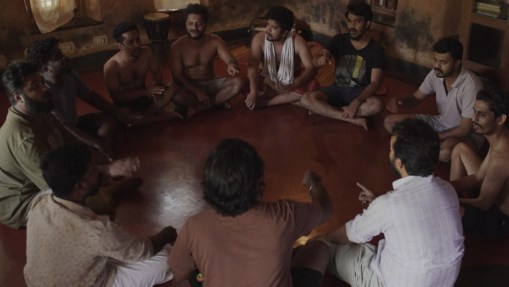
An auditorium is filmed in perfect symmetry from behind a fence as the sun rises over the building. A few men unload musical instruments from a van, parked slightly off-centre such that it tastefully disturbs the shot’s symmetry. The vehicle exits the frame a while later, revealing a dozen individuals at the gate of the imposing structure. The group, we will learn, is a theatre company invited to put up a play at the annual function of a residential association somewhere in small-town Kerala. They have arrived rather early to the venue; they believe they need the time for practice and preparation.

The troupe, called Little Earth School of Theatre, is the subject of Chavittu (“Stomp”), an outstanding new film by Sajas and Shinos Rahman that premieres at the International Film Festival Rotterdam (IFFR) this week. The Rahman brothers’ third feature is a boundary-bending formalist work that, for the most part, showcases the troupe’s preparations for their upcoming performance. Shot by Mukesh Muraleedharan (Uyare, Varane Avashyamund), Chavittu is dominated by a static, wide-shot aesthetic that loosens up as the film progresses.

We see the company’s rehearsal in considerable detail, their work on gesture, movement, voice and cadence. The nature of play they are putting up, on the other hand, remains sketchy and elusive. We gather that it has to do with money, coins specifically, and there is talk of revolution. There are dramatic confrontations and belligerent assertions. A hint of political lampooning is tangible, as are public service messages. But the directors are careful not to distract us with too much literary material. What we are left with are pieces of a puzzle whose final form is never clear.

Attention is devoted, instead, to the formal elements of the performance. The dance, seemingly a traditional form, involves stomping energetically to oral music made of emphatic scatting. Clenched fists, stern looks and occasional pirouettes feature saliently, while oversized coins, backless chairs, empty frames and long pipes serve as props. The musical sections are interspersed with equally physical narrative bits. The actors’ gestures here are very stylized, perhaps conforming to the form’s conventions. There is some improvisation, but directorial intervention mostly pertains to where a new song should begin or an old one should end. What is patent is that a performer in this company needs to have a supreme sense of rhythm.

These extended passages of theatrical rehearsal are periodically intercut with the auditorium being readied for the evening: props, accessories and backdrops being designed, chairs laid out, food arranged. In a surrealist touch that is at odds with the obsessive materialism of the rest of the film, we see these preparations “spill over” into the surrounding rural scenery: men wandering the landscape seated on each other’s shoulders, playing shadow volleyball, or performing short mime-like actions for the camera.

Much of the critical conversation around Chavittu is bound to revolve around what it doesn’t do. It is plain that the film avoids the temptations of dramatic development; there is hardly any story here to speak of in the first place. But what truly sets it apart is its refusal to offer any sense of interiority to the people we see on screen, who are not as much characters as much as presences. There is no evocation of their state of mind, no references to their private lives. We barely hear their names. These are not individuals that we are dealing with, but a body of consummate professionals.

It is likely that this omission of the troupe’s emotional life, this lack of individuation will be held against the film, but it is precisely what makes it so modern, so bracing. Chavittu is a procedural work intently focused on the physicality of its subjects, who are filmed in various states of undress, in a mixture of mid- and long shots, natural and artificial light. Unlike in a conventional documentary, this scrupulous attention to detail isn’t complemented with interviews or explanatory voiceover.

The sensuality that the film radiates comes not through dramatic or formal devices, but from the raw presence of young, athletic bodies populating the frame. For a bulk of its runtime, Chavittu showcases bare-chested men wearing shorts or lungis working together in close proximity, immersed in performance, not unlike the half-naked legionnaires in Claire Denis’ Beau Travail (1996). But in light of the codes of South Indian masculinity, this exhibition doesn’t scan as homoerotic sublimation or suggest the possibility of gay panic. In fact, despite the cohesion that occurs over song and dance, the company hardly feels like a community. What we have here is a group which is bound by nothing else than the activity they undertake together.

The first attempts at discursivity, at accommodating an expositional framework, occurs about an hour into the film, after the sun sets and the annual day function begins. Prominent members of the residents’ association and dignitaries from the town deliver back-scratching opening addresses to a family audience. One elderly executive of the organizing committee rails against the death of Malayalam cinema and literature. Shortly afterwards, achievers of the community are recognized: a local Youtube star, a Facebook poet, an entrance exam hopeful. These felicitations are followed by a series of amateur performances by residents— Thiruvathirakali, a Carnatic kriti, an English number—which take precedence over the troupe’s play, scheduled after dinner.

We are clearly in the presence of a self-indulgent middle class—an anthropological group with a separate set of gestures and rituals, as the film demonstrates—that has lofty ideas about its own role as protectors of culture, even as it preserves a hierarchical notion of the arts. But it is to the Chavittu’s success that this bit of satire doesn’t come across as mean or blunt as it sounds on paper. Even the character of an ex-secretary of the association, a vain old man serving as intrusive coming relief, acquires a touch of grace by the end of the film.

Chavittu avoids devolving into caricature here thanks to the directors’ decision to cut between these amateur shows and the members of the theatre company waiting for their turn backstage. These actors don’t provide any reaction to the performances on stage, refusing us the convenience of second-hand judgment. They are instead absorbed in last minute preparations, refining moves or working over props. For the only time in the film, they are seen in isolation, as individuals getting into particular roles. One actor shaves his feet, another one dresses up as a woman, making us aware of a gendered distribution of roles for the first time.

This contrast between a committed theatre troupe working with focus and discipline and the family audience at the annual day function that just wants to have fun has definite parallels with the filmmaking process. It is notable that, except for the director and the screenwriter, there are no clear division of roles within the company. There is certainly no sense of hierarchy, no rank pulling, that prevents the members from lending a hand in other preparatory tasks. In this regard, it is apt that Chavittu ends on the audience, on us, with an image that embodies a mix of melancholy and hope.


[First published at News9]

“Without Franco, I wouldn’t be here, nor this book. Thank you, Francisco. It’s the only good thing you did in your life.” The author behind this characteristic note of thanks is none other than French filmmaker and critic Luc Moullet, whose endearing and very funny autobiography, Mémoires d’une savonnette indocile (“memoirs of an unruly piece of soap”) has just been published by Capricci. In 42 chapters, the “prince of shoestring cinema” walks us through his young years as a critic at Cahiers du cinéma, his filmmaking life, and his stints in various professional and educational bodies. The book was announced in 2012, with the intention for it to be published posthumously. Reading it nine years later, with the author still in the pink of health, one senses that the cause for Moullet’s original reticence may have had to do less with his comments on his peers and collaborators than with the encouragement the book might give to the French tax department to come after him.

“My whole life has just been a series of exclusive passions I was ashamed of,” notes Moullet in the first chapter. Frowned upon at home, cinema became clandestine education for this Paris-born recluse, who talked to practically no one and had few friends at school. Haunting the film club of the Latin Quarter, he gradually found a “standing place” at Cahiers at the age of 18, thanks to the detailed filmographies he could assemble with the help of English dailies. A first text on Edgar G. Ulmer was rejected by Truffaut, who “was afraid of being ridiculed by the caricature of himself that I was.” Once into the ranks, Moullet was on the hunt for “unknown and forgotten filmmakers,” this kind of provocative rehabilitation being a sure-fire way to critical limelight. Very soon in his career, he says, he decided to stick to two principles: to write in a way that was “easy to understand,” unlike some of his colleagues at the magazine, and “to educate through laughter”—principles that have evidently remained intact throughout his life.

We also get personal assessments of the other leading lights of the magazine, and hence much of the Nouvelle Vague, whose criticism, declares Moullet, was ratified retroactively by the success of their first films: François Truffaut (“one of the rare filmmakers to not have been flattened by the roller of traditional culture”), Jacques Rivette (“the driving engine of the new criticism”), Jean-Luc Godard (“he put everything into his work, nothing into his life”), Claude Chabrol (“a filmmaker who looks at others… our little Balzac”), Éric Rohmer (“his strength was not getting out of a narrow subject, imagining all its facets with an unusual, fascinating and passionate tenacity”), Jacques Doniol-Valcroze (“made all the girls fall for him without wanting to”). Interestingly, Moullet’s views of André Bazin register as more conflicted; the latter’s “art of analysis,” it would appear, was put in service of terrible films (“How could F.T. like this guy who often spent his time defending turkeys and destroying masterpieces?… Was Bazin a great stylist rather than a great critic?”). “In real life,” he adds however, “each of his gestures towards others seemed to be to be a model.”

The transition to filmmaking, Moullet tells us, was much easier, and happened without him even trying, at the age of 23 years. Everything he knew about shooting films at that time was taught to him by Rivette “over a lunch on Washington street between 1 PM and 1:40 PM.” Even so, after initial hiccups, Moullet the filmmaker overtook Moullet the critic, who nevertheless continued to produce texts, even major ones. The bulk of Mémoires is devoted to the discussion of each of his films: the reasons for their making, circumstances of their production, incidents from the shoot, their critical and commercial reception. Hilarious anecdotes abound, but sprinkled throughout are also tips for young directors both tongue-in-cheek (how to behave at cocktail parties, how to fudge your way to state subsidy, how to avoid paying lunch money to your crew) and serious (“never do your storyboarding when you aren’t absolutely sure of the participation of each actor”).

In terms of the information it offers, Mémoires has some overlap with Notre Alpin Quotidien (2009, also Capricci), the book of extended interviews that he wrote with Emmanuel Burdeau and Jean Narboni. All the now-familiar themes of Moullet’s work make regular appearances: geography (“I learnt to read maps before I learnt to read”), cycling (“Truffaut was an autodidact. I was a cyclodidact”), mountaineering (“I’ve seen every film, and I’ve climbed every mountain pass; well, 229 of them”), and naturally, women (“The drama of my life is that I’ve always been a toy for women… I was in love with four Françoises at the same time”). All this intersects with cinema in amusing ways, as when Moullet is scandalized at his own attraction for the Positif critic Michèle Firk: “How could I desire such a contemptible girl, a Biberman fan and a Fuller hater?” The episode would be the inspiration for Les Sièges d’Alcazar (1989) two decades later.

But it is, of course, the theme of money that gives the book its tuning note. What makes Mémoires such an unusual, and perhaps even radical, autobiography is its lack of any sense of shame in talking about creative work in terms of finances. It isn’t just that Moullet often translates budget numbers of his films into what it could buy (a small car, two lofts in Paris) or that he discloses all the fraud that goes on around state subsidies. One of the permanent fixtures of this book is the author’s discussion about his personal relationship to money. So he talks about making do with very little, picking “soap from Lelouch’s home, paper reams from Societé des auteurs, newspapers from trash cans… toilet paper from Centre du cinéma.” It’s easy to believe that Moullet completed the script of Brigitte and Brigitte (1965) in small writing in an old school notebook in order to avoid buying a new one, but less so when he declares that he used to remain in the buff at home to avoid large laundry bills.

Some of these no-holds-barred revelations around money are positively discomfiting. It is one thing to create shell companies to avoid tax or to charge Tunisian distributors of his films for old prints already paid for by the British. But it’s something else to be on the dole while producing profitable films or hiking in the Himalayas, and to buy studio apartments in Paris with this welfare money. Moullet’s financial wiles were, moreover, supplemented by inexplicable windfalls, like the time he was credited 80,000 Francs by Crédit Lyonnais owing to a computer error. He describes this incident in some detail in Mémoires and his elaborate efforts to make sure that the money wasn’t retrieved from him. “I have no regrets about it,” he states, “Bravo Luluc (but I had regrets about watching Vidor’s The Fountainhead only in 1958. To each his own morals).” Indeed, the filmmaker seems to have been more sensitive to the feelings of individuals than the rights of institutions in his dealings with money, as is attested by his desire not to ruin Françoise Vatel following the fiasco of A Girl Is A Gun (1971) or his periodic cheques to Jeanne Moreau for Nathalie Granger (1972), which he produced.

Borrowing a journalist’s qualification, Moullet describes his public self as “an unruly piece of soap,” whence the book’s title, as someone who has always eluded grasp, an individual who signs up for one thing and does another. Admittedly, there is a groupie side to him that has wanted to belong to “families” like the ones at the Cahiers or the SRF (Société des réalisateurs de films, where he was once treasurer). Also, as an outsider, an “apraxic autistic Alpinist,” the prospect of sticking to dominant standards, such as making genre films or shooting on digital video, has been an attractive one. But this is counterbalanced by a flight from commitment. The filmmaker explains his refusal to define himself politically as an “instinctive reflex” against his father, who was constantly switching allegiances, being at one point a pro-Nazi militant.

There are other areas in which this perpetual slippage manifests. Moullet admits that, whenever planning a new project, he tried to make it run counter to the grain of the previous one. So the “navel-gazing” of Ma première brasse (1981) was a repartee to the social film that was Origins of a Meal (1978), itself made against the inwardness of Anatomy of a Relationship (1975), a follow-up to the Western A Girl Is A Gun. In his docu-fiction hybrids, such as La cabale des oursins (1991) or Le ventre de l’Amérique (1996), one isn’t always sure whether to take what is seen and heard at face value. Moullet makes reference to pataphysics once or twice in the book, but even without that framework, it’s plain that his films often use trappings of scientific research (enumeration, measurement systems, statistics, reportage, expert commentary) to absurd ends.

In the same vein, at a number of places in the book, it isn’t always clear if it’s the memoirist or the farceur in Moullet who is holding forth; for instance, when he rails against the evils of automobiles or when he performs a ridiculous psychoanalysis of women’s fear of cockroaches. This détournement, this formal displacement as it were, seems to be at the heart of his work.

The tendency for evasion may also be a survival mechanism. The overall impression one gets from Moullet’s book is of a rather easy life, one without much drama, controversy or struggle. Except for a brief lean period following the failure of A Girl Is A Gun, there appear to have hardly been any money troubles for him; friends on festival committees and boards of institutions have lent more than a helping hand in getting his films funded and showcased; the filmmaker has enjoyed a stable marriage of over fifty years and the advantages of a relatively good health—facets that a romantic (and masochistic, Moullet might add) conception would deem unconducive to good art. Shooting only for nine days a year, he seems to have led a life consecrated instead to the pleasures of farniente.

Cinema, in such an order of things, becomes a simple activity, pure game, made for and with pleasure, without any high stakes riding on it. When shooting a scene, writes Moullet, he looks for the easiest way to film it, unlike Delmer Daves, Bertrand Tavernier or Rivette who “willingly complicate life.” How to open a bottle of Coke, what are the challenges in booking a room in a mountain refuge, why do the French deify dogs: these are the burning questions his movies tackle. Moullet’s greatest legacy as a filmmaker, and the prime pleasure of reading his memoirs, may well be to have whittled down the universe to a human size, to have offered a working model of a creative life responsive to the world around it, but not caught up in the social and political upheavals of its time. For an artist, as he wrote back in 1959, “it’s enough to be a maker of objects.”


[Originally published at Mubi]

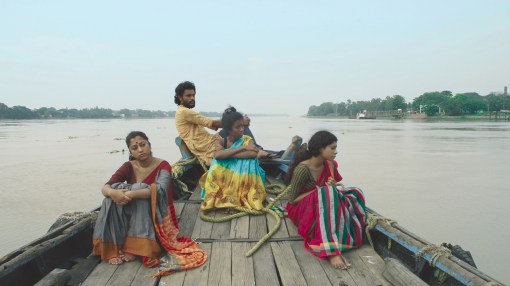
A train moves across the screen from left to right. The camera echoes the movement, panning slowly to the right, in the same direction as the locomotive. In the foreground, in front of the train, are three women, clad in sarees, striking a graceful pose before a tree, their heads gently responding to the moving vehicle behind them. The edge of the panning camera stops just to the right of the tree. We expect the train to come into view after it passes the tree, but no, the iron horse simply vanishes behind its trunk, as if swallowed by this compositional element. This shot, worthy of a John Ford, constitutes the opening of Bengali academic and experimental filmmaker Ashish Avikunthak’s seventh feature, Glossary of Non-human Love, one of the five Indian films screened in June at the International Film Festival Rotterdam (IFFR).

And it’s a shot unlike anything else in contemporary cinema, combining movement and stasis, a classical idea of plastic beauty with some SFX magic. It will be a question of such incongruencies and anachronisms all through Avikunthak’s film, which, we are told, is set in a future when Artificial Intelligence has taken over human life. Divided into 64 chapters, variously titled “Jealousy”, “Affection”, “Remorse”, “Delusion”, “Perfection”, “Rebirth” and so on, the film offers a series of vignettes in which half-a-dozen men and women, presumably hollowed out by AI, try to understand the cumulus of emotions and sensations around physical love.

The chapter names have little relation to what we see in the vignettes; if there is a connection, it is mostly oblique, for instance the chapter titled “Shadow” where an actor plays shadow cricket, or the one called “Non-Duality” where another performer smokes with a CGI double of hers. Many of the vignettes are propelled by dialogue, but the lines are shared by different actors such that none of them has any fixed identity. Several scenes feature the performers in the nude, composed into striking tableaux or engaged in minimal but precise movements, with their desexualized nudity echoing the blank states that their minds are. What sounds like residual memories of lovemaking are invoked, as are mythological and historical accounts; the difference between past and present, male and female, gods and humans all vanish in this collective stream of consciousness.

It is a tall order to process Glossary of Non-human Love in any meaningful way in one viewing, especially for those who don’t speak Bengali, caught as the eyes are between its visual provocations and the subtitles. Unless your name is Ashish Avikunthak, trying to closely follow its philosophical arguments will not take you very far. It will, in any case, take you away from the primary pleasures of the film, which lie not in its text but on its surfaces.

There is always something of formal interest in each of the vignettes, the film constantly experimenting with newer ways of composing them. At times, it is the gonzo camera angles that prompt the viewer’s eye to recompose space; elsewhere, it is the fragmented compositions in which the frame is divided into multiple rectilinear subframes, each one competing for our attention. Or it’s the fine-grained sound design, which suggests a world beyond what we see. Some sketches are presented as single-shot tableaux while others are distributed across several settings, jumping from one to another even in the middle of a single line of dialogue.

It is, however, the use of architecture in the film that is most striking. Discounting the outdoor locations, Glossary of Non-human Love is shot inside half-a-dozen different residences in Kolkata and Mumbai. The buildings range from angular, modernist designs to colonial structures and traditional brick houses; their peeling paint, rusty ironwork, double doors and grilled windows with Indo-Mughal motifs, scorched courtyards and general lived-in quality possess a nonhuman sensuality and warmth that stand in contrast to the icy, naked bodies of the performers.

Despite the dead seriousness of its subject, Glossary is also a film with a subtle sense of humour. Many of its indoor scenes are intruded upon by the external world, either visually through the windows or in the form of ambient sound, which pierces the Great Art Film Experiment conducted by the filmmaker and his collaborators, hermetically sealed within expressly emptied houses. In this, and in its attention to the textures of everyday living, it joins the cinema of Tsai Ming-Liang, whose work too taps into the spiritual possibilities of the quotidian spaces.

Equally provocative, but in another manner, Kerala-based filmmaker Don Palathara’s fourth project Everything Is Cinema is told entirely from the point of view (and the camera) of a Malayali filmmaker called Chris, unseen but voiced by Palathara himself. Chris, we learn, went to Kolkata in January 2020 to shoot some kind of a remake of Louis Malle’s documentary Calcutta (1969). But the project comes to a halt with the outbreak of the pandemic, and Chris is stuck in an apartment in the city with his partner, an actress called Anita (Sherin Catherine). At this point, his film turns inward, with Chris now shooting Anita in her daily routine.

The city documentary may have turned domestic, but the filmmaker’s gaze remains that of an outsider, with Malle’s voiceover over street scenes of Calcutta giving way to Chris’ voiceover over monochrome images of Anita. We see right away that their relationship is in tatters: the pair is estranged; Chris can’t stand Anita and subjects her to a barrage of criticisms on the soundtrack, ranging from mild rebuke for her supposed hypocrisies to misogynistic tirade. With little self-awareness and much self-love, he assumes a higher moral and intellectual stand, regularly quoting philosophers and undercutting Anita’s supposedly pseudo-progressivism.

Even within the confines of a private space, Chris and Anita are enacting a filmmaker-actress duo, that classic model of modernist filmmaking with its own gender biases: the camera-wielding filmmaker is the creator-subject (thoughtful, capable of Deep Emotion) with the capacity to describe the actress-object (shallow, conceited if interesting and colourful), not very unlike the power dynamic Malle found himself in in relation to the city he was filming. The camera, in Chris’ hands, becomes the vehicle of objectification and abuse.

The impression one gets, however, is that Chris is somewhat thick in the head. Making this film, he thinks he is incriminating Anita, finding irrefutable proof of her vanity and vileness. The poor idiot even assures us that he isn’t manipulating the footage to place her in an unfavourable light. But the visual evidence incriminates only him. Nothing in what we see of (and hear from) Anita confirms Chris’ negative characterization of her in the voiceover. He generously offers to intersperse footage of Calcutta as a welcome break for the viewer from having to constantly see Anita’s face, but it only serves as a welcome break from his obnoxious monologue.

So Chris’ film gets out of his hand and turns against him. The camera frame, instead of imprisoning the figure it contains, indicts the one behind it. In one of his many moments of self-flattery, Chris compares himself to the protagonist of Krzysztof Kieślowski’s Camera Buff (1979), a man who can’t relate to the world around him unless he sees it through the frame of a camera. But in fact, he is closer to the protagonist of another Kieślowski film, A Short Film About Killing (1988), which immerses us entirely into the subjectivity of a murderer. There are moments where we sense that there may be a more reflective, nuanced individual in Chris, as when he wonders why Anita stopped writing or when he mulls over the possibility of collaborating with her, but it’s these contradictions that serve to throw his darker thoughts into relief.

Palathara’s film is patently treading on dangerous ground. In its very concept, it offers the viewer a space to intimately identify with the deranged impulses of a woman-hater. But unlike a work like Gone Girl (2014), this identification is kept in check in different ways. Firstly, the (presumably) liberal audience of the film already has their sympathies aligned with Anita, especially as she is obviously in the right here. There are, then, scenes of Anita speaking for herself before the camera—like Malle’s subjects who return the camera’s gaze—puncturing Chris’ descriptions of her. Finally, Palathara amps up Chris’ odiousness to a breaking point—and this is arguably a failure of nerve on the part of the film—that we are more hostages to his point of view than accomplices.

The film doesn’t always succeed in working out solutions to the problem of identification posed by its framing concept, but for the most part, we are kept in a state of fugue, laughing sometimes with Chris and sometimes at him. And Palathara certainly deserves credit for taking the risk, for not settling for an easier way out by, say, telling the story from Anita’s perspective. His film is less a cinematic exploration of a relationship gone sour and more an investigation into the ethical questions of cinema through the time-tested device of a marriage-in-crisis picture. In just that, the film accomplishes more that most domestic dramas out there.


[Originally published at Mint]

The history of battle,” wrote Paul Virilio in 1984, “is primarily the history of radically changing fields of perception.” Examining the relationship between war and images, the French philosopher advanced that, through the ages, victory in an armed conflict has always been a matter of perceiving and representing enemies and enemy territories; that, in industrial warfare, “the representation of events outstripped the presentation of facts”. He continues: “Thus, alongside the army’s traditional ‘film department’ responsible for directing propaganda to the civilian population, a military ‘images department’ has sprung up to take charge of all tactical and strategic representations of warfare for the soldier, the tank or aircraft pilot, and above all the senior officer who engages combat forces.”

Virilio’s analysis has only become more accurate with time. A few years ago, MIT developed a camera that can look around corners — an invention that has obvious military application. In March this year, the U.S. Army publicized their goggles that allows soldiers to remain inside their armoured vehicles while being able to see everything happening outside. To be able to see the source of danger without exposing yourself to it — the Rear Window principle — is already a battle half-won. Photography and filmmaking have therefore increasingly been at the centre of contemporary military strategy.

The work of German filmmaker Harun Farocki (1944-2014) has, over decades, thrown light on the profound, multi-layered links between war, photography and cinema. His films echo Virilio in demonstrating how, in modern warfare, terrains are mapped out in extensive detail, combat tactics are thoroughly simulated in software and variables of battle are controlled to such a degree that the actual field operation simply becomes a logistical formality. In such an asymmetric war, the side that controls machine-filmed, amoral and objective images of a region is one that has already conquered it. To see is to capture.

Two films screened at the recently concluded Visions du Réel festival in Nyon imbibe the spirit of Farocki’s work and explore the intersection between images and war with great cogency and rigour.

Directed by Massimo D’Anolfi and Martina Parenti, the Italian feature War and Peace lives up to the ambitions of its lofty title. The opening part is set in a film archive, where researchers study footage from a “forgotten war”: the Italian invasion of (current-day) Libya in 1911. Perhaps the first war expressly filmed for public consumption back home, the clips show soldiers advancing in the desert and or assembled outside captured sites. These films, we are told, played a part in creating the fiction that was unified Libya. As it did elsewhere under various imperial film units, cinema here served as a colonizing force, with the power of writing history residing with those who wield the camera.

The second segment of the film parachutes us into a crisis unit in Italy that helps locate and repatriate civilians and military personnel stuck in war-torn areas around the world. More than a century since the Libya invasion, technology has now democratized image-making. Even the “enemies” have the means to fashion their own narrative through film. Thanks to global media and the internet, these images of war can now be produced, distributed and immediately seen across the world. We observe experts at the crisis unit investigating and interacting with these videos to navigate the chaos of the present. It’s effectively a battle for the control of future history.

Production and control of images of war is also the theme of the third part of the film, set at a French military academy. A new batch of recruits in what Virilio called the “images department” is being trained in the techniques of photography, visual composition, voiceover commentary, live telecast and filmmaking. At the end of the course, a whole combat operation is simulated in the campus for these trainees to shoot and edit into a wide-screen Hollywood-like movie, as though the primary goal of war was to fabricate images, “representation of events” outstripping “presentation of facts”.

War and Peace nevertheless concludes with a reflection on cinema’s power to prevent history from falling into oblivion. As footage of post-war devastation and testimonies of Holocaust survivors wash over reel cans, we realize that while cinema may not have been able to forestall historical tragedy, as Jean-Luc Godard lamented, its true mission may simply be to pick up the pieces, to preserve the memories of the victims of war. And that perhaps is the only way cinema could film peace.

Bellum – The Daemon of War deals with similar ideas as War and Peace, but weaves them into human interest stories. Made by David Herdies and Georg Götmark, the film follows three subjects living at different corners of the world: an engineer in Sweden, an American photographer working in Afghanistan and an Afghan war veteran in Nevada, USA. They don’t meet one another in the film, but their lives are all shaped by war and Western attitudes to war.

Fredrik Bruhn, the Swedish engineer, is involved in designing an AI-powered military drone that will take autonomous decisions on bombing a perceived target — a game-changing invention that will eliminate the need for any human intervention in combats. Bill Lyon, the war vet suffering from PTSD, has trouble reintegrating into civilian life and hopes to go back to the front, not just for the money, but also to regain some semblance of normalcy. Paula Bronstein is a photojournalist from the East Coast who covers the aftermath of the Afghan war. We see her directing her subjects with makeshift lighting, wandering the streets of Kabul coaxing children for a pose or signing photo-books at her exhibition back in the United States.

Bellum emphasizes that these are nice people. Bruhn is a doting father and a science enthusiast. Bronstein is empathetic and wants to put a human face to the fallout of the war. Despite his hatred for the conditions in Afghanistan, Lyon too is a loving husband. Well-meaning though they might be, it becomes apparent that their life and work are marked by a certain guilt surrounding the fact of war. This is evident in the case of Lyon, who has seen his friends and colleagues die in the field, but Bronstein’s own activity may not be untouched by a liberal sense of culpability about her country’s interventions in Afghanistan. Bruhn’s efforts to eliminate the human factor of war, too, is an attempt to eradicate feelings of guilt about liquidating an enemy, which, the film’s narrator notes, is the only real restraining force in an armed conflict.

Elsewhere, the narrator remarks that armies don’t use just cardboard silhouettes for target practice anymore, but well-defined human-like figures, such that soldiers find themselves in a situation as close to real life as possible. Lyon drives past a large military facility in Nevada, where a life-size replica of Kandahar was set up. Such hyper-realistic simulation environments, which were the subject of Farocki’s four-part Serious Games (2010), are ultimately designed to blur the boundary between reality and fiction and to have combatants take one for the other.

It’s judgment that defeats us,” says an embittered Colonel Kurtz (Marlon Brando) at the end of his famous monologue in Apocalypse Now (1979). What Bellum points to us is that this judgment, this human fallibility, is the variable that technology seeks to eliminate from the equation of war, seeking to forge amoral killing machines that will, somehow, do the “right thing”. In this mission, these two films show us, cinema will be always on the side of the powerful.


[Originally published at Firstpost]

In Cristian Mungiu’s Graduation (2016), a physician tries to have his daughter’s exam scores doctored in exchange for letting a local official bypass the waiting list for a liver transplant. As a loving father and someone whose own hopes about a new life in post-Revolution Romania was dashed, he wants his child to leave the country for better prospects in Western Europe. Through this low-key story about the moral conflicts of a middle-class family, the film diagnoses what it sees as grave maladies afflicting contemporary Romania: the comprehensive erosion of public institutions by political mafia and crooked officials, the deep distrust between social classes, the disenchantment of the younger generation with their predecessors, and the concomitant brain drain towards the West.

These thematic undercurrents of Graduation become the very subject matter of Alexander Nanau’s compelling non-fiction work Collective (2019), nominated for the Best Documentary and Best International Feature awards at the Oscars this year. The film borrows its title from a nightclub in Bucharest that caught fire during a heavy metal concert in October 2015, killing 27 young people. The incident provoked nationwide protests against the ruling Social Democratic (PSD) government, whose shady licensing practices were believed to be at the source of the tragedy. The Prime Minister resigned, putting in place an interim government of politically unaffiliated technocrats for one year. This, Nanau’s film shows us, didn’t provide any hint of a solution, as the bottomless corruption of the system continued to take its toll on those who survived the disaster.

More than thirty of the survivors, who suffered relatively minor, less-than-fatal burns, died over the following weeks at the public hospitals they were admitted to. Digging for the truth behind these unexpected deaths, journalist Cătălin Tolontan of The Sports Gazette discovered a series of man-made horrors: the disinfectants used at the hospitals had been dangerously adulterated at the factory, and further diluted by the hospital staff, causing deadly bacteria to infect the patients. More revelations followed: collusion of the factory owner with hospital management, procurement department and policy makers, political appointments of unqualified public officials and licensing of unfit institutions, the death of an important piece of the puzzle that may not be a suicide, bribes, fake invoices, siphoning of healthcare funds, offshoring of black money, the trail of blood seemed endless.

As a counterpoint, and a braking force, to this downward spiral, Collective offers the figure of Vlad Voiculescu, the newly appointed Minister of Health in the interim cabinet. A repatriate from Vienna and an erstwhile patients’ rights activist, he registers as an honest and empathetic official, who recognizes the institutional rot for what it is. With his slouched posture, fidgety hands and expressive gestures, he presents a human, vulnerable face of the ministry. “The state can crush people sometimes”, he confesses in his meeting with Tedy Ursuleanu, one of the survivors of the fire. whose photograph hangs in his office as an emblem of his mission. Nanau’s film intersperses images of Tedy between its coverage of Vlad and Cătălin, constantly reminding us of the object of their pursuit of justice. Tedy has outlived victims with fewer burns, and as an outlier, she indicts the system that has failed others.

What is bracing about Collective is that, amid this despondent description of graft and profiteering, it paints a poignant picture of democracy in action, making us witnesses to the movement of justice: a watchdog media that holds those in power accountable, policy makers who take feedback from media to correct course, and both of them lending their ears to the victims, whose plaint serves as a guide to action. Nanau’s film pits the capacity of a few good men—honest politicians, media personnel, conscientious whistleblowers—to effect systemic changes against a foul political-bureaucratic-mediatic complex that has every interest in snuffing out such efforts.

More pointedly, the film characterizes democracy as a long and slow process of negotiation and compromise involving the incessant interplay of individual will, institutional inertia and societal moods. There is a resistance at work in every stage of the decision-making process that tempers the forward thrust. The desire to confess failure on part of the ministry is converted into political doublespeak by its spokespersons to soften the blow to the media, the press’s impulse to go all out against the establishment is kept in check by the adverse impact it could have on the public. What is needed are radical measures, remarks Vlad, but they can’t be made in haste. His campaign to make hospital management more transparent is spun by PSD-backed TV channels into a scandal involving organ transplants.

In other words, Nanau’s film taps into the dialectical processes at play in the functioning of a democracy. The press’s instinct to foster a healthy scepticism towards the government comes up against the ministry’s job of assuring the public that things are fine behind the red tape. Even within the establishment, the Health Minister’s insistence on telling the truth about the corrupt practices of state actors cannot, however, come at the cost of defacing the state organs these actors represent. Ultimately at stake, suggests Collective, is the push-and-pull between the need for transparent governance and the imperative to nurture the trust of the public in the institutions that shape their lives.

One recent film that Collective most resembles is the American documentary City Hall (2020), Frederick Wiseman’s sprawling four-hour record of the day-to-day operations of the Boston municipal corporation. Like Wiseman’s body of work, Nanau’s film is a fly-on-the-wall account that abstains from directly addressing its audience; there are no talking heads, no on-screen texts, no voiceovers to provide us guideposts as to what is happening. The burden of the film’s signification, and its entire creative effort, instead lies in the way the material is selected and assembled. But where Wiseman limits himself, in each of his films, to one particular institution, Collective moves horizontally, following a particular investigation across institutions and ignoring the other responsibilities of these organizations.

Wiseman once said of his documentaries that “the assumption, correct or not, is that the audience has [the capacity to think]—because the only safe assumption to make about the audience is that they are as smart or dumb as the filmmaker.” This is true of Collective too, but that doesn’t mean that Nanau’s film (or Wiseman’s, for that matter) is impartial or non-partisan. Its objectivity is the product of its reluctance to spoon-feed the audience, not a surrender of all critical thought. The film ends with the 2016 Romanian elections, which saw the incumbent PSD win with a historic majority, rendering all the voting advocacy preceding the polls somewhat hollow-sounding. Vlad is in utter disbelief. His father has a meltdown over phone and asks him, a little like the doctor of Graduation, to leave the country and go back to Vienna, where he can actually serve the people. It’s a demoralizing end to a short-lived period of hope, whose effect Nanau multiplies with a shattering coda: the family of one of the victims commemorates at his grave on Christmas day, just after the election results. Theirs is a long drive back home.


[Originally published at Firstpost]

The Academy Award for Best Documentary was first given in 1943, a year after the United States had entered what would be known as the Second World War. Hollywood saw its top talent being mobilised for the cause. Actors and directors got busy promoting army recruitments, putting on shows for GIs abroad, selling war bonds and producing propaganda films. The Academy Award for these productions, broadly called documentaries, was part of Hollywood’s continuing contribution to the war effort.

A look at the twenty-five works nominated for the first edition of the award gives an idea of how loose the definition of a documentary was. Among the nominees are long and short films, pictures publicly and privately produced, animation and live action works. The only commonality they share — their only basis in reality, as it were — is an acknowledgement of and a support for the Allied participation in the war.

“What documentaries really have in common”, wrote British critic Judith Williamson, “is not so much truth, as the idea that they are true.” Even early landmarks of “documentary” filmmaking such as Nanook of the North (1922) tweaked the reality they depicted for poetic effect. Throughout the second half of the twentieth century, filmmakers around the world continued to render the distinction between fiction and documentary ever more indeterminate.

Even so, the distinction persists, both in the industry and in popular imagination. Distributors, lobbyists and award committees still prefer boxing documentaries into a single marketable category. One of the nominees for this year’s Oscar for Best Documentary, the Chilean film The Mole Agent directed by Maite Alberdi, plays on the ambiguity of the fiction-documentary divide, repurposing elements from mainstream moviemaking tradition to real-world ends.

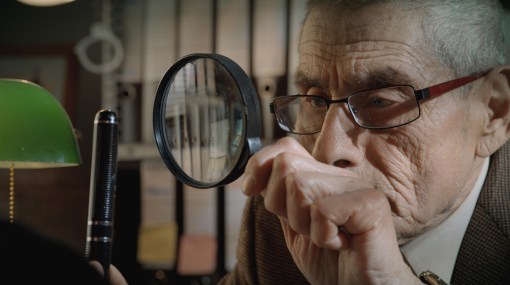
The premise of The Mole Agent comes straight out of a spy thriller: a detective agency in Santiago wants to investigate possible elder abuse at an old age home in the city. The only way it could do this is by planting a “mole”, a senior citizen who will report happenings from within the institution. Sergio, an octogenarian and a recent widower, is hired for the job from among several candidates. Romulo, the head of the agency, briefs him on his mission and trains him in the use of various electronic gadgets. Sergio’s uneasiness with technology makes for some of the film’s funniest passages, as does director Alberdi’s ironic use of film noir elements.

After Sergio checks into the nursing home, we are introduced to a select few residents, who become veritable characters in the film: Rubira who keeps forgetting whether her children visit her, Marta the restless soul who is pacified by fake calls from an inexistant mother, Berta who takes a liking to Sergio, Petita the in-house poet, among others. The occupants of the home are predominantly women, and as a rooster in a hen house, the impeccable Sergio becomes something of a heartthrob. Even as he secretly reports back to Romulo over the phone, he too grows closer to the women, listening to what they have to say, complimenting them, and helping them out with their anxieties.

While supposedly a real-life account, the documentary garb of The Mole Agent comes off early into the film. Following Sergio’s admission into the home, we are made witness to a host of interactions between the residents. These are recorded by a filmmaking crew present at the facility even before the arrival of our protagonist. The occupants of the house notice these cameras and microphones, sometimes wary of this foreign presence.

Notwithstanding Romulo’s alibi that the crew has been sent there on the pretext of making a documentary about the home, the film’s fictionalization becomes apparent, especially in shots that anticipate Sergio’s movements into and out of certain spaces. Romulo gives Sergio hidden recording equipment, but we hardly see any footage from it that isn’t already covered by the on-site cameras. Besides, with a documentary crew on site, it is patent that the home’s management would be on their best behaviour, forestalling any shocking discovery Sergio might make.

The Mole Agent thus makes no bones about its fictional nature. Even so, the film revives certain questions about documentary ethics, questions also confronted by any discipline engaging with a social other. The nursing home has evidently consented to participating in the film, but the consent of the residents themselves, who are also filmed during their less-than-dignified moments, remains open to discussion.

This is, of course, the challenge involved in dealing with subjects whose capacity for informed consent may be compromised. When American documentarian Frederick Wiseman filmed the disturbing everyday operations of a state-run institution for the criminally insane in Titicut Follies (1967), there were objections that his film violated the right to privacy of the inmates, whose consent could never stand scrutiny anyway.

Likewise, some of the elders in The Mole Agent, suffering to various degrees from memory loss, delusion or general disconnect, may not entirely have been at ease being filmed had they been in the best of their health. However, despite occasional humour at their cost, the film treats them with dignity and affection, recognizing the complexities of their experience. It manages to resolve whatever moral quandary its premise may have posed by siding resolutely with the residents. Alberdi’s film ultimately speaks for and with the elders, not about them.

In the final minutes, Sergio concludes in his report that there is no abuse at the facility, and that what’s ailing the residents is simply interminable loneliness. This statement of purpose, so to speak, clarifies the original conceit of The Mole Agent. Rather than sustaining a mystery around Sergio’s presence at the establishment, the film chooses to designate him as a “spy” right at the outset, preparing the audience for some sordid revelations through his eyes. But the revelations never come. Instead of penetrating a hermetic world for our thrill, the film turns outward, reflecting our voyeuristic desire back at us: the infiltrator becomes an insider, reciprocates the love and trust of the residents, and ends up incriminating the very person who hired him.

In a way, then, the political argument of The Mole Agent is antithetical to the institutional critique of Titicut Follies. The establishment in question is less a failure in itself than a symptom of a larger failure: the superannuation of the aged once they have outlived their social utility. The nursing home is strewn with individuals whose grown-up children are too busy with their own lives to take care of or even visit their parents, those who have lost their spouses and are looking for romantic validation, and those who are struggling simply to keep their personhood intact.

When Romulo puts out an advertisement seeking super-senior citizens for a job, numerous men line up for the audition. In his interview, Sergio invokes the difficulty of finding a job as an octogenarian and remarks how mentally liberating it feels to be ‘useful’ again. Having been desperately lonely following the demise of his wife, the new project gives him a sense of purpose, something that seems inaccessible to most other residents of the nursing home.

So despite juggling documentary and fictional elements, The Mole Agent doesn’t intend to question ideas of truth. On the contrary, it is determined to state a simple truth about society, which it deems is best conveyed by the hybrid form it has chosen.


[Originally published at Firstpost]

On 2nd October 2018, Saudi journalist Jamal Khashoggi went to the KSA embassy in Istanbul to obtain documents that would enable him marry his Turkish fiancée, who was waiting outside the building. He did not return. A noted critic of the Saudi crown prince Mohammad bin Salman’s (MBS) policies, Khashoggi was choked to death in the conference room of the embassy. His body was dismembered and reportedly burnt in a barbecue pit over three days. In February this year, the White House declassified a report that stated in no uncertain terms that the grisly murder was carried out by intelligence agents acting under the express approval of the crown prince. US president Joe Biden has, however, refused to pass any sanction against MBS for the killing.

American filmmaker Bryan Fogel’s persuasive, pressing new documentary The Dissident, which premiered at the Sundance Film Festival last year, sticks so closely to these hard facts that it seems it has no other ambition than to state them as they are. It’s a worthy goal, especially in view of all the hand-wringing that political leaders across the so-called free world have been engaged in over the matter. Torch-bearers of free speech like the UK and France have loudly decried the murder, but shown themselves unwilling to do anything that will impact their arms trade with Saudi Arabia. The Arab world predictably rallied behind the kingdom, while countries like India and Pakistan, far from condemning the killing, welcomed an investment-bearing MBS with red carpet in 2019. This bending of a country’s foundational values under a heavy purse recalls Groucho Marx’s quip: “Those are my principles, and if you don’t like them, I have others.

Fogel’s film synthesizes the testimonies of Khashoggi’s fiancée, Hatice Cengiz, his friends and colleagues at the Washington Post, the Turkish officials who discovered and publicized the murder and other Saudi dissidents exiled across the world, especially Montreal-based video blogger Omar Abdulaziz. In doing so, it offers us a picture of the journalist’s personal and political situation during the weeks leading up to his visit to the embassy and of the fallout of the assassination in the weeks after. We also get a glimpse into the scope of Saudi intelligence operations, from large-scale computer farms that troll dissidents and set the narrative on social media to investment in technology that infiltrates mobile gadgets of targets across the world, allegedly even that of MBS’s buddy Jeff Bezos.

The Dissident is not an analytical work; Fogel’s approach has little to do with either the meditative formalism of a Laura Poitras or the long-sighted storytelling of an Adam Curtis. He holds the viewer captive to the here and the now, and his film is largely an ‘operative’ text that seeks to convince and call to action. To this end, he uses all the means at his disposal to hold the viewer’s attention. Several stretches of The Dissident have the licked finish of an international thriller: spectacular drone images of megapolises dotted with skyscrapers, a musical score that ratches up the tension, and an accelerated style of editing that weaves different kinds of testimonies to create a sense of inevitability to the events. A description of warring IT-operations is animated literally as a colony of dissident bees taking on an army of Saudi flies.

You can’t deny that this method is effective. After all, the film (nearly) pulls off the impossible by making us root for Jeff Bezos. But there are stretches where this ends-over-means approach irks. It’s one thing to dramatize Abdulaziz’s media operations in Montreal, but to have a camera wistfully track away from Cengiz as she stands outside the Saudi embassy borders on distasteful. There are multiple moments where we don’t know if what we are looking at is fictional re-enactment or documentary footage, for instance the low-fi visuals of people talking in cafés that accompany audio recordings, or pictures supposedly from Saudi Arabia’s social media war-room — images that seem suspended in the realm of alternative facts. As the then-president Donald Trump said of Khashoggi’s killing, “Will anybody really know?”

The Dissident is so focused on excavating and arranging facts that it seems to have come into being on its own. And its mission is so obviously vital that it seems decadent to talk of its artistic construction. While its accent on raw detail renders the film almost a-thematic, there is a motif to be discerned: the gradual redrawing of the contours of political affiliation that can shift the ground one is standing on. The film lets us know that Khashoggi was not always a heretic; that he was, in fact, an insider in the House of Saud, who represented a happy face of the regime. Even when he was critical, we are told, he was seen as a well-meaning reformist who believed in MBS’s vision. But with his reactions to the Arab Spring and concomitant Saudi-sponsored counter-revolutions, it appears as though he would fall lower and lower in the eyes of the kingdom, even though he continued nurture the same love for his country.

The film regularly tells us that Khashoggi was targeted for his dissent, but it hardly probes into the material of that dissent. This is important. There is a valid argument to be made somewhere that reducing a complex journalist to a martyr for free speech is a liberal contrivance that neglects the breadth of his life’s work. But Fogel’s refusal to delve into the details of Khashoggi’s criticism of the crown prince is a wholly defensible stance. The Dissident is a film about principles for which any discussion about how Khashoggi may have ‘provoked’ the Saudi government is already a concession. For Fogel’s film, dissent is an end value in itself, worthy of being protected and celebrated irrespective of its content. As such, it wouldn’t want to have anything to do with realpolitik. It is, after all, international realpolitik that has deemed that pursuing justice for Khashoggi comes at too high an economic price.

[Originally published at Firstpost]

Liberal imagination tends to consider translation as an act of building bridges between cultures. But if the history of colonialism and nationalist hegemony has any lesson to offer, it’s that building bridges isn’t necessarily a guarantor of mutual respect. Translation is an act of faith, and as someone who cannot produce new discourse, only affirm existing ones, the translator is essentially a powerless figure, even when his/her own existence is at stake.  

This powerlessness is front and square in the superbly-edited first scene of Jasmila Žbanić’s Quo Vadis, Aida?, nominated for the Academy Award for Best International Feature this year. Seated amid clouds of cigarette smoke, a tense but focused interpreter, Aida (Jasna Đuričić), translates between a group of civilians from Srebrenica, Bosnia, and a unit of UN peacekeepers. The locals are worried about the advance of the Serb army into their city, supposedly a UN-protected “safe area”, while the Blue Berets assure them that the NATO has their back.  

As the camera pans back and forth between the two camps, in a meditative manner that belies the tension of the situation, Aida translates words, but the essential part of the communication succeeds without her intervention: rising and falling pitches, quivering voices, defiant stares and denied handshakes. Aida is personally implicated in the standoff, but her emotional state has little bearing on either the tenor of the negotiation or its outcome. Hers is not to reason why, but to smoothen a process, even if the process is to dispatch a group of people to certain death.  

Quo Vadis dramatizes the days preceding the Srebrenica massacre, in which over eight thousand Bosniak Muslims were slaughtered. It weaves a factual account of how the genocide was allowed to happen with a fictional story told from Aida’s point of view. A host of factors are summoned to court: the deep-seated ethnophobia of the Serb soldiers, the cunning media manipulation of General Mladić (Boris Isaković), who orchestrated the massacre, the indifference of the NATO for whom Bosniaks were simply pawns on a political chessboard, the failure of the UN command to stand up to Mladić and their ignoble capitulation to him.

All this clear-eyed analysis would have been formally unwieldly were it not for the character of Aida, who binds these diverging perspectives together. Her unique position between the Bosniaks and the UN forces helps the film to never deviate too far away from her own story. Aida tries, with every means at her disposal, to rescue her husband and two sons from the fate reserved to the other members of her community. Part of Žbanić’s accomplishment is the way she manages to open up the film from this narrow narrative perspective to larger political questions in a fairly organic manner.

This tactic isn’t without considerable limitations. Though a Bosniak herself, Aida is a quasi-outsider who shares little with the huddled masses that make up the refugees at the UN camp. No Bosniak outside of Aida’s family has any individuality to speak of, and the only two characters to be singled out during negotiations with Mladić exist solely in order to be humiliated. Refugees are marshalled, instead, into a series of vignettes depicting the injustice and violence they are subject to — images that recall Hollywood’s recreations of historical atrocities in their unsettling virtuosity. The absence of any reference to armed resistance by Bosniak soldiers or civilians is, moreover, a political convenience that weakens the film’s argument.

Quo Vadis is at its strongest, though, when it sticks close to Aida, whom it follows with a handheld camera whenever it isn’t allowing us a moment of repose with static or slowly panning shots. Jasna Đuričić’s turn as Aida is formidable, and director Žbanić composes her shots around the character’s nervous physicality. Wearing trousers and an unbuttoned blue shirt over her blouse, the middle-aged Aida briskly moves through numerous obstacles at the UN facility, climbing up and down containers, and snaking in and out of its makeshift offices. The frame can barely contain her energy. Associated all through the film with two objects — cigarettes and loudspeakers — she becomes a powerful visual anchor for the viewer.

War films have a tendency to lionize their protagonists, turning them into heroes who shape or defy the course of history. Quo Vadis, however, takes pains to underscore that Aida is not a hero. Her character has little by way of ideals or even work ethic; she is willing to translate patent lies and she is willing to not translate uncomfortable truths. She is an accidental interpreter and would rather be rescuing her family than arranging toilet facilities or delivering babies at the camp. Aida is determined to save her husband and two sons, even if it means passively shepherding the other refugees to their grave, and she has no compunction about this. For her, it isn’t about justice or community rights, it’s about familial survival. And this relative moral complexity holds the character at a healthy distance from the viewer.  

But the real human complexity arrives with the film’s extended coda in which Aida comes back to Srebrenica years after the war. She is a foreigner in her own neighbourhood, which is now occupied by Serbs. In her class at school are children of the genocide victims, but also those of the perpetrators and enablers. Could Aida ever love teaching again, given that it was one of her former students who helped deport her husband and sons? With victims now expected to put their past behind and be part of the same civil society with war criminals, the notions of truth and reconciliation ring hollow. Performing together on a single stage for a school programme, the ethnically diverse kids look alright. That would, at least, be Aida’s hope.


[Originally published at Firstpost]

« Previous PageNext Page »