Review


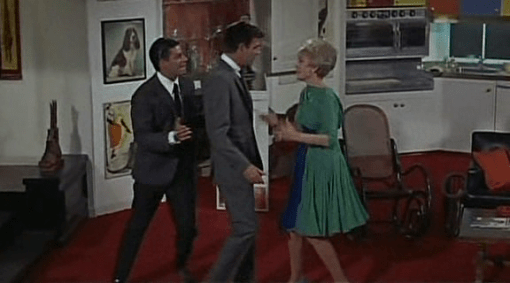
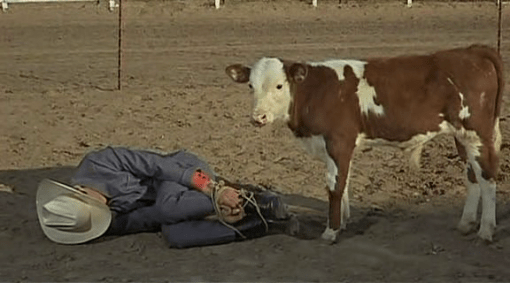
Jerry Lewis’s romantic comedy Three on a Couch (1966) works off a rather outrageous premise. Chris (Lewis) is an artist who has won a year-long residency in France. He wants to marry his girlfriend Liz (Janet Leigh) and move with her to Paris. But Liz, a psychoanalyst, can’t leave her practice because she’s not making progress with three of her patients who depend on her. Each of these three girls—of a uniformly doll-like beauty, differentiated by accents and hairstyles—has turned into a man-hater following a heartbreak. Liz is helpless and Chris is becoming increasingly morose. Chris’ best friend, the obstetrician Ben (James Best), gives him an idea: seduce the three girls so they can be cured of their misandry and Liz can leave for Paris. Playing three different men with characteristics tailored to each girl, Chris goes about making them fall for him.

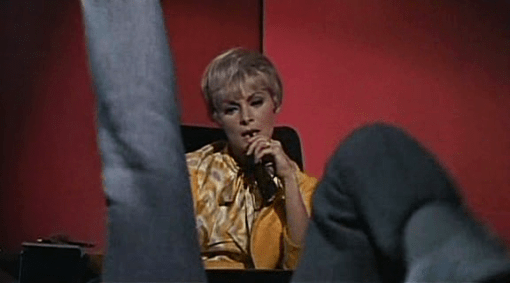
As the title indicates, psychoanalysis here is euphemism for sexual intercourse. When Liz penetrates the minds of her patients, her office is lit in saturated, psychedelic colours, like some seedy den of sin conceived by Frank Tashlin. One of the girls, a sportive type, keeps moving her legs, through which the camera moves at one point. Psychoanalysis being a substitute for sex, the three girls are in an unstated romantic relation with Liz. The comedy therefore derives from one man’s attempt to win back his girlfriend from the seductions of other women by seducing away these women. Underpinning the humour is the rather retrograde notion that lesbians simply need a good dick to be cured.

Well, that’s the text. But there’s something else going on underneath, against the flow, reversing the text even. We are told that Chris was once Liz’s patient. During the credits, we see him enter her office with the appearance of a hermit, but we don’t exactly know what his problem was. Given how Liz exclusively works with issues of sexuality, we might suppose Chris too is tormented on that front. In the first scene, Chris goes to the French consulate to claim his residency and reward. He is an artist—one of Hollywood’s euphemisms for a gay man. Posing for the photo-op, he kisses the French diplomat, who tells him that it wasn’t necessary. “For $10000, you’re lucky it wasn’t on the lips”, says Chris.

When we first see Ben, he’s trying to convince Liz to go with Chris to Paris. “Any girl that won’t have babies is anti-business” is the reason this obstetrician gives. Shortly after, he arrives at a bar to talk to Chris. The whole scene plays out like the first meeting of two lovers who have long separated. This conversation, as all of Ben’s scenes in the film, is loaded with innuendo that suggest that his relation to Chris, “his best friend”, is more than platonic. He lays out the plan to Chris: “If I were a girl who hated men and wanted someone to talk me out of it, I wouldn’t go to another girl, I’d go to Cary Grant”. “Man is the cause, man is the cure”, he says, prompting Chris to play the “bohemian” lover to the three girls. Chris likes the idea, but demurs. Ben reminds him of their college days. “You seem awfully happy about this”, notes Chris, to which Ben replies, “Well, it’s good for my business”.

As the plan is afoot, Ben visits Chris in his apartment. The exchange between them strips away all context, accommodating any supposition:

Ben: “What are you so sad about?

Chris: “What am I looking so sad about? Suppose Elizabeth finds out.

Ben: “How is she gonna find out?

Chris: “That’s what I’m worried about.

Ben: “In a city as big as L.A.? It’ll never happen.”

Chris: “In a city as big as L.A. That’s when it does happen.”

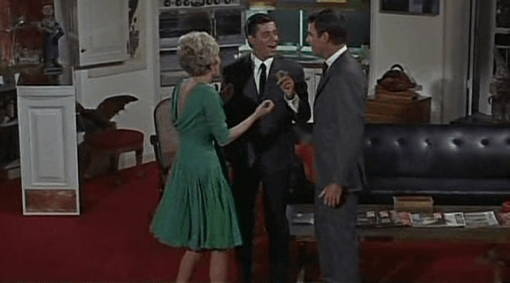
Just then, Liz rings the bell. Chris opens fumblingly, and Ben prepares to leave the apartment right away for no reason. The couple sits on the couch as Liz starts recounting how her patients are showing signs of cure, not knowing that Chris is behind all this. Now, Jerry Lewis’ sequencing tends to be rather austere, not particularly marked by camera movements. During conversation scenes, he avoids shot/reverse shot constructions, instead drawing the viewer into the space through axial cuts from medium two-shots to tighter solo shots. But here, he allows himself a flourish. The camera arcs from behind the sofa where the couple are sitting and goes at the diametrically opposite point, reversing the actors’ on-screen positions. The reversal is equally thematic, for Chris is as much a pawn in Ben’s plan as Liz is in his.

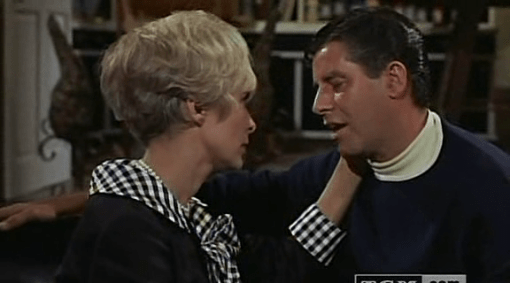
Notwithstanding the tacked-on happy ending, one against-the-grain reading of the plot illustrates its symmetry: Chris thinks he’s winning back Liz by seducing the girls, but it might well be Ben who’s trying to win back Chris by urging him to carry out this hopeless plan. So we can’t always say who’s controlling whom; at several points, the three characters move in a way that swaps their positions in the frame.

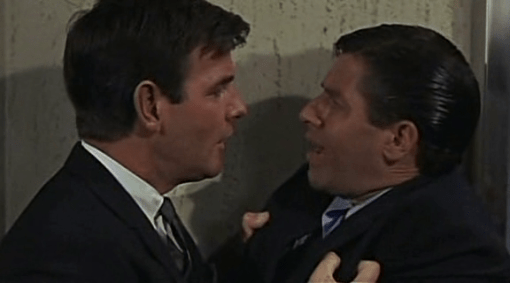
Ben’s romance is barely veiled. In a ballroom scene, as Chris necks Liz during a slow dance, Lewis cuts to Ben’s reaction, a wholly uncomfortable insert held for too long. Ben forces an awkward, pained smile. As the couple dances, Ben gets up from the seat to encourage Chris to continue dancing, as though he needed that encouragement. In a later scene, Ben and Chris leave a party hall into a private room. Lewis makes an ambiguous cut to Liz discussing with her secretary about how pretty something looks; “a natural romance”, adds the secretary. (The entire party scene—constructed around a Kafkaesque elevator that’s always there but never accessible—is small masterpiece of screen comedy, dialled-up with uncharacteristically tight, claustrophobic compositions that cry for a release.)

In his extraordinary Rock Hudson’s Home Movies (1992), which played this week at the Filmmuseum München retrospective online, Mark Rappaport picks out moments from Hudson’s films that surreptitiously relay information about the actor’s homosexuality, revelations often mitigated by a safely heterosexual plot context. The filmmaker extracts these lines and gestures out of their context to build his case that Hudson’s homosexuality was there to see for anyone who cared to pay close attention. This hacking of the texts, this decontextualization, frustrating from an academic point of view, is very much the point of the film, which forges a young admirer’s private fantasy in the vein of Hollywood Babylon from public documents. Rappaport’s explosive work throws light on the complex workings of the Hollywood movie, where several extra-textual narratives intermingle to pin down an ever-slippery network of meanings.

Someone watching Three on a Couch with no knowledge of the actors’ private lives may similarly suppose that Jerry Lewis and James Best were queer, and that this detail was being sublimated in a story about heterosexual supremacy. The scenes between them have a touch of camp, but Lewis’ performance and characterization are especially striking.

A Lewis operation is generally room-wrecking, his physicality dominating every other element of the aesthetic. Here, on the other hand, he is largely withdrawn. He doesn’t begin with the Lewis persona right away. He starts off, in fact, as a rather obnoxious figure, throwing tantrums and blackmailing Liz when she refuses to go with him to Paris. In his scenes with Liz, he is often photographed from the back, not unlike how Cary Grant is filmed in Hitchcock’s Suspicion (1941), the lack of our access to his facial reactions making him seem even more sinister. There are no reverse shots, and his inward-looking body language clearly spells a repressed character.

What’s Ben’s seduction plan for Chris if not an opportunity for him to perform heterosexual romances with women without ever personally investing in it, just like what Rock Hudson and other queer stars of Hollywood always did in their movies? It even offers Chris a chance to cross-dress as a character named Heather. Sexually speaking, the Jerry Lewis persona oscillates between a childish pre- or asexuality and blustering ultra-masculinity. Here, Ben’s plan decomposes Chris’ relatively complex personality into three simple archetypes: Ringo the alpha man of the west, Warren the sportive urban male and Rutherford the gay mamma’s boy. Once this decomposition is in place, all three archetypes are subjected to the Jerry treatment; in a montage of funny courting scenes (chopped up into single gags so as to put Jerry back into his comfort zone), we see how each of these men fails in the sole characteristic he is supposed to uphold.
So I suspect Three on a Couch is to Lewis what Punch-Drunk Love (2002) is to Adam Sandler: a deconstruction, a look at what likes on the other side of his screen persona, defined equally by arrested development. But the more fundamental question of whether it’s legitimate for heterosexual actors like Lewis and Best to play gay characters playing heterosexual characters is a Gordian knot I can’t yet undo.

This kind of in-joking—whether imposed or willed—is not uncommon in the work of queer actors like Grant, Hudson and Montgomery Clift. And unlike, say, Indian male movie stars, who operate in a firmly heterosexual framework that can only allow their drag roles and performed queerness to be read as jokes, Lewis and Best are working in Hollywood of 1966, whose historical and cultural context won’t let viewers brush aside the significations of these ‘crossovers’. Which is to say, Three on a Couch may have been a cultural relic even in its time, like all Jerry Lewis films.
[From my column on studio-era Hollywood films for Firstpost]

Warner Brothers was arguably the most interesting film production house of the 1930s, certainly at least from a political and social point of view. Like other studios, it knew how to harness the Depression-era audience’s desire to escape the doom and gloom around them by offering cheerful backstage musicals. But Warner also proved itself willing and capable of registering the harsh reality that this audience lived in. The studio’s tendency to both profit from the general resentment and to assuage it with uplifting messages of hope and courage may have its roots in the political leanings of its chief Jack Warner, a heavyweight supporter of Franklin D. Roosevelt who is said to have gotten his wartime directives straight from the White House.

Heroes for Sale (1933) was produced by First National Pictures, a subsidiary of Warner Brothers’ that mostly handled the studio’s second-tier products. There were few stars in these films and the budgets were relatively low, which allowed them to be bold in their choice of plot and setting. While in a Warner Bros. picture, tragic stories would regularly be attenuated with a tacked-on happy ending, the First National films didn’t need to sugarcoat their bitter vision. Heroes for Sale was made just after Roosevelt swore in as the 32nd president of the United States. As though symptomatic of this particular time, the film embodies both a discontentment with the preceding Hoover administration and a hope for the new one, the duality manifesting as an incongruity between plot and character.

Injured in combat during the war, Tom Holmes (Richard Barthelmess) returns home to discover that the military accolades he deserves have been given to his army peer Roger (Gordon Westcott). Not wishing to rock the boat, Tom takes up a modest clerical job at the bank run by Roger’s father, only to be crippled by, and sacked for, a morphine addiction he acquired at a German POW hospital. After rehabilitation, Tom starts a family and successfully runs a laundry in Chicago, but finds himself unwittingly caught up in a riot following a wave of automation and job loss. Returning from an imprisonment of five years, he learns he is on a list of suspected communists, and is forced to wander the country as a drifter without a home, a family or a job.

The script, by Robert Lord and Wilson Mizner (an opium addict himself), has a stark anti-establishment bent. Throughout the film, we witness authority being abused to crush the little man that Tom represents: a commander who sends his soldiers on an impossible mission, a banker who misappropriates people’s money, businessmen who sack their employees without second thought, police who fire at protestors, law that accords disproportional punishment to white- and blue-collar crimes, enforcers chasing vagabonds from their camps. Heroes for Sale is punctuated by images drawn from real events of the preceding years, such as urban breadlines, the veterans’ march to Washington and the ensuing firing. At the end, Tom tells Roger, both hobos on the run now: “You started way up high and I started pretty low. And we end up here in the rain, together.”

While the grim analysis above remains faithful to the reality of the Great Depression, the reaction to it suggested by Heroes for Sale is one of stoic acceptance. All through his ordeals, Tom refuses revolts against his lot, nor does he switch over to the wrong side of the law. As a result, the account of his constant exile from society—army, rehabilitation centre, prison, endless wandering as a vagrant—scans like a modern-day Book of Job, where Christian forbearance, charity and an unquestioning faith in powers that be are presented as the noblest possible response to relentless suffering. This answer is justified by the failure of the anti-automation riot Tom tries to prevent, as well as by the presence of the inventor Max (Robert Barrat), a caricatural communist who is simply a disgruntled capitalist at heart.

This call for patience is wholly in line with the studio’s support for the new regime and the promises of the New Deal. In fact, the film devolves into an unveiled propaganda for Roosevelt towards the end. “It takes more than one sock in the jaw to lick 120 million people”, says Tom to Roger, explicitly referring to the new president’s inaugural address. The economy, and with it the morale of the nation, will rise again is the message. After one hour of attacking one American institution after another, here’s a turnabout, an unfounded appeal for trust. Trust in institutions, especially the banking establishments that had lost public legitimacy after the stock market collapse, was what the Warner brothers would have liked too; their existence depended on it: Goldman Sachs was on advisory board of the studio and had co-financed its purchase of First National Pictures.

Director William A. Wellman’s style is notoriously hard to pin down; his personal vision of the world, even more so. There is little formal or thematic consistency across his body of work, except perhaps a certain taste for gritty realism expressed in particular details of action, gesture and setting. Any line of moral, political or philosophical thought one can discern in one film will invariably be contradicted in another. As critic David Phelps puts it, “the films have no metaphysics but physics.” As a result, critical consensus on his work still remains unresolved, his status as a major American filmmaker open to question. Manny Farber was a great admirer of the textures in his films, asserting that “when Wellman finishes with a service station or the wooden stairs in front of an ancient saloon, there’s no reason for any movie realist to handle the subject again.” In contrast, Andrew Sarris declared that, with Wellman, “objectivity is the last refuge for mediocrity.

Be that as it may, Wellman brings a lean muscularity to Heroes for Sale, which possesses a novelistic sprawl without ever turning laboured or precious. The film hurtles from one genre, one setting to another, making vast leaps in time that are all the more striking in that they are executed with straight cuts without transitions. Wellman’s characteristic camera movements expand and contract spaces with considerable effectiveness. He tracks across the laundry floor twice to show the wrecking impact of automation on the employees. Wellman steers clear of sentimentalism despite the thoroughly melodramatic construction of the scenario. A comparison with his collaboration with David O. Selznick, a high-strung sentimentalist, a few months before in The Conquerors (1932) reveals on how light-footed Heroes for Sale actually is.

There’s something about Wellman’s style that makes it free of value judgments about what is being depicted. To be sure, scenes can provoke the desired emotion in the viewer, but only in so far as the script needs it. Many episodes in Wellman’s work seem to unfold in the passive voice, displacing interest from the characters on to the action they are embedded in. The riot sequence in Heroes for Sale is a good example. The strikers wreck the laundry and hurl stones at the police, who fire back. The camera pushes through the fighting mass to pick up Tom’s wife, who has come to look for him. A barely perceptible blow to her jaw knocks her down dead. Since the previous shot shows both the rioters and the police wielding batons, we are not sure who is delivered the blow. Wellman’s staging and editing of the action takes no sides, shifting the emphasis from assigning responsibility to describing results. A riot took place, blows were exchanged, a woman was killed.


[Originally published at Firstpost]

Somi wears a broad smile. She’s in her late twenties—or early thirties, she doesn’t know—and pregnant with her second child. “I think it’s a girl”, she tells her husband Sukhram, five years her junior. Somi cooks, washes their clothes and takes care of their first child, while Sukhram is about the house doing nondescript work. They have a pet parrot and raise poultry in their plot of land. It might be the picture of a modest but ordinary family, except for the fact that both Somi and Sukhram are renegades from the Naxal movement who surrendered to the Indian state, got an amnesty, and were resettled under the country’s rehabilitation policy for ex-Naxals. Their “second-life”, in a colony in rural Maharashtra comprising of refugees like themselves, is the subject of a compelling new documentary titled A Rifle and a Bag, which screened online at the Visions du Réel film festival last week.

In long, fixed shots, the opening passage of the film gives us a sense of the couple’s everyday reality: scenes from domestic life, Somi’s visit to the pregnancy clinic, the couple’s conversation about their to-be-born second child. These images of quotidian life are, however, soon punctured as we learn about Somi’s past as a Naxal commander, the deadly reprisals the couple have risked in their surrender, their lingering feeling of deracination. Somi’s role as a wife and a mother is in stark contrast with her older role as a Naxal higher-up. But Somi makes no remark about this conventional distribution of labour, content instead to secure a future for her children.

A large part of A Rifle and a Bag presents the couple’s interaction with the Indian state and civil society on a day-to-day basis as part of their rehabilitation. Somi runs from pillar to post to unsuccessfully obtain a caste certificate for Sukhram, who can’t safely go back home to Chhatisgarh to get one. Without this certificate, they can’t admit their son into a school. The film develops around the central irony that Somi and Sukhram, of a tribal origin, have to identify themselves in terms the Indian state understands. The state and the civil society, though, aren’t malevolent forces. In fact, the officers, teachers and doctors whom we only hear interacting with Somi could hardly be more understanding and sympathetic. It’s the system they help function, faceless just like them, that holds Somi and Sukhram like a vice.

Earlier in the film, a self-congratulatory meeting organized by the local Rotary chapter, and blessed by the army, reinforces the new-fangled national identity of the ex-Naxals, pointing out that Naxalism is truly a national problem, affects as it does twenty-two states. Somi and Sukhram manage to find a place for their son at the boarding school, however briefly. In a scene at the school that puts too fine a point on it, the children are made to perform morning prayers, taught violently patriotic slogans and are, quite plainly, indoctrinated into the nationalist ideology. Somi, on the other hand, hardly has any national consciousness. Asked why she joined the Naxals, she says she wanted to get back at the local landlord who let the police harass her kin.

Through these contrasts, A Rifle and a Bag brings to surface the losses involved in the family’s integration into society. In their new colony, Somi and Sukhram don’t get a land to farm on—their primary occupation—but simply a plot large enough for a house. They are not only alienated from the world around their settlement, which still associates them with Naxalism, but also their relatives in Naxal-dominated areas. That we seldom see them outside their house or within a community only exacerbates the impression of their isolation. Owing to their situation, they can only send their child to a boarding school, where the boy acquires a body of knowledge vastly different from their own, in a language not their own. In a poignant exchange towards the end, Somi recounts her Naxal background to her son, as though restoring his ties to the family history, against the narrative he will soon be taught.

Not surprisingly, Somi appears to persistently doubt whether they have made right decision in surrendering, whether their new life is indeed better. To be sure, her family is objectively “making progress”. There’s a new bike, there are new clothes, the poultry makes way for cattle. Their colony has electricity and there’s cable television at home—material comforts contrasted with her past life in the jungle. But we never fully know why Somi or Sukhram left the Naxal organization, or what they are hoping for through their rehabilitation. Somi continues to maintain that the ideology behind the movement is righteous, even though its ways may be wrong. It’s to the film’s success that its loyalty lies with Somi’s unavowed incertitude than with any ideological certainties.

A Rifle and a Bag was produced and directed by Cristina Hanes, Isabella Rinaldi, and Arya Rothe, a trio known as the NoCut Film Collective. They adapt a non-interventional style—familiar in international documentary practice—in which Somi and Sukhram play themselves, their reality fictionalized just enough to constitute the narrative structure. They punctuate the film with repeated compositions—the house gate, Somi across an office desk, the changing phases of the moon—to impart a sense of place. This restrained form, marked by large ellipses, nevertheless makes space for considerable feeling, allowing us to recognize the tragedy behind Somi’s perennial smile.


[First published at Silverscreen]

[From my column on studio-era Hollywood films for Firstpost]

One of Paramount Pictures’ most prestigious assets was director Josef von Sternberg, a Viennese émigré most known for his seven-film collaboration with iconic actress Marlene Dietrich, who had moved to the States following the success of their first film together, The Blue Angel (1930). The sixth entry in the cycle, The Scarlet Empress, is a loose biography of Catherine the Great of Russia. The arrival of the talkies in the late 1920s had given fresh impetus to studios to remake their silent epics in sound. The year before had seen Garbo play Christina of Sweden in the commercial hit Queen Christina (1933) and Paramount themselves had released Cleopatra (1934), starring Claudette Colbert, a month before to considerable success. But nothing, not even Sternberg’s earlier films with Dietrich, anticipates the stylistic aggression of The Scarlet Empress, a box-office bomb.

Sternberg’s film follows a fairly linear trajectory. Ordained to be married to the Grand Duke Peter of Russia (Sam Jaffe), Catherine (Dietrich) travels from her hometown in Prussia to Russia, accompanied by the handsome Count Alexei (John Lodge). Catherine falls in love with the count, who has described Peter to her in lofty terms. Having reached Russia, Catherine is subject to a series of rude awakenings: Peter is a sinister idiot who devises torture toys, his aunt the current Empress Elizabeth (Louise Dresser) is a cold, cruel ruler who only wants Catherine to produce a male heir to her throne and Alexei appears to be a perennial skirt-chaser. Hardened by her betrayal, Catherine shields herself from the world, weaponizing her sexuality and waiting for the right moment to seize power.

It’s a rather intimate, psychoanalytical retelling of Catherine’s story that casts her private romantic problems as the motor of History. It locates the dissolution of her humanity in a wrenching scene in which she discovers that Alexei is also the illicit lover of Elizabeth. Later in the film, after taking over Elizabeth’s private chamber, Catherine restages this primal scene as a form of therapy, this time forcing Alexei into her old role in order to make him recognize the harm he’s done. Catherine’s ascension is conditioned by her private disappointments—the dissolution of her Prussian identity, her unhappy marriage, her heartbreak with Alexei and the her being reduced to an heir-producing machine. “We women are too much creatures of the heart”, remarks Elizabeth, lamenting the burden of the crown. It’s Catherine’s predicament too, one which she turns to her advantage.

Nothing in the synopsis above obliges Scarlet Empress to be the film that it is. In the hands of another equally-capable director, this might have been a sober, moving tragedy about thrust-upon greatness. But Sternberg was a sophisticated stylist and he conceives the film in an idiosyncratic form that derives from gothic, baroque and expressionistic tendencies in western art and architecture. Every detail of the film—sets, costume, lighting, dialogue, acting, music—is distorted to a grotesque degree having little to do with reality, leave alone history. Sternberg’s genre-bending treatment of the narrative applies horror movie tropes to a historical psychodrama, resulting in a very campy, very exotic aesthetic comparable to what Sergei Eisenstein would devise years later for his Ivan the Terrible films.

Sternberg’s primary means of breaking away from realism is through a ‘encumbered’ mise en scène, a deep physical space saturated with decorative objects all pointing to the unfathomable cruelty of the Russian royalty: a decadent palace housing gargoyle like sculptures, thrones attached to busts of withered old men clutching their faces in grief, clocks and toys depicting sexual deviancy and human torture, expansive clothes that seem like medieval torture instruments themselves, a skeleton leaning over a dining table, tableware and even food that spell out anguish and pain. (It is a curious irony that the contemporary face of evil, seizing power in Germany as Sternberg’s film was being made, glorified an aesthetic that was the polar opposite of the one pictured here.) The human characters are thus lost in layers and layers of clothing and décor, trapped in an ethos of terror they have little agency over. Catherine is doomed, physically and morally, to the same fate as her predecessors.

Nothing is left to accident in Sternberg’s film. Every visual, every gesture and every word planned in advance — Catherine playing with a suspended rope, falling on a haystack and tucking straws into her mouth for Alexei to remove, Alexei bowing his head in sorrow after Catherine asks him to perform an elaborate ritual, Catherine wrapping the tip of Peter’s threatening sword with a piece of her dress, a high official humiliatingly dropping a diamond in a priest’s plate — everything carrying specific meaning. Working with cinematographer Bert Glennon for the fifth time, Sternberg develops a rather complex lighting pattern that favours certain image planes over others (a similar scheme will be developed in India later by Guru Dutt and V. K. Murthy). This produces a film of great visual allure as well as ambiguity.

The chief source of ambiguity, though, stems from Sternberg’s bold mixing of tones. The Scarlet Empress is both a tragedy about Catherine’s sealed fate as well as risqué comedy about her sexual conquests. The challenge the film poses is that it never clearly distinguishes these two elements of the film. The duality of innocence and evil is introduced in the film’s first scene, in which a young, bedridden Catherine clutches her doll as her governor reads her tales of notorious Russian tyrants. The calamity facing Catherine registers clearly all through the narrative, reaching its peak in a gorgeously expressive wedding scene in which the bride Catherine’s halting breath threatens to blow out the candle she holds before her veil. Cutting to a soaring choral score, Sternberg films Catherine and Alexei in increasingly tight closeups, freezing them in their despair and helplessness via a characteristic top lighting.

On the other hand, the film suspends us in an attitude of uneasy humour about Catherine’s destiny. This strategy primarily manifests in the figure of Marlene Dietrich, an icon of screen irony. The viewer never once believes in the innocence of Christina even back in Prussia as a young maiden. Dietrich plays up the plain country girl stereotype, feigning wide-eyed naïveté and real love. Starting from this, The Scarlet Empress effects a progressive ‘defeminization’ of Catherine, her billowing white frock slowly giving way to military furs and finally to a dazzling white uniform with coat and trousers. Catherine’s rise to power thus coincides with a merging of the character with the Dietrich persona. The actor conveys Catherine’s sexual maturity with tremendous humour and wit. The joke on paper (that Catherine the Great slept with the whole Russian army) is taken through all its variations by Dietrich’s actorly intelligence, her manner of introducing wholly gratuitous but suggestive sentence breaks (“And your duties… Dmitri?”) and her typical way of sizing up men around her.

All of this excess somehow passed through the newly introduced Motion Picture Production Code. Part of it has to do with the film’s way of having its royal cake and eating it. A biographical picture situated in a different time and country (Russia, no less) perhaps gave the film immunity from the censors. The sadism, cruelty and debauchery could always be defended by appeal to a dubious historical accuracy. Whatever the case, it’s a wonder that Sternberg managed to go as far as he did, especially at a point where the country was reeling from the aftermath of the Great Depression. Film history is all the richer for it.


[Originally published at Firstpost]

[From my column on studio-era Hollywood films for Firstpost]

A projectionist at a Universal theatre sets up his machine and projects a film. On screen, a bevy of beauties are seen walking down the stairs. The stairs turn into a ramp, the ladies slip and fall into an abyss. They end up in a bustling section of the netherworld where an army of devils is forging weapons and canning men and women into barrels. Amidst the commotion, a taxi appears out of which a seemingly endless number of animals step out. They drag two men behind them with a rope. The men have a fight with the tiny driver of the taxi, who hands them a bill several metres long. The two men burn down the taxi with a magic breath. Wanting to see this bit of action once again, they call out to the projectionist off screen and have him rewind the last portion. Somewhere between all this is a title card that reads “any resemblance between HELLZAPOPPIN’ and a motion picture is purely coincidental”.

If the description above makes no logical sense, it is intended so. One of the challenges that Hellzapoppin’ (1941), among the most unclassifiable films in the history of Hollywood, sets for itself is to disrupt conventional logic of film narratives and frustrate our expectations of them. Produced by Universal Studios and directed by H. C. Potter, Hellzapoppin’ was adapted from a highly successful Broadway revue of the same name that premiered in 1938. The brains behind the revue, the comic duo of John “Ole” Olsen and Harold “Chic” Johnson, are also the “protagonists” of the film. They drag the viewer through a potpourri of one-liners, terrible puns, running jokes, action stunts, visual gags, song-and-dance numbers and meta-cinematic games connected by little other than their presence. Their sole weapon is interruption, their only guiding principle, incoherence.

But Hellzapoppin’ does have a ‘story’ (“because every picture’s gotta have one”). After the frenzy of the first few minutes, Olsen and Johnson are revealed to be actors trying to make a film (“a picture about a picture about Hellzapoppin’”). In this film within the film, they are supposed to play guests at a party hosted by heiress Kitty (Jane Frazee). The affluent Woody (Lewis Howard) is in love with Kitty, but Kitty loves the playwright Jeff (Robert Paige), who doesn’t want to upset his friend Woody by returning her love. Olsen and Johnson, playing themselves, device a plot to first hook up Kitty and Jeff, and then to separate them. Orbiting around these figures is an undercover Russian prince (Mischa Auer), a love-hungry young woman pursuing the aristocrat (Martha Raye) and a free agent of no defined purpose (Hugh Herbert) who outbids Olsen and Johnson in their charades.

It wouldn’t be a hyperbole to state that there’s nothing quite like Hellzapoppin’ in classical Hollywood. The film doesn’t particularly obey the conventions of a genre and appears to lie outside of established moviemaking traditions. Its parentage in cinema is therefore hard to establish. If it has a certain affinity to the anarchic spirit of the Marx brothers, especially Chico, its sense of play and gratuitous action have strong echoes of the Dadaist cinema of Europe, such as the work of René Clair and Man Ray. In its tendency to make up the narrative as it goes along, it also recalls the Surrealist game of Exquisite Corpse, where a story or an image passed from the hands of one artist to another, the result bearing the signature of everyone and no one at once.

A more instructive comparison would perhaps be the world of Looney Tunes, the cartoon series produced by Warner Brothers where we find a similar kind of meta-humour at work. These cartoons, especially ones featuring Bugs Bunny and Daffy Duck, have an elastic narrative universe that accommodates every kind of absurd plot development and prepares the viewer to accept these bizarre turns of events as they are. Like them, Hellzapoppin’ constantly calls attention to its own artifice, as Olsen and Johnson slip in and out of the film (and the film within the film) to directly address members outside the story. They ask the cameraman to stop lingering on bathing beauties. They prompt the projectionist to adjust the misaligned frame weighing down on them. At one point, they instruct one particular member of the audience to go home.

It is also important to note that, before their eastward move to Broadway, Olsen and Johnson were renowned figures of the vaudeville circuit in the American Midwest. In the early 1930s, vaudeville, as a popular form of entertainment, was fighting a losing battle against Hollywood’s talking pictures, which poached both its audience and its talents. Chaining together unrelated variety acts was part of its tradition, but the competition with talkies appears to have obliged vaudeville to distinguish itself even more, not unlike the way cinema was forced to turn more spectacular when television posed a threat in the early 1950s. As a result, Olsen and Johnson’s act turned, per one report, “wilder and zanier”.

This change translated, in the Broadway avatar of Hellzapoppin’, into a gleeful transgression of the theatrical space. Accounts of the revue talk about the ways its action overflowed from the stage into the audience’s space. During the show, it’s said, that a man walked the aisles selling tickets for a competing Broadway musical, another interloper threw rubber snakes at the audience, while a lady ran up and down the hall calling out the name of a certain Oscar. This violation of the audience’s distance from the spectacle—domesticated later by the performances and ‘happenings’ of the 1960s art scene—makes the film’s regular breaking of the fourth wall seem tame in comparison.

Contemporary American reviewers of Hellzapoppin’ the film, for one, seem to have thought so. Writing for Time, James Agee wrote that the film “loses the frenetic quality it achieved on the stage” and that “Olsen & Johnson’s ability to exude a kind of ectoplasm which engulfs a theatre audience and makes it participate in the show is necessarily cut off when the show is confined to the screen.” The notice in New York Times called the comic duo “noisy, boorish and often downright sadistic”. Unburdened by comparisons to the Broadway version, the film appears to have better fared in Europe. The French critic André Bazin, for instance, likened the film’s operation to “the penetration of a neutron into a stable molecule” and stated that its gags “push the metaphysical limits of laughter”.

Even with eighty years of hindsight, we may perhaps not be able to improve on these reactions. For, despite all its chaos and confusion, Hellzapoppin’ conceals no great mystery. It is a film that wears all its enchantments on its sleeve. There’s a plainness and innocence in the way it rejoices in playing with the possibilities of the medium. Early on, Olsen and Johnson walk through the backlot from one set to another. Every time they enter a new space, the shot changes and so do their costumes, thanks to the magic of a straight cut. Footage is quickened, reversed or slowed down. Double exposures are used for amusing special effects. Off-screen space becomes integrated into the shots. And in the film’s crowning passage, familiar to many thanks to a viral clip on the internet, a group of black performers break into an astounding Lindy Hop dance number, jaw-dropping in its physicality and athleticism. It’s as pure as spectacles get.


[Originally published at Firstpost]

[From my column on studio-era Hollywood films for Firstpost]

Cecil B. DeMille’s This Day and Age (1933) tells the tale of a group of youngsters taking on the corrupt system that has a stranglehold on their town. Steve (Richard Cromwell) witnesses the murder of his friend, the Jewish tailor Herman (Harry Green), by the local mafia boss Garrett (Charles Bickford). But his testimony is repudiated in court and Garrett walks scot free. Steve and his friends decide to carry out their own investigation and bring Garrett to justice. The film was made at a time when detective novels, especially involving teenage sleuths like the Hardy boys, enjoyed great fandom. While not a detective story in itself, DeMille’s film draws from the popularity of the genre, circumscribing the fact-finding efforts of its young leads within a larger political framework.

As its title indicates, This Day and Age purports to recount the story of its time. It begins appropriately with images of modern technology—aircrafts, zeppelins, motorboats and skyscrapers. But the film views modernity primarily in the possibilities of the younger generation and its power to wash away old structures and bring new moral life to society. As part of a “boys’ day programme”, Steve and two of his friends are appointed as the town attorney, judge and police commissioner for a brief time. They witness first-hand how the “system” fails to protect the innocent: judges trot out rules from books to defend Garrett’s acquittal, the defence lawyer grills Steve until he gives into doubt, and all proof of the murder is discredited. The boys realize they simply can’t win within this system, designed only to sustain itself, and must construct their own, based on their sense of truth and justice: they kidnap Garrett and convict him in a kangaroo court.

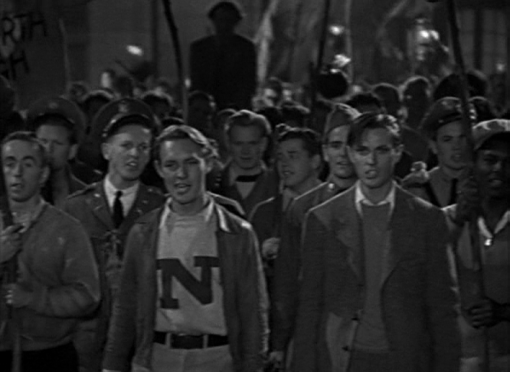
DeMille’s paean to youth has touches of what Nicholas Ray would undertake in the next couple of decades. The film’s first real shot is that of students walking into their high school union meeting. We will see their marching feet in closeup thrice in the film. The night they kidnap Garrett, they take over the town’s streets, and DeMille portrays this as the way forward for the nation. The film’s glorification of youngsters as a power in politics has an unnerving parallel with the rise of the Hitler Youth organization in Germany. The National Socialists had come to power a few months ago, and the Hitler Youth saw a twentyfold increase in its membership the year the film was made. This Day and Age capitalizes on this hopefulness about the younger generation pervading the air.

On the other hand, unlike in Nicholas Ray’s pictures, the film smoothens out all the rough edges around intergenerational relations. For one, the parents in DeMille’s film aren’t failed figures imprisoned by social norms. They are sympathetic and supportive of their children’s undertaking. Steve tells his parents that he’s going to get Garrett, and his father simply wishes him luck. DeMille’s paternalistic view of the teenagers finds them stuck between two ages, between the fragility of childhood and the moral urgency of adult life. When one of the boys is shot, he crawls into a foetal position and says, “I want my mother”, before collapsing. This sorry image is dissolved over a shot of Garrett’s cabaret girls dancing to a jazzed-up version of “Rock-a-bye Baby”. This desire for generational rapprochement reaches a peak in the film’s final scene, where the boys’ demands for justice are harmonized and blessed by the old boys of the system.

This Day and Age is an excellent case study to demonstrate that Hollywood films aren’t as much expressions of a coherent set of political beliefs as fruits of numerous contradictions created by conflicting production demands. On one hand, the film evidently draws inspiration from the socialist spirit of the times. The damage wrought by the Great Depression had brought popularity to social movements and trade unions around the country. The socialist writer Upton Sinclair would contest in the Californian gubernatorial elections as the Democratic Party candidate the following year. It’s telling that DeMille and Paramount Pictures, who aren’t generally known for films about everyday people, came together on a project defending the little man. The film, in fact, begins with a student union meeting to discuss unemployment.

On the other hand, a rather strong conservative streak is to be traced in the film’s conception of good and evil. The good, represented by youth, free enterprise and the common businessman who refuses to submit to the tyranny of unions, is brought into a provisional opposition with evil, symbolized by the mafia, politicians (who may be immigrants) and the government. The teenagers’ fight against Garrett is repeatedly cast as a truly American act, the tune of “Yankee Doodle Dandy” serving as a recurring motif. The mafioso Garrett, in contrast, is someone who threatens small businesses and perverts the young, his cabaret corrupting innocent children’s rhymes for lurid entertainment.

Some of the ideological contradictions of the film originate from the figure of DeMille himself, a notorious conservative. The filmmaker was partly Jewish, but also one of the most virulent anti-communists in Hollywood. He reconciles his Jewish identity with his Americanism in the character of the tailor Herman. A fierce independent wary of unions, Herman is glad to cook different foods for his friends, and that includes ham for an Irish boy. “The stomach is the last thing to get patriotic about”, he remarks. DeMille had visited the USSR in 1931, an experience he described in positive terms. The strategic superimpositions and dissolves he employs in the film—the boy detectives crawling at Herman’s house searching for clues dissolved with Garrett’s cabaret girls crawling to the tune of “Three Blind Mice”, shot of a rat dissolved with Garrett’s face—themselves show an influence of Soviet montage techniques.

The film’s ideological confusions acquire tremendous power once Garrett is abducted by the boys. At the end of a robust kidnapping scene involving boot polish and adhesive tapes, Garrett finds himself hunched over like a primate, his hands stuck to his knees. He is carried to a mock courtroom in an amphitheatre populated by the youngsters of the town, armed with ropes, guns and torches. He is strung up and the planks under his feet are removed one by one, and he soon hangs free over a pit of rats. The boys press for a confession, lowering him progressively until only the rope his seen and his screams heard. It’s a scene drenched in sadism—intercut with another disturbing scene of sexual menace—but also righteous anger of the teenagers.

DeMille, a master of Biblical spectacles, amps up the uneasiness in the subsequent scene. Having confessed to Herman’s murder, Garrett is now propped up on a stick like a pagan offering and taken on a procession to the court—a sequence that has an echo in the garish “golden calf” episode of DeMille’s The Ten Commandments (1956). The boys march in militaristic unison, waving banners and belting out “The Battle Hymn of the Republic”. A shot of Garrett on the stake, haggard and resigned, introduces a rather queasy note in this celebratory theatre of revolution. The mob action is supported by the police and receives official sanction in the courthouse, where Garrett’s confession, though obtained under duress, is used to incriminate him. Couching a crusade for justice within a fascist form, This Day and Age is a work alive with the tensions of the era as well as the dynamics of Hollywood film production.


[Originally published at Firstpost]

[From my column on studio-era Hollywood films for Firstpost]

Produced by the short-lived Parklane pictures and distributed by United Artists, Robert Aldrich’s Kiss Me Deadly (1955) follows the exploits of low-level private detective Mike Hammer (Ralph Meeker). After picking up a distressed woman (Cloris Leachman) on a highway, Hammer finds himself embroiled in a mystery too big for him to even understand, leave alone solve. A group of men with sketchy motivations, looking for “the box”, try to kill him, while every woman he comes across falls heads over heels for him. The more Hammer tries to get to the bottom of things, the farther they seem, and the more he risks losing. Ultimately, the film poses this question: how far will the detective go in his violence, misogyny, cynicism and pig-headedness before he realizes that he is only a tragic hero, doomed to failure?

Kiss Me Deadly was adapted by A. I. Bezzerides from Mickey Spillane’s detective novel of the same name. Bezzerides, a novelist himself, strips down concrete references from the source material. The object of everybody’s search becomes a box containing a nondescript “whatsit” instead of a drug consignment. The mafia makes way for a nameless, faceless “them” who pull all the strings. Such abstraction lends the film to different readings. Thanks to a reference, however, to the Manhattan Project and the radioactive quality of the box’s contents, the film is traditionally taken to be a commentary on the anxiety about nuclear age. Hammer’s developing paranoia comes to fruition when a femme fatale Lily (Gaby Rodgers) who double-crossed him ends up opening the box on a whim.

In a peculiar fashion, the film proceeds on two fronts at the same time. While the plot marches forward steadily, Aldrich and Bezzerides devote their attention elsewhere. Instead of accompanying Hammer in his search for truth, they reverse the gaze, looking rather at Hammer’s seedy operation, his obstinacy and his escalating paranoia, desperation and violence. Two or three things seem to be happening in parallel in every scene of the film. A debriefing sequence doubles as a game of seduction. A dinner with family becomes a confessional about a killing. Hammer goes to confront the story’s antagonist at the latter’s mansion, only to get into a long romantic exchange with the villain’s excessively forward sister. Full of stubs and false tracks, the plot appears to go nowhere, yet plot is the least of the film’s concerns.

It becomes clear as the film advances that Aldrich and Bezzerides are aiming less for a realistic detective story with allegorical underpinning than a myth with a very physical presence. The legend of Pandora’s Box particularly looms over the ending, but the whole film itself unfolds like a dream. The dialogue veers on the poetic and the actors’ line reading is weirdly protracted with pregnant pauses. Hammer’s dodgy cop friend Pat (Wesley Addy) speaks in an affectless, extra-terrestrial tone, his mechanic pal Nick (Nick Dennis) amps up the Mediterranean stereotype, Lily orders Hammer to kiss her in an incantatory repetition, while her boss, the doctor Soberin (Albert Dekker) makes pensive declarations full of mythological references.

The cumulative effect of these eccentric lines and dialogue delivery is the impression that what Hammer is navigating through is a nightmare of dilated time, a mechanical world of cold images programmed to perform specific functions. The surreal texture of the film’s soundscape is likely the reason British artist repurposed it for his recent experimental film, The Whalebone Box (2019), also about a mythical box with supreme powers. The movie’s oneiric quality is pitted against a heightened presence of the real Los Angeles. Several locations from the city feature in the film, most notably the uphill funicular known as the Angels Flight. In his epic study of the representation of Los Angeles in film, Los Angeles Plays Itself (2003), filmmaker and academic Thom Anderson deems Kiss Me Deadly “close to definitive as a portrait of the city in the mid-fifties.”

Accentuating the sense of the story’s oppressiveness is Aldrich’s muscular approach to direction. The story takes place in summer and, even when we aren’t sure where it’s headed, we feel the sultriness of the air. The film’s harsh, directional lighting scheme flashes the actors like headlights on a highway, as the camera lingers on their sweaty faces and jagged features. Doors are knocked down with more force than is usual in detective movies, the punches land harder. Hammer dispatches one henchman down a large flight of stairs. He’ll later jam the fingers of an elderly coroner in a drawer.

Like his peer Samuel Fuller, Aldrich employs a shot division that focuses largely on actors’ feet. The film’s first shot is that of a woman’s running feet. A while later, we see the same feet rise off the ground as the woman is tortured. As the film progresses, the image of feet accrues a frightening aura, belonging invariably to men sporting dark suits and heavy, leather shoes. This disembodied, faceless menace—sophisticated, emotionless and sure in its movement—becomes almost a metaphysical threat. We don’t know who these feet belong to, but we understand that its trace runs deep.

Matching the labyrinthine machinery of the plot is an equally complex cinematography. Shot by Hungarian emigré Ernest Laszlo, Kiss Me Deadly employs a camera choreography that rivals those of Orson Welles and Max Ophüls, as do the low-angle, deep space compositions. A three-minute scene of Hammer questioning a contact at a boxing gym is filmed in a single shot. It includes a conversation about a champion boxer in the ring without even a glimpse of the ring. Another three-minute shot, dominated by horizontal camera movements, finds Hammer grilling a soprano in a cramped hotel room. Aldrich varies his sequence construction from scene to scene, and the film remains as unpredictable on the visual level as on its narrative level.

The single most accomplished element of the film, though, is its multi-layered sound design that imparts complementary values to everything we see. This principle is evident from the credits sequence onwards, in which Nat King Cole’s I’d Rather Have the Blues is overlaid with the sound of heavy breathing of the girl in Hammer’s car—we know something is off right away. Throughout, Aldrich mixes in ambient noise—the buzz of the boxing gym, the sound of the sea, street traffic—in a way that expands the world we see on screen. At times, he superposes contradictory sound elements running against the grain of the image. So you have chamber music playing as a voice threatens Hammer on the phone. Or Schubert’s Eighth Symphony over the detective’s interrogation of a witness. In one stylized action sequence, Hammer’s escape is scored simultaneously to a piece of generic music, the sound of the ocean and sports commentary.

A B-movie with no stars or studio backing, Kiss Me Deadly has gathered a reputation among filmmakers and cinephiles over the years as a crime movie classic. The amoral, machine-like operation of Hammer finds an echo in the vigilante of John Boorman’s Point Blank (1967), itself inspiring Jim Jarmusch’s The Limits of Control (2009). Quentin Tarantino’s Pulp Fiction (1994) pays tribute to Aldrich’s film in its suitcase with glowing contents. But the first to consider Aldrich as a serious artist—and this film a masterpiece—were the young critics at the French film magazine Cahiers du Cinéma. Charles Bitsch, who became a filmmaker himself, called it one of the most significant films of the decade and Aldrich, “the first filmmaker of the atomic age”.


[Originally published at Firstpost]

[From my column on studio-era Hollywood films for Firstpost]

The story of Moonrise (1948), in many ways, is antithetical to the way Hollywood tells it. One of the ideological pillars of the classical Hollywood narrative is individualism, the idea that a person is what he chooses to be. In this view of things, factors outside one’s control, such as social milieu, upbringing or race, have little bearing on what one might make of their life. Moonrise, in contrast, foregrounds man as a product of circumstances. The protagonist Danny’s father is hanged for murder, and Danny (Dane Clark) spends his whole life struggling with the question of whether violence runs in his blood. In the film’s first scene, an overt bit of directorial messaging cuts from Danny’s father being hanged to the shadow of a suspended doll looming over baby Danny in the cradle.

As he grows up, Danny is bullied by peers, especially Jerry (Lloyd Bridges), the son of a wealthy banker. He is called by his second name, Hawkins, to remind him of his father’s sin. Danny lives in a constant state of fear and distress. As he puts it in an outburst late in the film, no one gives him a job, and girls stay away from him “like he was poison”. He carries a dead man on his back all his life, and he might be one himself. Danny keeps away those around him, with a few exceptions. He looks out for Billy the deaf-mute (Harry Morgan), the only one in town more unfortunate than him. He longs for the romantic attention of Gilly (Gain Russell), whom Jerry also courts.

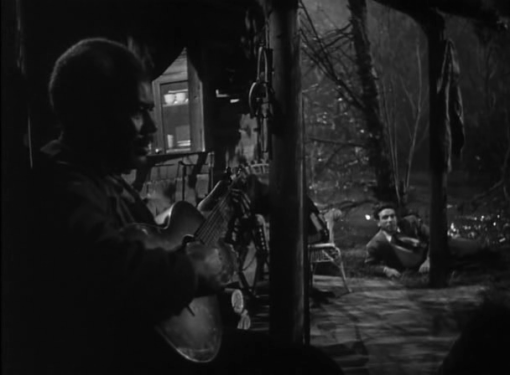
In a tussle in the woods on a dance night, Danny ends up killing Jerry in a mix of pent-up rage and self-defence, and hides his body in a cave. As word starts getting around about Jerry’s disappearance, Danny grows desperate, meeting Gilly only secretly and frequenting his friend Mose (Rex Ingram) who lives in the woods with his hunting dogs. Mose is depicted a wise, well-read man who recognizes the dignity of every living being. He has no back story, but regretfully claims to have resigned from the human race. As a black man in the American south, he surely knows a thing or two about being judged for your involuntary inheritances.

When the noose starts tightening around Danny, another large-hearted figure comes into the picture. In contrast to the judgmental eyes of the small town, sheriff Otis (Allyn Joslyn) views Danny’s action in light of his difficult childhood. Like Mose, he recognizes crime as a product of social factors. In a powerful conversation with the town coroner, he says, “If you went into all the reasons why that rock struck Jerry’s head, you might end up writing the history of the world.” The Sheriff cuts Danny some slack, urging him to come surrender so that his sentence may be commuted. Gilly, too, sticks by Danny when she learns the truth.

These humane gestures are amplified by the film’s vision of small-town America. The story is set in Virginia and the place seems frozen in an unspecified time in early 20th century. People are referred to by their origin: hillbillies, Yankees. Prejudices run deep, especially against those way down the social ladder as Danny and Mose are. Soon after the murder, rumours float around about the killer’s identity. “A small town’s like a stomach—always digesting”, remarks the sheriff, referring to public incrimination by way of rumour-mongering. In the nuanced view of Moonrise, the familiarity enforced by small-town life is the source both of bigotry and saving grace.

This complexity is also extended to the anti-heroic protagonist, who is repulsive and sympathetic in equal measure. He is the result of his difficult circumstances, but he is also a difficult personality. While he fends for the hapless Billy, Danny practically forces himself on Gilly, who turns down his advances several times. When she gently criticizes him for his childishness, he pushes the pedal on the car he’s driving and crashes it. Emerging out of the crash, the first thing he does is to kiss a half-conscious Gilly. He tails her after the event, imposing himself despite her protests until she gives in.

Director Frank Borzage accentuates Danny’s shadowed existence by holding him at a distance from the viewer. We generally see the character under a blanket darkness or as a silhouette. At times, his face is blocked or covered by something on the foreground. Even in closer shots, he is filmed in profile and often with shadows creeping up on his face. This strategy also helps the filmmaker minimize his dependence on the capabilities of the lead actor, Dane Clark, a relatively new leading man in town. Clark plays Danny with an unflattering nervousness, a low voice and with no charm whatsoever. As a result, the viewer’s identification with the lead actor is weakened, if not thwarted.

Moonrise, moreover, progresses on a disharmonious scale from the start. After the execution of his father in the opening scene, we see young Danny being roughed up by his schoolmates. The murder takes place in the very next scene, as though a foreordained event. Danny courts Gilly in immediately afterwards, this segue into romance right after a murder producing an unnerving overtone. Save for a scene with Gilly at the town fair, Danny is never happy or at peace. This succession of one anxious scene after the other creates a sense of instability, a lingering feeling that it is not going to end well for the protagonist.

And yet, Moonrise makes an appeal for Danny. There’s a Christian charity at work in the film, no doubt part of Borzage’s temperament. Borzage, the most affirmatively Catholic of filmmakers in Hollywood along with John Ford and Frank Capra, shares the perspectives of Mose, Gilly and the sheriff. The church is present only at the margins of the story, but its fundamental spirit of forbearance suffuses the film. There’s a relentless seriousness about Moonrise that Borzage, unlike Ford and Capra, refuses to dilute with comic relief. There’s no irony or scepticism to be found in Borzage’s work, which embodies a sincerity almost pre-modern.

On the other hand, Moonrise signals a shift away from the director’s established style of soft, top lighting and diffusion filters. Working with fledgling cinematographer John Russell, freshly off Orson Welles’ Macbeth (1948), Borzage goes for an expressionistic style of high chiaroscuro. The framing is deep, the edges sharp and the shadows dark. The fisticuff between Danny and Jerry is as rough as anything in Fritz Lang, as is the manic frenzy of a key scene involving a Ferris wheel. The focus on hands, as in the extended shot that opens a conversation between Danny and Gilly or the shot where the sheriff tries to trap an insect on a table, brings in a materialist, hard-boiled texture to the images, far from the ethereal aesthetic characteristic of Borzage, where human beings often vanish into pure concepts.

It isn’t wholly unlikely that this change in style was influenced by the production company, Republic Pictures, one of the smaller Hollywood studios. Modesty of means often calls for invention, as is evident in a sequence at a railway station. The whole scene consists of shots of five people waiting on a platform bench. We never get a reverse shot of the approaching train or its passengers. This displaces the scene’s focus from the new stranger entering town to the reaction of Danny and the townsfolk to his arrival.


[Originally published at Firstpost]

[From my column on studio-era Hollywood films for Firstpost]

Classical Hollywood didn’t need a reason to make a film on Abraham Lincoln, a national icon revered across the political spectrum. By the time John Ford made Young Mr. Lincoln (1939) for Twentieth Century Fox, dozens of movies were already produced about him. Ford’s own brother, Francis, had played Lincoln seven times on screen. But Young Mr. Lincoln, featuring Henry Fonda in the titular role, isn’t a prestigious biopic about the 16th American president. It’s the story of Abraham the inexperienced lawyer trying to find his footing in small-town Illinois.

There’s a dual perspective at work in Lamar Trotter’s script. On one hand, for the film’s 20th century audience, Abraham Lincoln is already part of the collective consciousness as one of the greatest political figures of all time. The film plays on this awareness by hinting at foreordained nature of young Abraham’s destiny. Abe decides to become a lawyer by the toss of a stick at the grave of his first sweetheart Ann Rutledge (Pauline Moore). He frequently stares at the ice-laden Sangamon river in the distance, as though heeding the call of a higher power. In the film’s final moments, he advances as a silhouette into the sunset. As he exits the frame, he walks into an approaching storm, the wind and the lightning suggesting the political tumult that awaits America in the coming decades.

On the other hand, Young Mr. Lincoln assures that it’s simply the story of a callow lawyer in Springfield, Illinois, in the 1830s. To this end, it minimizes the figure of Lincoln and instead presents him as an everyman unaware of what lies in wait. We see him judging a cooking contest, alternately chomping on an apple and a peach pie. He splits a piece of wood in record time. He plays ridiculous tunes on a Jew’s harp. At the first pangs of romance, he tosses a rock into the river. He has an awkward dance session at a ball with his wife-to-be, Mary Todd (Marjorie Weaver). Before his first trial, he polishes his shoes and cuts his own hair. The Lincoln of Ford’s film is not the solemn orator of history books, but an entertainer with a self-deprecatory sense of humour. This minimization, in fact, only adds to the legend-building project of the film.

The film contrasts Lincoln’s straightforward persona with the pompous airs of those around him. In the first scene of the film, Lincoln’s co-legislator in New Salem delivers a harangue in which he promises to chase out corrupt elements from politics like “dogs from a meat house”. His speech, full of sound and fury, is followed by Lincoln’s. His head lowered and hands in the pocket, Abe delivers a short and heartfelt speech in sinking intonations, suggesting an honest language very different from the painted words of his peers. Similarly, the words of the prosecutor (Donald Meek) at his first trial, leaning on Biblical references and thunderous exhortations, is followed by Abe’s jovial argumentation, which is evidently on the level.

At the same time, the film subtly reinforces Lincoln’s essential integrity and rectitude. In his first address to the people, Abe is framed tightly, centred, head-on, and from a low angle. Sunlight seeping through gaps between wooden planks forms a vertical, striated pattern in the background to evoke a notion of uprightness. Abe interacts plainly with plain folks of the New Salem village. He trusts them to pay for their purchase later. He doffs his hat when pioneers of the 1776 revolution pass by in a parade. Ford’s Lincoln is the son of the soil, a herculean figure as adept at working an axe as debating in a courtroom. Throughout, Abe is associated with nature, the trees and the river, his understanding of law deriving from the intuitive understanding of right and wrong.

Like various figures representing the law in John Ford’s westerns, Abraham of Young Mr. Lincoln is a man of the book intervening in a society that believes in mob justice. When two young men from a neighbouring village are accused of murdering a local ruffian, the whole town tries to barge into the prison to capture the men and lynch them. To stop them, Abe poses himself between the crowd and the prison. He wields his imposing physique as his first weapon, forcefully pushing back the barging pole with his foot. He assures the crazed men he’s not there to make a speech, but he slowly segues into a monologue in which he appeals to the good will of individuals over the wisdom of the mob. A while earlier, when the prisoner’s mother Mrs. Clay (Alice Brady, in her last screen role) asks Abe who he is to help them, he says, “I’m your lawyer, ma’am”.

This double signification of Abe as a greenhorn as well as a master rhetorician also manifests in the figure of Henry Fonda, who excelled at conveying good-to-the-bone innocence without making it seem boyish. His blank stares often serve as a clean slate on which viewers project their own emotions. Fonda is self-effacing in several sequences of the film. For most part of the final trial scene, his Abe is merely a dark silhouette seen from behind. He sits on the floor, refers to books at the corner of the courtroom, and stands at the judge’s desk with his head buried in his hands. It is not until he wins the case, when the familiar figure in a top hat walks transfixed towards cheering, off-screen crowds, that his character assumes a mythical aura, that his Abe finally becomes Lincoln.

Henry Fonda was a tall man, 187 centimetres in height, six less than the real Lincoln. Few directors understood as well as Ford that he was a great actor of the legs. The filmmaker accentuates Abraham’s clumsiness by focusing on Fonda’s long legs, which seem even longer the way he wears his trousers up over his navel. When we first see Fonda, he’s on a chair, with his legs crossed over a barrel. This horizontal position—made iconic in Fonda’s later collaboration with Ford, My Darling Clementine (1946)—will appear several times in the film, most strikingly in the final courtroom scene. When Abe is reading a book in the woods, his head rests on a log and his legs are posed against a tree. He then sits up, leans against the tree and works the log with his left leg. He scratches his right shin as he mulls over the words of the law. When Ann shows up shortly on the other side of a fence, he approaches her and hops over the high rail with an ungainly leap. Ford captures the actor in many such unflattering poses, making the legendary stateman feel more human, one among the people.

John Ford’s film exhibit great pictorial beauty and the director had the uncanny knack of finding the most powerful yet unobtrusive camera angles and movements. More crucially, he had the ability to infuse his stories—none of which he wrote himself—with an eternal, transcendental quality. A sense of the supernatural marks his death-touched Lincoln. A poem by Rosemary Benet describing the maternal yearnings of Nancy Hanks, Lincoln’s mother, opens the film. The spectres of his mother, his sister Sarah and his beloved Ann loom large over Abraham, who can’t but see them reincarnated in Mrs. Clay and her daughters. As he leans at Ann’s grave, whose demise is conveyed via a heart-breaking ellipse, the Sangamon river flows by in the background. This too shall pass.


[Originally published at Firstpost]

[From my column on studio-era Hollywood films for Firstpost]


Made by Paramount studios and starring Kirk Douglas who passed away this month, Ace in the Hole (1951) is one of Billy Wilder’s best-known pictures. The film is a satire about a newspaperman Chuck (Douglas) in rural New Mexico who orchestrates a media frenzy around a miner (Richard Benedict) trapped inside a mountain. Chuck colludes with the local sheriff (Ray Teal), who is running a re-election campaign, and the local engineers to ensure that Leo isn’t rescued for at least six days, by which time the story would snowball into a national phenomenon and he would be hired by the top agencies in New York. Wilder, known for his tough, cynical classics, was also producer on the film, ensuring that his acidic sensibility dominated the film.

Wilder develops the story wholly through the warped mind of Chuck, who it seems would do anything for a scoop, including sustaining a tragedy for the sake of readership. “Good news is no news. Bad news sells better.”, he tells his naïve colleague, the photographer Herbie (Robert Arthur). He isn’t religious and smirks at the local beliefs about Indian spirits haunting the mountains. But that doesn’t prevent him from exploiting the angle for his story.  Chuck thus positions himself as the rational man towering over the simpletons of hinterland America, who are little more than fodder for his media circus, an agnostic for whom nothing—not the living, not the dead, not the living dead—is sacred.

Wilder doesn’t overwhelm the viewer with all this pessimism right away. The film’s script modulates the character gradually and subtly. Chuck is introduced as a rather affable character—overconfident but eminently likeable for that reason. His wayward career shows no sign of a moral compromise and he does uphold certain ethical principles as a reporter for the Albuquerque Sun-Bulletin. Moreover, being played by a star like Douglas naturally renders the character endearing. But the tensions slowly surface as Chuck’s sociopathic fantasies come forth, masked as professional aspiration. His eyes light up when he hears about a prospector stuck inside the mountains. Making his way through the caves, he tempts Herbie with stories of journalistic greatness.

Chuck becomes more and more menacing as the story unfolds, a transformation reflected in the accumulating paraphernalia around him: a new telephone connection, a fax machine in his room and, then, the return of alcohol. In the process, Wilder divorces the audience’s perspective from Chuck’s, who now becomes an object of critique rather than identification. Wilder’s satire spirals away from Chuck to include other characters who exploit Leo’s predicament in their own ways. Most important of these is Leo’s wife Lorraine (Jan Sterling) who also wants to leave the boondocks by latching on to Chuck. In an unnerving scene, she cosies up to Chuck, who views her seduction as a deviation from the media narrative he’s crafting and violently slaps her to put her back in line.

            Chuck’s cynicism, though, hits a wall when his plans go awry. In the battle between the telephone cable and the cross on the wall of his room, old-fashioned values triumph: Chuck experiences guilt, which he tries to violently deflect on to Lorraine. And so, the film curves into a Christian fable of sin and suffering. Not a fable from the New Testament though: in the end, Chuck gets to address the crowd from the top of the mountain, but his speech feels less like Christ’s sermon than like Moses’ exhortations on the Sinai. Wilder’s film offers no redemption for Chuck, only punishment; he doesn’t even get to make his great confession.  

Billy Wilder’s renown as a scriptwriter has often come at the expense of his strengths as a filmmaker. True, the screenplay of Ace in the Hole is nimble and constantly moves forward without flashbacks or dream sequences. Even the passage of a whole year is accomplished with a straight cut. The virtues of the script, however, don’t take away from Wilder’s economic but vigorous approach to image-making and scene building. The triggering action of the script—an out-of-work journalist walks into a small-town newspaper office—is portrayed in just four shots, establishing Chuck’s character and nonchalant attitude right away.

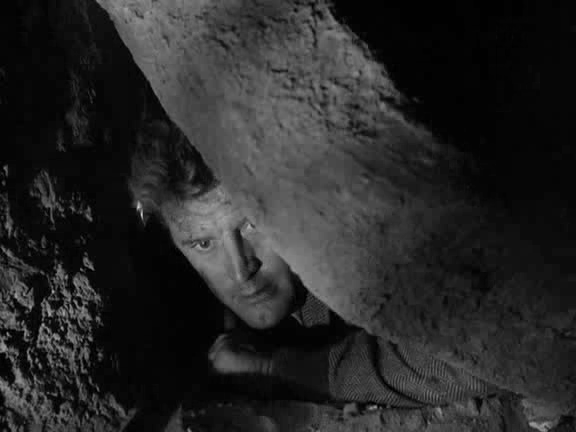
            Wilder’s images in the film are dynamic, with an emphasis on the diagonal throughout. The recurring shot of Chuck peering at Leo through a gap in the rocks has a straight line slashing across the screen, producing a sense of both instability and claustrophobia. A scene of Chuck corrupting the sheriff by promising him a re-election is shot in a tight space to conjure an atmosphere of twisted intimacy. Wilder makes the lighting progressively dramatic, and the shots are increasingly invaded by shadows as the film advances. He films Chuck from a slightly low angle all through, the compositions taking his character from assertive to threatening to positively malevolent.  

             Central to the composition is the figure of Kirk Douglas himself. An emblem of classical, rugged masculinity, Douglas had a face that was uncertain in its signification. While his wavy locks and genial smile gave him an air of a Greek god, his cleft chin, like those of Robert Mitchum and Cary Grant, and protruding jaw line bestowed a slightly sinister aura. Douglas plays with this ambivalence in Ace in the Hole. His characteristic head tilt combines with his leaning posture to accentuate the diagonality of the shots. Douglas peppers his performance with fleeting but eye-catching gestures—a matchstick dragged over a typewriter, the flip of a bottle, a snap of the suspenders, a spectacular drop of his cigarette into a glass of water after persuading the sheriff—to suggest a master rhetorician at work.  

            Chuck is a New York man, a master of the universe for whom a job at a small-town press is just a sojourn. Douglas conveys this sense of superiority in the fable-like first scene in which he strolls, unannounced and unflappably, into the newspaper office to sell himself. His tone and gesture paint him as a man who stands tall over the poor chumps of Albuquerque. But he becomes restless when he finds himself stuck with his $60/week job even after a year. In a remarkable scene filmed in a single shot, he paces about the news room, delivering a begrudging paean to New York life, evoking both nostalgia and desperation. His zing returns when he smells a breakthrough story, and he plays up his east coast exceptionalism by rough-housing a deputy sheriff.

            While within the classical Hollywood tradition of satire, whose practitioners include Charlie Chaplin, Frank Capra and Preston Sturges, Ace in the Hole feels rather modern, partly because Wilder refuses to soften it with a morally upright protagonist. Its lampooning of people vacationing in front of the mountains is broad and caricatural, but it is also discomfiting in its pungent suggestion that it takes a city to bury a man. Like the best satires, Wilder’s film spreads wide outside of its immediate milieu to accommodate a broader cultural criticism.

Ace in the Hole is, in a way, a critique of capitalism, of the American promise of upward mobility so prevalent in its time. Everyone is Wilder’s film is either selling or consuming something at the cost of someone else. While Leo’s condition is a free resource for journalists and businessmen to exploit, Chuck conspires with the authorities to eliminate competition and ensure his monopoly. This idea of a systematic exploitation and commodification of human suffering—and not as the result of a single individual’s moral perversion, but as the rational logic of a system—is part of what lends Wilder’s film its unrelenting and unnerving quality. 


[Originally published at Firstpost]

« Previous PageNext Page »