Birds (Or How to Be One) (Babis Makridis)

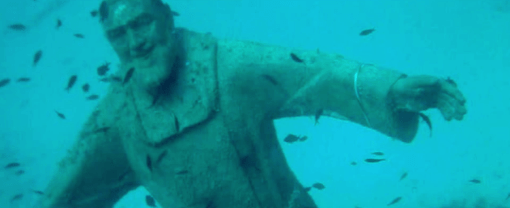
Makridis’ peculiar third feature is inspired by Aristophanes’ comedy The Birds, but it exists between three narrative registers: a documentary about an ‘off’ production of the play by Nikos Karathanos and Onassis Stegi, a freewheeling screen adaptation of the play featuring the same actors in several exotic locales around the world and a poetic essay film about human beings’ relationship to their avian peers. Divided into nine thematic chapters answering the titular question, Birds teases out our eternal quest to emulate our feathered friends: the desire for flight, the yearning for lightness, the urge to escape gravity (literal and social), the impulse to rise to the skies through the construction skyscrapers, the fear of falling and the thrill we harness from it, the fantasy of crossing political borders, but also the need for community and for defending it against outsiders, manifesting ultimately through aerial warfare. Makridis does not emphasize or linger on these ideas, instead suggesting associations through fugitive but evocative images. It is the strength of his film that it does not attempt to ‘interpret’ or ‘modernize’ Aristophanes’ comedy. While it dips in and out of metaphor, Birds takes the outlandishness of the original premise at face value. As a result, the adaptation it offers is literal, one in which the human characters imitate bird cries and indeed audition to become birds, not unlike the two prospectors of Amit Dutta’s The Golden Bird (2011) who try to rise above the human form. In doing so, Birds offers another intriguing demonstration of the Greek taste for the absurd. (The equivalence between man and animal is, moreover, a significant motif in Lanthimos’ work.) This loose, opaque treatment produces results that are as funny as they are flummoxing.

This Is Paris Too (Lech Kowalski)

Kowalski’s freestyle documentary seeks to offer images of Paris not generally seen on screen: homeless immigrants on the outskirts of the city leading a nomadic, shadow existence under bridges, on abandoned sites and in urban interstices. It’s winter, and we watch them fight the cold with inadequate blankets and cheap anoraks, subsisting on community kitchen and standing huddled in the daytime without much to do. A few have built some form of shelter, but most just find a spot to sleep. We see them through the eyes of Ken Metoxen, a native American friend of the filmmaker’s, who wanders the breadth of the city on foot and in public transport. Sometimes Ken interacts with individuals such as Aman, an over-enthusiastic boxer from Afghanistan who cannot participate in ring fights because he lacks the necessary papers. The communication is awkward—Ken does not speak French; Aman doesn’t speak English—and is soon replaced by Aman fervently showing his boxing skills to a compliant Ken. The latter listens patiently as Aman pulls out his phone to show videos of Taliban bombings and tortures in Kabul. Ken empathizes with the suffering of the immigrants through a shared history of oppression. But Kowalski’s choice to refract these vignettes of Paris through a native American’s point of view has no theoretical underpinning. He simply wants to film Ken as a flaneur, experiencing (and revealing to us) a foreign city from an outsider perspective, which leads to an exceedingly long, final tracking shot on Ken spanning several blocks of Paris. Much of all this is impressionistic, and there’s very little that seems to have been thought through, the result coming across like outtakes from a larger project between Kowalski and Ken. In a surprising coda, the director discusses his experience as a child of immigrants to America and his relationship with Ken, who is revealed to be a cross-dresser—a gratuitous, inward-looking turn that hints at several unexplored possibilities.

The Last City (Heinz Emigholz)

Emigholz’s return to fiction opens with a reminiscence by the filmmaker about a dream city that keeps changing place and about people who keep changing shape. This personal statement gives way to five interconnected stories taking place in five different cities: a filmmaker and a weapons designer talk about war in the Israeli city of Beersheba; an elderly artist converses with his 30-year-old self in Athens, a mother finds contentment in her incestuous family in Berlin; in Hong Kong, a Chinese woman schools a Japanese woman on her country’s unspeakable war crimes; an art dealer and a cosmologist discuss the possibility of life outside earth in São Paulo. The Last City scans like a long pedagogical exercise demonstrating everything that shouldn’t be done in films: camera that is constantly canted and misaligned with the horizon, eyelines that never match, cuts that break the 180-degree rule, camera setups that keep changing, actors who play multiple roles of ethnicities different from their own, blatant discontinuities in makeup, costume and décor not just within scenes, but within a single line of dialogue. All this, of course, is part of the setup. Filming pieces of buildings through extreme angles, Emigholz is integrating the city space into the conversations. His ‘last city’ is an ever-changing, universal town that has been homogenized out of its history and identity, just like its people who seem to have no ethnic essence. A wild, entertaining speculative fiction, Emigholz’s film recalls Hiroshima Mon Amour (1959) in the way its characters work on each other’s memory and history in fraught urban encounters. Only that there is neither Hiroshima nor any social taboo conditioning the encounters anymore. Edited in a brisk rhythm, The Last City is also a very funny work in the way it pokes fun at its own ridiculous, disparate premises, which are tied together in some sort of a logic-defying hyperreality.

Undine (Christian Petzold)

If, in Transit (2018), Petzold drew on American film noir to create fruitful frictions with his basic realist style, in Undine, reportedly the first of a new trilogy based on elemental beings, he leans on the legend of the eponymous water nymph whose curse it is that her human lover will meet his death if he is ever unfaithful to her. In Petzold’s version though, it is Undine (Paula Beer) who appears to be cursed, unable to break the tragic mould of the legend. Jilted by her boyfriend, Undine finds an ideal love almost immediately in Christoph (Franz Rogowski), an industrial diver who seems to be as ethereal a creature as her, but fate plays a nasty hand. The film harks back to Yella (2007), firstly in its forked narrative in which the protagonist enters a new life just when everything closes in on her. More notably, like Yella, Undine transposes a supernatural reality onto the banal, hyperrealist surface of reunified Germany. Petzold offsets stretches of dead time showing characters doing everyday activities with evocative images of heightened intensity that signal the coexistence of a fantastic realm. Both Undine and Christoph experience each other as quasi-spectral beings, and because they take turns leading the narrative, we are never sure whose fantasy we are in. Petzold, moreover, imposes another layer of signification onto this composite: Undine is an urban historian dealing with the many narratives that impose themselves on Berlin. Professionally and personally, the past for her, as for Yella, is never dead and buried, but something to be always reckoned with. So the film offers a three-fold narrative, with the romantic story, the Undine legend and a political allegory finding echo in each other. If this layering allows Petzold a way to animate his clinical style with mystery, at times it also gives the impression that he is hedging his bets.

Glauber, Claro (César Meneghetti)

In 1975, Brazilian auteur Glauber Rocha made a film in Italy titled Claro in which he reimagined Rome as the historical centre of imperialism. Meneghetti’s documentary about the film—and about Rocha’s sojourn in Italy—assembles archival footage and interviews with surviving cast and crew members, film critics and the director’s Italian friends. The interviewees watch clips from Rocha’s film and recall how such and such scene was shot. The discussion blossoms outward to include the general social situation of the time: the cultural permissiveness that allowed Rocha and co. to live in apartments without paying rent, cohabit while blurring the boundary between friendship and love, and spike each other’s drinks before shoot. With interesting anecdotes about the Brazilian’s bluster and idiosyncrasy, the testimonies help locate Rocha within the intellectual landscape of Italy at the time. Throughout, Meneghetti cuts outdoor scenes from Rocha’s film with shots of the same places in current-day Rome, suggesting the demise of radical political dreams, but evoking certain continuities as well. Interestingly scored, these interludes also serve as spaces of reflection for the viewer, a respite from all the talking heads. In all, we get a sense of Rocha’s complex relationship to the European country: even as he was criticizing it as a ‘colonizing’ empire, the filmmaker saw in Italy a channel for distributing Cinema Novo works and, indirectly, a rampart against the growing authoritarianism back home. But there is hardly any rough edge to Rocha himself. His Latin American background gets little notice and he comes across as a mad prophet conjured into existence in Rome. Most collaborators describe him as an eccentric visionary who saw beyond his time, some others speak of their great love for him. But one piece of priceless archival clip at the end alone makes up for any deficiency: Rocha having a glorious public meltdown after the 1980 Venice Film Festival, where he destroys Louis Malle (‘second-rate filmmaker’), Cassavetes (‘commercial director under avant-garde garb’), Michel Ciment (‘takes American money’), Andrew Sarris (‘CIA-backed imperialist’) and other ‘Hitchcock lovers’.

Film About a Father Who (Lynne Sachs)

At first glance, Lynne Sachs’ latest documentary comes across as another iteration on the now all-too-common work of ‘personal archaeology’ in which filmmakers trace their roots through public and private archives, at times rending open the specific ways their unhappy families have been dysfunctional. Sachs, for one, employs home movies shot over half a century in half a dozen formats—8mm, 16mm, VHS, Hi8, Mini DV and digital—by herself, her father and her siblings, filmmakers Dana and Ira Sachs. The material turns around their father, Ira Sachs Sr., a ‘hippie businessman’ who sowed his wild oats across the world and virtually birthed a baseball team. Senior’s constant womanizing comes down heavily upon his children, some of whom have known the existence of the others only after decades, but also upon his mother, with whom he nevertheless shares a close but complicated relationship. Sachs weaves through years’ worth of footage and layers it carefully into a simple, direct account with a voiceover addressed at the audience. She takes what could’ve been a narrow family melodrama into much stickier territory. As she says, the film isn’t a portrait of her father, but a meditation on relationships with this man as the connecting element. Sachs and her siblings sit with their father, now infirm with age, and ask him to recollect episodes from the past. What do they expect? Confession? Reckoning? Simple testimony wrought from a gradually vanishing consciousness? Sachs goes beyond all gut responses to her father’s behaviour—disappointment, rage, disgust—towards a complex human reality that can elicit only inchoate sentiments, as suggested by the film’s incomplete title. She isn’t filming people or their stories, but the spaces between people, and how these spaces are always mediated by the actions of others. Senior’s wayward life, itself rooted perhaps in a traumatic childhood, profoundly shapes the way his children look at each other. Two living room discussions are intercut as though they are unfolding in the same space, the only way the filmmaker is able to bridge these invisible branches of the family tree. Sachs’ film is ostensibly a massive unburdening project for her; that she has been able to draw out its broader implications is a significant accomplishment.

[From Luc Moullet’s Fritz Lang (1963/70, Seghers). See Table of Contents]

Critique of Our Times

Clash by Night (1951) is an adaptation of a play by Clifford Odets. Lang is certainly at ease in modern New York theatre which wallows in the spectacle of human degradation. But where the New Yorkers ascribe degradation to a kind of undefined Ananke, clumsily associated with the social constitution of America, and mostly explicable by the playwrights’ resentments, Lang insists on the notion of responsibility. Fate, represented once more by the movement of waves, becomes one with the realist document, the presentation of port life, boats and fishermen in the credits sequence.

This time around, the characters are bestowed with a certain psychological depth, which rules out implausibility. After ten years of tumultuous life, Mae comes back home to lead a more orderly existence; she marries Jerry, a brutish and unsophisticated fisherman older than her, whom she leaves for one of his friends; but she returns to her house for her child. Jerry is full of good will, but can’t understand a woman who has lived in other milieus. In contrast, Earl the lover is rather abject; with Jerry refusing to hand over the child to the adulterous couple, and Mae refusing to leave without the child, he splits without confronting Jerry. Earl is a violent lunatic.

It’s one of the rare occasions in Lang’s work where secondary characters have their own existence, which can be explained by the faithfulness to the original play. There’s the completely senile grandfather, tormented by the image of an abandoned baby girl, the infirm and alcoholic uncle, and especially the typical young American couple: Marilyn Monroe plays a worker who knows perfectly what she wants, where she’s going and whom she wants to marry. The man she has chosen, Keith Andes, is passive, listless; he lets himself be led around by the nose. It’s a microscopic study of American society, run by women, just as they dominated the fake Übermenschen of the German period.

(more…)

Judy Versus Capitalism (Mike Hoolboom)

Hoolboom’s hourlong documentary is a biography of Canadian feminist and activist Judy Rebick presented in the voice of the subject herself. Divided arbitrarily into six chapters—titled ‘weight’, ‘abortion’, ‘others’ etc.—it traces Rebick’s childhood, the influence of her father on her romantic life, her first activist interventions, her conscious decision to gain weight as a defence mechanism, her involvement in the pro-choice movement leading up the legalization of abortion in Canada, her mental disorder and its roots, and her continuing struggle for the cause of social justice. As the years progress, we see Rebick’s concern grow beyond feminism, gradually encompassing questions of mental health and Israel-Palestine, and we end up with a picture of resistance and activism as a way of life. The account is chronological, and Hoolboom lets Rebick’s words drive the narrative. He illustrates her words with photos and videos from her personal album or associated archival footage from the corresponding time periods. The film is at its most inspired when Rebick opens up about her dissociative identity disorder, about the way it serves as a protective shield against the trauma of childhood abuse. As she talks about her various alters, Hoolboom, whose Scrapbook (2015) constitutes one of the most resonating cinematic explorations of selfhood and the ego, cuts to a series of faces of different ethnicities, genders and ages—a witty, sideways association with Rebick’s activism that’s constantly bound up with the question of ‘others’ outside herself. But for the most part, Judy Versus Capitalism falls short of its inventive title and remains a conventional portrait. Because Rebick’s testimony is powerful and stands on its own, Hoolboom is (rightfully) obliged to respect it and let it take centre stage. As a result, there’s little here that couldn’t have been accomplished by a more academic documentary.

From Time to Time, I Burn (Carlos Segundo)

With his dazzling debut Slits (2019), Brazilian filmmaker Carlos Segundo initiated a meditation on the nature of the digital image, and its relation to reality, memory, loss and mourning, against a backdrop of flagrant social inequality. In From Time to Time, I Burn, he continues this interrogation into the ontology of images and the way they fundamentally alter reality. But this time, he approaches them from the other end of photographic history. The quantum physicist of Slits studying high-definition digital images makes way for an experimental photographer, Louise (Rubia Bernasci), who works with the most rudimentary of photographic devices: a pinhole camera that she exposes to orchestrated movement of human bodies for several minutes. Standing naked before the device, she enacts a pseudo-ritual of seduction with another model. With its aperture always open, the camera ‘combines’ these bodies in a process of chemical communion into an organic composite in which racial and gender distinctions don’t hold anymore. Louise, an Afro-Brazilian who takes care of her pious, ailing mother, experiences a kind of religious epiphany when one of her models whispers something into her ear. Like Slits, From Time to Time is an enigmatic film about a subjective experience with images, and its narrative feels like an abstracted version of a longer treatment. In a short introduction, in which he also expresses solidarity with artists resisting the current “political virus” in Brazil, Segundo cites the Holy Trinity as an inspiration for both works. The claim is as baffling as the new film, but one gets the sense that, for Segundo, there’s something fundamentally religious about image-making, particularly in the kind of transubstantiation it effects between reality and representation. It may be that Segundo is shrouding very concrete political ideas in quasi-religious mystery, which seems to be a foundational value in his films. His subsequent work will, no doubt, throw more light.

Marriage Story (Jessie Jeffrey Dunn Rovinelli)

In its pared-down quality, Marriage Story seems to take off from the audiovisual abstraction that So Pretty (2019) ended with. This new short film does away with many of the narrative layers of the latter feature—community life, literary adaptation, political action. Even the carefully panning camera and exceptionally dense sound design of So Pretty give way to simpler formal elements. In fact, there are only three shots in the film, which may narratively be described as a rudimentary sketch of an afternoon session of sex between Rovinelli and her girlfriend Anika Kash. In the first, the filmmaker prepares coffee on a stove. In the second, she and Kash make love on the living room couch while, in the third, Kash sits on a chair reading out a text detailing a passionate sexual encounter with another woman. Bright red frames punctuate the film, and they constitute the entry and exit images as well. In every shot, a quotidian middle-class décor is subverted with elements that don’t typically belong there. The kitchen of the first scene is a picture of conventional piety and domesticity, complete with a religious painting on the wall. But Rovinelli has a slow stream of red light wash over the muted colours of the kitchen as though from a discotheque or a police siren. Combined with the sight of Rovinelli’s unconventional, naked body with its tattoos, breasts and dense armpit hair, the setting becomes something else. Similarly, in the third shot, we only see Kash’s ‘topless’, bare body on a chair, while a television set next to it projects the image of her head speaking the lines. Drawn from disparate sources, including the Song of Songs and writings by St. Theresa of Avila, the text conflates sacred and profane ecstasy in a manner that recalls Bernini’s St. Theresa. With all this, Rovinelli appears to be reintegrating what bourgeois religiosity keeps apart, i.e. the experiences of the spirit and the flesh.

Fireball: Visitors from Darker Worlds (Werner Herzog, Clive Oppenheimer)

Thank heavens for Werner Herzog, for he is one of the few remaining auteurs who still believe in the capacity of film for cosmic reflection, in whose work man is more than a moral-political creature. The visitors in Fireball are meteorites, i.e. rocks and dust formed millions of years ago in the far reaches of the universe that grace the earth. Herzog and British geologist Clive Oppenheimer go across the world in search of stories about these interstellar travellers—myths, legends, rituals, scientific accounts—even accompanying an Antarctic expedition for space rocks. They position these meteorites as objects alternatively of scientific research and around which the film’s human subjects create meaning: the rocks are rare minerals, but also existential tokens, like cave paintings, whose transhistorical origin relativizes our own lives. This bivalence could produce two different responses to the film. A viewer looking for a scientific investigation could be frustrated by the mystification Herzog’s methods bring, just as a viewer seeking philosophical edification could find the geological explanations wanting. While the film’s scientific orientation could arguably be ascribed to the influence of Oppenheimer, the manner in which it juxtaposes the absurd and the sublime is vintage Herzog. It’s the mark of the filmmaker’s strength and sophistication that he is able to identify both these potentials in his material without undercutting the value of either. Under his camera, the eccentric takes on a heroic aura just as the erudite acquires a touch of the ridiculous. Herzog shies away neither from Malick-like preciousness nor from Hollywood cynicism; he can break a solemn philosophical mood by joking that Bavarians like him are not made of stardust, but he can also provoke a tear or two with a cut from an aboriginal painting to a telescopic view of a meteorite crater. A borrowed shot of an explorer breaking down at a momentous discovery while the rear end of a busy team member occupies the background of the frame sums up the film’s all-accommodating generosity. Apt, considering the film’s theme is the twin role of meteorites as a destructive as well as a life-creating force.

Tenet (Christopher Nolan)

Christopher Nolan is a fanatic who has been increasingly willing to throw himself under the bus for the sake of his truth. Interstellar (2014) left behind his fanboys, Dunkirk (2017) thumbed its nose at sacred filmmaking tenets, while this new film ventures into even more untested terrains. That he has gaged a $250 million project for his personal desire to revive cinemagoing in the middle of a pandemic, moreover, cannot be ignored while evaluating the film. The world’s most popular poet of time has, once again, conceived of an ingenious, impenetrable syuzhet in which narratives in forward and reverse chronology are woven together within the framework of a spectacular if old-fashioned Euro-thriller: a CIA operative (John David Washington) must thwart the efforts of a future generation that seeks to annihilate all past in order to preserve itself. This chronological mesh makes for some unwittingly funny, but eye-popping reverse motion sequences that descend directly from the Lumières’ self-constructing wall. What’s impressive about Tenet, and its predecessor, is the filmmaker’s unapologetic privileging of an abstract figure of style over grammatic or affective considerations: the ‘trans-temporal’ crosscutting in Dunkirk, reverse motion here. In a way, these are bold, formal experiments that, in their failure, throw light on the mechanisms of classical storytelling. Nolan, who has always taken care to place his characters’ emotional or moral predicament at the centre of his narrative contraptions, does away with it in Tenet, Washington’s unflappable protagonist being little more than a sexless, humourless cipher. Despite the overwhelming intensity of the exposition scenes, he has also seemingly let go of the need to tie up the logical loose ends of his hypothesis, letting the contradictions and loopholes remain as they are. While a more thoughtful story could’ve drawn out all the themes of the intriguing premise, it is notable that Nolan, who has been crusading to preserve and employ celluloid from within a media climate hostile to such backward-looking attitudes, chose to make Tenet the tale of a man who fights to preserve the past at the expense of the future.

Corporate Accountability (Jonathan Perel)

In Toponymy (2015), Perel pursued the traces of Argentina’s military dictatorship on its landscape, examining in essence the way governments inscribe preferred narratives onto geography. In the new film, he continues this exploration by looking at the role of large private corporations in enabling and carrying out state-sponsored pogroms against political dissidents of the junta. The structure is simple: in static shots from the dashboard of his car, Perel photographs the company facilities as they are today while a brisk voiceover lists out how each firm helped military and security forces detain, torture and get rid of problematic workers in exchange for financial perks. The text, read out from an official 2015 report, is numbingly repetitious, and drives home the pervasiveness of these military-industrial operations. Perel’s decision to frame the sites through his car’s windshield creates a sense of illicit access, even though there is visibly little stopping him from going nearer the facilities. Some of the companies continue to operate under their own name, while some others have changed, with at least one site carrying a memorial sign for the injustice perpetrated there. Perel is, in effect, photographing the ur-filmic image of factory entrances, but all we see is a handful of vehicles leaving the gates. This eerie absence of human figures evokes the disappeared workers who, at some companies, were picked up at the entrance, a site, as Farocki has demonstrated, of class dialectics. But Corporate Accountability also exhibits kinship to landscape films such as Too Early, Too Late (1981), Landscape Suicide (1986), and to the more recent Did Wolff von Amerongen Commit Bankruptcy Offenses? (2004) and Status and Terrain (2019). The question that Perel raises is this: how do you film criminal responsibility when you are removed in time and space from these acts, and when you can’t put a face on to the perpetrators? After all, corporations aren’t people and you can’t indict a logo. The filmmaker foregrounds this crisis of representation by emphasizing the primacy of the source report, which carries the burden not just of describing the crimes but of differentiating criminal accountability from mere complicity. Perel’s reading out of the report’s copyright page is thus bitterly ironic since adapting it is precisely what he cannot do.

[The following is a translation of a program note that Godard wrote on Fritz Lang’s The Return of Frank James (1940). The note, originally written in 1956 on behalf of UFOLEIS (Union française des œuvres laïques pour l’éducation par l’image et le son) for film club screenings of the film, was republished in Godard par Godard (1985, Cahiers du Cinéma). 

A. Presentation

I. The Director: Fritz Lang

 The Return of Frank James is the third film Fritz Lang made in the United States. F. Lang was forced to flee Germany when Hitler came to power, and he had taken refuge in France (where he made Liliom) before leaving for Hollywood, where he settled down in 1934. Naturalized as an American citizen in 1939, Fritz Lang is today a veteran of Californian studios and, like his compatriot Otto Preminger, has adapted himself to them very well. He’s the last representative, along with Carl Dreyer, of that glorious era which saw the combined talents of Griffith, Eisenstein and Murnau (on this subject, refer to a volume of film history for F. Lang’s role during German expressionism).

Fascinated by the Far West since his youth, he worked from 1938 to 1940 on a film that would retrace the entire history of the American West, a sprawling fictionalized documentary like the one Eisenstein had attempted with Mexico and the one Orson Welles would dream of with Brazil. The project was shelved, but Lang’s penchant for the Far West and its legendary heroes encouraged the head of 20th Century Fox, Darryl Zanuck, to entrust him with the direction of a typical Western, The Return of Frank James, which marked Lang’s debut in colour film.

II. The Western

It would be incorrect to classify the Western as a separate genre. What sets a Western apart from other films is only the setting in which it unfolds. In fact, there are historical Westerns, crime Westerns, comic Westerns, and cowboy psychology can be as meticulously probed as those of Bernanos’ peasants or R.L. Stevenson’s adventurers. To be sure, characters in Westerns are among the most ‘stereotyped’ in the whole of cinema, but that’s because myths play a significant role in their existence. Jesse James [1], the ‘beloved bandit’, or ‘The Durango Kid’, are first of all heroes from legend; they are treated by screenwriters as such, in the same way as The Song of Roland or Chanson de Guillaume. That explains the frequent comparisons made between their reactions and those of Corneille’s characters: the same concern to act solely on the given word, the same respect for a homespun morality ruled by a sense of honour.

III. Practical Tips

As part of the projection, we could use the disc Rocky Mountains of Times Stompers (Vogue EPL 7201) in order to create an ‘ambiance’ that will put the viewer in a favourable mood. This disc includes famous tunes from the Far West such as Oh Susannah, Old Faithful, Down in the Valley etc.


B. Discussion

I. Dramatic Value

a) The Return of Frank James is the story of a revenge. After gaining notoriety in the West, the James brothers lead a peaceful life. Frank learns from one of his friends, Clem, that Jesse has been murdered by the Ford brothers, their old enemies, who have been acquitted after a trial. Frank, followed by Clem, vows to avenge his brother and sets out in search of the Fords. To get the money that they need, Frank and Clem hold up a cash desk at a small railway station, but a clumsy move by Clem ends in the death of an employee. Frank is wanted for murder. In order to mislead the Fords, Frank passes himself off as dead with the help of Clem and a young rookie reporter, Eleanor Stone, whose articles about the death of the famous Frank James create a nationwide sensation. This way, Frank manages to catch the Ford brothers off guard. One of the Fords plunges fatally during a fight, but the other, Bob, manages to escape. Wanting to save Clem [2], who is charged with the death of the railway employee, Frank James falls into the police’s hands. Bob Ford reappears during his trial and taunts his adversary. But Frank is acquitted thanks to a skilful defence by an old lawyer friend of his. Right away, Frank goes after Bob Ford, who flees after he hears the verdict. Young Clem tries to stop him, but he is shot in the fight and dies in Frank’s hands. Bob Ford is also hurt and dies in a nearby barn. Having had his revenge, Frank James marries Eleanor, the pretty journalist.

b) The theme of vengeance is Lang’s favourite (we find it in all his works, in the second part of the Nibelungen films, in Man Hunt, in Rancho Notorious, in The Big Heat): a man leads his peaceful little life and refuses to poke his nose into other people’s affairs until he loses someone dear to him. He takes law into his own hands, not in the name of society, but on his own behalf.

All of Lang’s scripts are constructed the same way: chance forces a man to come out of his individualist shell and become a tragic hero insofar as he ‘forces the hand’ of the fate abruptly imposed upon him.

II. Cinematic Value

a) Fritz Lang’s mise en scène is of a precision that borders on abstraction. His découpage is a mixture in which intelligence trumps sensitivity. Fritz Lang is more interested in a scene as a whole than in an insert shot, like Hitchcock for example. The role of sets is primordial in each one of his films. Let’s recall that he was once a brilliant student of architecture. One image could singlehandedly define Fritz Lang’s aesthetic: a policeman takes aim at a fleeing robber and is about to kill him; in order to bring out the inexorable quality of the scene better, Lang has a viewfinder attached to the gun; the viewer immediately senses that the policeman cannot miss and that the fugitive must mathematically die. 

b) If The Return of Frank James has an happy ending, in contrast to so many of Lang’s other films, it shouldn’t be seen as a concession to the American censors. Going beyond the moral man, Fritz Lang arrives at the sinful man, which explains his bitterness. But more than the sinner, it’s the study of the regenerated man that attracts the most Germanic of American filmmakers. If the fierce individualist Frank James finally finds happiness, it’s only after he is rewarded morally for his troubles. “Why are you so happy today?”, asks his fiancée; “Because, from today, I can look at myself in the mirror without feeling ashamed”, replies the former outlaw.

III. Additional Reading

– The Western: Or the American Film Par Excellence, J.-L. Rieupeyrout and A, Bazin (Éditions du Cerf).


(UFOLEIS notes published in Image et Son, issue no. 95-96, Oct-Nov 1956)


Footnotes:

[1] Cf. Jesse James, a film made by Henry King in 1938, whose sequel is The Return of Frank James.

[2] [Translator’s note] It’s actually Pinky, Frank’s black ranch hand, who is charged with murder.


[From Luc Moullet’s Fritz Lang (1963/70, Seghers). See Table of Contents]

II. MATURITY (1951-1960)


Critique (1951-1955)


Having attained complete maturity, as much in expression, progressively simpler if we discount the recent tendency for aestheticism (1945-49), as in content, which glorifies man’s adaption to the world and rejects revolt, Fritz Lang now assumed a higher perspective, posing a judgmental eye on the world surrounding him, contemptuous and sarcastic, whose finesse went completely over critics’ heads. This severity was that of a wise, old man who was now more than sixty, but also that of an isolated and bitter man and especially that of a foreign observer who reacted violently to the social order imposed by the American way of life. This scepticism produced by the vision of contemporary reality found an echo in the evocation of times gone by. There was now, on one hand, a critical vision of this romanticism, of this spatial and temporal exoticism once so dear to Lang, in two “historical films”, the western Rancho Notorious (1951) and the adventure film Moonfleet (1954). On the other hand, there was a critique of contemporary mores in Clash by Night (1951), The Blue Gardenia (1952), While the City Sleeps (1955) and The Big Heat (1953).

Critique of Romanticism

Made for the producer of House by the River, the Technicolor film Rancho Notorious (1951) follows Frank Haskell, who shoots the accomplice of his fiancée’s murderer and hears the man’s final words on his friend’s whereabouts: Chuck-a-Luck. Wandering the West seeking his vengeance, he learns that Chuck-a-Luck is a ranch in the wilderness offering a hideout for thieves in exchange for 10% of their loot. Frank gets deliberately imprisoned with Frenchy, the lover and the second-in-command of Altar, the lady boss and owner of the ranch. He manages to get to Chuck-a-Luck, suspects Frenchy, but discovers the real culprit and has him arrested. Suspecting Frenchy of a betrayal, the bandits shoot at him, but kill Altar who gets in the way.

The theme of vengeance isn’t treated here as dogmatically as before. There’s no evolution for the hero, who, at the most, stays back a little too long at Chuck-a-Luck, where everything is so nice and pleasant. Vengeance mostly represents a poetic and mythic force here. Rancho Notorious in fact showcases the myths of the Western, and views them with a critical and disabused eye. The real hero here is a woman, played by Marlene Dietrich, who rules the lair of bandits—as magnificently organized as Mabuse’s gang, with everything in proportion—with an iron fist. Frenchy the cowboy is little more than a prince consort. In the thoroughly moral universe of the Western, what dominates is robbery, rape, and murder, as Frank affirms at the end in a speech full of lyricism. In a brief flashback, Lang seems to lament the good old days of the traditional Far West. The whole film is drenched in a cold atmosphere that accentuates the desolate quality of the setting. The limitation of human power is underlined by the omnipresence of luck, roulette wheels, and games of chance. The ranch itself is called Chuck-a-Luck. These themes and critical observations are diluted in the very natural presentation, in the realist discretion of this apparently lazy chronicle, which doesn’t exclude the virtues of friendship between men from its framework. Honour and word aren’t empty terms here. This objectivity constitutes the film’s strength.

(more…)

Autofiction (Laida Lertxundi)

Autofiction, the first of Basque-origin artist Lertxundi’s films I’ve seen, opens with an establishment shot of a city skyline. A while later, we are on the sunlit roads of the metropolis, where a cavalcade of police motorbikes prepares for a rally. Cut to bodies of various unconscious women being dragged on concrete and loaded on to a truck. Before we can figure out what’s happening, we are presented with short testimonies of women talking about motherhood, abortion and loneliness, testimonies that are cut with vignettes from the MLK day parade in the city. The bright pastel colours that compose the studio the women are photographed in, combined with the big, yellow typeface of the title and the sunny outdoors, suggest a pastiche of cheerful Reaganite suburbia. At one point, a woman crawls out of her living room couch into her large, suburban backyard to settle into a foetal position under the sun. But what’s the connection? I presume that the crimes taking place in broad daylight, whose perpetrators we don’t see, tie metaphorically with the women’s accounts, in which post-maternal deracination, post-abortive disorientation and post-separation depression are all conceived in terms of personal choices and experiences, independent of structural forces conditioning them. By intercutting these testimonies with a civil rights rally, Lertxundi is restoring the political character to these personal experiences. At the end, a rectangular opening on a card frames parts of women’s bodies separately, hinting at the unity behind these fragments, just as Lertxundi evokes the socio-political unity shaping individual experiences. The title, moreover, implies that Lertxundi might be articulating details of her own life through these accounts, thereby scattering her subjectivity and rendering it interchangeable with those of the women she films.

Orphea (Alexander Kluge, Khavn)

In Orphea, 88-year-old Kluge and 47-year-old Khavn revive the Orpheus-Euridice myth as an avant garde punk musical. In this version, Orpheus becomes a woman named Orphea (Lilith Stangenberg) while Euridice is a man called Euridiko (Ian Madrigal) and the underworld itself is Manila at night time. The filmmakers treat the myth rather loosely, converting it into a string of ‘set pieces’, in which Orphea is either navigating one lair of degenerates after another or reading out lines of Ovid from a teleprompter, or belting out arias and folk tunes in half a dozen languages in front of a matte screen. Unlike Straub’s inconsolable one, Orpheus here seems to get along just fine without Euridice. The result resembles a blithe experimental video game produced by Maya Deren and Kenneth Anger. Through Orphea’s valiance but also her ultimate impotence, the filmmakers mount something of an elegy for the revolutionary potential of art. One of the suppositions is this: what if, despite Orpheus’ desires, Euridice didn’t want to be rescued? Orphea is regularly transported to wartime USSR, and mourns its countless dead, seeking, like the Soviet ‘biocosmists’, justice for the dead. Towards the end, the present also makes its way into the film in the form of border surveillance footage and refugee camps. The connections are often only suggestive, such as Orphea’s descent in the Lethe river invoking the sea route of contemporary migrants. Strangenberg appears in most every frame and is a hypnotic presence, and there is never a dull moment in the film. Kluge’s heterogenous style—on-screen texts, multiple sub-frames, stop-motion animation, declamatory text readings, archival photos and found footage—goes really well with the atmosphere of pure play. But it is literally a mixed bag where anything goes, so your mileage may vary.

Movie That Invites Pausing (Ken Jacobs)

Ken Jacobs’ film is dedicated to his teacher and abstract expressionist painter Hans Hofmann, whose legendary classes are part of almost every historical account of 20th century art. Hofmann’s painting and pedagogy emphasized the use of flat colour fields to generate the perception of depth, the impression of planes emerging or receding out of the canvas surface. Jacobs finds a filmic equivalent to this idea, producing the illusion of movement and dynamic colour without relying on pro-filmic reality. This is the setup: over the camera lens lies a fabric (or a translucent material) made of a hexagonal beehive pattern that gradually changes orientation over the course of the film. With what seems like a slightly mobile camera, Jacobs appears to photograph a liquid surface, first, and then some crystalline solids lit by stroboscopic light flashing at 120BPM (either that, or he has inserted these ‘black leaders’ artificially). At first, the result registers like the sight of a patterned gold foil slowly melting, but soon the hexagons vanish ‘underneath’ the liquid. Towards the end of the film, however, the fabric/material dominates the foreground, with the hexagons strongly asserting themselves with their dark borders. This receding and the emerging of the textured plane and the creation of new depths ties to what Hoffman called the ‘push and pull’ of the painting, the feeling of airiness that you get when you stare long enough at a Pollock, for instance. The strobing light also causes the hexagons to ripple like the liquid and ‘animates’ the surface into repetitive, gif-image like movements. More than pausing, which allows you to see various hues of gold and orange on the image, it’s speeding it up or slowing it down that the film tempts you to; playing it at 0.25x or 4x its speed illuminates its process better.

Inventing the Future (Isiah Medina)

Inventing the Future, Medina’s second feature, is adapted from a book of the same name by Nick Srnicek and Alex Williams. The text in question describes the limitations of the current ‘folk politics’ of the left and contrasts it with the long-term vision with which Hayek and the Mont Pelerin Society conceived, disseminated and installed Neoliberalism into the ‘political common sense’ through universities and think tanks. An accelerationist outline for the future, it calls for a radical increase in automation that would result in fewer jobs, which, combined with a Universal Basic Income, could help reinvent newer forms of the self and the social. These rather weighty political ideas of the text are concentrated and tossed at us by the soundtrack—as read out by a girl who appears on screen from time to time—which Medina uses as a foundation for some extremely aggressive imagery. His blindingly rapid montage solders together what may be 25,000 shots in such a way that, in many stretches, we barely have time to register what we’re seeing. Even when a locus of anchoring images—crowds, people with phones, Lego blocks, the voiceover girl—constitute a set of identifiable visual motifs, the truculent editing forecloses any possible synthesis. Even the voiceover text, whose relative simplicity allows us to gather ourselves, is periodically chopped up and interrupted by an atonal piano melody or by another overlapping voiceover saying something else. Medina’s film appears to bear a mimetic relation to its source text in the sense that seeks cinematic correlatives to the ideas expressed. While the lightning-fast montage may be said to imitate the cognitive processes of the schizophrenic attention economy, the notion of UBI translates here to a universal access to image-making—thanks to ubiquitous cell phone cameras—which questions the need for new image production and shifts the burden of creative expression onto editing—a proto-Godardian idea. Conceptually strong though it may be, the punishing formal violence of Medina’s film makes it physically painful to watch.

IWOW: I Walk on Water (Khalik Allah)

While it continues and refines the street portraiture of Field Niggas (2015), Khalik “Danny” Allah’s IWOW also addresses the central moral-aesthetic issue weighing down on the earlier film, namely the filmmaker’s fraught relation to subjects whose consent in collaborating with him may not be wholly free and who, by dint of this power imbalance, run the risk of being commodified. As though in response to this problem posed by his obscured authorial position, Khalik places his self squarely at the centre of IWOW, where he claims to be nothing short of Jesus himself. This claim is, of course, tongue-in-cheek as Khalik confesses to having been inspired by the psychedelic mushrooms he keeps consuming. But it’s also a dramatic ruse that allows him to brashly interpret his work of ‘saving people’ in terms of Christian iconography and test it against the charity of his well-meaning family and friends, who are understandably concerned by his radical altruism. Khalik interrogates the limits of his own goodwill through his relation to Frenchie, an elderly Haitian street dweller with a speech impediment and a drug addiction, with whom he has worked over the past seven years. By his own admission, Khalik is a universalist who sees the same human essence binding everyone. To this end, his editing pattern disregards social hierarchies, cutting between extreme close-ups of outcasts and his friends and family in a manner that is often very provocative. Yet his focus is on the stories of those at the absolute bottom of the social ladder living on the streets of Harlem. The reason for this comes by way of an explosive monologue by one of his subjects, who describes the historical process behind the neighbourhood’s impoverishment and the real threat posed by gentrification; we then understand that the people Khalik films won’t be allowed to exist as they are once the district becomes ‘respectable’, i.e. the kind of place that will screen Khalik’s films and organize his exhibitions—a contradiction that the filmmaker reveals to be fully conscious of.

Sportin’ Life (Abel Ferrara)

Ferrara’s new documentary follows works by Daido Moriyama, Vanessa Beecroft, Bret Easton Ellis, Gaspar Noé and Wong Kar-wai as the sixth project commissioned by Saint Laurent as part of their project titled Self, which purportedly celebrates self-expression in the arts. Running for just over one hour, Sportin’ Life combines personal footage from Ferrara’s festival Q&As, media interviews, his concerts as a bass guitarist, television reports, internet videos, sessions from the US congress, Ferrara’s family photographs and clips from his own films. The interview excepts are quite direct and present Ferrara, invariably accompanied by his favourite lead man Willem Dafoe, talking about collaboration, making films with friends and family, and his approach to his craft. Interspersed with them are news reports about the Covid-19 crisis, Donald Trump’s feckless response to it and the mounting deaths in Italy and the US. It’s indeed striking how Ferrara is able to mould such pre-charged, disparate material into recognizable, personal imagery, with its references to Catholicism, its sense of being locked indoors, and the general end-of-days ambiance that pervades so much of his films. It’s as though the world has finally caught up with the dystopian fiction of 4:44 (2011), and so Dafoe gets to deliver his Dalai Lama-like monologue once again. On one level, Ferrara, holed up with his family in his apartment in Rome, is meditating on creation at the time of global destruction. The way he ironically superposes his concert music on low-fi footage of people dying drives home the idea of art’s impuissance in a more unequivocal manner than does Orphea. But the film is also Ferrara’s answer of sorts to public narratives about his oeuvre. In interviews and Q&As, we see journalists attach labels to his work—dark, radical, indie—that Ferrara doesn’t bother acknowledging. With this film, he appears to be simply ‘making his next move’ unmindful of the end game, i.e. responding to his immediate circumstances, remaining alert to the moment and, if we go by the equation ‘Pasolini=Dafoe=Ferrara’, making films as an existential coping mechanism. Towards the end of the film, however, Ferrara casts these sundry elements into a malevolent vision of the universe; the killing of George Floyd, the ensuing riots and violence are all stripped of their immediate, political meaning and shaped into a metaphysical picture of chaos. Maybe Ferrara is playing Nero more thoroughly than he imagines.

[From Luc Moullet’s Fritz Lang (1963/70, Seghers). See Table of Contents]

Crime Dramas (1944-49)

The war about to end, Lang turned to more intimate, less general subjects set within the scope of contemporary America. The Woman in the Window (1944), Scarlet Street (1945) and Secret Beyond the Door (1946) form a new trilogy, to which we can add House by the River (1949) and which can be called psychological, even psychoanalytical, crime dramas. After the struggle against Nazism, here’s a struggle with oneself.

Featuring the same actors, three of whom are present in the first two, photographed by the same cinematographer, and the last two produced by the company Lang founded, Diana, these films are hinged on repetitions. An evolutionary repetition with corrective variations from one film, one scene to the next. Like certain great filmmakers, Hawks for example, Lang is a specialist of remakes, the first form of repetition. Remake of films by others: Scarlet Street is a remake of La Chienne (Renoir), Human Desire that of La Bête humaine (Renoir), Der Tiger von Eschnapur and Das Indische Grabmal those of Das Indische Grabmal (Joe May), only written by Lang. We must also count the four Mabuse pictures (1922, 1932, 1960), the multiplication of films through two versions or two very different episodes, whose fans know that one is always superior to the other: one must be “for” Das Brillantenschiff, Dr Mabuse, der Spieler, Kriemhilds Rache, Das Testament von Dr. Mabuse, Der Tiger von Eschnapur, and “against” Der goldene See, lnferno, Siegfried, Le Testament du Dr. Mabuse, Das Indische Grabmal, films of a more demagogic beauty. Not to mention constant reworkings from one film to the next, reworkings that are more often of themes than of forms. For the same theme, Lang would conceive of different forms, the second of which improved on the first; similar forms, however, appeared across different genres and subject matters. That’s why it’s impossible to distinguish between a still from Scarlet Street and one from The Woman in the Window, while the films seem very different when watching them.

Repetition from one scene to the next, because Lang, who seeks to deepen reality, realizes the complexity involved, corrects the first attempt with a second, contrary attempt. Hence the principle of double endings, partially considered in Fury. At times, Lang credits himself for it (cf. his statements on The Woman in the Window), and at times, he rejects it, attributing it to an interference by the production company afraid of the Censor Code (Beyond a Reasonable Doubt). It’s possible to believe that this denial served as Lang’s excuse against criticisms of implausibility that were made over the extraordinary twists towards the end of the film, or that it shows an influence of his detractors or his friends following the completion of the film. Perhaps the Hays Code did occasion these twists, but Lang was always able to integrate the corrective ending into his own world view. The consistence and sameness of this principle, at times admitted to by Lang and foreign to American cinema, has to do in fact with his metaphysics and moral codes: man constantly oscillates, as we have seen, between revolt and submission to law or to his own individual reasoning. His reasoning rests on trifles, and it isn’t unusual that there are multiple endings, because if chance plays an essential role in human life, the direction it takes is purely accidental. Reality always has two faces and undercuts the importance that tidy endings enjoy among the audience, which is used to neat dramatic structures in line with an artistic order reflecting a Social Order. Only the action counts.

(more…)

The Salt of Tears (Philippe Garrel)

A young man at a bus stop glimpses a girl across the road. She gives him directions, and they board a bus together. There’s a spark between them. They look at each other, making sure their eyes don’t meet. The girl has fallen in love, the man hopes for a sexual encounter that doesn’t happen. “I’ll never forget you”, he says before he leaves town. Weeks later, the girl sends him a card, pouring out her feelings for him. He reads it and locks it up in a drawer without a thought. It’s hard to describe The Salt of Tears, or any of Garrel’s recent films for that matter, without running the risk of making it sound like a bundle of French art movie clichés. These films are all resolutely focused on romantic and sexual entanglements between young, heterosexual people and the seemingly infinite range of emotions they sustain in the participants. Digital black and white cinematography, a voiceover articulating the protagonist’s predicament and a sweet piano score all attest to a grand decadence at work. But Garrel is able to infuse these abstract, almost archetypal character relationships with a vitality, thanks to the extremely controlled actor gestures that concentrate the whole emotional force of these relationships.

Luc (Logann Antuofermo), the young man, aspires to study carpentry on the wish of his father (a wonderful André Wilms), whom he loves and looks up to. Something of a skirt chaser and a jerk—wholly inadequate words, for Garrel is interested precisely in a detailed exploration of what these judgments and coinages mean—Luc abandons Jemila (Oulaya Amamra), the bus stop girl, because he is too cowardly to tell the truth to his current girlfriend Geneviève (Louise Chevillotte), who gets to bed with him right after they meet. He abandons Geneviève too and tells himself that he was never in love because his feelings for neither woman could overpower his professional ambition or his bond with his father. So despite being focused on the sex, Luc has a little of the tragic romantic, looking for love even though he believes that finding it with wreck all his current certainties in life. It’s a characteristically French type, also seen in Jean Paul Civeyrac’s Le Doux Amour des hommes (2002), in which a world-weary young man wants to experience a love so Deep that it will rescue him from his emotional tundra.

The strength of the writing is that it doesn’t categorise Luc’s relationships into love and sex, and instead lets them hover on a fuzzy zone between and around these poles. Why he continues to stay with Betsy (Souheila Yacoub), his third girlfriend with whose male colleague he shares a ménage à trois, is no more a mystery than why he chooses to leave Jemila and Geneviève. What is sure is that Luc destroys one life after another with his behaviour, leaving the kind of lifelong scars he himself is unconsciously wishing for. When he does find in Betsy the love he was looking for, he loses his ties with his father, as he expected and wanted, but also becomes vulnerable, beset by jealousy and helplessness. Nuances of character description aside, much of the film’s pleasures are on its surface: in the way actors look at or hold each other, in the calming interludes with Luc or his father working on pieces of wood. There is a dance scene at a disco with Luc and Betsy that is a thrilling number hinged on Betsy’s energetic, sensual movement around the floor. Someone watching The Salt of Tears without an idea of who made it might take it for the work of a 21-year old. That, I suspect, is both its strength and weakness.

Uppercase Print (Radu Jude)

Found footage filmmaking, especially the kind that seeks to perform an ideological interrogation of the past, and particularly of a socialist past, seems to have a special power to produce some astoundingly lazy works. The end of the Cold War has meant that younger audiences cannot relate to accounts of life in communist regimes except in an ironic, patronizing way. We get it: the politicians are conmen, the people sheep, the fashion corny and the media so crude and manipulative. Nothing that a video search wouldn’t throw up. To be sure, Uppercase Print isn’t wholly a found footage film. Adapted from a ‘documentary play’, Jude’s film intersperses archival footage from Romanian television shows and news reports of the early eighties with dramatizations of a police case file from the same period. The case involves pro-freedom messages written in chalk on the walls surrounding the party headquarters. The security office takes accurate measurements of the messages written in uppercase, analyses the handwriting and convicts a teenager in the locality. Jude employs a set of gigantic sound stages designed like a pie chart. He has his primly dressed actors utter lines from the report—charges against the teenager, testimonies by his family and friends, and records of the security personnel tailing him—in a declamatory manner staring at either the camera or each other. The boy confesses, but claims he was inspired by messages on Western radio, while his parents chide him and urge him to recant. His friends and teachers turn against him and his seemingly innocuous deed marks him for life (and beyond). All this dramatization goes in circles, and is pretty testing, and saps all our interest before it moves ahead narratively.

Some of the archival material is thematically linked to the case files, as when a graffiti about food shortage is cut to a TV report about new refrigerator models. But most seem to have been picked as quaint documents from the era: street interviews with traffic rule violators, Busby Berkeley-style musical numbers, televised cooking recipes, countless clips of children singing and as many of pageantry organized in honour of Nicolae Ceaușescu. With these assorted extracts, Jude may have been intending to give a picture of life in communist Romania comparable to what Harun Farocki did in How to Live in the German Federal Republic (1990). But, unfortunately, Uppercase Print doesn’t have necessary spirit of synthesis. The critique is hardly earned, and the film is even less instructive about life communist Romania than a broad comedy such as Tales from the Golden Age (2009).

To be fair, the juxtaposition of archival footage and the case files is interesting on paper. It taps into a fragility and paranoia underlying the functioning of the state which triumphalist propaganda tries to conceal: that the state perceives a boy’s zestful scribbling as a security threat is so absurdly out of step with the paeans to youth beamed across television sets. But there’s hardly anything here that hasn’t been explored already, and much more successfully, by the work of Andrei Ujică. For a film leaning so much on television footage, Uppercase Print intriguingly omits the televised struggles of the Romanian revolution itself. That’s because Jude’s film is less interested in TV as a medium than the messages its shows convey, among others the gradual incursion of capitalism into everyday life. To this end, the narrative makes a startling leap from 1985 to present day. As the camera pans across a cityscape in which large commercial banners cover drab, low-income housing, we hear the actors playing the security personnel justify their actions (of surveying and recruiting schoolchildren as informers), the implication being that these regime criminals have succeeded in blending into the anonymity of the new market economy. Nothing prepares us for this critical coup, though, and it’s a tedious journey by the time we arrive there.

Summer of 85 (François Ozon)

Whether Summer of 85 is in autobiographical in any way or not, I don’t know, but it certainly gives that impression. Adapted from the 1982 novel Dance on My Grave by British writer Aidan Chambers, the film tells the story of Alexis (Félix Lefebvre), a timid working-class teenager who finds love in a Jewish boy named David (Benjamin Voisin) after the latter rescues him from a boating accident. The year is 1985 and Alexis is 17, just about the age Ozon was at the time. When the film begins, he is in police custody, talking to us in a voiceover. As Ozon cuts between this gloomy present and the sunny few weeks preceding it, we are drawn into the mystery that looms over Alexis’s current situation and his relationship with David. We share Alexis’s confusion as David, aided by an excessively indulgent mother, seduces him, convinces him of their closeness and persuades him to work at his shop, even as David’s professor (Melvin Poupaud, the star of Ozon’s previous film, By the Grace of God (2018)) at school urges him to continue his literature studies. David seals Alexis’s trust by making a pact with him: the one who outlives the other will dance over the latter’s grave.

The ‘mystery’ itself is of no great interest; it’s Ozon’s highly cinema-aware way of unfurling it that holds the viewer’s attention. Ozon is evidently a cinephile, and while this sophistication weighed down heavily on the laborious Double Lover (2017), it treads rather lightly here. There are, firstly, the direct references to Joseph Mankiewicz’s Suddenly, Last Summer (1959, which features two queer stars, not to mention gay icon Liz Taylor) in the film’s title, the poster in David’s bedroom, the plot elements of David’s mother ‘procuring’ boys for him and Alexis’s explaining the mystery through a therapeutic confession. Consciously or otherwise, Ozon also draws on several Hitckcockian elements here: a gay romance sealed by a pact (Rope, Strangers on a Train), the creepy, mollycoddling mother figure (Strangers on a Train, Psycho, Birds etc.), the beautiful sea cliff against which the action takes place (North by Northwest, Suspicion), a violent outburst at a fairground (Strangers on a Train, Stage Fright), an older teacher who solves the mystery (Rope), David’s remaking of the docile Alexis’s look (Vertigo) and Alexis’ obsession with exhuming David’s dead body (The Trouble with Harry, Vertigo). And the diminutive Alexis’s insecurity recalls Polanski’s reworking of Hitchcock. There’s a very morbid, very funny scene in a morgue involving a cross-dressed Alexis and David’s corpse that is something Hitch would’ve fondly approved of.

Like Hitchcock, Ozon seems to have precisely story-boarded his sequences to the last gesture, last glance, especially in the early stretch of the film, where the dynamic between Alexis, David and his mother is conveyed with great economy and efficacy. But Ozon is also trying to go beyond Hitchcockian mechanics to something more tender, less cynical. Once the film reveals its entire mystery about one hour in, it becomes something of a coming-of-age tale, turning its focus to Alexis’ heartbreak over David’s betrayal, his confusion with his sexual identity, his nuanced relationship to his blue-collar parents and his grief over David’s death, which was so far only a theoretical preoccupation for him and which is now seen as another betrayal. There is a good amount of nostalgia and a desire to imitate the ‘eighties aesthetic’ at work in the film, especially in its choice of costumes and colour composition, but Ozon’s sense of time and place, as always, is very sharp. Shot through what seems like a diffusion filter, the film captures the sights and sensations of summer in a memorable manner. Summer of 85 may be one of the few films set in the Normandy region that doesn’t provide a lugubrious image of the place. The muted colours and the low-income housing complexes, for once, don’t take on a moral quality. They simply are.

Genus Pan (Lav Diaz)

I haven’t followed Diaz’s work this decade as closely as I would’ve liked to. The few hours of The Halt (2019) that I saw at the MAMI Mumbai Film Festival was very impressive in the way Diaz turns the film’s poverty of means into an advantage: the low-budget sci-fi atmosphere is so muted that it feels strangely contemporary. Clocking at 157 minutes—practically a short film by Diaz’s standards—Genus Pan is even more rudimentary in its production values. Three working-class men, Baldo (Nanding Josef), Paulo (Bart Guingona) and Andres (Don Melvin Boongaling), travel across the fictional island of Hugaw, returning from their temporary job. Baldo is mercenary and extracts commission money from the younger Andres, who wishes to save for his sister’s treatment. Paulo is a devout Catholic, and acts as a moderator between the other two, going so far as to reimburse Andres on behalf of Baldo. Not unlike the three characters in Stalker (1979), these men of different temperaments and beliefs wander about in a jungle where paranormal things may be happening. Hugaw, we learn, is a scarred land with several historical layers of oppression, violence and debauchery: once a trading post for intra-continental smugglers, it was successively colonized by the Spanish, the Japanese and the Americans. Today, it is ruled with an iron fist by a ruthless general who kills dissidents.

Diaz, as is his wont, is dealing in allegory, and we imagine that the island of Hugaw stands for all of Philippines. But there is also something universalist about Genus Pan, which is a reference to the undeveloped brain of the human animal. A radio broadcast tells us that many of us haven’t yet outgrown the traits of the chimpanzee. While parts of the film recall Hesus the Revolutionary (2002), the work that might be closest to this bitter, slightly misanthropic vision is Diaz’s Butterflies Have No Memories (2009), where too the political critique turns sour. The film changes rhythm once Andres comes back home to Hugaw to announce of the deaths of Baldo and Paulo. Paulo’s wife (Merly Bucong) and Baldo’s daughter (Diaz’s AD Hazel Orencio)—two of the most helpless creatures in all of Diaz’s cinema—suffer in silence, while one of the general’s slimy lackeys, Inngo (Joel Saracho in one of those sleazy roles that Diaz writes and casts so well), exploits them to exact personal revenge on Andres. The film is set days before Good Friday, and solemn processions of self-flagellating believers amplify the mournful ambience around Andres’s doomed fate. I’m certainly missing much of the social nuances of the story, especially concerning the tribes on the island, but I must add that Diaz himself abstracts much of the details, such as the Andres’ background as a dissident. It could be that these details were established in Diaz’s contribution to the omnibus film Journeys (2018) from which Genus Pan reportedly derives.

Diaz’s modus operandi is familiar: shooting almost exclusively outdoors, he plants his camera at such an angle that a deep field is carved out in the frame. There are no camera movements or musical accompaniments. Unlike The Halt, however, the deep space here remains largely static as the action unfolds in the foreground. Much of the visual interest lies in the specific ways actors enter and leave the frame or, in scenes where they don’t walk, remain scattered across it. Because Diaz shoots in vast open spaces, at times, we aren’t sure about the scale of things until the actors appear in the frame. As the film shifts to the village, the shades of the forest make way for stark sunlight; I get the impression that Diaz has deliberately overexposed his shots a little which gives a bleached out, slightly uncanny aura to human figures. There are two instances of flashback—a device I don’t recall in Diaz—including one which dramatizes a false testimony. Instances of violence are directed in a very offhand, amateurish way which, combined with the broad characterization of the general, gives the film an imperfect, agit-prop, ‘Third Cinema’ kind of quality. Finally, while the action is leisurely paced, the editing is functional, hinting at a desire to end shots quickly and move on. I think that it’s refinement at work.

[From Luc Moullet’s Fritz Lang (1963/70, Seghers). See Table of Contents]

Spy Films (1941-43)

With war looming over the USA, and much before Pearl Harbor, Lang began to contribute to the struggle against fascism. Not in order to exculpate himself from any affiliation to Nazism, as certain historians claim, but because of a profound and personal desire expressed in the second Mabuse film, among others. Five films in all, four of them in succession if we count Confirm or Deny (1941) which Sam Fuller speaks about elsewhere and which Lang quit during the shoot—just as with Moontide (1942)—which proves that Lang cherished his freedom of expression more than the beneficial domesticity imposed by Fox, Man Hunt (1941), Hangmen Also Die! (1942), Ministry of Fear (1943), and as addendum, Cloak and Dagger (1946).

The last one is a little odd: if it reuses all the elements of the other spy films, its aesthetic is based on an outmoded, even embarrassing sentimentalism, impressive and convincing in the audacity of its excesses than in its quality. It feels too loud not to be sincere. Is it the nostalgia of the exile that’s speaking? We can’t say.

These works, with the exception of Hangmen Also Die! with its 1961 rerun in Paris, were poorly received by critics. It is true that they bring nothing new to Lang’s work, but even so, they are undeniably successful, clearly superior to the spy films Walsh churned out serially at the time, and more perfect than even Foreign Correspondent and Saboteur, contemporary films by Hitchcock. It’s understandable that finicky critics don’t like these films, for what they have in common is a total disdain for realism, and particularly for local colour. The Austrians (Man Hunt), the Czech (Hangmen Also Die), the Swiss and the Italians (Cloak and Dagger) and even the English (Man Hunt, Ministry of Fear) are characterized, in their behaviour as in their living conditions of the time, with a schematism that could seem repulsive to local population and to those who knew Europe under occupation or at war, and which could be compared to Minnelli’s The Four Horsemen of the Apocalypse. But, with the ties between America and Europe severed, Lang only had access to second-hand accounts. This rejection of realism also seems voluntary. Everything holds together thanks to the implausible, the fantastic and the extraordinary. The synopsis of the plots is telling.

(more…)

City Hall, or 272 minutes of “the future that liberals want”. I don’t know if Frederick Wiseman intended his film to coincide with the run-up to the American elections. But what is certain is that this wide-ranging documentary on the day-to-day operation of the Boston municipal government presents the city as a kind of laboratory offering a glimpse into one possible future for the nation. Mayor Marty Walsh, who is a something of a protagonist in the film, says so in no uncertain terms: he hopes Boston will be a model for other cities to follow. If Boston is a laboratory, what are the experiments? More equitable contracting opportunities, better rehabilitation facilities, reinforcements for food banks, construction of homeless shelters, more funding for eviction prevention, pushback against discriminatory renting practices, certification for same-sex marriages, authorization of marijuana retailing, increase of inner-city school capacities, and so on. True to his style, Wiseman films all these processes non-intrusively, in which the subjects don’t interact with the filmmaker or even look at the camera. Most of the film’s scenes are either speeches to an audience or a group discussion, both of which allow the filmmaker to compose them with countless portraits of attentive faces.

While what we see is practically the ‘Democratic agenda’ made real, Wiseman remains focused on a central theme. Boston, we are told, is 55% non-white, a fact that the city hall hopes to reflect in its policies. Wiseman, likewise, picks out diverse faces in the audience speaking or listening closely, as though to mirror Boston’s demographic distribution. In a way, City Hall is a picture of how a multicultural city comes to terms with its ethnic reality, how identity groups gain in power and how values enshrined by institutions are challenged and modified, all through democratic, constitutional means. However, given Wiseman’s non-interventional style, we aren’t told what to make of these observations. Wiseman doesn’t provide any reaction to the municipality’s policies from people and institutions outside it. In this absence, the audience’s own opinion about the proceedings comes into play in a significant way. In other words, viewers from the extreme-right could find as much material to justify their beliefs as liberals might.

On the other hand, the fact that there is hardly any friction within the operations of the city hall itself tilts the film’s balance. For a film about democracy in action, we barely see any dissent within the meetings themselves. We get new angles into specific issues, sure, but nothing that resists the fundamental thrust of the institutional charter. Only a faintly humorous, somewhat superfluous sequence late in the film, in which businessmen seeking to commercialize marijuana in an impoverished district face the cross-examination of the district residents, comes anywhere close to capturing the fault-lines of the democratic process. Moreover, Mayor Walsh unequivocally comes across as a political hero dedicated to the cause of his people. The mayor is everywhere, now supporting a gathering of nurses on strike, now thanking a group of war veterans, now extending support to Latina hopefuls, now organizing an NAACP rally. The only opposition he faces in his work is Trump’s federal policies, which register as an abstract external threat that the paternalist mayor will help his people overcome. In this respect, the film veers uncomfortably close to propaganda.

So it’s ambiguous whether City Hall is really ambiguous. The film adds to the impression of objectivity by expanding sideways. Almost obsessively, Wiseman documents operations at every organ of the city hall, located all across the city: from traffic control to pest control, from animal shelters to archaeological repositories, from cross-cultural cooking sessions to construction sites. This breadth is aimed at exhaustiveness, to show that the municipality’s operations touch every aspect of the city’s life. To this end, Wiseman glues together his sequences with shots from the city streets showcasing residential and official architecture, commercial establishments and the sea port. This offers a dialectic in which the city hall’s work becomes the invisible labour sustaining the order and beauty of Boston’s visible surface. Conversely, these digressions also risk scattering the focus of the film, all the more so because they are presented in bits and pieces, almost half-heartedly. City Hall is at its strongest when it depicts Boston as a seismograph of the larger changes afoot in America. At the same time, when it remains on its focal point, it starts losing its nuances. More than Boston, it’s Wiseman’s film that is a real litmus test for its viewers.

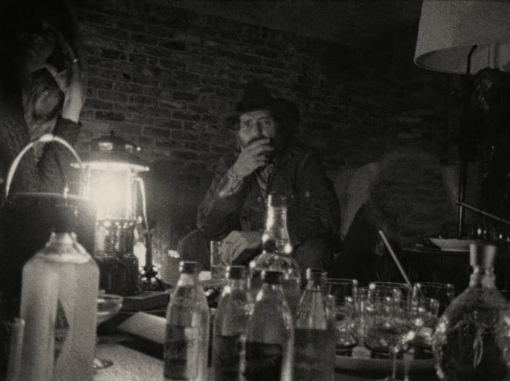
Orson Welles has been quite productive of late, considering he’s been dead for 35 years. Produced by the same team as The Other Side of the Wind (2018), Hopper/Welles is a documentary born of the director’s filmed discussions with Dennis Hopper in 1970, prior to the making of Wind. Coming out of their graves to give us company in our collective confinement, Welles and Hopper hole up in a dark room with half a dozen technicians to talk filmmaking, politics, religion, love, magic, news, television and literature while dutiful assistants scurry about readying one refill of liquor for them after another. Talk is perhaps not the right word here, for what Welles to Hopper does may better be described as an interrogation, a grilling. He plays the Grand Inquisitor, pressing his timid interlocutor to state his artistic and political beliefs, pulling theories out of nowhere to counter him and never allowing him a respite or a resting ground. While part of it is low-key ragging, Welles’ insistence clearly comes from a place of goodwill and seeks to draw out the young man’s best. Hopper, in his early thirties, is rather unsure and self-contradicting before Welles’ towering figure. Sporting a hat, he constantly caresses his beard, qualifying all his tentative, half-joking answers with a nervous, self-protective giggle. What Hopper lacks in persuasiveness he makes up for with his keen attention and youthful vigour; his eyes are full of life. “You’re a hard man to talk to”, he tells his questioner.

At the beginning of the film, a short text let us know that both Welles and Hopper changed the face of movies with their respective debuts. In doing so, it places both filmmakers at par with each other. That doesn’t quite reveal the entire picture. Now, in 1970, Welles is a greatly respected, almost legendary figure, but whose glory days are behind him, something of a ‘has-been’ if he ever ‘was’ for Hollywood. Hopper, on the other hand, is a star hot off an era-defining blockbuster in Easy Rider (1968). Yet, in their conversation, they are able to find a common ground, namely the question of authenticity in filmmaking. We never see Welles, save for rare glimpses of his bellowing pin-striped trousers moving at the edge of the frame. Hopper’s eyes, wide in evident admiration, follow him everywhere he moves in the off-screen space. At several points, the Caravaggesque Hopper literally looks up at Welles, who appears to be playing some kind of metaphysical force, re-orchestrating a Kafkaesque trial for Hopper. What results is a stark power imbalance between the seen and the unseen, between the subject and the author, between the one who is recorded and the one who wields the camera. Hopper’s cinematic forefather looms large over him even as he speaks about the need to one-up his old man.

I can’t imagine what form the film would’ve taken had Welles edited and completed it himself, but as it exists, it looks nothing like what he has done until this point. Shot with multiple handheld cameras and a single lantern next to Hopper, the film never ‘settles down’. The operators constantly move around the room, seemingly for no reason, relocating the camera, changing focus, zooming in and out in a way that may be disorienting for those interested solely in the dialogue. The camera’s magazines run out and the clapboard cracks indifferently in front of Hopper’s face even when he is in the middle of an important point. Whether on Welles’ instructions or on editor Bob Murawski’s, the view keeps switching from one camera to another at a frenetic rhythm, with inexplicable black leaders inserted in between shots. The overall impression is that Welles is making something like a Cassavetes picture, improvising the whole film with his actor by placing him in a dramatic situation and teasing out his responses by way of direct questioning. Welles, we are told, is also in character, as the filmmaker from Wind, and Hopper calls him Jake (Hannaford) as well. So the film may be said to operate in some undefined region between documentary and fiction, a precursor to F for Fake (1973); as much a story about a director shaping and rehearsing with his actors as a record of a man eating, drinking and getting drunk over two hours.

But the primary pleasures of Hopper/Welles are rather straightforward: two maverick filmmakers in a terribly fascinating conversation. The movie-related anecdotes that emerge are very interesting, for instance Hopper’s relationship with the Fondas, or his work on Crush Proof (1972), a self-financed experimental film by architect François De Menil (scion of the Schlumberger family and a cousin to Sylvina Boissonnas, producer of avant-garde French films including the early work of Philippe Garrel), as are the political talking points, such as Welles’ support for Francisco Franco, his prediction about a black US president and Hopper’s observation about the rift between the counterculture and deep America as he saw it in the varied response to Easy Rider. Most of all, it is compelling to see two artists grapple with the cinematic-aesthetic problems of the time. As the discussion turns around the films of De Sica and Antonioni, Hopper and Welles reflect on the challenges in dealing with boredom and lack of drama on screen, a few years before Jeanne Dielman (1975), among other narrative films, would do away with drama altogether. Going public after 50 years, Hopper/Welles is both a standalone film and an anniversary celebration. It hasn’t dated one bit.