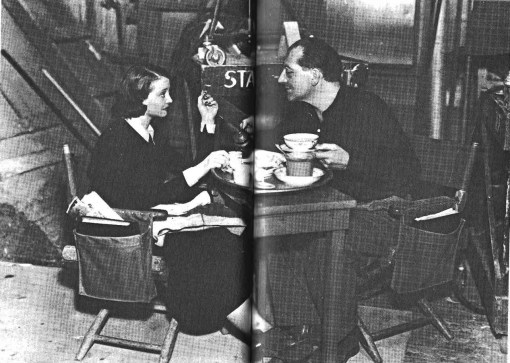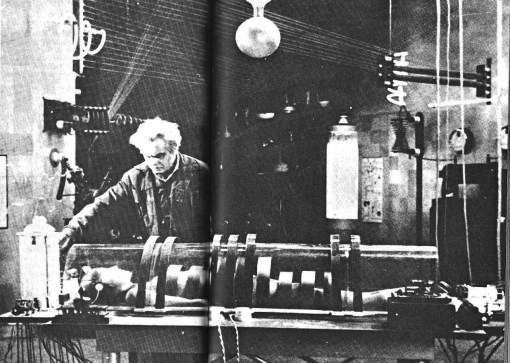
[From Luc Moullet’s Fritz Lang (1963/70, Seghers). See Table of Contents]

Should Man Revolt or Adapt? (1940-1949)

No matter its results, the revolutionary impulse seems to be condemned by Lang as foreign to nature and inspired by the desire to create a new social order, a new collective morality, while the asocial impulse—often stemming from the barriers that Society places around itself for protection—seems to him to be more congenial, as though reflecting an individual and natural morality. But these are only tendencies that we sense in the direction of actors, or which the dramatic construction hints at. Except when he’s dealing with some typical examples of the American society, ones particularly marked by it, Lang doesn’t judge and remains objective. He judges neither Joe Wilson nor Eddie Taylor, no more than he does the killer of Dusseldorf. He doesn’t show a path to follow. What counts for him are facts, their circumstances, their immediate significance. Even when there appears to be a moral significance, it is, more or less, simply the reflection of a metaphysics.

On the other hand, in this period, Lang becomes more of a moralist than a metaphysician. Not happy with simply showing reality, he now reflects on what he’s showing. His style becomes simpler, less lively, and more sober because he doesn’t have to recreate the world as he sees it anymore, i.e. through formal experiments, especially expressionism; Lang now simply shows how and why people act the way they do in a given milieu—which is the reason characters become more important than the sets—and tries to draw out a moral point of view.

America seems to be the chief reason for this evolution: in contrast to Germany, America is a country whose essential problems are moral and immediate. Now, Lang worked in three genres, the Western, the spy film, and the psychological drama. The first of these, especially, and the second, in part, are typical of America and are always conceived in moral terms. What we have here then is an adaptation of Lang’s world to existing genres, a period of trial and errors, of reflection which makes the oeuvre go around in circles, and which, though very successful, is less memorable than the previous period.

(more…)

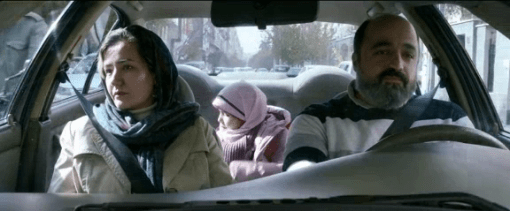
There Is No Evil (Mohammad Rasoulof)

Jean-Luc Godard once remarked that the most illuminating film on the concentration camps would deal with the everyday routine of the camp guards. Rasoulof’s Golden Bear winner, There Is No Evil, takes off from a similar idea, imagining four stories of soldiers in Iran’s army whose responsibility it is execute prisoners sentenced to death. The first of the four episodes in the film deals with the home life of a middle-aged executioner, not a soldier, but a freelancer who carries out assembly-line executions in batches. In the second segment, a young musician, newly recruited to the execution unit of the army, refuses to kill and tries to hold his ground. One of his mates in the army, who doesn’t have these scruples about simply carrying out orders, constitutes the subject of the film’s third part. The final section revolves around another middle-aged physician who had, as a youth, refused to kill prisoners and was forced to be underground ever since. So the four episodes echo each other in direct ways: the hangman of story 1 could be the older version of the soldier in story 3, just as the doctor of story 4 could be the elderly equivalent of the renegade of story 2; stories 2 and 3 themselves are mirror images of each other, as are consequently 1 and 4, exploring two opposed attitudes faced with the compulsion of having to act against your conscience.

Working within a broadly mainstream narrative idiom, Rasoulof gives different textures to the four episodes. The first segment unfolds like a short story, immersing us into the domestic minutiae of a middle-aged head of the family. We see him pick up his wife from work, drive her to the bank, prepare meals for his ailing mother, go out with his family for pizza, shop at the supermarket and dye his wife’s hair for a wedding the following day. He gets up before dawn, heads for his work, where he pushes a button to send half a dozen prisoners to death. The ending shocks us, all the more because it comes at the end of a series of quotidian activities. It’s all part of a day’s work for the man, inured to the executions. The anxiety induced by this ending is sustained till the end by the second episode, an existentialist parable shot with the fluidity of a video game, in which a conscientious rookie executioner breaks out of the army camp by tying up the guards. The third, the longest and arguably the weakest section of the film, is novelistic in its examination of a personal relationship broken irreparably by the guilt of a soldier who has just killed his lover’s idol. Despite the ample presence of barren, rural exteriors, the closing episode is essentially a chamber play about a simmering family secret that is the consequence of a physician’s desertion from the duties of an executioner. While the film’s subject matter will dominate discussions about it—as it should; Rasoulof was sentenced to a year in prison following the Berlin premiere of the film—it’s the director’s versatility and stylistic nuance that register foremost.

Da 5 Bloods (Spike Lee)

Lee’s latest film is an action-adventure tale based on a pretty incredible outline: four Black Vietnam war veterans return to erstwhile battlegrounds in order to recover a chest full of gold bars they had buried forty years ago. The consignment, we are told, belonged to the US government, which sought to pay mercenary troops with it, but “Stormin'” Norman (Chadwick Boseman), their unit leader, now dead, convinced them that the gold must be used for the racial reparations that America hasn’t been willing to voluntarily make. As the “Bloods” trace and recover the gold, running into volunteer minesweepers and undefined guerrilla outfits, Paul (Delroy Lindo), the only fleshed-out character of the group, begins to succumb to greed and war trauma. This already eclectic, charged outline allows Lee to weave in quick history lessons as well as contemporary political talking points without upsetting the genre framework. He is literally delivering a Geschichtsunterricht when he intermittently cuts to photos of figures from Black political and cultural history that his characters regularly evoke in seeming self-satisfaction. But for the most part, the adventure story progresses robustly, with both character development and pamphleteering kept on the sidelines.

A film professor, Lee is very well aware that Hollywood movies tend to enforce a form of historical revisionism and that he is working within a subgenre that comes loaded with certain cinematic, social and philosophical baggage. On one hand, he is making yet another war fantasy in which Americans come out trumps. But he is also parodying, reconfiguring the image the Vietnam war—the ‘American war’ as the Vietnamese characters put it—has in the minds of movie audiences. Locating the Civil Rights Movement within the context of the Cold War, as the opening newsreel footage does, Lee’s film casts the Vietnam war as one without cause for the Blacks, one in which Black soldiers were sent to the front along with whites, even as they were denied equal rights back home—this injustice falling in the long line of unreciprocated acts of patriotism by Black people (ask not what the country can do for you etc.) Politically astute as he is, Lee inscribes this racial contradiction within the larger colonial context of Western presence in Indochina. While this trip is a therapy and even a means to racial justice for the Bloods, for the Vietnamese, their invasive, re-colonizing presence (first as soldiers, then as tourists—“they didn’t need us; we should’ve just sent McDonalds”, remarks one Blood) only revives the terrible injustices of an unequal war. Whatever they are back home, the Bloods are, for the rest of the world, GI Joes. Lee acknowledges this by periodically puncturing the film’s identification with the Bloods by testing it against the Vietnamese’s view of them, and also by including archival image of the war violence the Vietnamese suffered in the same manner that he includes photos from Black history. (Whether these images are drawn exclusively from Western sources is, however, unknown.)

The film’s various heterogenous elements don’t cohere as they would in a more classical film. But this disharmony is in keeping with Lee’s brash, all-accommodating, critic-proof style, which is hinged not just on assembling disparate formal and narrative elements, but also on ruffling simple, self-contained elements. Notice the way he cuts the plainest of conversation scenes to the point of upsetting spatial coherence. Conversely, he employs a more cohesive sequencing where a more frenetic composition is de rigueur, namely the battle scenes. The abrupt, almost cavalier manner in which he ends scenes is apparently agnostic to the emotional value scenes. If, at times, these cutaways seem premature, at several other places, they undercut the melodrama rather wittily. Finally, the fable-like quality of the story serves as a rather powerful mould for Lee’s political vision, all the more so because it is so general, so apolitical. The tale of a group of idealists losing their idealism under the temptation of individual, material gain goes perfectly with the parable of renewed racial solidarity the filmmaker wants to narrate. In the process, Lee is contributing to a new foundational narrative of America erected on popular Black mythology—what Birth of a Nation (1915) was for the Southerners, Lincoln (2012) was for the Unionists, or America, America (1963) was for immigrants.

Days (Tsai Ming-liang)

I haven’t closely followed Tsai’s work since Visage (2009), and because I regularly find myself disappointed by one-time favourites, I expected some amount of disillusionment with Days. I am relieved to report that Days is not just a fine film, but also one of Tsai’s most representative and resonant works. The filmmaker’s eternal muse, Lee Kang-sheng, plays a lonesome pisciculturist (?) who is ailing from some kind of nervous disorder. He travels to a city, or perhaps to another country, for treatment. In parallel, we see the everyday life of a young man, played by Anong Houngheuangsy, who lives out of his suitcase in a loft in a urban commercial complex. In long stretches, we see him prepare his meals and get ready for work. He works at a small clothing retailer at night and also freelances as a gay masseur. He meets Lee when the latter hires him for a full-body massage at his hotel room.

As is his custom, Tsai develops this outline very sparsely. In extended shots, we see either character performing one particular action. In the process, Anong’s modest but devoted meal preparation assumes a dignified, nearly religious quality, not unlike Lee’s perambulations as a Buddhist monk in Tsai’s earlier films. But Tsai’s sensorial radar is much wider and picks out the voluptuousness of everyday objects and settings. He is a filmmaker sensitive to the household textures of the Asian working class: patches on the wall left behind by the previous tenants of Anong’s loft, where probably lived children, its ivory-tinted doors of compressed-wood, the pastel-coloured tiles of the bathroom, the polish of fluorescent light as reflected on Anong’s humid skin, the extra-green vegetables he chops into an extra-red container, the reflection from his triangle-shaped steel ear piercing, the various objects of recycled plastic around the studio all compose a veritable symphony of the inanimate.

There has always been an undercurrent of ‘post-apocalyptic spirituality’ in Tsai’s cinema, a ‘neo-animist’ generosity that finds possibilities of rapture and communion in the most modern, lifeless settings. But equally, his work taps into the sensual charge that the human figure can have on screen. Critics often talk about the presence of a star, but Lee here is reduced to just that, a presence: at many places, his body is hardly anything more than still life. Even so, our attention is riveted on the human figure (no more than two or three shots in the film without it). I also believe that the current health crisis might have sharpened my (our?) general sensitivity to the human presence on screen: in their complete lack of human figures, for instance, the shots in James Benning’s Maggie’s Farm (2020) are haunted by an absence, crying to be ‘filled up’. All this to say that the super-erotic, super-relaxing massage sequence is only different in degree, and not in kind, from the rest of the film; a different note on the same scale.

There’s no intellectual algebra to be performed here. Tsai films loneliness, and the refuge from it offered by fleeting intimacy. That’s his great subject, the way reincarnation is for Apichatpong or romantic entanglements are for Hong. He also likes filming Lee (one is the corollary of the other). Here, as in the past thirty years, he films Lee eating, sleeping, walking, just sitting or staring into the void. Now, additionally, he also films him ailing, suffering, undergoing treatments and perhaps healing—making the film a sequel of sorts to I Don’t Want to Sleep Alone (2006). It’s Warhol, on a less playful, more spiritual key. This inextricable nature of Lee’s presence in Tsai’s cinema is also the reason the equally important presence of the second actor, Anong, introduces a somewhat unsettling note. Days is, quite unequivocally, a series of contrasts between Anong’s blooming, young physique and Lee’s older, hurting body. Is Tsai changing muses, committing a form of artistic adultery? The film ends, not on Lee, but on Anong’s wandering on the city sidewalk, fidgeting with a sappy music box Lee has handed him—a decision that lends the preceding, wonderful shot of Lee’s face in the morning a valedictory aura. Tsai’s next project will, no doubt, throw more light on this seeming transition.

Malmkrog (Cristi Puiu)

Five Russian characters, variously of aristocratic and bourgeois background, assemble at a chateau somewhere in Mitteleuropa in winter and debate religion, morality, metaphysics, politics and aesthetics, as silent butlers serve them lunch, snacks, tea and dinner around the clock. Puiu simply parachutes us into this situation with no introductory information. Who are these people, why are they discussing these topics in French, and most importantly, why does no one give up? As the conversations progress, we learn that it’s sometime around the turn of the twentieth century. It is plain that the two men and the three women are all grappling with the intellectual upheavals of their times. Ingrida (Diana Sakalauskaité) is appalled by the desacralization of military duty, Edouard (Ugo Broussot) believes it’s Europe’s mission to civilize the entire world, Olga (Marina Palii) is convinced that a pacificism rooted in Christian teachings is the key to the question of violence, Nikolai (Frédéric Schulz-Richard) plays the devil’s advocate to her, taking the philosophical foundations of Christianity to its absurd limits, and Madeline (Agathe Bosch) assumes a moderating voice. Extremely polite and formal, the exchange reeks of sexless, stereotypically Caucasian sangfroid, even when it’s intimidating and contemptuous.

If there ever was a clinching argument for dubbing foreign films over subtitling them, this is it. It’s not just that the characters never stop talking. It’s that as you are reading the subtitles, you are likely to miss the minimal physical action unfolding on screen—just like the video where you don’t notice a bear crossing as you are busy observing the basketball being passed. Puiu expressly uses physical action to counterpoint the incessant pontification. All through, the butlers, especially the head steward Istvàn (Istvàn Teglàs) on whose movement Puiu often begins his extremely long but imperceptible shots, wander about serving refreshments to the five statue-like speakers, who are almost oblivious to their presence. They are also attending to the sixth aristocrat in the house, a bedridden general, who needs to be bathed, clothed and fed. At exactly the one-hour mark, Olga faints to the ground, producing the first significant movement, and the first break in the discussion, in the film to our great delight. Puiu’s curious but detached camera observes the speakers from a close distance, slightly panning left and right to follow a character now and then. Characters are regularly framed against doors and windows and, in conjunction with the many framed elements of the décor, are rendered as static and stuck-in-time as the furnishings.

Whether one finds these debates riveting, like I did, or insufferable is a matter of taste, but what is evident is that Puiu is interested in more than the subject matter of these discussions. Like in a William Wyler film, the working class is constantly present at the margins of a bourgeois chamber drama that takes centre stage. And this dialectical presence, along with the increasing clarity that we are close to 1905, forebodes a turbulence that comes, sure enough, in the middle of the film. We perceive that the supreme refinement and courtesy with which the debates take place, in fact, conceal a violence that is a response to the ethnic, nationalist and class agitations Russia and its bourgeoisie are facing at the time. The extremely hierarchized, class-coded relations of the butlers within themselves—exemplified by Istvàn striking one of the manservants under him for spoiling the coffee—provide a picture of the larger social structure outside the chateau.

But more than Wyler, it’s Buñuel that Malmkrog frequently recalls; whence the subterranean humour of the film. While its apparent why the characters are indoors—they’re snowed in—it’s absurd the way they refuse to perform even the smallest of physical gestures, like moving a chair or passing the plate. It’s patent that they can’t do an errand even if their life depended on it. We get the impression at the very beginning of the film that, for all their lofty discourse about the destiny of Europe and the meaning of war, the bunch is oblivious to the ferment right under its nose. When, in the middle of the film, the butlers don’t respond to their call, the characters sit at the table in disbelief, ringing the bell again and again as though that will set things straight. The punchline for this setup comes when the group is promptly sprayed down by a line of bullets. At the same time, despite this deliciously morbid humour, Puiu doesn’t undermine his characters or their beliefs, as is discernible from the way he arranges the six chapters of the film non-linearly. What the characters debate over, in the final analysis, are important philosophical questions in their own right. It’s just that their idealism is superseded by events that may only be made sense from a materialist perspective. So, in a way, these are tragic figures, spirited away by History just as they think they’re approaching enlightenment.
[From Luc Moullet’s Fritz Lang (1963/70, Seghers). See Table of Contents]

Lang and Me

In 1941, when rumours began to circulate that Hitler’s ships were assembling to cross the English Channel, then known as the Corridor of Hell, and invade England, I had an idea for a script: what would happen if the London office of the Associated Press were to be destroyed by bombardment, if the AP set up shop in the wine cellar of the Ritz, and if its head found himself trapped by a German time bomb in the same cellar with the official censor of the British press? I’d thought of this story from the particular point of view of a practicing war correspondent, whose work has its own rules and duties: when must he deliver the information? Should he instead keep it a secret? What should he decide, redacted or good for print? Who can judge? What is the best solution? My AP head, a prisoner of the cell and the bomb, decides it’s good for print. The government deems him wrong; the profession deems him right. You probably remember, or were at least told about it, that Hitler’s attempt to invade England failed. The boats were scuttled, the Channel was full of oil, the free countries heaved a sigh of relief. That was the general situation at the time. In my original script, the AP head was killed by the bomb.

Since I’d never set foot in England, I sought the help of an old friend, the late Hank Welles. He had covered the Great War for The Chicago Tribune and had, at one time, managed the Paris office of the Tribune. I asked him a load of questions about London’s streets, its slums, its cellars, about transatlantic cable terminals near Penzance etc.  I wrote ninety-two pages of the adaptation in fifteen hours. Hank prepared cocktails of coffee and cognac. As I asked him technical details about London’s atmosphere, I played the keyboard—I mean I worked on the typewriter—while listening to him. 20th Century Fox bought the story, titled Confirm or Deny, for $20,000.

Hank and I were delighted to learn that Fritz Lang was to direct this film. A peerless creator, Lang remains a symbol full of meaning for all filmmakers. Darryl Zanuck had Jo Swerling adapt the script.

A while later, we heard that Lang wasn’t involved in the film anymore and that Archie Mayo, I think, was to replace him. Why? What had happened? Mayo, I know, was also a filmmaker with a lot of experience. But there were certain touches, certain nuances, certain secret flashes as imperceptible as an exclamation point in literature that Lang could’ve harnessed to the smallest detail, with which he could’ve nailed it so perfectly that you’d have your hair standing on the head.

Whatever it was, I was very disappointed. I knew Lang’s stylistic signature from M until Fury, this admirable cinematic account of mob rule and blind justice.

I was disappointed by the film too. It was a cheerful, rather ordinary melodrama sprinkled with love scenes and punctuated by humorous touches. There was everything except my original idea: the journalist’s struggle with himself to decide whether to print or withhold an information of international importance at a time of war. There was a syrupy love story, with a dash of the sour cream of goodness, embodied by an old journalist. This sermon didn’t move anyone. The war cry seemed to be coming from behind a lectern rather than a teletype. One of my key scenes was when the editor, caught in the trap and finding it impossible to warn the hotel manager that a bomb is about to go off in the cellar, uses the Allied transmission code to send an SOS to the rest of the world, so that it can reach the manager, who is five metres away on the other side of the wall. I thought this scene was sensational.

One day, at the bar of the Screen Director’s Guild, I met Fritz Lang and asked him what had happened to the story of Confirm or Deny. If I remember correctly, he told me that he had read the adaptation I’d written, that he had liked it, and that the final script had nothing to do with the original anymore. So he left the film, which I’ll always regret. I often think that if he hadn’t left, he might have introduced some of the original flavour that had excited him in the first place.

Now, I have something else to reveal to you that will amuse you. In 1946, I had an idea for a film. It was set inside an insane asylum [1]. I sent the script to Fritz Lang. His assistant returned it to me on June 26th 1946 with a letter from Universal under the letterhead of Diana Productions. The letter said that Lang thought my script was very interesting, but that he was already preparing a film on the same lines.

(Unpublished, 1962)


Footnote:

[1] It was to become Shock Corridor.

[From Luc Moullet’s Fritz Lang (1963/70, Seghers). See Table of Contents]

The Asocial Impulse

In these countries [that Lang migrated to], the difficulty consists in living without transgressing the law or becoming its victim. The heroes aren’t ambitious or vengeful anymore, like they were in Germany, but individuals like others, bogged down in the anonymity of apparently affluent and carefree crowds, common to both France and America.

Liliom (France, 1933) is loosely adapted from the play by Molnar. Liliom is a thug from the suburbs of Paris who once killed a man somewhat inadvertently. Will he go to hell or the purgatory? Up there, they discuss his case using movie projections of important moments from his life. A good deed allows him to return for a day to earth, where he meets his old friends. Liliom is something of a victim of his unfortunate circumstances and the film is an interrogation of his responsibility, his guilt or his innocence. The categorical affirmation found in the silent films makes way for an uncertainty about objectivity. That, in the film, it’s cinema that furnishes the case files comes across as a tribute to the art Lang has chosen. This intrusion of cinema into cinema will turn up again in Lang’s work from Fury to Die 1000 Augen des Dr. Mabuse, passing through Clash by Night. A tribute that’s at the same time a critique: appearances, as cinema unveils them to us, are misleading and could easily be contradicted with the evidence of another moment or of another camera angle. Adding to this fallibility of cinema is the theme of the sorcerer’s apprentice. Lang displays a real pleasure in dominating the world through film and seems to place himself under a slightly critical eye. A reflection on the notions of justice and responsibility, a reflection also on the value of his art, Liliom masks its seriousness with fantasy.

Lang’s humour, more substantial and more Bavarian in films between 1928 and 1932, turns out to be of a great finesse here; it’s accompanied by a certain nostalgia rather close to that of Max Ophüls, but more tender, less bitter. This nostalgia manifests particularly in the creation of a dreamworld that supplants reality. At that time, Lang was already doubly stateless: an émigré from the defunct Austro-Hungarian empire, an exile from a Germany defeated by arms and reduced to slavery by Nazism, separated from his wife whom he’d be forced to divorce, he had no ties other than those preserved by memory. As it happens, Liliom was made after the shelving of a project that demonstrated a nostalgia for old Vienna, Die Legende vom letzten Fiaker (The Legend of the Last Vienna Fiacre): in 1918, fiacres had to cede their favourite ground, the Hauptallee, to cars. The last coachman dies of bitterness and wants to take his fiacre to Heaven. They don’t allow the fiacre to enter. “Okay, I’ll go to Hell”, retorts the coachman. God intervenes: “Alright, alright, drive me in your fiacre…” The fiacre enters, getting mixed up with the Chariot, God’s regular vehicle. No doubt that Lang reused much of this project in Liliom.

We notice that the fable doesn’t reject reality, but moulds itself over the harshest, most unpleasant truth—that of the suburbs, its poor, and its apaches—affirmed here with power. This raw reality is always depicted with a poetry that transforms it into phantasmagoria. This dialectic gives the film its colour. The dialogues are deliberately theatrical and romantic. The actors deliver brilliant performances: chiefly of note are Antonin Artaud, Charles Boyer, Madeleine Ozeray, Florelle, Mila Parély and Viviane Romance, whom Lang discovered with this film. The amorous duo exhibits a rather outmoded romantic sensibility, notably in the flower scene. Unfortunately, Lang’s stylistic efforts in terms of sets and lighting don’t add up to much because the film, a commercial semi-failure, was massacred during its release by distributors, who mutilated it left and right, doing away with its Germanic aspect that threw the French audience off balance, and thus destroying the meaning of the work. It’s also unfortunate that the last reel of the film hasn’t been found yet.

(more…)

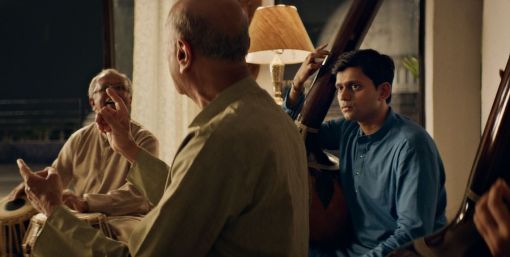
Chaitanya Tamhane’s splendid follow-up to Court (2014) deepens, inverts one of the primary themes of his debut feature. If the defence lawyer of the earlier film (Vivek Gomber, the producer of both projects) was an idealist groping his way through an indifferent system, Sharad, an apprentice Hindustani music singer not only finds himself unable to live up to the lofty ideals of his tradition, but is gradually disabused of these ideals themselves. Sharad (Aditya Modak, a Hindustani singer himself) is a conservative in the literal sense of the word. His occupation is to conserve: he works at a small music publishing house that transfers old cassettes and LPs into CDs. On a regular basis, we seem him physically caring for his aging, ailing Guruji (Pandit Arun Dravid), applying ointments, helping with his toilet, preparing food for him and accompanying him to concerts as well as clinics. Sharad is not the greatest of talents, he’s not even his Guruji’s best disciple, but imagines himself as part of a tradition, a tradition that gives a structural meaning to his life, but one that dissolves into legend the further one follows it into its past.

Sharad witnesses this tradition getting progressively ‘diluted’ under the pressures of modernity and technological advancement. He possesses rare recordings of lectures by his Guruji’s teacher, a fabled figure named Maai (‘mother’), none of whose music exists in any recorded form. Maai’s lectures call for an ascetic, spiritually rarefied, extremely demanding way of life on the part of the Hindustani musician (the words ‘disciple’ and ‘discipline’ sharing etymological roots). His own Guruji, on the other hand, concedes to a few intimate concerts to make ends meet. Sharad is scolded by Guruji for wanting to start performing concerts at the age of 24. He, in turn, finds it in order to set up a personal website and to teach music at a school, but chastises one of his teenage students who wants to join a ‘fusion’ band. On television, he watches kids without any musical lineage finding wide recognition, just as he notices on the internet that his peers have had larger worldly success without having to go through the rigours he has had to. The promise of omnipresence and instant gratifications of the modern world beckon him, but—spirit willing, flesh weak—Sharad soldiers on, hanging on to Maai’s words like St. Bruno to the crucifix: “While the world changes, the cross stands firm.”

On one level, the film is dramatizing artistic doubt, the musician’s feeling that he simply isn’t good enough. But, as a Hindustani vocalist, the stakes are higher for Sharad. His own failure to live up to certain ideals is one thing. But it’s when he learns from a music historian—or rather, realizes himself—that the tradition he enshrines is itself a bundle of legends that his life’s foundations are assailed. It isn’t, then, a dilution of tradition that modernity ushers in as much as a disillusioning, a reinterrogation. Maai and Guruji, it turns out, aren’t the exemplars Sharad had taken them to be. To be sure, he had this doubt all along, for he knows that his own father, despite his passion for and knowledge about the music of his tradition was a mediocre musician himself; for, at some point, Maai’s discourse becomes one with his own inner voice. The fountain is corrupt, innocence is lost.

Tamhane builds up gradually to this assault on Sharad’s worldview. But he isn’t particularly interested in showing how Sharad reacts to this epistemological violence. In fact, he takes particular relish in not giving us an idea of how he reacts. Throughout the film, he cuts from a popular talent hunt on television to Sharad watching it with a poker face; that is, Tamhane doesn’t tell us how to react to the TV show. That’s because it doesn’t matter whether Sharad regards the show with the condescension and contempt of a superior musician or whether he is jealous and resentful about its enticements. What matters is that he is exposed to socio-artistic structures outside his own.

In a very direct manner, The Disciple zeroes in on a fundamental, civilizational sentiment that underpins artistic succession in the subcontinent: that of filial piety, as opposed to the parricidal narrative that informs the Western conception of self-realization. Even when his faith has been questioned, Sharad continues his service to Guruji, caring for him till the final days, like icon worshippers who hold on to their idols even (and especially) when the meaning behind them are lost. Physically as much as psychically and artistically, he labours under the weight of Guruji, just as the rebelliousness of the lawyer of Court simmers under a begrudging respect (and dependence on) his father. In both films, this Oedipal repression is set against the pragmatism of the mother, who, in The Disciple, is more worldly, not possessing the redoubtably attractive idealism of the father. In the film, Sharad is estranged from his mother following his father’s death, and connects with her only after the idealist parental figures—Guruji and Maai—pass away in his mind. I must add that this bit of psychoanalysis isn’t at all gratuitous; it seems plain that the film is dealing in these simple, bold relations in a very frontal way.

Bold is not the adjective one may think of when speaking of the baby-faced Tamhane, who comes across as a well-behaved, dutiful child himself in his interviews, or of his two films, which seem rather averse to emphasis or overstatement. But some of the bluntness of The Disciple could hardly be described otherwise. One of Tamhane’s ostensible strengths is his belief in the importance of humour to his work. While comedy remained a sporadic visitor to the Court, here it is systematized, generalized in the way the filmmaker links two sequences. Some of it is pretty on-the-face: shot of Sharad sitting stunned in disbelief at losing at a competition cut to him meditating at a yoga class to let off the steam, moaning sounds from a pornographic clip spliced with Sharad’s belaboured aalap. If this is easy laughs, it also attests to a filmmaker’s increasing confidence about his material: the humour doesn’t undermine the characters’ values or the gravity of their situation.

Tamhane also has the very valuable knack of picking up interesting faces. His lead actors, many of them musicians themselves, are all very good; Modak undergoes an incredible physical transformation midway in the film, gaining a telling paunch that reinforces his kinship to the lawyer of Court. But I refer to the faces in the crowd, each of which seems individualized, with its own story. Tamhane’s sedate, wide-angle style was served well by the subject matter of Court, where almost every scene has a crowd. The Disciple, however, except in its fascinating shots of concert audiences, limits the filmmakers to a few characters, resulting in several conversations filmed tastefully as a two- or three-shot over a table, with the camera slightly arcing towards Sharad.

Equally of note is Tamhane’s decision to vary his compositions throughout the film. Firstly, we hardly see Sharad in the same place more than once. It takes a while for us to inventory all the spaces Sharad haunts: Guruji’s spare loft in a chawl, the independent house where he lives with his poor aunt, its terrace where he practices, the recording studio where he works, the yoga class, the various concert halls and patrons’ houses. Even when Sharad is in the same space, the composition is so starkly different that we don’t perceive right away that it’s the same location. The effect of this variation is that it doesn’t let Sharad settle into a routine, and he is constantly caught in a spatial flux. The only strong, anchoring image of the film finds Sharad on his bike, cruising on Mumbai’s deserted late-night roads, listening to Maai’s lectures—his sole guidepost in a changing universe. The Disciple is also a period movie that unfolds over several decades—and a meticulous one at that, picking out era-specific electronic gadgets, currency notes and porn clips—and ends in our time of the thumping return of conservatism (to be liberal about it), which imparts an ironic colour to Sharad’s disillusionment. Maybe it’s appropriate that, in our era of hollow idols, the film closes with Sharad stepping into his father’s shoes, giving up performing to run a music label, even though the hallowed values of his father have been rendered void.

[From Luc Moullet’s Fritz Lang (1963/70, Seghers). See Table of Contents]

Man Seeks to Conquer the World (1922-1938)


The defeated man of 1918 tries to gather himself, and with the improvement in his condition, he forges a less tragic metaphysics for himself. In this normal reaction, we find two successive variations: the revolutionary impulse, where man seeks to become the master of the whole world, and the asocial impulse, where he seeks simply to become the master of his own life and must transgress an all-too-arbitrary law in order to do that. The revolutionary impulse dominates in the German films, while the asocial impulse belongs rather to the American period.


The Revolutionary Impulse (1922-1932)

The theme of the man who wants to dominate the world was already present in Die Spinnen (1919), before sporadically resurfacing in the expressionist period (Siegfried, Metropolis). But it’s a motif deriving most of all from the convention of crime stories. As always, Lang starts from the thematic and artistic traditions of his time, and not themes particular to his personality, and deepens them, finding their latent meaning.

In the two parts of Dr. Mabuse, der Spieler (Dr. Mabuse the Gambler, 1922), the first carrying the same title and the second Inferno, we find not a deepening of the theme, but a realist depiction of facts and atmosphere which are its most evident components: secret societies, hidden vices, hypnotism, unlimited violence, multiple disguises, lust and depravity, secret doors and betrayals, thieves and forgers. Mabuse the sorcerer’s apprentice, whom we successively see as a psychiatrist, a drunk sailor and a great financier, seduces a degenerate, the countess Told, the top informant of his enemy, the prosecutor Wenk. He kidnaps her and does all he can to ruin her husband. He forces his regular mistress, the dancer Cara Carozza, to poison herself. He tries to get rid of Wenk twice. He hypnotizes him, drives him to commit suicide in his bathtub. The police intervene in time and rescue the countess as well. Mabuse ends up in an asylum.

Doctor Mabuse’s goal is of a practical, and not metaphysical, order: he seeks power for the benefits it brings him, material and sexual benefits in particular. This need for pleasure is justified as compensations for deprivations of the war and for the moral rigidity of the Empire. By way of an extravagant crime story, moreover, the film only reproduces facts prevalent in the depraved and divided Germany of the time: “The fight between the villains and the police recalls the street clashes ordered by Noske, the socialist home minister” (George Sadoul, Histoire du Cinéma mondial, p. 154).

Keeping things at a descriptive level means that there’s no moral judgment yet: Wenk employs the same sneaky means as Mabuse to defeat him, and he is as amoral as him. He intervenes, not as much to rid society of a criminal as to get back at a rival in love and win back his mistress. But one could say that this comes at a price: the first part, very different from the second as always in Lang, an excellent but banal soap opera, can be defined as a study of human gestures and attitudes, their movements and the relation between their movements, a phenomenological study that owes everything to improvisation and observation and almost nothing to expressionism, and which comes close to modern cinema, particularly Lang’s more recent works like Human Desire. With almost nothing—characters that move from one chair to another, light cigarettes and play cards—Lang creates an autonomous world more captivating and original than the mostly spectacular one of the second part, with its by-the-numbers fights and its car chases inspired from the exploits of the Bonnot Gang and the Apaches of Paris in 1910.

(more…)

Build the Wall (Joe Swanberg)

Why would Joe Swanberg, 39, feel the need to focus on the aging pangs of a fifty-year-old? Perhaps the precocious auteur, who had a body of work by the time he turned thirty, feels professionally, mentally much older than he actually is. Or perhaps forty is the new fifty. In any case, we are far from the interpersonal dynamics of Drinking Buddies (2015). Kent (Kent Osborne), who is the anchoring perspective of the film, is set in his ways. He is turning fifty, a fact he isn’t particularly fond of, and is having an old flame Sarah (Jane Adams) come over for his birthday. Unfortunately, another friend Kev (Kevin Bewersdorf) invites himself over at the same time, insisting that he will build the stone wall in Kent’s garden that he has long promised and that he will be as discreet as possible about it. Kent tries in vain to dissuade Kev because he has made romantic and work-related plans with Sarah that he doesn’t want to upset. But even Sarah occasions deviations from Kent’s routine; she gifts him a new vacuum cleaner he had made clear he doesn’t need. In a scene that’s literally a boner killer, he interrupts sex with Sarah only to get hung up on a shower curtain she keeps dislodging everyday. Kent’s mounting exasperation doesn’t derive as much from not ‘living in the moment’ as from the frustration of his wholly reasonable desire to keep his life simple and organized.

All of Kent’s expectations are thwarted: he falls out with Sarah, who ends up helping out Kev with the wall, around which a veritable community takes shape. The narrative partly hinges on the comic reversal that the over-serious, self-parodical, lone wolf Kev ends up forging a more wholesome relation with others than the sensitive, laid back Kent. But Swanberg doesn’t milk this scenario for its third-wheel comedy. (All the characteristically uncomfortable humour stems, instead, from Kent’s days out with Sarah.) He is rather interested in exploring the contours of romance at an age where you possibly expect to be accepted as you are. There is, equally, a simplification of form evident in the film, which runs for less than an hour. To be sure, scenes are still constructed around improvised acting and predominantly natural lighting, but there is an economy of exposition that feels positively mid-to-late career. With an exception of a pan shot here, a handheld shot there, most of the film unfolds in static shots, with the director occasionally drawing us in to the conversations using tighter setups. The more explicit flourishes, like cutting on sound cues, are muted by the overall austerity of the film. The film is set in a lush, wooded corner of Vermont and its meditative pace is redoubled by the natural expanse of the region. Swanberg also sets a series of formal counterpoints: intense, lone outdoor activities (wall building, axe throwing, woodcutting) that sublimate domestic frustrations, harsh sounds of sawing and stonework piercing the sylvan silence, and Kev’s DIY documentary sequences interspersed with Kent and Sarah’s fumbling. He perhaps forces the issue a little towards the end, but a shot of Kent in a jumpsuit sawing wood on his birthday is poignantly emblematic.

Coronation (Ai Weiwei)

A documentary on Wuhan’s COVID-19 outbreak made by Ai Weiwei: fair to expect that the artist’s iron fist will come down hard on China. It indeed does, but it’s the velvet glove that comes first. Coronation opens with overview shots of Wuhan’s impressive skyscrapers and advanced highways. Two people drive into the cordoned-off Hubei province and are interrogated by cops at the border. When they do manage to get in, the region registers like a ghost town from a modern horror movie, with no gas station open for hundreds of miles. They somehow make it to their home in Wuhan, only to find the fish in their aquarium dead. Ai constantly shuttles between such personal accounts of the lockdown and a macroscopic view of state-controlled healthcare and funeral activities in the province: treatment of patients on ventilators, extremely strict safety precautions followed at a hospital, song-and-dance exercises for patients that instruct them in best hygiene practices, construction of sprawling health facilities overnight, the equally rapid evacuation from the facility, package and delivery of the ashes of the cremated to the bereaved. A good part of the footage is slick, employing zany camera setups even in highly-restricted locations. Working from Cambridge, UK, Ai doesn’t reveal how he commissioned/obtained all this material (some of which were already circulating on the internet), nor does he get caught up with ethical questions such an approach raises. By all appearances, it’s a supremely efficient machinery that we witness in Wuhan. At times, Ai overlays these images with an 8-bit musical tune, as though to suggest the state’s video-game-like approach to problem solving. But the critique in these ‘macroscopic’ project remains muted as the sequences retain a Wiseman-like surface level neutrality.

The critical burden is, instead, placed on individual testimonies: a delivery man who is stuck in Hubei and is unable to return home, a lady who couldn’t see her father-in-law after he was diagnosed with the virus and died, patients at the hospital who claim they are being retained even after recovery just for image management purposes, a man who is prevented from collecting his father’s ashes without being accompanied by a ‘work unit’ in charge of his father’s case. A humorous sequence features an old woman, once a diligent middle-level executive in the Party, who fully trusts her government and refuses to consider information that might upset this faith. Earlier, workers at the hospital reception ask the cameraman to show only positive images of Hubei and to avoid emphasizing the outbreak. What emerges from this composite portrait is a sense that the source of China’s greatest strengths—executive efficacy, responsiveness, technological progress—is also the source of its more worrisome qualities—citizenry that lives in fear and denial, complete control over private data, an autonomous political will. Of course, none of this is news to anyone, but the personal testimonies introduce a grain of resistance that cuts down the stakes to human level. As the young man who is trying to recover his father’s ashes says, “one can’t just vanish silently in this world”.

A Shape of Things to Come (Lisa Malloy, J.P. Sniadecki)

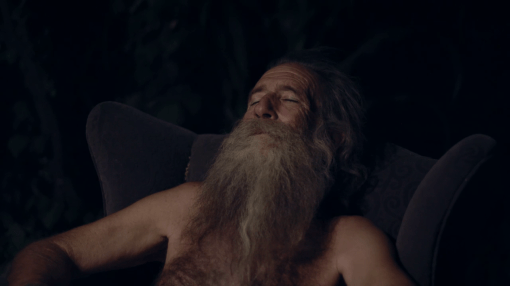
Sundog (an inspiration for McConaughey’s Moondog in The Beach Bum?) is an elderly white recluse who lives somewhere near the Mexican border in a desert stretch of Arizona. He resides in his barely recognizable trailer, around which a tiny ecosystem has sprouted. Several cats live with Sundog, who also rears a battalion of pigs with great care. With his rifle, he hunts boars to feed himself and the cats. At one point, we see him catch toads, wash them and extract glue from their feet, which serves as smoking material once it’s dry. Save for a series of grunts and chortles, he doesn’t speak to the camera. At times, we see him calling someone, presumably his son, asking him to come over for a visit or pontificating on the state of things. This stilted exposition device, combined with the filmmakers’ decision not to be seen or to interact with Sundog, reveals a slight fictionalization at work. Like wildlife photographers, Malloy and Sniadecki are discreet, content in filming the old man in his routine. Almost exclusively, they photograph him in very tight shots such that we hardly get to see his immediate surroundings or even his actions. This, combined with the shallow visual field, inhibits our vision and produces a sense of unwelcome, suffocating intimacy. This way, the film dislodges Sundog from his environment while also avoiding picturesque images of the desert.

The film naturally calls to mind another fly-on-the-wall portrait of a recluse, Wang Bing’s Man with No Name (2009). But unlike Wang’s film, A Shape of Things to Come has little anthropological or philosophical inclination. Its attention is more on the human-interest story offered by the person of Sundog. Moreover, in contrast to the hermit in Wang’s film, Sundog is not a ‘primitive’, ‘naturally’ independent of human communities. He is, in fact, a sophisticate, an emissary from the countercultural movements of the seventies, who has deliberately removed himself from society. He wears jeans, has a mobile phone, drives a pickup truck, purchases books at the nearest shop from time to time, and listens to music on the radio. He even goes to the local concert, where he dances. He doesn’t need to be on his own; it’s a choice. Interspersed with vignettes from Sundog’s routine are images of military presence: A10s flying over the desert, border patrol presumably monitoring illegal migration, incongruent surveillance towers scanning the desert. Increasingly bothered by this ‘encroachment’, Sundog decides to take out a couple of towers with a powerful sniper rifle, and becomes something of an eco-terrorist in the process. As its title indicates, the film proposes Sundog’s story as one possible sign of things to come. I am not entirely sure if there’s any significant ideological inference to be made from Sundog’s actions. They could as easily represent a form of redneck libertarianism as much as a militant environmentalist consciousness. This is where the filmmakers’ refusal to intervene, either within the film or through a framing commentary, arguably hurts the work.

A Night at the Opera (Sergei Loznitsa)

The protean, prolific Sergei Loznitsa makes his documentaries using one of two kinds of material: original footage shot on location or archival footage. Considering his recent projects, I find that films fashioned out of Loznitsa’s own stock tend to be markedly superior to his found footage work. In both cases, the filmmaker assembles his sequences without any voiceover commentary and with hardly any on-screen text. The construction has a tendency to be deliberately diffuse, with shots of extended lengths furnishing very little narrative material at first glance. This approach turns out to be quite productive in the “original footage” films such as Maidan (2014) and Austerlitz (2016) because the impression of a synthesis at work is more evident. What is possibly also helpful is that what we see in these films doesn’t come with a received narrative, which means that the viewer is expected to do more work in negotiating with them. On the other hand, Loznitsa’s found footage projects, like The Event (2015) and State Funeral (2019), by the weight of their subject matter, greatly limit the number of ways the viewer could approach them. For instance, the latter film consists of a veritable onslaught of state-sponsored pageantry at Stalin’s funeral whose meaning is exhausted even before we are through with the film. There’s hardly any ‘justification’ of why one shot was selected over another or why the film lasts as long as it does. With Loznitsa vehemently refusing any discursive framework, the viewer is no more enlightened or surprised than at the beginning of the film, save perhaps an admiration for the enviable access that the filmmaker has to archival material.

I won’t push this objection too far, for it can be made to almost any found footage work. Moreover, The Event demonstrates why even such an approach can be illuminating in light of current global crises such as the one featured in Maidan. On the other hand, Loznitsa’s new archival work, A Night at the Opera, is another baffler. For just under twenty minutes, we see the who’s who of international politics and culture trickle into the Garnier Opera in Paris. The timeline can be roughly pegged at the late fifties, or the early sixties, but it isn’t clear whether the footage is of one single event or many. The VIPs arrive at the entrance, greeted by teeming fans, pose for the press and enter the opera. A few stray, intimate moments capture a smiling guard or little girls anxiously waiting with bouquets, but for the most part, it’s a high-society affair. After the national anthem, we see a telephoto sequence of a prima donna performing to great applause. As the film ends with images of the Parisian public celebrating on the road, I wondered what to make of it. The sole emotion the work evoked was the pathos inherent to all archival footage: a sense of death at work, all the pomp and power leading to the grave. Like those aristocrats in Russian Ark (2002), indulging in one last flourish before the fall, the top bananas at the gala affair seem ready to be culled by time. It’s a melancholy feeling, but it’s hard to deny that it’s also the product of laziness. With the absence of any knowledge about the Garnier Opera during the fifties or any accompanying text to ‘pin down’ the context, the material we see seems no more special than what you might find in the Agence France-Presse vault. That may not be Loznitsa’s problem. But then, maybe it is.

[From Luc Moullet’s Fritz Lang (1963/70, Seghers). See Table of Contents]

We must undertake a project, accomplish a more commendable task without fail, by voluntarily letting go of the various means of expression that rely on technical virtuosity and which, by that fact, will always reek of artifice.

Fritz Lang (1926)

Born in 1890 in Vienna, Fritz Lang entered the film world in 1916. Having studied architecture, studied and practiced painting and other related arts—caricature, interior decoration, etching etc.—having amassed a vast knowledge of the world through faraway journeys and diverse experiences, the most painful of which was the war, Fritz Lang approached cinema via the intermediary of theatre at a point where he had already attained a certain maturity as a man.

That explains why, in his first directorial efforts (1919-1921) and even in his first scripts (1916-1919), we find themes, guiding principles and figures of style that we notice even in his most recent films, the only difference being a deepening intensified by the years.

Fritz Lang’s body of work is therefore one and indivisible. It’s founded on a certain conception of the world whose rudiments are distinctly discernible even in the first scripts he wrote. Rather than studying the films in chronological order as common sense demands, we must first study this conception of the world, this Idea existing prior to the creations it brought forth. The only possible order then is the one that traces different evolutionary forms of the Idea, which respect chronology only loosely.

(more…)

[The following is a translation of Luc Moullet’s Fritz Lang (1963/70, Seghers). The book consists of two parts: Moullet’s monograph and a collection of writings by and on Lang. I have chosen not to translate the second part because (a) Lang’s articles and interviews were originally published in English and are thus available in English elsewhere, (b) many of the texts on Lang (by Bazin, Godard, Rivette etc.) are already translated in their entirety into English, and (c) I think the second part, with its patchwork of excerpts, registers more as filler material that adds little value to Moullet’s monograph.]

I. Search (1916-1949)

II. Maturity (1951-1960)

III. Conclusion

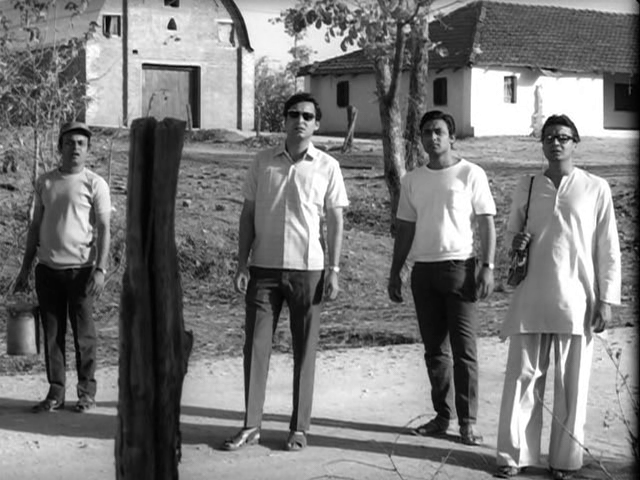
[The following is a translation of a set of letters between Raymond Bellour and Marie Redonnet on Satyajit Ray’s Days and Nights in the Forest (1970), originally written in 1993 and published in Bellour’s Pensées du cinéma (2016, P.O.L.)]

Days and Nights in the Forest

It’s always strange to walk out of a film with another person when we don’t know them well enough to be sure (a dangerous certainty) that they are thinking what you’re thinking. Especially when the film surprised you, took unexpected turns that you felt you followed well, and you don’t know if the other person, who might not have the same relation to cinema, reacted to the film in a similar way, or will at least use similar words to describe it.

Here, on the other hand, was a certainty, still a silent one: we liked the film. Terribly so: it left us speechless for a while, but we knew we’d have time to discuss it in the evening (a civilized ritual around the 8PM screening: have the dinner after the film in order to work on it slowly, privately, like an event that you don’t want to overload with other things, or digest at the wrong time).

Like all memories, of course, it later becomes something of a dream (I have always admired, with perhaps an excessive mistrust, those who are able to recount old conversations as if they had recorded them: are they so different from me, or do they implicitly embrace a mixture of truth and fiction? Or maybe they take notes immediately. But in that case, etc. etc.) I remember latching on to some references to articulate my surprise, to rationalize my amazement: this Satyajit Ray, who couldn’t apparently be more different, made me think, at least in his setup, of Rohmer (this was suggested to me by a friend of mine who loved the film and urged me to go see it right away), of early Fellini (I Vitelloni, for example), or even of Hawks (the fate of groups, the games of men and women, the transition from light to serious, the logic of plot reversals: the miraculous balance of “classical” cinema, modern though it is). In short, it’s still about the Rules of the Game between ethics and aesthetics (now that I’m writing (to you), I recall that Ray had assisted Renoir on The River).

I perhaps told you this, we thought it was really extraordinary that we could prepare for this transformation, that we could retain all the trivial elements of this story, as though suspended in a fishing net, in order to fully make use of them, in the form of a viewer memory, when the story veers, first slowly and then suddenly (that’s where the dexterity, the miracle lies), into the tragic, assuming a sweeping density by endowing its four merry men with a touch of fate.

We didn’t need to recount the film to each other at that point because we had just walked out of it, but we have to play that (minimal) game here. It’s not wholly true though: we did recount it in way, in order to pinpoint the moments in the film that had struck us and to arrive, unwittingly, at what had transfixed us.

So I’ll recall the crux here: four friends leave Calcutta to spend some time in the countryside. Two of them, familiar actors in Ray’s films, look like respectable executives; the third is a famous sportsman (he’s the only one with a backstory, presented through a really unexpected flashback that occurs during their journey, in the middle of their banter, signalling the future course of the film: his girlfriend has left him brutally following a mediocre, incriminating letter from him.); the fourth is the joker of the gang. They move into a forest guest house after bribing its watchman. There’s another house nearby, and the men get to know the family living there: father, daughter, daughter-in-law and her young boy. There are also women of the village, Duli being one of them. The film tells the story of these four bachelors who are out seeking adventure, going around these women towards whom their desire remains vague, only to turn concrete before their imminent departure: Sekhar, the jester, doesn’t get anyone; the sportsman Hari is committed to Duli; Asim to the daughter, Aparna; and Sanjoy to Jaya, the daughter-in-law (I checked these names in Charles Tesson’s book on Ray).

We were hardly interested in Hari, I think, except in order to notice what was extreme about the beautiful native (Duli) who sells herself, who is of a sensuality at once raw and perverse, mastered and uncontrolled, but very autonomous in any case, during the love scene in the forest, the only scene of lovemaking, of which the hero ends up being the victim (after the young woman leaves, he is assaulted by a villager whom he had unjustly accused of theft: the villager had observed the scene, which thus becomes more intense)

But the impression left by the scene fed into what we were constantly thinking about: that here was an extraordinary film on men and women, extraordinary because of the stance taken by a man to show the superiority of women when it comes to intelligence and behaviour in romantic relations.

We soon arrived at the great scene between Asim and Aparna, which could appear to be the most beautiful moment in the film. The groundwork for it is laid by two previous scenes thanks to which the film takes a turn and speeds ahead: a memory game in the forest in which Aparna crushes everyone, Asim in particular, the only one who puts up a fight; and a visit to the local fair, during which the group splits into three couples, with the sensual counterpoint of traditional dances to go with it—it’s audacious of Ray to film these female bodies so modestly and so sensually, to show them in harmony with the couples trying to find their feet.

We were amazed by how Aparna’s character, quite enigmatic so far, somewhat charming but sarcastic and rather removed, bursts out with a contained violence towards a half-flirtatious, half-romantic and mostly childish man, to whom she nevertheless imparts a consistency because she confides to him: her ability to memorize everything since early childhood, her brother who killed himself three years ago seemingly without reason, her mother who set herself on fire when Aparna was twelve. All this to explain her distance, her inability to enter the game of explicit seduction and her marked singularity (I thought so later, I think so now: is this Ray’s romanticism, an idealism that bestows the woman with an extra bit of aura and depth? Or as we originally thought: the naivete and vulgarity of men with their simplistic, dull desire—or, at least, the image they give of that—which rejects not only what is singular in a woman’s desire, but also the identity proper to a mutual desire, its only chance of being shared.)

But we hadn’t yet come to the scene that became, for us, the scene—that’s why we wanted to see the film together the next day, to freely write a few pages each to prolong the memory of what we discussed that evening, before, during and after the sad result of the elections (I’m looking at this obscene image on channel 2 again, enough to singlehandedly condemn television, which can never be cinema: between Madelin and Longuet, presentable forty and fifty somethings passably done up, stands a pulpy student of twenty-three years, fleshy lips and long hair, supposedly representing French youth and especially showing the desire they may have for her).

I think it was I who stopped suddenly at the scene that was hiding beneath what we had discussed before, like how one stops before an evidence: I told you that we’d just witnessed one of the most violent scenes of desire that cinema has ever offered. Until this scene, Jaya seemed, in contrast to her sister-in-law, a rather simple character: a sociable, cheerful woman (we have just learnt of the suicide of her husband from Aparna, but our attention doesn’t shift to her). Jaya returns home with Sanjoy from the fair to which he had accompanied her; she offers him coffee; they are alone in the house, where Ray has set up a muted but very charged lighting scheme that tightens the space. Jaya goes into her bedroom for a moment (there’s a fluctuation of memory here stemming from one of those loose ends characteristic of great mises en scène) and comes out of it transformed, covered with jewellery bought with Sanjoy at the fair. She offers herself with an absolute immodesty that reinforces what she recounts: the death of her husband, widowhood, the wife’s desire expected to vanish with her husband’s death. Sanjoy listens to her in silence, terrified. He is unable to take a single step towards her or make even one of the gestures he evidently imagined and looked forward to; he can only clam up. The more Jaya’s desire saturates the space the more thoroughly Ray’s sequencing withdraws into itself, so as to suddenly limit the whole world to what is happening—or rather, what is not happening—between this man and this woman.

That is where we began to feel differently. I was with Sanjoy, lost, understanding of his terror, projecting something of myself onto the character without knowing where each of us was, caught in a vague no man’s land. I told you how, when confronted with certain bodies, bodies that are too strange but whose strangeness is fascinating, a kind of imaginary madness opens up; I guess everyone has his own, which he recognizes the day it happens (this is amplified for me here by the evident otherness of the Indian woman that Jaya embodies so strongly: heavy, somewhat fleshy body of a glowing sensuality that doesn’t coincide really with the material body and induces a disorder, a dissociation between seeing and touching, or even between two modes of seeing, two modes of touching, which we’d prefer keeping apart). You seemed surprised by this male thing; and you spoke to me about the woman. You told me (I couldn’t think of it that way): a woman can offer herself like that only in order to want to not be taken. She remains in her mourning, which she bears tragically, which she exhibits, to the point of obscenity. This excess she indulges in is what protects her; this excess in which the other is nothing, can’t project himself into, for she desires him in a dead man’s place, as though to prove to him that he has no place there. Writing to you, I wonder if it’s this very intuition that Sanjoy has, considering that his terror mounts to such a degree: the fear of being denied, like the fear among women, as they say, when they can’t tolerate a pure, immediate physical desire. The harrowing magic of the scene, which we must see again to know more about, at least on the means of producing such a shock, could be in not letting either the man or the woman, who are trying to talk to about it like us, decide whether there’s a shade of comprehension or an opacity in what surfaces and dramatically stops between a man and a woman, whether either of them is aware of the horror they provoke in the other or whether these two horrors simply coexist in a space that has become, either way, unbearable.

R.B.

(more…)