Ugetsu

Cahiers du cinéma no. 95; May 1959.

Ugetsu

In 1959-1960, I wrote several long articles (including this one) at Cahiers du cinéma which won me a certain prestige. Why this sudden effervescence? Because the big names of Cahiers had just moved onto filmmaking. And I was occupying empty chairs.

The most faithful review would perhaps consist of multiplying exclamations, superlatives and metaphors, of speaking of the clarity of crystals and the purity of water. But, at the risk of introducing a tonal rupture between the work and its criticism, we must go further. The very intention of criticism – which, unless it needs to fit in half a page, must put up with the treacheries of analytical convention – is not to go after the work’s essence. While there is such a thing as cinematic evidence, it’s impossible to speak of evidence when it comes to criticism. Gratuitousness and complete relativity alone can be the judges of our seriousness and competence. Yes, there’s no other approach to genius than to miss the forest for the trees.

In addition to platitudes and poetic references, I confess being the victim of another temptation: to take Ugetsu for a Japanese film by Mizoguchi when, in fact, it’s a film by Mizoguchi, comma, Japanese. It’s the nature of masterpieces to surpass the boundaries of collective civilizations – if I can be excused for this barbaric and paradoxical association of words that considers as fact that which can only be virtual – from which they nevertheless emanate. One must be aware of the origins, but also accept finally that they explain nothing. One mustn’t say that only the Japanese could have reached this high – a good joke: with Ugetsu, they have for once equalled the greatest works of the West. Confident about our quantitative superiority when it comes to quality, we tend to push our goodwill too far – perhaps due to snobbism, but especially because it costs us so little, applies as it does to exceptional and unquestionable works. And, through different means, we arrive at almost comparable results. I don’t think I’m getting too far from the subject at hand when I cite the Ray of On Dangerous Ground, the Murnau of Tabu for the shot and scene structure, the Preminger of Bonjour Tristesse for the direction of actors rather than Hiroshige and Hokusai, Kinoshita and Kurosawa, Noh and Kabuki, who are evoked without discrimination – rightly or wrongly, knowingly or not – when it comes to anything Japanese. At the most, we could say – something I wouldn’t take the responsibility for – that it’s a Noh view of Kabuki in the first part, and a Kabuki view of Noh in the second.

What we westerners don’t understand – native symbolism, that is – has no importance whatsoever. What a phrase book can decipher is of no artistic interest and that’s why it’s excellent to see a Mizoguchi without subtitles from time to time – it’s as fascinating as the most fascinating show in the world, that of rushes.

The most important thing is not to understand, but to understand that there’s something to understand and that we don’t understand: the means is the end here, since the ending will always turn out to be banal; it wouldn’t get you too far to understand that beans symbolize death, or anything of that kind. In fact, what’s more serious is that certain subtle connections, deriving from the mutual confrontation of symbols or the confrontation of symbols with what we understand, elude us. I propose a question: can the Japanese understand better than us the amazing scene of Miyagi’s death, which we believe to be based, just like our modern cinema, on action and not on ideas? Is it a westerner who could boast of having better understood the meaning of Man of the West, Ordet, Elena than that of Ugetsu?

Ugetsu greater than Mizoguchi

Come to think of it, is Ugetsu really this clear crystal, this pure gem that I just evoked, dazed by my first contact with the film? It’s possible to think so of The Crucified Lovers, Princess Yang Kwei-Fei, monotonous and more literally-Japanese monogataris. Ugetsu is not a film of pure sensitivity like them, made without apparent effort within an artisanal framework. It’s a work of labour and research. My thesis would be that Ugetsu is greater than Mizoguchi. It’s the most complex film in the world and the simplest at the same time, since Mizoguchi considers the complexity of what he shows with a constantly even distance and objectivity. It’s at once the most accomplished art and a withdrawal from this art. The perfection of imperfection and the imperfection of perfection. The perfect balance, in short. The sublimity of Ugetsu stems from the fact that it contests other films on equal terms and that it reigns over them immediately nonetheless. The frames brim with effects, but it’s up to the viewer to go look for them, and not up to the director to bring them to us on a platter through some expressionist solicitation.

Ugetsu, I repeat, is a film entirely on the margin of the eight-five other films that make up Mizoguchi’s filmography, which goes around in circles to end somewhere near Princess Yang Kwei-Fei. And this is perhaps thanks to the transcendence of chance and constraint. Like all works of old age worthy of that name, Ugetsu is a synthetic work. We know that, with age on his side, the creator ponders the vanity of an endless accumulation of invention, and sets out to seek his calling elsewhere. But beware, it isn’t in the Kamchatka or the halos that he’ll discover this elsewhere: the film would then run the risk of being the product of a pure idea, with no other connection to the physical world than through the channel of a retrospective. I prefer Ugetsu to the second part of Ivan the Terrible, more complete than the first, because the force of a juvenile cinema goes hand in hand there with the nobility of an adult cinema.

If it’s difficult to speak about Ugetsu, it’s because it’s a film, not a book, and a film that could never have been a book. The meaning of Ugetsu is resolutely cinematic, hence monist, as opposed to the fallacious atomism of literary creation. What is the film actually about? The unity of all things, their continuity, their confusion. The point of view of Ugetsu is located on the level of imagination, in the literal sense of the word, and that’s why idea and perception in it are closely related. The present and the past, life and death, real beings and ghosts, failure and success, what difference does it make at the end of the day? None, although we know that only the present has a physical reality, that ghosts don’t exist. The fact remains that we imagine them and that it’s true that we imagine all that we imagine; that only what we imagine is true and sovereign, by the very fact we imagine them: unless, with scientific progress, we discover another form of knowledge overnight. And we don’t have the right to cherry-pick aspects of this fact, since rejecting even one part of it is to admit that we can deny the physical world, that we can reject everything, since there is no priority, whether its source is direct or indirect, in everything that can make up an image1. And it’s this monism in which intelligence can see only contradictions that constitutes the entire being of the film, since we are less able in this film than any other to distinguish form or content.

Akinari is betrayed

Well, let’s talk about it, the content. The film is based on two stories from the collection Ugetsu Monogatari (1776) by Akinari Ueda (1734-1809), the Japanese Mérimée. In fact, compared to Thomas Kurihara’s old, expressionizing film, whose remake it is, Ugetsu doesn’t owe much to Ueda. See for yourself:

In “The House in the Thicket”, a peasant leaves his wife home alone to go sell cloth in the city. War follows; on his way back, he gets robbed, falls sick, wanders away, returns home after seven years and finds his wife there; but he realizes the next day that it was the ghost of his dead wife that received him the previous evening in order to encourage him to persist with his task.

In “The Lust of the White Serpent”, a young intellectual is tempted by a serpent that has assumed a female form. He brings back a precious sword from the enchantress’s solitary house and is interrogated by his family about the matter: he is arrested for theft of the Treasure of God since, obviously, no one knows the enchantress or her house. He is sent to prison only for a few months, having proved that he was victim of a demonic possession. But the Thing redoubles its rage, takes the form of our hero’s wife, kills her, before returning to its ophidian form and being put in a cage.

Mizoguchi has dropped all this melodrama and added a lot of material of his own: faced with the threat of the Shibata army plundering villages and recruiting farmers, Genjuro, a peasant attracted by the profits of pottery, and his brother-in-law Tobei, who dreams of becoming a samurai, leave town with their respective wives, Miyagi and Ohama, to sell pots, vases and tablecloth at the city market. En route, Miyagi and her son turn back to avoid rapist pirates; but she is killed on the way. Finishing his sales, Tobei becomes a samurai and finds Ohama, whom he had abandoned, in a brothel; they start all over again. For his part, Genjuro, suddenly rich, becomes the lover of princess Wakasa, who is simply the ghost of a young girl who couldn’t find love during her life. A bonze reveals the mortal danger he runs and immunizes him against the spirit, with whom he brutally breaks up. Completely impoverished, he comes back home to find Miyagi. But, the following day, he wakes up to the unpleasant surprise that it was Miyagi’s ghost that had received him the day before in order to encourage him to accept his fate, to continue with his task and to raise his son with the help of his sister and his brother-in-law. There are hence important differences between the film and Akinari’s text. Genjuro’s son, his profession as a potter, Wakasa’s human (and no more animal) nature, the secondary couple Tobei-Ohama: these are what Mizoguchi added after having expunged quite a lot.

Wakasa and Miyagi hold hands

Ugetsu shouldn’t be seen, based on its conclusion, as an apology for resignation and for specifically bourgeois values. Mizoguchi never proposes anything: his art is to show us the beauty of a world of extreme simplicity, but this beauty must be renounced in order for it to be grasped; without which we wouldn’t even see it. Just as how God would only be a myth if evil didn’t exist, everyday life would lose all meaning without Wakasa. Man must abandon the humdrum of existence – and this is Mizoguchi’s original sin – which he often does at the price of his life, in order to experience the beauties and dangers of the glory that seduces him, and only then will he be able to truly appreciate the simple life given to him. This is how the curve becomes a straight line. Beauty always has a moral significance, either in its consequences or in itself. Ugetsu is, if I’m allowed this gibe, a successful Run of the Arrow, it’s the onward and the return trip, the addition plus the subtraction. This turn of phrase determines the construction of the film, which narrates the story of two couples; one survives, not without the cruellest wounds; the other perishes (in fact, in the original script, Tobei and Ohama were to kill themselves); the superimposed happy ending upsets the balance of the film, which is neither optimistic nor pessimistic; we know since long that Mizoguchi’s universe is one of indifference, and the cruel fate of Tobei and his wife establishes a link with his other films.

Every scene in the film is matched with another one, similar in subject but different in manner: two lance murders; two ghost appearances; two trips to the city; Genjuro turns his mould two times etc. Every movement is responded to by another one in the opposite direction, as in the introduction and the epilogue, the arrival at the market. Every gesture, every movement that the creator puts in place is the formulation of a prejudice, an exercised prerogative about the existence of the universe. The first reflex is to cross arms and do nothing. On the contrary, Mizoguchi goes one step ahead of error and erases it on his way back. By this onward and return movement, he substitutes for a void something that we can consider at least as the presence of a void.

The movement of the artist

Like all synthetic works, Ugetsu is a work marked by domination, the filmmaker’s domination of his material and of himself (hence the abundance of long shots in the depiction of psychology). That is, by self-justification. The works of great men generally champion a way of life which is that of common mortals, while their own is exceptional. Well, Ugetsu establishes a link between the artist and his work. It insists on the humility and the necessity of creation. Genjuro is an artist: his profession as a potter is perhaps the one that resembles that of a filmmaker the most. I don’t think this is an interpretive hallucination: the aesthetic conversation between Genjuro and Wakasa on the secret of beauty have everything a message needs; no doubt that they must be applied to the work of our auteur. Creation, the artist’s as of the peasant, is portrayed as a temptation, but also as the only redeeming temptation in this world where everything is but temptation, since it’s the only noble one. At the outset, every artist is a rebel, a dissenter; but the very fact that he is an artist leads him to discover beauty and his thirst for wealth and fame, which can only be satisfied through a spiritual progress sanctioned by success, turns slowly into a search for beauty and morality. In his essence, the artist is an impure being who, beyond theory and principle, temptations fulfilled and rendered vain, if only thanks to intelligence which is his domain, becomes the purest of all. While everyone, in The Crucified Lovers as much as in Portrait of Madame Yuki, was a prey to the irremediable, in Ugetsu, which is Mizoguchi’s Under Capricorn in a way, an exception among eighty-six films cut from the same cloth, Prospero, pardon me, Genjuro triumphs over the irremediable by accepting it. And, through his evolution, we perceive Mizoguchi’s evolution. We often forget that filmmakers are filmmakers and that the most important problem for them is not racial or social, for the good reason that they have no reason to fear racism at the moment and that almost everyone is guaranteed to anyway find a job that allows them to not die of starvation. The most important problem is that of their existence and their role in society: are they pariahs or beings like others? Is there a chasm between the characters they depict, most often men in the crowd, and themselves? No, the answer is simple, it’s enough to be a maker of objects. But very few films give us this answer, and it’s even rarer that the artist’s life is closely associated with the details that have made this answer possible. After several apprenticeships with the sublime through the conventional, here’s a lightning strike.

What follows is a return to the norm: after such a peak, Mizoguchi will continue to make films like he did before, in a style that isn’t “new style”. And what he sings of here is this perpetual movement of the artist that justifies his vain and relentless labour. Ugetsu is Ugetsu and the critique of Ugetsu. Genius and humility are united once and for all in a perpetual oscillation.

At full speed

Of all Japanese films, of simply all films, Ugetsu is unquestionably the quickest, the most brutally quickest. Just ninety-three minutes for a script so rich that anyone else, Japanese or not, would’ve extended over three hours. In each scene, which is often a single shot, the action is presented at top speed, with strictly minimum editing. The Americans – and God knows how much they’ve tried – could never attain such concision. And Mizoguchi, before as much as after Ugetsu, drew much of his power from an extremely slow tempo. Why this change? Because Masaichi Nagata, in response to the increasing commercial success of his films in Europe and to the reservations that got the too-slow Oharu only a simple Silver Lion at Venice as opposed to a Golden Lion for Kurosawa, decided so. If Ugetsu is a masterpiece, it’s largely due to western influences and not the noblest ones at that. For my part, I don’t see anything wrong with that; and I will not follow these purists who are satisfied only when they can’t understand anything by dint of total esoterism. If we Europeans seek to renew ourselves through contact with the Orient, why shouldn’t the Japanese draw from curious Latin and Anglo-Saxon exoticisms? It’s surely not the first time that a masterpiece has sprung from the meeting of two most dissimilar civilizations. The seeds of this constrained evolution – but voluntary this time around – were already present in the previous Mizoguchis, animated by the same rhythm, no matter that it was slow or fast, which didn’t allow for the superfluity of well-mannered transitions and edits.

It would be ridiculous to think of this constraint as a disadvantage, especially as Mizoguchi, who isn’t mad and, as an aside, whose name we pronounce “Mizogutchi”, has completely annihilated the principle by pushing it to its extreme and extending it to all aspects of the mise en scène. But he couldn’t have thought of it all by himself.

Is it a question of telling us that we are at the countryside? And wham! A shot of the fields, interrupted right away by another insert of a lake, and lake in Japanese means Lake Biwa. A single shot, slightly mobile, shows us the hero and all the potentials of the drama. Thirty seconds after the credits, we know everything, thanks to an expertly concise and elliptical dialogue, which makes characters address each other as “my wife”, “my brother” etc. and describe the character traits of each one in an adjective. And Mizoguchi never stops rushing towards his final goal. A speed that would upset the Japanese as much as the European. All great films purport to show us God’s point of view; we already know that, I invent nothing, but what I didn’t know until now, and which Ugetsu just taught me, is that they are made for an ideal viewer who is more than “in the image” of God, who is God. It feels ten times faster for us, and we need ten viewings to be on equal footing with the film since, alas, the rushes must’ve already been pulped. The effects are conceived to enrapture the artist, or someone in his place, and not the viewer.


1I made fun of myself in Up and Down, where I utter this line while getting on the bicycle: a slope of 6 degrees.

[Translator’s Note] Moullet has fun typing out the full title of the film in French, Les Contes de la lune vague après la pluie (“Tales of the hazy moon after rain”), every time he refers to it – a running joke lost in translation. Clearly, he was paid by the word.


[From Luc Moullet’s Piges choisies (2009, Capricci). See Table of Contents]

Based on a True Story

[Possible spoilers ahead]

Delphine (Emmanuelle Seigner) has had a success with her new novel, Vienne la nuit, and fans are queuing up to get their copies autographed. They have all been touched deeply by the book and believe that it speaks to their own personal problems. Unnerved by this unsolicited responsibility, and the series of poison letters she receives for having made money out of her family’s story, Delphine retreats into a shell, unable to write anything anymore. She meets the mysterious, charming Elle (Eva Green), her “biggest fan”, who casts a strange spell over her. Elle helps Delphine with her work, sorting her notes and giving her suggestions, and starts occupying an increasingly large place in her life. She disparages Delphine’s ideas and insists that Delphine must not give into the demands of what her editors want but write her great, “hidden book”. Delphine doesn’t resist the takeover and instead sees Elle as a potential subject for her next novel. What ensues is a tug-of-war between Delphine and Elle to unlock each other’s history. That description might make it sound like an arthouse cliché à la Persona, but Polanski’s circular film treats the obvious symbolism directly, without conceit, and steers clear of the lures of psychological interpretation.

Based on a True Story is an adaptation of Delphine de Vigan’s 2015 novel of the same name, reportedly an autobiographical work. A viewer of Polanski’s film can well imagine the extreme self-reflexivity of the book: here’s a novel about an author who withdraws into herself for four years following the success of her latest book. In 2011, Vigan wrote a personal book about her mother’s suicide and it took her four years to come up with Based on a True Story. She is married to the literary journalist François Busnel who, just like his character in the book, was mired in controversy for interviewing Vigan on his own show and who was traveling the USA interviewing authors at the time Vigan wrote this book. Elle (L. in the book) urges Delphine to reject fiction, dive into her memoirs and write about her own life, but Delphine argues that even autobiography needs a perspective and is, in the final analysis, fiction. The solution to Vigan’s problem of perspective is the character of L./Elle, who gives concrete, personal form to Delphine/Vigan’s memories.

Surmounting creator’s block by representing it is not new even to cinema – Fellini did the same thing in 8 ½ – but the special force of Vigan’s material comes from the social commentary it derives out of the situation. Vigan’s/Delphine’s creative paralysis comes from the conflicting demands society makes of her as a woman, an artist and a woman artist. L./Elle is the ideal version of Delphine, always perfectly groomed and dressed, capable of saying no to her editors and publicists, turning up to events she’s signed up for, rejecting the need for male companionship, and even burning down the house with her abusive father. She is a ghost-writer, which means she doesn’t ever have to burden herself with book tours, speeches and signing sessions, and can therefore concentrate on her writing all the time – a luxury that Delphine can only dream of. Delphine, on the other hand, is in a relationship with a famous journalist whose company she increasingly looks forward to. L./Elle’s self-confidence and unapologetic career-focus is in contrast to Delphine’s jealousy over her boyfriend’s courting of American authors and her guilt of ignoring her children. On screen, this pits Green’s impeccable elegance and command of space against Seigner’s maternal clumsiness and vulnerability.

Needless to say, Polanski’s adaptation – the very intention to adapt – unmakes the vertiginous mise en abyme the book constructs with Vigan at the epicentre. Even worse, the story of a middle-aged matron (played by Polanski’s wife) being supplanted by a younger, more beautiful woman introduces an uncritical element of male fantasy into the film, especially bothersome considering the filmmaker’s history. The film nevertheless works as a dramatization of the creative process, reimagines as it does the quotidian artistic dilemma of what to write about and whom to write for as a ghost story. We are not sure who is haunting whom, with Delphine trying to get into Elle’s head to mine material for her book and Elle taking over Delphine’s life to instruct her on what to write. Delphine keeps getting complimented for capturing her reader’s minds so accurately, but it is Delphine’s whose mind-space is constantly conquered by her reader-subjects. The artist writes on the world, but the world writes on the artist too, dissolving the boundary between the two. It’s truly the death of the author.

A few years ago, when I heard Haneke was making a film about the internet, I expected what we got from The White Ribbon and Amour: a declarative statement about the dangers of the digital age and its capacity for abetting evil. But Happy End is more open, more suggestive than the conclusive theses that were Haneke’s previous two films. To be sure, there’s hardly anything spontaneous about the new film and its shot compositions are still very calculated, perverse in their vehement disavowal of violence, but the manner in which information is presented or withheld forces the viewer to actively stitch the pieces together to understand what’s happening. Even when the final picture emerges, one is not entirely sure if all the behavioural details, choice of shots or narrative information have been accounted for, which makes for a summary that’s far from decisive.

Michael Haneke’s Happy End, an oxymoron if there ever was one, is set in Calais in the northern extreme of France and centres on an upper-class white family that owns a public works construction business. The grouchy head of the Laurent family, Georges (Jean-Louis Trintignant) suffers from dementia and wants to kill himself. His doctor son Thomas (Mathieu Kassovitz) is married but is having a kinky online affair with another woman. Georges’ daughter Anne (Isabelle Huppert) heads the business one of whose sites her bumbling son Pierre (Franz Rogowski) manages. Following an accident at the site, in which a worker is seriously injured, their business comes under the risk of government sanction. Meanwhile, Thomas’s daughter Eve (an incredibly precocious Fantine Harduin) from his first marriage is forced to move in with him following her mother’s death. Present in the outer orbit of the Laurents are housekeeper Rachid (Hassam Ghancy), his family and the many refugees of the Calais jungle waiting to get across the channel.

None of these character relations are clear until late into the film. The Laurent family is given to us in shards, as though like pieces of a broken mirror. They appear to be representatives of an old order, the haute bourgeoisie, now crumbling under the weight of political and technological turmoil. Georges the patriarch has lost his mental faculty and thus economic power; he wanders the film looking for ways to die. In an interesting scene, he’s on his wheelchair in an impoverished part of town, having forgotten his way home. Amidst deafening traffic noise, he speaks to a group of male refugees, who don’t understand why he’s willing to give them his watch in exchange for information. Waning under his mother’s supervision, Pierre feels emasculated. Thomas doesn’t really believe in marriage anymore. Eve is out poisoning herself and other people. At the eye of it all is Anne, trying to unsuccessfully hold this European union together.

Numerous instances of digital media feature in the film. Eve records her life with her smart phone and sends the recordings to friends. She watches videos of YouTubers discussing their personal lives. Thomas’s affair takes place entirely on phone, e-mail and social media. This increased publicization of private lives, which Haneke clearly sees as dangerous, is contrasted with the infusion of the public affairs into the Laurents’ private lives. Their business is troubled by strikes in Scotland. The government is grilling Pierre to trace possible negligence as the cause of the accident. At Anne’s all-white engagement, Pierre brings in refugees from the area and creates ruckus. (Not that he’s the voice of the marginalized, he simply uses them as bugbear). The family members love each other, but you sense that it’s the wealth that ultimately holds it together, the stability of the family dependent on the stability of the capitalist social structure they represent. Happy End is Haneke’s vision of post-Brexit Europe.

Okja

[Possible spoilers ahead]

Bong Joon-ho’s Okja begins with Lucy Mirando (Tilda Swinton), the new CEO of Mirando Corporation, unveiling “super-pig”, a new porcine variant her GMO company has come up with to solve the world’s hunger problems. In order to soften its public image and garner popular support for the new pork variety, the company announces a “best super-pig” competition, in which super-piglets are given to farmers around the world for a duration of ten years. One of these creatures, now named Okja, grows up with Mija (Ahn Seo-hyun), an orphaned farmgirl living in the mountains of South Korea. When the competition day arrives, Okja is taken by Mirando to Seoul and then to New York against Mija’s wishes. Mija, with uninvited help a group of American activists from the Animal Liberation Front (ALF), follows Okja to New York to get her back home.

Bong lampoons Mirando Corp as being headed by a family of deranged egotists convinced of the nobility of their mission. There’s no pretence to realism here. Swinton, that epitome of ironic existence, draws from Cruella de Vil and Jake Gyllenhaal as Johnny, Miranda’s neurotic PR, clearly works off cartoon/anime types as well. Though he’s ultimately with them, Bong parodies the ALF activists too, with their facetious politeness and misplaced idealism. Both are, of course, gross exaggerations and Bong’s equating of both reeks of a cool cynicism towards his subject matter. On the other hand, the filmmaker invests all his heart into the world of Mija and Okja. The film spends considerable time depicting the Edenic life in the mountains, where men and CG animals live in symbiosis with nature. The elephantine Okja, a cross between a pig and a hippopotamus, eats a small dose of fruits, helps Mija and her grandfather in fishing and sustains the ecosystem with her droppings. Bong doesn’t question this violation of nature’s rules, effectively acknowledging Mirando’s claim of having created a superior animal.

As the film shifts to the technologized jungle of Seoul – a disorienting change from the mountains – the film takes on more complex tones. A long, compelling action sequence finds both Mija and the ALF members coming together to hijack Okja, plant a spy-cam on her and let her be taken to the Mirando test facility in New Jersey. There’s a conversation between ALF and Mija translated by a Korean member of the group that speaks to Bong’s status as a Korean director making English-language films. The punch-line for this scene comes later and with the splash of violence that was always on the cards. Meanwhile, at the Mirando lab, Johnny has successfully bred Okja with a male super-pig and whipped up a meal with samples from Okja’s body. Scenes such as these involving ALF and Mirando corrupt the innocent fable of Mija and Okja and change this children’s film into a genetically-altered organism in itself.

Yet, Okja is a Disney movie at the DNA level. In the Korean portion of the film, Okja is demonstrated to be an intelligent, non-human person capable of empathy and even sacrifice: she saves Okja from a fatal fall at the risk of her own life – another disconcerting characteristic for a manufactured animal the film doesn’t bother to question. The film’s final scene takes place in Mirando’s large-scale abattoir where super-pigs are stocked and killed. Bong shows us the slaughter and we are all the more repulsed because the animals are invested with human emotions. This anthropomorphism reveals an instrumental morality typical of Hollywood animation, which only humanizes animals that aren’t eaten. The super-pigs need to be saved not because all animals need to be saved, but because they are extremely useful, higher beings. As Mija and Okja walk out of the facility, lucky to be alive, a super-pig couple nudges out their piglet out the barbed-wire fence to be smuggled out by Okja. Followed by a collective howl of thousands of super-pigs doomed to die, it’s a very disturbing scene with unsavoury echoes of the Holocaust. It moves us for the wrong reasons. Tough luck if you aren’t a species with human-like expression.

Burning

Lee Chang-dong’s first directorial project since Poetry in 2010, Burning portrays the civil life of an ex-serviceman Jong-su (Yoo Ah-in) who falls in love with a shop girl Hae-mi (Jeon Jong-seo). After a trip to Kenya, Hae-mi grows close to a dodgy, rich young man called Ben (Steven Yeun). Jong-su, meanwhile, discovers that his estranged father, who likes collecting knives, is tangled up in a case involving assault of a government official. In a marijuana-fuelled meeting at sundown at Jong-su’s house in the countryside, Ben reveals that he likes burning down greenhouses – a metaphor that Jong-su, wannabe novelist, picks up a little too late. Hae-mi vanishes and Jong-su spends his time stalking Ben to find out the truth. The closer he seems to get to the bottom of his girlfriend’s disappearance, the more it seems that he’s imagining things. Lee’s excellent film is a thriller that’s also an astute socioeconomic portrait. And the philosophical questions the thriller aspect of the film raises, Lee seems to be telling us, are also emanations of class conflict.

The protagonist Jong-su’s predicament is whether he has inherited any of the insanity and violence that characterizes his father. As a child, he was forced by his father to burn his mother’s clothes when she left home for someone else. The confusion as to whether he’s seeing things as they are or he’s losing it manifests in Jong-su’s slow response to happenings around him. He takes time to make sense and even longer to act (and Yoo realizes this slowness in his sluggish physicality). He’s trying to write a novel, but doesn’t know on what. Outside of odd delivery stints, he is unemployed, like many of his young compatriots. He refuses to take up a menial job, preferring to move back to his father’s now-deserted home outside Seoul. His relation to Ben (“Gatsby”) is also determined by class resentment and Lee’s film is clear-eyed about the classist spaces of Seoul. Ben lives in a swanky apartment in Gangnam, where Jong-su’s pick-up truck sticks out like a sore thumb. The places that Ben frequents (and which he sometimes invites Jong-su to) – the brewery, discotheque, gymnasium, art museum, the church even – are in stark contrast to Jong-su’s downtown hangouts and Hae-mi’s matchbox-sized studio in a noisier part of town. Lee includes several shots of the characters navigating Seoul’s various districts and of Jong-su driving around in his pick-up truck, following Ben’s Porsche, like Scottie from Vertigo. Just like Hitchcock’s film, Burning is full of repetitions, reflections, pairings whose patterns appear to impart sense to Jong-su’s quest and redouble his obsession.

Burning unfolds as a metaphysical thriller like Blow-Up, and Shutter Island. Its protagonist is never sure whether his understanding of the world is reflective of reality or simply a product of his broken self. But, as with most narrative films that intend to depict the enigma of perception, the ambiguity Burning constructs runs the risk of being undone by the nature of the medium itself. Lee’s film is inspired from two short stories both titled “Barn Burning”, one by William Faulkner and the other by Haruki Murakami – influences acknowledged several times in the screenplay. While, in literature, it’s possible to present reality as being entirely refracted through the protagonist’s subjectivity, the fact of having to film in third person adds an objective dimension to Burning’s narrative. Ben’s demeanour and behaviour is there on screen for the viewer to see for herself. Lee gives Ben all the trappings of a gay serial killer, and even if his protagonist is unable to make up his mind on Ben’s true nature, the viewer is pushed to. Sealing the issue is a final scene at Ben’s house where he is with another girl: Jong-su isn’t present here and the scene exists in order to bait the viewer and challenge her view of Ben. It would have better served Lee’s accomplished film to obscure Ben’s presence.

Cahiers du cinéma no. 304; October 1979.

Cahiers (300th edition)

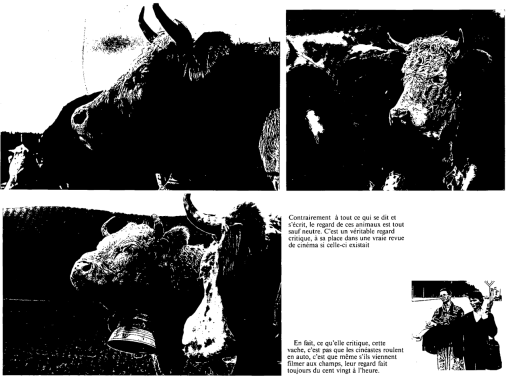
            I’d said that my film Origins of a Meal was equivalent to a cow’s neutral gaze. But not everyone had the same opinion about this gaze.

Dear Cahiers,

I feel, perhaps mistakenly, called into question by Godard in your 300th issue. He presents “three photos of cows: it seems evident to me that they all have a different expression.” “The gaze of these animals is anything but neutral. It’s a truly critical gaze.” The third photo shows a cow with a bell, the second one without a bell and the first cow without a bell doesn’t appear to be the same as the second. These are three different cows, as Godard confesses when he speaks about “three photos of cows”.

Moreover, the face of the first bovid is a three-quarter profile, while we only see the left part of the face of the other two cows.

These differences in identity, lighting, angles bring about a slight difference in gaze (not of the first two anyway) and attitude. In the same technical conditions, Godard could well have taken, as a tribute to Hitch, three photos of Giancarlo Giannini, current-day Delon and Robert De Niro and claimed that it pertained to a critical gaze. Godard simply proves is, in fact, that the attitude and the gaze of one cow is not identical to those of another, especially when the technical conditions are different. But what if they were comparable?

To be fair, what was needed was three photos of the same cow in similar technical conditions. Then, I think, we’d have arrived at the same neutrality over time, just like with the three aforementioned “artists”. After reading Cahiers, I went to various pastures (Alps, Pyrenees, Massif Central) where I got a confirmation of this famous neutrality. This sameness of gaze, from birth to death, is even the opposite of a critical gaze, which is clearly not the same when faced with the trivial and when faced with facts conducive to criticism.

I can’t help but raise my voice against this undertaking of Godard’s, who seeks to rob cows of their unique privilege which men have access to only very rarely.


[From Luc Moullet’s Piges choisies (2009, Capricci). See Table of Contents]

Kapoor & Sons

[Spoilers ahead]

When their grandfather (Rishi Kapoor) falls ill, Rahul (Fawad Khan), successful novelist, and Arjun (Sidharth Malhotra), struggling novelist, return home to parents Harsh (Rajat Kapoor) and Sunita (Ratna Pathak Shah). Arjun believes that Rahul’s perfect life is built at his cost and resents that his parents like his brother more. While supportive of Arjun, Rahul believes he has his head in the clouds and is unwilling to grow up. Harsh is sitting atop a failed enterprise and is annoyed with his wife’s desire to start her own food business. Sunita complains about Harsh’s financial incapacity and dependence on his brother. Another bone of contention between the brothers is the presence of Tia (Alia Bhatt), who is romantically attracted to both of them. This interpersonal algebra is further complicated as the film unfolds, to a point that the entire family is held in tense suspension by mutual grudge.

If the Kapoor family seems out of place in this Bollywood version of Coonoor, here emptied of its local population or landmarks, it’s partly because they are exceptional. Exceptional not only because they are upper class, but because they are unhappy in their own way. Kapoor & Sons stands out in the way it puts its hand into sticky areas of familial life not generally broached by Indian cinema, where moral centres are clearly defined when the family unit is threatened. Everyone in Kapoor & Sons has their reason, and no one’s really right or wrong. (That this detail registers as revolutionary speaks of the industry’s general compulsion to infantilize its audience.) The misery of the Kapoors is spontaneous, independent of external factors. To the world, it’s a happy family, but as the shiny wrappers come off, each member confronts the image the others have of them, confirming their suspicions of not having been truly loved.

The film is centred around grandfather Kapoor’s final wish of having the whole family convened for a photograph. This conceit makes for the film’s most effective set-piece: director Batra intercuts shots of the characters finding out truths about each other with the photo-shoot taking shape under the threat of rain. It’s thrilling and low-key tragic the way this quotidian inconvenience imposes a time pressure over the intense drama: the photograph can’t be made if the characters keep talking, but it won’t be made precisely because the characters haven’t talked enough. When they do assemble for the abortive photo-shoot, we realize that the crux of the problem lies not in the existence of secrets but the in lack of time for the characters in which to explain themselves to each other. Lack of time is what the photograph is about too: the photo purports to hold memories, but constantly lies, picking out a moment in time and stripping away its history. And the lie of the photogenic happy family is what the old patriarch wants to go down with.

Kapoor & Sons is located at the twilight of Bollywood’s old vision of family (community, filial respect, hierarchy, role-playing), now being fast replaced by an occidental vision informed by disruptive liberation narratives (romantic individualism, liberalism, free enterprise, feminism). It’s curious that, despite taking place in a Westernized upper-class milieu, the film looks backwards, dealing with old familial and civilizational sentiments: the guilt parents experience over their children’s perceived faults, the obligation children feel to fix their parents’ lives, the childhood hurt siblings preserve and nurture even as grownups. While Harsh’s and Sunita’s disillusionment with the familial institution is gradual and protracted, Rahul and Arjun face a rude awakening, having to confront primal truths: finding the father at the house of a lover, learning that the mother truly loved one child more than the other.

Commendably written and directed, Kapoor & Sons is constructed out of long, fleshed-out scenes, all of them conversations of some kind – a noteworthy quality in itself. While the effort to crank up the temperature is apparent (a pipe leakage, a dog entering a clean house, a tiff at a card game always at hand to heighten tempers), there’s a clear-cut evolution to every scene. As the film proceeds and the drama reaches a fever pitch, you sense that an expiatory sacrifice in order to appease the narrative gods: it’s not the old man as you’d expect, but his son, and this sudden hole in the family fabric creates a dual perspective of the tragedy, the grandfather’s and grandchildren’s. At the same time, the film treats its material preciously and often forces the issue, spending too much time reinforcing this sibling rivalry and verbalizing that which the actors already convey without words. Rajat Kapoor stands out, but Ratna Pathak Shah’s character is somewhat hollowed out. A more austere, improvisational approach, letting the actors define the contours of their characters themselves, would have helped in a more rounded picture, and made the cruelty family members are capable of towards each other all the more personal.

Bhavesh Joshi Superhero

Bhavesh Joshi Superhero confirms Vikramaditya Motwane’s status as a reliable metteur en scène, a filmmaker capable of mounting effective entertainment in various genres without much personality. He’s made four films so far: a coming-of-age drama, a literary romance, a lone man survival saga and, now, a social-minded superhero movie. All films with specific pleasures and specific ideas, but without any connecting theme. That Motwane isn’t an auteur is a moot proposition and, in the era of instant canonization, perhaps not even worth arguing about. What is of pertinence is that Bhavesh Joshi is his weakest film by far. The failure is instructive in its own way. His films, it now appears, are only as good as their material, and when the latter is uninspired, the films aren’t either.

Motivated by the nationwide anti-corruption movement of 2011-12, two young men from Mumbai, Bhavesh Joshi (Priyanshu Painyuli) and Sikandar Khanna (Harshvardhan Kapoor), launch an activist YouTube channel. Wearing black jackets, paper bags over their heads and carrying a smiley-faced LED panel, they confront various misdoings around them with a camera, uploading the videos online and garnering public support. The project is only half-serious, and, for Sikandar, a means to impress girls. Bhavesh is revolted when Sikandar bribes to get his passport issued and so punches him in rage. In revenge, Sikandar outs Bhavesh’s identity on the channel, just when he’s exposing the water mafia headed by the local MLA and enabled by the police.

Motwane treats the pair’s activism with irony, but when they move from policing individuals to confronting institutions, the film shifts to a serious tone and eventually into full-blown melodrama replete with a strawman villain spouting parables from Greek mythology. Casting relatively unknown actors allows for a surprising protagonist swap midway. For a film that intends to be topical – several reproachful references to the current government, the true-blue Gujarati name of the vigilante protagonist being an insurance against backlash – the characters are oddly unrooted, their familial and social situation not even getting a passing mention. This tendency for topicality is complemented by a desire for legend-building. When Bhavesh Joshi Superhero completes his first foray, we only see him as a silhouette against a burning background.

The compulsion to create a legend clashes with the work’s realist moorings to create a totalitarian vigilante story that pits one man against the entire universe. The film’s distrust of all state and public institutions results in one implausible plot point after another: because everyone is corrupt, the bad guys can get away with anything, anywhere. The opposition party has no voice, the police is rotten to the core, the media is manipulated by the powerful, and the public is swayed by the media. It’s Bhavesh Joshi (and YouTube) vs the World. Yet, it’s the media and the judiciary the script eventually looks to for resolving its plot and bringing the villains to account. For a film that started with the acknowledgement that justice is not a question of setting the crooked straight, but a long-drawn, institutionalized process of negotiation and influence, Bhavesh Joshi takes a quick U-turn.

Motwane and team imagine Mumbai like Gotham City, made and unmade over and over. The film’s best passage is a chase sequence in which the superhero on bike snakes in and out of not just the city’s roads, but impossible locations such as its local railway as well – a parody of a regular day for many residents of Mumbai. The film accentuates the home-made quality of its super-hero, he might as well be called Jugaad-man: we see him buy electronic parts from the black market, stitch together his own attire, customize his bike with makeshift power boosters. The action sequences, likewise, are shot with an improvisational, low-budget aesthetic to look like local variations on Soderbergh. The film tempers its seriousness with touches of humour: after a botch-up, the hero makes for the exit limping, his undercover identity consists of thick-rimmed glasses and an absurd, off-the-shelf bald patch he puts on with the help of a Chinese instructional manual. The final fight sequence takes place on a pipeline and Motwane shoots it like a video game – scattered grace notes in an otherwise ordinary venture.

First Man

Made during the runup to the golden jubilee celebrations of the first moon landing, First Man begins in the middle of action: Neil Armstrong (Ryan Gosling) manoeuvres his plane at the edge of atmosphere, veers close to catastrophe, but manages to land back on earth without much damage. The reason for his lapse of judgment, it is revealed, is that his toddler daughter is suffering from an incurable tumour. She dies shortly thereafter and Neil moves with his wife Janet and son to Houston, having been selected for the test programmes in NASA’s moon mission. Life in Houston has all the trappings of middle-class normalcy – sub-urban house with a lawn, grill parties with neighbours, pastel-coloured wallpaper – but Neil and Janet can never blend in. The moon mission is proceeding at full throttle against all odds, resulting in the loss of several astronauts, all Neil’s friends and neighbours.

It appears that, constantly touched by death, Neil is a stoic, melancholy man, not yet on the moon, but entirely not of this earth. He removes himself completely from family life, content to gaze at the moon every night. In the film’s most effective scene, he is forced by Janet before he leaves for the mission to have a final chat with his sons, which Neil completes like a press meet. Gosling channels some of his work from Lars and the Real Girl and one of the ironies First Man is going for is that this man, brilliant engineer but a social outcast, is constantly asked to bear the burden of history, to be in the eye of media attention, give press conferences, attend White House dinners, and be the receptacle of popular anger against the mission; that he had to go to the moon to be able to get back home. The thrust of Damien Chazelle’s interspersing of Neil’s incurable gloom and the agitations of the sixties is that, no matter one’s privileged social-historical situation, private grief is all-consuming and can’t be relativized.

In this, the film also seems to want to paint a metaphysical portrait of the sexes. Like Western heroes, Neil’s and his fellow male astronauts’ straying away from the pull of domesticity towards the unknown and the endless suffering of their wives and children comes across as descriptions of an eternal condition. The repeated superposing of the domestic scenes at home featuring Janet and children and NASA’s commentary of the mission is supposed to have an Odyssey-like weight, but only grows increasingly wearisome. Janet’s character, more than Neil’s, remains greatly underdeveloped (Claire Foy’s drama school tics condemn it to a type) and it’s symptomatic that this film, which namechecks various discontentment of the sixties, completely sidesteps the sexual revolution that could’ve given Janet a more rounded presence.

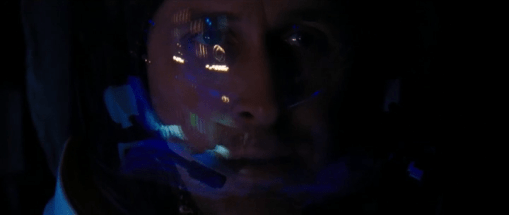
Some of the formal choices are interesting, especially its low-budget-movie tendency to avoid spectacle for suggestion of spectacle: most of the thrill is conveyed to us not through rocket ballets but via numbers on screen, the low-key score, the sound of metals clinging, the actor’s frenetic breathing and the claustrophobic setting of the capsule. Not allowing for sights outside the capsule makes for a subjective experience of impending death. It also reinforces the film’s parallel theme about man’s conflicted faith in technological progress. In a recruitment interview, Neil says that he wants to go to space in order to get a better perspective of life on earth, hinting at a distrust of technology that wasn’t able to save his daughter.

Given that everyone knows how Apollo 11 or the preceding missions panned out in reality, screenwriter Josh Singer pegs the dramatic power of his script on the time-limited nature of the mission. Kennedy’s declaration that an American will be on the moon within the decade taken alongside the impossible odds against which that goal has to be achieved lends the film the thrill of a countdown. Chazelle employs glass as a crucial element of his mise en scène and the material comes to reflect Neil’s emotionlessness, his distance from his family as well as the vastness of the unknown facing him. The last scene, loudly understated, is La La Land Redux.

High Life

The human aspect of space travel is also at the centre of Claire Denis’ first full-length English language production, High Life. Far in the future, death row inmates are given a choice to volunteer for a one-way mission to the nearest black hole. Strict rules are observed on board, the inmates are still treated like prisoners, with everyday tasks to be completed. Overseeing the ship is a slowly-disintegrating captain (Lars Eidinger) and a cookie scientist Dibs (Juliette Binoche), who is trying in vain to produce babies by artificially inseminating the female prisoners with semen samples from the male prisoners. With exposure to radiation mounting as they near the black hole, the prisoners get increasingly restless and Dibs keeps them sedated by adulterating their rations. But the strict prohibition of sexual contact between inmates leads to a breaking point and the mission is thrown into jeopardy.

Well, that is the story, but we don’t get to it right away. The film’s opening fifteen minutes constructs an otherworldly ambience. A glide through a misty garden with a mysterious shoe hints at earth. A baby is seen in a cradle surrounded by screens and electronic equipment, her father Monte (Robert Pattinson) speaks to her through the computers, but he’s perched on top of a spaceship trying to fix an issue. There’s no information about how these spaces are linked and the enigma creates fertile connections in the viewer’s mind. The film proceeds in several stretches through such mosaic of details, which are glued together through clumsy expositional elements such as an Indian professor in a train on earth spelling out the premise. The image of a man and his child aboard a ship heading nowhere is a combination of hope and doom that the film drops for the more ordinary spectacle of the inmates going bonkers.

The everyday events on the ship unfold gradually with sudden bursts of violence, causing the attrition of the crew. We are never sure how big the prison-ship is or what the exact relation between the spaces we see is, except that the garden is a more spiritually-invested zone that disinfects the inmates, gives them an experience of home and helps them come to terms with their dire situation. Monte resists Binoche’s charms to preserve his essence, but is overpowered by her and fathers a baby unbeknownst. His resentment and eventual acceptance of the child perhaps is perhaps what the film is most committed to, turning the story into an allegory of sorts for life on earth. The narrative shifts back and forth in time and there’s a twenty-year jump that finds the baby all grown, now picking up human concepts like faith and cruelty through videos still being transmitted from earth – an improbable Bildung we are asked to take on faith.

As is customary for Denis, particular attention is given to the various textures of the ship: the plastic curtains overseeing the garden, the fabric in “The Box” where prisoners go to let out steam, the padding on the ship’s walls, Binoche’s writhing skin, the actors’ hair which seems to have some special power in the narrative. Every bodily fluid that exists is roll-called and becomes a resource to be harnessed. Denis shoots in odd aspect ratios and that adds to the echo of Solaris resounding through the film. The film, to be sure, is a distinct auteur excursion into this derided genre. But it lacks the consistent ambiguity of The Intruder or the emotional beats of 35 Shots of Rum. Going one-up on the cynicism of Bastards, High Life seems to embody a bitter outlook towards not just civilization, but the human race in totality. Why bother?

Seesaws and connections

Cahiers du cinéma no. 410; July-August 1988.

Francois Truffaut

Thematics

When we examine Truffaut’s work, we run the great risk of getting caught up in thematic and psychological constants, of enumerating them and continuously looking for them.

It’s that everything invites this approach. Truffaut was the first critic to systematically list the commonalities across various films of a filmmaker he defended. That was needed in the years 1954-57 in order to prove that directors like Hitchcock, Aldrich, Ophuls or Nicholas Ray were also auteurs of films, something that a lot of people denied. And, more than any other approach, this catalogue furnished irrefutable proofs. It’s normal, then, that to speak of Truffaut the filmmaker, we adopt an old principle conceived by Truffaut the critic. But it’s somewhat of a tautology: how could one suppose for a moment that the champion of the politique des auteurs wasn’t himself an auteur? A tautology and an anachronism: discovering auteurs through Hollywood standards of the forties and the fifties constituted an unusual and justified quest. Looking for auteurs among independent French films of the sixties and the seventies is a little like looking for Blacks among Africans…

On top of that, the choice of Truffaut encourages this approach: five of his films reuse the same central character (and the same actor): a continuity that we don’t find in any other filmmaker, except of course the comics. And, with some indulgence, we could even extend this consistency to The Wild Child or Small Change – the Doinel from before The 400 Blows – or to Day for Night or Two English Girls, thanks to Léaud.

Even if it takes the easy way out, I’m not against such an approach. It’s perhaps indispensable. But there are so many similarities that lend you a helping hand… So, we stop there and forget the rest, the essential. After all, if Truffaut titled his first article on Hitchcock “A bunch of false keys”, it’s because he knew very well that with so many commonalities one could also end up at the wrong place. “Auteur perhaps, but of what?”  said Bazin. A quip that must be used for the films of Zeffirelli, Cavani, Robbe-Grillet, David Hamilton, Vadim, Petri, Ken Russell, Magni, Albicocco, Moguy to name a few.

An example: the literature on Truffaut often evokes the theme of the double, the presence of mirrors. I confess that I didn’t notice them during my viewing. On reflection, it seems quite evident to me. But it doesn’t take us far. If I didn’t notice them when I saw the films, it’s because these constants don’t work very well, too derived as they are from outside influences, that is to say from the masters Hitchcock, Ophuls or Sirk. Perhaps because there’s no moral resonance in the Hitchcockian sense: the innocent double of the culprit belongs to an ideology different from Truffaut’s, where no one’s either innocent or guilty, good or bad. Perhaps because the mirror has no plastic existence in the work of this filmmaker who tends to give plastic values a miss.

High points

Every film of Truffaut’s contains one or many moments (varying according to the viewer’s sensitivity) that leaves a precise memory, striking and indelible even after twenty or twenty-five years. Perhaps the only exceptions to this law are Two English Girls1, one of its kind, a meteor in Truffaut’s work, and Such a Gorgeous Kid Like Me. It’s not a coincidence that these are consecutive films: should one see here a fleeting influence of post-68 modernity? Whatever it was, after the relative lack of success of these two films, Truffaut was to definitely return to the practice of high points.

This presence of a high point is an increasingly rare characteristic today (except among the comics, and Truffaut makes you laugh).

It’s difficult to find them in Duras, Bene, Rocha, Rivette, Jancso, Fassbinder, Oliveira, Straub, Bertolucci, Satyajit Ray. It’s a general impression that emerges from their works, the whole and not the part. This is another feature that links Truffaut to olden filmmakers and draws him away from the modern ones. Today, films of which we recall a single sequence are failed or low-calibre works. Interesting films tend to be difficult to grasp, to slip away like an eel from any effort to analyse them.

It could be a line of dialogue or a short series of words, the child invoking the death of his mother to justify coming late to class (The 400 Blows), the “yes, sir” addressed by the employee to his boss, who understandably takes it for a declaration of love, or Antoine’s repetition of his name thirty times in front of the mirror (Stolen Kisses).

There is a commonality here with dialogue-based French cinema of 1930-50, but in Truffaut, the author’s remark doesn’t have a descriptive, accessory or gratuitous character like the too-famous “bizarre, bizarre” of Jouvet or the “atmosphere, atmosphere” of Arletty. It’s rather a rapid, unusual, paradoxical and provocative explosion that often changes the course of the story being narrated.

The intermittent and literary aspect of these high points partly explains the success of his films among viewers and critics: this shows an evident proof of talent that’s easy to communicate to others…

We could also add to the list the opening tirade in The Green Room, where Truffaut the actor walks around a coffin and expresses his indignation about the Church easily assuring the superiority of the other world. Here, the high point is in the text, in the performance and in the situation all at once.

For the high point is often based on the situation, the idea of a scene: The Man Who Loved Women is killed by a double “accident at work”: run over by a car while getting to a pretty woman across the road, he snaps the tube of his drip trying to caress the nurse. The murderer in Confidentially Yours gives himself away when he lights a second cigarette while already having one in the mouth. There is the actress who agrees to shoot only if she is served a block of butter at breakfast, which the manager hypocritically obtains by mixing many packets, Valentina Cortese’s opening of the wrong door (Day for Night).

At times, it’s an odd story picked up from a minor news item: Nelly Benedetti sets out to kill her husband with a huge rifle in a contemporary restaurant (The Soft Skin).

Romantic high points are frequent: Fanny Ardant meets Depardieu, now married like her to another person, after many years in a very eighties, banal and adulterous context (an underground parking), but when he kisses her, she faints in the purest romantic style (The Woman Next Door). If the ten-year-old boy keeps going to his friend’s place, it’s not to meet the friend, but his mother, whom he is in love with (Small Change). Pisier (Love at Twenty) slowly turns Leo’s love into a sibling relation while she openly flirts elsewhere, an ambiguous situation unknown in cinema where one had to either love or break up. The woman discourages and terrifies the seducer on the street by bluntly expounding the reality of sexual facts (The Soft Skin). Nathalie Baye says yes to Menez’s allusive courtship right away, challenging the man to proceed further, turning the tables once again (Day for Night). And I easily have twenty more examples in reserve.

The high point, especially when it’s anecdotal, draws its power from its genuine quality. It’s so odd and absurd that it couldn’t have been invented. It’s necessarily true. It’s hence very much at home in Day for Night, where the viewer tends to take the story of the shoot for an unquestionable reality because it distinguishes itself very clearly from the film being shot, Pamela, a very obvious fiction. A new form of an accentuated impression of reality, even though it’s totally refuted upon reflection.

The high point is almost always comical, except when the situation is too dramatic: that’s the case with the two funerary urns (Jules and Jim), the paltry remains of the two heroes, with the presence of a single person at the funeral. In the olden days, when cinema filmed the burial of its protagonists, it made sure it showed a large and heavy coffin and, if possible, a large crowd. Another high point in opposition to cinematic tradition.

There are rarely more than three or four high points in a single film. It loses its effectiveness beyond that. It’s omnipresent in Shoot the Piano Player (Aznavour’s hand going over the body of Marie Dubois, over that of Michèle Mercier, Lapointe’s song, the dying grandmother, Nicole Berger’s suicide etc.) and this is thanks to the heterogeneity of facts. This permanence creates an obstacle, a refusal to accept the reality shown and, secondly, a dangerous and reductive addiction. After Piano Player, high points will be more integrated, better distributed across a smooth narration, appearing after we’ve had the time to warm up to the film, to accept it.

The paradox

As we have seen, it often characterizes the high point. One of the rare commonalities with Godard. It’s the woman who takes the initiative. Or it’s Léaud who calls Delphine Seyrig “sir” (adding to this is the flamboyant paradox of the Léaud-Seyrig couple). It’s Antoine’s arrest, not when he steals a typewriter – as any writer would have had it – but when he returns it (The 400 Blows). Through an insane investigation, the man who loved women succeeds in finding out the address of the pretty girl he once glimpsed. On the telephone, she doesn’t sound unresponsive to the man’s approach, and we expect a typical seduction lesson during the scene of their meeting. Bang, the man learns that there’s been a mistake and leaves with an apology, while the woman’s attitude makes us think that it could all have worked out very well. Truffaut manages to surprise us every time. He defuses the scene, avoids the commonplace the viewer expects, all the while retaining the potentials of the situation, harnessed to the maximum. A praiseworthy approach for an age in which the viewer is often way ahead of the story.

The absence of surprise is also the reason for the failure that, in my view, constitutes Fahrenheit 451. We’d read the book, or knew that it was a variant of 1984. It’s the same principle, certainly original, but repeated from start to finish, with good guys and bad guys. And, on top of that, the publication of the shooting diary eliminated the few unknowns that remained for a certain number of viewers. A disappointment that’s customary with long-matured or late-blossoming films (The Big Red One, The Demise of Father Mouret etc.)

This taste for paradox, this desire to do the opposite of what others are doing, must be seen against a work and a life in contradiction with itself, in constant oscillation. It’s this game of seesaw that makes the work so “alive”, so unexpected, and gives it its force, far removed from all sectarianism. Truffaut reacts every time against what others are doing, and against what he himself did the moment before. The contradictions are numerous…

This classic filmmaker, who’s always taken pains to establish a protective distance between his work and himself, between the public and the private, who has always eliminated the “I” from his films, suddenly starts playing lead characters in The Wild Child and The Green Room. This maniacal perfectionist, who rewrites his scripts ten times, who spends six months on his editing which he sometimes modifies five or six times after the film’s release, makes his films with the least malleable material that exists: children.

As a critic, he champions, with the rage of a fanatic, films that were the total opposite (except those of Gance and Welles): masterpieces of a modest appearance, founded on rigour, moderation and discretion, primarily The Golden Coach, all Resnais, all Hawks, Journey to Italy and even – in a certain sense – Hitchcock, hidden behind his labels (detective movie-humour). Whence a non-paradox, there where people often see one: it’s not surprising that, like his masters, he too made films of a modest and conformist appearance.

As a critic, he champions films by atheist intelligentsia and celebrates an art inherited from the past, based on a traditional aesthetic and on Christianity. As a director, the denounces common sense morality against that of conventions, in a spirit agnostic and respectful of human insignificance (Jules and Jim) and rises against the mirage of the Christian hereafter (The Green Room) with a vigour much more energetic than that of Jean Aurenche whom he once decried so much.

What is this discontinuity between the detractor of post-war “progressive-humanist” cinema and the signatory of the “Manifesto of the 121” that many leftists didn’t dare to even sign, between the pro-Langlois, anti-Cannes militant of May 1968, the seller of La Cause du peuple and the one who had Bernard Granger slapped, guilty as he was of deserting the theatre for the Resistance (The Last Metro) or the one who associates the only true villains of his entire filmography (Richard Daxiat in The Last Metro and Lonsdale in The Bride) with political engagement.

Was the image that Truffaut gave of himself a false image intended to forge a legend, or was there an evolution – as we can rightly say in the case of Godard or Chabrol – or is there a natural dichotomy between the critic, sensitive to what had been done, and the creator, understandably driven to do something different from what the masters had done? I admit to hesitating between the second and third options. I am tempted to say that, in Truffaut, we must make reference to an instinctive logic based on the precise moment of action, which we will discuss later.

Connections

The existence of high points is the most evident characteristic in Truffaut. Is it the most brilliant sign of his art? It’s better to qualify our statement here.

There are high points in Small Change (romantic: the kid loves his friend’s mother; anecdotal: the baby falls from the sixth floor and is unhurt; verbal: “thank you for the frugal meal”). But the film doesn’t work. It’s a series of gems without any connection between them, a collection of interesting scenes that Truffaut couldn’t put in his previous films. It doesn’t work because Truffaut didn’t deploy his master weapon, narration. No principal story, no connecting thread. Like all failures, Small Change is negatively more revelatory of its auteur’s art than his perfect successes.

On the other hand, let’s consider a film essentially built on narrative talent, but without high points, Such a Gorgeous Kid Like Me. It holds together magnificently. It’s a series of dizzying dramatic turn of events, sudden impulses of characters, absolutely unbelievable – but we don’t have the time to realize that – and without any concern for psychology. Characteristics that provoked the distain of French critics. Like in Piano Player, Confidentially Yours or the beginning of Stolen Kisses, it’s the little world of fantasy, very Left Bank à la Queneau-Vian-Audiberti, superposed on the more structured world of the American crime novel by Goodis, Farrel or Williams. Another game of seesaw. The film works marvellously on pace and narration, but it’s a tightrope act since it rests on nothing. I realized that well the day I saw a scene from the movie on television isolated from its context. It seemed to me to be totally gratuitous, morbid, voyeuristic, abject. Evidently, it’s the connection between the elements that makes for Truffaut’s art and not the elements themselves.

We can say the same thing about Confidentially Yours, where an element essential to a work supposedly so respectful of its characters is surprisingly lacking: we don’t understand why the secretary falls in love with her boss. We could suppose that she has a maternal side, a protective side for the man in danger.

We could suppose that, but the film doesn’t give us any clue to say so. There is surely an explanation for this blatant miss: Trintignant, small, timid, awkward, evidently stands for Truffaut. And a description of Fanny Ardant’s motivations towards Trintignant-Truffaut would’ve constituted an indecent intrusion into Truffaut’s private life, which would’ve disturbed his modesty.

We realize that this apparently conformist and narrative filmmaker works against psychology or without bothering about it, whereas we frequently group narration, psychology, classicism and realism together.

Why did the man who loved women love women so much? Sure, there is a brief reference to the mother. But it has more visual and comic value than explanatory value.  It’s only after having seen Blake Edwards’ remake that I realized that Truffaut had eliminated the reasons for this neurotic, or at least odd, behaviour and that the film held together very well without these explanations. On the other hand, Blake Edwards’ film gets unfortunately tangled up in a very American and very pedantic psychoanalytical study that forestalls the surprises created by the actions and the elliptical elegance of the original.

We sense that Truffaut was hostile to psychology inasmuch as it supposes a certain continuity in the individual. He latches on to an actor’s truth of the moment, which can be entirely different from the truth of the next moment. We understand better the Truffaut character, apparently so contradictory. It might be that we are nothing more than unpredictable reflexes and instincts – the moral of Jules and Jim.

Psychology, in the literal sense, study of the psyche, study of the soul, is hardly present in Truffaut, except perhaps in the beginning, in The Soft Skin, for example. It’s rather the observation of instinctive behaviours (whence The Wild Child and all the films on children and adult-children). What interests Truffaut is the sudden explosion of unusual reactions. He plays on the unusual. And, at the same time, thanks to the actor’s work and thanks also, as we have seen, to the unquestionable enormity of behaviour, he makes us believe and accept these behaviours. The difficulty of the undertaking necessarily brings him to either dazzling success or total failure. In fact, there’s only one total failure, Mississippi Mermaid, where Belmondo was happy to recite a text which aimed too high. Finally, Truffaut is able to make us overlook psychological improbability just as Hitchcock could make us accept factual improbability. We accept the relationship between Mrs. Tabard and Antoine Doinel while it doesn’t stand a considered examination.

The last storyteller

Connection, and so narration, but not traditional narration. There are some great narrators in cinema – Griffith, Ford, Pagnol, Mankiewicz, Fassbinder. After the death of Fassbinder (whom he admired), Truffaut became the last storyteller. No one’s left now. The end of an era. Comencini, Brocka, Cronenberg, Rohmer use narration well, but it’s less important in their work than the thing narrated. There’s Chabrol, in theory. But he doesn’t use his storytelling gifts in Death Rite, or in The Twist, or in Alice, or in Blood Relatives, or in The Horse of Pride

Great narrators base their art on a certain manner of taking their time and, often, on a duration that’s much longer than the average. With Birth of a Nation, Intolerance, Orphans of the Storm, One Exciting Night, America, Griffith stays at around three hours. Ford gets close (Cheyenne Autumn). Pagnol crosses it (Manon of the Sources) and pegs his minimum at two hours. With Cleopatra¸ we are at four hours and Berlin Alexanderplatz eyes fifteen hours.

Truffaut, on the other hand, never takes his time. He is afraid of boring the audience. With his customary discretion, he prefers to stick to the norms, except with two films, where he marginally crosses two hours (The Last Metro, Two English Girls). He was so remorseful about the latter film that he cut a quarter hour from it to bring it under limits.

And if One Exciting Night or Sleuth took a story unfolding in a brief time interval and extended it over a long runtime (Sleuth, in this regard, has set a record), Truffaut does the reverse: twenty-five minutes of runtime for six months or a year of life narrated (Les Mistons, Love at Twenty). All these films unfold over months, years (Jules and Jim, The Wild Child, Adèle H. etc.), the shortest time interval being that of Confidentially Yours, perhaps a few days. But it’s an exception. In truth, I must say that I’m hard put to discern the time interval in which the stories unfold, except The Last Metro and Jules and Jim because they refer to the two great wars. It’s as though the exact duration was of no importance (we sense it clearly in Adèle H, or Two English Girls). The reason for it is that, rather than narrating an action, as other great storytellers do, Truffaut narrates feelings, the evolution of feelings, or an idée fixe2.

The action, even if it exists, is of little importance in Truffaut’s work. We aren’t all that eager to know if the bride gets caught by the police, or who the murderer of Confidentially Yours is: the ultimate insult for a crime movie… It doesn’t matter how it ends, what happens next to the characters, if there is a happy ending. The ending often seems to be the product of chance (Les Mistons, The Soft Skin, Piano Player, Mermaid). We are always in the present moment, we never let ourselves be anguished about the future (the opposite of Hitchcockian suspense).

The idée fixe is The Bride (a vengeance abstract in its disproportion), The Wild Child (Itard’s pedagogical obsession that ends up becoming an absolute torture by education) and, of course, The Green Room, The Man Who Loved Women, Adèle H., three consecutive films, as though by chance. Here too, the idée fixe becomes abstract: by dint of pursuing the man she loves, Adèle doesn’t even recognize him anymore. Curious premonition, two years before the Buñuel of That Obscure Object of Desire.

Feelings: Truffaut gleans ten interesting seconds one day, ten the month later; this is the principle behind the two films adapted from Roché and, less overtly, behind all his films. A survey of action, of emotions (or of the idée fixe) with numerous short stopovers at meaningful moments connected by the commentary track.

Here too, a surprising contradiction: fan of the ten-minute take in his reviews, expert of the long shot during filming, Truffaut soon manages to butcher his long shots (with the exception, right at the beginning, of Léaud’s famous interrogation by the social assistant in The 400 Blows) to retain no more than ten seconds sometimes.

Mister Post Office

You must’ve noticed a practice that’s familiar in the novel: less attached to reality than cinema, the novel can afford to flit over time. Truffaut’s cinema, as everyone has noted, is the continuation of the novel, the 19th century French novel in particular3, often quoted throughout his films whereas he ignores references to plastic arts (except, indirectly via Almendros and the “candle period” in a work that remains rather accessory to Truffaut and more conventional than his – cf. Adèle H.) and to music (except contemporary French pop music). I will consider as negligible the borrowings from Mendelssohn, Chopin, Vivaldi (Vivaldi, for Truffaut, is perhaps mostly The Golden Coach). The opposite of Godard.

Perhaps this indifference stems from the fact that painting and music are arts more foreign than French, elite and thus more distant for Truffaut the autodidact.

From the novel, he goes to the source, to letters, since the novel, at its beginnings, disguised itself as a collection of letters (Manon, La Nouvelle Héloïse, Laclos etc.). Truffaut, a famous letter writer, turns some of his films into a series of letters. It’s these letters that facilitate declarations of love. If I had to describe Truffaut in a single word, it would be Mister Post Office.

There is, in his work, two pieces of anthology. The first is the series of letter exchanges in Jules and Jim, where the camera insists more on the material circulation of mail while the soundtrack discreetly evokes the content and the evolution of emotions. The second, adapting to the evolution of time, is the exchange of telephone calls (often hung up or aborted) by the lovers of The Woman Next Door and of Confidentially Yours.

This importance of connection, through post, allows the filmmaker to summarize the contradictory evolution of minds briefly and precisely, to express in terms discreet and concrete at once a range of emotions that, shown more directly, would come across as too indecent or could be suspected of falsity: when an actor and an actress kiss, the viewer can always suppose that they are pretending. On the other hand, when these emotions are indirectly alluded to and the viewer actively participates in their discovery, they can hardly be questioned.

Postal reference will also constitute one of the strengths of Adèle H. Truffaut takes pains to show all the material circumstances of Adèle’s quest – difficulties in getting the mail, in having the money sent to her, her various wanderings – which most other filmmakers would’ve eliminated as being too trivial.

Truffaut – and it’s the secret of his critical genius – always starts from the material and the particular to arrive at the abstract and the general. An autodidact’s approach more in tune with lived facts than learned ideologies. When he becomes a militant ideologue, he falls flat (Fahrenheit).

Connections are of so much importance that they become a world in themselves, the only world that creation really exerts a hold on, that they locate their power on the exaggerated banality of the connected elements: everything is relation, everything is but relation. Everything’s been said, everything’s been shown. Maybe creation is only an art of relations. Plastic values, as we have seen, tend to be ignored, the composition of the image “within the frame” has nothing exceptional about it, the social is forgotten or disdained (whence the ire of Zhdanovian critics) and I’m tempted to say that there’s no psychology. We can wonder what remains. Disconcerting gaps, especially since this is one of the most complete bodies of work in existence.

A typical example of the neutrality of elements is the last shot of The Bride, probably the most beautiful last shot in the history of French cinema. I won’t say the most beautiful ending in the history of all cinema, since there’s the wave that drowns Matahi in Tabu, and Citizen Kane, whatever one says about it. But we’re not very far.

Generally, in cinema, we guess the ending five minutes in advance, if not earlier.  Comforted by a quick glance at the watch, we have already put on our coats, scarves or our shoes – as the case may be – to prove that we’ve not been fooled, that we are ahead of the director. All that is impossible, thankfully, in The Bride, where Truffaut manages to surprise us (like he had us with the final bridge of Jules and Jim, whose broken section was hidden in the preceding shots). Vaguely uneasy, we wonder at the beginning of the shot how Truffaut can possible conclude, since it’s time the film ended. We’re sure, at any rate, that it’s not the current shot, so trivial, that can serve as the epilogue. In a long hallway, the heroine wheels a trolley containing food for the inmates of a women’s prison. A banal shot that could’ve been shot by anyone.

It’s only in the final seconds of the shot – the hallway turns right, there’s no one in the frame, but we hear a scream off-screen – and we understand that everything’s been said. There can’t possibly be any other conclusion, nor as logical a conclusion. And just then, the external signs of the film’s end appear. The time interval between the ending and the viewer’s understanding, if there is one, isn’t more than one second one way or the other.

Nothing in the shot, everything in the relation to the context. Genius is genius precisely because it’s based on nothing.


1Although the stain of blood…

2There are exceptions such as The Last Metro and Day for Night. His knowledge of the entertainment world is so considerable that, along with the plot it constantly fuels, it constitutes the principal subject of his films. Ellipse and overview are very rare here. It’s perhaps due to these characteristics that they constitute Truffaut’s two biggest hits among the audience.

3Everything links Truffaut to the past, not to the present. It’s perhaps more the rejection of the present than the necessity of the past. Truffaut is at his best when he limits himself to studies of romantic relationships disregarding the period (notably Two English Girls) or when he situates himself in the past: the 19th century of Adèle H., The Wild Child, the twenties in Jules and Jim, all the more so because there’s no one to contest their veracity. Or it’s the Occupation (The Last Metro), the fifties (The 400 Blows), the isolated world of entertainment (Day for Night, The Last Metro) that he understands marvellously.

The opposite of Resnais. Resnais is the present invaded by the past. Truffaut is the past experienced in the present; that is, the search of the present moment.

It seems that, after 1959, Truffaut cut himself off from the world around him through work. That’s of no problem when the film doesn’t engage with it, hinged when it is on fantasy (Confidentially Yours), feelings (Mermaid) or abstraction of the idée fixe (The Green Room), but there’s something scholarly, and indecisive, in the presentation of provincial social reality in The Woman Next Door, thankfully very marginal to the film. This isolation destroys Love on the Run: it’s a film based solely on the relation between its elements, between various stages in the life of a man, which is right up Truffaut’s alley, but the modern element is not simply neutral here. It’s negative in that it expresses a total absence of experience, which contrasts with the elements of the past (deriving from Love at Twenty) which are infinitely more genuine. Bed and Board was limited in this regard, closer to the world of René Clair than that of 1968-70.

A filmmaker can’t film everything. It’s to the credit of Truffaut’s intelligence for having always known, expect one near-exception, what he could film and what he couldn’t.


[From Luc Moullet’s Piges choisies (2009, Capricci). See Table of Contents]
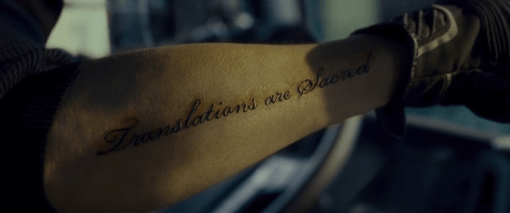
Gully Boy

My issues with what I’d seen of Zoya Akhtar’s work so far were related to the question of perspective. The outlook of Zindagi Na Milegi Dobara and Bombay Talkies revealed an overprivileged life out of touch with the rest of the country, a personality entirely shaped by Western liberal notions having little empirical grounding. The works came across to me as unwieldy transpositions of popular ideas – McPhilosophy – onto Indian narratives. So, when I heard that her latest film, Gully Boy, was about a youth from Dharavi rising to stardom as a hip-hop idol, I had my prejudices: another Bollywood-Hollywood crossbreed, an underdog rap movie embodying a bourgeois ideology of making your own life, middle-class attitudes to poverty and shop-worn wisdom about following one’s passion, tailored to Western tastes with suitable amount of local colour added. While these tendencies are still discernible in Gully Boy, Akhtar and her co-writer Reema Kagti mount a powerful rebuttal to these prejudices. With great intelligence and feeling, they pre-empt the objection that wanting to transplant a musical phenomenon rooted in the African-American experience onto the slums of Mumbai is false consciousness. Their magnificent film demonstrates to us that, at this particular juncture in Indian history, it’s this very objection that’s reactionary, a product of false beliefs about what our society is and isn’t, that the image of a boy recording his voice on an iPad through a tea strainer is not the figment of an uprooted imagination.

Gully Boy is a portrait of “young India”, the dreamers as a recent book put it, a pan-social generation that is still embedded in old traditions, but takes its behavioural and aspirational cues from a wider international community. All they need is food, clothing, shelter and internet. When Murad (Ranveer Singh) writes his first rap lines in Hindi/Urdu, it’s in the roman script, a hybrid form just like the film’s bilingual titles. He sleeps, works and rolls cigarettes in the attic of his matchbox house in Dharavi. Murad goes to the mosque on Fridays and is answerable to the strict codes of the family hierarchy. He dreams of becoming not a movie icon or a ghazal singer – enticements that his immediate surroundings offer – but a hip-hop star, a notion foreign to his milieu. Words surround him all the time; he lives in a noisy environment and wakes up to the creeping sound of his parents quarrelling. He desires peace and privacy, also concepts foreign to his milieu, but the attic can only offer so much. As his father (Vijay Raaz) brings home a second wife less than his age, Murad plugs in the earphones to drown out the Shehnai and the sorrow. Akhtar cuts to his perspective. We hear a rap track as we see the newly-wed being welcome by the first wife. This escape from reality through music from another world, later amended by a return to reality through the same music, is dissonant and incongruent. Incongruence, however, is the point.

All through the film, Akhtar and Kagti emphasize the outsider perspective to the story and foreground their own foreignness. They populate their film with outsider figures: slum tourists whom Murad surprises with his knowledge of hip-hop, a European traveller who decides to stay back with Murad’s friend and guide MC Sher (Siddhant Chaturvedi), the rich family that Murad chauffeurs and, most notably, a Berklee student Sky (Kalki Koechlin) who produces music with Murad and Sher as part of her project. An alter ego of Akhtar’s, Sky brings to Murad’s universe an undiscriminating perspective, new social codes and modes of thought. She takes Murad on a night crawl to spray paint at construction sites, bus stops and shopping malls – artistic interventions which, in Murad’s world, are acts of vandalism. The kitchen of her quiet, spacious apartment is bigger than Murad’s house.  “I can’t believe I’m doing a music video” says Murad to her, to which she responds, “I can’t believe you were going to take up a job.” Gully Boy recognizes that change can come neither from within nor from outside but from a dialectical interaction of the two. Thanks to her material, Akhtar is able to refuse looking at Dharavi as a self-contained ecosystem isolated from the rest of the globe. The residents of her Dharavi are not poor-but-happy fatalists content with their everyday victories and limited social mobility. They dream big, they form their self-image from the outsider’s gaze. Murad derives his worth from the feedback he gets online. In a climactic showdown with his father, he points to the number of likes and comments on his videos and claims that he won’t let someone else tell him what he should aspire for. In doing so, the film throws a loaded challenge: a viewer tempted to judge Murad’s internationalist consciousness and ambition as shallow and false falls in line with the father’s point of view.

If it’s hip-hop that promises a ticket out of poverty for Murad, it’s the safer route of education for his long-time girlfriend Safeena (Alia Bhatt). Higher up on the economic ladder, Safeena is determined to become a surgeon and lead a life with Murad – in that order – whatever that takes. When she learns that a friend of hers is flirting with her boyfriend, she goes to the girl’s workplace and beats her up. This scene of two women fighting over a man seems overreactive and questionably comical, but it soon is revealed to be part of Safeena’s pathological jealousy: when she breaks a bottle over Sky’s head for courting Murad, it isn’t funny anymore. Safeena articulates her reason: she has one life and she will not let anyone run roughshod over it, even her boyfriend. Safeena is the counterpoint to Murad’s mother, who must resign herself to a life she didn’t choose. (In a nice bit of mirroring, Murad finds his temperament and muted masculinity echoed in Safeena’s father.) If Murad runs up against tradition in direct, confrontational ways, the headscarf-sporting Safeena fights it from within. She constantly lies and uses her perceived vulnerability to get what she wants. She will even weaponize the system of arranged marriage to suit her ends. In an astute bit of writing, the threat that she faces as a woman – of being withdrawn from the economic ladder and getting married off – is opposed to the threat that Murad faces as a man: the thread of being chained to the workforce. The freedom she desires she had? To be able to put on lipstick, go to parties with friends and stay out late – another loaded challenge to the audience to judge these as petty and shallow.

Every time we think a characterization, an event or a turn of phrase seems out of place in the film’s milieu, the film turns the suspicion back on to us, asking us why not. Why shouldn’t, in a film full of failed father figures, Murad’s masculinity be untouched by his circumstances? Why shouldn’t the words (“mazboot” to mean solid, “awaaz karo” to mean make some noise) sound translated from English? There’s a monologue towards the end questioning the 9-to-5 life, which sounds like the product of middle-class professional anxiety. But, the film repeatedly asks, why shouldn’t Murad question it, why shouldn’t he rap to a different beat? Why should this heightened consciousness about life necessarily be the prerogative of those higher up the social ladder? If the film characterizes this YOLO wisdom as being typical of a generation, it doesn’t skirt questions of class. Murad is forced to briefly take over his father’s job as a chauffeur to an upper-class, strawberries-for-breakfast family. In a heavy-handed scene saved by Ranveer’s lack of reaction, the man of the family urges his daughter to do her post-graduation, pointing to Murad’s status as a graduate. A while later, in the film’s best sequence, the girl storms out of a party back to the car. Murad observes her crying on the rear-view mirror. He doesn’t say a word and, as they drive home together, yellow lights from Mumbai’s street lamps washing down their faces, a voice-over begins: Murad has converted his inability to console her into a verse. Akhtar throws into relief their physical proximity and social distance with a shot of the car from the side. The voice-over provides Murad a liberty he doesn’t have in the diegesis.

Akhtar is responsive to the class-coded nature of the various spaces in the film. Murad’s presence in the recording studio, at upscale pubs or at Sky’s gated community have a friction matched by Sky’s decision to shoot her video in Dharavi. The austere warehouse where the rappers meet, on the other hand, promises a utopian space free of class distinctions. Several scenes take place at a playground in Dharavi, a zone of horizontal male bonding outside of community strictures, and Murad’s success story is one of being accepted into and assimilated by traditionally exclusionary spaces. In one scene on a New Year’s Eve, Murad is turned away by a bouncer from the vicinity of a rap concert. He shuts himself in the car in rage and shame and raps a verse. This response to being excluded from a public space by turning the private space of someone else’s car into a personal space for creation is part of Murad’s innate adeptness with space, his constant slipping from his attic to the terrace, to the bridge, to the round or to Safeena’s house. There’s an endearing romantic scene between the two, a spin-off of Romeo and Juliet, where Murad calls Safeena on the phone from outside her house. They speak to each other over phone but looking at each other: she’s on the balcony, he’s down below. This culturally-defined but entirely-comfortable distance is to be contrasted with the scene in the car with Murad and the rich girl.

Akhtar’s keen sense of space is coupled to an equally-sharp attention to behavioural detail. She observes the (predominantly male) hip-hop subculture with an ethnographer’s eyes, touching upon the various rituals, rites of initiation and social codes involved: the head-banging and arm waving, the animalistic circling around before a faceoff, the “bohot hard, bohot hard” (“hardcore, hardcore”) chants of encouragement, the spontaneous recruitment of groupies, the putdowns hinged on perceived lack of masculinity, and the class anger sublimated in performance. The attire, accessories and hairstyles of the participants, their body language, and even their choice to play the Dozens are derived from Black hip-hop culture and Akhtar makes no effort to disguise or attenuate this. She recognizes that this whole space is an opportunity for youth, marginalized and privileged, to leave behind their given identities and play out ones they have chosen for themselves from a sea of internationally available sub-cultural identities. These gestures and behaviours don’t exist outside the space of the warehouse and the concert hall: their being unrelated to the real world is their reason to exist. Hip-hop here is an external agent of change – like Sky, like Akhtar – offering an alternate mode of life, a parallel community outside of family, work, mosque, free of judgment and hierarchies. Notice the scene when Murad walks into the warehouse for the first time. He starts rocking to the music as soon as he hears it. It’s an instant recognition of one’s lot, a spontaneous initiation into a brotherhood forged on a beat.

The terrific rap is written by a battalion of hip-hop artists and music producers on whom the film is partially based: Divine, Naezy, Kaam Bhari, Spitfire, Ace, Dub Sharma, MC Altaf, MC TodFod, Desi Ma, the list is long. The verses are top rate and so are the roasts. But as pleasant is how Akhtar and her dialogue writer Vijay Maurya, who plays Murad’s uncle, show a great sense of prosody. The words they pick and the way the actors deliver them have a cadence and vitality rivalling the rap tracks. When Murad is christened ‘Gully Boy’, his friends repeat the name like an incantation. A moment earlier, the word ‘export’ was brilliantly rhymed with ‘visfot’ (explosion). One of the quarrels between Murad’s parents yields this bit of verse: “Baccha hai?/Haan/Baccha hai yeh?/Haan/Saala saand ki tarah chhati pe baitha hai baccha hai yeh?” (“A kid?/Yes/He’s a kid?/Yes/He’s sitting on my chest like a goddamn bull and he’s a kid?”). An exchange in Marathi between MC Sher and his father sounds straight out of a rap battle. Akhtar’s knack for picking up rhythms from Murad’s environment – the sound of door knocking, a passing train, the footsteps of Murad coming down the attic, the ubiquitous “bhai” (“brother”), the vowel-dominated Mumbai Hindi slang that ends imperative sentences with ‘ka’ (“pyaz katne ka, cooker mein dalne ka, teen seeti ke baad nikalne ka”) – hints at the source of his gravitation towards hip-hop, just as the factory noise of industrial Britain is said to be responsible for the blossoming of heavy metal music in the country.

Ranveer Singh is extraordinary as Murad and it’s one of the great Hindi cinema performances. Several scenes in the film would’ve simply collapsed had he interpreted his role differently. When you see him first as the unwilling participant in a carjacking, he is in the background of the shot, out of focus. Even when he is in focus, he’s barely conspicuous. Donning sweat shirts and jackets over a kurta or a loose shirt left untucked, a backpack, a talisman on his neck, mascara under the eyes, he cuts an awkward figure. There’s a constant softness to his voice, even when he becomes increasingly comfortable with the rap scene, that is in contrast with the coarser textures of his peers’. In his first open mic session, Murad is pushed by MC Sher to rap out his own writing. Ranveer reads the text out from his notebook to an “old-school” beat in metre, without any deviation or improvisation, like a primary-schooler forced to recite a poem for a competition. He misses the beat once: a calculated amateurishness worthy of Gary Cooper. This apparent innocence gives his tracks a moral power and rounds off the rough edges of the roasts. Notice the pitch drop in the final battle when he goes from “Tere kaale noton ki raid lag gayi” (“your black notes have been raided”) to “ab yeh sikka mera bolega” (“let my coin do the talking now”). The shifts in his tone when he speaks to Safeena, to his friends or to characters outside of Dharavi go hand in hand with his changing body language in different spaces. Just looking at him you could figure out the kind of location he’s in.

There’s a distinct lack of a feeling of bruised masculinity in Ranveer’s Murad – no rage or resentment – contrary to Vijay Raaz’s rather flat characterization. Unlike Safeena, Murad is not irreverent or calculating. His verses aren’t controversial or especially provocative, nor is his rhetorical style. They’re inward-looking, less about societal evils than about self-realization. With an unassuming Mumbai accent, Ranveer minimizes Murad’s own experience in front of others. He thanks MC Sher for the warm reception on the first day. When Sher tells him not to pay heed to rich kids dissing his provenance, he gently replies “no, brother, they’ve seen the world.” The first meeting with Sky at a pub is a lesson in modest cordiality. He will later thank Sky for not insisting on sleeping with him, innocent of the power dynamic at hand and of the etiquette of class relations. Look at Ranveer’s reaction to the recording of his first appearance: a toothy grin with his thumb on his lower lip, followed by a half-suppressed Charlie Chaplin laughter when a peer compliments him on a line. Or his first gig at a studio, where he measures his distance from the microphone with a trembling hand.

Ranveer’s self-subtraction is made more striking by being pitted against three remarkable performances. We first see Alia Bhatt’s Safeena, ironically, in a wordless scene with Murad, where the two, showing obvious signs of familiarity and comfort with each other, share a pair of headphones at the back of a bus. Safeena is diminutive and, her hair wrapped up under a colourful scarf, has the air of a soft-spoken schoolgirl. But her pluck and self-determination, bordering on hysteria when she gets violent, are in stark contrast with Murad’s timidity and constant doubt. She shouts and wails if necessary and segues from her standard-accent Urdu to Mumbai slang when needed. In her breakup call with Murad, a scene that is the conceptual reverse of their first romantic call, she sits on the bathroom floor with her hair untied, grilling her boyfriend at the top of her voice, her nose all red. Murad and Safeena’s complementing temperaments and command of space is also reflected in Murad’s relation with Siddhant Chaturvedi’s MC Sher and Vijay Varma’s Moeen. Chaturvedi’s is a patently star-making turn. In the scene at MC Sher’s tenement house with his alcoholic father, the simmering resentment and violence in Chaturvedi’s eyes is evident as glances at his father or when he says his mother ran away. The thrill and success of Murad’s first open mic session hangs entirely on approving reaction shots of Chaturvedi. Varma’s Moeen is a street fighter, residing in moral twilight, more rooted in the reality of Dharavi. He’s always in Murad’s orbit, supportive, but won’t share any of his lofty moralizing. Varma is always doing something interesting with his hair, hands and mouth, and his funny, moving performance, like Chaturvedi’s, seals a claim for a long haul in Bollywood.

Gully Boy is kinetically shot with a shoulder cam, as is par for many action movies, and it puts the audience on stage with the rappers. The rough yellow light of Mumbai outdoors is complemented by soft, bounced light of the interiors and the subdued colour palette. While the big dinner scene with the family is disorienting in its vague spatial relations, two particular scenes are lucidly edited with fine economy: the sequence at the hospital where Murad’s father promises his employer that his son will take over his job conveys the rigid chain of command through a fluid series of glances, and the scene at the party where Safeena assaults Sky superbly triangulates between Safeena, Murad and Sky’s points of view conveying their mutual jealousy and grudge. There are moments where the screenwriters pull the strings a little too hard and, I think, there are a handful of directorial missteps too. Sky’s video starring Murad and Sher is shot in Dharavi and features a questionable montage of workers posing for the camera. It’s an employment of the poor as wallpaper that Akhtar avoids elsewhere in the film. But Gully Boy is almost a unique phenomenon in that it manages to scoop out a piece of reality that brings into perfect harmony a social-historical analysis, the needs of the genre, and Zoya Akhtar’s position as a privileged artist. I doubt she can surpass this work. I also hope I’m wrong.

Roma

Alfonso Cuarón’s Roma is no doubt full of memories. But the question is whose? Made as a tribute to Cuarón’s childhood nanny, Roma unfolds solely through the perspective of Cleo (Yalitza Aparicio), the indigenous-origin housekeeper of a middle-class white family living in the Roma neighbourhood of Mexico City. The family stands for the director’s own and one of the four young children represents Cuarón himself. But we don’t know which one. Roma is not about him or any of his family members. Unlike in Spielberg or Fellini, it’s not the child’s experience that the film intends to recreate. Instead, the film presents the life of Cleo as conceived by the adult Cuarón. This results in a greatly sympathetic and reverential portrait, but the sympathy and reverence often cloud the humanity of Cleo.

One’s intellectual reaction to Roma might depend on where one stands on the issue of appropriation in art: is it right for a white, male filmmaker such as Cuarón to narrate the life of a native woman? I think Cuarón’s decision to hinge a film based on his personal life to the point of view of someone outside it is admirable and shows a humility and maturity surprisingly absent in the most intelligent of filmmakers. Roma makes it amply clear that this is not about Cuarón or his family, even though they are at the centre of it all and have their own cross to bear. It’s the story of Cleo over one tumultuous year.

At the same time, the life that Cuarón imagines for Cleo is curiously circumscribed by his own limited perspective of it. Cleo has little life outside the family and, whenever we see her away from home, it’s in service of the larger narrative thread regarding her romantic betrayal and pregnancy. Played by a non-professional, Cleo barely speaks except for the functional chitchat with the children and never expresses herself. This, of course, could be an empirical reality Cuarón has lived, but he extends this trait to her life outside work as well. Cleo has no inner life and her interaction with the other maid of the house, Adela, are almost always responses to Adela’s remarks. Political and social reality are strictly in the background and Cuarón limits the film strictly to the description of an everyday, emotional reality. We never know, quite intentionally, what relation Cleo bears to others of her community and station, or what she thinks of the protests going on in the city.

Much of Roma exhibits this disconcerting dual-perspective. Cuarón fills the film not with general cultural artefacts of the period but very specific memories – the toys sold outside movie theatres, two men taking shelter from rain under a small protrusion on the street, the tune of a wandering flute seller, stuffed heads of dogs displayed like trophies, the fanfare of the military marching through streets, a Fellini-like forest fire following an evening of revelry – so specific that they couldn’t be anyone else’s but Cuarón’s. Outside of an unsettling shot of earthquake debris fallen over a baby on a ventilator, there’s no sense of Cleo’s memories finding a place in the film. This tension between two incomplete perspectives is never resolved: Cuarón’s commendable intent to give Cleo the narrative space is undermined by the limitation of his vantage point. He can only imagine Cleo as a noble sufferer giving her all to his family – a stance that runs the risk of dehumanizing the character.

Given the “unmarketable” subject matter, the acclaim for the film on either side of the Atlantic is surprising and perhaps even welcome. Roma has the logistical muscle of Hollywood and the calculated reserve of an art film. The long-shot filmmaking with real sound, the use of non-professional actors, the stoic rhythm enabled in part by slow pan shots, measured editing patterns and muted dramatic progression is complemented by the spectacle that the film’s expert set-pieces offer (the scene at the beach is as breath-taking as the opening sequence of Gravity). Too bad that the space left behind by Cuarón’s conscious self-effacement isn’t filled by what he wishes would fill it.

BlacKkKlansman

At the beginning of BlacKkKlansman, a clip from Gone with the Wind is cut to a fake-archival harangue about miscegenation delivered by a white supremacist (played by Alec Baldwin), whom we never see again. The point is blunt; that Gone with the Wind was racist. This cut-and-dried approach is not new to director Spike Lee, whose previous work Chiraq used a range of in-your-face agitprop devices to animate a classical text and imbibe it with a welcome urgency. But here that MO falls flat, applied as it is to a material that has other ambitions. Inspired by a true story, BlacKkKlansman follows Ron Stallworth (John David Washington, son of Denzel), a Black detective from Colorado Springs who manages to get a membership to the Ku Klux Klan.

The year is 1972 and, as his first mission, Ron has to attend a speech by Kwame Ture to sense the response of the black students who’ve invited him. At first ambiguous, Lee’s attitude towards the speech is clarified in the precious way he edits it to show its power and influence over the awakening of Ron’s own Black-consciousness. It’s an abrupt transformation for a character that we’ve just been introduced to as a man who knows what he’s doing. Lee’s film proceeds by several such fickle happenings. The supremacists of the KKK that the Ron’s stand-in, Flip (Adam Driver), meets are all intentionally cartoons. They whoop and holler at a screening of The Birth of a Nation – a film geek’s idea of redneck entertainment. There’s a lot of racist slur thrown around whose purpose is not realism but provocation.

Poised between the Black Panthers and the KKK is the Colorado Springs police department Ron is part of. While the racism internal to the department is a talking point, the police force finally comes off as a group of well-meaning, tolerant individuals marred by a few bad apples. There’s an interesting idea about race as performance in the film, but the film’s thrust is towards an emphatic reassertion of identities. Early on, Ron’s assurance that the talk about race war among the Black students is just that, empty talk, is matched with Flip’s comment that the KKK members are blowhards who won’t dare to get into action. Just as one thinks the film is setting up a false and dangerous equivalence, Lee cuts between initiation rituals at the Klan and a gathering of Black students listening to a testimony about the lynching of Jesse Washington. The idea is that the two congregations are fundamentally, qualitatively different: one is about a violent assertion of power and the other is about memory and resistance. The blossoming of Flip’s Jewish consciousness when faced with ghastly antisemitic speech reiterates the notion: that minority identity politics is a defensive reaction to the threat of majoritarian aggression.

Lee is nothing if not topical and BlacKkKlansman is wrapped in a presentist perspective whose target is the current American government. Ron is warned about David Duke’s attempts to become mainstream through politics, the Klan members rail against PC culture, and slogans about making America great abound. After the film wraps up its excuse for a plot, scenes from the 2017 far-right rally in Charlottesville are played: the tiki torch march, Duke hailing the renewal of the right, the car attack and, finally, Trump claiming that both sides are equally condemnable, clarifying Lee’s primary reason for making this film. As the final shot, an upside-down American flag becomes black and white, in case you just woke up.

The goats of Le Poil

Cahiers du cinéma no. 197; Christmas 1967/January 1968.

Georges Sadoul

Please note that I filmed Shipwrecked on Route D17 (2001) in Le Poil.

Critics today start writing at eighteen or twenty years of age and retire at thirty. Sadoul, on the other hand, came to criticism at thirty. He’d taken interest in cinema earlier than that and from up close. But he’d been a Surrealist, a communist, a jurist or economist – I don’t really know – and a host of other things before becoming a full-time critic and historian of cinema. His knowledge runs deep into the most diverse of domains. At times – he has been criticized for it – he seeks out the best encyclopaedia to complete his information. But we sense that he regrets not being able to know more, that he’d have really liked to furnish information that’s first-hand. For most part, they were. Even regarding particular issues. Coming out from my documentary Black Earth, Sadoul reproached me for not revealing the real reason why the village of Le Poil, whose ruins we see for a few seconds in the film, was deserted by its inhabitants. Le Poil, in contrast to its surrounding villages, owned only goats, animals which devour roots and prevent vegetation. It was obvious I didn’t speak about it: it was Sadoul who told me that!

He is the first to have systematically explained cinema from the point of view of an economist and a political historian. Everyone who followed copied him, becoming dime-store Sadouls. Faced with the wave of vulgar determinism that was leftist criticism, one tended to forget that it originally had an interesting stance – that of one single man – that had to be taken not as the basis of all judgment but as an opening which was rich in significations and didn’t exclude others. The mistake of this criticism was to turn the doing of one particular individuality into an iron-clad law. Sadoul is known especially for his single-volume history of cinema, published in large numbers in, I think, thirty countries. Reading it in 1949 is when I discovered the existence of cinema as art. The book helps us find a lot of basic information easily and quickly. But it’s mostly a condensed, popular volume with summary, truncated judgments.

In fact, the real Sadoul is that of The General History of Cinema (till 1920) in four volumes, a fascinating (true-to-life) novel of close to two thousand pages where the narrator takes us through the suspenseful struggle between trusts and filmmakers. The length allows him to bring nuance to his judgments. Even when questionable or narrow, they are always justified.

The real Sadoul is the reviewer of Lettres françaises. By his clarity, which I tried to rediscover in vain and which many, even here, must be jealous of, by his honesty – he is the only critic who doesn’t hesitate invoking his personal experience to explain a judgment, while the others disguise their subjectivity under hypocritical abstractions, he constitutes the base of critical reference. Especially since 1959.

I liked reading Sadoul from 1949 to 1952 because he was the first and only cinematic reference. Once my training was done, I made him a target from 1952 to 1959, only to start liking him again. Not that he changed, or that I did. But, before 1959, the best in cinema was American, a cinema found on expression and not on subject matter. In 1959, the best in cinema was French and founded on subject matter. Sadoul’s system had once again become the best.

Along with Cournot, Sadoul is one of the rarest whose criticism is still alive and relevant. In fact, next to him, young ones like Ajame, Benayoun or Chapier are stiff fogeys. Last year, he fought with the force of a Truffaut and with a humour that was his own against the dangers of cinematographic standardization and sanctification of the internegative. Moreover, he has a technical knowledge of filmmaking, something quite rare among his peers.

Of course, Sadoul often – less and less often to be fair – said bad things about good films and good things about bad ones. But in doing so, he spoke well. I mean he had arguments, though easily refutable given they were borrowed from his system. I mean that his judgment was based on something. On the other hand, at Cahiers, we said good things about good films and bad things about bad ones, but we often spoke badly. And speaking badly when you are saying good things about a good film is infinitely more serious than speaking well when you are saying bad things about it. This contrast shows that there is no critical text that can be entirely satisfying. Critical opinions must be added up to get a reflection of reality. We aren’t there yet: with Sadoul dead, Cournot making films, Cervoni remaining confidential and Delahaye episodic, there is no criticism anymore in France, and even less elsewhere.


[From Luc Moullet’s Piges choisies (2009, Capricci). See Table of Contents]