Nachrichten Aus Der Ideologischen Antike – Marx/Eisenstein/Das Kapital (2010) (News From Ideological Antiquity – Marx/Eisenstein/Capital) – THE THEATRICAL VERSION
Alexander Kluge
German
The theatrical cut of Alexander Kluge’s epic length video work News from Ideological Antiquity – Marx/Eisenstein/Capital (2008) could be considered as notes from notes from notes on Das Kapital. This inheritance of texts, across media and languages, is what informs the central discourse of Kluge’s 83-minute collage work. After the completion of October (1928), which he mostly edited partially-blind and under the influence, Eisenstein set out to adapt Karl Marx’s Das Kapital as filtered through James Joyce’s Ulysses. The project was, of course, not realized and this is precisely the fact from which Kluge’s launches his investigation as to whether the book can be adapted at all. Using archival footage, (seemingly endless amount of) on-screen text, reading sessions accompanied by piano scores, interviews with historians, agit-poetry by Bert Brecht based on The Communist Manifesto and even an overstaying, outsourced short film directed by Tom Tykwer, Kluge examines the possible ways in which the gargantuan socioeconomic text can be realized in popular art forms. Such an effort, as Kluge illustrates, becomes especially challenging in film since it would mean attempting to capture the abstract nature of capital in the concrete events and things around us. Kluge, it appears, likes to see this as an ever evolving process, driven by the development of technology (At least, unlike Eisenstein, Kluge doesn’t have to worry about film stock), in which he is but only a connecting link. (His film is, after all, far removed from the source: Marx-Engels-Eisenstein-Kluge). But there is a more fundamental question if one is to believe in such long-ranged projects: How much of Marx is still relevant today? Was Marx, like Kluge, a part of a longer chain, the beginning or the end of it? Kluge, like Godard, sums up the predicament in a poignant image: the debris of Karl Marx’s real tombstone in London being overshadowed by a lionizing token monument nearby.
You Will Meet A Tall Dark Stranger (2010)
Woody Allen
English
If you can get past its bone-deep cynicism, Woody Allen’s You Will Meet A Tall Dark Stranger (2010) is not half as terrible as it is made out to be. For those like me who’ve actually cared to follow Allen’s career in the noughts (or his career, in general), the message of Stranger shouldn’t come as a big surprise: The world is nondeterministic, completely random and morally neutral and those of us who’re lucky enough to have been caught in the right currents live happily, As for the less fortunate, we can always trick ourselves into believing that we are all special in our own way and we actually matter – in this life or the next. Or whatever else works. Given this unbridled pessimism, it is something of an achievement that Stranger is one of the most lighthearted films of the year. Of all his recent works, it is here that Allen makes the best use of voiceover. Where storytellers like Inarittu abstain from voice over to heighten the sense of haphazardness and unpredictability of the universe, Allen employs it to obtain a godlike ironic distance from the equally haphazard and unpredictable transactions. Allen keeps divorcing morality of actions from their consequences in such a systematic manner that even immorality is deemed pointless and left at the mercy of Lady Luck. With an effortless control over his expansive canvas of characters, he plays out every combination of attitudes and situations possible, all of which, as expected, dovetail into meaninglessness. (The film’s almost like a treatise on atoms and their various bonds. Someone even mentions Heisenberg). Stranger is additionally a meditation on spaces – private and pubic – and realms – art and reality – and the way their internal tensions influence the relationships between the people inhabiting them, as is underscored by the adept cinematography, editing and blocking. But then, what’s the point of it all?
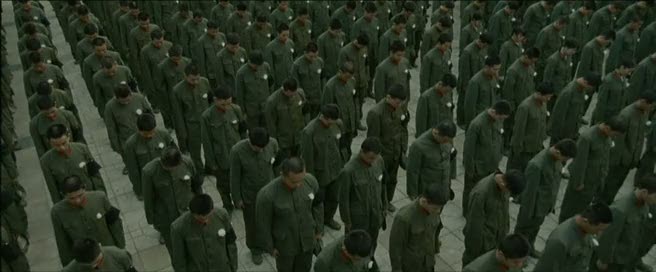
There’s a problem with state-sponsored filmmaking: No matter how brilliant an artist you are, your works will eventually be evaluated based on your government’s activities – past, present and future. Xiaogang Feng’s Aftershock (2010), the Chinese entry for the Oscars, is a fine melodrama, with lots of empathy for its characters, but, despite its ambitions, it can’t help but spell the state agenda. It is rather interesting that the focal point the film – a work that so doggedly deals with family drama – is the death of Mao Zedong. In the film’s triggering event, the massive Tangshan earthquake of 1976 (an awfully done segment that tries in vain, like Lu’s work last year, to match Hollywood), a woman (Fan Xu) is given the choice of having either her daughter or her son rescued. The choice, actually, is of sacrificing either one. Devastated, she chooses her son, and doesn’t get to know that her daughter is, in fact, alive. Mao passed away months after the quake. Feng establishes a parallel between the two mishaps and treats them as kindred events that shape the microcosm and macrocosm of the story. The quake splits the twins into son and daughter of two different families. Mao’s death bifurcates Chinese history and ideology into one that is stuck with the nation’s past and one which thrusts forward, trying to catch up with the rest of the world. (That the two earthquakes which bracket Aftershock‘s proceedings occur on either side of the Soviet dissolution is significant). Feng sketches the son’s family as being problematically patriarchal and the other family as somewhat liberal and progressive. Through the familial trajectory (the daughter marries a Canadian and returns home just after the 2008 Sichuan quake), the film seems to appeal for reconciliation between the two histories and to point out that that they were, after all, children of the same parents. I’m not sure if this nationalist sensibility is really that reproachable, but Feng portrayal of the Chinese army as all do-gooders and the current government as highly people-friendly distracts us from the finer aspects of this work.
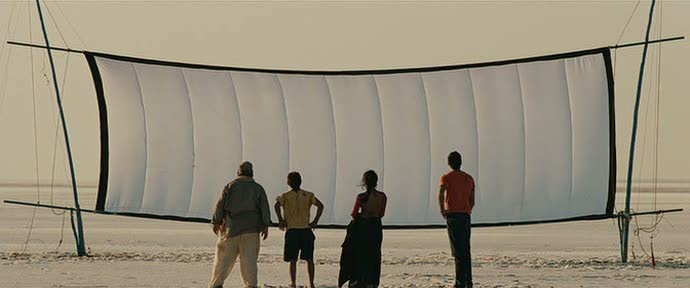
Road, Movie (2009), written and directed by Dev Benegal, follows Vishnu (played by middle cinema darling Abhay Deol), the son of a small time hair oil seller, who borrows an ancient Chevrolet truck from his neighbour and hits the road on the pretext of selling his father’s stock and delivering the truck to its proper destination. Little does he care that the truck doubles as mobile cinema. On his way, he encounters a village in dire need of water where a dacoit group has been terrorizing the villagers, appropriating the available water, bottling it and selling it back to them. A paean to popular cinema of yesteryear, specifically to those times when films used to be a collective social experience that transcended class, race, gender and other disparities, Road, Movie views (and literalizes, as in the carnival segment) cinema, in the Bazinian sense, as a collective dream that acts as a fulfillment ground for our real life desires. Consequently, it laments the death of that collective experience due to corporatization of film production and segmentation of potential markets*. Through plot details, bizarrely enough, it equates cinema to both water (suggesting that both are essentially public commodities unjustly being appropriated for the benefit of a few) and oil (in that both are ultimate stress-busters and great social levelers, as is pointed out in the recurring song borrowed from Guru Dutt’s Pyaasa (1957)). Road, Movie is also self-consciously generic, as its title points out, likening the journey on a road to the trajectory and experience of a movie. True to the conventions of its genre, the individualistic, petit bourgeois protagonist realizes the meaning and importance of living in a community and, among other bromides, that the journey is more important than destination. But then, Benegal also keeps deviating from the genre in that he avoids conjuring up a revolutionary hero out of Vishnu. He may mean good, he might have learned a few important lessons, but he’s as helpless in front of these social forces as he was at the beginning. He can do nothing but go back to his dreary middle class existence. Oh well, at least there’s Tel Malish.
[*See Jonathan Rosenbaum’s review of Sleepless in Seattle (1993) for a detailed examination of the phenomenon]
Tamil auteur Myshkin’s third venture Nandalala (2010) has its opening credits rolling over an image that seems straight out of Solaris (1972): two weeds gently swayed by the water flowing over them. Likewise, in the film, Bhaskar (Myshkin) and Agilesh (Ashwath Ram) are two kindred fishes flowing upstream, possibly trying to undo their births into this brutal world, in search of their origin: their respective mothers. As is made explicit in a near-surreal night scene at the beginning, the fear of being abandoned – by mother, by the state and by God – forms the backbone of Myshkin’s film. Walking along the margin of the highway like those reptilian critters we see, the duo comes across and strikes a rapport with a number of people almost all of whom live on the fringes of society. Bhaskar and Agilesh, themselves, are misfits who’ve broken away from the establishment – the asylum and the school. Those in the mainstream, on the other hand, are seen in the safety of their houses and cars. Paranoid, hateful, hypocritical and downright barbaric, they seem distrustful of everything that might distract them from their well laid plans. (That Myshkin casts himself in a starless film that he had to struggle to get funds for makes this a story of a marginalized filmmaker struggling with the industry as well). Social integration, however, is not what Nandalala aims for. For Myshkin, as is represented in the opening shot, it is the society that is constant flux around these central characters who find meaning in their relationship with each other rather than their position in the society. (The last scene is probably a little more cynical than it appears to be). Punctuated by Fordian skylines and generally jarring bird’s eye view shots that desert the characters, Nandalala, over-scored, overacted, imprudently written and characteristically over-directed at times, nevertheless continues to refine and fortify Myshkin’s cinema of physicality with its long shot filmmaking, chopped framing, brittle cutting and Mifune-esque performances.
Olivier Assayas’ ambitious five-and-a-half hour biopic Carlos (2010) is obsessed with movement. For one, it attempts to chronicle at length the activities and philosophy of those radical counterculture movements of Europe in the 60s and the 70s. It is also keen on charting the movement of history in relation to its central figure – an aspect that is perhaps the most fundamental part of the film’s text. Then there is its endless preoccupation with physical movement: of people and of goods. Some commentators might point out that Carlos plays out as a good history lesson. Actually, it makes for a better geography course. From South America to Europe, from Africa to Asia, Carlos is always on the move. One could say that, like the shark, he will perish the moment he stops moving. (In this respect, the picture’s last line, after Carlos is captured by French feds, is terribly befitting). He is almost entirely defined by his location and his political orientation at any given point in time can be deduced if the country he lives in is known, which is why Assayas’ film is as much a travelogue as it is a biography. For Carlos, men are no different from the countries they represent – a mentality that eventually turns against him for good. Carlos is always on the move too, with its syntax infested with zooms, pans, tilts and dollies, as though it’s breathlessly trying to catch up with its subject. That’s why the film’s most telling shot is almost purely photographic: a very gradual zoom-out shot of a plane standing still at the Tripoli airport after it has been denied permission to land. Following the juggernaut that the film hitherto was, this decidedly incongruent shot leaves the viewer gasping for air. This is probably how Carlos feels at that moment as well, for he stands on the brink of a massive failure. Till this point, the film’s heady trajectory and Carlos’ cardiograph would have looked exactly the same.
Now, all this talk about Carlos in the present tense might sound nonsensical given that the real Carlos is an old man serving life sentence in northeastern France. But one must also keep in mind that Assayas’ Carlos is purely a fictional character built upon the filmmaker’s vision and based only partially on the real Ilich Ramirez Sanchez, as is noted in a clear-worded disclaimer flashed at the beginning of each of the three segments of the movie. This deviation is what saves the film from becoming an insipid reportage like The Baader-Meinhof Complex(2009), another genre film that tried to tap into the zeitgeist of the age. (In fact, the first section of Assayas’ film is no better than Edel’s, with the director spending hours together reconstructing what could have been dispensed with an intertitle or a newsreel; but narrative telescoping is not even remotely a part of the agenda). Shot on 35 mm (although I bet at least a few shots were done on video) and spanning about 25 years, Carlos religiously charts the rise and fall of the eponymous terrorist/revolutionary, played by fellow Venezuelan Edgar Ramirez, in a surprisingly straightforward fashion. Painstaking production design that pays attention to period, geographical and cultural details – no mean job for a picture that spans numerous years and countries – and a nearly-anachronistic soundtrack which is almost always used in contrast to the imagery mark the major deviations from the genre. And Assayas’ camera is more than willing to parade these details, in addition to Ramirez’s seemingly malleable physique, and the result is a film with myriad empty, connecting shots.
To a large extent, Assayas’ film views Carlos as a chronic narcissistic turned on by weapons and women. “Weapons are an extension of my body” he tells a woman before thrusting a grenade under her skirt. He caresses firearms as if they were his lovers and kicks around women as though they were his handguns. Throughout, Carlos’ physical prowess and virility are equated with his military power. Scenes depicting his military exploits are interspersed with his conquests in bed. His political career in the film is bracketed by shots of him standing stark naked in front of a mirror and admiring well-built body and him lying on a stretcher clutching his private parts under the paunch. All this sounds awfully contrived on paper, but the fact that Assayas derives these metaphors from undisputed biographical details helps turn such tepid arthouse tricks into a clever piece of artistry. However, all this is made evident an hour into the film and Carlos remains more or less an unchanging protagonist for the rest of the film. Like Sorkin’s Mark Zuckerberg, Carlos is the fixed centre of the film around which the universe rearranges itself, in turn redefining and reshaping him. (In retrospect, the last line of Fincher’s film describes him to a T). Does he hypocritically change sides despite his apparently unchanging cause or is it the volatile course of events that have remapped his loyalties? Is the world too dynamic for an old timer like him to catch up or is he a mere mercenary – a selfish, two-bit petit-bourgeois, as his friend puts it – afraid of death? It is probably the latter, although he would like to think not.
Curtained and distorted by wisps of cigarette smoke, Carlos is an amorphous figure, with ever changing identities, loyalties and worldviews, and a master of disguises (like Assayas himself, who seems to be hopping genres and feeding on them). Like your typical movie star, he appears to be always conscious of what he’s wearing and not half as much about what he is speaking or doing. As a matter of fact, the film illustrates, he is more a performer than a revolutionary or a terrorist. Throughout, Carlos revels in theatricality. Like Edgar Ramirez, he is a polyglot and before one thinks that he might not know a particular language, he delights himself with a mini-performance delivered in that very language. Fifteen minutes into the film, in its first explosive conversation, we get a sneak peek into the five-hour play that is to come. Carlos’ friend points out to him that he is only craving for applause. He tells her, “You’ll be hearing my name a lot”, and asks her to look at him when he’s talking. During the OPEC raid, he models himself after Che Guevara, complete with the beard and the beret (an actor playing a half-actor-half-revolutionary playing a revolutionary), and introduces himself as “My name is Carlos. You may have heard of me”. The conference room itself resembles a theatre, where he directs his seated audience-actors and performs before them from the end of the hall, Elsewhere, regularly, he shouts, he throws tantrums and he flips, occasionally spouting hyperbole without apparently understanding them a la actor extraordinaire Jules Winnfield.
[Carlos (2010) Trailer]
“Without newspapers you don’t exist”, says one interviewer to him – a day before he finds a bullet in his medulla – winning a half-affirmative smile from Carlos. And why not? It is, after all, of his doing. He is the writer, director, the actor and the PR man of his life. He is, also, his own audience. Carlos lives outside himself. If his inner life comes across as something enigmatic to us in the film, it must be the same to him as well. Assayas does not push hard on the psychological front and is concerned more with the “what” of the story than the speculative “why”. It is not a human character, but the totality of events involving Carlos that is the hero of his film. He does not try to delve into the psyche of the man, or some such thing, to make his point. Instead, he lets Carlos’ actions reveal how self-contradictory a person he is. (Ramirez’s non-Method portrayal itself comes across as all surface and no center, as if he’s playing a mummy that’s been totally hollowed out) One might wonder whether he really believes in all those flowery platitudes that he mouths off now and then. (After all, he respects the truth value of clichés). It doesn’t really matter, suggests Assayas’ film, for his actions turn out to be far removed from the directives of these rhetorical remarks. He announces that he is a man of peace and that he loves life while he is more than happy to lodge an extra bullet or two into a man who only tried to resist him. He tells the interviewer that he studied dialectics in Moscow but also insists that no one tell him what to do. He speaks to the Saudi Arabian oil minister in fatalistic terms while, elsewhere, he comments that he is entirely responsible for his men. Possibly the greatest irony that marks Carlos’ life, which one federal agent notes towards that end, is that, for all his anti-capitalistic, anti-American baloney, he really had no criminal records against America.
In fact, this whole enterprise that Carlos sets up and develops is more symptomatic of corporate capitalism than anti-capitalistic revolution. Missions are throttled and determined by the inflowing funds rather than their agenda. A delayed assassination plan allows for competition to seal the deal. We witness countries nourishing anti-state organizations for political gains in the exact manner that corporations fund parties for fiscal benefits. The world is a market and revolution, a business. Pretty much like modern economics, Carlos illustrates how the numerous political maneuvers in different parts of the world are linked intricately to each other and often in contradicting ways (which reminds one of Godard’s observation regarding Jews, Hollywood, cinema halls and Mecca in his last). The film, itself, is directed and edited like a corporate thriller full of roundtable discussions and cutthroat business strategies. Moreover, Carlos is ostensibly a “gangster movie” as well, with its detailed account of the rise of an underdog, his notoriety and his disgraceful fall (in addition to its multiple nods to The Godfather (1972)). But then, there’s only a little difference between the two genres anyway. Mike Wayne notes in his book Political Film: The Dialectics of Third Cinema that the gangster figure – a man who steals from the rich and keeps it for himself – in popular cinema is emblematic of the dark side of capitalism while the bandit – the Robin Hood variant – represents a subversive if temporary threat to the same system. One could take this further and observe that the revolutionary goes one better than the bandit in that he is interested in not merely providing temporary monetary relief for the poor, but in toppling the establishment that creates a need for bandits. The tragedy about Carlos (and many of his cohorts) is that he fails to recognize if he is being the revolutionary that he wants, an ineffective bandit out of touch with the masses or a parasitic gangster running a reign of terror.
Placing Carlos’ example in a broader context, Assayas’ film makes a strong if not the ideal case against armed struggle. It probes, as does Bellocchio’s masterful Vincere (2009) (although Assayas’ ideological investment is relatively insubstantial), into a hermetic passage in history and opens it up for present day-analysis. Like Edel’s film, but with a far more focus and detachment, Carlos examines how an armed movement with an urgent, uncompromising objective is bound to foster authoritarianism and how a revolution is deemed to go against itself when its operative hierarchy branches out from a single spearhead – the father, if you will. Make no mistake, whatever organizations Carlos was associated with, they were, thanks to their pigheaded adherence to a shallow and monolithic view of the world, undemocratic (“soldiers must fear their leader” goes the rule of thumb), racist (anti-Zionism easily mutates into anti-Semitism), sexist (especially when radicalism is uncritically married to certain religions, one of which Carlos is reportedly a proponent of), imperial (a pro-Palestine stance, it seems, reads as an anti-Kurdish one), bourgeois (by forming a bohemian clique far removed from the lumpenproletariat, the group it pretends to champion) and downright fascist. All these symptoms are even more relevant in the post-9/11 world where the resistance to occupation has translated into such a blanket rejection of western traditions that movements often lose sight of what is genuinely progressive and what is not.
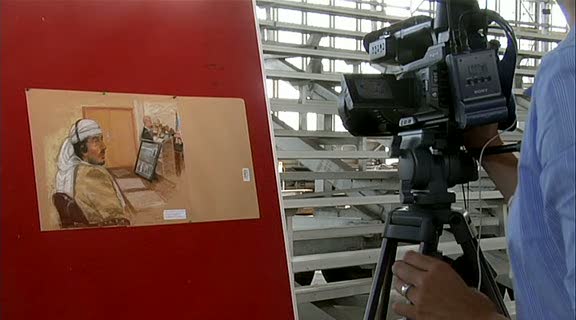
The approach of Laura Poitras’ documentary The Oath (2010) is akin to having your cake and eating it too. And your neighbour’s. And the next one as well. Split between two geographies and worlds – Yemen, where Abu Jandal – erstwhile Al Qaeda member and Bin Laden’s bodyguard – drives the streets for a living, and Guantanamo Bay, where Salim Hamdan – Jandal’s brother-in-law and a driver in the same organization – is imprisoned by the US government on charges of “supporting terrorism materially” – The Oath attempts to indirectly examine both the alleged indoctrination of young Jihadis for the purpose of suicide bombing and the Bush regime’s seemingly opaque and opportunistic justice system. Cutting back and forth between conversations with the loquacious, confident and charming Jandal and the uninhabited, melancholy premises of the detainment facility where Hamdan is held, Poitras establishes a parallel between the two men: both are prisoners over whom the possibility of death looms every instant and who, paradoxically, find safety in the very jails that hold them. (Jandal, placed high on Al Qaeda’s hit list, seeks refuge in the prison of TV images while Hamdan ghettoizes himself out of fear after he returns). “I’m a soldier, I’m not a martyr”, says a hypocritical Carlos in Assayas’ latest work. Jandal maintains the same, even though he sees no wrong in blowing up passenger planes. Poitras does enough to build on Jandal’s self-contradictions to paint a portrait of him as a conflicted buffoon whose only oath of loyalty is to life – not God, religion or political cause. But then, the film’s agenda doesn’t stop there. Poitras is liberal enough to dispel the conservative notion of Jihadis as mean killing machines and to label all her subjects as being “merely human”, but she’s also selectively neocon in that she develops a Freudian sketch of Islam and Jihad which does nothing to challenge the equally-distorted western perception of these larger institutions. This self-serving worldview notwithstanding, The Oath makes for an intriguing watch in the way it keeps stressing the gargantuan role that the visual media has come to play in our daily lives and administrative systems where the presence of a camera is the sole screen that separates memory and forgetfulness, justice and tyranny and life and death.
Kak Ya Provyol Etim Letom (2010) (How I Ended This Summer)
Aleksei Popogrebsky
Russian
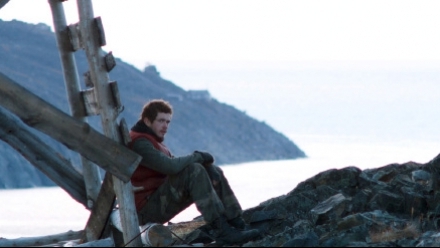
Aleksei Popogrebski’s How I Ended This Summer (2010) chronicles an unspecified number of days in the life of Sergei (Sergei Puskepalis), the sole operator of a meteorological survey unit on a remote island in the Arctic Ocean, and the younger, hipper Pavel (Grigoriy Dobrigin), an intern at the station. Popogrebski embellishes his widescreen canvas with breathtaking images of Chukotka, Russia, which appears as though it is the very edge of the earth. For Sergei, however, it is the very edge of his life, for confronting this seemingly limitless stretch of unpopulated, hostile and godforsaken terrain is like confronting the human condition itself. Faced with this predicament, Sergei holds-on to illusions that comfort him the most: work (however mechanized and pointless it may be) and family (both his real family that lives on the mainland and his newfound ‘son’ Pavel). Communication, or rather the inability to establish it, forms the prime motif of Popogrebski’s film. Be it between the island and the mainland or between two individuals in the same room (and, since we are in that realm, between man and God), meaningful communication seems to be a luxury. (The film abounds with radioactive emissions, short waves and SMS smileys while there are only a few shots shots where we see two people together in the frame). Taking the idea of the lack of communication to a more tangible domain, How I Ended This Summer could be seen as a quasi Cold War allegory – a reading that’s quite plausible given that residual nuclear deposit on the island is what drives the plot – where an utter lack of understanding and introspection on the part of both the superpowers not only proved internecine, but has also left an indelible mark on generations to come. Popogrebski, of course, can’t propose a retroactive solution. He can, and does, only look forward to a renewed future, even if it means starting with a simple hug.
Hong Sang-soo’s easy-to-type Hahaha (2010) is the kind of picture that critics comfortably dismiss as light and frivolous. That’s because Hahaha is light and frivolous. And consciously so. The film presents two young friends who accidentally meet and decide to hang out in a pub nearby. During their bout, they take turns to recite their experiences during last summer in a sea-side town. As the two mildly amusing stories unfold, we realize that they are not all exclusive as both tellers believe. We see characters and events that span the two stories, time-line of one story flowing into the other and the characters’ paths intersecting in bizarre and not-so-bizarre ways. Perhaps these two men are drunk enough (or dumb enough) to not realize that their stories share a single universe. Or it may be that one of them is only playing along and making his story up. Or maybe both of them are playing a game of Exquisite Corpse. It is also equally possible that both of them are sincere and it is Hong who is pulling their legs by actually making a film out of their stories wherein he fuses and confuses separate characters. The two stories are contaminated by regularly occurring zoom shots that lend the film the look of a bad sitcom or, more accurately, an amateur video made on the sets of Hahaha which reveal the artifice of it all. Existentialist in approach, Hong’s film argues, as does Allen’s Melinda and Melinda (2004), that one’s life is how one interprets it to be and that value of things resides only in one’s perception of those things. Consequently, like Allen’s film, one of the stories is high on marital drama and the other, on romantic comedy. (Actually, the former ends up being hysterical while the latter is pretty bland). But the film is also a testament to the power of stories in embodying our desires and overcoming our fears and a lighthearted appeal for the existence of personal, eccentric histories – personal and national – as opposed to the unquestionable, unfruitful facts handed down by text books.
God created man in his own image. Aaron Sorkin’s Mark Zuckerberg (Jesse Eisenberg), it appears, created the 21st century man in his own image: a two-dimensional, unchanging prisoner of a projected persona. This threatening, ever-endangered entity called the “image” – social and cinematic – is what both Mark Zuckerberg and director David Fincher are respectively after in The Social Network (2010), the one picture of recent times that has given birth to the finest of film criticism*. The closest the trajectories of these two figures ever come in the film is the surprising moment when Zuckerberg wields a digital camera to photograph his friends diving into the pool. Clearly, Fincher’s romanticizing of Zuckerberg’s dream run attempts to equate the latter with a film director – to possibly Fincher himself, although it is a bit difficult to imagine David Fincher as anything but the establishment – in the way both of these misfits vainly put up with the bureaucratic minutiae of the head honchos and thrust their vision – the images – forward even if it means compromise on personal fronts. Both of them overcome the schemes and vagaries of the real world – emotions, accidents and flaws – using the surety of binary numbers: Zuckerberg with his codes, Fincher with his Red One. Zuckerberg, however, belongs to both film noir and fantasy. He is both Jake Gittes who learns to give up hope the hard way and David who defeats the Goliaths of Harvard, both Mario who tries to win back his princess and the dragon that tries to imprison her in a digital jungle, both Faust and the Devil, a crusader who makes a million enemies to regain a friend. What makes The Social Network particularly rich is its beneficial (and sort of natural) ambivalence towards copyright, Web 2.0 and, in general, capitalism. In fact, Sorkin and Fincher seem to view Web 2.0 as being simultaneously socialistic and capitalistic, democratic and Darwinian, a refined laissez-faire system where the individual decides, drives and controls and a great leveler that brings down established social hierarchies in a matter of hours and a few keystrokes. These are exactly its pitfalls as well.
 The theatrical cut of Alexander Kluge’s epic length video work News from Ideological Antiquity – Marx/Eisenstein/Capital (2008) could be considered as notes from notes from notes on Das Kapital. This inheritance of texts, across media and languages, is what informs the central discourse of Kluge’s 83-minute collage work. After the completion of October (1928), which he mostly edited partially-blind and under the influence, Eisenstein set out to adapt Karl Marx’s Das Kapital as filtered through James Joyce’s Ulysses. The project was, of course, not realized and this is precisely the fact from which Kluge’s launches his investigation as to whether the book can be adapted at all. Using archival footage, (seemingly endless amount of) on-screen text, reading sessions accompanied by piano scores, interviews with historians, agit-poetry by Bert Brecht based on The Communist Manifesto and even an overstaying, outsourced short film directed by Tom Tykwer, Kluge examines the possible ways in which the gargantuan socioeconomic text can be realized in popular art forms. Such an effort, as Kluge illustrates, becomes especially challenging in film since it would mean attempting to capture the abstract nature of capital in the concrete events and things around us. Kluge, it appears, likes to see this as an ever evolving process, driven by the development of technology (At least, unlike Eisenstein, Kluge doesn’t have to worry about film stock), in which he is but only a connecting link. (His film is, after all, far removed from the source: Marx-Engels-Eisenstein-Kluge). But there is a more fundamental question if one is to believe in such long-ranged projects: How much of Marx is still relevant today? Was Marx, like Kluge, a part of a longer chain, the beginning or the end of it? Kluge, like Godard, sums up the predicament in a poignant image: the debris of Karl Marx’s real tombstone in London being overshadowed by a lionizing token monument nearby.



 The Seventh Art