Ljubavni Slucaj Ili Tragedija Sluzbenice P.T.T. (1967) (aka Love Affair, Or The Case Of The Missing Switchboard Operator)
Dušan Makavejev
Serbo-Croatian
“The threat posed to man by rats has still not been fully grasped here. Rats devour enormous quantities of food and other goods. They eat winter coats, entire libraries of books, corpses in autopsy rooms, even film stock.”
 Although such hybrids tend to be heavily reductive, considering Yugoslavian filmmaker Dušan Makavejev’s early features as (stay with me) Godard meets Bertolucci meets Anger meets Buñuel meets Waters proves to be a fairly useful starting point for exploration. Bringing to mind Godard’s self-reflexive examination of cinematic medium, Bertolucci’s Reich influenced analytical fiction, Buñuel’s hyper-surreal interjections, Anger’s extravagant imagery and Waters’ camp outings, Makavejev’s films seem to be completely in line with the French New Wave’s iconoclastic sensibilities, which seem to have remarkably captured the revolutionary spirit of the sixties. Blending news reels, pseudo-documentaries and on-location fictional footage shot in cinema-vérité fashion, Makavejev’s features remain an essential voice of (cinematic and sociopolitical) dissent, analysis and critique of the Tito regime. Like Godard, the primary hurdle for Makavejev in this direction seems to have been the problem of cinematic representation and the consequent need for returning to zero.
His second feature, following Man Is Not A Bird (1965), Love Affair presents us the titular love affair between an Hungarian immigrant Izabela (Eva Ras, who also appears in the director’s previous film), the titular switchboard operator, and Ahmed (Slobadan Aligrudic), a Turkish immigrant, who has served in the army for a considerable amount of time, is a party worker and is currently working as a sanitation officer for the government. Punctuating the affair are instructive documentary sequences where a sexologist and a criminologist go about explaining historical and cultural aspects of sex and homicide respectively. Then there are sequences from the local morgue where a dead body is being examined for cause of death. There are also sequences of extended conversations between Izabela and her friend Ruska (Ruzika Sokic) about the various affairs they have had. To top off this seemingly immiscible collage work is a documentary track that informs us about the history and consequences of rat infestation in Yugoslavia, including a scene where an on-screen text reads an absurd poetry about rodents.
Makavejev uses an interesting flashforward-flashback structure that regularly announces the outcome of the love affair, in effect squelching the tension that could have been generated if the film had gone conventional. During the post-mortem, we see the necklace and the undergarments of the victim presented as exhibits. Makavejev immediately cuts to Izabela wearing the same. A three month old fetus is found inside the victim, following which we see Izabela going to the hospital for a pregnancy test. It is only after Ahmed is identified as the murderer that Makavejev cuts to the actual event. A Godardian bedroom scene where Ahmed admires Izabela gives way to a cold, scientific and disturbing description of her dead body. Makavejev’s intention behind employing this structure may have been mere playfulness. Or it may have been an attempt to shift our attention from specifics of the plot to the nature of the relationship between Ahmed and Izabela. But it is more likely that Makavejev employs this device to denote the Vertigo-esque inevitability of a tragic ending to this doomed love affair (The “murder” itself is visually and thematically reminiscent of the one in Hitchcock’s film).
 Makavejev’s stance in this film, as in his other features of this period, seems to be that of William Reich, who was against pornography in sex and politics – a position that takes off from his ideology of free love and free-thinking. This pornography of the cinematic image is what Makavejev seems to be fighting against. His early films present themselves as attempts to work against the representation of workers and women in mass media by both (the then-popular) social realist films (in agreement with the maxim that realism does not mean reproducing reality faithfully but in showing how things really are) and Stalinist propaganda. The influence of propaganda art is visible everywhere in the film – through giant size posters of Lenin, Communist gramophone records and laudatory news reels and post card pictures – acting as a counterpoint to actuality. In Love Affair, like he did in his first feature, Makavejev continues to explore this chasm between the popular image of the worker and the truth about him (Here is an excellent essay that discusses Makavejev’s representation of the worker in Man Is Not A Bird).
One particular sequence exemplifies Makavejev’s discrediting of right-wing propaganda as nothing more than political porn. Izabela and Ahmed, after their first formal meeting, sit in her bedroom. She tells him that there is something good on television. Sipping coffee, they look towards the camera. Eschewing conventional eye-line match cut to a TV, Makavejev inserts news reels showing the Communist party destroying churches. She tells him that it is more intimate this way. They loosen up a bit. Ahmed calls Izabela a good homemaker. She places her head on his shoulders. The news reels again. A moment later they are in bed. Apart from this rendering of such Stalinist art as objects of arousal, Makavejev establishes the discrepancy between represented reality and the actual reality through his mise en scène by contrasting the joyous, dynamic, open spaces of the news reels with the empty, static and cramped apartment Ahmed and Izabela reside in. The two girls are often lost visually and aurally amidst the crowd and noise of the city. Even in the final scene, full of pathos, where Ahmed is arrested, Makavejev underscores this effacement of the individual for a faux nationalistic ideology by having exuberant Communist songs overpower Ahmed’s voice.
It seems to me, that for Makavejev, politics is sex and sex is politics. No, not on a metaphorical level, but quite literally. His films seem to present a notion that every authoritarian regime is fuelled by a distinct vision of sexuality – a possible influence of Reich, once again – and that this chauvinism/insecurity consequently shows up as the subjugation of one sex by the other. In line with that thought process, Makavejev fittingly boils down the larger picture down to sexual politics between the lead characters (Izabela looks at the camera, as she does frequently in the film, and shouts: “I didn’t sign up to be your slave”, thus opening up multiple plausible interpretations. Is she, apart from being the “everywoman”, a representative of Yugoslavia? Of represented Yugoslavia? Of cinema itself? A case could be made for each). There are lots of threads in the movie that can be neatly tied up together, I guess, only if the exact context of this film with respect to New Wave Yugoslavian cinema (Novi film) and the intricacies of the Yugoslavian politics is known. For instance, there are a number of stray slices-of-life sequences in the film that seem to serve no other purpose than to provide respite and true warmth to the couple, shielding them from the horrors of the external world. May be Makavejev wanted to avoid the criticism his earlier film received – that it was dark and pessimistic.
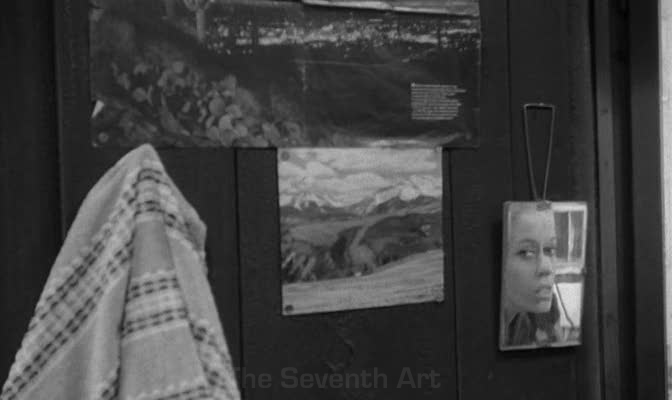 Love Affair begins with a quote: “Will there be a reform of man? Will the New Man retain certain old organs?” suggesting that the outward ideology of the nation may have changed, but underneath it amounts to one fascism replacing another, with one form of sexual oppression giving way to another (an idea that becomes more streamlined and incisive in WR: Mysteries of the Organism (1971) and Sweet Movie (1974)). In the narrative track about the history of gray rats, the narrator explains us that these pests were let into Europe in order to get rid of the deadly black rats and that the gray ones prevailed being “stronger, tougher, and more bloodthirsty”. And that this new rat turned out to be more resilient than man. The narrator wonders “It’s still unclear who will rule the Earth in 100 years: People or rats?”. The political mapping is only too clear here. But then, that does not render Makavejev as a pure leftist leaning towards capitalism. He remains a centrist in all these early films (He presents Yugoslavia herself as straddling two ideologies as his mise en scène portrays a country in transition, borrowing politics and cultures from both sides of the world), holding both traditional capitalism and tradition Communism at a cynical, if not downright contemptuous, distance and embracing only the “individual” and his right to live and love freely.


