Director: Clint Eastwood

Cast: Angelina Jolie, John Malkovich

The Buzz: Nominated in Best Actress, Best Cinematography and Best Art Direction categories

The Run: Won Satellite Award for Best Actress

Changeling

Schizophrenia Of The Script

Clint Eastwood should have promoted Gran Torino at the Cannes instead of making so much fuss over Changeling. The Oscar probably wouldn’t have snubbed one of the better films of the year if he had done that. Perhaps he was too confident of Gran Torino. Whatever the case, Changeling definitely isn’t a glowing bullet point in Eastwood’s glorious and pretty consistent filmography.

Changeling follows one woman’s struggle to get back her lost child. No, wait. It follows a genocide case loosely based on real life incidents. No, no, no. It is a gut-wrenching courtroom drama that raises questions about the capital punishment. Whatever. Clint Eastwood is one of the best storytellers Hollywood has and it is appalling to see him failing in his first step. Eastwood’s films have always been backed by strong scripts and great performances, only faltering slightly at a directorial level. But in Changeling, he takes up a script that takes a pretty good idea, blows it up and zooms it to fantastical proportions. Not only that, when it goes it uncontrollable limits, it snaps. There is a start change in tone and plot. It is as if the film just rebooted for the better. And just when it seems like it can redeem itself, the courtroom drama comes up to give the final set of blows to the film. As a result, whatever Eastwood is able to do (no, I don’t mean the Cannes promotion!) isn’t enough to even make the film linger for a while.

Angelina Jolie’s performance is inconsistent and is perhaps the weakest contender for the Oscar this year. Perhaps Ms. Zelwegger could have done the role better. Jolie shuttles between aggression and sympathy unconvincingly. Something like a mixture of Wanted and Alexander. Having said that, I must also tell you that the period details are well captured. But then, isn’t all this usual to Hollywood?

Director: Stephen Daldry

Cast: Kate Winslet, Ralph Fiennes

The Buzz: Nominated in Best Picture, Best Director, Best Actress, Best Adapted Screenplay and Best Cinematography categories

The Run: Won Golden Globe for Best Supporting (!) Actress

The Reader

Slow And Steady

Everything about The Reader is ambiguous. Even the title betrays us. Does it refer to the person who is reading out or the one who is actually “reading”? We are left searching for meaning among the seemingly divergent threads of the film. Even Roger Deakins’ beautiful images eschew from providing a coherent motif to the film. Early on in the film, a professor remarks that the western literature is characterized by secrets. That people in power are the ones with secrets. Right here, he may just have talked about he Reader itself. A quiet and powerful film that vehemently opposes black and white explanation.

What begins with a Truffaut-like tone shifts gears to become one of the best character studies of recent years. The plot follows the surreptitious affair between a teenager Michael and an ex-Nazi prison guard Hanna. Hanna is illiterate and seems to be indulging Michael only because he reads books to her. She is extremely inarticulate. Inarticulate because she does not know words that conceal her true thoughts. Inarticulate because she does not know words that express these feelings either. She is fascinated by things that verbalize or visualize those. Ebert mentions in his insightful review on the film that the movie is all about decisions. Damn right he is. Each decision one takes is a resolution of the conflict between one’s own conscience and others’, especially if the latter projects as a mass sentimentality. Daldry sticks to the cinematic proverb “show not tell” till death as he deliberately keeps all the vital points of the film low-key fearlessly.


The Reader was a very difficult film for me to come to terms with. They say a great film begins after the last frame. As the end credits rolled, I was furious for the Academy to have selected five unworthy contenders for the biggie this year. But it was a matter of days before the film began revealing itself. Everything began to make sense. And it became clear that Daldry may just be the man of the year at the Oscars.

Director: David Fincher

Cast: Brad Pitt, Cate Blanchett, Taraji P. Henson, Tilda Swinton

The Buzz: Nominated in Best Picture, Best Director, Best Actor, Best Supporting Actress, Best Adapted Screenplay, Best Cinematography, Best Editing, Best Sound Editing, Best Visual Effects, Best Make-up, Best Original Score, Best Costume Design and Best Art Direction categories (phew!)

The Run: Won National Board of Review Award for Best Director and Best Adapted Screenplay

Fast-Food Cassavetes

Life is still the same Box of Chocolates!

The Curious Case of Benjamin Button is a phenomenal idea. One that could have eternally made us rave about the magic of cinema. Only if Eric Roth had realized what the idea of a man who ages in reverse means. Only if he had not been so straight faced and stiff about it all. Man, why don’t they leave these things to Tim Burton?

The Curious Case of Benjamin Button is a great joke. A joke that could have generated an endless series of gags and surprises. Instead, Fincher goes in for the kitsch. Look, we have a man who ages in reverse. Quite extraordinary indeed. I hear that in Scott Fitzgerald’s short story, the lead character never learns of his plight and that he ages both mentally and physically in reverse. But in Roth’s version, Benjamin ages backwards physically and forward mentally. Also he becomes perfectly aware of the ramifications of his plight as he grows up. Great move by Roth I must admit. But it is never capitalized upon at all. I mean, there is no conflict between contradicting states of growth. Benjamin could have been replaced by a normal character (a la Forrest Gump) and the script wouldn’t have to change much at all. As a result the film becomes nothing more than a coming of age (or going!) tale of a normal mind. The physical state of Benjamin Button is never seems to be a concern for anyone in the film except the CG department.

Hollywood seems to have perfected the craft of storytelling without even letting the storylines catch up. Yes, Benjamin Button is eye-popping all the way, gorgeously designed and fantastically executed. But all this is like those high profile food items – mouth-watering when looked at, but never ever filling. I would have wanted to love the film. Only if the film hadn’t taken itself too seriously, sigh.

Director: Ron Howard

Cast: Michael Sheen, Frank Langella, Rebecca  Hall, Kevin Bacon

The Buzz: Nominated in Best Picture, Best Director, Best Actor,  Best Adapted Screenplay and Best Editing categories

The Run: Won the Satellite Award for Best Adapted Screenplay

Frost/Nixon

Not Exactly A K.O.

Ron Howard returns after his much trashed film The Da Vinci Code (2006) and he returns quite well. He takes up the iconic face-off between David Frost and Richard Nixon following the latter’s impeachment and churns out something that could have been only possible in Hollywood. Seen Rocky? Seen Mudhalvan (Nayak)? Now cross them and voila!

Riding on two striking performances (well, Sheen’s is easily questionable), Frost Nixon is yet another underdog story from the industry that is surprisingly riveting until the third act. There is a sense of balance among the characters. The interview is the last chance for both of them to redeem their lost pride. A lot is at stake for both of them. All this is quite subtly done. Oh yes, please add a clause “till the phone call” to all the statements above. And after this notorious phone call comes the fear of all ordinary directors of Hollywood. The fear that their effort may go unnoticed by the audience. Ron Howard is no exception here and verbalizes and over-determines whatever he wants to say in the final act as if pointing out to the audience his directorial skills. It’s downhill all the way from this point. The showdown is so dumb to the point that it contradicts the point of the whole film so far. And Sheen’s cool attitude sums up to nothing at all. How I wish the film was handled by some veteran. 

But a few points do stand out in the film including Langella’s confident performance of the American president. Frost/Nixon does not pretend to delve into the truth or offer a fair trial to Nixon. It assumes that Nixon is guilty and concentrates on his conviction alone. And I feel that this is a good move. But best movie of the year? Come on, this must be the joke of the year!

Director: Darren Aronofsky

Cast: Mickey Rourke, Marisa Tomei

The Buzz: Nominated in Best Actor and Best Supporting Actress categories

The Run: Won The Golden Lion at Venice Film Festival, Golden Globe for Best Actor (Drama)

The Wrestler

Just Short Of The Championship

Mickey Rourke is the surprise contender for this year’s Leading Actor award and he does a great job. Very few actors would have actually accepted to do the wrestling scenes leave alone pulling it off with such might. There is a sense of humbleness to his performance – A sense of dejection as if he continues to exist without living. Something like Hulk Hogan meets Bill Murray.

The Wrestler follows (literally) the aging WWE champion Randy “The Ram” Robinson who is now almost washed up and his only tonic of life remains the cheers of the oblivious audience. He shuns responsibilities, hides under his wrestling name and fears life outside the arena. He stands in contrast to his love interest Cassidy, a stripper who does her work reluctantly and whose life begins only when she steps out of the club. Aronofsky’s direction is striking. We follow Randy like his manager, right behind him almost throughout the film (even during the fights) and suddenly we are made god as we detachedly observe Randy’s life from remarkable distance. As a result, we both empathize with Randy’s situation and mercilessly cheer at the massacre he is involved in. In essence, Aranofsky makes us guilty and hypocritical, never overtly demanding sympathy for its central protagonist. The wrestling matches move from fantastic to gruesome and then to shocking without any sign of artificiality. And that adds to the raw power of the film.

The approach of the film is visibly fresh. But unfortunately, Aronofsky treads a tried and tested path. I mean, how many times have we seen the aging sports man, who is a loser in personal life too, coming back against all odds to pursue what he does best? As a result, the riveting performances and execution cower under a predictable script, hence making the film just good and not great.

Director: Sam Mendes

Cast: Leonardo DiCaprio, Kate Winslet, Michael Shannon

The Buzz: Nominated in Best Supporting Actor, Best Costume Design and Best Art Direction categories

The Run:  Won Golden Globe for Best Actress (Drama) 


Fast-Food Cassavetes

Fast-Food Cassavetes

No established director’s filmography seems to be complete without a familial drama. This year is the turn of Academy Award winning theatre director Sam Mendes. Revolutionary Road follows the happy married life of a couple, played by Leo DiCaprio and Kate Winslet, gradually disintegrating to debris. The lead pair reunite 11 years after Titanic (1997), proving that if the iceberg doesn’t get you, marriage will.

First off, Revolutionary is damn riveting. You are hooked to the screen even if the dispute between the couple seems redundant and outright silly.  The performances are generally convincing but that’s strictly a matter of subjectivity (Imagine, both of them got nominations in the Golden Globe, snubbed by the Academy). But what hurts is Mendes’ heavy-handed execution of the plot. He seems to show us how empty the lives are and how fake their passions are – a theme that’s 50 years old. Mendes knows this and cleverly places his film in that era. But he derives the film rather than letting it evolve. Every scene exists not because they are beautiful by themselves, but because they are the cause to the next. Each one seems calculatingly placed in order to push forth the stale state of affairs. He cuts to the drama forcefully. One more. The Michael Shannon character is a consequence of Mendes’ supreme lack of confidence in his own direction. Where directors like Cassavetes and Antonioni left the audience on its own to grapple some meaning out of it all, Mendes safely verbalizes the lead pair’s opinions about each other through Shannon. And he hides this sham under the remarkable performance of Shannon and the unstable state of the character’s mind. 

I am still skeptic about the costumes in the film. The film seems to take place in the 1950’s. But I can’t believe that men still wore hats and blazers whenever they went out. Of course, this might have been researched before put into execution. But what if it wasn’t? Revolutionary Road still makes up for a decent drama for anyone willing to witness something shallow yet grave, depressing and absorbing. Kate and Leo, that’s why you shouldn’t carry on with acquaintances from journeys!

“I don’t care if it’s a lie, as long as it’s entertaining.”

-Rashomon (1950)

I thought there was much discussion going on about the depiction of slums in Slumdog Millionaire. I was wrong. There is much more than that. Much more than what is necessary. I spent the whole evening reading blogs of people in the US about the film. Blogs because I wanted to know what the audience thought about the film and not the critics. US because it looks like USA is being pulled into every other argument nowadays (including the British film Slumdog Millionaire). And almost everyone mentioned how they loved the film because it shows true love and not because of the slums. Well, all I can tell you that the love story wouldn’t have been loved if there were no slums in the film.

Michael Walford)

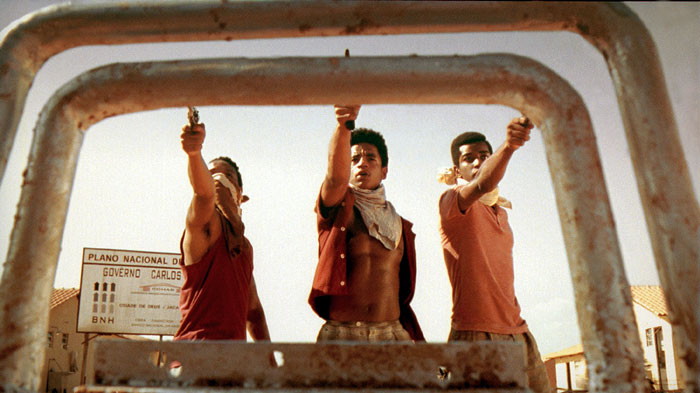
City of God (2002) (pic courtesy: Michael Walford)

I adore City of God (2002). I can of course exhibit escapism and say that I loved it because of the narrative slickness and how well it was shot and so on. But the reality is obviously far from that. I loved it because of its violence. Because of its incessantly shocking images. Because of the sheer hopelessness it provides us. Hold on, before you label me as a sadistic psychopath, I’ll clarify my intentions.  Poverty, violence and misery are things that instantly repel us in real life but interestingly fascinate us when we see it in cinema. Why? Because of the security of course. These are things that both tantalize us and drive us away. Call it guilty pleasure. One wants to be in it all, soak in it and get high in a strange sense. At the same time, snap out of it when it hurts his/her personal interests. The solution? Cinema. 

The cinema, substitutes for our gaze a world that corresponds to our desires” runs the famous Bazin quote. Indeed. It creates the safe distance between the viewer and the world that aids the resolution of the above mentioned conflict. The same safe distance that tourists of India find when they “empathize” with all the poverty they see it at first glance. In our case, the distance that Boyle safely assumes while filming. So why does it hurt us now? Because we all know in one measure or the other that this isn’t exactly what is happening out here. We are appalled that the west thinks that this is the “truth”. Hell, it is crazy. Read this headline from The Guardian:

Danny Boyle’s BAFTA-nominated crowd –pleaser shows how blind Bollywood producers are to the reality of India

Rolling on the floor laughing? Yes, because we have been here, done that and know it isn’t so at all. Now, in the same vein, if I had been a resident of Rio, I’ll probably be cursing Meirelles and the fans of City of God for assuaging their lowly needs by harnessing what isn’t true at all.  

Take the case of our own films like Page 3 (2005) or Fashion (2008). I’m sure a large part of the Indian audience felt that that was all there is in the respective industries. But the people who are actually in these industries would be infuriated by the unwarranted sensationalism that Bhandarkar has capitalized upon. Any claims of the film’s firm footing on reality would be repudiated by them, naturally. However, these stereotypical situations that the film shows us do happen in those industries (or they wouldn’t have made it into the film at all). Sure, these are issues that plague the film and fashion world. But in no way, does it provide a clear picture of the industry. 

There is an inherent laziness in the audience and critics about films that are “about” something. There is so much to see in this world and it is only wise to spend a minuscule time to each of them. As a result, we accept whatever thrown at us that is about something totally arcane to us as reality. We settle into a comfortable position and mould the ideas we see into easy stereotypes for future use. This is not just the case of the west and Slumdog Millionaire. This is the general tendency for all of us, isn’t it? I still have one dimensional ideas about the politics of Poland or the situation in Africa. Heck, what do we all think of the holocaust? Do we even bother to think about what were the other facets of it? Is that a mistake? May be. But may be not. There is no obligation for one to delve into everything and know actually what is really happening out there. This particularly is true when it comes to escapist cinema. 

Altfg)

Slumdog Millionaire (2008) (pic courtesy: Altfg)

And like Page 3 and Fashion, Slumdog does not completely betray reality. It does present images that are true and are really happening out there. Note the word “images”. Images that are consequences of momentary gazes. Images that present too shallow a depiction of reality to be taken seriously. Anything that is deeply rooted in reality can be only by a person who has been so personally affected by it that it becomes a part of his thought process (a la The 400 Blows). So, even if Boyle was deeply affected by what he saw, he cannot do justice to it so soon. Hence, what he presents here is nothing but images that have fascinated him. Images that he knows that would instantly attract the audience. Images that he uses to present his Bollywood-like love story. Yes, he just “uses” these images. No claims of depiction of reality can be made here, for the focus of the film isn’t that at all (even if he intended to). 

Now you may ask what’s with the cheesy title of the post?  I want to know if anyone found it as defamatory act that slanders Mr. Bachchan or Mr. Fincher. Of course not, everyone knows its plain silly. One that acts as a marriage of two worlds to produce a laughable (hopefully enjoyable!) effect. And this isn’t far from what Mr. Boyle has done. And I feel nothing especially wrong in that. The same is the case with films like Borat (2006). It might have been outrageous in Kazakhstan. But the Americans found it clearly funny as they found something that appealed to them (namely the East’s view of the US and their own laughable facets). Where Borat was unanimously deemed as a film intended just for harmless fun, Slumdog is being slammed despite it being one.   

Film critic Gautaman Bhaskaran notes in his review of the film:

“What is far more objectionable to me than this is the demeaning portrayal of India. Poverty is celebrated: destitution, squalor, beggar mafia and prostitution stare at us from the frames — magnified to distortion, glorified silly and used as tools of titillation to please the smug white world. Is this not what the developed West wants to see of India: its underbelly of crime and corruption that appears all black, dark and depressing with little grey or goodness.”

Now, I do hear that the film is appealing to the occidental audience because India is at the focal point of world economy. And that Slumdog is essentially a pacifier for the west to not get worked up on the country’s development. Mr. Bhaskaran says that this (misery, poverty) is what the west wants to see of India. I don’t know about the workings of the western mind, but I’m sure this is the case for all of us. I mean, how many times have we laughed at the mockery of the Chinese accent? How many times have we cringed at the epidemics of Africa and felt sympathy for it? Hell, how comfortable we have been whenever we call the western countries racially intolerant? So is this all that we want to see of the west? But well, these are issues about the darker side of the human psyche itself that we never want to delve into (our own “underbelly” if you please!).  

So, the film would still have worked if it were set among the slums of South America or among the settlements of Africa, right?  Yes, may be. But not as much as it would have worked in Mumbai. Because Mumbai alone has the three essential ingredients of the film – the repulsively attractive ingredient (poverty), the “change” ingredient (Mumbai’s changing face in the context of globalization) and Bollywood. As I said in my review (“It is a story that could possibly happen to anyone anywhere in the world – one of destiny and fate. So, why Mumbai? Well, Mumbai makes the possible probable.” )

And to close the circle, I comeback to the omnipotent opening quote. Everything that is there to Slumdog Millionaire, and to escapist entertainment in general, is summed up here. To use a oft-used cliché, Slumdog Millionaire is a mess. And what a glorious mess it is!

There is a very evocative scene in Slumdog Millionaire – one of the two that embody the whole film – Jamal watches a European opera being conducted in front of the Taj Mahal. The protagonist rues the loss of a woman holding her in his arms. Jamal doesn’t know a thing about what is going on there. But it entrances him for some reason. He is able to siphon the emanating emotion irrespective of the language, the setting or the form of the gesture. A completely Indian cast, A British crew and a limited release – there could only be a few more reasons for the film to go down unnoticed in the west. But hey, it happened. And how! With 4 Golden Globes and going strong for the Oscars with 10 nominations, Slumdog Millionaire has become the film that everyone is talking about – in one way or the other. 


Rediff)

Slumdog Millionaire: Tender Coconut in Tetra Pak (pic courtesy: Rediff)

The story? Not different from what you have heard before. But definitely different from what you have seen before. As the title completely gives away, it is “about” Jamal Malik (Dev Patel), a slum kid who participates in a game show and goes on to win the grand prize at the event. He is also in search of his childhood sweetheart Latika (Freida Pinto) who he meets after religious riots in the city. There are villains who try to stop him and some elements – human and superhuman – that help him achieve his goal. But why is this making waves all over? The answer may be – the right move at the right time towards the right direction. It is a story that could possibly happen to anyone anywhere in the world – one of destiny and fate. So, why Mumbai? Well, Mumbai makes the possible probable. 


Here is an excerpt from Mr. Amitabh Bachchan’s blog post on the film: 

“It’s just that the SM idea authored by an Indian and conceived and cinematically put together by a Westerner, gets creative Globe recognition. The other would perhaps not.”

Why is that so?

Look at the characters that Boyle uses. Note their objectives. Could they be more stereotyped? Jamal – A lad who has grown with Hindi cinema and unconsciously imitates that. He is still the young hero who dreams of taking his sweetheart away from the jaws of the dragon. His morals are those defined by traditional Bollywood flicks – love over money, hard work and righteousness at all costs. The 20 million never crosses his mind as does the cherished idea of a “familial” reunion. Salim – brought up with similar Bollywood dreams like Jamal, but with a different set of films! The gangsta flicks (a la Drohkaal , Satya and Company) that make you drool over the wads of money that flow here and there. The sheer romanticism of pulling the trigger with utmost indifference. The jump cuts. The cigarette smoke and the all-hiding ever-cool sunglasses. He dreams of literally bathing in loads of money, till the very end (At this moment of the film, a shiver ran down the spine when he strikingly resembled Private Pyle of the chilling Full Metal Jacket (1987)). Yet, the urge to remain upright and undo his sins. And Latika – the Rapunzel of the story, resigned to her fate, fantasizing that a prince charming will come take her away some day. The arrogant constable Srinivas, the savage Mafioso head Javed, the one dimensional child trafficker Mamen – now, how many times have we seen them before?

See how Boyle employs the typical plot points to find a resolution. The baddie turns good out of remorse and sacrifices himself to aid the damsel in distress to reach the safe-space of the narrative. The quintessentially Bollywood theme of predetermination and destiny makes the lovers meet again. The inevitable train sequence that separates Jamal and Latika in the first place.  Ring a bell? Well, why Not? These are the characteristic sequences of our cinema (“entertaining mass oriented box office block busters” to borrow Mr. Bachchan). And look how fresh and unseen he makes it all! Boyle has provided the kind of new wrapper to the old sweet that the Indian directors seem to have traded with star power some point down the lane. Indians are masters at storytelling by tradition and cinematically too. But what has happened is that the craft of storytelling always played a second fiddle to the story itself.  And Danny Boyle, thoroughly soaked in the Hollywood-type craft of story telling, notes this. In essence, he bridges the best of both worlds – Form and content – to provide something so familiar yet not so much. A stereotype film with stereotype elements celebrating stereotypes with honesty.

There is a lot of talk going on around about the depiction of slums in the film and how the film is essentially a “consolation and titillation” device for the west. Claims are being made that the film is clearly Danny Boyle’s version of the Indian story and not the truth. Of course it is. And the sad thing is that the film is being criticized for that very reason. This is where I sense absurdity. Cinema, art in general, is most definitely an abstraction of the world that the artist sees though a kaleidoscope of his ideologies and idiosyncrasies. And its appreciation is one that involves its decryption and the discovery of what the artist sees, not what the artist should have seen.  Danny Boyle says in an interview to NDTV that when a foreigner attempts to picture something on a land alien to him, he must be extremely honest in his opinion. Indeed. When I started watching the film, I was afraid that Boyle would be quite conscious of what he is doing and would probably try not to breach certain lines. But gladly, he doesn’t do that. He relentlessly attempts to show what he sees. The child beggars, the riots, the guided tours. Once more, I take to Mr. Bachchan’s blog.

“If SM projects India as Third World dirty under belly developing nation and causes pain and disgust among nationalists and patriots, let it be known that a murky under belly exists and thrives even in the most developed nations.”

Precisely. And that works the other way round too. Take Hollywood for instance. Though plagued with essentially American morals (beautifully parodied in Slumdog Millionaire at one point where the tourists offer consolation to the hurt guide, all in the “American way”), the industry has never flinched from showing the darker side of the nation. One of the most self-criticizing and self-correcting cinemas of the world, Hollywood and its associated branches have regularly treaded to their “dark side”, though unfortunately with considerable romanticism. Now, there is no reason for anyone, leave alone developing nations, to turn away from all the filth going on around. Note that all that Boyle has shown in the film has earlier been shown in Indian cinema numerous times, many times going unnoticed. But when Boyle, the unnamed representative of all foreigners, points this out – to us or the west, immaterial – our pride is hurt as if being frank (note that being frank is not related anyway to being true) is a crime. We argue that a westerner should not make comments about our country without even experiencing it. Now, I don’t understand this newly born possessiveness about our “underbelly” that hitherto was repudiated by “the commercial escapist world of Indian Cinema”.  If what this film is doing is slum porn, the behaviour of ours should be aptly called shameless opportunism.

I have a question. Zana Briski made an Oscar winning documentary about kids in red light areas – Born Into Brothels (2004) – that was hundred times more stomach churning than Slumdog Millionaire. Now, why was no claim made about that film’s portrayal of the slums, though by no means it projects a rosy view of the state of affairs? Was it because it was low-profile? Was it because only Slumdog seriously reminds us of the stale state of our mass entertainment, hence hurting our pride? Or was it because the facts were undisputable there and in that Slumdog, which is a work of fiction, they can be easily disowned? 

Having said these, one must also note that what Boyle has done here is not a consequence of frustration but of brimming hope. True, he does show the most shattering facets of Mumbai’s buzzing life, but he picks up situations that always have an outlet into redemption. Yes, it is typically what a  tourist would see in Mumbai. The contradictions, the happiness in spite of that and “the show must go on” attitude – aspects that residents would naturally be indifferent to. He never condescends on his lead actors. There is no sympathy for them. Boyle always films them from a downward angle.  Yes, he celebrates them during their highs, but does not go for tears during their lows. And amidst all this, he superficially studies the spirit of the city. Jamal’s win is necessarily an escapist entertainment, irrespective of the money, for the people who would go on to live their own lives after the show ends. All they need is a hero, which is a universal desire, who comes up from rags by the moral path (“substitution of their gaze”). Boyle’s film is an escapist fare about escapist fares. Slumdog Millionaire could well be termed as a crash course to Bollywood to the west – only that it celebrates the tradition honestly and in the right way. 

Sorry, but Mr. Bachchan again:

“The commercial escapist world of Indian Cinema had vociferously battled for years, on the attention paid and the adulation given to the legendary Satyajit Ray at all the prestigious Film Festivals of the West, and not a word of appreciation for the entertaining mass oriented box office block busters that were being churned out from Mumbai.”

Now, I’ve read a lot of support for the “Indian mainstream” cinema by people who claim it is purely a manifestation of the workings of the Indian mind and the West can’t possibly judge them using their yardstick. Now, once it has been decided that this type of cinema is clearly democratic (of and for the Indian people), then what is the need to expect admiration and applause from the west? Isn’t it being dishonest trying to entertain locals and requiring admiration world over? Here, in Slumdog Millionaire, Boyle presents escapist entertainment to the west in a form that they would naturally like (incidentally, being liked by the Indian audience too). Thus, it would deserve no more criticism than a mainstream Indian film does. But when it comes to admiration, the craft gains weightage and Boyle scores there. 

Cinematographer Anthony Dod Mantle does Christopher Doyle all the way. The restlessly blurred events, the dizzyingly deep focus shots and the skewed camera angles are clearly adapted from Doyle’s features with Wong Kar Wai, but definitely suit this film too. Probably one of those oriental good luck charms!  I will not elaborate upon A R Rahman’s soundtrack as I have been deemed as one of his notorious fanboys. But seriously, it is nothing short of triumphant and a sizeable fraction of the film’s success. And the editing is masterful with snazzy and relevant cuts between the past and the present. The final sequence tops it all where we have three visual sequences intertwined and led by a single soundtrack. It is definitely going to be a tough call between The Dark Knight and Slumdog Millionaire at the Oscars next month. 

I had mentioned one of the two sequences that typify the spirit of the film. The second sequence obviously being the one where young Jamal, covered in filth, celebrates after getting the autograph from the angry young man and the hero of this review Mr Amitabh Bachchan. Placing the celebrity above himself, despite of his own pathetic state. Celebrating life despite its own wishes. This is what Danny Boyle (or any foreigner who admires India) has seen in the country. And this is what he has honestly unfolded in the film, with significant decoration but no other hidden intentions. Mr. Boyle isn’t teaching us what to show, but how to show. He isn’t telling us how India is, but how he sees it. And positively, he isn’t showing us our darker side, but the brighter and more humanistic one.  

Verdict: 

oscarYes, the nominations are out and we have an interesting line up dominated by The Curious Case of Benjamin Button and Slumdog Millionaire with 13 and 10 nominations respectively. The Mozart from Madras A R Rahman gets 3 nominations – two for best original song and one for best original score. He may become just the third Indian after Bhanu Athaiya (Best Costume design , Gandhi (1982)) and Satyajit Ray (Honorary Oscar). Incidentally, another Indian, Resul Pookutty has also been nominated for the award in Best Sound Mixing category. 


Here is the complete list of nominees (courtesy: IMDB)


Best Motion Picture of the Year

The Curious Case of Benjamin Button (2008): Ceán Chaffin, Kathleen Kennedy, Frank Marshall

Frost/Nixon (2008): Brian Grazer, Ron Howard, Eric Fellner

Milk (2008): Bruce Cohen, Dan Jinks

The Reader (2008): Nominees to be determined

Slumdog Millionaire (2008): Christian Colson


Best Performance by an Actor in a Leading Role

Richard Jenkins for The Visitor (2007/I)

Frank Langella for Frost/Nixon (2008)

Sean Penn for Milk (2008)

Brad Pitt for The Curious Case of Benjamin Button (2008)

Mickey Rourke for The Wrestler (2008)


Best Performance by an Actress in a Leading Role

Anne Hathaway for Rachel Getting Married (2008)

Angelina Jolie for Changeling (2008)

Melissa Leo for Frozen River (2008)

Meryl Streep for Doubt (2008/I)

Kate Winslet for The Reader (2008)


Best Performance by an Actor in a Supporting Role

Josh Brolin for Milk (2008)

Robert Downey Jr. for Tropic Thunder (2008)

Philip Seymour Hoffman for Doubt (2008/I)

Heath Ledger for The Dark Knight (2008)

Michael Shannon for Revolutionary Road (2008)


Best Performance by an Actress in a Supporting Role

Amy Adams for Doubt (2008/I)

Penélope Cruz for Vicky Cristina Barcelona (2008)

Viola Davis for Doubt (2008/I)

Taraji P. Henson for The Curious Case of Benjamin Button (2008)

Marisa Tomei for The Wrestler (2008)


Best Achievement in Directing

Danny Boyle for Slumdog Millionaire (2008)

Stephen Daldry for The Reader (2008)

David Fincher for The Curious Case of Benjamin Button (2008)

Ron Howard for Frost/Nixon (2008)

Gus Van Sant for Milk (2008)


Best Writing, Screenplay Written Directly for the Screen

Frozen River (2008): Courtney Hunt

Happy-Go-Lucky (2008): Mike Leigh

In Bruges (2008): Martin McDonagh

Milk (2008): Dustin Lance Black

WALL·E (2008): Andrew Stanton, Pete Docter, Jim Reardon


Best Writing, Screenplay Based on Material Previously Produced or Published

The Curious Case of Benjamin Button (2008): Eric Roth, Robin Swicord

Doubt (2008/I): John Patrick Shanley

Frost/Nixon (2008): Peter Morgan

The Reader (2008): David Hare

Slumdog Millionaire (2008): Simon Beaufoy


Best Achievement in Cinematography

Changeling (2008): Tom Stern

The Curious Case of Benjamin Button (2008): Claudio Miranda

The Dark Knight (2008): Wally Pfister

The Reader (2008): Roger Deakins, Chris Menges

Slumdog Millionaire (2008): Anthony Dod Mantle


Best Achievement in Editing

The Curious Case of Benjamin Button (2008): Angus Wall, Kirk Baxter

The Dark Knight (2008): Lee Smith

Frost/Nixon (2008): Daniel P. Hanley, Mike Hill

Milk (2008): Elliot Graham

Slumdog Millionaire (2008): Chris Dickens


Best Achievement in Art Direction

Changeling (2008): James J. Murakami, Gary Fettis

The Curious Case of Benjamin Button (2008): Donald Graham Burt, Victor J. Zolfo

The Dark Knight (2008): Nathan Crowley, Peter Lando

The Duchess (2008): Michael Carlin, Rebecca Alleway

Revolutionary Road (2008): Kristi Zea, Debra Schutt


Best Achievement in Costume Design

Australia (2008): Catherine Martin

The Curious Case of Benjamin Button (2008): Jacqueline West

The Duchess (2008): Michael O’Connor

Milk (2008): Danny Glicker

Revolutionary Road (2008): Albert Wolsky


Best Achievement in Makeup

The Curious Case of Benjamin Button (2008): Greg Cannom

The Dark Knight (2008): John Caglione Jr., Conor O’Sullivan

Hellboy II: The Golden Army (2008): Mike Elizalde, Thomas Floutz


Best Achievement in Music Written for Motion Pictures, Original Score

The Curious Case of Benjamin Button (2008): Alexandre Desplat

Defiance (2008): James Newton Howard

Milk (2008): Danny Elfman

Slumdog Millionaire (2008): A.R. Rahman

WALL·E (2008): Thomas Newman


Best Achievement in Music Written for Motion Pictures, Original Song

Slumdog Millionaire (2008): A.R. Rahman, Gulzar(“Jai Ho”)

Slumdog Millionaire (2008): A.R. Rahman, Maya Arulpragasam(“O Saya”)

WALL·E (2008): Peter Gabriel, Thomas Newman(“Down to Earth”)


Best Achievement in Sound

The Curious Case of Benjamin Button (2008): David Parker, Michael Semanick, Ren Klyce, Mark Weingarten

The Dark Knight (2008): Ed Novick, Lora Hirschberg, Gary Rizzo

Slumdog Millionaire (2008): Ian Tapp, Richard Pryke, Resul Pookutty

WALL·E (2008): Tom Myers, Michael Semanick, Ben Burtt

Wanted (2008): Chris Jenkins, Frank A. Montaño, Petr Forejt


Best Achievement in Sound Editing

The Dark Knight (2008): Richard King

Iron Man (2008): Frank E. Eulner, Christopher Boyes

Slumdog Millionaire (2008): Tom Sayers

WALL·E (2008): Ben Burtt, Matthew Wood

Wanted (2008): Wylie Stateman


Best Achievement in Visual Effects

The Curious Case of Benjamin Button (2008): Eric Barba, Steve Preeg, Burt Dalton, Craig Barron

The Dark Knight (2008): Nick Davis, Chris Corbould, Timothy Webber, Paul J. Franklin

Iron Man (2008): John Nelson, Ben Snow, Daniel Sudick, Shane Mahan


Best Animated Feature Film of the Year

Bolt (2008): Chris Williams, Byron Howard

Kung Fu Panda (2008): John Stevenson, Mark Osborne

WALL·E (2008): Andrew Stanton


Best Foreign Language Film of the Year

Der Baader Meinhof Komplex (2008)(Germany)

Entre les murs (2008)(France)

Revanche (2008)(Austria)

Okuribito (2008)(Japan)

Vals Im Bashir (2008)(Israel)


Best Documentary, Features

The Betrayal – Nerakhoon (2008): Ellen Kuras, Thavisouk Phrasavath

Encounters at the End of the World (2007): Werner Herzog, Henry Kaiser

The Garden (2008/I): Scott Hamilton Kennedy

Man on Wire (2008): James Marsh, Simon Chinn

Trouble the Water (2008): Tia Lessin, Carl Deal


Best Documentary, Short Subjects

The Conscience of Nhem En: Steven Okazaki

The Final Inch: Irene Taylor Brodsky, Tom Grant

Smile Pinki: Megan Mylan

The Witness from the Balcony of Room 306: Adam Pertofsky, Margaret Hyde


Best Short Film, Animated

La Maison en Petits Cubes: Kunio Kato

Ubornaya istoriya – lyubovnaya istoriya (2007): Konstantin Bronzit

Oktapodi (2007): Emud Mokhberi, Thierry Marchand

Presto (2008): Doug Sweetland

This Way Up (2008): Alan Smith, Adam Foulkes


Best Short Film, Live Action

Auf der Strecke (2007): Reto Caffi

Manon sur le bitume (2007): Elizabeth Marre, Olivier Pont

New Boy (2007): Steph Green, Tamara Anghie

Grisen (2008): Tivi Magnusson, Dorthe Warnø Høgh

Spielzeugland (2007): Jochen Alexander Freydank


And as a part of this run up to the Oscars, I would like to present brief opinions on the films that are hogging the limelight this evening.  This will not be an exhaustive series by any chance, but will be trying to cover only the biggies.

Cheers

If you have even a shred of conscience and feel that good cinema is possible in the country, read the following and sign up. 


cut-the-old-crap

THE DELHI MANIFESTO

  • Our cinema screen has become an ill-constructed, and conventional portal to a world we aspire of, rather than a mirror, which reflects us.
  • Our emotions are guided by leitmotifs placed deftly, and religious beliefs exploited.
  • Our spirit of inquiry has become dead and we have been reduced to mere receivers in the process.
  • Cinema and television has replaced interaction with imposition of thought. Its thought. An artificial, fake and ill-created thought, a manifestation of our needs to escape ourselves.
  • The medium has become a symbol of cheap entertainment, devoid of any examination of the form, and a victim of our collective need to create personalities, perfect alternate universes, and images of our aspiration.
  • Our criticism has become trivial. Stories take precedent over the intrinsic qualities of the cinematic medium.
  • Our film lovers are snobs, indulging in their wholehearted pseudo-intellectual diatribe, condemning the ignorant, and the ignorant have become so used to a cinema that’s meager that they are satiated with films from the West.
  • Our parallel offerings remain strictly entrenched in the tradition of the mainstream, and hence, are versions of the same, rather than its replacements

We reject a system that encourages the above, despite its realization, and seek:-

  • a) To incite discussion on the possibilities, limitations and viability of the application of the auteur theory as a critical prism.
  • b) To use criticism and our theories to both champion and strive for innovation and cutting edge in form, form and content.
  • c) To attempt a formulation of a pure love for cinema, a middle ground between the pseudo intellect of the snobs, and the ignorance of the unknowing, and attempt to mobilize their film loves to this new ground.
  • d) To attempt a critical theory that moves beyond the supply of the story and the statistical rating points.
  • e) To observe, notice, and champion upcoming films, filmmakers, and technicians, who remain obscured in the looming shadows of commerce and a faux parallel cinema.
  • f) To champion cinema that creates dissonance, repulsion, interpretation, confusion and discussion rather than loud claps, whistles and scrupulous satisfaction
  • g) To work towards a film love which adopts a middle ground, to reinstate the cinema director to his deserved position, to celebrate Indian cinema of the past and the present, to examine its potential, we propose ”The Delhi manifesto.”


 A Delhi Suburb, 1st Jan 2009

Sign up here