Ayneh (1997) (aka The Mirror)
Jafar Panahi
Persian

“I’m not acting anymore.”


Ayneh

Iranian cinema has been getting a lot of attention in this first decade of the new century and rightly so. The contribution of stalwarts like Abbas Kiarostami is being progressively applauded with Kiarostami himself being called as the unofficial leader of the whole movement. And if we jot down the names of the most vital of his Iranian contemporaries, we would almost instantly arrive at one name that has been surprising the audience with the sheer power of the films he has been creating with shocking consistency – Jafar Panahi. The charming The White Balloon (1995) put him on the world cinema map firmly and films like The Circle (2000) just added to his glory. But a quiet little film that he made in between these two films, Ayneh (1997), is one that has intrigued me for years and has made me return to it multiple times.

One should be careful while furnishing the story of Ayneh for the very plot is subject to one’s own interpretations. You’ll know what I mean when you see the film’s tradition defying form that can by itself start a perpetually healthy conversation about cinema. You have a little girl Mina ready to go home after the school. Her mother has not come to pick her up. So she decides to go home on her own. There are a lot of struggles in her venture and a hope for triumph seems vague. And suddenly at one point in the film, Mina throws down her scarf and announces that she is not going to act any more. This is where we are revealed that what we have witnessed is a film shooting. Mina quits and walks home as the crew continues to film her from their vehicle as the shooting for the day seems to stand aborted. Or does it?

The film’s title translates to the word Mirror – an instrument that one can look at in two ways– one that reproduces reality as it is without any ornamentation or one that resembles reality only because it completely inverts it point by point. One is a statement about absolute truth and the other about absolute falsehood. And like this paradoxical idea that the mirror presents, Panahi’s film uses the cinematic screen as a mirror that simultaneously presents both striking similarity between the two formally different sections of the film and stark difference between the fiction of the first part and the intriguing “reality” of the second. Mina struggles to find the way to her home and her tongue-tied nature nearly shuts off the possibilities. On the other hand, we see a bolder Mina going out into the wilderness of Tehran and sorting it out herself. But what remains same is her untainted childishness that shows that children are after all, children. Inherently, this duality makes one think how fiction tries to track reality closely and how reality itself is so fictionalized.

There is a clearly defined point in the film where Mina breaches the fourth wall and quits shooting. She goes off from the “sets” and walks home on her own. The film makers continue to film her nevertheless without her knowledge. Now, it is comfortable to assume that what ever has happened till now is the fictional part and what ever is going on is nothing but reality. But are we witnessing reality as it is? How do we know that this dissidence of Mina isn’t staged too? How do we know that what the director is filming in the obviously “candid camera” style isn’t a highly skilled manipulation of the filmic medium? And are we sure that there is no artifice here even though the style is clearly self referential. I am reminded of another skillful film from Iran. In Abbas Kiarostami’s Close-Up (1990), we have a wannabe director who infiltrates the home of an unsuspecting family impersonating as Mohsen Makhmalbaf. He is caught alright and tried in the court in front of the camera. Note that this is as complex as films get. Kiarostami reconstructed the film with the same family and the crook and staged what happened earlier almost exactly. The trial scene is the real trial though. Here, the protagonist tries to gain sympathy by elaborating his love for cinema. This may be real, but how do we know that this person is not acting because of the presence of the camera? This meditation on the classic Schrödinger cat is perhaps the insuperable study of the nature of cinema but Panahi too manages to put forth some very thought-provoking questions on the ontology of the most popular art.

We as the audience play the most vital part in its execution and his property of Ayneh which places the audience as the completing half of the film is its biggest success. With its all-encompassing sound design that includes even stray sounds such as car horns and other banal conversations, the first half pushes one to accept it readily as a near-genuine representation of reality. But once that illusion is shattered, we are pushed on to a new version of “reality”. We mock ourselves for believing in the first half and comfortably settle once more into the new atmosphere coolly assuring ourselves that this is indeed reality. All this is engrossing and fun. However, the more demanding viewer will be once bitten, twice shy. (S)he will hold the film at an arm’s length. (S)he will be skeptical about what is happening on screen and will try to observe the film rather than get involved. In short, a complete detachment from the medium is achieved – an idea that giants like Godard have been trying for decades.

I like Panahi’s more “conventional” ventures like Crimson Gold (2003) and Circle (2000) which are pretty staggering in their own ways, but what sweeps me off my feet is his films like Ayneh and Offside (2006). In Offside, like Ayneh, Panahi seamlessly blends reality and fiction as we know it. We begin to question about the boundary between them. Is the football match a synthetic premise to construct the film’s ideas or is the drama outside the stadium really happening like the match itself? What other arts have been doing for decades – reflecting on the medium themselves rather than the content they carry – cinema has started picking up. At the end of it all, the content of Ayneh – the girl, her house, the social details –seems secondary even though a lot is open to discussion. And isn’t that a huge success for a such a minimal film such as this? And aren’t we all glad that filmmakers such as Kiarostami and Panahi exist?

Four Faces of King Lear

Four Faces of King Lear

Shakespeare’s plays have become an endless pool of resource for the filmmakers of the world. Their universality of themes and emotions has intrigued a range of directors and has prompted so many adaptations and retellings. One of them, King Lear, distinctly stands out. Romeo and Juliet may have become one for the classrooms and Macbeth may still be classified as a terrifying legend, but King Lear seems to grow with age and feels immensely relevant and profound now more than ever. The themes handled by the epic resonate and typify the post-modern era as if the book was written a few years ago. Of course, it is difficult to make a film that is both true to the literature and retains its cinematic qualities without the influence of theatre. But some of these projects have done this well, to say the least. Here are four of the cinematic versions that were but inevitable to come. 

King Lear – Jonathan Miller (1982), The United Kingdom

A film from the home country to begin with. Miller’s King Lear is my substitute for the impossible-to-find Peter Brook version. Made as a part of a massive project undertaken by the BBC in 1982 to film Shakespeare’s works, this version has been remembered almost solely for the monumental performances of all the actors. And in harmony with the intention of the production, the film remains thoroughly faithful to the classic. It attempts to take into it everything that Shakespeare put forth in his narrative.

I must admit that I was quite skeptical when I started watching the film. Shot in 4:3 and under an objective of just filming Shakespeare’s work, I expected the film to be too theatrical and plainly, an extended soap-opera. But the film is far from that. It almost completely does not use expressionist zooms, shot-reverse shots and even a background score for that matter. Yes, it is excessively lit and has got a soap-like visual quality, but it sure does possess cinematic values of its own. Its cinematography, particularly, uses room space well and with surprisingly long shots, achieves a quiet brilliance of its own. The camera is almost static but it conveys much even with that restriction. Interestingly, it almost always films Lear from a downward angle perhaps mirroring Lear’s own infallible pride.

Hordern’s performance as Lear is evidently great and at times, even imposes on the other actors’. Edmund’s character, played by Michael Kitchen, serves as the comic relief and regularly breaches the fourth wall to glorify his vileness. However, the production design of the film leaves a lot to be desired. Shot almost completely indoors, the film uses a bland colour palette that is neither as expressive as Kurosawa’s version nor as meticulously controlled as Kozinstev’s. But the 185 minutes of inspired performances more than make up for that and eventually deem it a very worthwhile effort.

Korol Lir – Gregori Kozinstev (1971), The USSR

Kozinstev’s least talked about adaptation is ironically a fantastic one. Shot arrestingly in widescreen, the film reminds us of the Tarkovsky classic Andrei Rublev (1966) with its measured pace and absorbing imagery. The extraordinary cinematography uses the widescreen judiciously as it uses track shots to cover the vast stretches of barren and decaying landscape that reflect the very nature of Lear’s mind. Kozinstev’s employment of largely empty rooms and lifeless locales coupled with the recurrent images of wild beasts that highlight the torment that Lear is going through provides the perfect ominous atmosphere for the tragic showdown.

Where the BBC version was elaborate and expressive for the sake of the text, Korol Lir is less verbose and more cinematic. The images take the driver’s seat and the emotions are kept suppressed. This quietness of the images adds to the menacing atmosphere that builds up. Kozinstev utilizes the black and white costumes effectively to convey meaning rather than verbalizing it. Yuri Yarvet shines as the (completely shaven!) foolish king and carries naturally with himself an air of madness.

Kozinstev remains mostly faithful to the text and retains most of the characters and elements as they are. However, his handling of Lear and The Fool are interesting. After the first part of the film, Lear is almost constantly shot downwards. At times, the camera neglects him and shuns him oblivion and others, it completely homogenizes him with the helpless mass. Kozinstev places Lear as an insignificant part in the huge fabric of nature. This stark contrast in his position before and after the partition evokes a sense of sympathy for Lear even though his plight is a result of his own decisions. Additionally, Kozinstev ties Lear’s fate to that of his kingdom itself. As Lear deteriorates, we see images of mass exodus looking as if headed towards doom.

And more fascinating is the character of The Fool. Kozinstev does use The Fool as the pivotal character but where Shakespeare killed off the character towards the end, Kozinstev retains him even after Lear’s death. An interesting proposition – The Fool without The King – considering that The Fool is but a manifestation of Lear’s mental self. The soul without the body, the shadow without the object.

Ran – Akira Kurosawa (1985), Japan

Moving farthest from the country of origin, we arrive at my favorite version of the tragedy. Akira Kurosawa’s Ran is a revelation and a slap for those who considered him defeated after such frustrating years. Kurosawa gives a complete reboot to the book and revamps it perfectly to suit the backdrop. He had already sizzled in the multi-layered feudal drama Kagemusha (1980) and in Ran he retains the backdrop to carve out a shattering masterpiece that is much more cinematic, much more harrowing and much more human than its counterparts.  As much cold at surface as it is with its gut-wrenching violence, Ran at heart it is an elegy, a requiem for the helpless decline of humanity.

Kurosawa makes remarkable changes in the text as he replaces the daughter trio with three sons. He completely eliminates the Gloucester subplot and the theme of lust from the picture. The central focus of Kurosawa remains the idea how man’s past catches up with him no matter what he does. Hidetora (The Lear character) suffers progressively as every one of his action turns back on him one by one. He shelters in a ruined fort that was destroyed by him. He then is protected by Tsurumaru who was blinded during one of his raids. And both his daughters-in-law have been affected by his wars in one way or the other. Hidetora has cast the boomerang, now he has to collect it.

Kurosawa was an excellent painter and it shows. With remarkable use of almost all colours, Kurosawa takes us the filmic medium as his canvas and strikingly brings out the brewing savagery and insanity of all his characters (“Ran” incidentally means Chaos).

Watching Ran even after 20 years of its production, a shiver runs down the body, for the images are of such power. The threatening clouds that preface each scene, the opening hunt, Lady Kaede’s vengeance and its termination and the final image of the blind Tsurumaru dropping the scroll of Buddha – more than an adaptation. Poetry of war.

King Lear – Jean-Luc Godard (1987), France

It actually isn’t fair to call this one a French adaptation. It is Godard’s adaptation, period.

And it isn’t fair to even call it an adaptation of King Lear; it is a film that tells about an adaptation. I might just be giving the article away, but there are some traces of the Shakespearean work to classify it with the other three films. It follows a man who calls himself Shakespeare Junior the fifth just after the Chernobyl incident as he tries to re-create Shakespeare’s (lost) work. And as usual, Godard uses this loose structure to weave his tangled web of ideas and reflections.

What Godard has done here is commendable because he takes Lear from one form of literature to another. All the Lears hitherto have been narrative oriented whereas Godard presents him inside an essay – an essay on art, its preservation and reproduction. He discusses how images are unique and how it is inimitable. Additionally, he places the audience directly in King Lear’s shoes. Lear wanted to believe everything he heard from his daughters and similarly, the audience is “led” to believe that the film has ended much before the actual finish (many times!). And through this mockery, Godard calls for a desertion of belief on the images we see. He emphasizes time and again that “seeing isn’t believing”.

The film regularly tells us that it is 3 journeys into King Lear. Godard grazes the book, which is essentially a tale of struggle of virtue amidst domination, power and betrayal, and extends its possibilities to ponder upon the nature of the cinematic medium. He explores three kinds of domination – domination of commercialism over art, domination of power of image over that of words and the domination of existing forms of cinema over the new ones. And surprisingly, the final tragic image of Lear (Don Learo here) doesn’t show him crying with Cordelia in his arms. Instead, his back is turned as Cordelia remains dead behind him. He continues to be blind.

As such King Lear is all about decadence. Everyone in the story is blind. Lear is blinded by his pride and the fear of hatred, Gloucester by mere belief and later physically, Edmund the sisters by their lust for power and even Kent by his loyalty. The only person unaffected by this “disease” is Cordelia (and perhaps The Fool who is but half a man) whose is the only symbol of virtue and righteousness in the story. And Shakespeare’s work is a tragedy only because of her death that apparently leaves us without a channel of hope.  However, Kent’s eventual awakening after Lear’s death is a possible conduit to sustenance of humanity.

To see how various filmmakers have been obsessed with the representation of power over virtue and vice versa, death and survival of good and vagaries of the human mind is as enlightening as it entertaining. One realizes that even after so many interpretations and analyses, the book remains a constant supplier of thought and remains open to so many adaptations. I, for one, would like to see at least two good Indian adaptations of the book. One, a neorealistic version set in the cities of modern India where struggle for survival is at its peak – something like what would evolve if Wong Kar Wai made it. And the other, a Ran meets Tokyo Story kind of adaptation rooted in the most rural of India’s villages where, also, the feud over familial property remains a fiery issue.

Into The Wild (2007)
Sean Penn
English

“Two years he walks the earth. No phone, no pool, no pets, no cigarettes. Ultimate freedom. An extremist. An aesthetic voyager whose home is the road.”


Into The Wild

Society, you’re a crazy breed” croons Eddie Vedder. At a time when the country was deemed unfit for old men and there was too much blood flowing around, one man sought to break away from it all, literally – Sean Penn, or rather Christopher McCandless. Adapted from Jon Krakauer’s book on McCandless’ journey of the same name, Into the Wild is the definite heir to the throne of Easy Rider (1969) and my candidate of the best movie of the year.

Chris has just graduated and his parents are all smiles. But he is fed up by it all – bickering parents, neglected teenage, excessive consumerism, the rat race and the causal love. And quite predictably, he hits the road and assumes the name of Alexander Supertramp (yeah, you got that right!). Inevitably, he meets people – the lost, the loveless, the solitary and the disillusioned. Inch by inch he musters, courage and energy to go all the way to Alaska, to a space far from any traces of civilization and where nature is found in its nascent form. He sheds every ounce of materialism – money, cars and even human relations – in order to discover true happiness and ultimate independence. But does he really get it?

I was skeptical of the casting in this film before I watched it and had already started cooking up alternate ones. Emile Hirsch has got a face tailor-made for the innumerable teen comedies from Hollywood whose moment of fame comes as fast as their descent into oblivion. But his work in Into the Wild is one that shatters such prejudices. One can see the common youth of today in him – sans heroics yet full of revolutionary ideas. And more absorbing is the work of Hal Holbrook as one of the many loners Chris meets. Completely deserving the Academy nomination, Holbrook’s performance is one that leaves you emotionally shaken, even with its minuscule runtime.

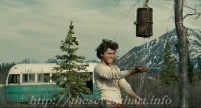
I’ve heard a lot of complaints about the climax of the film being too abrupt and contradictory to the whole purpose of the film. Though I do agree with the minor rush towards the end, I have to strongly disagree with the debates on the content. Although the film is apparently about breaking loose and coming out of the cocoon of modern life, it is essentially one about moving into a shell that more restrictive than ever before. Chris bit by bit shuns himself from everything in spite of meeting elder counterparts who regret similar decisions of their youth. He thinks that by doing so he moves closer towards nature and genuine satisfaction whereas in actuality, he is overseeing original human emotions that transcend logic and materialism. So Into the Wild becomes a road movie which is anti-road in a way. This is encapsulated in the very final mesmerizing shot of the film as the camera starts from Chris’ eyes and moves out towards the sky leaving Chris alone in the bus that looks like a micro shell in the ocean of nature.

Two scenes would stay in mind for ever. The first one is at a phone booth where Chris notices an old man making up with his wife over the phone. The call time nears the end as the broke old man desperately tries to convince her. Chris chucks his own call and gives his quarter to the man who keeps talking for a minute more, in vain. Chris knows that the man is troubled but what he doesn’t know is that he is seeing his future self in the old man. The second one being the moment of farewell where Ron (Hal Holbrook) reveals his wish to adopt Chris – a scene that has to be seen to be believed.

Undoubtedly, Sean Penn has got one of the finest pair of ears for music and it shows. We all know his love for The Beatles but in Into the Wild he goes with a complete soundtrack by Pearl Jam’s lead singer Eddie Vedder. With each song encompassing whatever it takes to be a roadie and each track topping one another in terms of the freedom and the simplicity it offers, one can easily place Into the Wild in the top 10 Hollywood soundtracks of all time. “No Ceiling” could well be called the successor to “Born to be Wild” and that’s just the tip of the iceberg.

There is an Alexander Supertramp is all of us craving to get away into the wild. But sigh…Into the Wild is not a film that grows with the years. Rather, it is one that can potentially become an idiosyncrasy of the past. And that is the precise reason it should be watched now. Into the Wild isn’t just the movie of the year. It is the movie of our generation, soon to be taken over by a more bizarre, more radical and more cryptic way of thought and life.

Histoire(s) Du Cinéma
(History Of Cinema)
1988-98


History of Cinema (1988-98)

History of Cinema (1988-98)

The candidate for this concluding part of the Godard marathon couldn’t be anything other than Godard’s magnum opus History of Cinema (1988-98) – a one-of-a-kind film that isn’t like anything seen before, even by Godard’s standards. In what I like to call “Stan Brakhage meets Sergei Eisenstein” kind of cinema, Godard completely does away with the need for a film camera as he employs loads and loads of footage from the most obscure corners of film history to express his ever-baffling, ever-revolutionary ideas and eventually reconstruct history – of art and of time itself. His editing prowess coupled with his oceanic knowledge of art and history result in a barrage of images, sounds and texts that anyone calling himself a Godard scholar, leave alone film scholar, would hesitate to come forward. Nevertheless, History of Cinema remains an immensely enriching experience for those who are game and those who earnestly try to get a whiff of what Godard is getting at.

Though the film as such is considered an eight part series that Godard gradually completed within a span of 10 years, the sharing of thematic and formal content among the film is so strong that any demarcation between the segments seems valid only for documenting purposes. Each film is as much tied to the others as it is singular – an idea that carries over to the commentary on cinema that Godard delivers – Cinema as an art that is as much connected to the preceding arts as it is unique. He regularly intersperses critical works of painting, sculpture, music and photography with entities of pure cinema as though suggesting that not only does cinema bear a definite relationship with them, but also that history repeats itself in one form or the other. As a result, the tracing of history of cinema necessitates a journey back not just to the year of the Lumiéres but much before.

History of Cinema (1988-98)

If we had to single out Godard’s most favorite quote it has to be the misattributed Bazin one: “The cinema, substitutes for our gaze a world that corresponds to our desires”. And this is where the series kicks off. Cinema as a substitute for our dreams – the dream factory. Godard explores the meaning of “dream” as interpreted by the two functioning extremes of cinema then. He presents the occident interpretation as one that had converted cinema into a portal offering an alternate reality, a second life, to the audience whose “dreams” were the fodder for the larger-than-life images that the films projected -one that continues till date. He crosscuts this with the adversarial position taken up by the Russian giants whose visions/dreams of the society after the 1917 revolution were the primary driving force that prompted the directors to make films that could make audience act and think, not get addicted to. Godard contrasts these notions and movements and laments the death of the latter while reconstructing fragments from pivotal moments of history and cinema.

In the centenary film Lumiére & Co. (1995), the filmmakers were asked a question: “Is cinema mortal?” If Godard had been asked the same thing he would have most probably said that cinema is already dead – killed almost as soon as it was born. In History of Cinema, Godard puts forth the idea, or rather the bitter truth, that cinema had infinitely more potential to influence history than any of its predecessors, but was ruthlessly narrowed down to a medium that tells “stories”. That, in an attempt to reproduce reality to utmost perfection, filmmakers have put on it a fake fabric of synthetic morals and eventually pulled over it a world of spectacle so as to mask the blunder. He argues that cinema could have prevented unfortunate tragedies and averted genocides rather than merely crying over damages dealt and observing helplessly the misery of its subjects.

History of Cinema (1988-98)

And in resonance with this ideology, instead of bemoaning what is lost and what could have been, Godard anticipates the death of cinema (He apparently asked Henri Langlois to burn the archives). Death, so that it can rise again from the ashes. “Art is like fire. Born from what it burns.” says Godard and that is precisely what he desires – Cinema to go down with all its exploitations and restrictions and rise in its purest form. Back to infancy, so that it can learn everything out of free will, without rules and without vanity.

Having said that, Godard also calls for a preservation of cinema and hence a preservation of history, for cinema has recorded both beauty and atrocity with equal emotional bias, if not with justice. True that cinema has always been a runner-up to history, but at least it has mirrored history to some extent. But unlike traditional methods that document history as a direct function of time, Godard attempts to reconstruct history as seen in retrospect. He utilizes existing film fragments to fabricate various histories of film – the one that was and the ones that weren’t but could have been. He examines how cinema could have been made independent of historical accounts and even made to influence them. In essence, he projects history backwards to uncover the history of projection. Godard examines such dualities in a number of places in the film – Infancy of art and art of infancy, newness of history and history of news and reality of reflection and reflection of reality – employing a variety of footage ranging from newsreels to pornography.

Godard elucidates this servile relation that cinema bears to history using images of dictators and authoritarians. He highlights how the visual medium itself is being manipulated by a few people in power and how in turn, modern cinema manipulates the audience. Godard reproaches this moral policing and expresses his disapproval of the hypnosis that the TV-driven audience is subjected to. He appeals for a cinema that provokes but doesn’t direct, a cinema that gives you options but doesn’t select one, a cinema that makes you think and doesn’t think for you and a cinema that is only complete with its audience. As he quotes in one of the segments, “Cinema does not cry. Cinema does not comfort us. It is with us. It is us”.

History of Cinema (1988-98)

There is an intriguing recurrence of the image of human hands in the film. Godard urges artists to think with their hands – their real tools that have the potency to both create and destroy, to beautify and to horrify, to document and to change. He argues that these are the instruments capable of changing and redefining history and it is the weakness of the mind that hinders the possibility. This motif is punctuated by quintessential Hitchcockian and Bressonian images of hands and their gestures that carry with them an air of graceful individuality. And amidst this theory, Godard expresses his deep admiration for Hitchcock and Rossellini (especially Rome, Open City (1948)).

It is naturally impossible to grab every reference and idea that Godard throws at us. Hence, History of Cinema becomes a film that one should watch multiple times with considerable spacing. Without doubt, uncovering each layer of its text, sound and image to see how Godard has constructed the history of cinema, just in order to rebuke it, is a progressive task that becomes possible only with much exposure to all the six arts that precede cinema. I, for one, am going to visit the film every year trying to gain something more out of every time and get a glimpse into the esoteric world that is Godard’s.

=========================FIN=============================

That brings me to the end of the series. This has been one heck of a ride for me – exploring a world that almost no one talks about. I must thank everyone who has been visiting the blog, especially Nitesh, Ed and Shubhajit who have presented some very interesting and illustrative facets of Godard’s ever-baffling works. And Godard himself, for I’ve never become so tired after watching a film. To get a measure of that, I spend around 3 hours watching an 80 minute film! His films extract so much out of you that following 1% of Godard is much more enlightening than absorbing 100% of the others. I do hope that I get my hands on more of his films some time in the future.

Of course, I have missed out on more than a dozen worthy Godard films and shorts including Here and Elsewhere (1976), the bizarre Keep Your Right Up (1987), the radical King Lear (1987), and the more recent Our Music (2004). I hope I can cover them in the Flashback series or elsewhere.

Till then, au revoir and a happy new year,
Le Petit Soldat

Éloge De L’amour
(In Praise Of Love)
2001

In In Praise of Love, Godard focuses on a single topic for discussion – that of preservation of history. He debates the validity of preserving history using media and the replacement of memory by technology. Additionally, he raises questions about Hollywood’s methods of representing history and argues that the industry manipulates history in order to make the audience sympathize or react but never to indict the guilty. There are also some hard-hitting statements made about the history of the United States that are readily controversial. And these questions in turn bring up the conflicts between image and reality, documentation and re-creation of history and proprietorship and openness of history.

In Praise Of Love (2001)

In Praise Of Love (2001)

The film is marked by extraordinary cinematography with the first half of the film taking up a neo-realistic character. Godard achieves complete distancing and passivity of vision that the Italian pioneers could never achieve. The second half of the film literally changes tone with its excessively saturated Wong Kar Wai-ish colour palette and expressionistic style. In some ways, In Praise of Love is Godard’s version of Wings of Desire (1987). He films the past in colour and the present in monochrome as if suggesting that the variegated experiences and stories of the past have now lost their colours and been demarcated by black and white regions – like what a child sees. This absence of an adult’s vision that plagued the very nature of revolution seems to have made history a matter of pop culture.

This creation of extraordinary out of the ordinary, refusal of cinema to act as a social mirror and one-dimensionality of perception about history, Godard suggests, is decidedly a result of the years of training of the audience’s minds by the films of the west. There is a fantastic sequence where we see a theatre that is screening both Bresson’s Pickpocket (1959) and the Wachowski siblings’ The Matrix (1999). Though both the films deal with the notions of fate, free will and existential imprisonment, the popular choice seems be the spiced up version.

For Ever Mozart
1996

For Ever Mozart is one of Godard’s most complex films. This is true of all his films that have a seemingly coherent narrative, but For Ever Mozart surpasses all its companions into a realm that only Godard has the access to. But by no means is it a self-indulgent film. While the whole world of filmmaking is crowding the narrow lane defined by the “rules of success”, Godard wallows alone in the vast unexplored stretches, taking his gigantic leaps and pondering on the barrenness of the field. Until someone gives him company and learns his language, I can just guess.

For Ever Mozart (1996)

For Ever Mozart (1996)

For Ever Mozart, on the outset shows us two threads the first of which follows a group of self-proclaimed theatre artists out in Yugoslavia to put up a play amidst the frustrating war situation around. The second thread, the more accessible one, involves a director with an urge to use filmmaking as an art (wanna guess who?!) against the wishes of his producer and audience. He believes the director to be the father and the actor to be the mother of any play and sure enough, after much labour by both the director and his actress, they deliver the film of their dreams. But what does the audience want? Terminator-4. This creates a tautology of sorts within the film between the two threads. One depicts the struggle of art to survive within the harsh realities of the world whereas the other portrays the battle of art with its own subverted form – Cinema among wars and war among cinemas.

There is a magical scene at the end of the film, perhaps Godard’s best. We see an anachronistic image of Mozart performing amidst an audience that is clad in jeans, chewing gum. The mute Mozart invites a layman to assist him in his concert. The director ascends to the hall with difficulty via a stairway (to heaven?) after which he retires. Is Godard suggesting that a time will come where art will be a commodity of the public and not just for the public? To steal from the film itself, “It’s almost nothing or… something I don’t know“.

JLG/JLG – Autoportrait De Décembre
(JLG By JLG)
1995

Godard’s influence of Van Gogh shows in his next film JLG by JLG: An Auto-portrait in December. Made largely inside his room, JLG/JLG looks like a home movie like some of his films of the late 80’s. The film seems to take place during the editing of Godard’s interesting reworking of the Greek legend – Oh Woe is Me (1993). Godard makes it clear that the film is only a self-portrait, not an autobiography – not an objective account of his psychological motivations, but an introspection that is subjective and only skin-deep.

JLG By JLG (1995)

JLG By JLG (1995)

The most interesting aspect of the film is that we get a glimpse into Godard’s daily life, which by itself is quite extraordinary. We see what he reads –  a huge private library which stores some of Godard’s most famous quotes that have enthralled audience through the decades. We see what he speaks – as we have seen before through his various quirky characters. We see what he watches – the films that find their way into almost all of his movies in the form of references and posters. And we see what he thinks – like the relationship he conjures up between stereo speaker system and the Star of David. His financial difficulties clearly show up as we even see an official raid into his shabby household. These claustrophobic images are intercut with paradisaical images of the winter that seem to bear a strong relationship with Godard’s own mental landscape during that period.

Although all this gives the feel of an honest documentary observing a day in the life of a filmmaker, it is, like most of Godard’s filmography, an essay that presents as many ideas as its predecessors and provides a commentary on larger issues hidden beneath the veneer of the quotidian events that we see. Godard begins with his favorite theme of individualism versus the community (crystal and smoke, according to him), moves on to the regular issues of truth, image and fate and finally takes up an elegiac tone that shows a clear yearning for the past carrying over from his previous films. And who wouldn’t be disarmed by a film whose closing quote reads “A man, nothing but a man, no better than any other, But no other better than him.

Les Enfants Jouent À La Russie
(The Kids Play Russian)
1993

The Kids Play Russian employs the same (lack of) structure as Germany Year 90 Nine Zero and forms the last part of what I would call Godard’s Elegy Trilogy (wow! that rhymes!). This time it’s Russia, the head of the family, the massive Redwood tree that has fallen. Godard suffers a one-two slap with the fall of the USSR and his angst shows. The impressionist images are replaced by the mesmerizing surrealism of Dovzhenko and literature replaces the music of Germany 90. However, he does go a step further and probes what should be the future course of the country, still crying out “We will not change”.

The Kids Play Russian (1993)

The Kids Play Russian (1993)

Godard calls Russia the birthplace of fiction and emphasizes that a history of Russia would most definitely reflect the history of fiction itself. And hence, fall of the USSR (rather communism) means the fall of fiction. He traces back the history of image projection as the first Franco-Russian alliance and calls his relation to Russia as the last one surviving. In that sense, Godard himself is the Lemmy Caution of activist cinema – once a visionary, now undone. He employs the fictional figures of Anna Karenina and Prince Andrei to represent Russia and its plight hereafter. He imagines what they would be doing if they were alive during the collapse of their motherland. But again like all three films of the series, the film is one that is built on hope and promises.

The final image of the film captures a borderline-wild Godard continuing to work in his recording room, lit partially by the harsh light. More than “The show must go on” attitude, what shows here is “And miles to go before I sleep” mentality that has kept Godard afloat amidst his larger-than-life troubles in both his personal and professional life. A sexagenarian with fractured relationships, doomed ideologies and whose only redemption is in Cinema, pushing forward with more vigour than ever – only a few images can be more moving than this. The Idiot will go on. So will Cinema.

Allemagne 90 Neuf Zéro
(Germany Year 90 Nine Zero)
1991

And I thought Godard didn’t have a masterpiece. Once more after many years, Godard follows Lemmy Caution (remember Alphaville?), now the “world’s last spy”, after the collapse of communism in Germany and the breaking of the wall. If Alphaville was The Return of the Jedi, Germany 90 is the Revenge of the Sith.  In the first film, Lemmy was a virus eluding the clutches of the supposedly omnipotent Alpha 60 whereas here, he is a lone warrior meandering unharmed in the bigger Alphaville and the sole survivor of a species that would soon be extinct. Evidently a requiem for what Godard considers the death of Germany, Germany 90 is perhaps the best contender for the adjective “sublime”.

Germany Year 90 Nine Zero (1991)

Germany Year 90 Nine Zero (1991)

Tinged with a slight green throughout, the film juxtaposes images of sincere yearning by a man whose raison d’être has been questioned with fleeting sequences from the classics from the early expressionist German cinema. Godard classifies music, love and poetry as belonging to socialism alone and as languages not understood by the new world. Though elegiac in tone, the film is uncharacteristically (for Godard) hopeful in actuality. There is a definite promise of restoration in the form of Dora, the symbol of Germany in the film, and the assurance of “music after life”. On a lighter note Lemmy comments “You have to admit, Marx did triumph. When an idea is born among masses, it becomes a material force. That’s one way of looking at it.

Lemmy Caution who represented all that is living and all that is human in Alphaville represents all that is lost and destroyed in Germany 90. The recurrent images of exile crucifixion and torture may be for the whole of socialism itself, whose pro-mass approach was nailed down by the elite bourgeoisie. Now as Lemmy walks alone through the remains of the now- nonextant world, we see what Godard is referring to by “solitude of history” – Lenin icon amidst Greek ruins, people moving towards the west in blue cars, machines resembling dragons almost swallowing Lemmy, history books being sold as souvenirs. The fugitive events that shook the world seem to have single-handedly made Godard’s political period a thing of arthouse circuits. It is more than solitude of history, it is solitude of Cinema.

Nouvelle Vague
(New Wave)
1990

Watching New Wave, it felt like a Tarkovsky film, especially Nostalghia (1983) at many places – may be because of the organic pace and camera work of the film, may be because of the very presence of Domiziana Giordano (and the horses!) or may be the hypnotizing locales of Italy, I don’t know. But the film surely echoes some of the elements of the Tarkovsky classic for Nouvelle Vague is essentially a yearning for the past and nostalgia of la dolce vita of yesteryear.

New Wave (1990)

New Wave (1990)

The basic premise of the film follows a rich couple Richard and Elena, visibly dissatisfied with their lives, attempting to search for that elusive object called happiness and hence trying to discover their place on earth. They assume roles of the dominating and the dominated in turns Yet again, Godard crafts a film that works on so many levels that it becomes intensely personal in more than one way. Richard and Elena may be representing the French New Wave and traditional cinema respectively as they try to find their own place and struggle to accept their mutual existence. So the film on one level becomes a superficial study of how the New Wave affected established cinema and vice-versa. With characters named de Sica, Mankiewicz and Aldrich, this argument seems plausible, but one shouldn’t restrict the film to a mere interpretational exercise, again a Tarkovskian trait of the film.

The regular intertitles read “Things, not words” and this is exactly what the film seems to be following. Godard bids adieu to his immensely talkative pair of periods, for the events around the world have made words completely futile. He places the images in the driver’s seat such that the basic feel of the film prompts one to classify it as elegiac. Coming soon after the twin collapse of East Germany and the USSR, Nouvelle Vague will be remembered as a befitting farewell to the most revolutionary ideology in the annals of mankind and the most subversive period of filmmaking in cinema history.