Taxi Driver (1976)
English
Martin Scorsese

Martin Scorsese’s Taxi Driver (1976) is hailed as the one of the best American movies ever made. The tale of the single male, his alienation from the ultra urban society and his voluntary involvement in the mires of the underworld definitely has its own share of lovers and haters. This post is about the classic scene from the movie where the protagonist, Travis Bickle talks to himself!

Travis Bickle (Robert De Niro) is fed up by everything that is going on around. He decides to end it all and purchases a few guns. He prepares a setup on his robe so that holstering of the weapon is easier. He stands in front of a mirror and tests the setup. When he is about to finish, he enters a monologue similar to that in Raging Bull (1980).

Travis: You talkin’ to me? You talkin’ to me? You talkin’ to me? Then who the hell else are you talking… you talking to me? Well I’m the only one here. Who the fuck do you think you’re talking to? Oh yeah? OK.

Here is the video:

Scorsese uses the power of the mirror once again to carve out his character. Travis Bickle has always been a loner with his only attempt at love also failing. In this situation, Travis sees his only companion in the mirror – his image. His arrogance is also visible that establishes his hatred and inability to accept a stranger’s company and the “society” in general. The social isolation coupled with the rot of the society eventually leads to his mental disintegration and hence his choice of violence. Interestingly, the whole monologue is rumoured to be an improvisation by De Niro himself.

Nattvardsgästerna (1963) (aka Winter Light)
Swedish
Ingmar Bergman

“God, my God! Why hast thou forsaken me?”
 

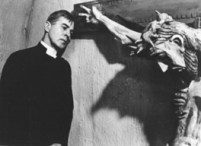
Winter LightFaith and doubt in God have always been a critical theme in most Bergman films, especially the ones in the so-called “Faith Trilogy“. Nattvardsgästerna (1963) is the second installment in this trilogy following Såsom I En Spegel (1961). Having established the concepts of God as love and God as a monstrous spider that can be simplified as “Godlessness” in the first part of the trilogy, Nattvardsgästerna puts these two concepts into test.

Tomas is a pastor who has lost his wife few years ago. As a result of this he has created, for himself, a Utopian world where nothing is deadly and God is always benign. He ignores the harsh realities of the world such as the Spanish Civil War and the nuclear race. Hence, He is unable to impart faith to people who come for help. There is Märta, an agnostic who loves him and desperately seeks to snap him out of his facade of belief and fantasy. Märta’s belief will depend on Tomas’ reciprocation of love which does not seem plausible yet. After a spiritual conversation with a believer about causes of suffering, Tomas realizes that his apathetic attitude towards love has cost him more than the cruel reality itself. Having recognized his isolation from society and hence love and communication (also addressed in the sequel), Tomas proceeds towards the pulpit with what seems to be a “revitalized belief”, thus providing a reinforcement for Märta’s faith, if not his own.

The film can be viewed as a bridge between absolute faith in God (as love) suggested in Såsom I En Spegel and absolute disbelief (as absence of love) as will be shown in its sequel. Symbols and metaphors galore, Nattvardsgästerna boasts of fantastic performances by Gunnar Björnstrand as Tomas and Ingrid Thulin as Märta. Nattvardsgästerna was followed by Tystnaden (1961), the final film in the trilogy that describes a colder and more apocalyptic premise of the “belief theory”.

The Pianist (2002)
English/German/Russian
Roman Polanski

Hollywood has always had a constant flow of World War movies coming from it. But not more than a dozen stay in memories of the average film goer. Writing off the Clint Eastwood double bill and a few forgettable ones, Roman Polanski’s The Pianist (2002) may be considered the last successful World War movie. Adrian Brody’s chilling portrayal of the Polish pianist Wladyslaw Szpilman won him the Oscar in 2002, making him the youngest to do so.

In one of the best scenes in the movie, Wlady meets an old friend who promises to provide him a refuge from the Nazi army. As he leaves for the hideout he watches his friend Dorota play the Cello. Upon reaching the house, his friend’s spouse informs him that no one knows he is here and it is a locality frequented by the Nazis. After the person asks Wlady not to make any kind of noise and leaves, Wlady notices a piano and sits in front of it. He takes his hand towards the keys on the piano and we cut to his face. A music piece is being played. It is only after some seconds we notice that the music is actually playing in his mind and his fingers are just hovering over the keys. He is happy for the few minutes he “plays”.

I have uploaded the video in Youtube for your convenience:

Polanski, who has been in the industry big time, is at home directing the film. Though the scene has not a word spoken, it conveys so much about an artist and the influence of political situation on his work. In contrast to Dorota, who is free from any trouble from the Nazis and is playing her music peacefully, Wlady is under a pressure from the ruling government and is unable to produce his music. This is true of any artist who works within the boundaries of political restrictions. Not all of the artist’s true intent is put forth to the world. Right from the medieval (even before that, in fact) painters (featured in the Tarkovsky classic “Andrei Rublev“) to film makers such as Kieslowski, artists have not been given freedom of expression owing to the clash of ideologies of the creator and the ruler. This scene sums it all up with effortless ease.

Yume (1990) (aka Dreams)
Japanese
Akira Kurosawa

“Yesterday I was trying to complete a self portrait. I just couldn’t get the ear right, so I… cut it off and threw it away.”
 

YumeThe first thing that strikes everyone about Japanese cinema is the Samurai culture. And the first thing that strikes about Samurai films is Akira Kurosawa. Akira Kurosawa’s later films, however, were not received well even though they were offbeat works such as Dodes’ka-den (1970), Dersu Uzala (1975) and Yume (1990). Yume presents itself as a episodic collection of eight vignettes apparently based on the director’s dreams.

The first dream “Sunshine Through The Rain” presents a kid witnessing the wedding procession of foxes against his mother’s warnings and his subsequent punishment. In the second segment “The Peach Orchard” has a boy witnessing her sister’s dolls (which represent peach orchards) performing a dance and later scolding him for cutting down peach orchards. The next dream “The Blizzard” portrays a few mountaineers trying to scale a peak against all odds posed by the harsh nature. “The Tunnel” sequence is a chilling account of a Japanese army official who meets a dead soldier from his squad who refuses to believe that he is dead. In the “Crows” dream where Martin Scorsese plays Vincent Van Gogh, we are given a tour through the works of Van Gogh. The “Mount Fuji In Red” segment shows a nightmare portrayal of Nuclear explosion. In the seventh dream “The Weeping Demon”, a man meets a demon who explains that a large scale mutation took place that resulted men such as him. In the final dream “Village Of The Watermills”, a man looks at a village that abandoned the use of modern technology and has decided to live in a clean and peaceful environment.

Spectacular imagery and and amazing production design spells class all over. The film, without doubt, provokes mixed reactions from the audience. But it is indisputably, a daring work of art by all measures. Let’s face it. Which other director has the guts to make a picture based on their dream! The film was nominated for the Golden Globe for best foreign film in 1991.

Bicycleran (1987) (aka The Cyclist)
Persian
Mohsen Makhmalbaf

“His name is Nasim (Breeze), but he resembles a typhoon. He rides bicycle blindfolded. This man has stopped a train in India with his eyes. In Pakistan, he’s lifted two bulls on a finger and this time he is gonna ride and live on a bicycle for 7 days round the clock.”


The cyclistThe objectives, outlooks and needs of different levels of a community, naturally, do not concur. One man’s grief is another man’s pleasure. Mohsen Makhmalbaf’s Bicycleran (1987) captures this difference in the context of an event as viewed from people from different sections of the society. Though a bit more dramatic than most films then from Iran, Bicycleran has enough raw power and truth value to be classified under the neo-realistic genre.

Nasim is a Afghani labourer whose wife is sick and is in need of immediate treatment. Times are hard and labourers cannot expect more than 50 Tomans per day for their work. But Nasim’s requirements are higher and he tries everything he can including a feigned suicide attempt to blackmail people into giving money. Finally, through a bookie, Nasim agrees to put up a show where he would be riding a bicycle for 7 continuous days. The show begins amidst a lot of objections and . with time pedestrians and vendors begin to gather around him. Nasim witnesses his own exploitation by various people from different strata of society – vendors making it their sales hub, middlemen betting and common people getting relief from his plight. In spite of a lot of physical, emotional and social obstacles Nasim manages to finish the 7 days. At the time of glory, Nasim is asked to dismount from the bicycle by the reporters. He is indifferent to all the commotion (possibly because of the physical and mental fatigue) and continues to ride in the circular path.

The film can be viewed as an allegory of the struggles of the working class, a society that exploits them and an upper class that views them as objects of amusements. The recurrent themes of roundness that occur through the images of wheels, cycles and structures signify the vicious circle of fate and inevitability that the working class treads in. The film won the best film at the Hawaii Film Festival in 1987.

It’s A Wonderful Life (1946)
English
Frank Capra

The grandmother of all feel-good flicks, It’s A Wonderful Life (1946) , may seem very mellow and even stereotype when viewed today, but Frank Capra‘s financial bomb gives the viewer full satisfaction at the end of the movie, every time. George Bailey’s (James Stewart) “Oh, Shucks” and “Gee, Whiz” make him a very lovable character that is a rarity in this generation.

The scene I am writing here is the final one in the film. George Bailey has committed suicide after he has gone bankrupt. His guardian angel resurrects him and shows him how the world would have been if he weren’t there. George is convinced that his life was better and wishes to live again. After he comes back to life carrying all the positives, he returns home to find that all his friends and relatives have put in small amounts of money to save him from his present situation. Yes, it is good wishes everywhere. George is saved.

Though this scene is sugarcoated to the maximum possible extent and perhaps too good to be true, it portrayed something that Hollywood would be repeating for decades to come – The indomitable nature of the human spirit. Aped in every forms possible, this scene reminds you that it’s a wonderful life indeed!

George Lucas: “This ain’t gonna be easy”
Steven Spielberg: “Not as easy as it used to be”

Lucas and Spielberg are at it again. After the intensely dramatic Munich, Spielberg freaks out and does what he does best – getting people on their feet. I don’t know why he chose Indiana Jones for that. Probably, he didn’t want to bring in aging sharks or senile aliens. Surprisingly (and commendably), he has banked on Harrison Ford once more to deliver. Does Indiana Jones And The Kingdom Of The Crystal Skull (2008) live up to the expectations set by its first three installments? Yes and No.

Indiana Jones And The Kingdom Of The Crystal SkullSpielberg has chosen a very simple plot in order to not distract the audience. Indiana Jones (Harrison Ford) escapes from of group of commies led by Irina Spalko (Cate Blanchett) who are in search of an artifact. Removed from his college for getting involved with the communists, Dr. Jones is called for action by Mutt (ShiaLaBeouf) , the godson of Prof. Oxley (John Hurt), a long time friend. Henry informs him that his mother Mary Williams (Karen Allen) and Prof. Oxley have been kidnapped in South America while in the hunt for a so-called crystal skull. It his up to Jones to hunt for the skull and return it to its proper place. In the journey, he finds that there are others vying for the skull too and discovers his true relationship with his family and friends.

The film promises enough twists and turns required for a franchise such as Indiana Jones till the central act after which the plot takes a back seat and action takes the driver’s (literally!). The last act succumbs to predictability and acts as nothing more than fillers. The characteristic wry wit of Indy is still intact and is charming as ever. There are numerous references to earlier Spielberg films as well. The chaotic party in 1941, the terrorizing truck shots of Duel, shots similar to the massacre the Omaha beach landing in Saving Private Ryan, the famous rear-view shot in Jurassic Park, the best moments of its prequels and even a few beings that look like the grown up versions of E.T. – The Extra Terrestrial!

Expecting a 65-year old Indy to be weaker than his former self is nothing but normal. More of brain work is expected from him during perilous situations. Even Indy expects that early on. But his vulnerability stops there and it seems that no one cares that he is fit to receive pension. Indy seems to go on and on like a 30 year old. Hats off to Harrison Ford for performing those larger than life stunts with the same vigour as he did in the opening installment. Only he could have pulled this off without shattering the audience’s perception of Indiana Jones. Cate Blanchett’s character, Irina Spalko is reminiscent of Yuri of Command & Conquer: Red Alert game. With her cold witch-like eyes, Blanchett is the perfect foil as the megalomaniac Russian scientist. But the character neither has the depth to suit such a performance nor poses any threat to the juggernaut of the protagonist. It was disappointing to see George McHale (Ray Winstone), Indy’s friend, portrayed as a thorough stereotype that one expects only in bottom-of-the-barrel movies such as The Mummy and the like.

Hands down, Indiana Jones And The Kingdom Of The Crystal Skull has the best action sequences filmed in recent times. The stunts and the choreography have quality written all over. The production design has deliberately (and effectively) retained the look and feel of the post-war cold era. Spielberg regular Janusz Kaminski , who gave us a glimpse of hell in Saving Private Ryan sizzles in the action sequences. His cinematography has given the director the best possible output for his effort . A definite Academy Award nomination. The other regulars Michael Kahn and John Williams maintain the pace and excitement to support his work.

In this age of special effects, it seems easy to churn out a high-octane action flick and Steven Spielberg knows it by heart. He has put forth his trump card (Indy, of course) into the game. But has relied on it too much that he has neglected the finer aspects of plot and characterization. It is compensated by the other side of the balance with spectacular action and stunt sequences that characterize Indy. But the bottom line is: ” It’s Indiana Jones and what else do you want? Go to the theaters now“.

Verdict:

DISCLAIMER: People with weak constitutions/heart problems please stay away from this post. Contains graphic violence and thematically disturbing images.

The year was 1990. There was an unusual crowd at the theater. Upon investigation, it was found that it was the occasion of the release of next film by Ramanarayanan, the master of “religious thrillers”, if they exist. Aadi Velli (1990) had set high expectations in the minds of the film fanatics and they did not want to miss the rare chance of seeing it in theaters. The whole crowd got in. The show finally began. But only half the people returned.

The whole film has such exhilarating moments that people went numb watching it. The climax which tops all the scenes is one that was jaw-dropping (minus the drool) and will be cherished by generations to come. I had the chance of seeing it on VHS about 15 years ago and boy did I love the film! I recently got hold of the original VCD. As a service to mankind, I have cut out the best parts from the climax and uploaded it on you tube. I am presenting the same below. (If you have hurried to this point, read the disclaimer above)

Notice the time-slice photography in the duel, later copied by The Matrix. Also note how easy it is to generate King Katari. But please kids, these stunts have been performed by expert programmers and professional monster-creators. Do not try this at home.

Though King Katari is defeated, it will remain as the best villain in the memories of the audience for its efforts, intimidating acts, courage, shape, size, colour, cost, elastic coefficient etc. As a Cinemaniac and responsible human being, I request all of you viewers to spread the word and ask as many people to watch the video so that we do not miss one of the best moments in world cinema history.

P. S. : Please do not compare with Narasimma or Yaarukku Yaaro. I hate such comparisons.

Bowling For Columbine (2002)
English
Michael Moore

Perhaps Moore’s best work till date, Bowling For Columbine (2002) examines the ever-increasing gun crimes especially among the youth of the United States of America. Though the truth value of the facts stated in the movie are constantly debated there are some scenes that you can’t resist appreciating.

One of them is the part where the movie tries to provide a brief history of America to trace back the gun culture. Playing just over three minutes, the scene is a completely animated sequence with South Park like caricatures being used to describe the progress of events. The narration is rapid and comic with lots of slang and voice modulations. The fast narration is interwoven with these caricatures that, from time to time, utter some weird but funny lines. You can view the scene here:

For those who do not have speakers (such as me), here is the transcript of the scene (Bear with me, its long!)

Once upon a time, there were these people in Europe called pilgrims and they were afraid of being persecuted. So they all got in a boat and sailed to the New World where they wouldn’t have to be scared ever again.
– Oh, I’m so relaxed.
– I feel so much safer.
But as soon as they arrived, they were greeted by savages.
– They got scared all over again.
– Injuns!
So they killed them all. Now, you’d think wiping out a race of people would calm them down, but no. Instead, they started getting frightened of each other.
– Witch!
– So they burned witches.
In 1775, they started killing the British, so they could be free. And it worked. But they still didn’t feel safe. So they passed a 2nd amendment, which said every white man
– could keep his gun.
– I loves my gun, loves my gun.
This brings us to the genius idea of slavery. You see, boys and girls, the white people back then were also afraid of doing any work. So they went to Africa, kidnapped thousands of black people, brought them to America, and forced them to work very hard for no money. And I don’t mean no money like:
-I work at Walmart and make no money.
I mean zero dollars. Nothing, nada, zip. Doing it that way made the USA the richest country in the world. So did having all that money and free help calm the white people down? No way. They got even more afraid. That’s because after 200 years of slavery, the black people now outnumbered the white people in many parts of the South. Well, you can pretty much what came next. The slaves started rebelling. There were uprisings and old masters’ heads got chopped off and when white people heard of this, they were freaking out. They going
– I want to live!
– Don’t kill me, big black man.
Well, just in the nick of time came Samuel Colt, who, in 1836, invented the first weapon ever that could be fired over and over without having to reload. And all the settlers were like:
-Yee-hah!
But it was too late. The North soon won the Civil War and the slaves were free to go chop the old masters’ heads off. Then everybody was like:
-Oh, no, we’re gonna die.
But the freed slaves took no revenge. They just wanted to live in peace. But you couldn’t convince the white people of this.
So they formed the Ku Klux Klan and, in 1871, the same year the Klan became an illegal terrorist organization, another group was founded: the National Rifle Association. Soon, politicians passed one of the first gun laws, making it illegal for any black person to own one. It was a great year for America. he KKK and the NRA. Of course, they had nothing to do with each other; it was a coincidence. One group legally promoted responsible gun ownership; the other shot and lynched black people.
That’s the way it was till 1955, when a black woman broke the law by refusing to move to the back of the bus. White people just couldn’t believe it.
– Huh? Why won’t she move?
– What’s going on?
Man, all hell broke loose. Black people everywhere demanded their rights. White people had a major, freaky-feel meltdown
and they were all like:
-Run away! Run away!
And they did. They all ran fleeing to the suburbs, where it was all white and safe and clean. And they went out and bought a
quarter-of-a-billion guns. And put locks on their doors, alarms in their houses, and gates around the neighbourhoods. And finally, they were all safe and secure and snug as a bug. And everyone lived happily ever after.

Though this is a gross simplification of the truth, it still has the potency to grab your attention. In just 3 minutes, it gives us the outline of how the country has become what it is now. Without being a documentation or making a serious issue out of it, the scene gives a blow by pin-pointing the mistakes of the nation and the consequences, all in the typical Michael Moore style!

La Strada (1954) (aka The Road)
Italian
Federico Fellini

“What a funny face! Are you a woman, really? Or an artichoke?”
 

La StradaSeldom do films come that are so simple in their presentation yet possess such strength in their characters. These are the films that sweep you off the ground with their sheer brilliance. Federico Fellini’s La Strada (1954) is a benchmark for industries such as Bollywood which flourish on fantasy for film making. La Strada marks Fellini’s transition from neo-realism (His previous film being the brilliant I Vitelloni (1953)) to fantasy. And what a transition it is!

Gelsomina is a innocent and childlike girl brought up isolated from her surroundings. She has always been with nature and children like her. Her life takes an unexpected when Zampano, a wandering stunt performer “buys” her from her mother. She learns to play the trumpet for performing with Zampano. The film follows her encounters with various people on her journey with the “road” being a metaphor for life. Zampano is a beast-like man who has no soft corner towards Gelsomina and ill-treats her consistently. They also meet The Fool, a comedian from another troupe who Gelsomina likes. Things are not smooth between The Fool and Zampano and the latter kills The Fool inadvertantly. Witnessing such cruelty is all novel to Gelsomina who goes into a shell and is eventually deserted by Zampano. Zampano learns later that Gelsomina passed away. The film ends with Zampano breaking down and realizing his mistakes.

A film with great characterization and humour bubbling with innocence. Gelsomina’s character acts as an angel who provides salvation at the end to the sin-hardened Zampano. The images and references of Gelsomina’s childlike innocence indicating her “angelness” appear throughout the film. Guilietta Masina gives a wonderful performance as Gelsomina with strong support from Anthony Quinn as Zampano and Richard Baseheart as The Fool. Oscar winner for best foreign language picture in 1957.