Salò O Le 120 Giornate Di Sodoma (1975) (aka Salò, Or The 120 Days Of Sodom)
Italian
Pier Paolo Pasolini
“We fascists are the only true anarchists.”
 Once in a while, there comes a movie that shatters the beliefs of people on cinema and redraws the lines between right and wrongs of the medium. These are the films that redefine the boundaries of film making thus providing new standards and freedom for films to come. At a time when swearing on screen was a taboo, came the classic Gone With The Wind (1939) with the legendary “Frankly my dear, I don’t give a damn.” quote. A Clockwork Orange (1971) that questioned induced goodness and evil in a very strong way, Straw Dogs (1971), famous for its graphic rape scene, Un Chien Andalou (1929) that introduced surrealism in cinema, the semi-snuff Cannibal Holocaust (1980) and its brutality – all these movies may have been snubbed by audience and critics at the time of their release, but no one can question their impact on the future generation of directors.
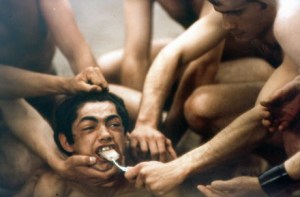
The year was 1975. Pier Pasolini‘s last few few ventures were not received well. What was to be his last film, released. Films were no longer safe now. Banned in almost every country it penetrated, Salò (1975) is a disturbing account of 4 Fascist officials running riot in a holiday villa. A few dozen teens are “captured” brought to the mansion. They are made to perform grotesque sexual acts while the “ladies of the house” narrate erotic and perverse stories. In another round of events, the inmates are forced to dine on human faeces. The ones that do not follow the instructions are tortured and even put to death. After all the debauchery, the officials take pleasure in watching the “violators” being brutally dismembered. More description of the scenes will be futile.
With what exact state of mind did Pasolini make this film, I don’t know. To me, Pasolini’s depressing work looks like a satire on overuse of power, especially pointing out to the division of classes in Capitalism (with Pasolini himself being a member of Italian Communist Party). Whatever be it, Salò has the power and the influence to be considered one of the critical films of the 20th century.
 I’m sure many would have watched Quentin Tarantino’s Reservoir Dogs (1992) or Pulp Fiction (1994) and become fascinated with the style of film making – Long conversations about…er, just conversations, dark humour, petty issues magnified, weird characters. Though Tarantino was influenced much by the works of Godard, the effect of Truffaut’s Tirez Sur Le Pianiste (1960) on his style cannot be written off. Tirez Sur Le Pianiste primarily acts as a cross between the 50’s film-noir style and Hitchcock’s troubled characters.
 During a war, more than armies and governments, it is the children who are affected most. The images of the atrocities and violence in the war makes an impact that is life-changing for them. The subject of children of war has been a less tackled one when it comes to Cinema. Andrei Tarkovsky’s Ivan’s childhood (1962) gave as an immensely personal account of war as seen by the title character. Another critical film on the same subject is Elem Klimov’s Idi I Smotri (1985). The film is hailed as one of the best anti-war films for its depiction of the influence of war on children.
 Michael Haneke‘s disturbing portrayal of an aging music teacher is definitely not for every one. Very graphic in nature and strongly thematic, La Pianiste (2001) attempts to simply document its central characters rather than offering a judgment on their conduct. A truly multi-layered film with characters that can be analyzed for hours.
 Ingmar Bergman‘s Oscar-winning film is the first of the “Faith” trilogy and is followed by
  La Peau Douce (1964) is perhaps François Truffaut‘s least talked about good movie. Release alongside Jacques Demy‘s big favorite Les Parapluies De Cherbourg, La Peau Douce could well be called “eclipsed” by the former. From the outside the film could be written off as a mild drama, the characters in the films have much more impact than any melodrama. At first watch, it is but natural to think of Woody Allen‘s wonderful film Match Point – An illicit affair, the secrets revealed, tensions high for protecting egos. But neither is the film as verbose or as happening as Match Point.
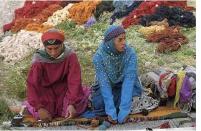 A co-production of the French and the Iranian film industry, Gabbeh (1996) is perhaps the best and most typical starting point for the westerners who would like to get an insight into the cinema of the east. Released in 1996 Gabbeh has managed to enchant the westerners and the Asians alike for not only its artistic merits but also for its subtle exposure of the culture of Iran. The film is centered around a nomadic tribe, which is tightly bound by blood relations. The tribe has its own rituals and beliefs which it passes on for posterity. One such practice is the weaving of carpets for a person depicting the journey of their life. The tribe carries and updates the carpets wherever they go.


 The Seventh Art