He doesn’t imitate Amitabh Bachchan, he plays him. So insists Firoz Khan, also known as Junior Amitabh Bachchan, one of the three celebrity impersonators at the centre of Geetika Narang Abbasi’s documentary Urf (A.K.A), currently playing at the International Film Festival Rotterdam (IFFR). Through a series of talking head interviews with Firoz, “Junior Dev Anand” Kishor Bhanusali and “Junior Shah Rukh Khan” Prashant Walde, the film offers us a glimpse into the world of what are known as “tribute artists,” lookalikes who play stars on stage, television and in films. Interwoven with these interviews are vignettes from the production, promotion and release of Amir Salman Shahrukh (2016), a minor movie starring lookalikes of three major Bollywood stars.

By means of relaxed exchanges in domestic settings, Urf examines the outlook of its subjects (and their family) towards their profession. Firoz “Bachchan” Khan emphasizes that physical likeness to a star is only part of the requirement; the bulk of it, he says, involves research, practice and hard work. Indeed, many of the artists we see in the film make up for what they lack in resemblance with a conscientiousness and charm that is impressive. Kishor believes that his mimicry of Dev Anand has a signature of its own that would inspire neophytes more than the star’s persona itself. Prashant is just happy if he could make people laugh, no matter in derision or delight.

Despite this touch of pride, their self-image proves rather conflicted. The three artists we see in the film are united in their desire to break away from being typecast and strike out on their own. All three appear to be on different stages of the same journey: Kishor, the most senior of the trio, has long transitioned into a busy career in light music. The middle-aged Firoz is now a regular on TV shows where he does not have to play Bachchan anymore. Prashant, for his part, seems at a crossroads, still trying to find his voice. The older men regard their earlier fascination with impersonation as youthful indiscretion. In their testimony is a sense that the work of a lookalike comes with an expiry date, that at some point the need to find one’s own identity takes precedence.

Underlying this ambivalence is a change in the nature of stardom and celebrity. In a mixture of wistfulness and self-deception, Kishor and Firoz view themselves as the last of their kind. The latter offers a striking diagnosis of why there are increasingly fewer impersonators in Bombay: it is that there are scarcely any stars with their own styles anymore, absorbed as actors today are into an anonymous naturalist manner. And then, says Firoz, celebrity isn’t as scarce as it used to be. Technological advance, including multiplication of distribution channels, has meant that stars can be seen by fans any time they want, rendering the vicarious thrill of impersonators redundant.

Unusual though its subject is, Urf is a work that comes in the line of documentaries looking at various facets of the lives of impersonators. Premiering in the same IFFR fourteen years ago, The Reinactors (2008) trained its attention on the community of lookalikes and cosplayers dotting the Hollywood Walk of Fame. Just About Famous (2015) normalized the practice, portraying these artists as consummate professionals serving a concrete cultural function. Perhaps the best of these documentaries, Bronx Obama (2014), spirals out from the private life of the president’s lookalike to explore America’s class and racial relations.

If celebrity impersonators in these earlier films were presented as social outcasts hustling to make ends meet, the individual we see in Urf can only be described as solidly middle class. We accompany Kishor on a visit to his spacious new apartment in a high rise, but professional doldrums aside, even Prashant seems financially better off than most of the hopefuls that make up the fringe of the Bombay film industry. At one level, their relative success marks them out as exceptions in a niche if competitive field, but it also reflects a vast demand for lookalikes that persists in spite of the pejorative associations the profession carries.

We see signs of this flourishing secondary market all through Abbasi’s film. The impersonators are featured performers in weddings and corporate events, play body doubles to their stars in commercials and get top billing in parodies and B-grade knockoffs of popular movies. Urf relates this parallel economy to the insatiable thirst for celebrity that Bollywood inspires or, more often than not, manufactures. Ardent fans from all across the country assemble outside Shah Rukh Khan’s home to catch a glimpse of their idol, declaring with a zealot’s faith that “he will come.” Some of this adoration rubs off on his lookalike, Prashant, who is constantly asked for photographs by admirers who wouldn’t stand a chance of getting as close to the original.

These reflections notwithstanding, Abbasi’s film is a modest proposal. Unlike The Reinactors or Bronx Obama, it does not hazard wider socio-political arguments. There is certainly something to be said about the paradox that the work of these impersonators is devalued as being unoriginal by an industry that thrives on formulas and remakes. But Urf is not the place for theoretical considerations. Abbasi’s film instead lets the human-interest stories take centre stage. It does not address the lookalike artists as a community. Its success, on the contrary, lies in individualizing them, in letting them recount their journeys and aspirations without undercutting them. Far from the freaks of primetime television, they come across as decent, reasonable people providing for their families while trying to keep the inner flame alive.


[First published at Firstpost]

Sci-fi movies often trade in scenarios that are set in a distant future, but which are largely determined by the conditions of the present. It is not just that the worlds imagined by these works are invariably limited by the possibilities of today—quickly rendering them quaint or antique with the passage of time. It is that many of them, by design, seek to clarify the present moment by isolating and exaggerating its most prominent aspects. The health crisis of the past two years has brought out many of the fault lines underpinning modern civilization with blinding clarity, making it easier for artists to extend them in creative speculation.

The current pandemic hovers in the background of Prappeda (“Hawk’s Muffin”), a feverishly active science-fiction feature in Malayalam made by Krishnendu Kalesh, playing now at the International Film Festival Rotterdam (IFFR). We don’t, however, witness any images of the present, which is invoked solely through an on-screen transcript of a conversation between a military pilot, assigned with the dispatch of ‘antidotes’ following a virus outbreak, and his command base. After the drop, the pilot is rewarded a vast stretch of land and instructed to go into hiding “until last man standing.”

What follows is a story set some hundred years after this murky operation. The land, now a dense rubber estate, is occupied by the descendants of the pilot: his grandson (Sreekanth Pangapattu), the senile patriarch of the clan who is also the narrator of the film, the old man’s middle-aged daughter (Nina Kurup) who has stopped speaking after a mysterious encounter in her youth, and granddaughter Ruby (Ketaki Narayan), a sensitive young woman who looks after her mother. The old man has relegated the management of the estate to hired hands Xavier (Jayanarayan Thulasidas, also the film’s producer), a military renegade who keeps outsiders at bay, and Shepherd (Mano Jose), a priest-cum-retainer intended to rein in the unruly Xavier.

This feudal order of things is challenged when a local policeman Thumpan (Nithin George) enters the premise, claiming to be an heir of the pilot and demanding a share in the estate. Roaming the woods, meanwhile, Ruby discovers an alien being that has crash-landed (Rajesh Madhavan). The creature, seemingly out of a movie by Guillermo Del Toro who is thanked in the credits, has an endearing air about him: his extremely frail frame, beady eyes, silly hair and jerky gestures are put to comical use, multiplied by jump cuts and time lapse shots. He performs a dance, gifts Ruby precious stones and takes her to a hidden niche near a majestic waterfall. A fairy tale romance ensues; the alien helps Ruby see the world anew, she takes him in her protection.

As the synopsis suggests, Prappeda unfolds partly like a children’s fable, partly like a political allegory. The film opens with a faux-newsreel about a mythical amphibian that will help the world’s elites in their domination of the planet. The continued influence of this elite is announced by helicopters constantly flying over the estate and by mysterious bots invading the premises following Thumpan’s “contamination.” The inhabitants of the manor, like the residents of M. Night Shyamalan’s The Village (2004), have no contact with the outside world and believe everything that this implied nexus wants them to believe.

The film is saturated with these weighty assertions and mythical notations, but pursuing them may not lead one any further than a set of conspiracy theories. Where Prappeda succeeds is not in the quality of its ideas, but in its constant attempts at formal invention. A cinephile-turned-filmmaker, Krishnendu Kalesh adopts a heterogenous style reflective of the name of his production company: Hybrid Tellers.

He employs a host of narrative modes with roots both in mainstream cinema and art film: musical numbers alternate with naturalist drama, silent cinema pastiches with impressive special effects, melodramatic episodes with abstract passages. Low-key drones are interwoven on the soundtrack with an emphatic, staccato score made of violins and percussions. The taciturn Ruby can speak, but her words are conveyed to us through intertitles and on-screen texts, which share the work of exposition with voiceover and dialogue. There is no sense that the filmmaker perceives a hierarchy between these modes, which co-exist without harming the film’s fundamental tone.

Prappeda has the stylistic brashness that one expects from debut works, and thankfully so. It trots out one power move after another, which succeed more often than not: a remarkable shot of Ruby discovering the fallen alien floods the frame with the blinding white of a parachute; a crack appearing on a wall is cut to an intertitle supplying building instructions; when Ruby and her friend discover photo negatives in the attic, the sequence suddenly atomizes into a series of photograms; a text on screen identifies a popular song playing on the soundtrack.

Besides Del Toro, the credits also thank Georges Méliès, Andrei Tarkovsky and Hayao Miyazaki all of whose influences are tangible here. There are repeated invocations of silent cinema, in particular, in the use of intertitles, sped-up footage and changing aspect ratios. Ruby observes a fight between two men, scored to slapstick music, through a Nickelodeon-like opening in the wall, as a projector hums on the soundtrack. This combination of dystopia and film history, seen recently in Norbert Pfaffenbichler’s 2551.01 (2021), imparts an unusual texture to the film, even when the two are not always perfectly integrated.

The production design, likewise, mixes markers of different eras such that we are never sure what time period we are in. The archaic rubs shoulders with the futuristic in Prappeda: candles and sewing machines find a place alongside electronic gadgets and modern weaponry. The sylvan setting, the earthen colour palette of browns and greens, the expressionist wall design incorporating creepers suggest a distant past, while CGI robots, war machines and synthetic noises hint at a far future. This lack of specificity, it must be added, plays to the film’s advantage.

Prappeda does not seek emotional involvement from the viewer as much as a visceral response. This is, after all, a film where the narrator vanishes midway in a blink-and-you-miss moment of stupidity. The meek and caring Ruby is offered as a provisional point of identification, only for this connection to be severed after a tragic event. The story is shrouded in mystery, and an explanatory montage towards the end only complicates the affair. What Prappeda instead provides is the pleasure of fabrication, a vision born of an adolescent daydream. Chances are slim that you will see a shot of a woman delivering a baby as she is parasailing over the clouds in another film any time soon.


[First published at News9]

An auditorium is filmed in perfect symmetry from behind a fence as the sun rises over the building. A few men unload musical instruments from a van, parked slightly off-centre such that it tastefully disturbs the shot’s symmetry. The vehicle exits the frame a while later, revealing a dozen individuals at the gate of the imposing structure. The group, we will learn, is a theatre company invited to put up a play at the annual function of a residential association somewhere in small-town Kerala. They have arrived rather early to the venue; they believe they need the time for practice and preparation.

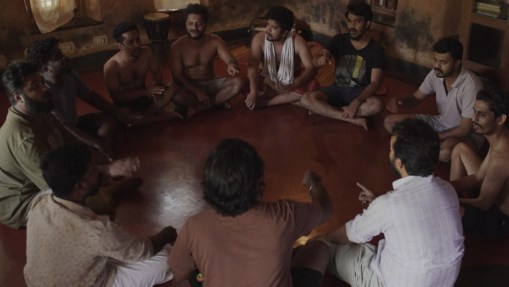
The troupe, called Little Earth School of Theatre, is the subject of Chavittu (“Stomp”), an outstanding new film by Sajas and Shinos Rahman that premieres at the International Film Festival Rotterdam (IFFR) this week. The Rahman brothers’ third feature is a boundary-bending formalist work that, for the most part, showcases the troupe’s preparations for their upcoming performance. Shot by Mukesh Muraleedharan (Uyare, Varane Avashyamund), Chavittu is dominated by a static, wide-shot aesthetic that loosens up as the film progresses.

We see the company’s rehearsal in considerable detail, their work on gesture, movement, voice and cadence. The nature of play they are putting up, on the other hand, remains sketchy and elusive. We gather that it has to do with money, coins specifically, and there is talk of revolution. There are dramatic confrontations and belligerent assertions. A hint of political lampooning is tangible, as are public service messages. But the directors are careful not to distract us with too much literary material. What we are left with are pieces of a puzzle whose final form is never clear.

Attention is devoted, instead, to the formal elements of the performance. The dance, seemingly a traditional form, involves stomping energetically to oral music made of emphatic scatting. Clenched fists, stern looks and occasional pirouettes feature saliently, while oversized coins, backless chairs, empty frames and long pipes serve as props. The musical sections are interspersed with equally physical narrative bits. The actors’ gestures here are very stylized, perhaps conforming to the form’s conventions. There is some improvisation, but directorial intervention mostly pertains to where a new song should begin or an old one should end. What is patent is that a performer in this company needs to have a supreme sense of rhythm.

These extended passages of theatrical rehearsal are periodically intercut with the auditorium being readied for the evening: props, accessories and backdrops being designed, chairs laid out, food arranged. In a surrealist touch that is at odds with the obsessive materialism of the rest of the film, we see these preparations “spill over” into the surrounding rural scenery: men wandering the landscape seated on each other’s shoulders, playing shadow volleyball, or performing short mime-like actions for the camera.

Much of the critical conversation around Chavittu is bound to revolve around what it doesn’t do. It is plain that the film avoids the temptations of dramatic development; there is hardly any story here to speak of in the first place. But what truly sets it apart is its refusal to offer any sense of interiority to the people we see on screen, who are not as much characters as much as presences. There is no evocation of their state of mind, no references to their private lives. We barely hear their names. These are not individuals that we are dealing with, but a body of consummate professionals.

It is likely that this omission of the troupe’s emotional life, this lack of individuation will be held against the film, but it is precisely what makes it so modern, so bracing. Chavittu is a procedural work intently focused on the physicality of its subjects, who are filmed in various states of undress, in a mixture of mid- and long shots, natural and artificial light. Unlike in a conventional documentary, this scrupulous attention to detail isn’t complemented with interviews or explanatory voiceover.

The sensuality that the film radiates comes not through dramatic or formal devices, but from the raw presence of young, athletic bodies populating the frame. For a bulk of its runtime, Chavittu showcases bare-chested men wearing shorts or lungis working together in close proximity, immersed in performance, not unlike the half-naked legionnaires in Claire Denis’ Beau Travail (1996). But in light of the codes of South Indian masculinity, this exhibition doesn’t scan as homoerotic sublimation or suggest the possibility of gay panic. In fact, despite the cohesion that occurs over song and dance, the company hardly feels like a community. What we have here is a group which is bound by nothing else than the activity they undertake together.

The first attempts at discursivity, at accommodating an expositional framework, occurs about an hour into the film, after the sun sets and the annual day function begins. Prominent members of the residents’ association and dignitaries from the town deliver back-scratching opening addresses to a family audience. One elderly executive of the organizing committee rails against the death of Malayalam cinema and literature. Shortly afterwards, achievers of the community are recognized: a local Youtube star, a Facebook poet, an entrance exam hopeful. These felicitations are followed by a series of amateur performances by residents— Thiruvathirakali, a Carnatic kriti, an English number—which take precedence over the troupe’s play, scheduled after dinner.

We are clearly in the presence of a self-indulgent middle class—an anthropological group with a separate set of gestures and rituals, as the film demonstrates—that has lofty ideas about its own role as protectors of culture, even as it preserves a hierarchical notion of the arts. But it is to the Chavittu’s success that this bit of satire doesn’t come across as mean or blunt as it sounds on paper. Even the character of an ex-secretary of the association, a vain old man serving as intrusive coming relief, acquires a touch of grace by the end of the film.

Chavittu avoids devolving into caricature here thanks to the directors’ decision to cut between these amateur shows and the members of the theatre company waiting for their turn backstage. These actors don’t provide any reaction to the performances on stage, refusing us the convenience of second-hand judgment. They are instead absorbed in last minute preparations, refining moves or working over props. For the only time in the film, they are seen in isolation, as individuals getting into particular roles. One actor shaves his feet, another one dresses up as a woman, making us aware of a gendered distribution of roles for the first time.

This contrast between a committed theatre troupe working with focus and discipline and the family audience at the annual day function that just wants to have fun has definite parallels with the filmmaking process. It is notable that, except for the director and the screenwriter, there are no clear division of roles within the company. There is certainly no sense of hierarchy, no rank pulling, that prevents the members from lending a hand in other preparatory tasks. In this regard, it is apt that Chavittu ends on the audience, on us, with an image that embodies a mix of melancholy and hope.


[First published at News9]

I learnt a new term on social media this year (or maybe it was last year, who knows?): the Overton Window. Wikipedia defines it as “range of policies politically acceptable to the mainstream population at a given time.” By extension, it also designates the gamut of utterances that defines the limits of a discourse at a given point in time. As we sit aghast here in India watching this window slide to the right of the political spectrum—to a point that inclusion of conservative and extreme-right figures on televised debates constitutes diversity of opinion—the pandemic appears to have redrawn the old battle lines of film discourse. Forget the fight for celluloid over digital cinematography and projection. The old fogeys of today are those that think the theatrical experience means something, while the median of the Overton Window consists in debating what makes for good OTT content.

I don’t feel particularly compelled to take sides on this debate. As it happens, 2021 was the year that I did not go to the cinemas at all, and truth be told, it wasn’t entirely due to the health crisis. A number of other projects kept me busy in these twelve months, including the release of the hardcover version of my first book, and as it is, I find it increasingly hard to get excited about this or the other production. Except for the end-year binge that made this list possible, I must say I hardly saw films in 2021 and that includes older ones. I regret not being able to watch West Side Story, which had a run of less than a week in my city and was elbowed out by another Disney tentpole released on the same day. Who would have thought that the Overton Window now ranges from Spielberg to Spiderman? Anyway, here are my favourite films from this cursed year.


1. France (Bruno Dumont, France)

What comprises the blight of modern life? The reverse shot, answers Bruno Dumont in his scorching new dramedy about celebrity news reporter France, played by a dazzling Léa Seydoux, who cannot help but make it about herself in every story she does. Fresh off two films on Joan of Arc, Dumont gets his hands dirty with the profane world of modern media. And yet, it’s a spiritual tale that he tells. The filmmaker often quotes Péguy about the need to “stand up where one is.” That is what France does after she is subject to one moral crisis after another in her professional and personal life: rattled by a minor accident that she causes, France begins to see things “as they are”, subtracting herself from the reverse shot, but this grasping at saintliness doesn’t last long. She returns to her profession, not necessarily wiser but more authentic, and in doing so, reaches a state that may be seen as one of grace. It isn’t a media satire that France is after, but something all-pervasive, the simultaneous genuineness and falsity of our emotions faced with harrowing images of the world. Dumont’s film is daring, tasteless, compelling, overblown, contradictory and superbly stylized. Familiar but uncanny, it is everything you don’t want it to be.


2. Dear Chantal (Nicolás Pereda, Mexico)

An apartment evermore waiting to be occupied, letters responding to inquiries not heard, a voice never embodied in the image: Pereda’s five-minute short is a haunting, haunted tribute to the late Chantal Akerman that is structured around absence and substitution. We hear Pereda replying to fictitious queries by the Belgian filmmaker about renting out his sister’s apartment in Mexico City, and we see his sister readying the apartment, moving out paintings or clearing foliage from the skylight. In the film’s robust organization, Pereda, his sister and Akerman become mediums, connecting links in each other’s (after)lives: Pereda, unseen, serving as a middleman between the apartment owner and the impossible future tenant; his sister, unheard, taking the place of Akerman who will never feature in Pereda’s film; and Akerman herself, unseen and unheard, bringing the siblings together in a non-existent real estate deal. In an act of respect and love, Dear Chantal creates a physical space for Akerman to continue to exist, even if not in flesh and blood, just as No Home Movie, Akerman’s final work before her suicide in 2015, grappled with the physical absence of her recently deceased mother. The film imagines an alternate reality that brings Pereda and Akerman together not in artistic collaboration, but in the banal transactions of everyday living.


3. What Do We See When We Look at the Sky? (Aleksandre Koberidze, Georgia)

How would Lubitsch do it? Well, if the old master were a contemporary filmmaker, ‘it’ would probably resemble Koberidze’s off-kilter, disarming romantic comedy about two lovers-to-be who work at a shop around the corner without recognizing each other all summer. What Do We See is obviously designed to please, but there is never a sense that it panders to its audience. Like the best storytellers, Koberidze knows that pleasure can be deepened by deferring gratification, and to this end, his film takes surprising excursions away from its central story, restarting at will and relegating its lead couple to the margin as though reposing faith in destiny to bring them together. This vast negative space of the narrative clarifies the larger objective of the film, which is to integrate its characters into the landscape of the ancient town of Kutuisi, whose faces and places, ebbs and flows, become the central subject. Pinning down the fable-like story on the voiceover allows the director to employ a complex, highly unusual visual syntax—that nevertheless derives from classical Hollywood cinema—without disorienting the viewer. The film involves magic, but Koberidze demonstrates that a towel flying through the frame can be as enrapturing as the most outlandish fairy tales.


4. Babi Yar. Context (Sergei Loznitsa, Ukraine)

The title says it all. Loznitsa’s new documentary represents a modulation of style for the filmmaker. Where his found footage work so far dropped the viewer into specific historical events in medias res, without much preparation, Babi Yar. Context offers a broader picture. With the help of archival material, but also uncharacteristic intertitles, the film details the events leading up to, and following, the Babi Yar Massacre of September 1941, where over 33,000 Jews were killed over two days in the eponymous ravine in Kiev. We see Ukrainian citizens welcoming the occupying Nazi forces with enthusiasm and collaborating in the persecution of their Jewish compatriots. In an illustration of the failure of archival, the massacre itself isn’t represented except in photographs of its aftermath. Loznitsa’s shocking film is a rousing J’accuse! directed at his nation, at the willingness of its citizens in enabling genocide, at the amnesia that allowed for the valley to be turned into an industrial dumping ground. Loznitsa’s newfound desire to contextualize his material should be construed less as a loss of faith in images to speak ‘for themselves’ than as a critical acknowledgement of their power to deceive. After all, the Red Army is welcomed with comparable pomp after they liberate Kiev, this formal continuity with the reception of the Nazis concealing a crisis of content.


5. Bellum – The Daemon of War (David Herdies, Georg Götmark, Sweden/Denmark)

The spectre of Harun Farocki hovers over Herdies and Götmark’s excellent documentary about war, technology and the production of images. A meditation on Western attitudes to armed conflict, Bellum unfolds as an anthology of three human interest stories: a Swedish engineer involved in designing an AI-powered military drone that will take autonomous decisions on bombing a perceived target, a war veteran in Nevada suffering from PTSD and having trouble reintegrating into civilian life, a photojournalist from the East Coast who covers the aftermath of the Afghan war. Well-meaning though these individuals might be, their lives and work are marked by a certain guilt surrounding the fact of war. This is evident in the case of the vet, but the photographer’s own activity may not be untouched by a liberal sense of culpability about her country’s interventions in Afghanistan. The engineer’s efforts to bypass the human factor of war, too, is an attempt to eradicate feelings of guilt about liquidating an enemy, which, the film’s narrator notes, is the only real restraining force in armed conflict. Bellum cogently points out the ways in which technology—of training, of intervention—increasingly eliminates human fallibility from the equation of war, for as Colonel Kurtz put it, “it’s judgment that defeats us.”


6. The Card Counter (Paul Schrader, USA)

I don’t know if Bruno Dumont and Paul Schrader saw each other’s films this year, but I’m certain they would both have much to say to one another. If First Reformed (2017) was the subtext, The Card Counter is the text, a film that is all surface. Where the earlier work stood out in the authenticity of its character and milieu, the new film aspires to an artificiality worthy of the casinos and bars it mostly unfolds in. Schrader tells the same Catholic story he has always been telling, that of God’s Lonely Man who is mired in mud but has his eyes on the skies. Oscar Isaac portrays William Tell, convict turned cardsharp who tries to save a younger man from self-destruction, but faced with divine indifference, decides to play God himself. Formally, Schrader doesn’t deviate from the Bresson-Ozu-Dreyer axis of the previous film—what Schrader rightly or otherwise called the Transcendental Style—and this reserve produces a productive friction between the film’s style and noir setting of the story. In that, The Card Counter is highly reminiscent of American Gigolo (1980), which is to say that, despite the references to Abu Ghraib, it is a work completely out of joint with the present. It is incredible this film even exists.


7. The Year Before the War (Dāvis Sīmanis, Latvia)

Even if we are done with the 20th century, suggests Sīmanis’ singular, absurd period comedy, the 20th century isn’t yet done with us. When Hans, an opportunistic doorman at a Riga hotel, is falsely implicated in a bombing, he flees the Latvian capital to shuttle from one European city to another. The Europe of 1913 that Hans traverses is less a real geography than an abstract zone of competing political currents. War is around the corner, and there are several groups trying to influence the course of history. Zealous ideologues seek to entice and co-opt him, subjecting him to what Louis Althusser called “interpellation.” All through, Hans fights hard to follow his own moral compass, flee subjecthood and retain his individuality. A historical picaresque, Sīmanis’ film is interested in the singularity of this particular juncture in Western history—a point at which fin de siècle optimism about technology and human rationality came crashing against the reality of trench warfare—where countless isms sought to impose their own vision on the world. It would seem that Sīmanis views Latvia of the early 20th century as something of an ideological waystation, an unstable intellectual field where free radicals like Hans couldn’t help but be neutralized. And that vision isn’t without contemporary resonance.


8. Mr. Bachmann and His Class (Maria Speth, Germany)

Maria Speth’s expansive documentary about a batch of preteen students, mostly of an immigrant background, in a public school in Stadtallendorf, Hessen, is a classroom film that achieves something special. Remaining with the children for almost its entire four-hour runtime allows it to individuate them, to look at them as independent beings with their own skills, desires and prejudices, just as their charismatic teacher-guide-philosopher Dieter Bachmann adopts a different approach to each of his pupils. For Bachmann, it would seem, whatever the students accomplish academically during the year is of secondary importance. He knows that he is dealing with a group with an inchoate sense of self: first as pre-adolescents, then as new immigrants. Consequently, he spends a great deal of effort in giving them a sense of community, creating a space where they can be themselves. At the same time, the classroom is a social laboratory where new ideas are introduced and the children brought to interrogate received opinion, all under Bachmann’s paternal authority. Speth insists on the particularity of these individuals and there is no sense that our star teacher is indicative of the schooling system in Germany at large. Bachmann is an exception, and in his exceptionalism lies a promise, a glimpse of how things could be.


9. Out of Sync (Juanjo Giménez, Spain)

It’s an ingenious, wholly cinematic premise: estranged from family and friends, a sound engineer spends her nights at her film studio until she starts to experience a lag between what she sees and what she hears. Juanjo Giménez’s absorbing psychological thriller riffs on this setup, weaving its implications into a coherent character study of a young woman out of sync with her life. The result contains some very amusing set pieces constructed around the delay between sound and image, but also one of the most sublime romantic scenes of all time, one that begins with rude abandonment and ends at a silent movie show. Marta Nieto is brilliant as the unnamed protagonist who withdraws into a shell and then reconnects with herself and the world. She brings a fierce independence to the character that nuances its vulnerability. Its claustrophobic premise notwithstanding, Out of Sync feels like a very open work, integrated gracefully with the urban landscape of beautiful Barcelona. Watching the film in 2021, when so much of real-world interaction has been rendered into digital images and sounds, using Bluetooth speakers with their own latency to boot, is an uncanny experience.


10. Shared Resources (Jordan Lord, USA)

Ambitious to a fault, American artist Jordan Lord’s new work is nearly unwatchable. Yet it bends the documentary form like few films this year. Shared Resources is a home movie made over a considerable period of time, presented in scrambled chronology. We learn that Lord’s father was a debt collector fired by his bank, that his health is deteriorating due to diabetes, that the family lost most of its possessions in the Hurricane Katrina and that they had to declare bankruptcy shortly after Lord’s acceptance into Columbia University. All this material is, however, offered not directly but with a voiceover by Lord and his parents describing the footage we see, as though intended for the visually challenged, and two sets of subtitles, colour-coded for diegetic and non-diegetic speech, seemingly oriented towards the hearing disabled. In having his parents comment on images from rather difficult episodes in their lives, the filmmaker gives them a power over what is represented. Through all this, Lord initiates an exploration of debt in all its forms and shapes: paternal debt towards children, filial debt towards parents, the debt of a documentary filmmaker towards their subjects, one’s debt to their own body, the fuzzy line between love and indebtedness. This is an American film with an Asian sensibility.


Special Mention: From Where They Stood (Christophe Cognet, France/Germany)

Favourite Films of

2020 • 2019 • 2015 • 2014 • 2013 • 2012 • 2011 • 2010 • 2009

[The following is a translation of an essay by Nicole Brenez titled ‘René Vautier: droits, devoirs et passion des images‘, originally published in Afrique 50 de René Vautier (2013, Les mutins de Pangée). The translation has been published as part of an anthology of Brenez’s writings assembled by Sabzian on the occasion of the film historian’s State of Cinema address, to be delivered on 23 December 2021.]

“…even when committed to a cause with all his heart and soul, René Vautier subordinates his images to nothing or no one, not in a proprietary sense (on the contrary, they are offered to anyone who needs them; we find them in numerous activist films and this sometimes results in the loss of precious copies too, as was the case with Algeria, a Nation), but in the name of an inalienable liberty. Emerging from the conception of cinema developed by René Vautier is the principle of an autonomy of images, whose existence, meaning and freedom, established in their own right, must be protected with the most vigilant intransigence: a symbolic and inalienable territory organized in time, from which history can be established. This autonomy (in the literal sense of a singular law) belongs to no one, not to filmmakers, not to cinema and not even to the people whose oppression and struggles these images document; everyone has the right to enjoy them and none the right to own them. This autonomy is in no way a counter-history, it establishes the possibility of an exact history.

[…]

One must point out that an autonomy of images has nothing to do with the fetishization of a shot, a motif or a medium (film, video, digital), so common among filmmakers. Rather, it has to do first and foremost with a symbolic operation, the responsibility of images in face of history, which subordinates and reconfigures other authorities: participants, author, signatories, context, intertext. René Vautier’s work deploys a precise and broad conception of the functions and uses of images: to document, to tell the truth, to do justice, to testify, to offer proof at a trial, to converse with other images, pieces of information, instructions and signals, to contradict, to counterattack, to convince… René Vautier explicitly invested images with all these duties: but in order for them to accomplish these, he had to also implicitly conceive of a right of images, which makes them irreducible to the host of uses and instrumentalizations they can be subjected to.”


[Full text here at Sabzian]

[From Luc Moullet’s monograph King Vidor’s The Fountainhead (2009, Yellow Now). See Table of Contents]

In the United States


The reception of the film by the American press was negative.

Variety (24/6/1949) found the film “cold, unemotional, talkative,” and lamented the overacting: “Underplaying would have served the story better.” The choice of Cooper was deemed “a casting error. Neal is a whimsical heroine. She hasn’t adapted herself to the demands of the screen.” The implication is that she’s just a stage actress.

For Harrison’s Reports (2/7/1949), “the characters are unreal. The subject is a series of digressions,” there is “a whole philosophical salad that average people don’t understand; […] motivations get lost in a maze of blur.”

In the New York Times (9/7/1949), the famous Bosley Crowther, the Ellsworth Toohey of cinema, who called the shots at the time, found the right catchphrase: “A picture you don’t even have to see to disbelieve.” About the explosion, he concluded: “If all were excused such transgressions, then society would indeed be in peril! … high-priced twaddle we haven’t seen for a long, long time.” Roark’s buildings, “from what we see of it, is trash.” The story is “a complex of bickering and badgering among these cheerless folk.”

Easy prejudices, all the more so as Patricia Neal plays mainly with her eyes, which doesn’t belong as much in the theatre, given the distance of the audience. And Cooper was typecast by the critics as a cowboy, although he had already played, in Peter Ibbetson, an architect quite similar to Roark.

Archer Winsten of the New York Post even declared that “intellectually, Vidor is a simpleton.”

The American critics of the time were confined to their own small domain. They knew nothing about architecture and not much about literature. They hadn’t read the novel: eighteen hours of reading…

They were known for their mediocrity and had castigated many great films, Under Capricorn, On Dangerous Ground, Good Sam, Moonfleet etc…

The paradox is that The Fountainhead is a very American film in its search for effects. The opposite of a Mizoguchi, a champion of whittling, who seeks to conceal all effects, Vidor offers them to be seen full screen. If only one film from the whole of Hollywood production had to be preserved, it would be this one. It is so Hollywoodish that it seems to become a caricature of it, which is what the critics must have felt.

It was a rather expensive film (four times the budget of Ruby Gentry), and it made a loss (about $2,100,000 in revenue against a cost of $2,511,000, not including the cost of prints). This is hardly less than the $3,100,000 of epics such as Samson and Delilah or Land of the Pharaohs.

According to Warner and Ayn Rand, the film worked better with the middle classes, and in the suburbs, than with the intellectuals, whom it was principally intended for.

This commercial failure explains Vidor’s reservations about The Fountainhead. In Hollywood, it was in a filmmaker’s interests to not defend one of his children that did not please the public. The producers accepted quite readily that a director could have a failure—one, but not two or three in a row. You can’t always get it right. But you couldn’t transgress the old adage: “The public is never wrong.” And a mea culpa was always welcome in these puritanical lands…

Vidor does not say a word about The Fountainhead in his autobiography. As mentioned earlier, he may have preferred casting Bogart over Cooper. But when I met him, I began to enthusiastically defend the choice of Cooper, and he told me then that I was probably right. It’s hard to prove your interviewer wrong when he says a lot of good things about your work. And in life, King Vidor was a quiet, awkward, welcoming man, a kind of good, diligent student. Just the opposite of his films. In contrast, his French counterpart Abel Gance was really at one with his work, Vidor was inclined to sort things out rather than get into conflict all the time. He was successful in life and work, and had no need to court controversy.

The only point on which he objected to the film for a very long time was the final explosion.

It’s true that it can be a good tactic for a director to speak ill of one of his films, at least in interviews given long after its theatrical release. The interlocutor will be embarrassed, and will tend to reassure such a modest filmmaker. This is a welcome change from all those directors who think of their new-borns as the greatest of masterpieces. I have sometimes practised this method myself, with success.

The end of The Fountainhead is perhaps stupid and ridiculous, as Vidor said in 1962, especially since no architect in the world, to my knowledge, has practised this kind of dynamiting. But it fits perfectly into a work that is not based on plausibility. There is a bigger-than-life aspect to this film.

Let’s not pay too much heed to the author’s word, even and especially if he is great. Pialat, Ulmer, Losey, DeMille, Lara have said a lot of stupid things about their films too. Vidor defended Grease and Monicelli’s Proibito. And let’s not forget—in times when there are many interviews—that it’s boring to always say (or even to think) the same thing. I have experienced this.

More recently, Vidor has begun an about-face: “I don’t want to advocate destruction as a means of enforcing an artist’s integrity. But it’s part of his work. It has been said that sometimes destruction is just a new construction, two sides of the same thing.”[1]

At the end of his life, a little disillusioned by his forced retirement, he even declared: “At the time the film was made, I felt that the hero’s gesture was excessive, I’m not so sure about that today.”[2]

(more…)

[From Luc Moullet’s monograph King Vidor’s The Fountainhead (2009, Yellow Now). See Table of Contents]

The Excess That Transcends


Vidor’s craft here is based on excess, an excess that is to be found in the nature of the actions as well as in the characters, which are extremely complex or extremely linear. All this is redoubled by the excesses of an ultra-fast pacing and of techniques used to the fullest extent on every front. Vidor doesn’t deal in half-measures. It’s a series of contradictory phrases that crash into each other, of pointed tips, jagged edges and uninterrupted electric shocks. Here is a clever, knowledgeable, hyper-professional film, but also one that is abrupt, brutal, coarse, chopped, condensed, convulsive, crazy, delirious, discreet, electrifying, fascinating, frenetic, hysterical, icy, rough, scathing, shredded, surreal, torrid, hectic. A barbaric object, a meteorite. The emotion it generates gives you goosebumps. A runaway horse. Pomposity looms large in the end, but is transcended by its very excess.

Vidor employs EVERY classical device—the perfect film for film schools. It’s Duvivier, Delannoy, plus genius. And finally, it’s this shameless accumulation of old effects (there are even superimpositions, blur effects and an abundance of transparencies) that makes it extremely modern. Vidor doesn’t linger on effects like so many others. They are quick, very obvious, and they blow us away. A comparison may be possible with the Fuller of Verboten!, Forty Guns, and Shock Corridor, with a lot more money, or even with Aldrich.

What is strange is that the film combines the Baroque and the flamboyant Gothic, while it’s meant to praise the architect Roark, whose art is quite the opposite, with its search for simplicity and purity, associated with the modernity of America. Roark—and Frank Lloyd Wright even more so—rejects fuss, European influences, Greek art, the Victorian or Tudor style, whereas here we find German expressionism, with the complicity of an Austrian musician and a Russian screenwriter.

We can sense Vidor’s frustration with his previous clients who had deceived him, taken advantage of him. And here he is pulling out all the stops, as they say.

But at the same time, The Fountainhead cuts across a whole tradition of classic American cinema.

It’s highly reminiscent of Frank Capra’s films, with the struggle of an asocial, marginal or lone man against the whole system and its prejudices, as seen in Mr. Smith Goes to Washington, It’s a Wonderful Life, Meet John Doe and Mr. Deeds Goes to Town. These last two films, moreover, starred Gary Cooper.

The commercial failure of The Fountainhead in the USA can be explained to some extent by the fact that this formula, which had worked well until 1940, seemed outdated after the war. It’s a Wonderful Life (1946) resulted in a small loss. And Gary Cooper as the Good Samaritan in Good Sam (McCarey, 1948) wasn’t a success at all.

As with Capra, it seems like a lost cause for the lone man, but the almost miraculous ending allows him to amend the situation. A critique of the society doesn’t keep the great American principles from standing up for the cause of the good in the end. The Best Years of Our Lives (William Wyler, 1946) denounces the unscrupulous opportunism of bankers too, but rest assured, everything turns out well.

We find here one of the figures of style dear to Capra, the montage sequence where, after a string of quick shots of newspaper cuttings, we witness the violent reactions of the crowd in the street.

Another direct link with American films of the great tradition is the choice of the biopic, the life story of an important man, real or imagined, which we find in Citizen Kane (1940), Sergeant York (Hawks, 1941), Wood’s The Pride of the Yankees (1942) and The Stratton Story (1949), the two Al Jolson biopics etc. Gary Cooper was, besides, the specialist of the genre.

There is also the principle of rise and fall, greatness and decadence, which mark the itinerary of Gail Wynand, Henry Cameron, and also Howard Roark, who comes close to being jailed, although he finally triumphs. All of them having started from nothing, of course. The pervasive myth of the self-made man, very common in American cinema.

(more…)

[From Luc Moullet’s monograph King Vidor’s The Fountainhead (2009, Yellow Now). See Table of Contents]

In The Fountainhead in particular, Vidor expresses himself on all creative fronts, unlike a Hawks, a Chaplin or a Capra who neglect photography a little, a Nicholas Ray who is not good at editing, a Cassavetes who doesn’t care about music or the sets. This versatility obviously tries to make us forget the literary origin of the work, to absorb it.

Vidor is a complete filmmaker who plays on all sides. He cares very much about the visuals (he started painting in 1938), the music (he owned five guitars), the sound (Hallelujah was the first film to really use the capacities of sound), the rhythm and editing (The Big Parade was shot with a metronome) and the sets.

How does that translate here?

Sound

It is the element that one notices right away and which produces the first striking effects of the film. After the first scenes in which Roark successively confronts the dean of the school, Peter Keating and the old architect, scathing in their speed and the haunting verbosity of these secondary characters, we receive the first shock: the architect Henry Cameron breaks the bay window of Roark’s office with a T-square, with a totally unexpected violence, with no obvious reason—it’s a friend’s office—but as if to symbolically break up the buildings in front of him. There are thus multiple sonic assaults that punctuate the film right up to the last scene: another window broken with a stone, at the door of the hated newspaper (an effect that will be repeated in Ruby Gentry, when the whole town rises up against the heroine suspected of murder), the many sirens, that of the ambulance rushing towards the hospital, that of the boat, that of the police car at the exit of Wynand’s wedding (what is it doing there? It seems an unlikely presence to me), the model of the building that Wynand hurls down suddenly, the one knocked down with a cane by the architect who corrects the Cortlandt building, the statuette that falls to the ground, thrown from the tenth floor, the newspapers torn angrily, the boat violently splitting the waves, the work of the drilling machine in the quarry, the marble under the chimney that Dominique breaks frantically, the off-screen blast when we arrive at Dominique’s country house, announcing the final blast. There is an erotic vertigo around breakage and explosion, seemingly translating Dominique rush of desire, like an inner cry from her body. Love = Breakage = Destruction, which is reminiscent of the Eros/Thanatos of Duel in the Sun, and which clearly shows the necessity of the final explosion. Do these sounds recall the sounds of orgasm? Perhaps.

These noises sound all the more aggressive as they are unexpected. Two seconds before their appearance, we can’t imagine them entering the soundtrack. They make you feel uncomfortable. One of them—the statuette falling to the ground—is anticipated by an astonishing echo, occurring earlier, that owes to Steiner’s music.

(more…)

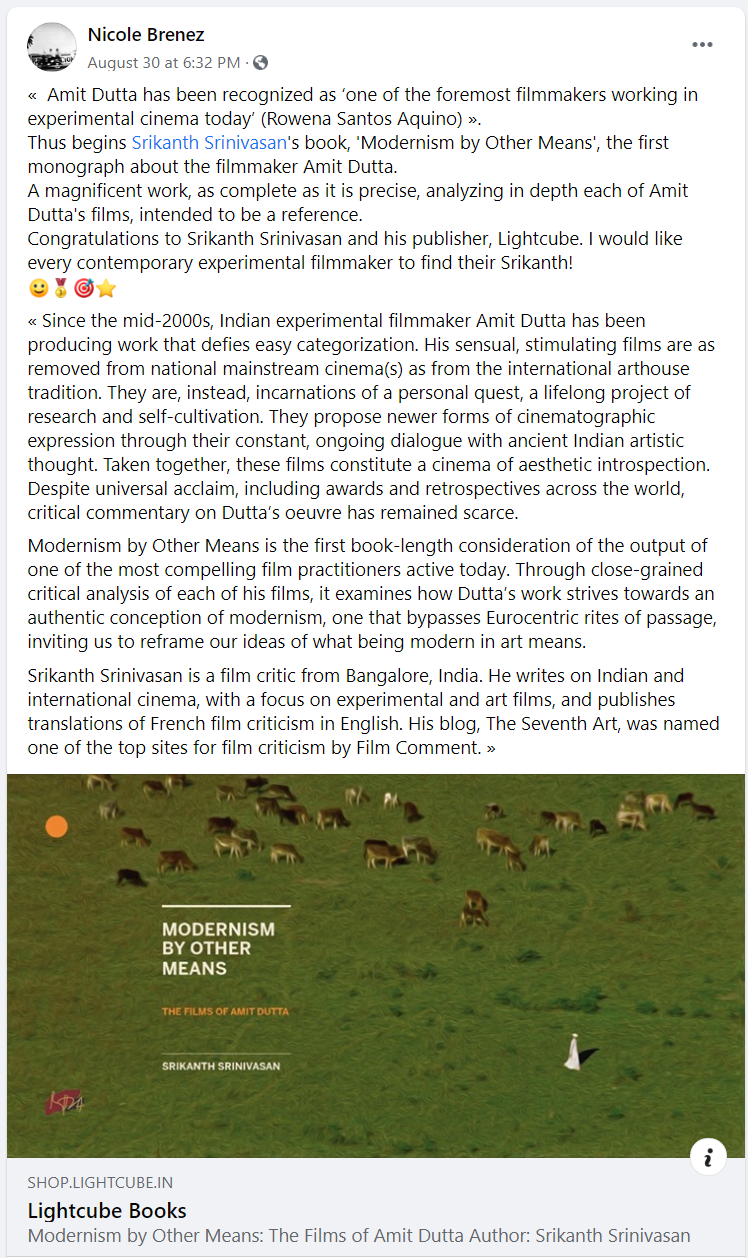
My first book Modernism by Other Means: The Films of Amit Dutta is now available for order in a limited edition hardcover version, lovingly produced by Lightcube!


Book Description

Since the mid-2000s, Indian experimental filmmaker Amit Dutta has been producing work that defies easy categorization. His sensual, stimulating films are as removed from national mainstream cinema(s) as from the international arthouse tradition. They are, instead, incarnations of a personal quest, a lifelong project of research and self-cultivation. They propose newer forms of cinematographic expression through their constant, ongoing dialogue with ancient Indian artistic thought. Taken together, these films constitute a cinema of aesthetic introspection. Despite universal acclaim, including awards and retrospectives across the world, critical commentary on Dutta’s oeuvre has remained scarce.

Modernism by Other Means is the first book-length consideration of the output of one of the most compelling film practitioners active today. Through close-grained critical analysis of each of his films, it examines how Dutta’s work strives towards an authentic conception of modernism, one that bypasses Eurocentric rites of passage, inviting us to reframe our ideas of what being modern in art means.


Links

Hardcover book (India only)

Hardcover book (international)

Kindle e-book (international)

PDF e-book (international)


Reviews

“A magnificent work, as complete as it is precise, analyzing in depth each of Amit Dutta’s films, intended to be a reference. Congratulations to Srikanth Srinivasan and his publisher, Lightcube. I would like every contemporary experimental filmmaker to find their Srikanth!”

Dr. Nicole Brenez, Professor at the Sorbonne Nouvelle

Srikanth Srinivasan’s book on Amit Dutta is an invaluable foundational text for anyone wanting to explore the rich contours of Indian experimental film and is also an indispensable authorial study that opens up a far reaching interrogation and critical awareness of modernity and its relationship with contemporary filmmaking in India today.

– Dr. Omar Ahmed, UK-based Film Scholar and Curator

Amit Dutta might possibly be my favorite filmmaker to have emerged in the 21st century. His mix of playfulness, inquisitiveness, respect for his subjects, his devotion to numerous forms of beauty—all make him a rare and deep talent… I recommend the e-book [of Modernism by Other Means], which is inexpensive, and which is proving to be a really valuable document on a great body of work.”

– Zach Campbell, Independent Scholar

“Modernism by Other Means is structured chronologically, but Srinivasan’s prose flows between influences, memories, and Dutta’s visions of the future of his cinema, invoking Dutta’s style and perspective; he makes the proposition that we are reading about a filmmaker and artist who matters.

– Soham Gadre, Los Angeles Review of Books

With rugged clarity and verve, Srinivasan walks us through an extensive portrait of an elastic artist… Modernism by Other Means is nothing short of an essential aid not only in contextualizing Dutta’s films, but in some cases understanding the absolute basics of what each film communicates, the existing register it is working within or developing upon.”

– Maximilien Luc Proctorphotogénie

Helping the director return to cultural circulation is already a remarkable merit for the book dedicated to his work, but not being involved in the cultural economy gives value to both it and Amit Dutta’s films.

– Maksim KarpitskyCineticle

Dutta’s interests include architecture, as seen in the four-hour documentary Finished/Unfinished (2015), where he obsesses on every minute detail of an eighth-century rock-cut temple complex at Masrur in the Himalayas. Srinivasan’s book, too, is a manifestation of such rigorous study and examination.”

Arun A.K.The Art Newspaper


[Trailer for the book]

[From Luc Moullet’s monograph King Vidor’s The Fountainhead (2009, Yellow Now). See Table of Contents]

The Individual, the Collective

Vidor’s standpoint, if it seemed clear during the course of the film—in favour of individual creation, and against all collectivist diktats—was in fact rather ambiguous throughout his life: here he collaborated with a novelist who was very much on the right (she testified before the House Un-American Activities Committee with great pleasure, even going beyond the McCarthyist doctrine). This seems to tally quite well with the way this filmmaker, who voted for Eisenhower, makes fun of Reds in Comrade X, revels in the massacre of the Indians of the Northwest Passage. On the other hand, there was also the Vidor who filmed the everyday life—sometimes so difficult—of the average American in The Crowd (1928)—a first in Hollywood cinema—and Street Scene (1931), or the beautiful collective struggle of peasants to irrigate their land in Our Daily Bread (1934), a very Rooseveltian film which won an award at… the Moscow Film Festival. Not to mention Vidor’s great film-to-be, Ruby Gentry[1], shot in 1952 and written by Sylvia Richards, a well-known feminist and left-wing activist, which took a swipe at the narrow-minded and upstart bourgeoisie of the South.

We’re thus dealing with a highly complex character, which is also true of John Ford, the director of The Grapes of Wrath (1940) based on Steinbeck, but also of colonialist movies like The Black Watch (1929) or militarists films such as The Long Gray Line (1954) or Korea (1959), and of William Wellman, who could be considered one of the harbingers of socialism in light of Wild Boys of the Road (1933) and The Ox-Bow Incident (1943), but who also made anti-Red products such as The Iron Curtain (1949) or Blood Alley (1955).

To be sure, we can see this as an effort to adapt to the dominant ideology, from the New Deal to the witch hunts, but also as the ambition of a Hollywood director to work in all fields, to show that what counts is his way of doing things, more than the underlying ideology. If it comes to that, the ideal for a filmmaker would be to make a masterpiece out of both the Jud Süß and Salt of the Earth.

And when I try to make an assessment of the situation, everything is rather fuzzy. Because, on one hand, collectivism is as much the motto of soulless capitalism, based on stock exchanges and standards, as of the Soviets. And on the other hand, Stalin, Mao, Castro, Pol Pot and even Lenin perhaps represent the triumph of an individual, under the guise of collectivism, more than that of communism.

To complicate things, we notice that the left-wing press in France, in the years when The Fountainhead was filmed, began by celebrating the great individuality of auteurs fighting administrations and capitalism (Stroheim, Griffith, Welles etc.). And then, after May ‘68, there was a very clear reaction on the left against the all-powerful auteur. Godard, Duras and Resnais wanted to make collective films (or sometimes pretended to make them, by rigging the credits). The auteur was therefore classified as a right-wing figure. To this case file, let us add the brilliant creator Roark, who dynamites a social housing project…

I must add that Ayn Rand, by making Roark an architect who lives solely for his work and the satisfaction it brings him, puts him in a much more limited position than Wright, whose houses were made with the obvious desire to allow his clients to find pleasure in living in them and who was flexible enough to satisfy his client. Thus, in 1895, he built the Moore House in a rather old-fashioned Tudor style. Vidor always had the desire to please the viewer by all means possible. His film is proof of this, and we will come back to it later. Moreover, I believe that, of all the filmmakers, he is probably the one who has given the audience the greatest number of emotions.

Having turned his nose up at The Fountainhead, Vidor asserted solipsism, the doctrine that everything exists through the ego.

It could be concluded that, throughout his life, Vidor never ceased to oscillate between the two extremes, individualism and a sense of the collective, pure auteur cinema (Truth and Illusion, Our Daily Bread) and studio production: he made fifty films within the System. His tactic was to alternate: an easy film, and then a more committed film. Let’s say that, rather than taking a radical stance, he was passionate about the individual/collective relationship, which is what differentiates him from other filmmakers like Lubitsch, Leone or Hitchcock, who didn’t give a damn about it.

(more…)