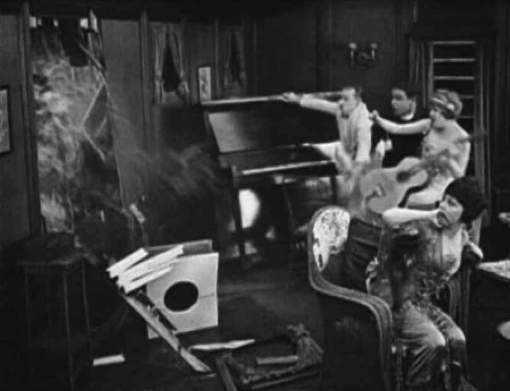
[From Luc Moullet’s monograph Cecil B. DeMille: The Emperor of Mauve (2012, Capricci). See Table of Contents]

Old Wives for New, with Sylvia Ashton: bodybuilding in the America of 1918.

We don’t think of DeMille as a maker of comic films. Yet, he often provokes laughter, as much as a Blake Edwards or a Preston Sturges.

Above all in comedies, of course: at one point in The Affairs of Anatol, a furious Elliott Dexter breaks everything in the apartment of his fiancée, Wanda Hawley, when he realizes that she hasn’t given up the easy life set up for her by Theodore Roberts, the rich man who has kept her. It’s a fine destruction scene—within the setting of a modern apartment—comparable to those in regular epic films. At one point, Theodore Roberts makes his job easier by handing him a piece of furniture to destroy, when he should be shocked by this fury directed at the girl he loves. The weight loss cure that Sylvia Ashton (Old Wives for New) undergoes remains an irresistible comic monument, as does the folding bed concealed by a fake piano (Saturday Night). There would be no end in sight if we wanted to draw up an inventory.

But the dramas arouse laughter too: in The Road to Yesterday, the character of Rady, a nerdy runt, is comical from start to finish. I’ll always remember his disgusted reaction, at a corner of the frame, when he sees the two leads kissing, although he is the one who is supposed to marry the pretty heroine.

Another very funny scene: Roland Young parachutes into a den of lions, just before their feeding time (Madam Satan).

North West Mounted Police is supposed to be a serious Western. But the best part of the film is the little game between two privates, the Scotsman McDuff and the Canadian Duroc, who belong to rival armies and play at shooting at each other all through the film, without ever touching each other of course, by aiming at the top of the hat [1] or knicker buttons (hence the shot of Akim Tamiroff… in underwear). And when another soldier notices McDuff’s latest miss and kills Duroc for good, there is a general consternation among the two fake enemies, who first believe that the other has betrayed the secret pact uniting them, before realizing, happy in the face of a death suffered or caused, that it was not so. It’s the duo Akim Tamiroff-Lynne Overman once again, already present in the previous film, Union Pacific. One takes the same and starts over.


Footnote:

[1] An idea inaugurated in The Road to Yesterday: the kid who shoots arrows.

[From Luc Moullet’s monograph Cecil B. DeMille: The Emperor of Mauve (2012, Capricci). See Table of Contents]

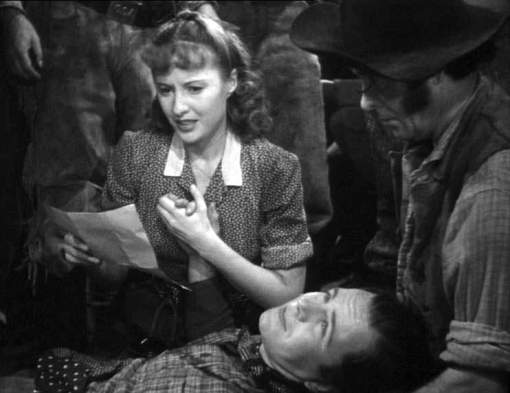
Union Pacific (1939) with Barbara Stanwyck: reading out the love letter to the dying man.

Conflicts in DeMille’s work sometimes evoke Cornellian dilemmas and conjure all their power.

For instance, John Tremble, the hero of The Whispering Chorus must make a choice: either manage to prove that he didn’t commit the murder he is accused of—which now seems possible—and return to his wife, or accept going to the electric chair to avoid ruining the life of his wife, now remarried to the governor, on the eve of her delivery.

Jim Brett (Northwest Mounted Police) loves young April, but he must arrest her brother, guilty of desertion and threatened with a firing squad. And he knows well that if he arrests him, April will never forgive him…

There are several conflicts of this kind in The Greatest Show on Earth: Brad (Charlton Heston), the injured circus director, can only be saved if he agrees to receive the blood of Sebastian the acrobat, his rival in love who has almost compromised the survival of the circus with his misdemeanours. He begins by refusing this gift, but he has no choice. His friends tease him: if Brad marries the woman he loves, their children will have Sebastian’s blood.

The film’s credits mention that James Stewart plays the role of Buttons, the sad clown with his face permanently covered by a mask. The film’s viewers recognize James Stewart by his characteristic way of speaking. Stewart’s work is magnificent, playing solely on his voice and movements.

But Buttons was once a doctor who euthanized his wife. Pursued by the police, he found refuge in the circus with the help of this mask.

The policeman who tracks him down shows Brad a photo of the man he is looking for. And we see a photo of James Stewart. It’s the only time in the film that we see his face. The audience is thus one step ahead of the film’s protagonists, which it appreciates.

Brad needs a doctor for his blood transfusion. And his sweetheart is chasing Buttons, who smells trouble and prepares to leave the place. She convinces him to stay and perform the operation, under the supervision of the policeman, who even assists him and who realizes that Buttons is the doctor he is looking for. He arrests him after shaking his hand, congratulating him for his conduct and sacrifice. I could have just as well mentioned these sequences in the chapter on mistakes.

We are quite close to Corneille territory in Union Pacific: a dying, wounded man wants his fiancée’s letter, which he has just received, read out to him. Barbara Stanwyck has no time to look for the letter and takes out a piece of paper from a neighbour’s pocket. It’s an ordinary advertisement, and she begins to read it out as if it were a love letter, improvising with verve and lyricism. There are some variations of this principle in Wassell, with the love letter dictated to the nurse, but in fact inspired by her, while it is theoretically addressed to the fiancée, and with the blind man showing the photo of his younger sister. But we see that it is, in reality, that of his old grandfather.

[From Luc Moullet’s monograph Cecil B. DeMille: The Emperor of Mauve (2012, Capricci). See Table of Contents]

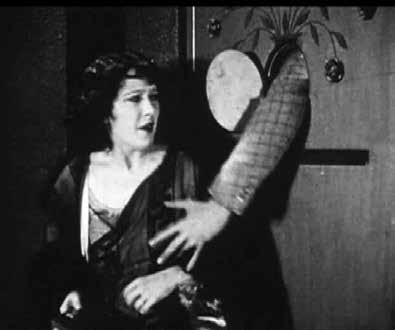
The Affairs of Anatol (1921): the peephole that serves every use.

It is generally defined by three characteristics: implausibility, decorative overload and bad taste.

These are indeed the characteristics that can be found in the work of DeMille, the renowned king of film kitsch. They can be seen as negative. And yet, DeMille intrigues us, fascinates us and arouses our admiration.

Let’s first say that plausibility isn’t indispensable to a film’s success. The question isn’t even asked when it comes to animation films. Why should implausibility be necessarily included in the list of charges just because there are actors who are filmed?

Decorative overload is of two kinds:

Either we see edifices to the glory of a god built by the Babylonians, the Aztecs, the Pharaohs, the Philistines, the Romans of the Empire, cruel people who are against the Christians we are supposed to be, against the Buddhists of today. They are all inspired by a taste for extravagance. It’s a universe that is often shown as detestable, but which is striking in its unusual quality.

Or we see the modern world of the 1920s. With post-war wealth comes numerous eccentricities, probably corresponding to reality, but which are exaggerated through the talents of set designers such as Wilfred Buckland, Paul Iribe, and above all Mitchell Leisen (1898-1972), a mannerist who later directed remarkable comedies like Easy Living and Midnight.

And it’s a veritable festival of baroque or rococo ornaments, as noticeable in the costumes and the choice of props as in the sets. Let us randomly mention the safe that looks like a cigar box and which hides a telephone (Old Wives for New), the boots with curved tips in the shape of Viking ships or snakes ready to bite, or the pool that you enter in tailcoats (Don’t Change Your Husband), the skin of an entire beast, complete with the head, on the stairs, likely to make you slip (Saturday Night), the giant peephole in the middle of the door in The Affairs of Anatol, which defeats its own purpose because you can put your hand or head into it, the garden entirely made of sugar in The Golden Bed, the electric machine of the mechanical ballet in Madam Satan, which follows a fashion show with seven models in increasingly bewildering outfits, with feathers in the shape of tentacles, endless trains and furry hairstyles, the huge mansions of Arizona that look like expressionist sets (The Road to Yesterday), and I could go on for a long time… Americans have an adjective to describe this clutter: lavish. You can sense C.B.’s mocking humour in this extravagant display, but he is also making fun of himself since he offered these very things as a source of attraction for his guests during weekend parties at his luxurious second home. Of course, there might be a direct relationship between ancient architecture (allegedly faithful to reality) and the eccentricities of the 1920s (which one supposes are more imaginary), but it is not a given: in Male and Female, the ancient episode comes just after a scene set in the barren backdrop of a deserted island. It’s only C.B.’s unmotivated desire for a flashback that occasions this parenthesis.

Some of the humour is lost today, because we can no longer tell eccentric outfits from normal ones, which have also become very laughable.

Bad taste is obviously part of the game. The worse it is, the better it is. How does one draw the line? By going beyond. A little kitsch would be banal and mediocre. It’s the excess of kitsch that makes for the film’s strength, arouses laughter, mixed with an admiration for the set and costume designers’ inventiveness. After Madam Satan (1930), kitsch has a smaller part to play. From the period of colour films, the interest of costume work is no longer based on extravagance, but solely on the beauty of the outfits and their arrangement in the shot.

Kitsch certainly makes its appearance later too, in Moses’s entrance or in the schematized relationship between Samson and Dalilah, or Paulette Goddard’s lipstick after an aquatic and desert marathon (Unconquered), but it is less present. I miss it a little.

[From Luc Moullet’s monograph Cecil B. DeMille: The Emperor of Mauve (2012, Capricci). See Table of Contents]

The Greatest Show on Earth (1951): a festival of colours.

DeMille takes a real, rather sadistic pleasure in showing disasters. It could be a sinking ship (The Little American, Male and Female, Cleopatra, Reap the Wild Wind), a zeppelin deflating in mid-air (Madam Satan), a train derailment or two trains colliding (The Road to Yesterday, The Greatest Show on Earth, Saturday Night and Union Pacific), a collapsing temple (Samson and Delilah, The Woman God Forgot), the Red Sea drowning the Pharaoh’s army (The Ten Commandments), and I’m certainly forgetting some others. This kind of scene is repeated over thirty-nine years of his career.

It’s like this: a destructive machine (train or any other) moves towards the viewer, breaking through obstacles (scrap metal and wood work, stone walls). It’s direct, unabashed penetration (which doesn’t surprise us in C.B. DeMille’s highly sexual cinema), often in the direction of the viewer, sometimes seen from a distance in a frontal and artificial manner.  The camera sways and the framing goes askew, as masses, beans and iron bars fall in the foreground, momentarily hiding the actors behind. Everything moves, changes places. A fundamental principle with DeMille is to always show falling masses or passing extras in the foreground. In Madam Satan, the effect is further accentuated by the sinking airship’s exasperating squeaking and creaking. Dust rises. Water invades the living room, its furniture and its books (Male and Female). A beautiful disorder is an artistic effect. In a colour film like The Greatest Show on Earth or Reap the Wild Wind, this chaos of iron and steel is enhanced by the intrusion of beautiful clothes or pretty spots of bright colours.

This technique is different from traditional cinematic disaster based on the bluff of numerous brief insert shots (which is obviously less expensive). DeMille works with frontal wide shots, while his colleagues express dramatic shock through aggressive syncopated editing.

Disorder is underlined by very different positions of extras within the shot. It’s almost a catalogue of all possible attitudes, conveyed with the most divergent broken lines of weapons or destructive objects.

The same disorder is found in scenes without disasters, such as the Roman orgy of Manslaughter or the magnificent golden calf sequence of The Ten Commandments of 1956, where extras occupy the entire image, following the tradition of academic painting. On closer inspection, these scenes make reference to famous pictorial models.

These scenes of chaos often conjure one of the four elements, namely fire, which is quite visible in The Woman God Forgot, Joan the Woman (with a very impressive single shot in colour), The Road to Yesterday, Triumph, The Godless Girl, The Greatest Show on Earth, and The Ten Commandments. The fire at the Parisian hotel in Triumph derives directly from an experience C.B. had at the Ritz on the Place Vendôme.

Along with fire, there is also electricity, natural (the lightning of The Ten Commandments) or more artificial (Madam Satan, The Godless Girl).

There’s also water: we have seen the frequency of shipwrecks and there is even a flood during the Siege of Orléans in Joan the Woman.

[From Luc Moullet’s monograph Cecil B. DeMille: The Emperor of Mauve (2012, Capricci). See Table of Contents]

Why Change Your Wife? (1919), with Thomas Meighan and Gloria Swanson: domestic struggle for the use of the bathroom, which inspired Lubitsch (The Marriage Circle)

A certain number of directors, when they film indoors, have their favourite setting: for Wyler, it was the staircase; for Resnais, it was the corridor; for Masamura, it’s the bedroom; for Hitchcock, it’s rather the cellar. For DeMille, it’s bathrooms. An innovative choice since it is a room that is not noble at all, a place to ease oneself, which was hitherto concealed by novels and films.

It begins with Old Wives for New (1918): the husband is angry with his wife, who has left the sink dirty, and he has to scrub it now. He reproaches her of never washing her hair.

And it continues in Why Change Your Wife? (1919): the couple fights over the place, since he is shaving when she wants to take toiletries from the little cupboard in front of him. Disturbed by her arrival, he risks cutting himself. It’s the beginning of the film, and it’s a classic scene since most other films begin with a less trivial sequence. Daily life can be a source of interest, of fun.

The largest element of this room, the bathtub, appears in Male and Female (1919). This one is of a refined luxury: a thermometer to measure the temperature, stylized ornaments on the levers and buttons. It’s a decoration that one expects to find at a king’s place rather than in the bathroom of an individual house.

Of course, eroticism comes into play. We never see Gloria Swanson naked in her bathtub. The foamy water hides her body. But the viewer knows well that she is naked, like anyone who takes a bath. This theoretical presence of nudity excites him. This is a typical reaction of the 1920s that is hard to understand in the 21st century.

Saturday Night (1921) goes even further: there is a shower in the shape of a giant, bright geyser, which will be echoed by the primitive, icy shower of The Godless Girl, which turns into torture. And there is Poppaea’s bath in The Sign of the Cross (1932), filled with donkey milk, whose entire circuit we see, from the milking of the animal to the pipes to the palace, and it’s only then that we understand what the milk is for: sovereign humour, no pun intended.

There is then the shower in the jungle in Four Frightened People (1934), Paulette Goddard’s very dirty tub in Unconquered, Hedy Lamarr’s bath in the small lake in Samson and Delilah (1949) and that of… doctor Wassell, which could be taken as a bit of humour.

It is difficult to imagine a Cecil DeMille film without baths or bathtubs. The viewer looks forward to a bathtub scene because it’s a film by him, just as he looks forward to an ancient interlude (and like he would later look for the shot Alfred Hitchcock appears in). He drools. He is reassured when the scene comes. I have the impression that he might ask for a refund if there was neither a bath nor an ancient interlude in the film.

This presence of baths is evidently linked to Puritanism, which always looks for purification (with its somewhat sectarian deviation: immersion, emphatic baptism). A civilization of bathtubs, which doesn’t exist among Catholics, especially in France: France has always been rather dirty.

DeMille thus accentuated the glorification of bathrooms, which helped the economic expansion of the cleanliness industry in the USA and, as a corollary, in France, during the Americanization of our country after each of the two world wars. DeMille is partly responsible for the contemporary obligation in France to shower, which is nevertheless excessive in character: we had managed very well without it for fifteen centuries. I only shower on Sundays myself.

[From Luc Moullet’s monograph Cecil B. DeMille: The Emperor of Mauve (2012, Capricci). See Table of Contents]

Joan the Woman (1916)

With mistakes come trials. And C.B.’s work accumulates trial scenes, either reconstructions of trials that actually took place (The King of Kings, Joan the Woman) or invented from scratch (The Cheat, The Whispering Chorus, Manslaughter, Reap the Wild Wind, Unconquered).

The treatment is realistic most of the time—like the depiction of the place where suspects and convicts remain before or after judgment, I mean prison. Screenwriter Jeanie MacPherson had even spent several days in jail to perfect her documentation for Manslaughter.

DeMille has done a lot of work in the casting of jurors, who should, in principle, for contemporary films, belong to different strata of the society. It’s incidentally in the choice of extras that American cinema has always excelled: a bit typical, but not too much either. And in The Whispering Chorus, we also find those little sketches that journalists make during a trial, since cameras were not allowed in the courtroom.

DeMille doesn’t neglect any of the various stages of the trial and tries to push the suspense to its peak: acquittal or conviction, with multiple variants since he films not only contemporary trials but also those from all places and times, beginning with that of Christ.

When it had the means, American cinema never failed to take advantage from this dramatic setting inaugurated by DeMille. It is an extremely good setting because of its official, almost frozen quality, with the basic elements remaining the same from film to film: defence attorneys, prosecutors, judges, jurors, crowds, defendants, all easily identifiable by the viewer. One actor, Gary Cooper, was even a regular of courtroom dramas, almost always as a defendant. Capra, Preminger and Stanley Kramer would become regulars of courtroom dramas.

[From Luc Moullet’s monograph Cecil B. DeMille: The Emperor of Mauve (2012, Capricci). See Table of Contents]

Robert Preston in North West Mounted Police (1940).

Many of C.B.’s films turn around the notion of fault: someone, usually quite nice, commits a fault. He redeems himself, either in a more or less heroic death or by confessing his mistake, or by benefitting from the indulgence of a superior.

It begins with The Squaw Man. The squaw kills a man, but it is to protect the one she loves. She confesses her fault and kills herself.

Maggie, the maid of Kindling, becomes an unwitting accomplice to a burglary. Her mistress eventually pardons her.

Edith, a woman of high-society, misappropriates money from a charity, whose treasurer she is, to buy a chic dress she likes, which sets the drama in motion (The Cheat).

The English soldier Eric Trent betrays Joan of Arc, his benefactor, who will be burnt alive because of him. And in 1916, his namesake, also played by Wallace Reid, sacrifices himself deliberately by destroying the German trench posing a danger for French soldiers. Joan, who then appears in a superimposition, is happy. The soldier of 1916 has rehabilitated, in some way, his supposed ancestor.

Marcia, the heroine of The Devil Stone (1917), accidentally kills her husband, who has seized, by dubious manoeuvres, an emerald that brings bad luck. This death and Marcia’s confession ensure that the ill fate no longer works. And the detective chooses to close the case.

The accountant of The Whispering Chorus (1918) commits a forgery. He is tracked down, arrested for a murder he hasn’t committed. But his return home would compromise the future of his wife, who has remarried. And he prefers to atone for his mistake on the electric chair—the “supreme redemption”, according to the film’s French title.

The odious Elizabethan count of The Road to Yesterday is absolved of his crimes when, on his way back to the America of today, he converts to Christianity and rescues his wife from a burning train.

The two protagonists of The Godless Girl inadvertently cause the death of a student, but redeem themselves at the end by saving many lives in a fire accident at the prison.

Ronnie Logan, Madeleine Carroll’s bad brother, deserts his combat outpost, resulting in the death of several other soldiers (North West Mounted Police); he too redeems himself in his death—just like the husband in Union Pacific, responsible for the death of a man during a holdup, and played by the same actor, Robert Preston.

John Wayne (Reap the Wild Wind) is responsible for the sinking of a ship. But in fighting the octopus which threatens the life of his rival, he redeems himself while losing his life.

A jealous Delilah delivers Samson to the Philistines. To make amends, she helps Samson destroy the temple and the power of the Philistines. She dies during this destruction.

The evil animal trainer of The Greatest Show on Earth organizes the holdup of a train, but he tries to prevent the convoy with his sweetheart from crashing, at the cost of his life.

Here we see Christian ideology come to the surface: crime and purifying repentance, or sacrifice. But this is more of a dramatic contrivance than a real ideological message.

The persistence of this motif across films becomes a bit tiresome.

Does it attest to a certain lack of imagination, or a desire to exploit a formula that works very well with the viewer? Filmmakers from the thirties were not afraid to steal from themselves, as films only had an ephemeral life then, exacerbated by technical progress (advent of talkies, of colour).

Other hobbyhorses: the distant sound of bagpipes or music announcing the arrival of rescue troops (The Plainsman, North West Mounted Police, Wassell, Unconquered), wedding through a go-between object (the sword of The Crusades, the necklace of The Road to Yesterday), the glove, a theatrical prop par excellence (The Crusades, The Godless Girl, Fool’s Paradise).

Also note the omnipresence of animals, dogs and cats in the comedies, monkey (Four Frightened People, The Godless Girl), donkey (The Road to Yesterday), wild animals (Male and Female, The Sign of the Cross, Samson), asp (Cleopatra), sharks (Feet of Clay), octopus (Reap the Wild Wind), zebras (The King of Kings), not to forget Noah’s Ark in the circus film. In contrast, children are almost completely absent. They are mischievous characters, confined to secondary roles (The Road to Yesterday, Male and Female, Why Change Your Wife).

[From Luc Moullet’s monograph Cecil B. DeMille: The Emperor of Mauve (2012, Capricci). See Table of Contents]

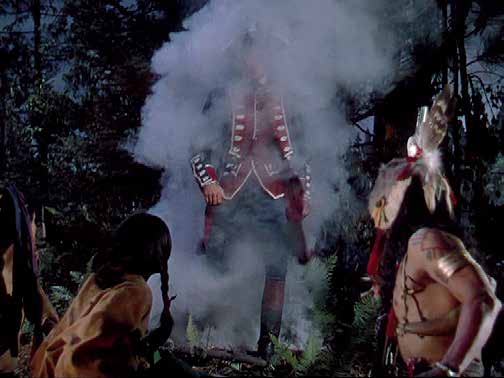
Unconquered (1946), Gary Cooper’s supernatural entrance.

We have seen, with Feet of Clay and The Road to Yesterday, how much DeMille was fascinated by the idea of reincarnation. In her memoirs, Gloria Swanson writes that DeMille was a firm believer in it. It is indeed the only problem for very rich people who have achieved everything in life. Walt Disney even had his body preserved in optimal conditions so that he could be brought back to life the day science would allow it. The problem is certainly less distressing for a Christian like DeMille, who believed in paradise (Paradise was incidentally the name of his pleasure house). But it does exist.

Whence this taste for back-and-forth journeys to the heaven (cf. the unfinished project The Sorrows of Satan and Feet of Clay).

But this motif can be found more discreetly in many of Cecil DeMille’s works, beginning with a play he co-wrote in 1913 called The Return of Peter Grimm. The list is long: the accountant in The Whispering Chorus who was thought dead and who reappears suddenly, just like the “KIA” husband of For Better, for Worse, or the hero of The Plainsman, who miraculously survives all the Indian arrows. In The Story of Dr. Wassell, Gary Cooper believes that his dear Madeline has disappeared forever from his life, that she is even dead, but in the end, we learn that it’s not so. And the same Cooper (Unconquered), decidedly in charge of immortality, plunges with his frail skiff into the furious waters of a frightening Niagara, but miraculously comes out by grasping on to a providential branch (an unbelievable moment, but it is a playful film). He emerges, like a ghost, from a smoke cloud behind an Indian encampment. Victory is then achieved because the English place the bodies of all their dead soldiers in wagons, seated and not lying down, to make the attackers believe that they are outnumbered. A theoretical resurrection which makes them winners.

DeMille wasn’t an exception. Reincarnation—or resurrection—was a frequent motif among great American filmmakers (cf. all of Frank Borzage’s work, Ernst Lubitsch’s Heaven Can Wait, Alexander Hall’s Here Comes Mr. Jordan, Alan Rudolph’s Made in Heaven, Joseph L. Mankiewicz’s The Ghost and Mrs. Muir, Frank Capra’s Lost Horizons and It’s a Wonderful Life, James Cameron’s The Abyss, even Alfred Hitchcock’s Vertigo and Otto Preminger’s Laura).

“Reincarnation” means “victory over death”, with which one man can help: the doctor.

More than the priest, who is somewhat forgotten in the work of this great Christian, the doctor is very present in For Better, for Worse, throughout Feet of Clay, a little in The Road to Yesterday, and much more in Wassell and The Greatest Show on Earth.

The doctor doesn’t intervene without reason. That’s why there are many cripples, disabled children (For Better, for Worse), blind people (The Ten Commandments, Wassell, Samson, Fool’s Paradise, Something to Think About) with a subjective shot of the person who loses or regains sight, mute persons (The Sign of the Cross, The Ten Commandments of 1956), people who can no longer use their arms or hands (The Road to Yesterday, Wassell, The Greatest Show on Earth), and disfigured heroes (The Whispering Chorus, For Better, for Worse, Fool’s Paradise). Handicaps typical of melodramas.

[From Luc Moullet’s monograph Cecil B. DeMille: The Emperor of Mauve (2012, Capricci). See Table of Contents]

Gloria Swanson in Male and Female (1919): the chaos of shipwreck.

Because of the somewhat constricted nature of the genre, DeMille and Paramount had arrived at a compromise: he would make high-society comedies, but with five minutes of ancient or medieval interludes. This is why, right in the middle of contemporary films like Don’t Change Your Husband, Male and Female, Manslaughter, Adam’s Rib, Triumph and even We Can’t Have Everything and The Dream Girl, there are strange parentheses. Paramount had something to keep the ambitious Cecil busy. Five minutes of epic film was less expensive than an hour and a half. This amazes us today, but let us not forget that we too have our commercial breaks on the television, sometimes with movie trailers very different from the film being telecast, and that there were once mid-film intervals, in Italy and sometimes in France, for changing 16mm film reels in rural theatres, to the benefit of ice-cream sales or advertising slides.

It often arrives at the worst possible moment. In the middle of Male and Female, given that the shipwrecked are dressed in makeshift outfits, we no longer even know if it’s an episode from the current story or a prehistoric flashback. Most of the time, the pretext for returning to the past remains feeble. DeMille seeks to show us that nothing has changed since the Neanderthals. The only real reason for the sequence is, of course, kitsch luxury. It’s probably the allusion to the lions of Babylon in Gerald Manley Hopkin’s poem quoted in James Barrie’s play, which Male and Female is based on, which gave DeMille the idea of going back in time.

At best, it could be said that the fragility of the link and the poverty of the trick make us laugh and sustain our interest: the worse it is, the better it is.

This economic motivation seems to have justified the structure of the first The Ten Commandments, only a third of which deals with antiquity.

The link between the present and the past is what comes out in Joan the Woman too. The story of La Pucelle is introduced by a remark by an English soldier fighting in France in 1915. And the preface to The Sign of the Cross, a ten-minute sequence added thirteen years after the shoot, presents us with reflections of American soldiers flying in 1945 over a Rome slightly destroyed by the bombardments and recalling ancient Rome. Apparently, these two scenes seem justified by the ignorance of the American public (passionate only about national, more or less modern events) about the European past. According to DeMille and Paramount, a precise link between the ancient and the modern was absolutely necessary to make these antiquities look less obsolete in the eyes of teenagers and their girlfriends. The same is true for the reintroduction of the ten commandments into the modern family of the eponymous silent film, for the final shot of an ultramodern train in Union Pacific, set in 1870, for the modern city in the last image of the life of Jesus. And not to mention the brief introductions at the beginning of the last three films, which situate them within an eternal cosmic discourse.

It is difficult to say to what extent this present-past relationship, which is the keystone of The Ten Commandments of 1923 and of The Road to Yesterday [1], corresponds to a commercial communication strategy or, on the contrary, to a personal obsession of the filmmaker. There are certainly both, but I’m tempted to favour the second hypothesis. It is too present across time periods, over more than forty years, for it to be simply opportunistic.

For it was a real problem for Americans in the 1920s: what relation can be there between the Christian morality taught in their childhood and the era of jazz, fast luxury cars and normalized breakups and divorces? 1919 and the end of the First World War gave birth to a whole new world—a rupture that is noticeable in the work of a European filmmaker like Jean-Luc Godard who has more than one thing in common with Cecil DeMille: he too is a Puritan womanizer, and he frequently contrasts the art of the past with the superficiality of the contemporary world.

With this essential difference that, in Jean-Luc’s case, the opposition seems irremediable, while Cecil tries to build bridges beyond the obvious differences. The ancient interludes tend to tell us that it’s the same thing going on in the time of the Cro-Magnons, the days of Nero and the era of airships, massive bombardments, ultramodern bathtubs and hot dogs. There is certainly an interest in making connections that justify, with more or less success, the apparent incongruity of the intrusion of the ancient into the modern. The Semadar character (Angela Lansbury) in Samson and Delilah is above all reminiscent of the busybodies of Poughkeepsie, just like those chatty women near the atrium (Cleopatra) or that family of ordinary Romans about to enjoy the spectacle of the massacre of Christians (The Sign of the Cross), evoking the weekend outing of an average American family as we see in The Greatest Show on Earth. The present-past relationship doesn’t work as much on the level of moral analysis or as a look into evolution (besides, even in Intolerance, there is hardly any evolution between the Babylonian massacres, St. Bartholomew’s Day and the modern episode, except that the innocent sentenced to death is saved at the last moment by the artifice of a chase). It works more on a formal level: the visual shock of two cultures. It is a superficial shock, but one that affects us strongly. In DeMille’s work, there is a union of all the elements that open up to the universal, the cosmic and the timeless in the same image. DeMille wants to show everything, and show everything together. We have a confirmation of this at the end of Madam Satan.

If one accepts that C.B.’s approach isn’t essentially opportunistic, it remains to be seen what is essential in his work: the description of the past or the present-past relationship.

It is very hard to pin down. In the beginning, everything derived from Cabiria, and so it was all focused on the purely descriptive aspect. It was only afterwards that the comparative aspect made its appearance, for multiple reasons, which became rarer after the commercial failure of The Road to Yesterday.


Footnote:

[1] And which is expressed fully with the help of superimpositions and dissolves, the basic figures of style in C.B.’s work.

[From Luc Moullet’s monograph Cecil B. DeMille: The Emperor of Mauve (2012, Capricci). See Table of Contents]

Joan the Woman (1916): first flagellation in DeMille’s work.

One of the most evident, and strangest, characteristics of his work is its sadomasochism—something that is as present as the theme of water in Renoir, the opulent women dear to Fellini, the port towns in Demy or Hitchcock’s suspense. This clearly proves, if proof was ever needed, that DeMille is an auteur.

It all began in 1915, with the first truly interesting films by our filmmaker, and continued without any notable interruption until the last opus in 1956.

Delight Warren (The Unafraid) is threatened with the worst torture if she does not sign a cheque.

The Cheat revolves around a rich Japanese man who brands a socialite guilty of rejecting him after he had lent her a large sum of money. According to him, one doesn’t go without the other. You don’t see this barbaric act in this understated film where everything works on evocation, the unsaid. But we do see what precedes and follows it, and everything around it. This understatement is obviously more powerful than if DeMille had filmed it all. It remains within the limits of good taste, and we can imagine everything…

DeMille shot The Cheat by day, and at night, he directed The Golden Chance, in which young Mary Denby is whipped by her alcoholic husband, who unjustly accuses her of all vices. The film is set in a contemporary America, but the action recalls the melodramatic situations of London-based novels, particularly the work of Charles Dickens (Nicholas Nickelby, Oliver Twist, David Copperfield), where the whipped child constitutes a leitmotif.

It was Joan the Woman the following year, where the heroine is threatened with being interrogated by the English, which is in keeping with historical reality. But there is also this astonishing scene where a French peasant woman, accused of collaborating with French troops resisting the invaders, is suddenly stripped naked by His Majesty’s soldiers and severely flogged. This is a kind of action that has not been recorded in history, and which doesn’t seem very credible. Moreover, the filmed episode has little to do with Joan of Arc. We find no such scene in any of the many films made on the Maiden of Domrémy. It should be noted that, to avoid the charge of indecency, DeMille had taken the precaution of casting a very flat-chested actress in the role.

In Why Change Your Wife (1919), the heroine tries to disfigure her romantic rival with vitriol. It isn’t vitriol, in fact, but eyewash intended to frighten the girl, and to thrill the audience with this unsettling threat.

To this, I would add the paw of the lion on the body of an unconscious Gloria Swanson in Male and Female (same year).

The whip, decidedly a central prop in our auteur’s work, appears again in the two versions of The Ten Commandments (1923 and 1956), since it was frequently used in the Egypt of the Pharaohs, and especially in The Road to Yesterday (1925), where the English lord Ken whips his rival to death, just after the gypsy woman is condemned to the stake.
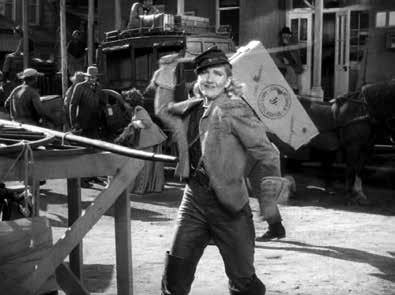
The Plainsman (1936): Calamity Jane (Jean Arthur) never lets go of her whip.

The King of Kings (1927) retraces the martyrdom of Christ in all its stages. There is, of course, a masochist component in the whole of Christian universe. In Jesus’s journey, we can see the itinerary of a man who did everything possible in order to be tortured and crucified. Had Pontius Pilate pardoned him, he would have been really annoyed and couldn’t have justifiably claimed the role of a glorious martyr. And his example led several Christians to try to imitate him. We would be justified in wondering whether it isn’t the Christian impulse that drove DeMille towards sadomasochism.

The Godless Girl (1928) is set in a juvenile prison, where, for more than one minute, the evil guard subjects the handsome, rebellious Hathaway to a powerful jet of ice-cold water. And when the young lovers meet and try to kiss each other from either side of the fence, he unleashes a strong electric current through the barbed wire so that the heroine cannot detach herself from the fence and burns her hand: a shot reveals a smoking cross imprinted on her palm (a cross again).

I almost forgot the Tsarist officer in The Volga Boatman (1926) who orders a young boatman to shine his boots, which he has slightly soiled by accident, and deeming his speech insolent, whips him on the face. Already back in The Little American, there was the German officer who orders poor Mary Pickford to remove his boots, which isn’t an easy job.

The Sign of the Cross is perhaps the one film by our auteur that goes the furthest in this domain. There is firstly the child that the Romans tie to a rope and lower into a pit with hellfire (a torture that Joan of Arc was threatened with too) so that he confesses where the Christians meet.

There is then the pleasure of the viewers in the arena—father, mother and son—who try to get the best seats possible and bet on the surviving gladiator. A pleasure mixed with dread before the martyrdom of Christians (a situation that is repeated, in a minor way, at the temple of the Philistines at the end of Samson and Delilah): we are spared no detail (except in the redacted version at the request of the censors, who nevertheless let go of shots of dykes and boy toys). The highlight is this ravishing starlet in a bikini tied up in front of a menacing crocodile. These are brilliant, very powerful scenes, especially since the visuals are sumptuous, but which make The Sign of the Cross look like a sick film.

All through The Plainsman (1936) and Union Pacific (1939), the beautiful Jean Arthur and Akim Tamiroff wield a menacing whip, which attacks objects around people, but never the people themselves. The Hays Code of 1934 was here.

At the beginning of North West Mounted Police (1940), it’s Paulette Goddard, a rather wild young girl, who is spanked by Tamiroff. She will be spanked again, with the relative protection of her pretty rich heiress costume, by the dandy Ray Milland, who finds her too capricious, at the beginning of Reap the Wild Wind (1941). In Unconquered (1946), we witness the preparations for the flogging of the same Paulette Goddard, who is decidedly used to corporal punishment, a torture that is called off at the last second. For the sadomasochistic audience, it’s the cracking of the whip and the concept of flogging that counts (and allows it to imagine the foreseeable consequences with delight) as much as the physical act, just as it was the idea of disfiguration with vitriol (which doesn’t take place) that marks the viewer’s mind (Why Change Your Wife). This avoids the reproach of the censors and the restrictions pertaining to children.

A novelty: at the end of Samson and Delilah (1949), the whipper Delilah and the whipped Samson are fully agreed on the use of the prop. She even apologizes to him for the pain she is about to inflict on him. It is part of the plan laid by Samson, who, as the viewers at the temple are fooled by this stratagem, then seizes the whip from Delilah, the latter leading him to the pillars of the building.

There is a very interesting variation of this in the middle of The Greatest Show on Earth (1951): the animal trainer Lyle Bettger, jealous of the special attention that his sweetheart, the beautiful Gloria Graham, pays to the circus director Charlton Heston, blackmails her during an act, by letting her remain under the elephant’s heavy foot for longer than expected: a guiding gesture from the trainer would be enough for the beast to crush her pretty face. In The Sign of the Cross, the animal brings down its foot for good.

I’ve saved the best for the last: Cleopatra, where the sadistic ritual is intimately linked to sexuality. To seduce Mark Antony, Cleopatra presents him with an astonishing spectacle where seductive nymphs, fished out from the sea in large nets (a woman was already fished out with a bait in Old Wives for New), come out of shells that look like vulvas, to perform lascivious dances, surrounded by the dance master’s whip and circles of fire that he raises around them and through which they move. It’s a delirious spectacle that attests to great virtuosity on the part of our filmmaker, and a rather implausible one at that: it’s hard to imagine a woman who, in order to win the heart of her enemy, organizes such a macho show focused on other women.

In Cleopatra again, during the Battle of Actium sequence, there is this very oppressive shot of a chariot’s cogwheel crushing a soldier’s face.

The reader will perhaps forgive me for forgetting other scenes of the kind, which are often brilliant and rather nauseating, the two adjectives being linked indissolubly.
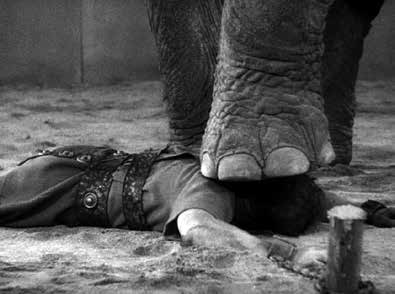
The Sign of the Cross (1932): gladiators and Christians in the arena.

This psychopathia sexualis is well in line with the image Cecil DeMille fashioned for himself: with jodhpurs and a baton in the hand (like his mentor David Belasco), he had all the makings of the perfect sadistic grandmaster.

We may wonder, is this whole arsenal there to please a public fond of sadomasochistic rituals? Or does it correspond to a personal need? I’m tempted to answer with the latter option. In fact, it all began as early as 1915, at a time when the film viewer’s sadistic needs were neither known nor exploited. One had to wait until the advent of the horror film, Tod Browning and James Whale, in the years 1925-1930, and then the actor Burt Lancaster, the most masochist of all, to find a comparison. In literature, Lovecraft himself comes after DeMille. One would even be justified in thinking that DeMille may have furnished ideas to masters of horror such as Tod Browning or James Whale. It was perhaps also that the public success of these scenes encouraged DeMille to persevere.

Why? Why? It’s not the essayist’s role to discuss this subject. Apart from Christian influence, which I’ve already alluded to, it should be noted that C.B.’s sadism is often exercised on women. And he was a frustrated man, at least during his youth: bald at a young age, he looks like the typical image of a small-time accountant in his photographs. And after 1914 and her miscarriage, his wife, for medical reasons and perhaps because she wasn’t interested in it, refused sex, a situation that seems to have lasted for the last forty-five years of their marriage. To be sure, our man made up for it elsewhere, after he achieved success and fortune. But this situation must have been hard for him. It reminds us of the scene in The Road to Yesterday where Ken tries to axe his way through the door of his wife’s bedroom. It’s a situation that must have left behind a mark, a desire for revenge, a recourse to deviant practices… But frustration can also be very fruitful for an artist: the situation of the DeMille couple is the same as that of the Faulkner couple.

Let us not forget a consistent foot (and shoe) fetish, as evidenced by Old Wives for New, Don’t Change Your Husband, Male and Female, Forbidden Fruit, The Affairs of Anatol, Feet of Clay, The Volga Boatman, Wassell and, of course, The Greatest Show on Earth, among others from 1918 to 1951.