[From Luc Moullet’s monograph Cecil B. DeMille: The Emperor of Mauve (2012, Capricci). See Table of Contents]
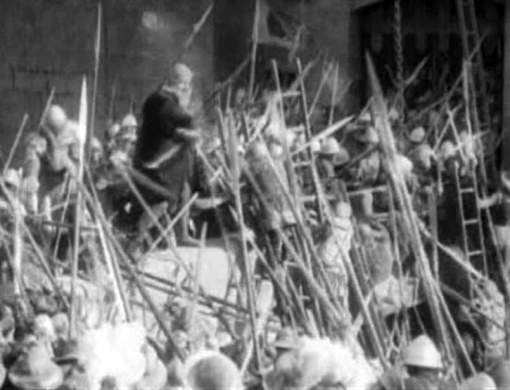
Joan the Woman: the Siege of Orléans, a beautiful disorder.

This title is a bit inaccurate, because there aren’t just films with Geraldine Farrar during this period, but these are his most ambitious and expensive films of the time, though not necessarily the best ones.

The collaboration with Farrar (who resembles the filmmaker Danièle Huillet a bit, but is less pretty of course) lasted five films. Curiously, he called upon her to play Carmen, obviously a silent version: the year was 1915. He chose her because she was the most famous soprano in America. It was a stupid choice: it’s as if Callas was asked to play Aida in pantomime. DeMille probably thought that a disc of Bizet could accompany the visuals in the theatres. It wasn’t to be: Bizet’s descendants were uncooperative when it came to rights, as was proven by their later opposition to Preminger’s all-Black Carmen, which was banned in France for some twenty years. The challenge for DeMille, a small-time, failed, hung-up playwright, was to bring the greatest Opera singer to Hollywood for the first time ever, just like he had got the famous stage actor Dustin Farnum to the West Coast to play The Squaw Man.

A prestigious affair…

Geraldine Farrar again played an opera singer, still a silent one, in Temptation (1915). Farrar was then thirty-four. It may have been believable on stage, with its distance, for her to play a nineteen-year-old Joan of Arc [in Joan the Woman, 1916], but not in cinema with its close-ups. Moreover, Farrar was something of a tank: you need a solid pair of lungs to sing. It was therefore the opposite of the traditional image of Joan of Arc, the frail young maiden who, with her faith and enthusiasm, defeated the powerful soldiers of the English army. So the spice, the paradox of the Joan of Arc story had vanished.

The film is worthy for the sequence showing the Siege of Orléans, the best battle scene shot by DeMille: a beautiful, chaotic and inventive wave of soldiers in action, with multiple arms under the fortifications, on the rampart walls and in the city. Carmen, in contrast, is interesting only for a brief sequence realistically showing the work of cigarette makers and was rightly sent up in [Chaplin’s] Burlesque on Carmen.

Farrar was followed by America’s sweetheart, Mary Pickford; or the triumph of the star system. Pickford’s salary came up to 71% of the final cost of A Romance of the Redwoods, a rather ordinary Western (in fact, a “Northern” since DeMille always preferred adventure films set near his native Massachusetts). In contrast, Pickford is remarkable in her spontaneity in The Little American, a contribution to the war effort (along with Joan the Woman, a film indirectly campaigning for entry into conflict, and Till I Come Back to You). DeMille hedges his bets: before the war in France, Pickford was seen trapped in the sinking Lusitania, which has a bit of Titanic about it. It’s all on the nose: Pickford, a young American girl above the fray, becomes, without wanting to, a heroine who saves the good French soldiers at the risk of her life… There are some rather melodramatic images here, with the trenches, the ruins, a Christ statue standing alone in the middle of rubble, and Pickford in a tearful pietà pose at its foot. Even so, the result is impressive. The scene may even have influenced Gance in J’accuse, made shortly after.   

Coming in the line of “great spectacles”, the last Geraldine Farrar film, The Woman God Forgot, is disappointing, offering us only a phoney Mexico from the time of the Aztecs.

Finally, this period is more interesting for its naturalist films and its low-budget melodramas.

Charlotte Walker, Raymond Hatton in Kindling (1915): a high point of naturalism.

On naturalism: going through DeMille’s work chronologically, it’s shocking to come across an almost neorealist film like Kindling, a pure gem that follows a series of uninteresting movies. What could have happened for DeMille to rise to the peak of his craft in one go? To be frank, the transition from the preceding period isn’t as clear-cut, which doesn’t make the critic’s job any easier. Later films like Maria Rosa or Chimmie Fadden Out West are just as disappointing as early attempts such as The Unafraid or Rose of the Rancho. There’s an element of chance shaping the choice of projects at any given point. I’ll come back to this naturalist period.

The melodramatic section includes very diverse films: the perfect outline of The Cheat (1915) contrasts with the complex and tormented itinerary of The Whispering Chorus (1917). The first part [of the latter film] is a realistic depiction of the life of accountant John Tremble and his family. When he is forced to flee following a forgery he has committed, the film becomes a wildly imaginative soap opera: he disguises himself, changes his physical appearance completely, assuming the identity of a dead body he finds by chance and which he passes off as his own. After a wide variety of episodes—a beautiful Chinese festival, a serious accident at work—he returns home. We learn that the police are after him for the murder of… John Tremble. Fortunately, his mother recognizes him and sets out to resolve the matter. But, alas, she dies two minutes later. He is arrested and lets himself be sentenced to death, not wanting to jeopardize the future of his wife, who is now married to a bigwig. The extraordinary nature of the story works very well, since it appears only slowly, halfway through the film, after an initial anchoring in everyday reality. We manage to understand everything of this extremely complicated story. A triumph of great melodrama, as is underlined by the film’s French title, The Supreme Redemption. The French titles of the films that follow reinforce their affiliation to the genre: Price of a Throne, Whirlwind of Souls, The Damned of the Heart.

[From Luc Moullet’s monograph Cecil B. DeMille: The Emperor of Mauve (2012, Capricci). See Table of Contents]


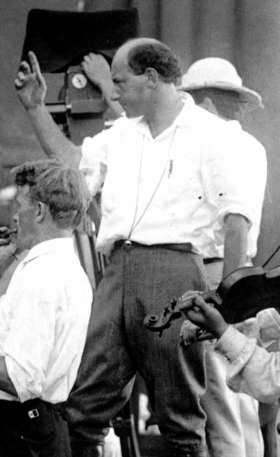
Cecil DeMille at work.

The first film was both an artistic success and a commercial triumph, achieved at the age of thirty-two (DeMille was born in 1881), which suddenly made Hollywood the capital of cinema. The Squaw Man (1914) is often misunderstood: it is not “the man who was a squaw”, but “the husband of the Indian woman”, which is the film’s French title. The strength of this production is its rapid pace centred on a story with twists and turns, since it is about an Englishman wrongly accused of fraud, who is forced to leave the country of his birth, before emigrating to New York and then to the Rocky Mountains, where he has an affair with an Indian woman, who is soon driven to suicide. He is exonerated and returns to England with his half-breed son to find the woman he loved. It’s actually much more complicated than that. There is here not only the interest generated by complete changes of place and milieu (the London gentry and the Wild West), but also the complexity of the various plots. In short, it was to become a model for more than fifty years of film history. No time to get bored.

It’s surprising to note that none of the twelve films that follow is at the level of this striking debut. There’s at times a certain observational humour in the life of the husband of a stage star, a real prince consort (What’s His Name?), and in the vaguely Henry James-like quality of a cosmopolitan affair (The Man from Home). And I love the gag from The Captive conceived by DeMille’s favourite screenwriter, Jeanie MacPherson: a prisoner of war is placed in a farm to work the fields, with a harness on his back. But once the war ends, it is he who places the harness on the shoulders of his boss, whom he has married. There’s an almost identical gag in Male and Female four years later. It’s not much. There are minor comedies in this period featuring a mediocre but successful comic, Victor Moore, midway between Fernand Raynaud and Jean Lefebvre (the two Chimmie Fadden films, Wild Goose Chase), and Westerns or adventure films (The Girl of the Golden West, The Virginian), but DeMille will learn to use the Western to his advantage only twenty years later.

Seen today one after the other, these movies disappoint in their casualness: whether they are set in Turkey, the Rocky Mountains, Andalusia, Montenegro, near Naples or Mexico, they have all been shot in the same Californian landscapes, with their small arid hills. There are the same houses and the same actors, who reflect very little of the physical characteristics of the local people.

This decline could be explained by the fact that The Squaw Man was co-directed by Oscar Apfel, who was more experienced than Cecil, who was going to be left to his own devices on the following films and was going to learn his lessons, which were honestly a bit laborious.

And then DeMille didn’t expect such a success. He may have been caught unawares, without a project close to his heart. It’s because everyone, attracted by such a triumph, asked him for more films…

1915: thirteen films in the year. A record! Some have said that this profusion was somewhat imposed on him by Lasky, his producer. He served as an example for other directors under contract. He showed them that he wasn’t one to laze around. He ensured excellent returns. But at this rate—more than one film a month—it’s hard to make anything good.

It should be noted that these films, shot on location for the most part, were, however, mostly adapted from plays, a cultural sphere that DeMille knew well since he was a playwright and an actor. It seems that he wanted to restore a certain prestige to cinema, then considered minor entertainment by the people of Boston, by bringing to it what he thought was the best in theatre, including plays by Booth Tarkington (future Pulitzer Prize winner and the author of The Magnificent Ambersons) and David Belasco, the numero uno of the stage around 1915, with whom Cecil and his father had already collaborated. This was enough to overcome the reticence of his older brother, William DeMille, who vigorously criticized him for getting mixed up in a kind of show business that was totally unworthy of their family.

[The following is a translation of Luc Moullet’s book on Cecil B. DeMille, L’Empereur du mauve (“The Emperor of Mauve”, 2012, Capricci)]

I. Career


Apprenticeship (1914-15)

The Farrar Years (1915-17)

Rembrandt or not Rembrandt?

A Pioneer of Naturalism

High-society Films (1918-1923)

A Time for Extravagance (1923-1930)

Hiccups (1931-1935)

The Safety of Adventure (1936-1946)

More and More (1949-1956)

The Emperor of Mauve (1949-1956)


II. Recurring Elements


Epics and Religion

Everything Is Theatre

S&M

Present/Past

Reincarnation and Resurrection

Faults and Other Hobbyhorses

Trials

Mr. Bathtub

The Conception of Chaos

Kitsch

An Heir to Corneille

Comedy

A Master of Storytelling

The Law of Two-Fifths

The Conception of Women

Actors

Opportunism, Politics, Witch Hunts, Racism, Xenophobia

Conservatism

Intertitles and Dialogues

Cecil Banknote DeMille

An Unwitting Genius?

Missing Films

Misfires

Influences

DeMille and the Critics


III. Seven Wonders


The Golden Bed (1924)

The Road to Yesterday (1925)

The Volga Boatman (1926)

Madam Satan (1930)

Cleopatra (1934)

The Story of Dr. Wassell (1943)

Samson and Delilah (1949)

[From my column on studio-era Hollywood films for Firstpost]

Cecil B. DeMille’s This Day and Age (1933) tells the tale of a group of youngsters taking on the corrupt system that has a stranglehold on their town. Steve (Richard Cromwell) witnesses the murder of his friend, the Jewish tailor Herman (Harry Green), by the local mafia boss Garrett (Charles Bickford). But his testimony is repudiated in court and Garrett walks scot free. Steve and his friends decide to carry out their own investigation and bring Garrett to justice. The film was made at a time when detective novels, especially involving teenage sleuths like the Hardy boys, enjoyed great fandom. While not a detective story in itself, DeMille’s film draws from the popularity of the genre, circumscribing the fact-finding efforts of its young leads within a larger political framework.

As its title indicates, This Day and Age purports to recount the story of its time. It begins appropriately with images of modern technology—aircrafts, zeppelins, motorboats and skyscrapers. But the film views modernity primarily in the possibilities of the younger generation and its power to wash away old structures and bring new moral life to society. As part of a “boys’ day programme”, Steve and two of his friends are appointed as the town attorney, judge and police commissioner for a brief time. They witness first-hand how the “system” fails to protect the innocent: judges trot out rules from books to defend Garrett’s acquittal, the defence lawyer grills Steve until he gives into doubt, and all proof of the murder is discredited. The boys realize they simply can’t win within this system, designed only to sustain itself, and must construct their own, based on their sense of truth and justice: they kidnap Garrett and convict him in a kangaroo court.

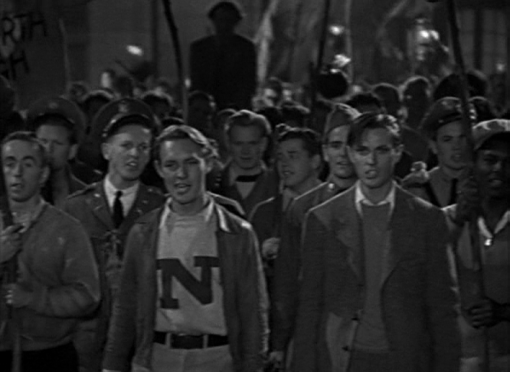
DeMille’s paean to youth has touches of what Nicholas Ray would undertake in the next couple of decades. The film’s first real shot is that of students walking into their high school union meeting. We will see their marching feet in closeup thrice in the film. The night they kidnap Garrett, they take over the town’s streets, and DeMille portrays this as the way forward for the nation. The film’s glorification of youngsters as a power in politics has an unnerving parallel with the rise of the Hitler Youth organization in Germany. The National Socialists had come to power a few months ago, and the Hitler Youth saw a twentyfold increase in its membership the year the film was made. This Day and Age capitalizes on this hopefulness about the younger generation pervading the air.

On the other hand, unlike in Nicholas Ray’s pictures, the film smoothens out all the rough edges around intergenerational relations. For one, the parents in DeMille’s film aren’t failed figures imprisoned by social norms. They are sympathetic and supportive of their children’s undertaking. Steve tells his parents that he’s going to get Garrett, and his father simply wishes him luck. DeMille’s paternalistic view of the teenagers finds them stuck between two ages, between the fragility of childhood and the moral urgency of adult life. When one of the boys is shot, he crawls into a foetal position and says, “I want my mother”, before collapsing. This sorry image is dissolved over a shot of Garrett’s cabaret girls dancing to a jazzed-up version of “Rock-a-bye Baby”. This desire for generational rapprochement reaches a peak in the film’s final scene, where the boys’ demands for justice are harmonized and blessed by the old boys of the system.

This Day and Age is an excellent case study to demonstrate that Hollywood films aren’t as much expressions of a coherent set of political beliefs as fruits of numerous contradictions created by conflicting production demands. On one hand, the film evidently draws inspiration from the socialist spirit of the times. The damage wrought by the Great Depression had brought popularity to social movements and trade unions around the country. The socialist writer Upton Sinclair would contest in the Californian gubernatorial elections as the Democratic Party candidate the following year. It’s telling that DeMille and Paramount Pictures, who aren’t generally known for films about everyday people, came together on a project defending the little man. The film, in fact, begins with a student union meeting to discuss unemployment.

On the other hand, a rather strong conservative streak is to be traced in the film’s conception of good and evil. The good, represented by youth, free enterprise and the common businessman who refuses to submit to the tyranny of unions, is brought into a provisional opposition with evil, symbolized by the mafia, politicians (who may be immigrants) and the government. The teenagers’ fight against Garrett is repeatedly cast as a truly American act, the tune of “Yankee Doodle Dandy” serving as a recurring motif. The mafioso Garrett, in contrast, is someone who threatens small businesses and perverts the young, his cabaret corrupting innocent children’s rhymes for lurid entertainment.

Some of the ideological contradictions of the film originate from the figure of DeMille himself, a notorious conservative. The filmmaker was partly Jewish, but also one of the most virulent anti-communists in Hollywood. He reconciles his Jewish identity with his Americanism in the character of the tailor Herman. A fierce independent wary of unions, Herman is glad to cook different foods for his friends, and that includes ham for an Irish boy. “The stomach is the last thing to get patriotic about”, he remarks. DeMille had visited the USSR in 1931, an experience he described in positive terms. The strategic superimpositions and dissolves he employs in the film—the boy detectives crawling at Herman’s house searching for clues dissolved with Garrett’s cabaret girls crawling to the tune of “Three Blind Mice”, shot of a rat dissolved with Garrett’s face—themselves show an influence of Soviet montage techniques.

The film’s ideological confusions acquire tremendous power once Garrett is abducted by the boys. At the end of a robust kidnapping scene involving boot polish and adhesive tapes, Garrett finds himself hunched over like a primate, his hands stuck to his knees. He is carried to a mock courtroom in an amphitheatre populated by the youngsters of the town, armed with ropes, guns and torches. He is strung up and the planks under his feet are removed one by one, and he soon hangs free over a pit of rats. The boys press for a confession, lowering him progressively until only the rope his seen and his screams heard. It’s a scene drenched in sadism—intercut with another disturbing scene of sexual menace—but also righteous anger of the teenagers.

DeMille, a master of Biblical spectacles, amps up the uneasiness in the subsequent scene. Having confessed to Herman’s murder, Garrett is now propped up on a stick like a pagan offering and taken on a procession to the court—a sequence that has an echo in the garish “golden calf” episode of DeMille’s The Ten Commandments (1956). The boys march in militaristic unison, waving banners and belting out “The Battle Hymn of the Republic”. A shot of Garrett on the stake, haggard and resigned, introduces a rather queasy note in this celebratory theatre of revolution. The mob action is supported by the police and receives official sanction in the courthouse, where Garrett’s confession, though obtained under duress, is used to incriminate him. Couching a crusade for justice within a fascist form, This Day and Age is a work alive with the tensions of the era as well as the dynamics of Hollywood film production.


[Originally published at Firstpost]