Jang Aur Aman (2001) (aka War And Peace)
Anand Patwardhan
Hindi/English/Urdu/Japanese
“In India, the ideology that killed Gandhiji was once more legitimate. Nuclear nationalism was in the air. The memory of one who opposed the bomb on moral grounds alone had begun to fade.”
 Documentary filmmaker Anand Patwardhan’s controversial War and Peace (2001) could well have been titled War and Peace: Or How I Learned to Forget Gandhi and Worship the Bomb, for the major theme that runs through the film is the disjunction that exists between the past and the present and a nation’s collective (and selective) cultural amnesia with respect to its own past. Shot in four countries – India, Pakistan, Japan and the USA – and over a period of four years following the 5 nuclear tests done by India in 1998, Patwardhan’s film was slammed by Pakistan for being anti-Pakistani and by India for being anti-Indian, while the film’s barrel was pointed elsewhere. Tracing out the country’s appalling shift from Gandhian-ism to Nuclear Nationalism and Pakistan’s follow-up to India’s nuclear tests, Patwardhan examines the role of the countries as both the perpetrators and the victims of a major mishap that is now imminent, taking the Hiroshima-Nagasaki incident as a potent example to illustrate why nuclear armament is not merely a potentially hazardous move, but a wholly unethical one. War and Peace is a film that should exist, even if amounts to only the ticking of a radiometer amidst nuclear explosions, for it calls for a realization that there can be neither a victor nor a finish point in this internecine nuclear race.
Minutes into the film, it becomes evident that Patwardhan’s stance is far from neutral. War and Peace is not a documentary which sets up the dialectics, leaving it to us to resolve the contradictions and come to an ideological stance. It is, clearly, anti-nuclear in its politics. Patwardhan’s editing is deterministic and it pointedly juxtaposes shots of unabashed right wing celebration of the success of the nuclear tests with those of the anti-nuclear protests being squashed by police force. The cross section of people Patwadhan takes for the pro-nuclear arguments consists almost entirely of common folk, far removed from any knowledge of the bigger picture, and the sample he gathers for the film’s anti-nuclear arguments is made up of activists, scientists and cultural icons whose opinions, naturally, seem far more logical than the former group’s. However, even amidst the one-sidedness of Patwardhan’s intent and approach and the near simplification of issues, War and Peace provides a lot for the audience to work with. Part of the pleasure in watching War and Peace comes from the cat and mouse game between the audience trying to pin down the filmmaker to a particular ideology, political side, a nationality or a religion and the director invalidating every such categorization, one after the other.
Eventually, beyond the seemingly-leftist tone of the first chapter, Patwardhan turns out to be an absolute centrist, with humanitarianism (and hence complete nuclear disarmament) being the only ideology he seems to support. One by one, he strips down every artificial façade people have been made to wear, to elevate the movie to a purely human level. In a moving scene, the friend of a Kargil-war martyr, a Pathan himself, tells us that he feels guilty because it was another Pathan who shot his friend. In another, two former generals – one from India and one from Pakistan – recall how futile the previous war was, both politically and personally. Likewise, Patwardhan nullifies every classification based on class, religion, nationality and political leaning in order to recognize people just as people and to acknowledge the existence of each one of them. But, despite the film critical and sometimes cynical attitude, never does Patwardhan assume a stance superior to the people he deals with. War and Peace is as much a personal film as it is political. From the film’s very first lines, Patwardhan ties his story to the history of the country. He goes on to tell us in a somber, disinterested tone, which will stay for the rest of the film: “That our family, like Nathu Ram Godse and his co-assassins, were upper caste Hindus cured me for ever, of any narrow understanding of nation and any vestige of pride in the accident of birth”. With the significance of his own caste questioned, Patwardhan merely goes on to explore if there is any worth in associating one’s name to these man-made trappings at all.
 When Mao Zedong told the Dalai Lama that religion was poison, he was, in fact, nurturing another poison called patriotism. Of course, in India, it is undeniable that both religion and jingoism work in union to charge the people up with faux ideologies, no matter which party forms the government. War and Peace investigates this strong synergy within the context of the nuclear race between India and Pakistan. Both ultra-nationalism, with its distorted, larger-than-life definitions of “bravery”, “martyrdom” and “sacrifice”, and religion, which perpetuates a misplaced sense of masculinity with its belligerent iconography and literature, as is elucidated by Patwardhan’s film, seem to operate in conjunction with the free market system to create an environment where might is indeed right. And this explosive mixture of religion, politics and capitalism, as Patwardhan highlights briefly, doesn’t exactly seem unique to India or Pakistan. “For God and Country” reads the American motto on its Air Force Association headquarters. In this regard, War and Peace shares a lot with Kubrick’s Dr. Strangelove (1964, alluded to in the film’s first few minutes), where, too, the nuclear superiority was equated with masculinity. In fact, in a panel discussion about Patwardhan’s film, former director-general of Pakistan’s intelligence agency, Lt. Gen. Asad Durrani tells us that the only fear Pakistan has about the nuclear bomb, thanks to the ease of access to it, is that it might go off accidentally!
Patwardhan emphasizes this effacement of the individual to serve national and religious ideologies continuously in the film. People are often photographed, in long shots, as being overshadowed by huge banners of political leaders, by paintings of gods, by commercials of consumer products and, sometimes, by the nuclear bomb itself – both in India and Pakistan (Even during his stay in America, Patwardhan manages to photograph a couple of security guards being dwarfed by a triumphant image of Neil Armstrong holding the American flag on the moon). There is a constant battle between individual conscience and populist opinion throughout Patwardhan’s film (In a noteworthy composition, Patwardhan photographs Raja Ramanna, father of India’s first nuclear program, through a ventilation in the piano that gives us a wheel like figure – the symbol on the Indian flag – imprisoning the man). In a cracking sequence, during a debate on nuclear testing, in a high school in Pakistan, Patwardhan finds a girl, who had just now spoken onstage ‘for’ the bomb, speaking against it. Upon inquiry about this discrepancy, she tells us that she chose a side that would give her more points to speak about and one that would be received well by the majority. It is a remarkable scene, with the politics of both the countries being boiled down into a single classroom, which strikingly underlines the tendency of common folk to conform to the majority in an unstable political climate.
But the real catalyst in this destructive process seems to be the free market system whose agents leave no stones unturned to create and exploit emotional imbalance among people. War and Peace examines how privatized media networks, instead of reassuring people, “brought [Kargil] war into the living rooms” by sensationalizing images of war and selectively filtering truth to evoke a vengeance-driven feeling of nationalism. The FMCG brands promptly followed up with slogans and graphics on their packages so as to reinforce the ruling party’s justification of the war. Even after the war, these firms did not forget to cash in on the remains of the war. “Cadbury’s salutes the heroes of the war”, “Hero Honda presents the 50th day commemoration” and other such commercials flood the Indian TV screen following the war. Extrapolating this set of arguments, in the final chapter titled “Song of India, Song of America”, and taking into consideration the infamous Tehelka scam that exposed the corruption of the Indian defense ministry, Patwardhan raises the question about the consequences of privatizing the defense industry, as it has been done in America. The point that Patwardhan seems to be making with this fabric of arguments seems to be that, in an attempt to ape the west, both India and Pakistan seem to have forgotten their basic necessities while going after a luxury called nuclear empowerment, which turns out to be only detrimental to the development of both countries.
The most unfortunate part about this kind of a system of governance, so the film points out, is that it makes science a culprit to the decisions made on religious and nationalist bases. The fundamentalists, both in India and Pakistan, believe that the A-bomb is a “gift from God” (Hindus and Muslims are seen, literally, worshiping the bomb). Science is transmogrified to serve the cause of religion and the fanatic nuclear race. Every decision is justified using science and mathematics and people, as a result, are reduced to mere numbers. One scientist tells us the casualty due to nuclear radiation is just one in a million. Another one talks about making tradeoffs for a greater cause. Probability theory is exploited to uphold morality and deaths are quantized and neglected in comparison to the superpower status a nuclear bomb might give the nation. General Leslie Groves, the director of the Manhattan project, as is revealed by historians in the film, decided to use two nuclear bombs in place of one (even when Japan had virtually lost the war) just in order to compare the effectiveness of uranium and plutonium based bombs. By the time this factoid is revealed, Patwardhan’s observation that the minorities – ethnic, social, political and religious – are the ones who end up at the receiving end becomes a universal truism.
 Patwardhan’s film is full of humorous moments brimming with great irony. These blink-and-you-miss moments often arrive as establishment shots, cleverly setting up the attitude of the filmmaker in the sequence to follow. Be it of a man cleaning the garden of Raja Ramanna, who is sedately playing the piano inside his house, a miniature cannon placed in his house besides a sculpture based on the Mahabharata war, a set of Nancy Drew books arranged alongside books on Islam in the girls’ high school in Pakistan, a destitute woman sitting indifferently besides the hordes of laymen celebrating the nuclear success or a bunch of puppies and kitten playing in the Gandhi ashram, Patwardhan’s ever-curious camera, even during the most serious of conversations, never hesitates to wander off to make a point of its own. But the remarkable part in all of this is that Patwardhan derives his assertions from reality – from actual objects present in the scene of discussion. Instead of cutting forcefully from one image to another to make an Eisensteinian statement, Patwardhan merely reframes using a gentle tilt or a pan, often with a socialist eye for detail, to highlight the various opposing forces acting on people.
War and Peace could well serve as a fitting documentary counterpart to Haasan’s Hey Ram (2000) – my pick for the best Indian film of last decade. Both are decidedly Gandhian films that examine the deadly confluence of politics and religion (one character in Haasan’s film equates this combination to “sex and violence” in cinema). Where Haasan’s film ends with the murder of Gandhi, War and Peace begins with that incident. While Hey Ram had the present in black and white and the past in colour to reflect the collective loss of memory that the nation seems to be suffering from, Patwardhan’s film presents us the past entirely using monochrome newsreels – both archival and reconstructed – and the present in colour, as if quarantining the past as a work of fiction (complete with a introductory countdown and a projector hum). Both explore the country’s selective renouncement of its own past whereby all the ills of the past are willfully retained and rewarded while the ideology that called for a non-violent and symbiotic way of life is as consigned as foolish romanticism. “This thing skips a generation”, notes one of the residents of Hiroshima, in War and Peace, referring to the effects of the A-bomb toxins on the new-born. This, in another sense, is indeed what both these films hope for – that the younger generation will open up to a past that their elders refuse to acknowledge.

 That is not to say that Kanchivaram is not a melodrama. On the contrary, I believe, it is precisely how a melodrama should be. The word “melodrama” has been used very loosely and often as a derogatory remark. Most of our mainstream movies have been put down because of the same reason, and rightly so. Where these ordinary films tried to exaggerate emotions through copious amounts of words, leaving no margin for discovery or imagination, Kanchivaram lets cinema do that for it. Its exaggeration is not the weak over-emphasis of words, but the subconscious amplification by images. Priyadarshan realizes that subtlety is the essence of art and places immense trust on his audience, yet never lets the movie lurk near ambiguity. His melodrama is not made of music cues or slow motion shots, but of cinematic compositions. Consider the final scene where Thamarai, who had earlier taken over the responsibility of taking care of her father from her mother, breathes her last. Vengadam takes her in his arms to show the sari he has been weaving for her. Earlier in the film, Vengadam had does exactly the same thing when his wife is in her death bed. Instead of having Vengadam break down, and cry out aloud the unfairness of it all, Priyadarshan merely uses the same camera angle – looking at the pair of actors through the weaving machine – to nudge our memory, make us work and only then earn the tragedy of the moment.
 Although attention-craving at places, Priyadarshan’s direction shows the signature of a mature director who knows his craft. He seems to know where exactly to use expressionist lighting and where to focus deeply. Speaking about cinematography, Kanchivaram would not be what it is without the contribution of three fine pieces of work. The first is Sabu Cyril’s production design. Though aided considerably by what looks like post-production processing, Cyril nevertheless does a terrific job in creating a uniform earthy tone to the film which eventually blends into the red of communism that later becomes the central point of the film. All the people in the film – the leads and the junior actors – look straight out of grandpa’s albums, with clearly defined facial features. The second is Thiru’s cinematography, which speaks for itself. This veteran cameraman had already proved his worth in

 John Abraham’s Donkey in the Elite Colony (1978) begins before its imagery does, with the narrator passionately reciting a fiery poem by Subramanya Bharathi, in praise of fire, during the credits. The first visual of the film follows up the verbal worship of fire in the poem with an extended shot of a sunrise. The tone is set for a leftist kind of film with revolutionary overtones. The seventies was a notorious decade in Indian cinema – both parallel and mainstream – as the permissiveness of American cinema had started showing its influence. And fortunately, it was also the period when cinema was taken most seriously and for the good. Malayalam film director John Abraham’s second film, and his only film made in Tamil, is a controversial film from the era and continues to be rated as one of the most important non-mainstream movies from the country.
 Director John Abraham and scriptwriter Venkat Swaminathan evidently draw inspiration from Bresson’s Au Hasard Balthazar (1966, even overtly referenced early in this film), where too the protagonist’s fate was tied up with the donkey’s. I say fate because none of the central characters (the women and the animals) seem to be able to affect the direction of their lives. Both Chinna and Uma are mute creatures who end up being victims of insecurities and questionable intentions of certain individuals who take refuge under the cover of their social standing. But Abraham is far from being a Jansenist (that Bresson is often claimed to be). He is more interested in doing away with the oppressive forces than in contemplating about the harrowing state of affairs as his opening and closing sequences testify. Towards the end of the film, when the professor finally searches out the whereabouts of Uma, he finds her sitting listless among the ruins of a temple, amidst abandoned idols, subtly raising an intriguing question – Has God forsaken his subjects or is it the other way round?
 But most interesting is the central piece of the film, where Abraham achieves a unique effect through repetition and montage. It is a sequence where Narayanaswamy’s father is recounting the villager’s complaints about the donkey. Each scene of complaint begins with a villager shouting out his gripe, after which, Abraham cuts to what actually happened. It is revealed to us that in none of the cases, is the donkey guilty of what the villagers are accusing it for. In contrast to the verbose ranting of the villagers, these flashbacks are completely devoid of words, with only a soundtrack playing throughout each one of them, as if stressing the inherent dubiousness in human words. At the end of each scene, we see Chinna and Uma walking past the father-son pair almost in the same fashion every time. This is followed by a section that shows a working class man taking advantage of Uma’s condition, much like the villagers making use of the donkey’s inability to object. The whole sequence of events repeats three or four times and constantly calls attention to itself, making it a bit of an overkill by today’s standards.
 The final act of Donkey in the Elite Colony begins on an ambiguous note, which, in a way, feels like a weak link. We are first shown Brahmins who are repenting for their actions, haunted by the implications of their sins, and then the workers rising to revolt. Is Abraham suggesting that a change has to come from within, rather than through an organized movement (This is a plausible explanation, for Narayanaswamy himself is one of the Brahmins)? Or is he of the opinion that a revolution is the only way for progress? The climactic act, at times seeming indecisive, is brought to a final resolution with the help of another Subramanya Bharathi poem – Dance of Death. The penultimate image in the film is that of burning houses, rendering closure to the film’s first sequence (the opening poem is recited in the soundtrack once more) and providing us with a clear solution rather than an introspective question. Abraham’s leftist tendency overwhelms, taking the film with it into an agitprop mode reminiscent of the Soviet cinema of the twenties. The film closes with a shot of the setting sun – a rather unusual metaphor for a propagandist showdown, for the revolution has just begun.
 If one is asked to describe briefly what Kamal Swaroop’s Om Darbadar (1988) is, some of the answers could be: carefully constructed non-sense, endless dream of a cinephile, a satire on everything, full stop to Indian parallel cinema, random footage, extremely challenging piece of filmmaking, the great Indian LSD trip, landmark Indian film that aims big. With all the ingredients required to make a cult classic, Om Darbadar is the kind of movie that can easily polarize critics and audiences alike. It is, in fact, surprising that the National Film Development Corporation consented to produce this film. Using image, sound and montage to the maximum extent (and often gratuitously) and dialog that seem like knitted from parts of different sentences, almost always making no meaning (written by Kuku, also the lyricist and the art director of the film), Swaroop’s film is an antithesis to whatever is recognized globally as Indian cinema – a reason good enough to make Om Darbadar a must-see movie.

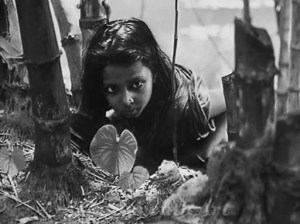 Based on a book by Bibhutibhushan Bandopadhyay, Pather Panchali is a series of loosely knit episodes in a poor Brahmin family in rural Bengal. Harihar (Kanu Banerjee) is a priest who also dabbles in play writing. His wife, Sarbojaya (Karuna Banerjee) manages the household and her two children Durga (Uma Das Gupta) and Apu (Subir Banerjee). There is also their old “aunt” Indir (Chunibala Devi) who loves eating the fruits given to her by Durga. Then there are their neighbours, the well-off Mukherjees, who share a love-hate relationship with their family. Mrs. Mukherjee helps out when Durga falls sick almost as her surrogate mother (as Ray hints early in his mise en scène) and Sarbojaya does the cooking in Mrs. Mukherjee’s daughter’s wedding. It’s a warm and isolated little world of theirs.
 The neo-realists strongly emphasized that the neo-realist filmmaker be just a passive observer of reality without imposing his interpretations on it. That whatever the situation of their characters, – glory or misery – the filmmaker must maintain objectivity, always subordinating reason to action. Although many of the staunch neo-realists themselves couldn’t achieve this complete objectivity, they did attempt to do so in theory. However, in Pather Panchali, Ray never claims to be a mere observer. It is true that he does not comment on the characters’ actions and situation or throw hints to the audience so as to tell them what to feel. But that does not mean Ray does not take a stance (or a neutral stance for that matter). Ray is biased for sure, but not towards his characters but towards life itself. He takes immense joy in infusing life on to the screen and providing a channel of hope to his protagonists. Quite in contention with the neo-realist theory, Ray does not hesitate using Pt. Ravi Shankar’s soundtrack generously (but not without much caution) or in concocting sequences with a tinge of humour.
 Like La Strada (another victim of the neo-realist baptism), that was as much away from its purely neo-realist contemporaries as it was close to them, Ray marries the neo-realist objectivity that avoids hyperbole and his own subjective view of life producing what may be, like Fellini’s film, called “neo-realism with a heart”. But again, Ray absorbs and deviates. Where, like many a film of later years, La Strada compares a road trip to life, Pather Panchali compares life to a road trip. Ray treats life as an inevitable journey which should go on no matter how shattering its events are. He punctuates his film with images of little roads through the woods and of characters arriving or departing from the village. In other words, Satyajit Ray presents life as a train journey where passengers may come and passengers may go, but the train itself never stops. Ray wasn’t kidding when he put that train in Pather Panchali – a train that Durga never manages to get on and one that Apu would, in Aparajito (1957), my favorite film of the trilogy.
 Mrs. Mukherjee confiscates the family’s grove as a penalty for the failure of repayment of loan. Later, the people of the village persuade Harihar to stay and tell him that this place is their ancestral land. It is as if the people of the village have assumed the land to be theirs despite of the fact that it was already there much before them. Ray touches upon the conflict between man and nature that has been dear to so many filmmakers before and after him. And this is where Pather Panchali gets deeper than meets the eye. Exactly like Herzog would do in

 The slew of movies in Tamil cinema based on villages stopped with the late eighties as cities became the prime audience of the filmmakers. Though infinitely many stories still lie in the villages waiting to be told, not many movies from the nineties and the new century have tapped it. One film that has indeed done it, Kamal Haasan’s Thevar Magan (1992), stands out as a vital milestone in the history of Tamil Cinema.
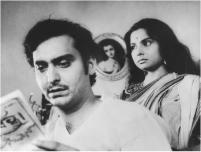 For a large part of the rest of the world, the name Satyajit Ray would immediately relate to the Apu trilogy and would probably stop at that. Ironically, a great number of his fabulous films have never reached the eyes of the Occident. Charulata (1964) is one such gem that never gets a mention when briefing the director’s work.
 The Seventh Art