Charulata (1964) (aka The Lonely Wife)
Bengali
Satyajit Ray
“Give me your word that no matter what might happen, you won’t leave”
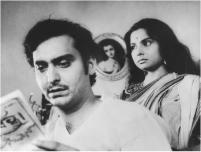 For a large part of the rest of the world, the name Satyajit Ray would immediately relate to the Apu trilogy and would probably stop at that. Ironically, a great number of his fabulous films have never reached the eyes of the Occident. Charulata (1964) is one such gem that never gets a mention when briefing the director’s work.
Bhupati is the owner of a newspaper The Sentinel and gives his heart and soul for its development so much so that he neglects the presense of his wife Charulata. Charulata kills her time doing petty stuff such as looking at people on the street through her opera glasses and doing embroidery. Bhupati asks his graduate brother, Amol, to somehow induce her to write which she seems interested in. Amol pretends to Charu that he is interested in writing and spends his afternoons with her trying to get valuable inputs from her. Finally, Amol manages to make Charu write an article and get it published in a renowned magazine but not before the latter develops a strong bond with her brother-in-law. Meanwhile, Charu’s brother and treasurer of The Sentinel doesn’t see prospects in running the newspaper and decides to run away with the funds. Bhupati comes to know of the betrayal and decides to suspend production after which Amol leaves the house with the intention of easing his brother’s burden. After a few sombre days, Bhupati and Charulata decide to resurrect the newspaper with both of the contributing. This is immediately followed by the climax where Bhupati accidentally discovers Charu’s attraction towards his brother and realises his mistakes.
Not one character is wasted or overdone in the film. In many ways, Charulata is Satyajit Ray’s most daring and open statement on the position of women in the society. Charulata is the epitome for the free and thinking woman of new India as opposed to her sister-in-law Manda. The tale of constrained relations between a man who has been complacent in his marital life, a woman who seeks forbidden love and a young man who becomes an involuntary catalyst for the exposure of truth is not only a commentary on contemporary India but also a fine work of art. Charulata won the Silver Bear at the Berlin International Film Festival in 1965.
 Japanese cinematic master Akira Kurosawa has always been a source of inspiration for both contemporary and future film makers. Right from Sergio Leone to Kamal Haasan, every one who has come across his films have been entranced by it. Kakukshi-Toride No San-Akunin (1958), which is considered one of Kurosawa’s finest, apparently inspired George Lucas to script the characters and the narration in the Star Wars franchise based on the two slaves of the film.
 Very few films have come out that are based on mythology of their country of origin. Except for the slew of animations films, there are no mainstream mythological films from India, a country with the richest mythology. Japan, on the other hand is conscious of its heritage and has adapted the same in various forms. Masaki Kobayashi’s Kaidan (1964) is based on a compilation of ghost stories from Japan and consists of four segments.
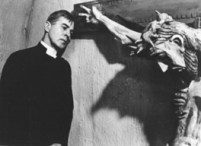 Faith and doubt in God have always been a critical theme in most Bergman films, especially the ones in the so-called “Faith Trilogy“. Nattvardsgästerna (1963) is the second installment in this trilogy following
  The first thing that strikes everyone about Japanese cinema is the Samurai culture. And the first thing that strikes about Samurai films is Akira Kurosawa. Akira Kurosawa’s later films, however, were not received well even though they were offbeat works such as Dodes’ka-den (1970), Dersu Uzala (1975) and Yume (1990). Yume presents itself as a episodic collection of eight vignettes apparently based on the director’s dreams.
 The objectives, outlooks and needs of different levels of a community, naturally, do not concur. One man’s grief is another man’s pleasure. Mohsen Makhmalbaf’s Bicycleran (1987) captures this difference in the context of an event as viewed from people from different sections of the society. Though a bit more dramatic than most films then from Iran, Bicycleran has enough raw power and truth value to be classified under the neo-realistic genre.
 Seldom do films come that are so simple in their presentation yet possess such strength in their characters. These are the films that sweep you off the ground with their sheer brilliance. Federico Fellini’s La Strada (1954) is a benchmark for industries such as Bollywood which flourish on fantasy for film making. La Strada marks Fellini’s transition from neo-realism (His previous film being the brilliant I Vitelloni (1953)) to fantasy. And what a transition it is!
 What is love? Is it the inevitable sensual desire that arouses? Is it only bodily game played by the hormones? Can science explain all loves? Or is it something that transcends reasoning? These are issues explored in Kieślowski’s Krótki Film O Milosci (1988). Released as an extended version of an episode from Kieślowskis phenomenal TV series Dekalog, Krótki Film O Milosci was shamelessly ripped off (including the title) for the Indian version Ek Choti Si Love Story.
 Cinema has evolved from being a medium of documentation and story-telling and to a medium of providing social, political and spiritual commentary of the era involved. But all such movies are not accepted with open arms. Tastes differ and so do ideologies. Films that have been against the political and religious ideologies of key organizations and powerful people have been shunned and their makers condemned. This was especially true of the films that were made in communist countries such as USSR and East-Germany. One such gem that came from the Czech Republic is Milos Forman’s Horí, Má Panenko (1967).
 Once in a while, there comes a movie that shatters the beliefs of people on cinema and redraws the lines between right and wrongs of the medium. These are the films that redefine the boundaries of film making thus providing new standards and freedom for films to come. At a time when swearing on screen was a taboo, came the classic Gone With The Wind (1939) with the legendary “Frankly my dear, I don’t give a damn.” quote. A Clockwork Orange (1971) that questioned induced goodness and evil in a very strong way, Straw Dogs (1971), famous for its graphic rape scene, Un Chien Andalou (1929) that introduced surrealism in cinema, the semi-snuff Cannibal Holocaust (1980) and its brutality – all these movies may have been snubbed by audience and critics at the time of their release, but no one can question their impact on the future generation of directors.
 The Seventh Art