Om Darbadar (1988) (aka Om-Dar-Ba-Dar)
Kamal Swaroop
Hindi
“To Prime Minister. Subject: The Googly. Dear Raju, Please ban googly in cricket and life in general. Thanks, A freedom fighter, Babuji B. Sankar.”
 If one is asked to describe briefly what Kamal Swaroop’s Om Darbadar (1988) is, some of the answers could be: carefully constructed non-sense, endless dream of a cinephile, a satire on everything, full stop to Indian parallel cinema, random footage, extremely challenging piece of filmmaking, the great Indian LSD trip, landmark Indian film that aims big. With all the ingredients required to make a cult classic, Om Darbadar is the kind of movie that can easily polarize critics and audiences alike. It is, in fact, surprising that the National Film Development Corporation consented to produce this film. Using image, sound and montage to the maximum extent (and often gratuitously) and dialog that seem like knitted from parts of different sentences, almost always making no meaning (written by Kuku, also the lyricist and the art director of the film), Swaroop’s film is an antithesis to whatever is recognized globally as Indian cinema – a reason good enough to make Om Darbadar a must-see movie.
Here’s the plot of the film: Horoscope, dead frog, cloudy sky, the moon, radio program, caste reservation, bicycle, Mount Everest, women’s liberation, communism, sleeveless blouse, Yuri Gagarin, miniature book, Nitrogen fixation, man on moon, terrorist tadpoles, computer, biology class, turtles, Hema Malini, typewriter, sleazy magazines, hibernation, text inside nose, googly, James Bond, severed tongue, fish rain, shoes in a temple, World War, assassin creed, Gandhi, illicit trade, the lake, goggles, hopping currency, helium breath, counterfeit coins, underwater treasure, diamonds inside frogs, fireworks, the zoo, explosives, town at night, dead man, visit of God, the Panchsheel Pact, foreign tourists, Promise toothpaste, holy men, Fish keychain, Ram Rajya, food chain disruption, anti-cooperation movement, birth control, bagpipes, gecko, Jawaharlal Nehru, Aviation centers, Potassium Cyanide. And I guarantee you, this is as lucid as it can get.

Om Darbadar is, hands down, the most confusing movie I have ever seen and not many movies can come close to dethroning it. Some might propose Buñuel’s first film, but one could at least find one pattern in that work – of anti-narration. This one regularly tantalizes us with a somewhat coherent narrative and just when it seems to get steady, snap! Or Last Year at Marienbad (1961), which is, in fact, an incisive study of the human memory. Om Darbadar, on the other hand, overwhelms us with its utter irreverence for integrity of reality, unity of content and consistency of form. Or the very many avant-garde films of Brakhage, Warhol, Anger, Snow or Smith, which, I believe, have always had a strong theoretical basis. No, this film does not have any single, central factor as its theme or motivation. Of course, one can find shreds here and there in the film that do make it seem like dealing with the idea of identity crisis in suburban India, but that’s strictly on a speculative level.
Often we witness directors claiming to show the world what real India is – a statement negated by the films themselves. Leave alone filming, it is to be accepted that even understanding the dynamics of such a largely diverse country is near impossibility. But, if there was ever a film that attempted to capture the workings of real India almost in its entirety, it has to be this one. Yes, it does bite much more than it can chew, but surely, digestion is not its intention. In a country where science, religion, mythology, arts, politics and philosophy seep into common lives trying to overpower each other, there is no single way to separate these threads so as to examine their influence on the way of life. This is a nation where the apparently inexplicable supernatural walks hand in hand with the most modern of scientific theories (In one scene in the film, Gayatri (Gopi Desai) asks Jagdish (Lalit Tiwari) if women can really climb Mount Everest without the help of men, he tells her: “Why not? After all, goddess Parvati did it”), a culture that is exposed to all the isms of western thinking yet revels in having its own interpretations of them (wearing a sleeveless blouse is equated to emancipation of women) and a country whose emotions are largely dictated by cinema, television and pop culture (Om Darbadar can be seen as a jab at just about every genre in Indian cinema).

Conventional (and good) cinema has relied on the fact that human psychology manifests itself in the form of their behaviour and speech and hence, an unhindered documentation of their lives would help us understand them better. But not many filmmakers seem to have embraced the reverse process – an entry into the real via the surreal. Kolker fittingly calls Buñuel “the neo-realist of the unconscious” and each one of his films testifies that. Likewise, the whole of Om Darbadar could well be the ultimate Freudian exercise that could help us (de)construct the actual world that Om lives in – a world that is as much fuelled by a love for pulp novels and thriller movies as it is by an aversion to zoology. But all is not so simple and the film is far from an extended dream sequence. Swaroop could have easily had Om (or his father, who begins the film’s narration) wake up at the end of the film, thereby taking us back to our comfort zones. Instead, he seamlessly blends present reality, past reality and fantastical reality to create an elusive work of cinema that defies literature, science and rationality.
Om Darbadar is an utterly frustrating, endlessly irritating and supremely hilarious film. Is it nonsensical? Yes, that is precisely its function. Is it pretentious? No, that can happen only when a film attempts to be something. Is it a one-of-a-kind movie viewing experience? You bet. Whatever one calls it, you cannot deny one fact – Om Darbadar is an indubitably addictive and thoroughly riveting piece of work that simultaneously repels a viewer by not pandering to his needs and yet, keeps him hooked on to the screen from frame one. Quarter hour into the film, I was completely disarmed and found myself laughing out loud through the rest of the film despite (rather, because of) the meaninglessness of it all. Om Darbadar is perhaps the kind of vision that flashes moments before one’s death. Call it the birth of Indian cinema, call it its death, call it Dadaist, call it anti-art, but be sure to bask in its absurdity while it lasts.
[Meri Jaan A A A…!]
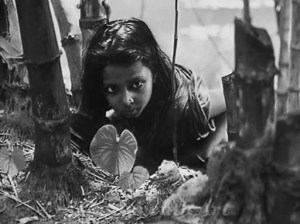 Based on a book by Bibhutibhushan Bandopadhyay, Pather Panchali is a series of loosely knit episodes in a poor Brahmin family in rural Bengal. Harihar (Kanu Banerjee) is a priest who also dabbles in play writing. His wife, Sarbojaya (Karuna Banerjee) manages the household and her two children Durga (Uma Das Gupta) and Apu (Subir Banerjee). There is also their old “aunt” Indir (Chunibala Devi) who loves eating the fruits given to her by Durga. Then there are their neighbours, the well-off Mukherjees, who share a love-hate relationship with their family. Mrs. Mukherjee helps out when Durga falls sick almost as her surrogate mother (as Ray hints early in his mise en scène) and Sarbojaya does the cooking in Mrs. Mukherjee’s daughter’s wedding. It’s a warm and isolated little world of theirs.
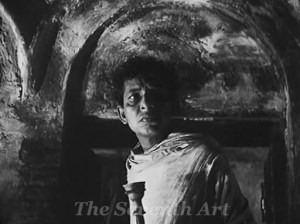 The neo-realists strongly emphasized that the neo-realist filmmaker be just a passive observer of reality without imposing his interpretations on it. That whatever the situation of their characters, – glory or misery – the filmmaker must maintain objectivity, always subordinating reason to action. Although many of the staunch neo-realists themselves couldn’t achieve this complete objectivity, they did attempt to do so in theory. However, in Pather Panchali, Ray never claims to be a mere observer. It is true that he does not comment on the characters’ actions and situation or throw hints to the audience so as to tell them what to feel. But that does not mean Ray does not take a stance (or a neutral stance for that matter). Ray is biased for sure, but not towards his characters but towards life itself. He takes immense joy in infusing life on to the screen and providing a channel of hope to his protagonists. Quite in contention with the neo-realist theory, Ray does not hesitate using Pt. Ravi Shankar’s soundtrack generously (but not without much caution) or in concocting sequences with a tinge of humour.
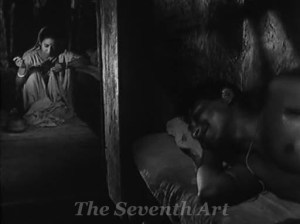 Like La Strada (another victim of the neo-realist baptism), that was as much away from its purely neo-realist contemporaries as it was close to them, Ray marries the neo-realist objectivity that avoids hyperbole and his own subjective view of life producing what may be, like Fellini’s film, called “neo-realism with a heart”. But again, Ray absorbs and deviates. Where, like many a film of later years, La Strada compares a road trip to life, Pather Panchali compares life to a road trip. Ray treats life as an inevitable journey which should go on no matter how shattering its events are. He punctuates his film with images of little roads through the woods and of characters arriving or departing from the village. In other words, Satyajit Ray presents life as a train journey where passengers may come and passengers may go, but the train itself never stops. Ray wasn’t kidding when he put that train in Pather Panchali – a train that Durga never manages to get on and one that Apu would, in Aparajito (1957), my favorite film of the trilogy.
 Mrs. Mukherjee confiscates the family’s grove as a penalty for the failure of repayment of loan. Later, the people of the village persuade Harihar to stay and tell him that this place is their ancestral land. It is as if the people of the village have assumed the land to be theirs despite of the fact that it was already there much before them. Ray touches upon the conflict between man and nature that has been dear to so many filmmakers before and after him. And this is where Pather Panchali gets deeper than meets the eye. Exactly like Herzog would do in
  The Seventh Art