After watching Inglourious Basterds last week, I skimmed through a few films I was referring to in my review and felt that Tarantino’s movie, its last chapter in particular, refers to them in a manner slightly deeper than mentioned. What I present here may be plainly speculative, but the very fact that Tarantino’s film retains enough ambiguity to generate such arguments makes the film one to be celebrated. Inglourious Basterds, more than any other movie, seems to be closest to Jean Luc Godard’s History of Cinema (1988-98). If one considers Godard’s film as a classroom lesson in cinema (Why not? The movie even resembles an office presentation!), then Tarantino’s movie is a student project (that would easily get an A+) based on that lesson. It seems that everything that the French discusses in his video anthology is absorbed and blended cleverly into a mainstream flick by Tarantino. For the sake of simplicity, I lift and reproduce the same lines from my post on Godard’s film to compare it with Inglourious Basterds.
“If we had to single out Godard’s most favorite quote it has to be the misattributed Bazin one: “The cinema, substitutes for our gaze a world that corresponds to our desires”. And this is where the series kicks off. Cinema as a substitute for our dreams – the dream factory. Godard explores the meaning of “dream” as interpreted by the two functioning extremes of cinema then. He presents the occident interpretation as one that had converted cinema into a portal offering an alternate reality, a second life, to the audience whose “dreams” were the fodder for the larger-than-life images that the films projected -one that continues till date.”
Tarantino’s film, on a basic level, as the director himself confesses, is a form of wish fulfillment. As with his other films, Inglourious Basterds unfolds as a revenge saga. But by situating his plot amidst real life events, unlike its predecessors, Tarantino is able to involve his audience more and provide better justification to the characters’ actions, rather than dealing with simple morality.
“[Godard] argues that cinema could have prevented unfortunate tragedies and averted genocides rather than merely crying over damages dealt and observing helplessly the misery of its subjects.”
Here, Tarantino seems to deviate. He seems to be of the opinion that cinema, perhaps all art, can’t ever change the world (unless, of course, you consider the way he uses it in the movie!). Proof? Take a look around. What it can do is to change the image of the world when it is passed onto a new generation.
“And in resonance with this ideology, instead of bemoaning what is lost and what could have been, Godard anticipates the death of cinema (He apparently asked Henri Langlois to burn the archives). Death, so that it can rise again from the ashes. “Art is like fire. Born from what it burns.” says Godard and that is precisely what he desires – Cinema to go down with all its exploitations and restrictions and rise in its purest form. Back to infancy, so that it can learn everything out of free will, without rules and without vanity.”
This is exactly what Marcel does when he burns the films – destroying those exploitative propagandist films of the Nazis and perhaps also those WW2 films that insist upon being loyal to reality and hence impotent. With the fire at the cinema hall that flips conventional reality, Tarantino places us at the beginning of a new history – of cinema (courtesy Tarantino) and of the world (courtesy Marcel).
“Godard attempts to reconstruct history as seen in retrospect. He utilizes existing film fragments to fabricate various histories of film – the one that was and the ones that weren’t but could have been. He examines how cinema could have been made independent of historical accounts and even made to influence them.”
This theory seems to form the core of Inglourious Basterds. Why should art ever trail history? As Bazin would say, Realism in cinema should just be the means, not the end itself. Tarantino, like Godard, sure can’t change history, but, at least, he can examine the history – again, of cinema and of the world – that could have been.
“Godard elucidates this servile relation that cinema bears to history using images of dictators and authoritarians. He highlights how the visual medium itself is being manipulated by a few people in power and how in turn, modern cinema manipulates the audience. Godard reproaches this moral policing and expresses his disapproval of the hypnosis that the TV-driven audience is subjected to. He appeals for a cinema that provokes but doesn’t direct, a cinema that gives you options but doesn’t select one, a cinema that makes you think and doesn’t think for you and a cinema that is only complete with its audience. As he quotes in one of the segments, “Cinema does not cry. Cinema does not comfort us. It is with us. It is us”.”
Tarantino, also, fills the film with fascists who seem to be exploiting the medium for questionable purposes. Goebbels’ film, like many a mainstream film that are made by another kind of fascists, has manipulated reality and wants its audience to buy that as truth. And Shoshanna’s film (like Tarantino’s) is what Godard seems to be wanting in place of Goebbels’.
“There is an intriguing recurrence of the image of human hands in the film. Godard urges artists to think with their hands – their real tools that have the potency to both create and destroy, to beautify and to horrify, to document and to change. He argues that these are the instruments capable of changing and redefining history and it is the weakness of the mind that hinders the possibility.”
Marcel, who had ‘created’ the small film with Shoshanna, is the one who would be setting fire to the pile of nitrate films. Tarantino, too, highlights his hand as he flicks the cigarette on to the heap – the hand that went from mere documentation of reality to direction of reality.
Brandon Colvin is of the opinion that Inglourious Basterds is primarily a comedy. I’m going to take a diametrically opposite path and say that this movie, when reduced to its human elements, stripped of all its film references and modernist facets, is a tragedy with a martyr called Shoshanna at its heart. The word ‘tragedy’ is often used loosely and seems to denote every tale that has a pathetic, miserable and depressing outcome. But, surely, Tragedy does not base itself upon emotions. In fact, it is quite the opposite. A tale is said to be tragic when two morally unquestionable and righteous forces are made to clash and a situation evolves when one of them has to let go of its stance, despite all convictions and emotions for the greater good. Tragedy is always the result of a choice that calls for a great sacrifice to go with it. As they say, it is our choices that define us. And a tragic choice defines us for life – either as a hero or as a coward (“merely human” would be the euphemism). Sansho the Bailiff (1954), even with its heavy pathos, is a melodrama whereas The Dark Knight (2008), despite its uplifting upshot, remains a tragedy. Shoshanna could well have married Zoller and led a very content life. Instead, she repudiates that path and takes up the task of liberating the Jews at the cost of her own life. Tarantino, apart from using Ennio Morricone’s moving piece Un Amico, employs mythological and historical iconographies to underline the magnitude of this tragedy.
The final chapter of Inglourious Basterds has got to be the densest that Tarantino has ever filmed. The chapter is ambiguously titled “Revenge of the Giant Face” as if recalling some B-movie from the 50s. But more than that, it seems to me now, it tries to allude to two of the most iconic “giant faces” of women that we know. The first would be that of Maria Falconetti in Carl Dreyer’s The Passion of Joan of Arc (1928) – a film that is constructed out of hundreds of such giant faces. The tale of Joan of Arc by itself is a tragedy in which Joan sacrifices a normal life for the good of her people, much like Shoshanna, who, too, goes down in flames at the end of her journey. Only that Shoshanna doesn’t just suffer and prefers to take all of them down along with her. And then there is the most dreaded giant head in Greek mythology – that of Medusa the Gorgon – a mere gaze into whose eyes is supposed to petrify you. Daniel Ogden (source: Wikipedia) describes this stare of Medusa’s as “seemingly looking out from its own iconographical context and directly challenging the viewer”. Now, the Nazi officers in the final chapter are watching a fictional film, seated safely away from real life action, without any apparent threat from the images on the screen. When Shoshanna slips in her own film, with her gaze directed towards the Nazis, she essentially “looks out of context of the movie”, challenging, literally, the viewers, in a manner in which the modernist director used their actors, and petrifying them by dragging them out of their passive state.


But then, our ideas about these two iconic characters are derived only through images and shadows – through paintings, through Dreyer’s film and through textual accounts. As George Steiner put it, “It is not the literal past that rules us. It is images of the past.” With the passage of time, history and mythology mingle to such an extent that it becomes virtually impossible to separate them. In Chris Marker’s magnum opus The Owl’s Legacy (1989), Jean-Pierre Vernant illustrates the mythos behind this practice of image (which is a word that referred to doubles, miniatures, copies and ghosts in general in Ancient Greece, the land of tragedies) creation. He tells us that images, for Ancient Greeks, were a means of facing man’s worst fears by reducing them down to caricatures. In Medusa’s case, this meant that they could see her directly in the eyes (a la Perseus who used a mirror – an image creating device – to slay her) and subsequently use these images to intimidate enemies. In Vernant’s own words: “So there is a way, though images and through stories of disarming the horror of death that the monstrous face expresses and which the image carries out so that what can’t be seen can be depicted in many ways” (recalling Godard’s quote about movies in History of Cinema: “How marvelous to be able to look at what we cannot see.”)
In the final chapter of Inglourious Basterds, Tarantino absorbs these images of dead characters from tragedies in mythology and history, blends it with the “image” of the tragic Shoshanna, who too is now dead, and, in essence, creates a mythology (Shoshanna the martyr) and history (Shoshanna the WW2 hero) of his own. Now, this is not far from what he does with his other characters in his movies, wherein he imbibes mythos and facts from within cinematic history to create new ones for his own characters. Only that, in Inglourious Basterds, his canvas seems to have expanded, with his universe transgressing boundaries defined by the history of cinema. Furthermore, Tarantino uses the images of the movie – his Medusa mask – to “look at what he cannot see” in reality. Throughout the movie, he keeps attacking Hitler’s “image”. He depicts Hitler as a weak and paranoid individual with vermin like attributes. When he kills him in the final shootout, it is the “image” of Hitler that he wants to kill (much like the mentality behind voodoo and effigy-burning practices), for he can’t kill him in reality – exactly the same thing that Florya (Aleksei Kravchenko) does in Come and See (1985) when he fires at a photograph of Hitler in an attempt to undo the images of history, if not history itself.
In The Conformist (1970), Bertolucci equates the fascists with Plato’s prisoners of the cave, suggesting that they are blinded by fake ideologies fuelled by personal insecurities. In The Owl’s Legacy, Marker equates the audience in the cinema hall (citing Simone Weil) to those prisoners, proposing that they are blinded by images they see on screen and take them for reality. In Inglourious Basterds, Tarantino combines both these notions and presents us Nazis watching movies in a cinema hall. These “blind” Nazis enjoy the massacre that Zoller is doing on the screen, assuming that this is how it was. Zoller, on the other hand, is the only person there who knows it wasn’t so and leaves the cinema hall, breaking free from one of the captive caves he is occupying. Additionally, Tarantino does not forget to free his audience from the chains of their cave. Like it was done in Bertolucci’s film, he keeps reminding us that we are watching a movie and whatever we are seeing is a mere paining on a plastic canvas (contrary to what other films on historical subjects want us to believe). In chapter two, Raine, seated at the centre of an arrangement that resembles a Greek theater, tells the captured Nazi officer that “watching Danny beat the Nazis to death is the closest we ever get to going to the movies”. Raine seems to know that he is just the shadow of a man placed on a simple image. And because he regularly attempts to remind us of the fakery of it all, Tarantino’s violence also helps to serve the same purpose – to try to disengage us from whatever is depicted on cinema screen even when it is unmitigated and concrete. As the movie’s title confesses, its all a fraud and a very beautiful one at that.
[The Conformist (1970)]
[The Owl’s Legacy (1989)]
(Images Courtesy: Imaginary Year, Hellenica)
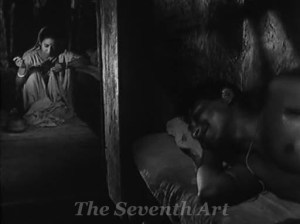
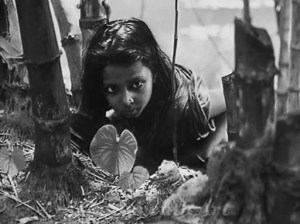 Based on a book by Bibhutibhushan Bandopadhyay, Pather Panchali is a series of loosely knit episodes in a poor Brahmin family in rural Bengal. Harihar (Kanu Banerjee) is a priest who also dabbles in play writing. His wife, Sarbojaya (Karuna Banerjee) manages the household and her two children Durga (Uma Das Gupta) and Apu (Subir Banerjee). There is also their old “aunt” Indir (Chunibala Devi) who loves eating the fruits given to her by Durga. Then there are their neighbours, the well-off Mukherjees, who share a love-hate relationship with their family. Mrs. Mukherjee helps out when Durga falls sick almost as her surrogate mother (as Ray hints early in his mise en scène) and Sarbojaya does the cooking in Mrs. Mukherjee’s daughter’s wedding. It’s a warm and isolated little world of theirs.
 The neo-realists strongly emphasized that the neo-realist filmmaker be just a passive observer of reality without imposing his interpretations on it. That whatever the situation of their characters, – glory or misery – the filmmaker must maintain objectivity, always subordinating reason to action. Although many of the staunch neo-realists themselves couldn’t achieve this complete objectivity, they did attempt to do so in theory. However, in Pather Panchali, Ray never claims to be a mere observer. It is true that he does not comment on the characters’ actions and situation or throw hints to the audience so as to tell them what to feel. But that does not mean Ray does not take a stance (or a neutral stance for that matter). Ray is biased for sure, but not towards his characters but towards life itself. He takes immense joy in infusing life on to the screen and providing a channel of hope to his protagonists. Quite in contention with the neo-realist theory, Ray does not hesitate using Pt. Ravi Shankar’s soundtrack generously (but not without much caution) or in concocting sequences with a tinge of humour.
 Like La Strada (another victim of the neo-realist baptism), that was as much away from its purely neo-realist contemporaries as it was close to them, Ray marries the neo-realist objectivity that avoids hyperbole and his own subjective view of life producing what may be, like Fellini’s film, called “neo-realism with a heart”. But again, Ray absorbs and deviates. Where, like many a film of later years, La Strada compares a road trip to life, Pather Panchali compares life to a road trip. Ray treats life as an inevitable journey which should go on no matter how shattering its events are. He punctuates his film with images of little roads through the woods and of characters arriving or departing from the village. In other words, Satyajit Ray presents life as a train journey where passengers may come and passengers may go, but the train itself never stops. Ray wasn’t kidding when he put that train in Pather Panchali – a train that Durga never manages to get on and one that Apu would, in Aparajito (1957), my favorite film of the trilogy.
 Mrs. Mukherjee confiscates the family’s grove as a penalty for the failure of repayment of loan. Later, the people of the village persuade Harihar to stay and tell him that this place is their ancestral land. It is as if the people of the village have assumed the land to be theirs despite of the fact that it was already there much before them. Ray touches upon the conflict between man and nature that has been dear to so many filmmakers before and after him. And this is where Pather Panchali gets deeper than meets the eye. Exactly like Herzog would do in
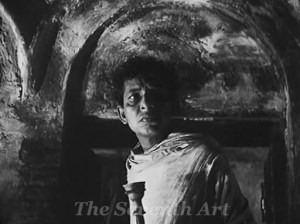
  Sansho the Bailiff cuts back to the last millennium to tell the tale of Zushio and Anju, children of a deposed governor whose only mistake was compassion towards his subjects. With the governor forced into exile, the children and their mother have to make their way into the neighbouring country, along with their faithful maid. But it is fate that decides their course and they find themselves separated into and by islands in no time. Mother is traded as a courtesan and the children sold as slaves to a rich man named Sansho. Years pass by as the kids assume a new identity. Zushio seems be moving closer to Sansho’s principles than his fathers’, mirroring Sansho’s son who refuses to take up his father’s job and becomes a monk. The only hope for his redemption lies in his sister’s faith in better times and in his own memory of the past.
 Mizoguchi, technically handicapped in comparison to Kubrick, gloriously achieves the same effect and, more importantly, in a decidedly “Japanese” fashion. As clarified in the opening quote (“This tale is set during the late Heian period an era when mankind had not yet awakened as human beings. It has been retold by the people for centuries and it is treasured today as one of the world’s great folk tales, full of grief.”), Mizoguchi, too, proclaims that the story is of the past – over and done with, its outcome fixed. Again, within the film he furnishes detail using direct flashbacks or visual fragments from the past. Contrary to Kubrick’s motionlessness, Mizoguchi’s camera tracks, pans and rises in a spectacular fashion (the shot in the manor after the slaves over is strangely reminiscent of
  The only hope that Mizoguchi presents in the film is by situating the tale in the past – by providing an apparent relief that all the pain and suffering is over and humanity has been discovered (“…an era when mankind had not yet awakened as human beings.”). But reading the opening quote once more, one can feel a strong vein of sarcasm running through. Is Mizoguchi decidedly making it a period drama? Or is there something more “present” to the tale? To clarify my doubts, I looked up the internet about the situation in post-war Japan. Not very surprisingly, I discovered that there indeed were atrocities committed by the occupying forces in the country during the post-war period and also a foundation known as
  The Seventh Art