[The following is a translation of a set of letters between Raymond Bellour and Marie Redonnet on Satyajit Ray’s Days and Nights in the Forest (1970), originally written in 1993 and published in Bellour’s Pensées du cinéma (2016, P.O.L.)]

It’s always strange to walk out of a film with another person when we don’t know them well enough to be sure (a dangerous certainty) that they are thinking what you’re thinking. Especially when the film surprised you, took unexpected turns that you felt you followed well, and you don’t know if the other person, who might not have the same relation to cinema, reacted to the film in a similar way, or will at least use similar words to describe it.
Here, on the other hand, was a certainty, still a silent one: we liked the film. Terribly so: it left us speechless for a while, but we knew we’d have time to discuss it in the evening (a civilized ritual around the 8PM screening: have the dinner after the film in order to work on it slowly, privately, like an event that you don’t want to overload with other things, or digest at the wrong time).
Like all memories, of course, it later becomes something of a dream (I have always admired, with perhaps an excessive mistrust, those who are able to recount old conversations as if they had recorded them: are they so different from me, or do they implicitly embrace a mixture of truth and fiction? Or maybe they take notes immediately. But in that case, etc. etc.) I remember latching on to some references to articulate my surprise, to rationalize my amazement: this Satyajit Ray, who couldn’t apparently be more different, made me think, at least in his setup, of Rohmer (this was suggested to me by a friend of mine who loved the film and urged me to go see it right away), of early Fellini (I Vitelloni, for example), or even of Hawks (the fate of groups, the games of men and women, the transition from light to serious, the logic of plot reversals: the miraculous balance of “classical” cinema, modern though it is). In short, it’s still about the Rules of the Game between ethics and aesthetics (now that I’m writing (to you), I recall that Ray had assisted Renoir on The River).
I perhaps told you this, we thought it was really extraordinary that we could prepare for this transformation, that we could retain all the trivial elements of this story, as though suspended in a fishing net, in order to fully make use of them, in the form of a viewer memory, when the story veers, first slowly and then suddenly (that’s where the dexterity, the miracle lies), into the tragic, assuming a sweeping density by endowing its four merry men with a touch of fate.
We didn’t need to recount the film to each other at that point because we had just walked out of it, but we have to play that (minimal) game here. It’s not wholly true though: we did recount it in way, in order to pinpoint the moments in the film that had struck us and to arrive, unwittingly, at what had transfixed us.
So I’ll recall the crux here: four friends leave Calcutta to spend some time in the countryside. Two of them, familiar actors in Ray’s films, look like respectable executives; the third is a famous sportsman (he’s the only one with a backstory, presented through a really unexpected flashback that occurs during their journey, in the middle of their banter, signalling the future course of the film: his girlfriend has left him brutally following a mediocre, incriminating letter from him.); the fourth is the joker of the gang. They move into a forest guest house after bribing its watchman. There’s another house nearby, and the men get to know the family living there: father, daughter, daughter-in-law and her young boy. There are also women of the village, Duli being one of them. The film tells the story of these four bachelors who are out seeking adventure, going around these women towards whom their desire remains vague, only to turn concrete before their imminent departure: Sekhar, the jester, doesn’t get anyone; the sportsman Hari is committed to Duli; Asim to the daughter, Aparna; and Sanjoy to Jaya, the daughter-in-law (I checked these names in Charles Tesson’s book on Ray).
We were hardly interested in Hari, I think, except in order to notice what was extreme about the beautiful native (Duli) who sells herself, who is of a sensuality at once raw and perverse, mastered and uncontrolled, but very autonomous in any case, during the love scene in the forest, the only scene of lovemaking, of which the hero ends up being the victim (after the young woman leaves, he is assaulted by a villager whom he had unjustly accused of theft: the villager had observed the scene, which thus becomes more intense)
But the impression left by the scene fed into what we were constantly thinking about: that here was an extraordinary film on men and women, extraordinary because of the stance taken by a man to show the superiority of women when it comes to intelligence and behaviour in romantic relations.
We soon arrived at the great scene between Asim and Aparna, which could appear to be the most beautiful moment in the film. The groundwork for it is laid by two previous scenes thanks to which the film takes a turn and speeds ahead: a memory game in the forest in which Aparna crushes everyone, Asim in particular, the only one who puts up a fight; and a visit to the local fair, during which the group splits into three couples, with the sensual counterpoint of traditional dances to go with it—it’s audacious of Ray to film these female bodies so modestly and so sensually, to show them in harmony with the couples trying to find their feet.
We were amazed by how Aparna’s character, quite enigmatic so far, somewhat charming but sarcastic and rather removed, bursts out with a contained violence towards a half-flirtatious, half-romantic and mostly childish man, to whom she nevertheless imparts a consistency because she confides to him: her ability to memorize everything since early childhood, her brother who killed himself three years ago seemingly without reason, her mother who set herself on fire when Aparna was twelve. All this to explain her distance, her inability to enter the game of explicit seduction and her marked singularity (I thought so later, I think so now: is this Ray’s romanticism, an idealism that bestows the woman with an extra bit of aura and depth? Or as we originally thought: the naivete and vulgarity of men with their simplistic, dull desire—or, at least, the image they give of that—which rejects not only what is singular in a woman’s desire, but also the identity proper to a mutual desire, its only chance of being shared.)
But we hadn’t yet come to the scene that became, for us, the scene—that’s why we wanted to see the film together the next day, to freely write a few pages each to prolong the memory of what we discussed that evening, before, during and after the sad result of the elections (I’m looking at this obscene image on channel 2 again, enough to singlehandedly condemn television, which can never be cinema: between Madelin and Longuet, presentable forty and fifty somethings passably done up, stands a pulpy student of twenty-three years, fleshy lips and long hair, supposedly representing French youth and especially showing the desire they may have for her).
I think it was I who stopped suddenly at the scene that was hiding beneath what we had discussed before, like how one stops before an evidence: I told you that we’d just witnessed one of the most violent scenes of desire that cinema has ever offered. Until this scene, Jaya seemed, in contrast to her sister-in-law, a rather simple character: a sociable, cheerful woman (we have just learnt of the suicide of her husband from Aparna, but our attention doesn’t shift to her). Jaya returns home with Sanjoy from the fair to which he had accompanied her; she offers him coffee; they are alone in the house, where Ray has set up a muted but very charged lighting scheme that tightens the space. Jaya goes into her bedroom for a moment (there’s a fluctuation of memory here stemming from one of those loose ends characteristic of great mises en scène) and comes out of it transformed, covered with jewellery bought with Sanjoy at the fair. She offers herself with an absolute immodesty that reinforces what she recounts: the death of her husband, widowhood, the wife’s desire expected to vanish with her husband’s death. Sanjoy listens to her in silence, terrified. He is unable to take a single step towards her or make even one of the gestures he evidently imagined and looked forward to; he can only clam up. The more Jaya’s desire saturates the space the more thoroughly Ray’s sequencing withdraws into itself, so as to suddenly limit the whole world to what is happening—or rather, what is not happening—between this man and this woman.
That is where we began to feel differently. I was with Sanjoy, lost, understanding of his terror, projecting something of myself onto the character without knowing where each of us was, caught in a vague no man’s land. I told you how, when confronted with certain bodies, bodies that are too strange but whose strangeness is fascinating, a kind of imaginary madness opens up; I guess everyone has his own, which he recognizes the day it happens (this is amplified for me here by the evident otherness of the Indian woman that Jaya embodies so strongly: heavy, somewhat fleshy body of a glowing sensuality that doesn’t coincide really with the material body and induces a disorder, a dissociation between seeing and touching, or even between two modes of seeing, two modes of touching, which we’d prefer keeping apart). You seemed surprised by this male thing; and you spoke to me about the woman. You told me (I couldn’t think of it that way): a woman can offer herself like that only in order to want to not be taken. She remains in her mourning, which she bears tragically, which she exhibits, to the point of obscenity. This excess she indulges in is what protects her; this excess in which the other is nothing, can’t project himself into, for she desires him in a dead man’s place, as though to prove to him that he has no place there. Writing to you, I wonder if it’s this very intuition that Sanjoy has, considering that his terror mounts to such a degree: the fear of being denied, like the fear among women, as they say, when they can’t tolerate a pure, immediate physical desire. The harrowing magic of the scene, which we must see again to know more about, at least on the means of producing such a shock, could be in not letting either the man or the woman, who are trying to talk to about it like us, decide whether there’s a shade of comprehension or an opacity in what surfaces and dramatically stops between a man and a woman, whether either of them is aware of the horror they provoke in the other or whether these two horrors simply coexist in a space that has become, either way, unbearable.
R.B.

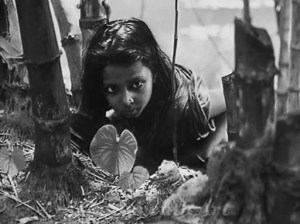 Based on a book by Bibhutibhushan Bandopadhyay, Pather Panchali is a series of loosely knit episodes in a poor Brahmin family in rural Bengal. Harihar (Kanu Banerjee) is a priest who also dabbles in play writing. His wife, Sarbojaya (Karuna Banerjee) manages the household and her two children Durga (Uma Das Gupta) and Apu (Subir Banerjee). There is also their old “aunt” Indir (Chunibala Devi) who loves eating the fruits given to her by Durga. Then there are their neighbours, the well-off Mukherjees, who share a love-hate relationship with their family. Mrs. Mukherjee helps out when Durga falls sick almost as her surrogate mother (as Ray hints early in his mise en scène) and Sarbojaya does the cooking in Mrs. Mukherjee’s daughter’s wedding. It’s a warm and isolated little world of theirs.
 The neo-realists strongly emphasized that the neo-realist filmmaker be just a passive observer of reality without imposing his interpretations on it. That whatever the situation of their characters, – glory or misery – the filmmaker must maintain objectivity, always subordinating reason to action. Although many of the staunch neo-realists themselves couldn’t achieve this complete objectivity, they did attempt to do so in theory. However, in Pather Panchali, Ray never claims to be a mere observer. It is true that he does not comment on the characters’ actions and situation or throw hints to the audience so as to tell them what to feel. But that does not mean Ray does not take a stance (or a neutral stance for that matter). Ray is biased for sure, but not towards his characters but towards life itself. He takes immense joy in infusing life on to the screen and providing a channel of hope to his protagonists. Quite in contention with the neo-realist theory, Ray does not hesitate using Pt. Ravi Shankar’s soundtrack generously (but not without much caution) or in concocting sequences with a tinge of humour.
 Like La Strada (another victim of the neo-realist baptism), that was as much away from its purely neo-realist contemporaries as it was close to them, Ray marries the neo-realist objectivity that avoids hyperbole and his own subjective view of life producing what may be, like Fellini’s film, called “neo-realism with a heart”. But again, Ray absorbs and deviates. Where, like many a film of later years, La Strada compares a road trip to life, Pather Panchali compares life to a road trip. Ray treats life as an inevitable journey which should go on no matter how shattering its events are. He punctuates his film with images of little roads through the woods and of characters arriving or departing from the village. In other words, Satyajit Ray presents life as a train journey where passengers may come and passengers may go, but the train itself never stops. Ray wasn’t kidding when he put that train in Pather Panchali – a train that Durga never manages to get on and one that Apu would, in Aparajito (1957), my favorite film of the trilogy.
 Mrs. Mukherjee confiscates the family’s grove as a penalty for the failure of repayment of loan. Later, the people of the village persuade Harihar to stay and tell him that this place is their ancestral land. It is as if the people of the village have assumed the land to be theirs despite of the fact that it was already there much before them. Ray touches upon the conflict between man and nature that has been dear to so many filmmakers before and after him. And this is where Pather Panchali gets deeper than meets the eye. Exactly like Herzog would do in
  I have hardly seen Satyajit Ray’s films and was apprehensive about taking up this book. I was afraid that it would require a prior introduction to films he talks about and especially to his own films. But as it turned out, I was completely wrong. Shubhajit


 Yes, the nominations are out and we have an interesting line up dominated by The Curious Case of Benjamin Button and Slumdog Millionaire with 13 and 10 nominations respectively. The Mozart from Madras A R Rahman gets 3 nominations – two for best original song and one for best original score. He may become just the third Indian after Bhanu Athaiya (Best Costume design , Gandhi (1982)) and Satyajit Ray (Honorary Oscar). Incidentally, another Indian, Resul Pookutty has also been nominated for the award in Best Sound Mixing category.
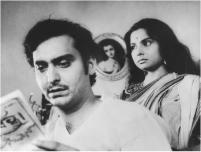 For a large part of the rest of the world, the name Satyajit Ray would immediately relate to the Apu trilogy and would probably stop at that. Ironically, a great number of his fabulous films have never reached the eyes of the Occident. Charulata (1964) is one such gem that never gets a mention when briefing the director’s work.
 The Seventh Art