[An edited version of the following text was originally published in Pardo, the Locarno Film Festival’s official daily magazine.]
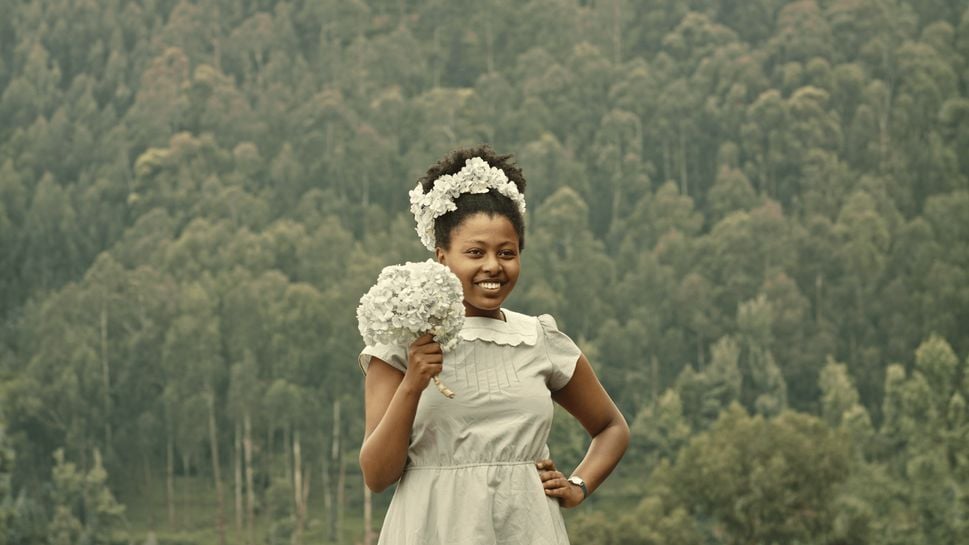
Strolling home through the countryside, insouciant teenager Eva plays mock bride, gathering white flowers to adorn her billowing hair. Her aunt warns her about the danger that lies buried in these parts. “Keep playing in those bushes, and you’ll say bye to those legs,” she cautions. In a few moments, Eva’s life will indeed turn upside down, but these landmines, remnants of the recent civil war in Rwanda, won’t have been the cause.
After her aunt walks ahead, Eva’s dreamy idyll is interrupted by a group of young men who whisk her away. Eva, now a kidnapped bride, finds herself in a suburban house, married to a functionary named Silas. If the casualness with which Eva loses her freedom is shocking, it pales in comparison to what follows. Deferring to tradition, Eva’s relatives advise her to accept her fate, which entails not just a psychological adjustment to her new situation, but also painful acts of forced sexual maturity.
Eva spends her days in silent protest, yielding to Silas physically but without an iota of emotional involvement. However, she finds solace in the company of Silas’s female cousin, residing in the same house, who informs Eva of the unfathomable trauma their family had to endure during the Civil War.
Bonding over a shared history of deprivation, the two women forge an empowering dynamic that oscillates between the maternal and the sisterly. As Silas’ cousin, Aline Amike cuts a wise, world-weary figure who navigates this male-centric world with a mix of resignation and caution. Sandra Umulisa’s Eva is the image of innocence defiled, her residual girlishness exorcised in agonising routines of precocious conjugality. Together, the women engage in nourishing conversations and rituals of mutual care, carving out a space of healing from the violent strictures of family life.
The premise of The Bride is the stuff of high melodrama, but in her assured debut feature, director Myriam U. Birara adopts a measured, pared back approach that keeps the temperature of the material in check. There is no musical score here to amplify the emotions, only occasional acapella vocals of a haunting quality. The austerity of the sound design makes Eva’s helpless cries all the more harrowing.
To the same end, Birara develops her scenes entirely in static shots whose simplicity belie their exquisite colour and compositional balance. Shot by Bora Shingiro in soft natural light and an earthy palette of browns and whites, the film keeps us at a critical distance from Eva even as it makes us intimately familiar with her predicament.

 The Seventh Art