March 2009
Monthly Archive
March 30, 2009
Posted by Just Another Film Buff under
All Posts,
Cinema of Germany,
Flashback | Tags:
1968 feature film,
Becker,
Best films of Werner Herzog,
German Cinema,
German film review,
Lebenszeichen,
Meinhard,
Signs of Life,
Stroszek,
The Unprecedented Defence of the Fortress Deutschkreuz,
Werner Herzog,
Werner Herzog's first feature film |
[4] Comments
Lebenszeichen (1968) (aka Signs Of Life)
Werner Herzog
German
“Dammit! This place is full of roaches. They’re not harmful. They are the most repulsive things on earth. They don’t even bite.”
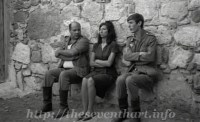
German master Werner Herzog has made more than 50 feature films and he is as intriguing as ever. His films, though he has requested people not to read too much into them, have made us raise so many questions about the world we live in. His first feature film Signs Of Life(1967) holds as many questions for us as does his recent Oscar nominated documentary Encounters At The End Of The World. Herzog’s natural affinity for documentary filmmaking shows as he presents the film in a cinema vérité style employing low-lying camera angles and without a soundtrack for most part of the film.
Signs of Life, at first glance, seems like an extension of his short film, The Unprecedented Defence of the Fortress Deutschkreuz (1967), which also followed a group of soldiers trying to take down a bunch of non-extant enemies. Here, Herzog presents us a soldier, Stroszek, who has been injured in war and has been relocated to a quieter place in Greece’s countryside for recuperation. He is put in charge of the defense of an isolated fortress housing 50 tons of ammunition along his Greek wife Nora and two other soldiers Becker andMeinhard. He spends the nights guarding the fort against nothing and the day time lazing around.
This radically new environment has variegated effects on the psychology of the three people who are used to bloodshed and constant unrest in the battle fields.Meinhard seems to rip apart every critter that comes his way and conjures up contraptions and techniques to eradicate the lesser creatures. Stroszek is petrified as he desperately looks for signs of life. He tries to invite a passing gypsy into the fort but is stopped by the probable-misanthrope Meinhard. He looks at Meinhard’s “victims” with childlike curiosity and even goes on to mentally animate the wooden owl that the gypsy presents him. And between these two people is the well-read Becker who tries to adapt himself to the milieu and stay flexible unlike the other two.
In the short film, the soldiers mention that it is an obligation for the enemy to attack and a defensive stance is equated to cowardice and desertion. They say that a state of passivity is just an illusion of peace and a delusory cover for barbarism that is to be unleashed. The soldiers in Signs of Life find themselves in a similar state of mind. They are supposed to guard an arsenal that they cannot use. The town that surrounds them is either made of toddlers or old men. The animals in vicinity are passive insects and lazy pets. Even the landscape is pacific yet carries a sense of foreboding with it. The walls of the fortress they defend are decorated with artifacts resembling human body parts (which may have been real human parts, considering what Becker tells us about the ancient Greeks). It seems like almost an insult to the soldiers that they have to defend the fort against dead partisans and a peasant crowd. And Herzog’s B&W cinematography adds to the barrenness of it all.
Why Signs of Life is all the more surprising is that the themes that would haunt the director and his works in the decades to come not only show their roots in this film but establish themselves with as much conviction as their descendants.Herzog translates his cynical view of Mother Nature and the inherent savagery that it conceals with its beauty using the landscape of the environment and of his characters’ mind that manifests itself through the bizarre acts they perform. We regularly see flora and fauna obstructing our view of the characters as if devouring them. There are bugs flying around he household irritating the soldiers.
It seems like Herzog is suggesting that humans and perhaps even the whole of nature is self-destructive to the core and would perish if not controlled by a higher order. Like the “cannibalistic” chicken in Even Dwarves Started Small(1970), Stroszek seems to be celebrating self-mutilation as he tries to hold explosives in his hand while they go off. This rage for self-destruction escalates to the point where he threatens to blow up the whole town with the stack of explosives under his control. This pervasive need to constantly expose oneself to danger may perhaps be the reason he opens fire at random in the first place. Now, once Stroszek is rendered a threat for the greater part of the human community, it is up to higher establishments of the society – Law and Science – to bring him down and save the town. Is Herzog suggesting that slavery is the only way of survival? Are we all subconsciously Darwinian in the way we tend to trivialize the lives of lesser beings? I don’t know, but Herzog sure does know the knack of both entertaining us and making us think.
March 25, 2009
Posted by Just Another Film Buff under
All Posts,
Books,
Cinema of Germany | Tags:
Aguirre,
Bangalore,
Beat Presser,
Cobra Verde,
coffee-table books on cinema,
film books,
Fitzcarraldo,
Goethe Institute,
Herbert Achternbusch,
Invincible,
Lena Herzog,
My Best Fiend,
Peter Berling,
Stroszek,
The Starving Students Movers,
Werner Herzog |
[4] Comments
Werner Herzog
Beat Presser
JOVIS/ARTE Edition, 2002
 Last month, the Goethe Institute – Max Mueller Bhavan, Bangalore organized their biggest film event since the Michael Ballhaus/Rainer Werner Fassbinder retrospective in June last year. This one was a photo exhibition titled “Werner Herzog: film has to be physical” followed by a ten film retrospective of Werner Herzog (eventually pruned to nine). Jovis Publication’s book Werner Herzog serves more or less as a collection of these photographs and as an excellent coffee-table book if you are planning to start a cinema themed restaurant. With translations in both German and French placed alongside the English text, the book cleverly positions itself to cater the home crowd, the “cinema people” and the rest of the world.
The book is completely photographed and edited by Beat Presser, who has collaborated with Herzog on multiple films as a still photographer. The book (and the exhibition) predominantly presents photos from three of Herzog’s films in which Presser worked – Invincible (2001), Cobra Verde (1987) and Fitzcarraldo (1982) – though there are quite a few snapshots from some of his other films too. With almost an equal number of monochromatic and colour photos (some spanning two sides too), the collection is a visual treat that not only takes us back to the experience of watching the director’s films but one that enhances the mystery that surrounds Herzog and his work.
Interestingly, the photo-exhibition at the Goethe Institute, Bangalore was the same one that Herzog himself visits in his documentary My Best Fiend (1999) as he chats away with Presser. And the book retains most of these photos in good resolution. Unfortunately, the best few photographs of the exhibition (including one from Stroszek (1977) that clearly stands out among the pictures in the collection) that oozed brilliance with their eye for the dynamic and static components of the photographic image are left out. But not all the photographs grab your attention. There are some seemingly offhand pictures – dull and unimaginative to say the least – that seem like fillers alone. But barring those, the photographs in the book clearly indicate the physical energy that Herzog summons upon his set during the shoot (Herzog himself is captured holding mining and trekking tools many times).
It is common knowledge that Herzog believes that film making is the stuff of brawns and not brains. That an atmosphere, an event or a visual force has to be personally experienced before it can be filmed. With a perspective of cinema (and life) that straddles probable lunacy and profound wisdom, Herzog’s working methods and ideas have often been elusive. What remains clear is his unassailable belief on the physical over the metaphysical and his support for the experiential over the theoretical. This book (and the exhibition at the Embassy) attempts to elaborate upon this principle of Herzog using the photographs. In these pictures that alternate between spontaneous and posed, we see Herzog himself performing the very many physical acts that occur in the three movies that the book covers. Be it the lifting of beer barrels like Zishe of Invincible or the running around during the shoot of Cobra Verde or even the interaction with his actors, one can easily see how this conviction in the physical realm is very important for Herzog when he films something.
The Arte Edition intersperses these photographs with prose and anecdotes written by people who have lived and worked with Herzog. There is Lena Herzog’s short yet fantastic section “Werner” that tells about the minor incident that sprang up (two years after Fitzcarraldo hit the screens) when the couple were shifting houses. Apparently, the guys from the moving company – The Starving Students Movers – upon seeing the couple’s names on the front door asked if they had to move a boat! Then there is playwright Herbert Achternbusch’s bizarre write-up “In the Beginning was the Word” about his reverence for Herzog for the way his life has shaped up. And then there is Peter Berling’s articulate section “Memories of Working with Werner Herzog” that recapitulates his experience during the shoot of Aguirre, the Wrath of God (1972). But all these essays play second fiddle to the paradisiacal images that occur regularly in the book.
This is the only photo-book I’ve read – based on cinema or otherwise. So I can’t exactly say how this one fares in comparison to similar books based on other celebrities. If you really want to know about the director and his methods, this is clearly not the book for you. However, if you want to program a cinema event of sorts based on Herzog’s films or to be the ultimate fanboy of the director or just to decorate your film library, this one might be a very good option. Oh, I haven’t given you the killer yet. This coffee-table book is generally priced at $35. In view of the exhibition and the subsequent retrospective, the Embassy offered the book for $3. Now that’s what I call a steal!
Verdict: 


P.S: Thumbnails of some of the pictures here at Kinski’s site.
March 21, 2009
Posted by Just Another Film Buff under
All Posts,
Cinema of Germany,
Flashback | Tags:
Aguirre,
Burden of Dreams,
Fitzcarraldo,
Klaus Kinski,
Les Blank,
Moving a ship,
Peter Berling,
Thomas Mauch,
Werner Herzog |
[4] Comments
Fitzcarraldo (1982)
Werner Herzog
German
“It’s only the dreamers who ever move mountains”
 If the judgment criteria for a film included the way it was made and the circumstances under which it was pulled off, Fitzcarraldo (1982) perhaps would rate as the best movie ever made. The Reason? Take a look at the outstanding documentary on the making of Fitzcarraldo – Les Blank’s Burden of Dreams (1982) – and see if you can believe it. Watching the making of Fitzcarraldo is like watching Picasso paint in Clouzot’s The Mystery of Picasso (1956) as we practically witness the work of art take shape through an array of improvisations and brainwaves and burst out into its moment of glory. One begins to wonder if the final product alone is sufficient while assessing an artist or if the tools and means of its creation should be considered too.
I may sound like appreciating the making of the film more than the film itself. But that in no way takes the credit away from Fitzcarraldo as a standalone piece. Some consider it as Herzog’s best film. Clearly, it is up there with the likes of Stroszek (1977), Aguirre, The Wrath of God (1972) and a few others. Fitzcarraldo follows the titular character’s larger-than-life quest to harvest rubber from a practically isolated plantation in order to make money to build an opera house. The central activity involves the towing of a gigantic ship from one Amazonian tributary onto another with the help of the supposedly savage natives. The story and the one behind it are legends by themselves and I would like to just add whatever we see on-screen is indubitably autobiographical – not in the physical sense, but the emotions underneath.
Fitzcarraldo is clear evidence that Herzog has this natural inclination to stage operas. Even though he would argue against bringing ideas of opera into cinema and vice-versa, Fitzcarraldo comes out as a grandly staged opera with its own exhilarating crescendos and chilling decrescendos. Herzog direction percolates into as far as his locales that seem to have taken a demonic life of their own. The ever-shocking Kinski in tandem with that element of Herzogian mystery are sure to haunt you long after the film has ended.
March 14, 2009
Posted by Just Another Film Buff under
All Posts,
Books,
Cinema of India,
Review | Tags:
Ankur,
Duvidha,
film book review,
film books,
Garam Hawa,
Maya Darpan,
Our Films Their Films,
Satyajit Ray,
Satyajit Ray books,
X Our Films Their Films review |
[18] Comments
Our Films Their Films
Satyajit Ray
Orient Longman, 1976
Surely, God is not a socialist. Why then would he bestow so much talent upon a single person and deprive the rest of the artists of country of any comparable finesse? Be it Japanese architecture, German music, English literature, Chinese paintings or world cinema, Satyajit Ray’s knowledge of the seven arts is everything a connoisseur could ever desire to have. And his book Our Films Their Films clearly shows why a true love for cinema is the only pre-requisite to be a filmmaker.
 I have hardly seen Satyajit Ray’s films and was apprehensive about taking up this book. I was afraid that it would require a prior introduction to films he talks about and especially to his own films. But as it turned out, I was completely wrong. Shubhajit here recalls how this book single-handedly induced him into the film culture. Why not? Our Films, Their Films is a rare book that works two ways. I can’t imagine any other book that is as interesting for strangers to cinema as it is for the film buffs. Ray never does it like an academic scholar churning out one jargon after another nor does he go too low-brow elucidating every shred of observation. Ray’s tone is conversational and at the end of the book, one does feel like he has spent a good few hours with an interesting man.
The book could be plainly called a bunch of essays by Ray assembled in a chronological order. But surely, it can pass off as so many other things too. Each of these articles has the charm of a short story, the depth of a critique, the personal quality of a diary entry and observations of a great essay. With a language that is neither overpowers the content of the text nor undermines its quality (which I think is true of his films too), Ray sets a standard for not only analytical but also for the verbal component of film writing. No wonder he also stands out as one of India’s key literary figures.
Cinematographe has this to say about the book: “The originality of Ray appears in an indirect manner: whilst talking about others, he offers us a subtle self-portrait“. This is so true. The essays in the book gradually and subtly unravel Ray’s perception of cinema and what he believes makes for great filmmaking, all of which reveals itself through the very many critiques of world films he presents. But the fascinating part is that he never takes the role of a filmmaker when he writes these pieces. He could well have elaborated on what lens John Ford used or what editing instruments Kurosawa employed. But the sections where Ray presents his views of international films could only have come from a true-blue cinephile whose very love for cinema is infectious. Look how he presents his opinion on Kumar Shahani’s Maya Darpan (1972), Kaul’s Duvidha (1973), Benegal’s Ankur (1974) and Sathyu’s Garam Hawa (1973), which organically unfolds into a fantastic review of the films.
But what really swept me off my feet are the observations that Ray makes in these early essays, the last of which was written in 1974. These observations – their almost prescient and intensely accurate quality just goes to show how deep Ray’s understanding of cinema was – both as a person behind and in front of the screen. I’ll give you an example. Ray met Kubrick just after he had made Spartacus (1960). He recollects: “On the strength of his Paths of Glory (1957), Kubrick had seemed to me to be one of the white hopes of American Cinema. He had first rate technique, he had style and I had a feeling that he had also something to say.”. Not just that, his opinions of Billy Wilder, Antonioni, Kurosawa and many others prove to be bang on the money.
If one takes a survey of the favorite section in the book among those who have read, it would definitely produce variegated results, for each section has the power to top the previous, no matter what order you read them in. My favorite section in the book Problems of a Bengali Filmmaker (along with Calm Without, Fire Within and An Indian New Wave?) provides an answer to almost every question I have had about the state of filmmaking in India. But again, this is one opinion that may change even before I finish this review. An Indian New Wave? may be just the winner in the long run, I suspect.
Reading the very many experiences of Ray abroad, one is regularly surprised about the range of people he knows in cinema and the dream-like way they meet each other. Reading these is almost like hearing a splendid raconteur recollecting his road trips with wide eyes. But all that is only because he presents himself with such simplicity. And that is partly a reason that this book shines with honesty. I’m sure, there would be hundreds of pages written from the other side of these meetings that would really give an idea of this monumental figure called Satyajit Ray.
Verdict: 
P.S: Some essays of the book can be found here. Do read it. I think this book is a must read for film-geeks and not-so-film-geeks alike.
March 11, 2009
Jag Mandir: Das Exzentrische Privattheater Des Maharadscha Von Udaipur (1991) (aka Jag Mandir)
Werner Herzog
German
“Culture in India is a basic life-sustaining force “
 Jag Mandir is a quiet and often overlooked film in the vast oeuvre of Werner Herzog. Apparently, 20 hours of footage was shot that covered the whole fest and the film hardly presents us a twentieth of that. A native walking into the film in between may well fail to immediately realize that it is his country that is being shown and these are figures from the mythology of various sections of his nation. You might take if for a scene from a procession in Thailand or a sketch from festival from Africa or even a snapshot from the gala celebrations in Brazil. Such is the diversity it presents that it reminds us of those clichés about Indian culture.
Werner Herzog’s Jag Mandir begins with an extended take of André Heller giving an introduction to the project (on which the film is based). He recollects his experiences organizing the folk-art festival called for by the Maharana of Udaipur, who the wishes that the succeeding prince sees the artistic diversity of the country before it succumbs to “mcdonaldization”. This is a mesmerizing section and Heller’s monologue contains observations that will leave you ruminating for a long long time. Being a native, I am always skeptic of westerners’ cursory probing of the country and the life-changing-experience it seems to give many. But Heller’s piece, though romanticized, gives everyone something to think about the way we live. The speech lasts for well over seven minutes and dissolves into the titles. Herzog then takes us back to the actual events which unfold without any demarcations between reality and fiction, as always with the director, The greater part of the film presents us footage of performances that run the gamut.
You have classical dancers in unison, street players wielding everything from swords to artificial horses, a man who lifts weights with his eyelids, a woman who balances a kid standing on a ten foot pole on her chin, a little girl who swings blazing torches with nonchalance and what not. It is highly likely the average Indian today hasn’t seen any of these folk art forms. The saddest and the most surprising part is that it looks like many of these art forms and skill sets aren’t seen around in the country today and may even have gone into oblivion without a trace. May be the Maharana’s nightmares have indeed come true.
P.S: Call it an obsession with a man obsessed with obsessions, but you’re going to be seeing more of Werner Herzog’s name on this blog. Trolls beware.
March 7, 2009
Posted by Just Another Film Buff under
All Posts,
Books,
Hollywood,
Review | Tags:
Alexander Walker,
Books on cinema,
books on film,
books on filmmakers,
film book review,
film books,
Harcourt Brace Jovanovich,
Stanley Kubrick,
Stanley Kubrick Directs,
Stanley Kubrick Directs: Expanded Edition |
[5] Comments
Stanley Kubrick Directs: Expanded Edition
Alexander Walker
Harcourt Brace Jovanovich (HBJ), 1972
A brief internet research about the best books written about the life and works of Stanley Kubrick gave me quite a few results with Alexander Walker’s Stanley Kubrick Directs (Expanded Edition) topping the list. Since there wasn’t any book called Kubrick on Kubrick, I had to go for this one! Stanley Kubrick Directs is literally a page-turner, for it contains more images than text. The book is divided into six sections – The Man and Outlook, Style and Content and four chapters dedicated to four of Kubrick’s most famous films.
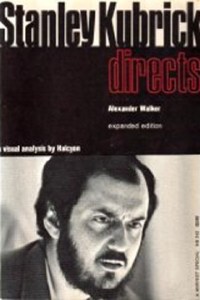 A friend once remarked that there was spirituality in the way Max Ophüls’ camera moved. I was reminded instantly of Kubrick then. But surely, not for the same reason. Kubrick’s tracking shots are anything but spiritual. I should label them “satanic”. These bewitchingly ominous shots, in my opinion, are the essential sequences from each of the films – be it in the French war trenches, in Korova Milkbar or aboard the Discovery space shuttle. And reading that Kubrick was impressed by Ophüls’ films forced a smile on my face. This is not the only reason that I find the opening section of the book – Stanley Kubrick: The Man and Outlook – fascinating. Walker presents us all of Kubrick’s preoccupations as a child and as a teenager and later establishes how the reverberations of these influences find their way to most of Kubrick’s films. As a film buff, it is rewarding to dig deeper into Kubrick’s films after reading these facts.
But Walker follows it up with the most disappointing of all sections in the book. In this section, titled Kubrick: Style and Content, Walker aims to present us the working methods of Kubrick. Unfortunately, this part turns out to be nothing more than a briefing of Kubrick’s early films, till Lolita (1961), interspersed with elaborations of some obvious facets of Kubrick’s films. Walker’s digresses without hesitation and adulterates the section with facets not in line with the chapter’s objective and analyses that at times seem downright speculative. As a result, this section seems like a poor excuse for a ramp up to Kubrick’s masterpieces that were to follow.
The book then presents us illustrated analysis of Kubrick’s Big 4 that followed – Paths of Glory (1957), Dr. Strangelove (1964), 2001: A Space Odyssey (1968) and A Clockwork Orange (1971). The first two films here take up two thirds of the analysis section and ironically are the least satisfying. Both the analyses of Paths of Glory and Dr. Strangelove are fraught with screenshots (by Halcyon) that are subsequently verbalized. Having presented the early influences of Kubrick, Walker should have let the audience connect the dots and interpret the film their own way. But he starts deconstructing Kubrick’s mise-en-scene frame by frame and strips us completely of the joy of discovering a film. No, I’m not cribbing, but it is a bit discomforting to see such great films presented cut and dried, preventing further exploration the reader may otherwise be tempted to perform. I know this is an analysis, but why at such grassroots level?
Surprisingly, Kubrick’s most profound film is given the least space. A big positive for this section is that it does not go over the top like many an analysis written on the film. Walker sticks generally to the technical and narrative aspects of 2001: A Space Odyssey and discusses “2001 that could have been” citing various choices made by Kubrick with respect to the script. However, it is dissatisfying to see the film grossly ignored in comparison to the earlier two films and sidelined to a smaller status. The film by itself warrants elaborate literature and any analysis should most definitely include the higher aspects it tries to encompass. Walker just grazes through those notions and it never looks like it is for the good of the audience.
But, comes the essay on A Clockwork Orange to salvage the book’s pride. This is the best of the four analyses and serves as a grand climax to an otherwise dissatisfactory book. This is one section that respects the complexity of the film but never once shirks discussion. Walker makes a great move by not just diluting the mise-en-scene by deconstructing it to particulars. He seamlessly integrates multiple ideas the film presents and provides us a solid critical analysis that clearly shines in comparison with the previous three. And it is this section that provides a sense of comfort when one closes the pretty ordinary book.
This book is widely considered the best book on Kubrick till date and that worries me. Kubrick’s canvas is visibly vast and if this is the best of literature available on him, there is a long way to go. Stanley Kubrick Directs does present considerable detail for people who are confused why he is the most critical Hollywood director on a technical level, but the treatment of the content of his film leaves a lot to be desired. May be I expected a bit too much.
Verdict:
Note: This is a section where I will be blogging on books on films and filmmakers. The entries will be far and few, but this will at least provide me an opportunity to read text – a thing that I used to hate till now.
March 4, 2009
Posted by Just Another Film Buff under
All Posts,
Cinema of Hungary,
Flashback | Tags:
Béla Tarr,
Cinema of Hungary,
cinema vérité,
Flashback,
Hungarian Cinema,
Hyderabad Blues 2,
Panelkapcsolat,
Scenes From A marriage,
The Prefab People |
[3] Comments
Panelkapcsolat (1982) (aka The Prefab People)
Béla Tarr
Hungarian
“What about those who are away for years? They never see their kids. The kids grow up with no dad. They grow up and the dad gets them ready-made “
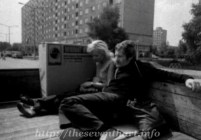 After watching films like Scenes from a Marriage (1973) and Hyderabad Blues 2 (1998), I had come to a kind of conclusion that films about marital life are and even have to be necessarily lengthy in order to depict relationships falling apart bolt by bolt. But Béla Tarr’s masterful venture The Prefab People brutally shatters that perception. The film is so masterfully crafted that I was afraid that Tarr would have to have a pathetic showdown in order to wrap up the film within 80 minutes. But gladly, one couldn’t have asked more after watching what Tarr delivers. He lets the film gradually evolve instead of providing it narrative momentum (but never without a direction). Watching The Prefab People, one can see why Mendes’ Revolutionary Road doesn’t exactly succeed.
The Prefab People is Tarr’s fourth feature and one can clearly see Tarr maturing as a filmmaker. He intelligently avoids all the mistakes of his previous outings (which were pretty good themselves) and makes it seem like a grand culmination of a chain of dress rehearsals. He substitutes the extreme verbosity of Family Nest (1979) with self-sufficient images. He sheds the self-indulgent meditation of The Outsider (1981) and makes a film that is universal in its appeal and as personal in its content. He avoids the complex mise-en-scene he employed in his mediocre single-shot adaptation of Macbeth (1982) and in exchange develops a keen sense of shot composition and cutting. One can virtually see where Sátántangó (1994) gets its pitch-perfect atmosphere from. But in spite of the trademark style of the director, The Prefab People is very much a cinema vérité film. It wouldn’t be a coincidence if one was continuously reminded of Cassavetes while watching this one. The resemblance is most glaring in the scene at the party, which has to be experienced to be believed.
These are beautiful characters and so are the actors. To use a worn out cliché, Tarr does not take sides. Both the husband and the wife have their own visions of what happiness is. Just that one is evidently naïve and the other is actually romanticized. But the masterstroke of the film is the Kubrickian theme of man and machine that Tarr blends in this outwardly boring suburban life. And just like the American genius’ style, Tarr controls his décor, landscapes and film equipment to provide a literature-free rendering of one of cinema’s most favorite themes.
March 1, 2009
Posted by Just Another Film Buff under
All Posts,
Cinema of France,
Cinema of Iran,
Cinema of Japan,
Flashback | Tags:
Abbas Kiarostami,
film tribute,
Five,
Five long takes dedicated to Yasujiro Ozu,
Five: Five long takes dedicated to Yasujiro Ozu,
Flashback,
humanist filmmakers,
Iranian film review,
jafar panahi,
Kiarostami,
long takes,
nature in film,
nature of cinema,
Yasujiro Ozu |
[6] Comments
Five Dedicated To Ozu (2003) (aka Five)
Abbas Kiarostami
Silent
“…”

Unquestionably, Kiarostami’s films are unlike any film ever seen, leave alone Iranian ones. But one film that is extreme and decidedly avant-garde even by Kiarostami’s standards – Five: Five long takes dedicated to Yasujiro Ozu (2003) – has turned out to be one of his finest works. In what can be described as a super-slow version of Koyaanisqatsi(1982), Kiarostami presents us five shots of the sea, filmed during various times of the day, at various distances and of varying lengths. Kiarostami quietly integrates the five elements of nature to create a film that is as warm as Ozu’s and as puzzling as his own, in a way, forming a singular connection between them.
The first shot shows us a piece of log lying on the beach as the incoming waves unsuccessfully try to pull it in. There is instant engagement here. I do not know about others, but I have spent hours watching such insignificant dramas of nature – the wind trying to knock off a fruit of a tree, a crow trying to pull out a twig that is stuck and the waves trying to sweep my feet at the beach. There is complete focus on the log and the incoming waves here. These are the only two components of the frame and these alone form the foreground of the image. Interestingly, this is the only segment where the camera actually moves in order to accommodate the object under consideration. Kiarostami shows us a very ordinary piece of event, but our mind conjures up a narrative of sorts – with its own formulation of safe-space and danger zones of the “narrative”. And things become complicated as the log breaks off and the larger part is swept off into the sea. Though completely unrigged, this “turning point” makes our attention shuttle between the drifting piece in the water and the struggling one on the beach. Is Kiarostami alluding to Floating Weeds?!
In the second one, we are shown the image of the sea as seen from an embankment on the beach. We are drawn into the horizontal waves that decorate the widescreen in the form of broad white lines. Gradually, we have people walking across in front of us pushing the sea into the background. People of all ages flood the screen in many amusing ways, regularly diverting our attention from the sea. There are even critters that wallow into the frame and easily gather focus. There is a feeling of watching a Béla Tarr film – but only in a sense. That is, in Tarr’s films, the dynamics of the foreground, though initially attractive, feel like clockwork after a while. Slowly, we sense the background – the still life – gathering a presence of its own and even imposing itself upon us. There is a feeling of intimidation and ill-omen whereas here, it works the other way round. The patterned backdrop is quite fascinating to start with, but as the humans start coming in the foreground, our attention is naturally devoted to them. We start studying them and even start expecting some new ones (I was hunting Jafar Panahi’s cameo). This segment ends the way it started – the sea alone occupying the stage.
The next shot presents us the sea sandwiched between the sky and land. This is shot from considerable distance and looks like a painting. It is early morning and there are dogs lying on the beach. Almost nil action takes place notwithstanding the stray movements made by the canines. Everything is in the background here as opposed to the previous two shots. Gradually, the contrast of the image starts reducing and after one point we are unable to differentiate between the sky and the sea. The shot fades to white after all the three elements of nature dissolve into one another.
The fourth shot is perhaps the most “interesting” of all. In a direct homage to Ozu’s style, Kiarostami places the camera at knee level and in close proximity to the sea. Soon, the screen is infested by ducks of various sizes, colours and gaits. This is the as close to comedy as the film gets. The ducks move at almost a fixed speed and their footwork seems like a musical rhythm. Suddenly, all the ducks that have gone past retreat as a bunch as if in a panic. The concentration is completely on the foreground here and the sea becomes no more than a comfortable backdrop.
The final shot lasts about half an hour and is the boldest of them all. It is night time and we can hear the loud croaking of frogs and barking of dogs. And it is only after a while we come to know that we are staring at the still sea. The reflection of the moon appears in a distorted way on the dirty surface of the water. Once more we desire the reflection to settle down to form the perfect circle. The notions of foreground and background are completely eliminated as the pulsating moon appears like a milk drop that falls into abysmal vacuum. And just when everything seems unperturbed, rain comes. The annoying frogs disappear and so does the reflection. Kiarostami has probably shot this in time lapse as the rain stops suddenly to restore the noisy atmosphere. The moon “settles down” and soon disappears behind the clouds. It is interesting to see that all the dynamics of the scene here is off-screen and their presence indicated only by the sounds they produce. We stare at nothing but dark blank space for most of the time but never once lose hold of what is happening in the film’s environment. A little later, we hear the rooster’s call and sure enough, bright sunlight strikes the image to reveal the clear blue water. This part is truly a revelation as one feels a fresh lease of life in the hitherto mundane and contemplative frame.
There is naturally a problem with a film that is as provocative as “Five”. How much of the content we derive out of the film is intentional? Was there a set of objectives for the director while filming the footage? Was every element in the mise-en-scene completely controlled by the filmmaker? Would the film have been different if each shot was prolonged or shortened? Here lies the classic tale of the emperor and his clothes. With a name as great as Kiarostami’s in the title cards, one directly gets ready to attach significance to the images, however banal they are. At the same time, it is but natural to feel awkward while watching such material. There is that absurd feeling of watching a Stan Brakhage film (I’ve seen over two dozen of his films and I must admit I can’t recognize most of them!) to the point of laughing at yourself. You get the feeling that Kiarostami is probably toying with his audience after all.
But surely, this isn’t anything like what Warhol did. Here is a filmmaker who understands what Ozu stood for and how big a responsibility the title of the film places on him. A filmmaker in the tradition of Ozu himself, Kiarostami does not go for cheap attention using complicated mise-en-scene and steady-cam shots. He doesn’t just see the world but observes it. He studies the relation between the various planes of the image. He experiments with the distance of observation and the range of emotions they evoke. In essence, he analyzes the subjective and objective components of the cinematic image never once losing the most important ingredient of his entire body of work – humanity. And that is why “Five”stands as a fitting tribute to one of cinema’s greatest humanists, by another.


 The Seventh Art