Director Priyanandan’s National Award winning Pulijanmam (2006) charts the efforts of a middle-aged, true-blue communist playwright Prakash (the recently deceased Murali Nair) who is about to stage a play based on a folk legend about a highly-skilled man, Kari, of the lower caste who defies god and enters the dark woods, assuming a tiger incarnation, to bring back tiger mane in order to cure the madness of the ruler. “Every generation takes what it wants from a story” says Prakash early on. For one, he sees himself as a reincarnation of Kari and the play as some sort of a self-portrait. History and mythology merge as Prakash finds his campaign against religion and against the ruling communist party’s decision to allow corporations to build resorts over farm lands to be increasingly similar to Kari’s inhuman crusade. Writers N. Prabhakaran’s and N. Sasidharan’s ambition to chronicle the fall of communism in one of the nation’s two most left-leaning states is palpable, but Priyanandan’s methods hurt the film beyond recovery. The director resorts to too much cross cutting, trying to thrust the parallel between the two stories down our throats and destroying the intrigue built up by the film’s first half-hour. The cinematography and composition is purely functional, with some flashes of brilliance to hold attention. Then there’s also the script’s tendency to cover too much ground and make a few social observations too many that stick out like a sore thumb. I must say it’s a tad disappointing to see this film being given the Indian National Award for best film over Goutam Ghose’s ideologically kindred and infinitely superior Yatra (2006).
“Your brother’s going away hasn’t changed him a bit. Such pride! Even your leaving will not shame him. He is as he was.”
Kumar Shahani remains one of the directors in that rarely seen and even more rarely discussed group of filmmakers that includes names such as Mani Kaul and M. S. Sathyu. Unfortunately, neither are there home video releases for most of their works nor are there widespread public screenings or film fest retrospectives within the country to generate interest. Heck, they don’t even make their way into the world of file sharing and peer to peer networks. We are now at a point where even the original negatives of the films face the risk of extinction. One can only hope that institutions like the World Cinema Foundation will do something about it. Kumar Shahani’s Maya Darpan (1972) is a seminal work in Indian Parallel Cinema not just because it canvasses critical social issues (a facet that, more or less, in hindsight, has become a characteristic of the movement) but also because it attempts to seek out a new aesthetic, which does not try to straddle mainstream cinema and art cinema, to do that. The very title, Maya Darpan (literally “Illusory Mirror”), aptly sums up both the film’s social (imprisonment by one’s own “image”, as defined by the class system) and formal (Maya Darpan could well be a sobriquet for cinema itself, encompassing both its illusive and realistic properties at once) concerns at once.
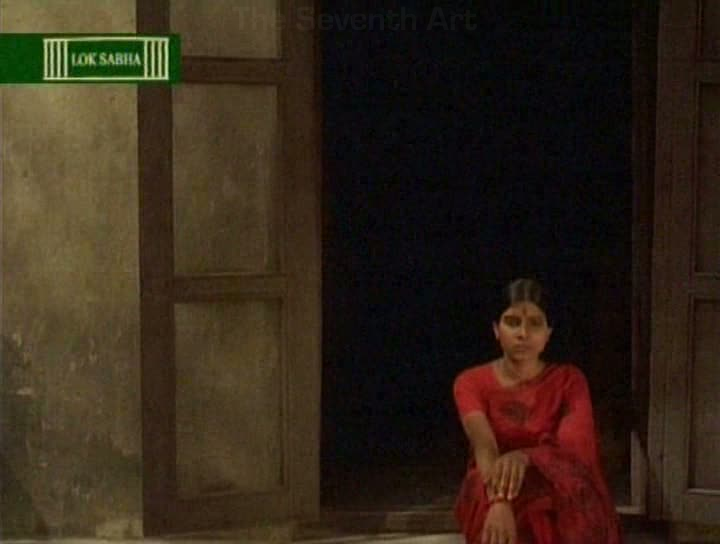
Shahani’s film is set in a provincial town in Northern India, at a time following the nation’s independence in 1947 (The film could well have been set in 1972, just after the worldwide leftist revolution had been put down, and there wouldn’t be much change to the script) when India was yet to be completely integrated as a political entity and when Nehruvian socialism was about to take on the existing feudal hierarchy. Taran (Aditi) is the daughter of a wealthy landlord (Anil Pandya) and lives with her father and her widowed aunt (Kanta Vyas) in their ancestral mansion (which goes on to represent the whole of upper class in the film). The town is witnessing protests by newly formed labour unions which are partly being politically educated by the local railroad engineer (Iqbalnath Kaul), who seems to have an unspoken romantic relationship with Taran. Taran’s unseen brother, who had, to the chagrin of their father, renounced his class privileges and gone off to an Assamese tea estate, asks Taran to join him. Stuck in a stifling patriarchal order, with pressure to get married to an upper class groom mounting, Taran decides to talk to her father about her plans. Actually, much less goes on in the film than what I’ve described and the film is more interested in assessing the formal possibilities of the medium than in following a seamless opportunity-conflict-resolution trajectory. Taran’s character does not arc in the traditional manner (she seems to have already entered the third act) although she eventually manages to switch roles with her lover.
Maya Darpan is a film about transition and transformation – from the bondage of regressive social structures to a progressive state of liberty and equality, from a setup where people have to assume rigid roles irrespective of free will to one where a individual can free himself of inherited roles and think for himself/herself (Taran recites a poem – “I’m called to birth again” – that recalls the legend of the phoenix, as she washes her hands). In other words, it is about the process of breaking the cycle of repression and exploitation into a zone of freedom (Shahani even inserts newsreels depicting World War 2 battle sequences and Gandhian protests during the British rule of India, perhaps to suggest all forms of oppression and subjugation). Shahani finds the cinematic idiom to express this cycle in the form of duplicated shots, redundant compositions and repeated actions and dialog. There are many shots that depict characters moving from the right edge of the screen to the left that are so schematic and mundane to the point of being humorous and self-parodying (One of Taran’s daily routines is to dust the set of chairs – presumably the symbols of power and authority in the film – that her father and other landlords use during their teatime. Fittingly, they are left scattered and disowned by her towards the end of the film). This transgression of social boundaries is also depicted by having characters cut through boundaries and cross railway tracks regularly. Consequently, Maya Darpan plays out like a piece of complex musical composition with many minute variations on a few primary motifs (The film’s unexpected coda itself is a set of classically choreographed tableaus that, I believe, presents the class conflict in dance/martial art form).
Shahani apparently assisted Robert Bresson on A Gentle Woman (1969) and the influence of the French director on Shahani’s style is obvious (especially the extraordinary opening sequence of that particular film, which is echoed at multiple places in Maya Darpan). Like Bresson, Shahani’s shot division has a tendency to break down sequences into their most basic components. Images of hands and feet, isolated in action, often punctuate the narrative. Also Bressonian is the use of sound in the film. Shahani employs tremendous amount of off-screen noise to complement the imagery rather than reinforce it (This divorce between image and sound is alluded to in the very first scene of the film – the nomadic camera, at first, seems to be searching for the voice on the soundtrack and eventually settles down near a sleeping character. The voice turns out to be non-diegetic). The presence of trains, automobiles, oxcarts and taps are all established by the soundtrack. In fact, the camera is never made privy to any sensational action. These actions are either relegated to the space off-screen or they are only provided to us through words. But the influence of Bresson is most palpable in Shahani’s use of his actors. He asks the actors, all non-professionals, to have no expression whatsoever on their faces when spouting their lines monotonically, without any modulation. The effect is all the more unsettling given how vehemently it goes against the natural speech pattern of the country.
As a result, Maya Darpan could be described as a film in which the sociopolitical concerns of Shyam Benegal and John Abraham are distilled through the minimalist aesthetics of Bresson (with a dollop of Resnais, Antonioni and Pasolini to boot). However, it should not be assumed that Shahani’s style is entirely derivative. Shahani’s Bresson influence is just the base upon which he works out his own ways. For instance, in Bresson’s films, conflicts would largely be kept internal and would very occasionally manifest in the characters’ physical actions. In either case, Bresson thoroughly remains a realist of space and time. Shahani, on the other hand, doesn’t hesitate to slip in the borderline-surreal elements. Large stretches of poetry and prose are recited by the characters on the soundtrack, which touch upon their psychology but abstain from analysis, while we see them wandering the barren, debris-filled streets of the town. Furthermore, Bresson’s characters have to go through a process of suffering before they can attain deterministic grace and happiness whereas Shahani’s protagonist is an active entity who chooses to change her life through conscious effort. Even the handful of comments online about the film mentions its innovative use of colour, which I find to be the least important aspect of the work. Shahani does this through the costume and production design of the film, which doesn’t exactly seem to succeed throughout.
Satyajit Ray once commented about Maya Darpan, along with other acclaimed works of the period (almost all of which he was critical of!), in his collection of essays Our Films, Their Films. I’ll type it down here:
Shahani’s other allegiance [in addition to Ritwik Ghatak] is to Bresson with whom he had worked on a film. The legacy of that lesson is to be seen in the girl in the centre of Mayadarpan [sic]. She, too, like Mouchette, suffers inwardly and wordlessly. No quarrel with that. But we are concerned with what happens outwardly. And here, I am afraid, Bresson evaporates. Does Shahani seriously believe that the major outward manifestation of such suffering is a slow, rigid ambulation up and down verandas repeated every five minutes or so throughout the film? Film language would be threatened with extinction if this were really so. To me Mayadarpan seems a combination of poor psychology and poorer stylization. Even the sophisticated response to colour goes for nothing in a film that is so gauche in its handling of the human element. Even more than [Mani] Kaul, Shahani seems to forget that when one imposes a rigid style on the actor without a thorough working out of its expressive possibilities, it becomes indistinguishable from bad acting. The method becomes, extremely risky in a story with an urban background, where the nature of life and work severely limits the expressive gestures. The only possible approach here is the psychological one, for which Shahani seems to have no use.
While I would not be so harsh and unforgiving about Shahani’s film, I do believe Ray makes some fine points there. Shahani sure does seem to be on an experimental ground, trying to figure out the most effective means to get his points across. Not all his flourishes work and there are a number of rough edges to the film. Some shots seem o serve no purpose except perhaps to further disengage us from the already alien narrative. But it would be a tad unfair to say that Shahani eschews psychological exploration altogether. True that he does not work towards psychological realism through the conventional means of writing, acting and scoring. His psychological examination is, akin to Michelangelo Antonioni, carried out through actor choreography, his compositions and his mise en scène (and, to a minor extent, through the poetry-driven non-sequiturs that brace the narrative). Taran is almost always composed against the mansion’s walls and amidst the imposing interiors of the building. She is arrested and suffocated by the endless amount of doorways and pillars in the mansion. During the course of the film, it’s as if the monstrous structure assumes a life of its own, consuming Taran into the void within. This is starkly contrasted with the lush and open spaces of Assam and of the working class section of the village. The bottom line is that, if not anything else, films such as Maya Darpan are of considerable interest to the native viewer since they repudiate accepted norms of psychological realism in a country whose cinema has always thrived on those norms.
Lavrente Indico Diaz is a multi-awarded independent filmmaker who was born on December 30, 1958 and raised in Cotabato, Mindanao. He works as director, writer, producer, editor, cinematographer, poet, composer, production designer and actor all at once. He is especially notable for the length of his films, some of which run for up to eleven hours. His eight-hour Melancholia, a story about victims of summary executions, won the Grand Prize-Orizzonti award at the Venice Film Festival 2008. His work Death in the Land of Encantos also competed and represented the country at the Venice Film Festival documentary category in 2007. It was granted a Special Mention-Orizzonti. The Venice Film Festival calls him “the ideological father of the New Philippine Cinema”. As a young man, Diaz was particularly inspired by Lino Brocka’s Maynila: Sa Mga Kuko ng Liwanag, describing it as the film that opened his eyes to the power of cinema. Ever since then, he made it his mission to make good art films for the sake of his fellow Filipinos. His body of work has led critics to call him both an “artist-as-conscience” and the heir to Lino Brocka. Diaz has also been compared to other great Filipino directors such as Ishmael Bernal, Mike de Leon and Peque Gallaga, whose films examined the ills of Filipino society (Image Courtesy: Rotterdam Film Festival, Bio Courtesy: MUBI)
Filipino director Lavrente Diaz is a very versatile artist. He started out as a guitarist (He recently released a music album to accompany his latest film), then wrote plays and short stories for television (a period he seems to hate, as is made clear in his works), later started writing poems (the poems that feature in his films are written by him) and then, in the early 90s, decided that he’ll be a professional filmmaker. The later films of the director present the same kind of problem to both commercial multiplexes and film festival screens – their length. His last four feature films have a total run time of around 36 hours! Diaz believes the long length of his films is an extremely crucial part of his aesthetic and radically alters the way in which the audience converses with his films. There is another specific problem in screening Diaz’s films world wide. That he is a very “Filipino” filmmaker. All his works are deeply rooted in the country’s history and politics. Any attempt to view the films in a de-contextualized manner is only futile. That makes Diaz one of the most uncompromising of directors working today. Diaz’s greatest ambition, as it seems, is to change the Filipinos’ (and rest of the world’s) perspective of their country and culture (He tells: “For me, the issue is: if you’re an artist, with the state the country is in you only have one choice – to help culture grow in this country. There’s no time for ego, you have to struggle to help this country. Make serious films that even if only five people watch it, it will change their perspective. You may make big box office but what do the people get out of it?”).
What is really striking about Lav Diaz is how vocal and frank he is about his ideology and his works. Most of modern mainstream auteurs and even festival regulars shy away from commenting on their work or on the ideas they present. Some of them bury their political concerns so deep within their films that they may simply be overlooked. Diaz, on the other hand, is like an open book. In all his interviews, he is always willing to discuss his films and explain what they deal with. None of this actually dilutes the impact of the films or the complexities they contain. Instead, it only opens up a wider and more pertinent band of response to the film. Furthermore, Diaz is also very transparent about his political views and even his personal life (His story is exactly the kind of success yarn pseudo-liberal Hollywood studios are looking for. But one sure has to appreciate the man for what he’s gone through and what he’s become). To say that he feels strongly against the Ferdinand Marcos’s rule of The Philippines till about two decades ago would be an understatement (“He siphoned the treasury as well. He got everything. No matter what they say, he stole everything – the money, our dignity. It is true. Marcos is an evil person. He destroyed us. The hardest part was that he was Filipino”). Diaz is also very optimistic about the role artists play in a political revolution and this belief directly manifests in his films in the form of artist figures present in the narrative.
I’d say that Diaz’s aesthetic stands somewhere in between Contemporary Contemplative Cinema and conventional documentary. Like the former, he prefers long takes shot from at a considerable distance, avoids the use of background music, includes stretches of “dead time” in his narrative and relies on mood and atmosphere more than exposition or psychoanalysis. He employs parenthetical cutting that allows a shot to run for more duration than the length of the principal action, but cuts soon enough to avoid the shot to parody itself. Unlike Contemporary Contemplative Cinema, there are long stretches of dialogue in the vein of early Nouvelle Vague films and the politics the films deal with are much more concrete. All his recent features have been shot in black and white as if they are historical documents and as if the vitality of its characters has been sucked out. His use of direct sound goes hand in hand with his use of digital video, which enables him to experiment with long shots. It is only in a blue moon that he uses close-ups and all his medium and long shots come across as clinical observations of his characters’ lives. That doesn’t mean his films lack empathy or compassion. But the way he generates them is more distilled and uncontrived. He composes in deep space and allows the viewer to get a complete sense of the film’s environment and time. He says: “There’s no such thing as the audience in my work. There’s only the dynamic of interaction. And in time, that dynamic will grow. The greatest dynamic is when people want to see a work because of awareness and they want to experience it; and in so doing, they may be able to discover new perspectives or just put these perspectives into a greater discourse.”
(NOTE: I’ve written here about all the films of Lav Diaz that I could get my hands on. However, I haven’t been able to see any his earlier works or his short films. I’ll append the entries for the missing films here once I get to see them)
Serafin Geronimo: Ang Kriminal Ng Baryo Concepcion (Serafin Geronimo: The Criminal Of Barrio Concepcion, 1998)
Diaz’s debut, Serafin Geronimo: Criminal of Barrio Concepcion (1998), even without the burden of its successors, is a poorly made piece of cinema. It’s got all the trappings of a bad student film – laboured acting, ill-advised cuts, unwarranted zooms and an occasionally bombastic score – that only worsen its low production values. Very loosely based on Fyodor Dostoevsky’s Crime and Punishment, Serafin Geronimo chronicles the titular criminal’s act of sin and his subsequent confession and redemption. Diaz chooses to externalize the moral conflict of the protagonist through a dental infection whose pain seems to grow unbearable. Additionally, there’s a lot of gratuitous violence – graphic and described – in the film (even in the censored version) that underscores the savagery of the world Serafin (Raymond Bagatsing), like Hesus, is caught in. Evidently, like the Russian author, the film wants to observe human suffering in all its brutality. But what the film does not seem to understand is that human suffering can’t be captured on film by merely recording mutilated bodies or the physics of their destruction. Such documentation must attempt to record the death of the soul – the internal through the physical – as well (Compare this film with the sublime, genuinely Dostoevsky-ian passage depicting Kadyo’s demise in Evolution). However, the scenes at the countryside, set in the past, are executed with certain affection and restraint. Diaz pushes his political ambitions to the background as the quest for personal justice and redemption takes precedence here over national issues. The use of curious, hand held camera and the staging of action in deep space during indoor scenes are few of the traits that would be carried over and refined in Diaz’s later, superior works.
Hesus Rebolusyonaryo (Hesus The Revolutionary, 2002)
Hesus the Revolutionary (2002) is set in the year 2010 and follows the titular resistance fighter (Mark Anthony Fernandez) whose loyalty and ideology are put to test when he is ordered by the leader of the movement to kill his cell mates and is subsequently captured by the military. The most noteworthy aspect of the film is that Diaz does not set the film in far future or alter the mise en scène to make it seem futuristic. The fact that the architecture and geography look very contemporary indicates that there has been no progress for quite some time. Additionally, he uses pseudo-newsreels as prelude to the narrative. All these moves aid Diaz’s vision of establishing the future as a mere variant of the past and the present. His intention is to provide a critical distance between the audience and the story and hence make them reflect on how the same kind of events have happened in the past and are still happening. The chiaroscuro driven mise en scène through which the protagonist secretly moves seems to have been derived from American noir films. Diaz films his characters in moderately long shots and uses a techno soundtrack (by the band The Jerks) that enhances the dystopian sense overarching the film. Even while working within the limits of the genre (thereby using some of its conventions), Diaz manages to suffuse the film with themes that he would progressively be concerned with. However, Hesus the Revolutionary, in hindsight, is only the tip of a gargantuan iceberg.
Batang West Side (West Side Avenue, 2001)
Thanks to West Side Avenue (2001), clearly Lav Diaz’s first major work, we now know what will happen if the Filipino filmmaker takes to genre filmmaking. Diaz takes the standard policier, blows it to a size beyond what the text can handle and, in essence, brings to surface the mechanics of the genre. Constructed as a (seemingly endless) series of interrogations and recollections, a la Citizen Kane (1941), the film presents itself like a sphere without a centre. (Like Charles Kane, the relationship of all the characters to the dead boy at the centre of Diaz’s film – which is developed strikingly with a plethora of parallels – becomes the guiding device.) The procedure becomes so routine and schematic, aided to a large degree by the repetition of spaces and compositions, that the lead detective (Joel Torre) becomes something of a Melvillian zombie trudging through generic structures. But then, talking about Diaz’s film in terms of the genre is not half as justified as reading it from a national and auteurist perspective. Firmly planted in historical and geographical particulars – Filipino youth living in and around Jersey City during the turn of the century – the film takes up the issue of disappearing Filipinos – a sensitive idea that would be pursued further in other forms the later films – and examines the historical deracination and alienation that marks these young men and women. The relationship between the various characters with the killed teenager reflects their own conflicted relationship with their homeland. The film, itself, is somewhat (and slightly problematically) neo-nationalistic in flavour, gently appealing for cultural consciousness, integration and a “return to one’s roots”. The narrative mostly involves the investigation of the murder of one Manila teenager, If one moves beyond its precise sociological ambitions, one also discovers the flourishing of to-be-familiar stylistic (and narrative) devices: Scenes in master shots, montage of long takes, monochrome passages in. video and use of total amateurs. (Oddly enough, my favorite scene in the film is among the most uncharacteristic of Diaz’s cinema: a breakfast scene cut with verve comparable to Classical Hollywood). However, the most unmistakable authorial trademark of West Side Avenue is also the feature that attracts me most to Diaz’s work: the candidness and enthusiasm about his politics and political engagement, in general, as well as that rare faith in and love for cinema. That is why, towards the end of the film’s five hours, when the detective and the filmmaker – two professions seeking to discover truth – catch up with each other and restore the hitherto-absent heart of the film, you don’t if Diaz identifies with the detective or the filmmaker. He’s both.
Ebolusyon Ng Isang Pamilyang Pilipino (Evolution Of A Filipino Family, 2004)
Running for almost eleven hours and twelve years in the making, Evolution of a Filipino Family (2004), which many consider to be Lav Diaz’s greatest work, is kamikaze filmmaking of the highest order. Mixing film and digital formats (which might be an economic decision), splicing the real with the surreal and weaving together documentary and fiction, Diaz concocts a glorious and flamboyantly self-reflexive film that slips seamlessly from one mode of discourse into another. The film’s central character is Ray (Elryan De Vera), a child found on the street by the mentally ill Hilda (Marife Necisito) and who goes on to live with another family of gold diggers. One could argue that Ray is the stand in for a whole generation of Filipinos abandoned by their “parents” and left stranded (Diaz himself calls Ray as the Filipino soul). Also central to the film is Hilda’s brother Kadyo (Pen Medina), who helps the resistance fighters by stealing ammunition from dead soldiers of the military. Interspersed among the sequences that drive this fiction are newsreels depicting rallies and riots against the then-existing Ferdinand Marcos regime, interviews of the legendary filmmaker Lino Brocka explaining political film movement during the Marcos rule and footage of artists reciting sappy, exaggerated and hilarious radio serials that everyone in the fictional world seems to be hooked to. Evolution of a Filipino Family is, as the title hints, a document – one that studies and critiques a whole era and suggests what’s to be done.
Diaz shoots almost exclusively in medium shots (to avoid any sort of manipulation, he says) and some of his compositions carry the air of evocatively rendered still life paintings. His soundtrack is even more remarkable and he edits it in such a manner that fiction regularly overflows into reality. Diaz throws in everything he’s got into this film. Examining a number of topics including commercialism versus art, the class struggle, art versus reality and the inseparability of past and present, Diaz creates a dense and incisive film that seems to announce once and for all what Diaz’s cinema is all about. At heart, Evolution of a Filipino Family is a film about resistance – political and cinematic. While Kadyo and the farmer army he works for exhibit their resistance by taking up arms against the military, Lino Brocka and his cohorts manifest theirs in cinematic terms. The link is very important, as Diaz himself has pointed out, since it is through the machinery of cinematic propaganda that the Marcos regime (as any totalitarian regime would) had reinforced its position among the Filipinos. If Hesus the Revolutionary set a fantastical revolutionary movement in the near future, this film uses the one that took place for real in the past. Diaz’s intention is not just to capture the spirit of the age, but, as in the previous film, to use this piece of history to study the present and understand the state of affairs.
Heremias (Unang Aklat: Ang Alamat Ng Prinsesang Bayawak) (Heremias (Book One: The Legend Of The Lizard Princess), 2006)
Heremias (2006) was devised as the first part of a diptych (the sequel is yet to be shot) and follows the titular merchant (Ronnie Lazaro) who decides to bid farewell to the group of artisans he is a part of and go his own way. After a near-mythical journey against the forces of nature, he lands in a shady town where his ox gets stolen and goods burned. After he comes to terms with the fact that he is not going to get justice from the corrupt police department, he decides to observe the scene of crime himself, with a hope that the criminal would come back sooner or later. It is here that he learns that the local congressman’s son is going to rape and kill a girl. And it is here – almost towards the end of this nine-hour film – that there is a trace of any “drama”. Heremias, petrified, tries to convince the local police officer and the town priest to do something about it, in vain. Diaz apparently built the film on the idea of paralysis (“the metaphor of being numbed”) and it is only during this final dramatic segment, where, for the first time, Heremias shows signs of concern and empathy, that he comes out of this (sociopolitical and historical) numbness. In a way, Heremias is the Jesus figure of the story who, after a drastic spiritual awakening, realizes that there are people worst off than him and becomes willing to suffer for the sake of others (Diaz believes this quality to be quintessentially Filipino).
Formally, Heremias deviates starkly from its legendary predecessor. Diaz seems to have found a new alternative to suit his long duration filmmaking style in digital video, where there is no worry of wasting film stock. He shoots in extremely long shots but mixes in close up. Diaz’s compositions early on in the film embody both fast moving objects, such as automobiles, and Heremias’ lumbering oxcart as if providing temporal reference for his kind of cinema. However, he also seems to be in a highly experimental mode, trying to arrive at an aesthetic that he might build his later films on. As a result, Heremias seems a tad derivative and falls a notch below the preceding and following films of the director. Where in later films he would fittingly cut after three or four seconds before and after a character enters or leaves the frame, here he provides a leeway of over a quarter minute, unnecessarily making the shots self-conscious (There is an hour-long fuzzy shot of Heremias watching a bunch of stoned teenagers partying, whose length, I believe, is not justified). But many of these shots are also highly rewarding and some even emotionally cathartic (for instance, the sublime shot where the light from Heremias’ lantern pierces the screen gradually). Ultimately, the film comes across as a minor, transitional (but nevertheless commendable) work that has a lot going for it thematically.
Kagadanan Sa Banwaan Ning Mga Engkanto (Death In The Land Of Encantos, 2007)
Death in the Land of Encantos (2007) was made immediately after the typhoon Reming/Durian devastated the town of Bicol (where the director had shot his previous two films), killing and displacing many families. The nine-hour film consists of two disparate threads the first of which plays out as a straightforward documentary where a filmmaker interviews the people affected by the disaster and gathers their opinion about the causes and consequences of the typhoon. The second thread in the film follows a fictional triad of artists who too live in the region of Bicol. Benjamin Agusan (Roeder Camanag) is a poet who has just returned from Russia and has discovered that his ex-lover has been buried under the outpouring of the volcano Mt. Mayon that was triggered by Reming. Then there are his friends Teodero (Perry Dizon), the level headed ex-poet who is now a fisherman, and Catalina (Angeli Bayani), a painter-sculptor who uses the debris spewed out by the volcano for her art. Benjamin is mentally disintegrating and has visions of his childhood and of his stay in Russia now and then. He is also hunted down by the government, which seems to have an agenda of killing all the soldiers and artists involved in the resistance, for his contribution to the anarchist movement. Diaz uses abstract time when dealing with sequences involving Benjamin wherein his immediate past, distant past and present (and possibly nightmares) reside in the same physical space, at times, like in The Mirror (1974) and The Corridor (1994).
Like in many contemporary works from around the world, fact and fiction reside alongside in Diaz’s film, even interpenetrating each other at times. Although this does reinforce the reality that the film is based on, Diaz views the marriage as a purely ethical decision intended to avoid exploitation of his people’s miseries (He had shot the documentary part before even deciding to make the film). As a result Encantos is like a Herzog film that encompasses its making-of. A peculiar thing that one notices about the film is that it is so full of artists – painters, sculptors, poets, filmmakers and writers all over. On that basis alone, one could say that Death in the Land of Encantos is Diaz’s most personal film. The film is built largely around long conversations that invariably end up discussing the role of artists in a revolution. Through the contrast between the two sections of the film, Diaz may just be exploring the seemingly unbridgeable chasm between artists and common folk that, as Evolution had elucidated, exploitative, commercial media have occupied. However, he is also very hopeful about the work of artists. Mt. Mayon is apparently symbolic of everything Filipino – both its beauty and its ugliness. Catalina making beauty out of its ugliness is what Diaz, as a filmmaker, seems to be attempting too – to embrace the state of Philippines in its entirety and use his art to correct its blemishes and restore its glory.
Melancholia (2008)
If Evolution of a Filipino Family delineated the Filipino political situation through the eyes of common folk (some of whom aid the resistance movement) and Death in the Land of Encantos revealed it through the point of view of the artists, Melancholia (2008) confronts the issue head on and presents the struggle from standpoint of the resistance fighters themselves. One gets the feeling that this is the film that Lav Diaz was working towards all along. Melancholia is divided starkly into three segments each of which takes place in different time frames. The first segment is set in the town of Sagada and simultaneously follows three seemingly unrelated characters. Rina (Malaya Cruz) is a nun who wanders the streets of the town collecting charity money for the poor, Jenine (Angeli Bayani) is a streetwalker who seems to be having some trouble doing her job and Danny (Perry Dizon) is a procurer who also surreptitiously runs live sex shows for willing customers. It is soon revealed that these personalities are only characters being played by the three as a part of a rehabilitation program initiated by Danny (actually Julian) to cope up with the loss of their kith and kin in the resistance movement. The progressively elliptical second and third segments of the film respectively show the time periods following and preceding the trio’s stint in Sagada and gradually reveal the actuality behind these masks that the three have put on.
True to its title, Melancholia is a film that wallows in sadness. It is also probably Diaz’s most cynical work to date (although Diaz is staunchly against cynicism: “There’s hope even if we still have a very corrupt and neglectful system. We cannot allow cynicism to rule us.”). It is, in fact, the film non-linear structure that reduces the intensity of this pessimism largely. By presenting the consequences before the cause, Diaz sets up an extended, enigmatic prelude that is put into perspective only after the third part of the film plays out. It is after the film has ended that we learn that these three characters have embarked on a process of unlearning, of shedding the knowledge about bitter realities and settling down into a state of ignorant bliss, of repudiating the harshness of truth for the comforts of illusion. And it is during the very final shot of the film, when the shattered and disillusioned Julian and Alberta move away from each other and out of the now-empty frame that we feel the entire weight of the seven-and-a-half-hour film being exerted on us. Melancholia is a purgatory of sorts – a limbo between the states of resistance and defeat – whose inhabitants can feel neither the vigor of life nor the solace of death. “Many people are like Alberta” tells one of the characters early on in the film. And that is the most disheartening part.
Walang Alaala Ang Mga Paru-paro (Butterflies Have No Memories, 2009)
The director’s cut of Butterflies Have No Memories (2009) is something of a misnomer. For one, Diaz had to shoot and cut the film so that it didn’t run for a minute more than the one-hour mark. As a result, it feels as if Diaz had one eye on his film and the other on his watch. There are shots that are abruptly drained off their life and some that feel perfunctory. But the film also seems to mark a turning point in Diaz’s outlook towards the Filipino people. Perhaps for the first time, Diaz portrays the common folk (and perhaps a particular social class) as being almost completely responsible for their misery. In Butterflies, an ex-Chief Security Officer at the mines, Mang Pedring (Dante Perez), blames the mining company, which has withdrawn production after protests by the church and activist organizations, for the economic abyss he and his friends are living in. But it is also starkly pointed out to us that, while they were getting benefited by the mining company, these folks did nothing to set up alternate ways of business and earning and, as a result, find themselves foolishly hoping for a past to return, even when such a regression is harmful it is to the collective living on the island. Mang misguidedly plans to reverse time and reinstall the factory by kidnapping the daughter of the owner of the mining company (Lois Goff), who has returned to the island after several years and who calls Mang her second-father. What Mang tries to do overrides personal memory and disregards the fact that it is he who has lived like a moth, inside a cocoon. As, in the final shot, Mang and his friends stand wearing those Morione masks (which bring in the ideas of guilt, remembrance, conscience and redemption – so key to the film), they realize that they’ve gone way too far back in time than they would have liked – right into the moral morass of Ancient Rome.
Los Angeles Plays Itself (2003)
Thom Andersen
English
“Los Angeles is where the relation between reality and representation gets muddled.”
Thom Andersen’s exceedingly engaging Los Angeles Plays Itself (2003) apparently began as a project to illustrate the representation of the city of Los Angeles in Hollywood cinema to the director’s students. But, luckily for us, it went on to become this 168 minutes of unadulterated, deceptively simple, video store joy that presents us with multiple levels of cinematic and sociopolitical discourse. Accumulating an enormous amount of footage from over two hundred films (the director himself is credited for the research), ranging from rare silent films to direct-to-video duds, splicing them with a high degree of meticulousness (Editor Yoo Seung-Hyun is the first technician to be credited on screen) and providing a deliberate, hilarious and nearly atonal voiceover by Encke King (simply brilliant), Andersen, armed with an formidable knowledge of the city’s history, geography, architecture and cinema, writes a dense and trenchant video essay on filmmakers’ perception of Los Angeles, audience’s perception of cinema and Los Angeles’ perception of itself. Los Angeles Plays Itself has to be one of the most entertaining films of last decade. Not only does it serve as a throwback to the very many noir, crime and action films of yesteryear, but it almost always points out the things that we have missed or overlooked in those films.
Los Angeles Plays Itself is divided into three parts that examine, in order, the way the city has been used as a backdrop for the plot, as a character in it and as the subject itself. Before that, Andersen establishes the reasons why he feels this study is justified and his criticism valid. Following this, he also gives a brief synopsis of present day Los Angeles, where permanent structures have become exclusive movie sets and makeshift film sets have become public offices. In the first part, Andersen presents numerous films that have tried to pass off Los Angeles as other American cities (two films even use it as China and Switzerland!), thanks to its seemingly malleable geography. Andersen discusses how action scenes eschew realistic continuity and cut from one place to another separated by tens of miles in actuality. Gone in 60 Seconds (1974) is probably the only film that emerges unscathed here (Andersen sees the film as a materialization of Dziga Vertov’s vision of a cinema that is purely made of mechanical objects). This section certainly throws one off balance with its complaints and it is here that the film comes close, if at all it does, to whining (Andersen openly declares that he dislikes geographic license, that the abbreviation, LA, is derisive and that artistic license is only a euphemism for laziness!).
However, there is another thread in this first part of the film that examines the use of the Los Angeles’ architecture in films. Andersen exemplifies that the modernist office and residential buildings, which were built as platforms for a healthier way of living, have almost always been used as the lairs of the villains and of madmen. The sleek, predominantly glassy, well-ventilated structures have somehow been associated with insidiousness and inhumanity. Perhaps this is a modern way of representing Transylvanian castles and haunted mansions. Andersen calls this “Hollywood’s war with modernist architecture”. In this section, he makes it almost seem like there’s an identity crisis experienced by his city. The second part of the Los Angeles Plays Itself explores films that have used Los Angeles as a character, as an integral part of the proceedings. It is here that he makes a distinction between “low-tourist” filmmakers (Hitchcock, for instance) and “high-tourist” ones (the avant-garde directors). Quite a few films are shown in a positive light here, most notable of them being Wilder’s Double Indemnity (1944), Aldrich’s Kiss Me Deadly (1955) and MacKenzie’s The Exiles (1961). The third and final part deals with films that have used Los Angeles as the subject itself. These are films that have confronted the darker passages of the city’s history head on. Andersen’s film is at its most “serious” here and talks about how films starting from Chinatown (1974) have increasingly been searching for scandalous events and eccentric public figures to tweak the rosy image of Los Angeles and create new ones that are equally flawed.
Perhaps the best thing about Andersen’s film is that it hints at new ways of watching and reading cinema. By ‘new ways’, I do not mean a radical realignment of our visual sense as Brakhage called for, but a more benign change in the way we receive and assimilate the cinematic image. In a typically Bazinian way, he says: “Movies bury their traces, choosing for us what to watch and moving on to something else. They do the work of our voluntary attention. So we must suppress that faculty as we watch. Our involuntary attention must come to the fore”. This may sound pretty intuitive, but it only goes on to show how submissive we have become to the totalitarianism of the pop-film image. Los Angeles Plays Itself strikingly and consistently segregates various planes of the film image for analysis and indirectly reveals how complacent we have become when it comes to observing an image. Almost always in Andersen’s film, our focus is made to shift from the plane of principal action – usually the foreground – towards the setting and backdrop of the action – the architecture for indoor scenes and geography for the ones shot outdoor. Moreover, Andersen presents us shot footage of the actual buildings and locations before unraveling their presence in older films. As a result, one feels a strange intimacy with these structures that enables one to identify as much with the film space as with the characters. The effect is noteworthy. By separating the foreground and the background of the shot and familiarizing us with the latter beforehand, Andersen’s film makes us notice the artifice underlying the shot’s construction and the sleight of hand behind its execution.
In many ways, as Jonathan Rosenbaum mentions too, Los Angeles Plays Itself is an extended piece of film criticism written in film form. Andersen stacks one insightful observation upon another, almost each of which transcends the particular context it is defined in and evolves into a starting point for discussion about cinema at large. Take the passage where he tangentially talks about the cinema of Robert Altman: “How can I say this politely? It’s hard to make a personal film based on your own experience when you’re absurdly over-privileged. You tend not to notice the less fortunate, and that’s almost everybody. If you ridicule your circle of friends, your film will seem sour and petty. If you turn their problems into melodrama, your film will seem pathetic and self-pitying”. What was made as an offhand comment about Altman’s films makes so much sense with respect to the works of many other filmmakers too. Lines such as these might give an impression that Andersen hates cinema. But a second look reveals that he makes these statements only in a descriptive sense and not a judgmental one (His qualms with Chinatown is more with its legend and its denouement than the quality of film itself). His stance is liberal (even socialist, one might say) and he seems to be championing films that reflect the realities of working-class lives in Los Angeles over ones that speculate about alternate histories and criminal underbellies.
The three parts of the film are not only arranged in an increasing order of importance given to the city by Hollywood cinema, but also in the decreasing order of attention the latter has given to the reality that makes up Los Angeles. By the time Andersen ends his film with a discussion of the UCLA gang of African-American filmmakers, the director’s resentment about the representation of his city in popular films becomes alarmingly clear. Not only have these films stripped the city of its identity to make way for a ‘vanilla city’, but they’ve also managed to overwrite its culture and history with a sensationalist view of the city that is far from the truth. Furthermore, as indicated by Andersen’s choice of closing his film with excerpts from the works of these African-American directors, this tendency has also sidelined personal, political, independent and honest cinema that genuinely cares for its subjects and the city. Hipster cynicism and conspiracy theories have replaced optimistic political discussions and concrete reality. It is only during these glorious final minutes of Los Angeles Plays Itself that it becomes evident that it is, first and foremost, an elegy for a lost world. Like Tsai’s Goodbye, Dragon Inn that released the same year, Andersen’s film is an elegy for the real people, the real buildings, the real locales and the real cinema of his city that have been virtually rendered nonextant by the tyranny of dominant forms of expression.
“There is always someone who’ll do you one better”
The more one learns about the life and works of Alfred Hitchcock, the more one sees how influential he has been on the generation of filmmakers that followed. More than the techniques and cinematic devices that Hitchcock had helped shape and the themes that he consistently dealt with, it is his very methodology of working – the now-legendary precision of his craft, the authorial domination that he seems to have exhibited (Godard had once equated him to tyrants and dictators) and the relentlessness of his approach – that seem to intrigue many. Interestingly, it is these very elements that elevate the films of Hitchcock into the realm of personal cinema wherein the director seems to have exerted a ruthless control over his films’ world in response to the unruliness of the real world. Although many filmmakers, such as Martin Scorsese and Quentin Tarantino, have forayed into the distinctive universe of Hitchcock, few filmmakers seem to be completely obsessed with his art. Directors such as David Lynch, Brian De Palma and Roman Polanski, each in their own unique way, have been carrying on the legacy of the master filmmaker with spectacular results. The filmography of the latter, especially, betrays such an obsession with that of Alfred Hitchcock that one can almost predict the next logical step for the director.
The major theme that pervades the entire body of work of Roman Polanski is that of the fickleness of the boundary between Good and Evil – the ease of induction of the former into the latter and the (in)ability of Good to recover from this demonic metamorphosis. For Polanski, like Hitchcock, Evil is an undeniable fact that lurks and simmers just beneath a veneer of order, propriety and Goodness. Most of his protagonists transition from a world of safety and predictability into a chaotic netherworld – from superego to id, if you will – where all their cherished beliefs go for a toss. The Bates Motel is just a turn away from the main road. Even when he adapts from existing works of literature, as in The Tragedy of Macbeth (1971), Tess (1979) and Oliver Twist (2005), his interest has always been on what motivates men to cross over to the other side. This theme relates directly in Polanski’s films to the question of commonplaceness of Evil and the existence of fascist tendencies within each one of us. A Freudian might connect this to Polanski’s traumatic childhood in the Jewish ghettos. Furthermore, this abstract theme also forms the template for a more personal examination of the male psyche, its fears and its insecurities. Evidently, these facets are also hallmarks of Hitchcock’s films and Polanski’s triumph lies in appropriating these elements and imparting his own artistic vision and personal dimension to them.
Even a cursory glance at Polanski’s early films illustrates both the presence of this motif and Polanski’s preoccupation with Hitchcock. Knife in the Water (1962) and Cul-de-sac (1966) are clinical, minimalist studies of the male psyche, reminding us of films such as Lifeboat (1944), and are direct predecessors of the film under consideration. Repulsion (1965) is, in some ways, a companion piece to Psycho (1960) and presents a pretty, young woman Carol (Catherine Deneuve) struggling against the fear of sexual conformism and ultimately breaking down in an alien land. Chinatown (1974) gives us Jake Gittes (Jack Nicholson) driving around Los Angeles with a wounded nose (that reminds one of the impotent, plastered leg of L. B. Jeffries in Rear Window (1954)) trying to get to the bottom of the supposed conspiracy around him, a la Scottie Ferguson, and eventually getting sucked into the inevitable spiral of impotence and death. Unlike what Hitchcock does in Vertigo (1958), Polanski does not severe our identification with the protagonist and makes us share his delirium throughout. The Tenant (1976), Polanski’s greatest film, is a glorious melting pot of Polanski’s Hitchcock influences, specifically Psycho, Rear Window and Vertigo, the essence of all his previous films and his Napoleon complex. Despite its flamboyance and non-committal nature, the two mirroring halves of What? (1972) are redolent of Vertigo.
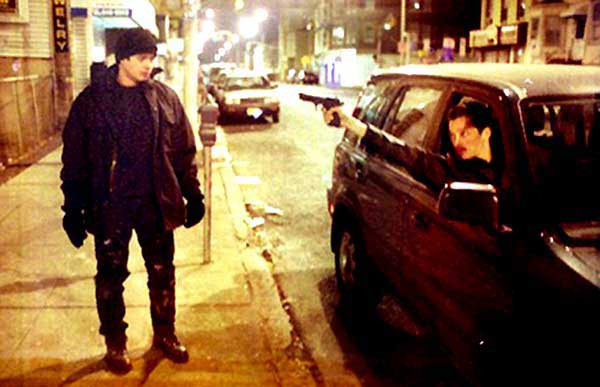
Frantic (1988) is no different, although one could argue that Polanski’s disillusionment with the American ideals, especially that of Liberty (Interestingly, he was rallying for the same against the communist regime of Poland in his short films), adds an extra layer to the proceedings. The very economy of the title – Frantic – recalls the directness of the titles of Hitchcock’s films. Written by Polanski and regular collaborator Gerard Brach, Frantic is a thriller in the vein of Hitchcock’s espionage films and follows Dr. Richard Walker (Harrison Ford) scouring the sunlit streets and dark underbelly of Paris in search of his wife Sondra (Betty Buckley). The film opens with the POV shot of a car travelling on the highway as if to suggest the imminent journey of the protagonist deep into his own psyche. In the car are Mr. and Mrs. Walker reminiscing about the city of Paris, where they had their honeymoon two decades ago. “It’s changed too much” remarks Richard. He might very well have been talking about their matrimony. The cab breaks down. The replacement tyre is also flat. Perhaps that’s how the Walker couple is too. The Walkers find another taxi to arrive at Le Grand Hotel and check in to Room 402 where a strikingly directed, 10-minute set piece unfolds.
As the couple indulges in amusing romantic talk that rarely shows signs of a crumbling relationship, we get occasional glimpses of Richard’s possessiveness about Sondra and a tinge of dissatisfaction on her part towards him (“Promises, promises”). Although there is no specific set of devices that Polanski employs for identification with a character (The first human POV shot comes only after the half-hour mark), thanks to his star persona, we immediately identify (in a positive manner) with Ford. We still see him as a charismatic, flawless, blue collar version of Indiana Jones. Richard takes a nap after a shower and finds his wife missing when he wakes up. Of course, one could resort to the old solution of labeling whatever happens after this as merely a bad dream that Richard has and that interpretation does have some validity. But whether it happens really or in his mind is really irrelevant for what is important is the profound change that Richard’s personality undergoes. It is after this incident that Richard leaves the safe and orderly world of conferences and hotel room formalities into a chaotic underworld of smuggling, murder, double dealing and racial politics. And it is in this precarious world in which Richard’s presumptuousness and superiority is revealed and regularly punished.
Paris is no more the city of love that he had seen twenty years ago. It is as “dangerous” and “dark” as the notorious alleys back home. In this unpromising climate, Richard embarks on a detective mission on his own, like Roger Thornhill, in order to “bring back” his wife, now that he has lost confidence in both the Parisian police and the American embassy there. He tries to make his way through his obstacles using the seemingly limitless amount of money he has got and, to an extent, succeeds. But eventually, money proves to be too weak a weapon to control and shape the unruly and the near-bureaucratic world around him. The world around him continuously reveals how powerless and unimportant he is. Ford is no more the omnipotent, omnipresent and the omniscient adventurer who could get an autograph from Hitler, escape from South American tribes and permeate the deepest of Indian caves with ease. He has aged and is, truly, away from Hollywood. The medicine man becomes a drug user. The revered VIP is seen roaming around barefoot with a junkie. His sense of security and identity is dislodged piece by piece to the point that he indulges in fistfights with random strangers in a random apartment without a shred of dress to cover him. The hotel’s security officer suggests that perhaps Sondra is with “someone she has been thinking about” to which Richard reacts with amazement and denial. This is perhaps his biggest fear for Richard – of losing his wife and of her finding a better man (“There is always someone who’ll do you one better” he says, albeit in some other context). The possibility of that happening seems very high, given the status of their relationship. And this way, Polanski takes apart the myth of the American Hero – a man who simply has to be the best, there’s no two ways about it.
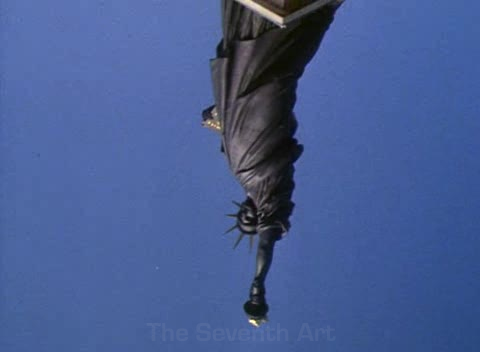
Of course, the last half-hour of Frantic is a significant failure. For one, it contradicts the themes set up so far in the film. While, till now, Walker’s pride and smugness was stripped off layer by layer and his own powerlessness pointed out to him endlessly, the last half an hour restores his original status as an American Hero who can penetrate any setup and rescue anyone. What had been a nightmare till now (Ennio Morricone’s surreal score deserves applause) turns into a dream where every move of Walker’s turns out right and with expected consequences. There might be a reason to this incoherence. Polanski was apparently forced to cut 15 minutes of the film and change the ending (note that Polanski was considered washed out by now). I hear, from a not-so-reliable source, that in the original ending that Polanski wrote, Sondra turns out to be a double agent herself. This twist ending would have served two purposes. First, it would have made a political statement, although superficial, about America’s involvement in the Israel-Palestine conflict (The nuclear detonator is concealed inside the miniature Statue of Liberty; the film was made during the Reagan era). Also, it would have been the final blow to Walker’s ego. His worst fear – that his wife is with someone else and that he is not competent enough for her fantasies – would have come true.
The studio’s intervention is telling. By having Richard plan and win the climactic showdown and save his wife heroically, the studio’s move only reinforces the glory of American conservatism that the film had hitherto satirized (Surely, the Walkers are conservatives. The Statue of Liberty a visual motif in the film. Richard mentions that they don’t vote anymore. Polanski and Brach don’t even give them token liberal statements to make). The Statue of Liberty which had till now been tossed around stands upright as the Walkers reunite. Additionally, the studio’s cut reestablishes the patriarchal structure of the Walker family that was threatened by the situation (It is only Richard who gets to give orders to his children). The whole point of the film is potentially undermined by the studio’s decision. Polanski would make amends for this blunder with his next film, Bitter Moon (1992), where too a couple plans to travel to the exotic east and rekindle their lost love. If the quintessential hero figure of Harrison Ford was the equivalent of Hitchcock’s Cary Grant, the stammering, insecure Hugh Grant would be that of James Stewart. In Bitter Moon, Nigel (Hugh Grant) ventures away from the boredom of his marriage and into his own erotic fantasy without a clue that he is still far from his wife’s. Polanski both brings down the last shred of esteem in the male character and the patriarchy that he embodies with the twist at the end (which is the kind of device that he seems to have had in mind for Frantic). Polanski, cleverly, even throws in gratuitous amounts of nudity, possibly, to appease the studio.
Interestingly, there is another film that achieves what Polanski’s film unfortunately doesn’t. Of course, Alfred Hitchcock’s Vertigo serves as the inspiration for Frantic, with the male fantasy being destroyed and chastised by the mysterious woman he seeks. And perhaps David Lynch’s Lost Highway (1997), which I’ve not seen, deals with the same thing too. But Frantic is remarkably similar to Kubrick’s final film, Eyes Wide Shut (1999). Kubrick’s film has often been compared to Polanski’s The Ninth Gate (1999) because both films deal with secret societies and strange rituals. Kubrick’s film is, in fact, closer to Frantic than The Ninth Gate, in which Polanski was eyeing something else altogether. In Eyes Wide Shut, Tom Cruise plays Dr. Bill Harford (Richard Walker in Frantic is also a doctor and Harford is an acronym for Harrison Ford!) who is nudged into a cat and mouse game of pursuing his wife’s fantasies and trying to build his own. Tom Cruise is the direct successor, in some ways, to Harrison Ford. Both are the icons of the confident, self-assured man in Hollywood. No one would imagine the existence of a weak, possessive and insecure person beneath their flawless exteriors. Had Polanski made his film a decade later, my guess is that he would have most definitely cast Tom Cruise in the lead role. While Polanski’s planned ending stops at the male’s disillusionment, the destruction of his dream and his subsequent return to harsh reality, Kubrick goes one step further and proposes what might be done for reconciliation.
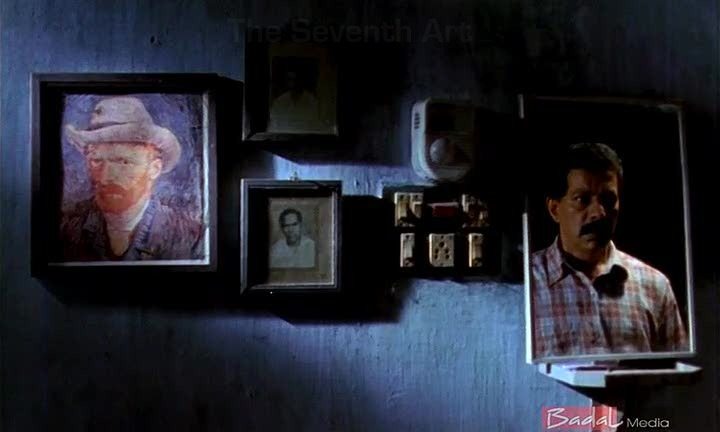 Director Priyanandan’s National Award winning Pulijanmam (2006) charts the efforts of a middle-aged, true-blue communist playwright Prakash (the recently deceased Murali Nair) who is about to stage a play based on a folk legend about a highly-skilled man, Kari, of the lower caste who defies god and enters the dark woods, assuming a tiger incarnation, to bring back tiger mane in order to cure the madness of the ruler. “Every generation takes what it wants from a story” says Prakash early on. For one, he sees himself as a reincarnation of Kari and the play as some sort of a self-portrait. History and mythology merge as Prakash finds his campaign against religion and against the ruling communist party’s decision to allow corporations to build resorts over farm lands to be increasingly similar to Kari’s inhuman crusade. Writers N. Prabhakaran’s and N. Sasidharan’s ambition to chronicle the fall of communism in one of the nation’s two most left-leaning states is palpable, but Priyanandan’s methods hurt the film beyond recovery. The director resorts to too much cross cutting, trying to thrust the parallel between the two stories down our throats and destroying the intrigue built up by the film’s first half-hour. The cinematography and composition is purely functional, with some flashes of brilliance to hold attention. Then there’s also the script’s tendency to cover too much ground and make a few social observations too many that stick out like a sore thumb. I must say it’s a tad disappointing to see this film being given the Indian National Award for best film over Goutam Ghose’s ideologically kindred and infinitely superior Yatra (2006).






 The Seventh Art