[The following is a translation of Luc Moullet’s tribute to Jean Douchet that appears in the January issue of Cahiers du cinéma. I’m grateful to Andy for sending the piece to me.]
—
I met Jean Douchet when he came to Cahiers du cinéma some months after me at the end of 1957. Truffaut, Godard, Chabrol and others, more and more taken up with preparing for and directing their first films, hardly had time—or the desire, at times—anymore to continue to write criticism. I and Douchet were delegated to take over, as much at Cahiers as at the Arts magazine. We were hence partners, accomplices and at the same time competitors (without overtly expressing this internal struggle). Douchet spent a large part of his time at his seat at Cahiers or at the Cinémathèque, making contacts with young viewers whom he encouraged to write for Cahiers, and with small parallel groups at Cahiers, such as the one that had formed around the Mac-Mahon theatre. He had a real entourage, in contrast to Rohmer, who often refused external contacts. More affable, and exhibiting great civility, he had an advantage over me, who was more preoccupied with making my first short films. But at the Arts magazine, he barely stayed longer than me, following the media backlash against the Nouvelle Vague at the end of 1960. Douchet’s activity at Cahiers was marked by initiatives such as the creation of a Prix de la Nouvelle Critique (which awarded, to his great anger, the prize for the most overestimated film to Psycho) and by strong critical stances for or against certain directors. Douchet violently opposed Buñuel, Antonioni, Bertolucci, Kubrick, Peter Brook, Autant-Lara (against whom he lost a lawsuit). This sectarian quality, his somewhat esoteric way of speaking, suited him well: he was highly inspired by spiritualism and the secret societies he haunted. Thereafter, in the spring of 1963, following the eviction of Éric Rohmer from Cahiers, he slowly left the magazine.
After this, he was mostly involved in public speaking, moderating debates at the end of film screenings, or on television in programmes on cinema, or as a teacher. His writing activity, at times destructive, hence made way for an oral activity, for a dialogue with the viewer, for a more convivial, more measured attitude. For more than half a century, he spoke with a certain serenity, seemingly beyond petty fights, beyond all famous filmmakers (except Antonioni, whom he could never stand). At the end of the day, a richer, more indulgent, more mediatory attitude—a real ombudsman—than during his time at Cahiers. Studying films in minute detail, and thanks to video cassettes, he discovered hidden meanings in certain sequences of Fritz Lang, notably in Fury and While the City Sleeps, that no one before him had noticed. Over the years, he had acquired a Santa Claus-like status. His majestic portliness won him all kinds of good wishes, and numerous filmmakers, from 1958 till his last years, happily gave him cameos, small roles in which he excelled, harnessing his inimitable appearance and voice. Among his very rare forays into filmmaking, one must note two unexpected accomplishments: a short comedy, Et Crac ! (1969), in which Bulle Ogier and Claude Chabrol engage in delicious fantasies, and La Servante aimante (1995), where he successfully integrated the backstage and the hidden face of theatre with Goldoni’s play.
It’s of little doubt that there is a distinct personality behind Mysskin’s films. Thanks to his acting jobs and interviews, the director is such a familiar figure that it’s also hard to see his films without imagining him personally commenting on the proceedings. But watching his past couple of works, and hearing him speak, I’m beginning to wonder if this distinct personality is of any interest anymore at all. Whenever Mysskin’s body of work seems poised to deepen in a particular direction, he marshals some unrelated inspiration or childhood fascination into a project that takes him back to square one: Takeshi Kitano, Bruce Lee, Arthur Canon Doyle. His latest, titled Psycho, is a tribute to Alfred Hitchcock. What remained intact throughout Mysskin’s meandering filmography was his capacity to tightly plot a story and hold the audience in a state of melodramatic high—an ability that collapses in this new film.
This is a movie about a serial killer, whose identity and MO we learn in the very first scene. Shortly after, a psychologist explains to us the motivation behind his particular brand of murders. Soon the structure for a thriller falls into place in the form of three intersecting tracks. In the first, we see the killer (Rajkumar Pitchumani) going about his job, picking up his victims and dispatching them. In the second, the police force is seen investigating into the kidnappings and murders. And in the central track, a blind music conductor (Udhayanidhi Stalin, conveniently bespectacled) is forced to carry out a parallel investigation because the killer’s latest victim is his romantic interest (Aditi Rao Hydari). In that, he is helped by a foul-mouthed, quadriplegic ex-officer (Nithya Menen) and her mother (Renuka).
All these characters are archetypes carrying echoes of Mysskin’s earlier creations. They have no social background, except that they belong to the filmmaker’s floating universe, where characters don’t need any logical reason to have names like Angulimala, Kamala Das and Sylvia Plath. This literal-mindedness has hardly been a hindrance to enjoying Mysskin’s films because these types are generally swept into a closely-knit narrative of tremendous forward momentum. Some of that is still present in Psycho, but the overarching structure is so lazily conceived that they are here revealed for what they are: a grab bag of character tics and story elements characteristic of the filmmaker assembled into an unsightly, unwieldy whole.
The most obvious failure is the second thread involving the police force. It’s a dead-end narrative that’s ostensibly borrowed from some other of Mysskin’s unfinished scripts. Familiar forward and backward camera movement follows the cops as they discuss the case walking towards scenes of crime. The investigative unit is led by a plainclothes officer (filmmaker Ram), who sings old Tamil film songs when under stress. This idiosyncrasy promises a hidden intelligence, but he ends up doing something so stupid that you realize his modesty was well justified.
As for the serial killer, Mysskin hangs so many references and backstories on him that it’s plain he hasn’t thought through the character enough. Clean-shaven and well-off, the man appreciates classical music. He’s given a history of Catholic school abuse. There’s then the Buddhist fable of Angulimala, like whose bandit our killer collects pinkies. We are also told that the victims are women who are at the top of their respective fields. His lair is a pig farm lit in incandescent hues and production-designed in familiar bloody, metallic palette. All of this is swept under a last-minute sympathy for the devil. As is customary with crime movies, Mysskin sketches a parallel between the killer and the protagonist, both affluent orphans, driving luxury cars with fancy numbers, listening to Beethoven, but the equivalence doesn’t hold, mostly because our protagonist is a cipher.
Finally, there’s the main narrative track, which starts with an aggressive romantic pursuit. It never takes off because it leaps to its emotional peak too soon in a moody night-time party scene lit by row lights. The hero sings of his love for the heroine, who bewilderingly conveys her hesitation by getting off her chair and sitting down twice in succession. Romance isn’t Mysskin’s strong point (his one sustained attempt at it, in Mugamoodi, was an embarrassment), and he’s clearly trying to force the issue in order to get the investigation going. A curious little subversion is at work in having a ragtag bunch of invalids (a blind musician, a quadriplegic cop, an elderly woman and a pot-bellied man) get ahead of the police in tracking down the perpetrator. But it soon becomes apparent that they exist in order to satisfy a concept. A colossally pointless drive sequence prefaces the climax, an excuse for an emotional transition through song with little logical link to the narrative.
At first glance, it appears that what pulls the viewer along, despite all these failings, is the way the team unravels the killer’s identity and location. But Mysskin, who made Psycho between two detective movies, is evidently deploying a fixed formula. Every revelation is preceded by a perplexing demand or action of the protagonist—he now needs two pigs, he now needs a measuring tape—which leaves the viewer guessing until the next scene, where the reason for his demand is revealed. This sensation of being left behind momentarily by the plot is indeed pleasurable, but the strategy becomes mechanical when you notice that the scriptwriter is withholding information that could well have been given without a scene’s detour. The inferences that the musician ends up making aren’t always novel or even pertinent to the case.
Psycho is Mysskin’s ninth directorial venture. There’s a perceptible change in his technique. While there’s no reserve to be sensed in aural assault of the sound design and the anxiety-inducing score he gets from Ilarayaraja, his sequencing is more restrained, the camera placement and movement less showy. Mysskin’s filmmaking is indeed an idiolect. That it sounds nice doesn’t necessarily mean it’s meaningful. After nine films, it’s still not clear to me where he’s headed. What moves him, disturbs him, excites him, outside of the countless movies and books that he namedrops? His apolitical aestheticism is a welcome difference from his more intellectual peers, but he seems incapable of following up on a line of thought. Wholly derivative (from himself and from others), Psycho jeopardizes his sole defence against that objection—that style is thought. Remains the feeling that this film could’ve been made by someone parodying Mysskin.
It only takes two minutes for Sam Mendes’ WWI saga 1917 to set up its premise. A pair of lance corporals (George MacKay and Dean-Charles Chapman) are entrusted by the General (Colin Firth) no less to courier a message to another battalion camping nine miles away. Failure to convey the message before dawn will result in the sure death of 1,600 soldiers. Its implausibility aside, this is an extremely cinematic setup, allowing the story to follow a pair of characters from point A to B. But Mendes chooses to film the entire two-hour narrative in an apparently single take, in the process snuffing out the rich possibilities of the premise.
Like Dunkirk, 1917 is an experiment in film narrative. And like Nolan’s film, it is a failure that’s instructive in the way it fails. The director of Dunkirk had interwoven not just three timelines, which is standard practice, but three timescales: unfolding over a week, a day and an hour but sharing the same screen time. But in popular cinematic grammar, multiple closely intercut narrative threads evoke a sense of simultaneity. Failing that, a thematic correlation as is the case with films like Cloud Atlas or Wonderstruck. Nolan’s consciously anti-grammatical film demands the viewer to actively shift the time markers in their head back and forth, compelling him/her to recognize the various ways war is experienced by its participants despite a unity of mission. Whatever the mechanistic thrills of this formal scheme, the process remains intellectual, far more exigent than the intuitive pleasures offered by the accelerated editing of The Dark Knight series.
1917 complements the challenge, choosing to preserve the spatial and temporal integrity of the narrative by filming it in a single shot. We understand right away, thanks to the history of war movies, that the corporals are going to make it to their destination no matter what, but we also know that they cannot possibly cover nine miles in two hours of real time, considering that they travel mostly on foot. It’s then immediately clear that Mendes has to fudge his filmmaking for the story to reach its conclusion. While the single shot setup purports to offer a slice of real time, as in Jafar Panahi’s Offside, the narrative itself is telescoped artificially into two hours.
Mendes conveys a sense of passing distance and time, without it actually happening, by chaining together a series of starkly different landscapes: cramped trenches, marshlands, lush meadows, drab fields, a surreally lit, ruined city, water bodies and trenches once more. The movement of the corporals from one landscape to another serves the same purpose as a fade-out in conventional movies: to evoke a sensation of ellipse in the viewer. What we then have is an edit-less edit, like in those commercials where the actor seamlessly moves from one vastly different environment to another while seeming to simply walk across rooms. The principle is that of video games, where we find the same idea of telescoping longer durations and distances into shorter screen time, even when the player has a feeling of contiguous experience.
The lack of cuts undermines the effect in another way too. Given that the viewer is planted in the here and the now, there’s no suspense against which the corporals’ action is to be measured. Hitchcock’s theory of suspense involves the revelation of dramatic stakes by a cutaway (to a ticking bomb, for instance). But considering we never know what’s at risk while the corporals are getting delayed, or if they’re getting delayed at all, we don’t share the urgency that the protagonists express time and again. The French film critic and theorist André Bazin championed long take realism, but only insofar as it preserved the spatial tension of a scene. The shot of an Inuit trying to hunt a seal, in Bazin’s example, has more impact presented in a single shot because it reproduces the danger involved as is. In contrast, conceit of 1917 perennially relegates the danger off-screen, rendering every dramatic development merely a shock.
“We experience life much closer to one longer continuous shot”, says Mendes in an interview. But do we? Anyone who has ever watched two people converse across a table will realize that we don’t pay attention to the empty space between them as our eyes leap from one speaker to the other. Our cognitive processes don’t track our ocular movement; our brain incessantly edits out insignificant information. Even our eyes constantly shuttle within a scene, causing counterintuitive mental compensations. Classical Hollywood continuity editing, which relies on closely stitching together vital bits of information from a single space, is thus perhaps more truthful to real experience than the long take. Defending classical scene construction over long shot filmmaking, Jean-Luc Godard wrote: “I would even see in that spatial discontinuity occasioned by shot changes, which certain devotees of the ‘ten-minute takes‘ make a point of despising, the reason for the greater part of the truth which this figure of style contains.”
Indeed, the formal schema of 1917 ensures that it lacks the psychological charge that even the most rudimentary war films contain. Mendes and cinematographer Roger Deakins rightly suppose that their camera must be able to move 360 degrees around the actors to capture their expression. There are even a handful of closeups in the film to underscore dramatically important moments. But these closeups are simply relayed as discrete packets of new information (grief, shock etc.) without actually anticipating them. The viewer’s identification with a protagonist often passes through a combination of an action and the protagonist’s immediate reaction to it. Think of Kirk Douglas walking through the trenches looking at the cowering soldiers in The Paths of Glory. The continuous camera movement of 1917, however, prevents shot-reverse shot constructions. Here, the roving camera introduces a delay between action and reaction, allowing the viewer to get ahead of the protagonists. Or we see the actors’ reaction before the camera pans to what they are reacting to, which makes the reaction only mysterious.
Finally, the notion of transforming the most horrifying of wars into an awe-inducing spectacle carries a stench of Big Money cynicism. To be sure, the idea is to immerse the audience into a time-space where there’s no time for mourning or contemplation, where the only action allowed is to move on, physically and mentally. “It doesn’t do to dwell on it”, tells a higher-up to one of the corporals after a tragedy. And there are references to the “horrors of war”, to death and destruction. But all of that is wrapped up in a triumphalist narrative closer to a speedrun through a particularly hard third-person shooter than a meditation on war. Deakins and Mendes concoct several visceral, stunning passages, breaking the monotony of the conceit with regular changes in scale, pace and tone. The viewer is perpetually aware of the creation of this spectacle, even when it tries to conceal it. This self-awareness, though, is led nowhere but a dumb submission to technical virtuosity.
Writing about his son’s enthusiastic visit to the offices of a comic book publisher, American critic Robert Warshow reflected on the benefits of disillusionment: “I think Paul’s desire to put himself directly in touch with the processes by which the comic books are produced may be the expression of a fundamental detachment which helps to protect him from them; the comic books are not a ‘universe’ to him, but simply objects produced for his entertainment.” Maybe 1917 is a new kind of war movie, a proto-Brechtian project that produces an illusion of the world even as it induces a doubt as to how that illusion was produced. And maybe that’s a good thing. We’ll know in time.
[From my column on studio-era Hollywood films for Firstpost]
The White Flight phenomenon of the 1950s saw middle-class America withdraw from the cities and settle down in the suburbs. This resulted in the television supplanting cinema as the preeminent medium of entertainment. The film industry intended to tackle this by offering unique attractions and introducing more spectacular formats such as the widescreen CinemaScope. The aim was to lure audiences from the cosiness of suburban houses back to theatres. One of the most prominent examples of CinemaScope, Nicholas Ray’s Rebel Without a Cause too sought to shake up the tranquillity of suburban life by exploring the disquiet simmering beneath its apparent peace and propriety. The constituent of this disquiet is juvenile resentment and dissent, but unlike The Blackboard Jungle (1955), Rebel Without a Cause tackles the subject entirely from the perspective of the youngsters.
In the first scene, three teenagers are seen detained at the police station at night: Jim (James Dean) for drunkenness, Judy (Natalie Wood) for vagrancy and Plato (Sal Mineo) for killing puppies. Ray expertly cuts from one character to another to develop of a collective portrait of youth gone astray. As the cops interrogate the trio, we get an idea of the reason underlying their worrisome action. Jim, the protagonist, bemoans a lack of authority in his life. His cuckolded father (Jim Backus), who can’t stand up to his nagging wife (Ann Doran), disappoints him with his indecisiveness and timidity. In his fear of inheriting his father’s spinelessness, he roughs up anyone who calls him a ‘chicken’, prompting his parents to move towns to cover up his aggression. At the police station, he gets thrown down by the interrogating officer, who earns Jim’s respect for that.
Judy’s father doesn’t dote on her the way he used to when she was a child. Suddenly expected to behave like a woman, Judy draws the attention of her parents through her transgressive behaviour. Plato lives with a guardian ever since his parents separated and left him alone. Armed with a pistol, he lashes out at anyone abandoning him. The film makes it amply clear that these are not teenagers from difficult economic backgrounds. The youth we see are affluent; most drive around in their own cars and live in large suburban houses. It is, in fact, the materialist and convenient life of post-war America, devoid of a sure moral grounding, that the boys and girls are reacting against. Rebel Without a Cause is thus an account of a generation coming to age at a time of peace, but also one of empty spiritual lives.
Produced by Warner Brothers, the film traces its lineage partly to psychiatrist Robert Lindner’s eponymous book on psychopathy. While its script does offer ample psychoanalysis of its characters, Nicholas Ray isn’t interested as much in offering a study of these wayward youngsters as obliging the viewer to share their viewpoint. Criminal behaviour is evoked, but it remains off-screen, registering simply as symptoms of a more fundamental problem. Classical Hollywood’s poet laureate of youth, Nicholas Ray immerses us into a world in which adults are only powerless spectators. His focus is on young people living through the final hours of a tumultuous period in their lives. The film unfolds in just over a day, a duration in which the teens break with their parents, make friends, experience death, find love and come of their own.
In one famous scene, the school takes its students to the Griffith Observatory in Los Angeles for a show on constellations. The youngers’ rivalries and grudges seem positively petty set against the commentator’s remarks on the insignificance of human life on the cosmic scale. On the other hand, the emotions they are living through is a veritable end-of-the-world scenario for them. Jim and his peers are, as it were, “half in love with easeful death”, even though they don’t wholly understand the concept. They engage in a sensational knife fight outside the observatory in a display of one-upmanship. That night, they continue their battle in the form of a “chickie race”, which involves driving stolen cars towards a cliff and jumping off at the last moment. Jim survives, but his rival Buzz (Corey Allen) perishes.
As Jim unsuccessfully explains to his parents that he should turn himself in and walks away to the police station, the other youngsters decide to threaten him against it. This leads to a long night of strife in which all the teenagers of the town are out on the streets, the adults relegated to the margins of this failed society. Running away from the mob, Jim, Judy and Plato end up at a deserted mansion near the observatory. They romance, crack jokes and horse around in the dark—a behaviour much removed from the death-stricken panic of the hour before. If the film’s depiction of the youngsters’ amoral power games was a sharp deviation from the clear moral binaries of classical Hollywood, this indifferent response to a fatal incident borders on the scandalous.
In their playacting at the mansion, the trio simulates a nuclear family—Jim the husband, Judy the wife and Plato the child. And in this improvised roleplay, they come to work through each other’s complexes and satisfy one another’s needs. The diminutive Plato sees in Jim and Judy parents who will never abandon him like his real parents did. Judy finds a protective figure in Jim, under whose affectionate kisses she can grow up at her own pace. And in standing up for Judy and Plato, Jim walks out of the shadow of his father’s cowardliness to find a stable moral compass. None of these roles is real, but it is good enough to take them through their night of sentimental education.
“It’s an age where nothing fits”, remarks Judy’s mother. She’s talking about Judy straddling childhood and adult life, but it could well be a comment on Ray’s use of the Cinemascope. Shot in a dizzyingly wide aspect ratio of 2.55:1, the film employs the horizontal spread offered by the format in striking ways. In the very first shot, Dean falls down drunk on the road, his body slowly contracting to accommodate itself into the frame. Objects and actors hurtle across the screen at great speed all through the film, and Ray’s compositions in deep space, his unusual camera angles and movements, his anti-grammatical editing produces a strong, baroque aesthetic. Ray pays great attention to the teenagers’ clothing and footwear, whose primary-colour dominated palette clashes violently with the brown-and-grey outfits of the adults and the sedate, beige wallpapers of the houses.
The single most non-conforming element, however, is the figure of James Dean himself. His very presence in the film, conveys a sense of spontaneous revolt. The memorable image of him in his iconic red jacket, collar upturned and his fists in the pocket, is a picture of coolness as much as of barely contained rage. Dean’s is a truly modern performance in the vein of Marlon Brando. His improvised body language, with muffled gestures and a lowered head, and his purposefully inarticulate line reading draw him inward from the screen, cultivating an aura of seductive mystery about him. Dean died in an accident a month before the premiere of this film at the age of 24. His death catapulted his celebrity onto a mythical plane, turning him into an enduring symbol of youth rebellion. Rebel Without a Cause, his most famous film, embodies what its French title describes: a lust for life.
That a coming-of-age tale told from a girl’s point of view seems exceedingly fresh partly points to cinema’s conditioning of the audience to the primacy of the male gaze. Rao’s film is the hidden half of a story we are intimately familiar with: a lively, popular boy loses his way in life because of his romance. Rao filters the story entirely through the perspective of her protagonist Meera (Teju Belawadi, daughter of filmmaker Prakash Belawadi), in whose voiceover the film unfolds. At times superfluous and overpowering, the anachronistic voiceover oscillates between the adult Meera, trying to make rational sense of her experience, and her teen self, living life as it presents itself, and nevertheless provides fruitful tensions with the image. From the outset, Rao portrays the movie buff Meera as someone who likes to see (the interaction of screen and spectator has generally been the prerogative of male cinephiles). Through countless shot-reverse shot constructions, she makes the viewer share Meera’s awakening of desire. All through, the emphasis is on Meera’s autonomy, her right to be alone, to want alone, to suffer alone. Rao plays off specific gestures (Meera pulling her boyfriend by his shirt sleeves, his preventing her from biting her nails) against a series of moods (the anxious wait for first kiss in monsoon, the languid summer vacation), specific memories of Meera’s against her lack of knowledge of events beyond her purview. Even when it goes in and out of student film territory, Gantumoote is carried forth by Belawadi’s incredible turn. Her frame drooping in harmony with her eyebrows, she looks over the shoulders, hers or her beloved’s, her eyes conveying her inner life with the directness of subtitles. She is an instant star.
Ee.Ma.Yau (“R.I.P”, 2018, Lijo Jose Pellissery)
Ee.Ma.Yau deepens the suspicion I had watching Jallikattu: that Pellissery works like a painter. First comes the underlying structure; in this case, the social machinery of a small-town Christian community that springs into action following the death of a member. Overseen by a trusted friend of the deceased’s son, a doctor, a priest, a policeman, an undertaker, a printer, a coffin maker, a gravedigger and a music band galvanize around the dead alcoholic. Overlaid on this impersonal societal analysis, like colours on a drawing, are human emotions and characteristics: desire (of an man wishing a grand farewell to his dead father), malice (of a man who is bent on arousing suspicion around death), self-righteousness (of a priest who makes it his mission to complicate things), greed (of a coffin maker trying to sell an expensive unit), generosity (of a friend willing to abase himself to alleviate his friend’s suffering) and compassion (of a rival battered by the dead man). Like Jallikattu, this is a film about how these individual qualities overwhelm and destroy the community from within, turning a complex collective calculus to see off a man with civility into a spectacle of uncivility. Despite the (sometimes unwatchable) sordidness of the happenings, the stress is on the basic dignity of individuals. Pellissery’s characteristic, long Steadicam shots bridge indoors and outdoors, connecting the perspectives of characters that were only pieces in a communal mosaic before the death. The uniformly caffeinated performances are pitched above everyday realism, but below cartoonishness. While his work on the image is still strong—the floodlight-bathed coastal town has a distinct character—Pellissery has no qualms dealing in the abstract or being literal-minded: a blunt coda resumes the film’s philosophical motivations. A potent shot of cheap liquor you don’t want to try again.
Suttu Pidikka Utharavu (“Shoot at Sight”, 2019, Ramprakash Rayappa)
An unmitigated disaster. All it takes is five minutes to figure that this is the work of a bona fide hack. It’s the director’s third film and he’s apparently never heard of a tripod. One could say that Rayappa really puts the motion in motion picture. Three men (or four, who cares, certainly not the filmmaker) rob a bank and hole up in a cramped residential colony of Coimbatore, Tamil Nadu. A hot-headed officer (Mysskin, paying his bills) is on their heels. It so happens that a group of terrorists are hatching a bombing plot in an apartment in the same colony. The specificity of location suggests that the writer-director has a personal connection to it. But all we learn about the area is that it’s overridden by ostentatious and treacherous North Indians, and so the good policemen of Tamil Nadu are obliged to carry out a clean-up job. A big twist at the end is intended to overhaul our understanding of the events. The director is clearly aware that he’s been cheating his audience so far, and tries to cover his tracks with no avail. The result is a cheap prank in the vein of The Usual Suspects. There’s a monumentally irritating constable character whose stupidity is amped up solely for the big twist to work. The sole point of interest is the final reveal montage: in maybe fifty shots in three or so minutes, we get to hear the whole backstory—an indication of Tamil film audience’s increasing capacity to absorb a great volume of sudden information, a capacity thoroughly abused here.
Kavaludaari (“Crossroads”, 2019, Hemanth M Rao)
A valuable archaeological find was robbed and the family of the archaeologist murdered in 1977 at the peak of emergency—the original moment of the Indian public’s disenchantment with politics and its practitioners. The case, thought to be a stub, is pursued by a traffic policeman (Rishi) after 40 years when unidentified bones of three individuals are found during a road-widening project. The cop collaborates with the original officer who investigated the case (Anant Nag) to complete the puzzle. Co-writer of Andhadhun, Rao renders the idea of the police officer living with his case literally, as the people involved in the murder materialize in his apartment with post-production effects. The film starts out as a more ambitious portrait of men and their obsessions, problematizing the investigators themselves, but eventually settles on a traditional whodunit arc. Rao loads the narrative with information after information, plot thread after plot thread, whether they serve to enrich it or not, whether they are indispensable or not. The surfeit of information in itself—mimicking the cognitive experience of navigating today’s mass and social media—sustains a feeling of mystery and importance. The film is generally a couple of steps ahead of the audience, but imagines it is taking them along. In a crucial montage, the suspense is taken to an artificial crescendo through an intercutting between three different spaces. It’s supposed to create an anticipation about the identity of the killer, but what it does instead is produce an anxiety that something grave is underfoot. This mechanistic approach to thrill aside, Rao exhibits an admirable economy of exposition. Several sequences are constructed out of the fewest possible shots, the camera craning across space to furnish additional details. There’s a charming shot of the two investigators waiting in a car in which Anant Nag tries to trap a CGI fly as Rishi observes with amusement from the back seat.
Thondimuthalum Driksakshiyum (“Evidence and Eyewitness”, 2017, Dileesh Pothan)
Having eloped, Prasad and Sreeja (Suraj Venjaramoodu and Nimisha Sajayan) are on their way to the north of Kerala when Sreeja’s matrimonial gold chain is stolen by a criminal (an ostentatiously self-effacing Fahadh Faasil) who swallows it when caught red-handed. The trio ends up at the police station of a tiny town to sort out the issue. It’s an open-and-shut case with no information withheld from the audience, and the film rejects novelistic suspense and epistemological mysteries. The director keeps riffing in scenes set in the police station by weaving in peripheral incidents of petty crime, which increases tension by delaying plot progression. This allows him to mix contrasting tones to great effect, visually (as in the shot of the devastated wife sitting next to colourful balloons), narratively (the triviality of the crime set against the seriousness of consequences) and conceptually (the sanctity of a marriage having to pass through a thief’s rectum). In an unusual characterization, he describes the police force as a rather transparent establishment where information trickles up and down with ease. The cops get comfortable with the plaintiffs on a first name basis, while the latter grow familiar with all the policemen. More sharply, the film spirals out of the story of small-time felony to weave a quasi-philosophical picture of individuals caught up in the whirlpool of impersonal institutional imperatives. The film’s Rashomon-like network of perspectives are centripetally held by the act of stealing a gold chain. The husband (seeking the stolen valuable), the wife (seeking honour and justice), the criminal (seeking liberty), the constable who lets him escape (seeking a closure to the case) are acting on a constant drive for self-preservation, but they are also capable of tremendous, sporadic grace. The equivalence between Prasad and the criminal—echo of another Kurosawa, Stray Dog—is perhaps overly stressed, but it doesn’t take away from the considerable accomplishment of this film.
Kirumi (“Germ”, 2015, Anucharan)
Anucharan wrote, edited and directed this debut feature. Kathir (Kathir) is an unemployed young man, offended by the disdain of his friends and family for his predicament. When he gets an opportunity to work for the police as one of their black-market mercenaries—employed to gather information, collect bribes and rough up suspects—he sees a way out of his impasse. He makes quick progress, soaring up the preferential ladder until he becomes too big for his shoes. There’s very little feeling for milieu here. We don’t get a sense of Kathir’s social situation. He seems to glide in and out of lower-middle class domesticity, rubbing shoulders with an unmarked pair of financially struggling friends, an underground police informer (Charlie, playing the kind of decent everyman that so well suits him), politically-enabled gambling lynchpins and, later, higher-up police officers. What it lacks in nuance and local colour, Kirumi makes up for with a smart structure. Taking the titular microbe as analogy, it sketches the tragedy of a disruptive agent that infects the corrupt body of the police institution—kept from total collapse by internal rivalries and mutual suspicions—only to end up strengthening its immunity and be rejected. Kathir is presented as someone resenting his lack of power and esteem, and his short-lived ambitiousness a product of his power trip. His horniness is regularly invoked, I suppose, as a reference to his compensatory, self-destructive masculinity. The filmmaking is cranked up for effect and the emotional peaks are somewhat misplaced. But the ending, with its perversely welcome cynicism in the mould of Chinatown, is refreshingly anti-climactic, understated and conceptually at home.
[From my column on studio-era Hollywood films for Firstpost]
In a meeting of the members of the Screen Directors Guild in 1950, one filmmaker introduced himself thus: “My name is John Ford. I make Westerns.” This extreme understatement, coming from a director who had already won three Academy Awards, also aptly describes Ford’s modest, pragmatic filmmaking style. Despite making over a hundred films in a variety of genres, John Ford is most remembered as the maker of Western pictures, especially ones starring John Wayne.
Made in 1939, Stagecoach was not just Ford’s first talking Western, but also his first prominent collaboration with Wayne and his first film shot in the Monument Valley, an iconic location in Southwest America that will feature regularly in the director’s future work. In fact, the film begins with shots of the Monument Valley in which a group of cavalrymen ride towards the camera. They inform the commander at their outpost that Geronimo, a notorious Apache figure intent on burning white settler ranches, is on the loose. Meanwhile, a public stagecoach carrying nine people makes its way to Lordsburg through Apache territory.
The literary quality of this simple premise—a group of people move from point A to B under great risk—is reinforced by the trope-like characters. The nine people aboard the stagecoach are all broadly outlined: the bumbling driver Buck (Andy Devine), the marshal Curley (George Bancroft) who has the authority to call the shots, the perpetually-drunk doctor Boone (Thomas Mitchell) who has hidden profundities, the timid whisky salesman Peacock (Donald Meek) who struggles in vain to protect his liquor from the doc, Dallas (Claire Trevor) the hooker with the heart of gold, Mrs. Mallory (Louise Platt) the wife of an army officer who is dismayed by the idea of traveling with Dallas, the suave gambler Hatfield (John Carradine) who has unclear designs involving Mrs. Mallory, and the scheming banker Gatewood (Berton Churchill) who has embezzled a large sum of money from miners. They are joined en route by a sharpshooter Ringo Kid (John Wayne), who has broken out of jail seeking to avenge his murdered brother.
As with any story of people confined in a space, Stagecoach depicts the changing group dynamics, shifting allegiances and the formation of a chain of command among the passengers. In their own way, the nine represent a microcosm of America, their eventual cooperation demonstrating that it takes all kinds to make a world. In one early scene, the upper-class Hatfield, Gatewood and Mrs. Mallory are shocked at having to share table with the likes of Dallas, who was thrown out by the respectable people of her town for her loose morals. The morally upright Ringo, on the other hand, constantly accords her equal respect and stands in for Ford, for whom the shared dinner is a vital sign of the community.
Stagecoach is set somewhere in the aftermath of the American Civil War. A former soldier in the Union army, the doctor is a man with forward-looking ideals. His ideas run up against Hatfield the gambler, a true-blue Southerner and a major in the Confederate army still hurting from the loss of the war. He even tries to kill Mrs. Mallory to save her honour when he suspects the Apache will lay their hands on her.
But Stagecoach is a film reacting to its own times as well. Ford was not a committed progressive, but he is responding here to the socialist spirit of the New Deal in the air. This is most apparent in the character of the banker, a figure looked down upon in the thirties as one of the factors behind the Great Depression. Gatewood is a libertarian railing against government intrusion into business and auditing of banks. “What’s good for the banks is good for the country”, he declares. While all the other characters have redeeming qualities about them, Gatewood, with his interminable whining and hypocrisy, never appeals to our sympathy.
The film is adapted from a short story by Ernest Haycox, but there’s something European, particularly French, about its suspicion of mainstream society. It might have to do with the fact that Stagecoach traces its lineage partly to Guy de Maupassant’s short story “Boule de Suif”. Ford’s cinema isn’t particularly known for its affection for outsider figures, but Stagecoach exhibits a deep affinity for outcasts and deadbeats, conventionally unsuccessful characters who are “victims of social prejudice”. Perhaps Ford the Catholic saw in Dallas the fallen woman, Ringo the orphan, Boone the drunk and Peacock the unmanly a kingdom of the meek. In contrast, the Law and Order League, the group of society women that kicks Dallas and the doctor out of the town, is presented as a bunch of busybodies scandalized at the smallest gesture of nonconformity. When Dallas and Ringo drive away from the town at the end, the doc cries out, “saved from the blessings of civilization”.
The critique of an exclusionary community is conveyed primarily through the character of Dallas, who is the heart of the narrative. All through the film, Ford emphasizes her pain of not belonging and her gratefulness at those treating her with dignity. Everyone, except the banker, eventually comes to respect her, yet she can’t become a part of them. Towards the end, when the group reaches its destination, Mrs. Mallory and company are taken indoors by the townsfolk, Dallas left standing at the doorstep. A contemplative moment finds her alone gathering her belongings from the coach. It’s a direct predecessor to the last shot of Ford’s The Searchers (1956) where it’s John Wayne standing alone at the entrance, incapable of taking part in the community.
Although Claire Trevor as Dallas gets top billing in the credits, history has deemed Stagecoach a John Wayne vehicle, and the actor has a veritable star-making turn as Ringo. He is introduced with an emphatic combination of zoom and track shots, the brief defocusing of the camera adding to the dreamlike texture of this introduction. But Ford mostly photographs Wayne in long shots underscoring his then-lanky frame. Ford’s characteristic low-level indoor camera positioning and use of architectural elements of the west produces a strong sense of space. With a large part of the film set inside the limited confines of the coach, Ford chains together closeups in tight shot-reverse shot configurations, creating intimate connections or oppositions between characters.
These close-grained conversation scenes are set against two grandiose action set-pieces. In the first, the stagecoach is pursued by a team of armed Apaches. Filmed in extremely wide shots, the scene is thrilling in its action choreography, with stunt doubles getting in and out of the moving vehicle, jumping on and off horses running at top speed. There’s a shot from the wheel of the speeding wagon that has become a staple in chase sequences ever since.
Even more impressive is the final showdown, in which Ringo takes down his brother’s three killers. Firstly, the lead-up to the sequence is a masterful tonal mix that intertwines an episode of anguished romance between Ringo and Dallas and a tense, wordless passage of the villains waiting at the saloon, punctuated by a muffled piano melody. The shootout itself is nothing short of mythical. Unfolding in the deserted main street of the town and lit by harsh side lights that produce tall shadows, the actual shooting is suggested by the gunshots Dallas hears. The villain trudges back into the saloon, now full of anxious faces, and collapses, signaling Ringo’s triumph. It’s a striking example of high stylization in the genre that is a precursor to the baroque formalism of the Spaghetti Westerns in the 1960s.
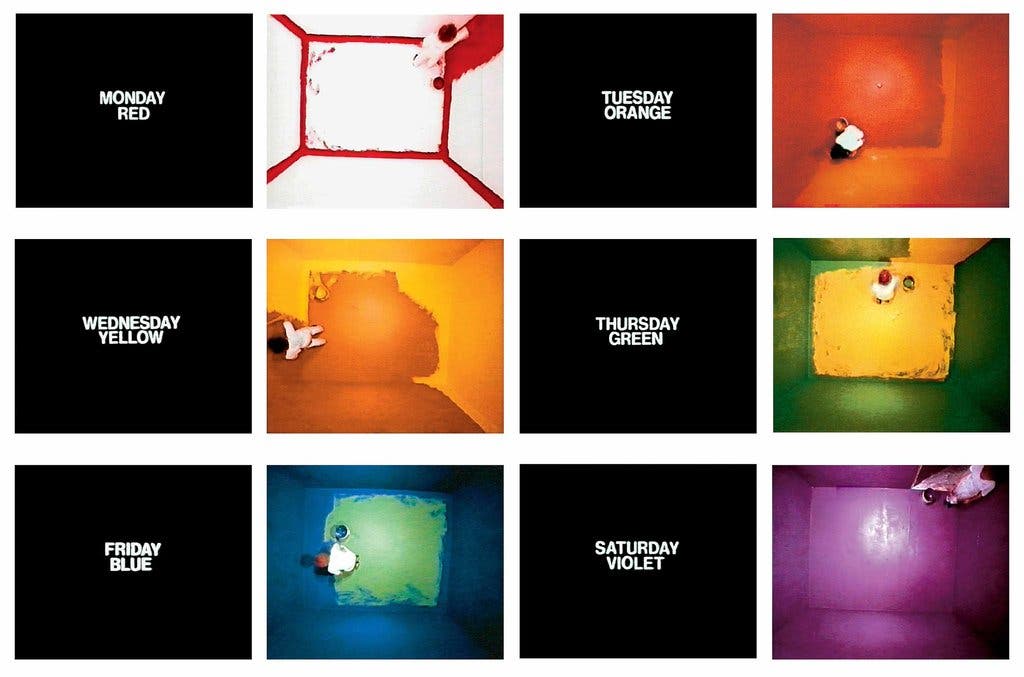
Audiovisual installations in museums, when they are longer than a few minutes, tend to encourage the viewer to move on. Wandering through the wonderful Kunstmuseum in Basel three years ago, however, my eye caught a 16mm projection. It was John Baldessari’s Six Colorful Inside Jobs. I was riveted, and I sat through the entire 30-odd minutes. Like much of Baldessari’s other pieces, Six Colorful Inside Jobs is a work that revels in irony and paradox, elevating banality by subjecting it to a conceptual structure based on repetition.
The conceit here is simple: a man walks into an empty room of about 12×8 feet and paints it all over with a single colour. He performs this action six times over six days, going through the colours of the rainbow from red to violet. Despite the plainness of the idea, there’s some amount of mathematics underlying each ‘job’. Since each day is a single unbroken shot, sped up to five minutes of screen time, the painter must complete his task before the camera runs out of film.
This ingenious concept turns Six Colorful Inside Jobs from a whimsical idea into a study of the contrast between painting and cinema. The frame here is literally being painted, and the film is a document of the frame making itself. (A comparable notion is at work in Sharon Lockhart’s NŌ.) At the beginning of each day, the room is a flat, colour field, undifferentiated except for the reflection of the overhead light. As the bearded man, dressed in white, starts painting, he emphasizes the room corners to produce an illusion of depth, or real space. This three-dimensionality, conversely, collapses into abstract flatness once the painter exits the room via the door on top right. Baldessari’s cool, impersonal art, though, is located beyond Greenbergian polemics, and his intervention here registers as a parodic take on the heated debates of post-war American painting.
A rather stark religious allegory, Six Colorful Inside Jobs begins with white light, which then breaks down into its individual wavelengths over the next six days. (In a bit of magic, the blue room at the end of Friday becomes indigo on Saturday morning.) The camera is fixed on the room’s high ceiling, and its wide lens embodies a ‘God’s eye view’ of the action. The artist in the room literally plays God, or an anti-God, creating a three-dimensional world from nothing, only to take it back to nothing.
In situating the act of creation in the humble task of painting walls, Baldessari also collapses the distance between the artist and the worker—a gesture that’s part of Baldessari’s general practice as well as a larger theme in 20th century art. A direct ancestor to Jim Jarmusch’s Paterson, Six Colorful Inside Jobs presents routine, structured as a six-day work week, as a source of unsuspected beauty. The painter carries out the same task every day, but the way he goes about constantly changes: his movement about the room, his brush strokes, his rhythm. He pauses now and then for a smoke break or to contemplate his creation. In a framework that leaves no room for qualities conventionally associated with artmaking—self-expression, innovation, skill—the painter nevertheless finds a space for an individual style. Six Colorful Inside Jobs is a cogent summary and entry point into Baldessari’s witty, provocative and ultimately edifying body of work.
The 2010s was the decade in which my film-love blossomed, matured, underwent crises, ended and made a late reappearance. My disillusionment with cinema and cinephilia resulted in a break of over three years, which offered me other interests and discoveries. 2016-2018 was a period in which I didn’t watch films as anything more than the casual moviegoer—this has also meant that I have missed the developments in world cinema landscape. Though I did ‘catch up’ on a few films from this period this year, it remains a significant gap, a marker of an enriching rupture in life.
While my memory of most of these films below has all but faded, I do remember them as works that made a stark impression on my cinephilic journey. I watched the first film on this list in a mountainous small-town cinema hall with a handful of other people. It was a very cold Monday evening in January 2017. I recall remaining seated in the hall after the film, quite stunned, and texting my friend Yvon that it was a “chef-d’oeuvre absolu”. There was a spring in my step during the familiar, ten-minute walk back home. For the first time in a long time, I felt confident about my decisions, about the place I was in life at that moment. I was reassured.
2019 was a special year for me. I came back to cinema in an abiding way after a break of over three years. It was also this year that I quit my day job to write and translate full time, even if it has mostly been for this site. This second innings of my cinephilia has been more guarded, and I find it hard to be excited about watching this or that film, even if it’s by a favourite filmmaker. Part of the reason for this change, I think, is that I don’t repose as much faith in the taste-makers I was earlier guided by (major festivals, branded auteurs, critical consensus). This has weakened, if not completely collapsed, the structure in my mind of what constitutes important cinema of a particular year. Adding to this is the fact that the way I react to films has changed. In my writing, I see myself responding to certain aspects of a work rather than forming strong opinion on its overall merit. As a result, I’m as stimulated by lesser works with strong moments or ideas as I am by expectedly major projects. Whether this breaking down of hierarchies is a sign of openness to new things or a symptom of waning faith, I don’t know.
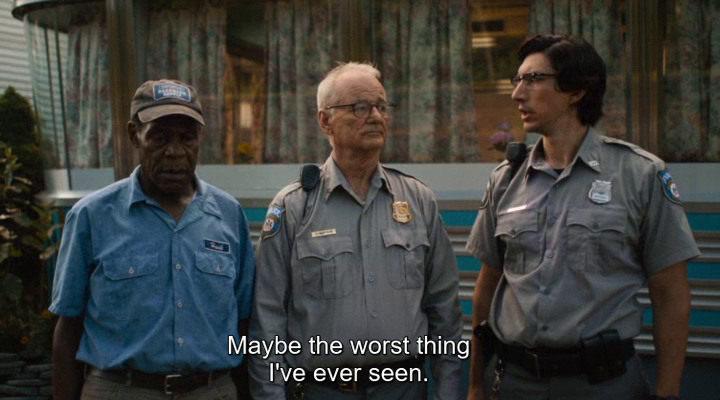
The state of affairs in the world outside cinema hasn’t been easy either. The staggering return of the politically repressed around the world has found an expression in some of this year’s films too (Zombi Child, The Dead Don’t Die, Atlantics, Ghost Town Anthology, Immortal). Personally speaking, the increasingly dire situation in India hasn’t been without its influence on the way I relate to cinema. The brazenness of the Citizenship Amendment Act (CAA) has now paled in comparison to the mind-numbing institutional violence towards the ongoing protests against the act. Looking at videos of police brutality on my social media feed, I wondered, as anyone else involved in matters of lesser urgency must have, if writing about cinema at this point even had a personal significance, leave alone a broader, social one. The directness of the videos, the clarity of their meaning and the immediacy of their effect made me doubt whether cinematic literacy—contextualization, analysis, inference, interpretation—was a value worth striving for. Weakening of convictions is perhaps part of growing old, but it makes writing all the more difficult. Every utterance becomes provisional, crippled by dialectical thought. I don’t have a hope-instilling closing statement to give like Godard does in The Image Book, so here’s a top ten list instead. Happy new year.
While multiple films this year about old age have presented it as a time of reckoning, Kore-eda’s European project The Truth offers an honest, rigorous and profoundly generous picture of life’s twilight. In a career-summarizing role, Catherine Deneuve plays a creature of surfaces, a vain actress who struts in leopard skin and surrounds herself with her own posters. Her Fabienne is a pure shell without a core who can never speak in the first person. She has written an autobiography, but it’s a sanitized account, a reflection of how her life would rather have been. “Truth is boring”, she declares. Responding to her daughter Lumir’s (Juliette Binoche) complaint that she ignored her children for work, she bluntly states that she prefers to be a good actress than a good person. Behaviour precedes intent in the mise en abyme of Kore-eda’s intricate monument to aging, as performance becomes a means of expiation and a way of relating to the world. A work overflowing with sensual pleasures as well as radical propositions, The Truth rejects the dichotomy between actor and role, both in the cinematic and the existential sense. In the end, Fabienne and her close ones come together as something resembling a family. That, assures Kore-eda’s film, is good enough.
The across-the-board success of Parasite invites two possible inferences: either that the cynical logic of capital can steer a searing critique of itself to profitable ends or that this twisted tale of upward ascension appeals to widely-held anxiety and resentment. Whatever it is, Bong Joon-ho’s extraordinary, genre-bending work weds a compelling social parable to a vital, pulsating form that doesn’t speak to current times as much as activate something primal, mythical in the viewer. With a parodic bluntness reminiscent of the best of seventies cinema, Bong pits survivalist working-class resourcefulness with self-annihilating bourgeois prejudice and gullibility, the implied sexual anarchy never exactly coming to fruition. He orchestrates the narrative with the nimbleness and legerdemain of a seasoned magician, the viewer’s sympathy for any of the characters remaining contingent and constantly forced to realign itself from scene to scene. Parasite is foremost a masterclass in describing space, in the manner in which Bong synthesizes the bunker-like shanty of the working-class family with the high-modernist household of their upper-class employers, tracing direct metaphors for the film’s themes within its topology. It’s a work that progresses with the inevitability of a boulder running down a hill. And how spectacularly it comes crashing.
3. Vitalina Varela (Pedro Costa, Portugal)
Vitalina Varela is an emblem of mourning. In recreating a harrowing moment in her life for the film, the middle-aged Vitalina, who comes to Lisbon following her husband’s death, instils her loss with a meaning. It’s a film not of political justice but individual injustice, the promise to Vitalina the that men in their resignation and madness have forgotten. It’s also a bleak, relentless work of subtractions. What is shown is arrived at by chipping away what can’t/won’t be shown, this formal denuding reflective of the increasing dispossession of the Cova da Moura shantytown we see in the film. Costa’s Matisse-like delineation of figure only suggests humans, enacting the ethical problems of representation in its plastic scheme. The film is on a 4:3 aspect ratio, but the viewer hardly perceives that, the localized light reducing the visual field to small pockets of brightness. Vitalina is a film of and about objects, whose vanishing echoes the community’s dissolution and whose presence embodies Vitalina’s assertive spirit. Her voice has its own materiality, her speech becomes her means to survival. Costa’s film is a vision of utter despair, a cold monument with an uplifting, absolutely essential final shot. A dirge, in effect.
4. Bird Island (Sergio da Costa & Maya Kosa, Switzerland)
The bird island of the title is a utopian place, a refuge for those wounded or cast aside by modernity. For sixty minutes, we are invited to look at five people working silently alongside each other in a bird shelter, tending to birds dazed by the airport next door. They don’t ask where these birds come from, nor do they expect them to leave soon. They simply treat the feathered creatures, re-habituate them into the wild and set them free. The reclusive Antonin, the new employee, is one such bird too, and his social healing at the shelter is at the heart of the film. Bird Island is full of violence, natural and man-made, all of which it treats with stoic acceptance, but it’s a work primarily about the curative power of community, the capacity for individuals to coexist in mutual recognition of each other’s frailties. In that, it’s the Catholic film par excellence, an allegory of the origin of religion. It’s also an exceptionally relaxing film to look at. Observing the participants absorbed like Carthusian monks in their individual tasks, even while working in a group, places the viewer on the same meditative state.
5. Heimat is a Space in Time (Thomas Heise, Germany)
Without question, Heimat is a Space in Time is the best 3½-hour film of the year. Heise’s sprawling experimental documentary uses largely personal documents—letters sent between family members, handed-down private documents—to evoke a broad history of 20th century Germany. As a narrator reads out the exchanges—Heise’s grandfather trying to reason with the Nazi state against his forced retirement, heart-rending accounts from his Jewish great grandparents describing their impending deportation, letters between his parents who were obliged to be in two different places in DDR—we see quotidian images from current day Germany and Austria, urban and rural. For Heise’s family, always made to justify their own place in the country and to never truly belong, the Germanic idea of Heimat seems positively a fantasy. While he reads out his great grandparents’ descriptions of their increasingly impossible conditions of living, Heise presents a scrolling list of Viennese deportees prepared. We try to look for the inevitable arrival of their names in the alphabetical list, our gaze forever deferred. When they do arrive, it feels arbitrary. In other words, what we hear could well be the story of any of the thousand preceding names. Perhaps all of them.
A worthy heir to Tarkovsky’s Solaris, Slits draws its inspiration from quantum physics to explore patently human concerns of loss, grief and memory. The uncertainly principle it offers is a choice between being in this world, awake to the problems of living, and finding meaning in the elsewhere. Physicist Catarina (Roberta Rangel) makes ‘sound-photos’ to study quantum the properties of light. She makes extreme zooms into a digital image to perceive the noise issuing from particular coordinates. These ‘dives’ enable her to listen to conversations from another space-time. Grieving from the loss of her child, Catarina unconsciously attempts to find closure through her research. But trying to inspect the surface of things from too close, she loses sight of her immediate reality; trying to find solace in the objectivity of science, she ends up rediscovering the great lesson of 20th century science (and cinema): that the observer influences the observation. Shot in high-definition digital video, Slits is to this new format what Blow-up was to photography. It locates in the trade-offs of the medium—between details and stability, between richness of palette and noise—visual correlatives to its key idea of quantum uncertainty. A brilliant, sophisticated work of politico-philosophical science fiction.
7. Little Joe (Jessica Hausner, UK/Austria)
Of all the recent classical Hollywood riffs in mind, none reinvigorates the B-movie tradition as intelligently or potently as Little Joe. Hausner’s modernist creature feature is a monster movie unlike any other: the dangers of the genetically-modified “happiness” plant that biologist Emily (Alice Woodard) develops is exposed early on, and there’s no triumphal reassertion of mankind to counter its menace. What we get instead is a protracted, total submission of individuality to a hegemony of happiness. Little Joe is many things at once: a multi-pronged attack on the wellness industry straight out of Lanthimosverse, the difficulty of being less than happy in an environment that demands you to be constantly upbeat, the fallout of women artists trying to expunge their maternal complexes in their work and of mothers having to lead double lives. Hausner’s camera appears to have a mind of its own, settling on the space between people, which is what the film is about: the culturally mediated relations between individuals. It’s notable that the titular plant reproduces not biologically but culturally. With its terrific score and work on colour, Hausner turns the cheesecake aesthetic of the film against itself. The result is a film of unusual intellectual density and formal frisson.
In Status and Terrain, the German obsession with documentation and due process is called to testify to the dialectical process of historical remembrance. Adamczewski’s gently moving camera surveys the length and breath of public spaces in the Saxony region, once a Nazi stronghold, now seemingly anaesthetized under liberal democracy. Official communication, bureaucratic reports and private testimonies read on the voiceover incriminate the buildings and monuments we see on screen, revealing their role in power struggles through the ages. Just as the documents vie for a narrative on the soundtrack, ideologies once thought dead and buried surface to stake their claims on the urban landscape in the present. Adamczewski moves through 80 years of German history non-chronologically, the collage of information pointing to the living, breathing nature of political belief systems. Nazi detention of political opponents in concentration camps, Soviet retribution and blindness to victims of persecution, rise of neo-fascist groups post reunification and the historically indifferent, bulldozing force of current-day neoliberalism play out on the surface of seemingly sedate cities and towns. Status and Terrain is a sober, bracing examination of the manner in which prejudice becomes writ, which in turn becomes history, but also of the way in which this history is contested.
The premise is a throwback to the clichés of the eighties: a group of teenagers at a suburban school prepare for their prom night. But in Taormina’s sure-handed treatment, this banal event assumes a spiritual dimension. In the film’s cubist first half, different groups of boys and girls make their way to the restaurant-turned-dance hall, where they will take part in rites of initiation into adulthood and experience something like a religious communion. And then, right after this VHS-ready high, a void descends over the film, turning its raptures into a mourning, not for those who have left this small-town existence but for those left behind: disaffected youth drift about the town or going through robotic social rituals, devoid of magic or warmth. It’s a work evidently deriving from personal experience, but one that’s refracted through a formalist lens. The strength of Ham on Rye is not the depth of its ideas, but the vigour of its prose. Taormina’s manifestly personal style emphasizes the surface of things, the idiosyncratic shot division focuses on gestures and minor physical details to construct scenes, and the eclectic sense of music imposes a global consciousness on a narrative that is otherwise extremely local.
“Cinephiles are sick people”, said Truffaut. Frank Beauvais agrees. Following his father’s passing and a breakup, Beauvais shut himself up in his house in a trou perdu in Eastern France, and watched over 400 films in a period of seven months. Out of this glut, this sickness that Beauvais calls ‘cinéfolie’, came Just Don’t Think I’ll Scream, a film about looking, made wholly of clips from these 400 movies. Through a rapid, self-aware voiceover, the filmmaker reflects on his self-imposed isolation, his panic attacks, the poverty that prevents him from changing his lifestyle, his complicated feelings towards with political action, the conservatism of those around him and his relationship with his parents. Beauvais’s film is a record of his malady as well as its cure. In its very existence, it demonstrates what anyone sufficiently sickened by cultural gluttony must’ve felt: that the only way to give meaning to the void of indiscriminate consumption is to produce something out of it. Just Don’t Think I’ll Scream is not just a cinephile’s film, filled end to end with references, but the preeminent film about cinephilia, the solipsistic hall of mirrors that Beauvais breaks down and rebuilds inside out.



 While multiple films this year about old age have presented it as a time of reckoning, Kore-eda’s European project The Truth offers an honest, rigorous and profoundly generous picture of life’s twilight. In a career-summarizing role, Catherine Deneuve plays a creature of surfaces, a vain actress who struts in leopard skin and surrounds herself with her own posters. Her Fabienne is a pure shell without a core who can never speak in the first person. She has written an autobiography, but it’s a sanitized account, a reflection of how her life would rather have been. “Truth is boring”, she declares. Responding to her daughter Lumir’s (Juliette Binoche) complaint that she ignored her children for work, she bluntly states that she prefers to be a good actress than a good person. Behaviour precedes intent in the mise en abyme of Kore-eda’s intricate monument to aging, as performance becomes a means of expiation and a way of relating to the world. A work overflowing with sensual pleasures as well as radical propositions, The Truth rejects the dichotomy between actor and role, both in the cinematic and the existential sense. In the end, Fabienne and her close ones come together as something resembling a family. That, assures Kore-eda’s film, is good enough.
 The across-the-board success of Parasite invites two possible inferences: either that the cynical logic of capital can steer a searing critique of itself to profitable ends or that this twisted tale of upward ascension appeals to widely-held anxiety and resentment. Whatever it is, Bong Joon-ho’s extraordinary, genre-bending work weds a compelling social parable to a vital, pulsating form that doesn’t speak to current times as much as activate something primal, mythical in the viewer. With a parodic bluntness reminiscent of the best of seventies cinema, Bong pits survivalist working-class resourcefulness with self-annihilating bourgeois prejudice and gullibility, the implied sexual anarchy never exactly coming to fruition. He orchestrates the narrative with the nimbleness and legerdemain of a seasoned magician, the viewer’s sympathy for any of the characters remaining contingent and constantly forced to realign itself from scene to scene. Parasite is foremost a masterclass in describing space, in the manner in which Bong synthesizes the bunker-like shanty of the working-class family with the high-modernist household of their upper-class employers, tracing direct metaphors for the film’s themes within its topology. It’s a work that progresses with the inevitability of a boulder running down a hill. And how spectacularly it comes crashing.
 Vitalina Varela is an emblem of mourning. In recreating a harrowing moment in her life for the film, the middle-aged Vitalina, who comes to Lisbon following her husband’s death, instils her loss with a meaning. It’s a film not of political justice but individual injustice, the promise to Vitalina the that men in their resignation and madness have forgotten. It’s also a bleak, relentless work of subtractions. What is shown is arrived at by chipping away what can’t/won’t be shown, this formal denuding reflective of the increasing dispossession of the Cova da Moura shantytown we see in the film. Costa’s Matisse-like delineation of figure only suggests humans, enacting the ethical problems of representation in its plastic scheme. The film is on a 4:3 aspect ratio, but the viewer hardly perceives that, the localized light reducing the visual field to small pockets of brightness. Vitalina is a film of and about objects, whose vanishing echoes the community’s dissolution and whose presence embodies Vitalina’s assertive spirit. Her voice has its own materiality, her speech becomes her means to survival. Costa’s film is a vision of utter despair, a cold monument with an uplifting, absolutely essential final shot. A dirge, in effect.
 The bird island of the title is a utopian place, a refuge for those wounded or cast aside by modernity. For sixty minutes, we are invited to look at five people working silently alongside each other in a bird shelter, tending to birds dazed by the airport next door. They don’t ask where these birds come from, nor do they expect them to leave soon. They simply treat the feathered creatures, re-habituate them into the wild and set them free. The reclusive Antonin, the new employee, is one such bird too, and his social healing at the shelter is at the heart of the film. Bird Island is full of violence, natural and man-made, all of which it treats with stoic acceptance, but it’s a work primarily about the curative power of community, the capacity for individuals to coexist in mutual recognition of each other’s frailties. In that, it’s the Catholic film par excellence, an allegory of the origin of religion. It’s also an exceptionally relaxing film to look at. Observing the participants absorbed like Carthusian monks in their individual tasks, even while working in a group, places the viewer on the same meditative state.
 Without question, Heimat is a Space in Time is the best 3½-hour film of the year. Heise’s sprawling experimental documentary uses largely personal documents—letters sent between family members, handed-down private documents—to evoke a broad history of 20th century Germany. As a narrator reads out the exchanges—Heise’s grandfather trying to reason with the Nazi state against his forced retirement, heart-rending accounts from his Jewish great grandparents describing their impending deportation, letters between his parents who were obliged to be in two different places in DDR—we see quotidian images from current day Germany and Austria, urban and rural. For Heise’s family, always made to justify their own place in the country and to never truly belong, the Germanic idea of Heimat seems positively a fantasy. While he reads out his great grandparents’ descriptions of their increasingly impossible conditions of living, Heise presents a scrolling list of Viennese deportees prepared. We try to look for the inevitable arrival of their names in the alphabetical list, our gaze forever deferred. When they do arrive, it feels arbitrary. In other words, what we hear could well be the story of any of the thousand preceding names. Perhaps all of them.
 A worthy heir to Tarkovsky’s Solaris, Slits draws its inspiration from quantum physics to explore patently human concerns of loss, grief and memory. The uncertainly principle it offers is a choice between being in this world, awake to the problems of living, and finding meaning in the elsewhere. Physicist Catarina (Roberta Rangel) makes ‘sound-photos’ to study quantum the properties of light. She makes extreme zooms into a digital image to perceive the noise issuing from particular coordinates. These ‘dives’ enable her to listen to conversations from another space-time. Grieving from the loss of her child, Catarina unconsciously attempts to find closure through her research. But trying to inspect the surface of things from too close, she loses sight of her immediate reality; trying to find solace in the objectivity of science, she ends up rediscovering the great lesson of 20th century science (and cinema): that the observer influences the observation. Shot in high-definition digital video, Slits is to this new format what Blow-up was to photography. It locates in the trade-offs of the medium—between details and stability, between richness of palette and noise—visual correlatives to its key idea of quantum uncertainty. A brilliant, sophisticated work of politico-philosophical science fiction.
 Of all the recent classical Hollywood riffs in mind, none reinvigorates the B-movie tradition as intelligently or potently as Little Joe. Hausner’s modernist creature feature is a monster movie unlike any other: the dangers of the genetically-modified “happiness” plant that biologist Emily (Alice Woodard) develops is exposed early on, and there’s no triumphal reassertion of mankind to counter its menace. What we get instead is a protracted, total submission of individuality to a hegemony of happiness. Little Joe is many things at once: a multi-pronged attack on the wellness industry straight out of Lanthimosverse, the difficulty of being less than happy in an environment that demands you to be constantly upbeat, the fallout of women artists trying to expunge their maternal complexes in their work and of mothers having to lead double lives. Hausner’s camera appears to have a mind of its own, settling on the space between people, which is what the film is about: the culturally mediated relations between individuals. It’s notable that the titular plant reproduces not biologically but culturally. With its terrific score and work on colour, Hausner turns the cheesecake aesthetic of the film against itself. The result is a film of unusual intellectual density and formal frisson.
 In Status and Terrain, the German obsession with documentation and due process is called to testify to the dialectical process of historical remembrance. Adamczewski’s gently moving camera surveys the length and breath of public spaces in the Saxony region, once a Nazi stronghold, now seemingly anaesthetized under liberal democracy. Official communication, bureaucratic reports and private testimonies read on the voiceover incriminate the buildings and monuments we see on screen, revealing their role in power struggles through the ages. Just as the documents vie for a narrative on the soundtrack, ideologies once thought dead and buried surface to stake their claims on the urban landscape in the present. Adamczewski moves through 80 years of German history non-chronologically, the collage of information pointing to the living, breathing nature of political belief systems. Nazi detention of political opponents in concentration camps, Soviet retribution and blindness to victims of persecution, rise of neo-fascist groups post reunification and the historically indifferent, bulldozing force of current-day neoliberalism play out on the surface of seemingly sedate cities and towns. Status and Terrain is a sober, bracing examination of the manner in which prejudice becomes writ, which in turn becomes history, but also of the way in which this history is contested.
 The premise is a throwback to the clichés of the eighties: a group of teenagers at a suburban school prepare for their prom night. But in Taormina’s sure-handed treatment, this banal event assumes a spiritual dimension. In the film’s cubist first half, different groups of boys and girls make their way to the restaurant-turned-dance hall, where they will take part in rites of initiation into adulthood and experience something like a religious communion. And then, right after this VHS-ready high, a void descends over the film, turning its raptures into a mourning, not for those who have left this small-town existence but for those left behind: disaffected youth drift about the town or going through robotic social rituals, devoid of magic or warmth. It’s a work evidently deriving from personal experience, but one that’s refracted through a formalist lens. The strength of Ham on Rye is not the depth of its ideas, but the vigour of its prose. Taormina’s manifestly personal style emphasizes the surface of things, the idiosyncratic shot division focuses on gestures and minor physical details to construct scenes, and the eclectic sense of music imposes a global consciousness on a narrative that is otherwise extremely local.
 “Cinephiles are sick people”, said Truffaut. Frank Beauvais agrees. Following his father’s passing and a breakup, Beauvais shut himself up in his house in a trou perdu in Eastern France, and watched over 400 films in a period of seven months. Out of this glut, this sickness that Beauvais calls ‘cinéfolie’, came Just Don’t Think I’ll Scream, a film about looking, made wholly of clips from these 400 movies. Through a rapid, self-aware voiceover, the filmmaker reflects on his self-imposed isolation, his panic attacks, the poverty that prevents him from changing his lifestyle, his complicated feelings towards with political action, the conservatism of those around him and his relationship with his parents. Beauvais’s film is a record of his malady as well as its cure. In its very existence, it demonstrates what anyone sufficiently sickened by cultural gluttony must’ve felt: that the only way to give meaning to the void of indiscriminate consumption is to produce something out of it. Just Don’t Think I’ll Scream is not just a cinephile’s film, filled end to end with references, but the preeminent film about cinephilia, the solipsistic hall of mirrors that Beauvais breaks down and rebuilds inside out.
 The Seventh Art