August 2021
Monthly Archive
August 10, 2021
[From Luc Moullet’s monograph Cecil B. DeMille: The Emperor of Mauve (2012, Capricci). See Table of Contents]

Victor Mature and Hedy Lamarr in Samson and Delilah (1949): the delicacy of colours in a new bath scene.
A curious film, which seems to have been made only for its ending. A bit like Vidor and Selznick’s Duel in the Sun (1946), whose title evokes only the final scene, and which is also one of the few American films of the time to be marked by the final death of the couple, who were also played by stars. A death that both protagonists, here, desire or consent to.
The scene is the only one in the film that exhibits great richness. A temple with an overloaded architecture, like Cabiria or Salammbô, with a sort of embankment at the centre, more reminiscent of the Roman arena and its circus games. There are hundreds of spectators.
The American public were 1949 was quite familiar with the Bible and the story of Samson, and knew that Samson dies as a result of the temple’s collapse, which he triggers with the strength of his arms and … his hair. If, by extraordinary chance, they did not know the Old Testament, they were informed of the ending by word of mouth and by the massive publicity around the film’s release.
The Bible does not mention the presence of Delilah at the temple (in DeMille’s film, she takes the place of the young boy mentioned in the Bible). An earlier scene establishes Samson and Delilah’s connivance, and we understand that they will meet the same fate. Shortly before the collapse, Delilah refuses when Samson asks her to run away: she thus atones for her fault, her treachery.
So here we have a spectacle whose outcome everyone knows, but which is filmed like a suspenseful episode, with preparations and a very elaborate staging. In fact, there is really no suspense. The viewer is therefore one step ahead of the other viewers, those sitting in the temple. He feels superior to them. The suspense, here, has to do only with the “how” of the action. How will Delilah manage to put Samson in such a position that he can destroy the temple? In front of two hundred people who have no desire to be crushed under the rubble, this is far from obvious. There are a series of miraculous coincidences that make the outcome possible and, paradoxically, the film viewer fears that the soldiers’ intervention on behalf of the Saran of Gaza will not allow for the final disaster.
We get the impression of a fatal, irremediable chain of events, and that is what fascinates us.
There is a very great cinematic moment, based essentially on sound, which may seem surprising in such a visual finale: we realize that Samson will succeed when we hear the faint sound of the stone starting to crumble. This noise is followed by complete silence, the silence of the dazed and worried audience (a bit implausible, since they are too far away to hear what we and Samson can hear) and an artificial silence produced by an intelligent sound mix, underlining the gravity of the action. It is all the more impressive because the beginning of the sequence was extremely noisy, with reactions of the crowd and music. The power of the scene lies in the fact that it is based on everything (big spectacle, gigantic set, numerous extras), but it is the nothing (faint noise and silence) that produces the greatest emotion.
This idea was taken up by Howard Hawks with the sealing of the corridor of the pyramid of Cheops in Land of the Pharaohs, produced by Warner. And the film will have a lot of imitators: another famous couple, David and Bathsheba, concocted by Fox, a new Quo Vadis? financed by MGM, a Salome produced by Columbia. Everyone was doing it.
The scene has been reproached for its theatrical quality, although that is quite logical since this temple is a theatrical place, and the theatrical rigidity accentuates the inexorable quality of the action. The cardboard cut-out quality of the collapsing stone blocks has also been criticised: they bounce with a slenderness impossible for such heavy material. That is the DeMille system, which neglects realism in favour of convention.
Only the idea of the collapse matters. In any case, Samson’s story was probably exaggerated by rumour before the biblical text was written.
—
To describe these bravura sequences, I preferred the chronological order.
That made it possible to establish precise relationships between films from the same period. For example, the four films from the period of eccentricities (1924-1930).
But I could have chosen other scenes, the murder of the Eurasian mistress (the silent version of The Ten Commandments), the shaving scene in Why Change Your Wife, the sequence with Satan Synne (The Affairs of Anatol), the staircase scene in The Godless Girl, the suspenseful finale in the mine in Dynamite, the couple stuck at the top of the broken-down roller coaster (Saturday Night), the scene with the Indians and the compass (Unconquered), and I know how arbitrary this selection can be. I am also aware that a scene from a masterpiece like Kindling could not have served our purpose as everything in it is very smooth and homogenous.
In my classification are a few very different choices, which has perhaps allowed a more logical classification: either the sequence appears within a mediocre (Cleopatra) or a modest (The Volga Boatman) movie, or it remains the most striking scene of a high-calibre work, surfacing in the middle (The Golden Bed) or the end (Wassell), or it is the conclusion of an ever-changing film (The Road to Yesterday, Madam Satan, Samson and Delilah) whose beginning is disappointing but which, little by little, expands in scope until the final apotheosis.
The principle of the brilliant final scene that floors the viewer, who will remember it for eternity, eclipsing the mediocrity of the beginning, is an excellent principle which can be found in many good films (Alexander Nevsky, Griffith’s Way Down East, Carol Reed’s The Third Man, Vidor’s Our Daily Bread, Mankiewicz’s Suddenly Last Summer, Ismael Ferroukhi’s The Great Journey). It is certainly more exemplary than the principle of the opening sequence towering over the rest of the film (Robert Siodmak’s The Killers, Delmer Daves’ Dark Passage, Almodóvar’s Volver, Ruy Guerra’s The Unscrupulous Ones, Welles’ Othello, Bergman’s Sawdust and Tinsel), but it is now outmoded by the evolution of cinema, which now depends on television broadcast to a great extent. Now, if the viewer doesn’t find the beginning of a film exciting, he is going to change channels. Television channels know this and make their choice partly on this criterion.
It should be noted that, often, a film’s big scene is not the one expected. The crossing of Red Sea, the tussle with the octopus (Reap the Wild Wind) and the sugar garden of The Golden Bed are less striking than other scenes in these films.
A rare case: a filmmaker who is better known for his not-so-good, but more expensive films, but whose best work, as with Jean-Pierre Melville, is to be often found in projects that are nevertheless more modest in appearance. Adjusting for inflation, Kindling cost 489 times less than The Ten Commandments, but is much more accomplished.
—
This book is dedicated to Vidéosphère.
August 7, 2021
[From Luc Moullet’s monograph Cecil B. DeMille: The Emperor of Mauve (2012, Capricci). See Table of Contents]
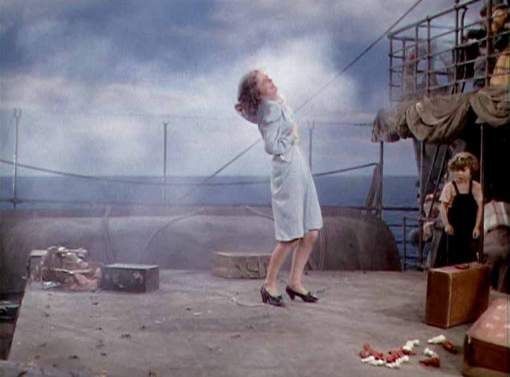
The Story of Dr. Wassel (1943): a young mother (Edith Barrett) succumbs to gunfire from the boat before her child’s eyes.
A work of a consistent quality, inspired by real events, describing the life of a physician who became a military doctor in Java during the war against Japan. He manages to safely lead a dozen crippled soldiers through the jungle to a ship to America.
It starts with a highly stylised introduction, with snow falling behind a small statuette, and it continues in a comedic tone: Dr. Wassell is paid by his poor clients of Arkansas… with pigs, which run away from the pigsty. Without any resources, he becomes a doctor abroad.
The first highlight of the film is its depiction of the daily life of a group of wounded soldiers lying on their stretchers, in rather wide shots without the hero. And the doctor has a hard time putting on his cufflinks, disturbed as he is by his servant, who tries to tie his tie at the same time. But we quickly move on to the dramatic, or even the lyrical, part. Guessing that the army is not going to repatriate the invalids, a disabled soldier stands up on his legs before collapsing. Driven to depression in the heart of the jungle, Hoppy takes the bandages off his hands so he can shoot the approaching Japs. He is massacred…
But the peak of the film is the end, where multiple effects add up as various characters behave, like before, in very different ways within the frame. The Japs bomb the ship that Wassell and his disabled crew are on. On the same ship, fat cats play chess unperturbed. A lady protests, “Will you stop pushing me?”—the same kind of unusual reactions there were towards the end of Madam Satan. A machine gun kills the mother of a four-year-old child, who doesn’t understand the situation and asks her mother to get up. A soldier, who is busy shooting, asks him: “How about joining the navy, big boy? Try this bonnet on.” And the kid is delighted to collaborate with soldiers, “I’m going to show mummy my new hat.” A blind man, with a very sensitive ear like any blind person, is the only one who can identify the noise of the American Flying Fortresses coming from afar to protect them.
Among the wounded, Wassell suddenly finds the doctor who had stolen the woman of his life, Madeline, from him. The colleague informs him that his wife is going to join him. Wonderful surprise, it’s not Madeline! Mad with joy, Wassell kisses the doctor’s wife, whom he has never seen before.
He learns that Madeline is on another boat, the Pecos. A few seconds later, he is told that the Pecos has been sunk. But it soon is known that there is a boat of survivors, which includes Madeline, whom he will join in the last shots of the film.
Wassell expects to be court-martialled since he has violated an order from his higher-ups. But he finds himself decorated by the president (played by an actor, which is exceptional in cinema, especially as Roosevelt was alive when the film was shot).
After the credits, we are told that Hoppy, the soldier with the bandages, is safe and sound. We then have the impression that all this is true. For, if this ending had been invented, DeMille could have included it in the continuity of the narrative. But it is probably a ruse on C.B.’s part to better validate the progression of his film.
We see that everything works on a constant succession of unusual contradictions, reversals of situations, like this kid who is all joyful just after his mother’s death.
So the viewer is suffocated, as it were, by this rush of strange, miracle-like facts. This is what makes for the power of this masterpiece.
This richness was not appreciated by French critics, turned off as they were by the nationalist side of C.B., who often opens his films with a shot of a coat of arms, or a military or institutional emblem. This preaching is also evident at the end of The Greatest Show on Earth, Kindling and Male and Female. But this naive and almost tacked-on hymn to America works well since it comes at the end of a high-quality work. We are then ready to accept anything. And it is presented so directly, so implausibly, that it becomes a form of private joke.
August 3, 2021
[From Luc Moullet’s monograph Cecil B. DeMille: The Emperor of Mauve (2012, Capricci). See Table of Contents]

Cleopatra (1934): the bewildering ballet of the nymphs.
It is a rather mediocre movie, undermined by the pompous, conventional and declamatory quality of the dialogue, which provokes unintentional laughter. The last scene—Cleopatra and the asp—which should have been the highlight of the show, turns out to be of no interest.
But there are three unforgettable sequences: the ballet of the nymphs, which I already mentioned, the tracking shot depicting the intrigue; the montage sequence narrating the battle.
The latter (the principle of which is taken up again, albeit less well, in The Crusades) is astonishing: it comes just after a series of rather soporific scenes.
In four minutes and four seconds, there are about two hundred shots (I couldn’t count exactly, it was too fast, especially because there are shots with two superimpositions). This means one shot for every 1.22 seconds on an average, including many shots shorter than this.
The subjects depicted are: the preparation of arms and armies for the battle, the charge of the cavalry on the beach; ground warfare; naval warfare.
Note the total contradiction with history: the battle of Actium between the Romans and the Egyptians, who were in league with Mark Antony, took place only on the sea and lasted two hours.
Here, it also extends over land, with the siege of a fortress, and takes place over two days and a night. Anyway, that’s not the most important thing.
The film accumulates tight shots of soldiers in action, of weapons being manufactured, shots with canted framing, effects featuring a marked horizon line, often at the top of the frame, and very pointed, academic interplay of blacks and whites bordering on pompousness, but fortunately very brief.
Everything is intermingled: with short and sometimes very tight shots, the viewer does not have time to ask questions. In the middle of this battle set in 31 BC, he accepts shots stolen from The Ten Commandments (1230 BC)—the chariots on the beach—and from the Siege of Orléans of Joan the Woman (set in 1429) without batting an eyelid. He is overwhelmed by the accumulation of some violent images. It’s a massive patchwork (there is even an underwater shot), unified by continuous martial music.
Why this directorial choice? One could suppose that the filmed naval battle was deemed a failure by DeMille, or that he had no money left to shoot the rest of the scene, or that there had been a total strike, or that C.B. was jealous of S.M. (Eisenstein), whose latest film he had just seen while shooting Cleopatra. It appears that he entrusted the responsibility for the sequence to a great specialist (I think I can sense the handiwork of William Cameron Menzies), who evidently acted on the instructions of our filmmaker.
The problem is that after this virtuoso sequence, the film plummets from a great height back to the monotonous routine which is that of almost the whole film.
A sequence which today registers as an exercise in style, a good film school assignment, the crown jewel of an outdated academicism, but which still makes an impression, especially since it comes after the mediocrity of the earlier sequences.
Alongside this bit of rapid montage, there is a scene conceived around a sequence shot, the one in which we successively learn about the state of affairs between Caesar and Cleopatra, the hardships of Calpurnia, Caesar’s wife, and the existence of a plot to assassinate Caesar and its motivations. Another filmmaker may have lazily settled for a discussion scene between two or three characters in static shots. Well, DeMille goes around the difficulty brilliantly.
There are two consecutive shots, with a total duration of two minutes and twenty-one seconds, the second one continuing the first, which is moreover tighter: these are tracking shots from left to right. The transition between them goes almost unnoticed within the continuous movement. DeMille frames six small groups in discussion successively, first a slightly caricatural set of five characters involved in gossip, then duos, and finally the meeting of the conspirators. All the pieces of information the viewer needs are here, but it is supplied by very different people with spaces between them. It doesn’t feel like a didactic exposition at all. First of all, because the tracking shot seems to be the only fundamental basis of the shot, because the different groups are at different distances from the camera, and because the camera is going through obstacles—especially columns—which seem to indicate that all this is filmed on the spot, like a television report on ancient Rome, all the more so because, at the very beginning, the first group is masked by a character walking across the frame. The best part is that at the end, behind Brutus and his friends, we suddenly see the bust of Caesar, whose laurel wreath is removed and tossed away by a conspirator: everything is conveyed in almost no time.
It’s a very modern, veritable lesson in cinema, which seems to me to be of a much higher level than the thundering montage sequence. These are some of the longest shots in C.B. DeMille’s cinema.
Rapid montage, sequence shot: here is a filmmaker who tries to express himself in the most contrasting ways, just as he jumps from the awesome compositions of Joan the Woman to the small objects of his intimate films (Don’t Change Your Husband or Old Wives for New) with great verve.
 The Seventh Art