Allow me to begin with a cliché: 2010 has been an insipid year at the movies. I really struggled to come up with this list because it just didn’t feel like there were many contenders for it. The tail of this list is shaky at best and I wouldn’t want to defend it with all my heart, I think. I’m not saying that there were no great films made in 2010. One bizarre phenomenon of the recent years has been the growing time difference between the world premiere of a film and its distribution/release. Movie lists this year have been almost entirely made of films that actually premiered in 2009 (or earlier) and, going by the trend, it wouldn’t be really a surprise if the 2011 lists consisted wholly of movies that premiered in 2010. (This list, however, is based on world premieres alone). This is not a wild thought at all, considering how stellar the list of filmmakers who premiered their films this year, without a release, has been. (Trust me, there are about 50 big titles that haven’t been mentioned in many of the lists. My biggest misses this year include The Strange Case of Angelica, The Autobiography of Nicolae Ceausescu, Nostalgia for the Light, The Ditch, Meek’s Cutoff, Get Out Of The Car, Cave of Forgotten Dreams, Aurora and The Four Times, among others. Rest assured that I’ll drop an updated list here around March, hopefully). Given this, 2011 is truly going to be one hectic year for film buffs, with dozens of vital films from both years to be seen. Fasten your seat belts.
1. Uncle Boonmee Who Can Recall His Past Lives (Apichatpong Weerasethakul, Thailand/UK/France/Germany/Spain/Netherlands)
 That Uncle Boonmee Who Can Recall His Past Lives is the greatest feature by the Thai director is only worthy of a footnote. It is, in fact, what Nathaniel Dorsky calls Devotional Cinema. Boonmee is a work that amalgamates the process of film, human metabolism and the intermittence of our being like no other. Treating life as one continuous entity without a beginning or an end, where death and reincarnation are just various modes of existence, Boonmee so lovingly examines how these modes are integral to functioning of film where, in each frame, the past dies, yet persists and projects itself into the future. Furthermore, the film is also Weerasethakul’s response to the recent upheavals in his country where the political past of the country seems to resist death, reincarnating itself in kindred happenings of the present. Weerasethakul’s picture is at once a tribute to national cinema of the past, an elegy for film and a welcome note to digital filmmaking. It is at once a return to nascence and a leap into the future. Uncle Boonmee is cinema. Uncle Boonmee is cinema.
2. Film Socialism (Jean-Luc Godard, France/Switzerland)
 Even if Godard confirms the rumour that he’s going to call it a day, there’s nothing really to get vexed about. That’s because he has produced a body of work that is yet to be discovered in its full form, qualitatively and quantitatively. Film Socialism is not his last film because it is his last set of films. Yes, like that gargantuan video work of the 90s about the history of cinema, Film Socialism is a work that reconfigures and renews itself every time one sees it. It might all seem like a loosely connected set of arbitrary images, sounds and words. But that’s because arbitrariness is in its very DNA. If not anything else, it is “about” arbitrariness – of value, of ideologies, of laws and of languages – and the death of grand truths. Itinerating between the 70s style agitation, 80s style humanism and 90s style lamentation of his works and with a novel appreciation for individual images, words and objects, Film Socialism is simultaneously a summation of his career and an undoing of it. From the self-deprecating opening line of his first feature, to the “No Comment” 50 years later, Godard has probably said everything in between. Film Socialism is his signature.
3. Honey (Semih Kaplanoglu, Turkey/Germany)
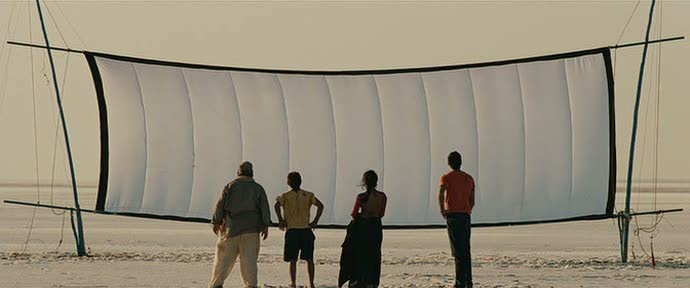
 Young Yusuf always looks up to his father. Literally. This might be partly due to his undernourishment, but it is also because he refuses to grow up. The final and the finest film in Kaplanoglu’s trilogy, Honey evokes the experience of childhood, or rather the experience of its end, like a few films do, intertwining reality, memories, dreams and anxieties of the age. It so affectingly captures what it means to be thrust into a fatherless world: a family without father, a film without a hero, a universe without God. (The previous film in the triad deals with Yusuf’s relationship with his mother). Yusuf’s conversations with his father, themselves, resemble private confessions to a higher power. Kaplonoglu’s picture is somewhat of a paradox. The reverse chronological structure of the trilogy prompts psychoanalysis while Honey itself is, cleverly, non-reductive. Like Erice’s The Spirit of the Beehive (1973) and Kiarostami’s Where Is the Friend’s Home? (1987), Honey is a film about childhood confronting adulthood against its own wishes. Ana dares to leave behind her childhood. Ahmed survives the confrontation. Yusuf refuses to grow up.
4. Certified Copy (Abbas Kiarostami, Iran/France/Italy)
 Abbas Kiarostami’s Certified Copy, at its worst, is a rundown of modern western philosophy, especially its key questions about perception, beauty and the self. So allow me to steal some from old Fred to sum up the film: “Artists alone hate this lazy procession in borrowed manners and left-over opinions and they reveal everyone’s secret bad conscience, the law that every man is a unique miracle; they dare to show us man as he is, unique even unto each move of his muscles; even more, that by strictly in consequence of this uniqueness, he is beautiful and worth regarding, new and incredible, as every work of nature, and never boring.”. Kiarostami probes the validity of every clause above and keeps examining what the ideal way to live is and whether there is an ideal way at all. Does one understand the world through grand mechanisms and regard what one sees and hears as abstractions of invisible truths or does one confront these concrete objects as they are and deem the ideas uniting them as abstract and removed from experience? Kiarostami’s film is an irresolvable tug-of-war between subtexts and surfaces, accidents and forethought, conservatism and radicalism and, well, form and content.
5. My Joy (Sergei Loznitsa, Ukraine/Germany/France/Netherlands)
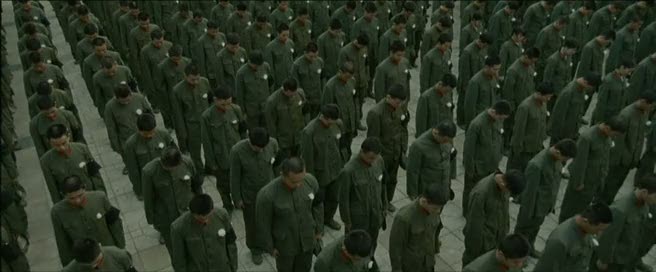
 I can’t believe I’m including this patently cynical, relentlessly dystopian and ideologically simplistic film in this list, but the talent and craft here are undeniably overwhelming. Sergei Loznitsa’s My Joy is a film that threatens the uniqueness of Uncle Boonmee in that it too collapses historical time to sketch the sociopolitical portrait of a country that has ceased to progress and is moving around in circles of betrayal, oppression and violence. Its causes might be varied – residual bureaucracy, newfound market economy, WW2, Cold War – the manifestations nevertheless, Loznistsa suggests, are the same. Echoes of a scene are felt in another, similar situations and outcomes permeate historically different periods and essentially nothing changes except costumes and period details. It’s as if the director and the set of actors are trying in vain to recreate another age that might offer escape. Loznitsa uses interruption itself as a stylistic device wherein the genre (road movie “detours” into a sci-fi nightmare) and the narrative (character identification killed) are disrupted for treatises on power and its abuse. As presaged in the opening scene, it is the director as tyrant and the audience as victim.
6. Of Gods And Men (Xavier Beauvois, France)
 At a time when blanket rejection of all religion is the most advertised and subscribed worldview, Xavier Beauvois’ Of Gods and Men comes as a much needed dose of sobriety. A worthy successor to that staggering Winter Light (1963, plugs to Bergman galore), Of Gods and Men is a expertly mounted tightrope act that strikes a tense balance between faith and reason, individualism and collectivism, idealism and materialism and democracy and authoritarianism. True to this spirit of philosophical investigation, the best shots in the film are composed like tableaus from ancient Greece, of which either God or the audience is regularly made a part. The stance here is, clearly, neither pro-religion nor anti-terrorist. The film is neither a critique about the perversion of religion by politics nor a lamentation about the loss of faith in a Post-Enlightenment world. It is about what Faith means to the individual. The monks in the monastery are neither theists deluded by the promise of a paradise nor victims caught in the vortex of international events. They are merely Kierkegaardian knights who leap beyond rationality to discover what it means to be human, to be mortal, to believe.
7. Shutter Island (Martin Scorsese, USA)
 An hommage to Alfred Hitchcock among others, and possibly a remake of Vertigo (1958) as well, Martin Scorsese’s atmospheric wonder Shutter Island is about the absolute loss of control, about not being able to know whether you’re awake or dreaming, about being swept off solid ground and left floating and about the agony of losing everything that was dear to you. For filmmakers, especially ones as authoritative as Hitch and Scorsese, this fear of losing hold is so palpable and justified. Set in post-war America, where red signaled danger in more ways than one and where either you were crazy or the entire world around you was, Scorsese’s film has someone or the other consciously playing roles throughout. The sense of artificiality and instability is accentuated all through with tribute-providing rear projection and matte backgrounds. As literalized in its story, Shutter Island is also a battle between modernist paranoia and postmodernist schizophrenia wherein the director’s playfulness is pitted against ambitions of serious, personal expression. And I’m sorry to spoil it for you, but there’s no twist in the film.
8. I Wish I Knew (Jia Zhang-ke, China)
 The greatest filmmaker of the last decade continues to do what he does best: make great films. Jia Zhang-ke’s I Wish I Knew, a cousin to his previous film, is a symphony of city symphonies. The sheer scope of Jia’s investigation and the humungous historical and geographical ground he covers is daunting. Walking a thin line between state propaganda and personal vision, dispassionate observation and critique and aesthetization and respectful documentation, Jia has created a film that might look like the most reverential and non-committed of all his works. Like his last film, Jia probes how the older Shangainese’s history and identity has inextricably been linked with that of the city and the state and how the younger generation seems to have found the luxury to be apolitical and the freedom to move beyond. Globalization isn’t so bad after all. Or is it? One could arrive at two wholly different films by just editing the film in two different ways – one film that the state wants Jia to make and the other that we want Jia to make. Jia’s probably made the film he wants.
9. The Social Network (David Fincher, USA)
 As the marketers of old studio films would say, The Social Network is a film for everybody. It truly is a film for every ideology, every reading and every level of engagement. The film is whatever you want it to be. There’s something about Sorkin’s Zuckerberg that’s both seductive and repulsive. His triumph is one that’s both inspiring and horrifying. Barring the last scene of the film, which probably kills off the ambivalence thus far and impresses itself on our memory of the film a little too heavily, the film does a remarkable balancing act, placing immense trust on the details for the maintenance of this ambiguity. It doesn’t have as much to say about how we live our lives online as it does about how we generally live in a world infested by final clubs of every sort, all the time conforming to popular ideas about the price of genius. That’s why The Social Network works much better when read as a slightly metaphysical tale, displaced from its context, than as a critique of the new world. There’s a vicious, Greenberg-like bitterness about this new phenomenon no doubt, but there’s also a sense of optimism beyond its control which acknowledges that there might be a way out after all.
10. Scott Pilgrim Vs. The World (Edgar Wright, USA)
 A hundred years from now, when social researchers (or aliens, if you are a Mayan) attempt to find out about this little curiosity called the internet, they will refer not to Fincher’s white elephant but this wicked termite that has volumes to say about how most of us perceive the world today. If The Social Network is about Web 2.0 as seen from outside, Scott Pilgrim vs. the World is the same experienced from within. If Fincher’s film is the Facebook movie, Wright’s is the Twitter movie. There is barely an action, a line or an event that is allowed to complete. Everything that is marginally superfluous or even implicit is edited out. Information travels at the speed of light and it is, more often than not, trivial, useless and self-parodying. Time and space melt down to form a unified, nearly irrational warp zone where there’s almost no difference between reality and dream. This confusion of identities, so typical of our era and often alluded to in the film, is reflected in the pastiche-like nature of the film which borrows as much from web design and TV commercials as it does from comic books and video games. Devilishly inventive, “sublime”.
(Image Courtesy: Various)




 The Seventh Art