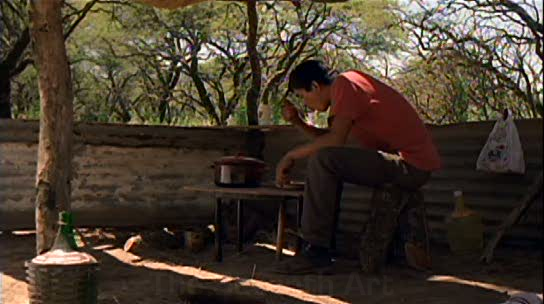
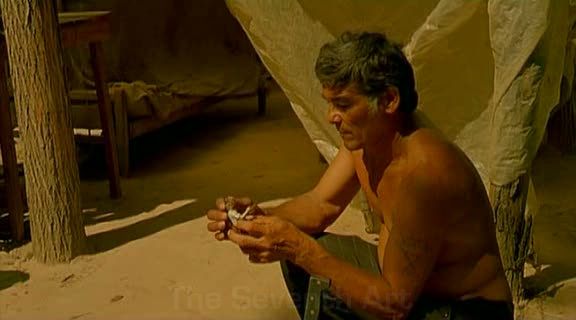
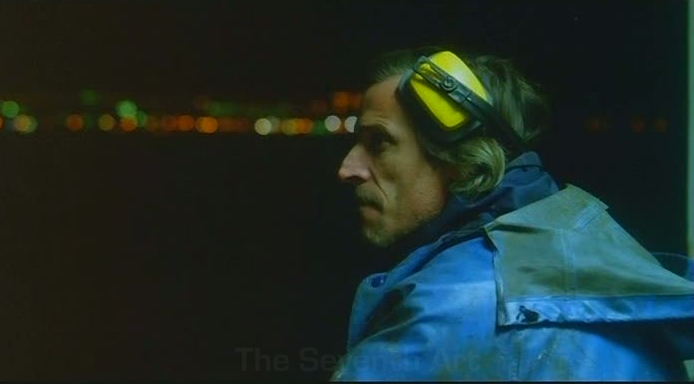
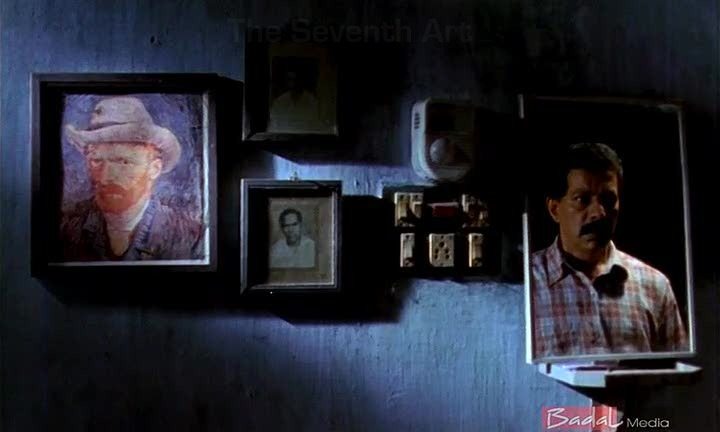
Walang Alaala Ang Mga Paru-paro(2009) (Butterflies Have No Memories)
Lav Diaz
Tagalog/English
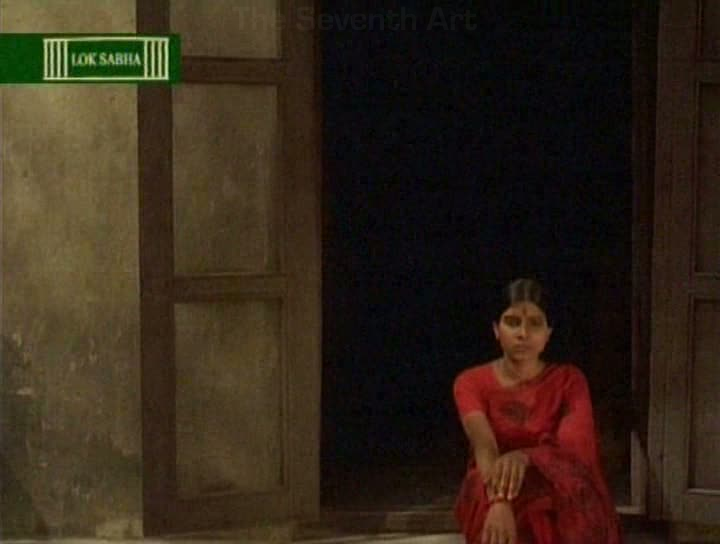
The director’s cut of Butterflies Have No Memories (2009) is something of a misnomer. For one, Diaz had to shoot and cut the film so that it didn’t run for a minute more than the one-hour mark. As a result, it feels as if Diaz had one eye on his film and the other on his watch. There are shots that are abruptly drained off their life and some that feel perfunctory. But the film also seems to mark a turning point in Diaz’s outlook towards the Filipino people. Perhaps for the first time, Diaz portrays the common folk (and perhaps a particular social class) as being almost completely responsible for their misery. In Butterflies, an ex-Chief Security Officer at the mines, Mang Pedring (Dante Perez), blames the mining company, which has withdrawn production after protests by the church and activist organizations, for the economic abyss he and his friends are living in. But it is also starkly pointed out to us that, while they were getting benefited by the mining company, these folks did nothing to set up alternate ways of business and earning and, as a result, find themselves foolishly hoping for a past to return, even when such a regression is harmful it is to the collective living on the island. Mang misguidedly plans to reverse time and reinstall the factory by kidnapping the daughter of the owner of the mining company (Lois Goff), who has returned to the island after several years and who calls Mang her second-father. What Mang tries to do overrides personal memory and disregards the fact that it is he who has lived like a moth, inside a cocoon. As, in the final shot, Mang and his friends stand wearing those Morione masks (which bring in the ideas of guilt, remembrance, conscience and redemption – so key to the film), they realize that they’ve gone way too far back in time than they would have liked – right into the moral morass of Ancient Rome.
Udaan, one of this year’s entries at Cannes in the Un Certain Regard section, is a coming-of-age tale set in the heartland of India and tells the story of seventeen year old Rohan Singh (Rajat Barmecha) who is expelled from his boarding school in Shimla, along with three of his friends, and is forced to return to his hometown of Jamshedpur to his estranged father, Bhairav Singh (Ronit Roy). He discovers that he has to put up with not only the tyrannical ways of his father but also with his six year old step brother Arjun (Aayan Boradia) who is treated no better than Rohan by their father. Bhairav makes Rohan work out every day. He gets him admitted to an engineering college and instructs him to work in his steel factory. It is clear that it is not just the steel he wants to temper. Rohan regretfully abides, wearing the bland white jacket over his snarky one-liner T-shirts. More interested in the ambiguity of poetry than the precision of engineering drawing, Rohan starts bunking classes, winding up at the river bank to write. Naturally, writing becomes the tool for him to express himself, apart from other methods like shouting into a deserted basement at the dam and reciting largely improvised stories to patients and staff at the local hospital, where his brother is admitted for a few days.
Rohan is portrayed by debutant Rajat Barmecha. Barmecha plays Rohan straight, without the usual film vocabulary actors succumb to, and he is the greatest success for the film. With their long lashes, his eyes suggest everything from desire to rebellion. As Rohan, he appears to be the kind of person who seems to be willing to listen to your problems and the kind of person who hopes that you listen to his. With his “feminine” countenance (a feature that his father derides heavily in the film and the reason I predict that he won’t make it big in Bollywood), he’s also the person you believe won’t be parading his chutzpah or doing something alarmingly foolish. In short, he appears to be a person whom everyone will trust. Ironically, he lies to his father whenever he is in potential trouble (In a well realized arc, he later chooses to tell the truth to his father, not out of guilt, but because he knows that he knows his father well enough and that he can handle the consequences). He would probably have gotten away from his father and his rigid laws if it wasn’t for Arjun, whom he seems to view as a younger, not-yet-scathed version of himself. Predictably, he becomes Arjun’s surrogate father (and mother too, if we are to consider his oft mentioned femininity in the film). Meanwhile, Bhairav’s brother Jimmy (Ram Kapoor), who does not have children of his own, becomes Rohan’s surrogate father and the latter, his surrogate son. Each of the three otherwise unrelated characters is connected to the others via the beastly persona of Bhairav. These are all familiar writing tricks, of course, but first-time director Motwane treats the text with skillfulness of a semi-veteran.
You know that a coming-of-age film is on the right track when it starts with the protagonist jumping over the walls of his hostel into the city streets. In fact, Udaan strictly adheres to the path laid out by the genre, carefully working out culture-specific variations and steering clear of conventional pitfalls of the nation’s industrial cinema. The latter was possible perhaps because the film draws inspiration more from the west’s treatment of the genre than from the melodramatic traditions of Bollywood (more on this later). There seems to be an influence of virtually every landmark coming-of-age film in Udaan. Rohan and his college friends, high on booze, deliberately pick on a group of mooks at a pool hall – a scene that seems directly out of Scorsese’s Mean Streets (1973, the appropriation doesn’t seem like homage or pastiche for it is employed in a very similar fashion for very similar effects. One might also recall that Anurag Kashyap, who has co-written and produced this film, had already harnessed Keitel’s LSD trip in his reworking of Devdas, which Motwane co-wrote). Rohan’s and younger brother Arjun’s having to put up with an authoritarian father they barely know has echoes of The Return (2003), but where, in the latter film, the father is a mythical, metaphorical figure looming over the kids like a phantom, Bhairav is an everyman grounded in reality (One of Rohan’s friends tells that every father in the city is like Bhairav). The teenagers driving like crazy through the city streets at night, too, might have been from Nick Ray. But it is The 400 Blows (1959) that Udaan seems to want to emulate the most. Right from Rohan’s breakout from the regressive boarding school, to the motif of running and up to the final freeze frame on his face (albeit on a less ambivalent note), Udaan smells of Truffaut’s masterpiece (There’s a fleeting, pretty stunning image of Rohan’s face, framed head on with harsh light from above, which recalls young Doinel’s). And that’s besides the fact that this is Vikramaditya Motwane’s debut film and might be highly autobiographical.
Udaan’s embracing of these films, especially The 400 Blows, and the tropes of the genre as treated by the west is of note because it is what defines the interesting politics of the film. Udaan is, at its centre, a war against tradition in all its shapes and sizes. Bhairav is the symbol of tradition and conservatism in the film. He acts like his father did and metes out the same kind of punishment to his kids as his father had to him. With his dark glasses, trimmed moustache and perpetually disgruntled look, he is the quintessential patriarch guarding the passage between tradition and modernity. He has married thrice, works out extensively everyday, drinks every night, smokes throughout, doesn’t hesitate to use his belt on his six year old, ridicules his first son’s feminine looks and is probably also proud of this skewed sense of masculinity of his. He admires the famed industrialists and other icons of Jamshedpur and literally prostrates before them. He calls his brother Chotu (“little one”, which he sure isn’t) and insists that the kids address him as “sir”. His brother Jimmy is the counterbalancing force to Bhairav in the film. He is a man who had chosen the road less traveled (and supposedly failed). He is a progressive man who believes that Rohan should do what he wants to. It is Jimmy who paid any heed to what Rohan’s mother felt her son should become. Bhairav, on the other hand, is disgusted by Jimmy’s impotence and obesity (he would have anyway called Jimmy impotent, given his definition of what being masculine is). The two vastly different father figures, resulting from a schism within the family, are the choices provided to Rohan, who similarly has to choose between industrial work and poetry. Obviously, he chooses to emulate Jimmy, and in a predictably rebellious manner.
[Udaan (2010) Trailer]
Along the film, Rohan repudiates everything that is traditional and everything that binds him to his biological father. He shatters the rickety old car of his father with a crowbar, he discards the familial watch that Bhairav gives him on his eighteenth birthday (a familiar cliché in Indian cinema) and he even punches his father right on the face. Towards the end, he manages to make his father chase him unsuccessfully, once and for all, after having run behind him everyday. He will perhaps become everything his father isn’t (which is exactly what the latter tries to prevent). There is also a conspicuous absence of women in the film. Motwane and Kashyap avoid the pitfall of succumbing to the view that all women are victims of tradition. There are two women who are alluded to in the film – Rohan’s deceased mother who wanted her son to be a writer and his friend’s mother who chastises her son for having thrown out his abusive father out of the house – who, too, reflect the dichotomy between modernity and tradition that Jimmy and Bhairav respectively represent. Moreover, Rohan being a very liberal person like his mother (whom he seems to have a lot of love for) and his wanting to break away from Bhairav’s patriarchy puts the film onto an oedipal course as well, which is not very alien to the narrative at hand. One reason why Udaan is one of the few truly liberal films out there is because it carefully avoids, through its script choices, subscribing to that awful pseudo-liberal axiom that you can follow your dream no matter who you are. By locating the protagonist in a regressive middle class setup (which is beset by the problems caused by the recession) and eventually shifting him into a more progressive, flexible middle class, Udaan comes across as an honest, non-exploitative bourgeois film. Of course, it does not mobilize this trajectory for more overtly political purposes (Rohan father is a steel industrialist in Jamshedpur while his friend’s parents live in Singur. This tempting premise is left unexplored), but that’s probably because the film chooses to work completely within the genre.
This liberal support of the individual, free of all traditional baggage, is what makes Udaan a very “western” film (“western” in the same way Kurosawa was) and it is perhaps what makes the film very offbeat with respect to Bollywood cinema as well. Where the typical film would have portrayed Bhairav as an ogre on the outside and a child within (he would probably have confessed his love for his son to a friend or would have spread a blanket over Rohan while he’s asleep!), Udaan retains him as a threatening force. There’s no gentle giant act that Bhairav is made to undergo. But that does not mean that he is merely a concept or a one-dimensional monster. What makes him very human is the fact that he seems to know that he’s acting it all out. He’s a man blinded by tradition no doubt, but seems to be aware of that limitation. He tells Rohan that he didn’t have much to say to him when he visited his school. Even when he apologizes to his kids (before he distracts them from reflection), he does so within the limits of dignity allowed by his “character”. The triumph of writing lies in its belief that it need not “prove” that Bhairav is a human being. He just is and Ronit Roy plays him with the same kind of conviction. This consciousness of one’s limitations and the choice to be what one is also goes down well with the basic libertarian idea, which the film espouses, of a man making up his own destiny (which is very frequently mutated to condemn crimes of all kinds).
Udaan’s one more connection to The 400 Blows must be noted. While Truffaut’s work tried to break away from a tradition and the moral squalor that it seems to have brought, it simultaneously represented a move away from the traditions of cinema, with its technical radicalism and its inclination to make cinema author-centric. It was a battle being fought against the tradition (of quality) on multiple levels, virtually kicking off the New Wave. Udaan, on the other hand, has its feet planted firmly on the genre. Motwane is not a strict modernist like Truffaut was. Even if he is opposed to tradition and might be using cinema as a medium of personal expression, he does not go to the extent of taking up genre-blending or self-reflexivity. Sure, it does break away from the conventional story telling methods of the national cinema, but it does so only to adopt conventions of a different cinema. The aesthetics of the film – sunrays scattered by tree leaves piercing the camera lens, faces gazing towards infinity from the edge of the frame, cute symbolism, characters dragged softly into and out of the shallow focus and guitar riffs trying to create the blues – virtually cry out “Sundance!”. Some of the lines feel very scripted (a shortcoming that is commented on within the film and nearly overcome by making the protagonist a writer). But there are stretches in Udaan that are also directed with considerable finesse. There is much restraint in the score. Where a lesser film would have tried to cover up the silence with piano pieces, Udaan dares to leave it as it is. In the film’s most striking moment, Rohan relaxes on a cot after having dragged his heavy trunk upstairs. There’s no music. Almost no sound. Just the anxious face of a teenager back from an arduous journey and ready to embark on a longer and more important one. The shot lasts a few seconds. You wish it went on – the shot and the journey.
Tie Xi Qu: West Of The Tracks (2003)
Wang Bing
Mandarin
“We have to leave sooner or later anyway. Can’t hold back the tides of progress.”
I’d so far thought that it was Jia’s The World (2004) that truly summed up the state of the third world in the first decade of the new century. While I’ve not changed my opinion entirely, Wang Bing’s phenomenal DV work Tie Xi Qu: West of the Tracks (2003) forces me to. Epic in scope and size, West of the Tracks is divided into three films subtitled Rust, Remnants and Rails. Between 1999 and 2001, when China had embarked on a mission of mass privatization of the country, Bing lived and shot this film in the district of Shenyang located in the city of Tie Xi in northeastern China where smelting and electrical industries were to be closed down. These industries were purportedly established by the Japanese to help them produce ammunitions for the war, but were nationalized after Japanese retreat. Although these factories were doing well till about the eighties, the profits started waning by the mid-nineties (due to bad management, some workers say) and, by the end of the decade, the factories had filed for bankruptcy resulting in mass layoffs and appalling cuts in pay of the workers. The film is a Herculean effort by a single man, who is credited as the producer, director, cinematographer and the editor of the film (which is ironical considering that this is the kind of film that tries to efface authorship). Bing apparently shot several hundred hours of footage for this film and edited it secretly and illegally in a TV studio. The result is one of the greatest films of the decade.
Rust, the longest of the three parts of this monumental work, opens with extended tracking shots photographed from a train that succinctly sum up the nine-hour film that is to follow. The snow-tainted lens of the handheld camera tells us the attitude of the filmmaker towards his subject – that of a empathetic and trustworthy observer who will place himself amidst the people he will be documenting – and the train, which comes to a halt after trudging through the snow-clad premises of the Shenyang smelting complex, itself becomes a fitting metaphor for the underproducing factories that will soon come to a full stop. In Rust, Bing chronicles the everyday life of the workers at the copper, iron and zinc smelting factories of Shenyang and through it, the failure of a utopian socialist dream. A large part of this section gives us workers going about doing their routine – unloading the metal ores, refining them, operating the blast furnaces and processing the extracted metals – and relaxing at the break rooms where they play chess and mahjong, involve in verbal fights and talk cynically about the state of the factory. This technique is crucial for the film since it is this very technique that aids the film to abstain from making any overt political statement and helps us empathize with the workers’ plight and way of life. It is this experiential mode of identification that justifies the running length of the film too. Had Bing cut down the film to a more viewer-friendly runtime, the product would have been a more analytical and agenda-driven film rather than a humanistic work that it is.
It is in these decidedly mundane sequences that we witness how inhuman the work at the factories is. The communist dream of the glorious worker seems a mere propaganda when one observes what happens at these industries. We are told that the lead content in the factories’ atmosphere is hundred times the allowable limit. The workers later go to a hospital to rid their bodies off the poison that they have taken in from the factory. The machines have literally infested their lives. The workers have become functional accessories required to keep the machines running, literally and figuratively (This personal sacrifice asked of people for a supposedly greater good – a motto that seemed common only to totalitarian socialist regimes – manifests in even more objectionable terms in the second part of the film), but they would have to almost kneel begging for pension before the government. The toughest part in this whole ordeal seems to be to come to terms with the fact that the faith that the workers had towards their government turned out to be an act of naïveté. Rust is the least narrative of the three segments and it is indeed tough to get hold of a perspective through which you can assess the happenings. In fact, the only probable protagonist of this section is, like Tsai’s cinema hall, the industrial complex itself. The complex, through its days of glory and disgrace, appears to denote the death of a civilization – from being a place full of people and public baths to a cold, deserted wasteland. After the industry is shut down, one of the workers, ransacking the now-empty break rooms, finds the identity card of a worker among the debris. We do not get to know the name on the card. We needn’t. It’s the condition of all the industry workers at Shenyang.
The three hour long second segment of the film, Remnants, takes place in the residential complex that houses the family of the workers at the Shenyang factories. Bing employs the same identification technique as in the previous film, following a large number of people living in the area and getting us accustomed to the way of life in the place. The first hour mostly deals with a bunch of teenagers knocking about the township during Valentine’s Day without any apparent work or education to care about. Some of these directionless youth take to violence and turn hoodlums for petty sums of money. It is in this infinitely rich segment that the film opens up numerous avenues for analysis of class, crime, justice and human rights. Like the Shenyang industries, the residential complex is to be torn down as per orders and is to be replaced by privately constructed and owned chain of apartments. Some of the residents, who realize the power of the institution they are up against, decide to dismantle their own houses (like the workers who take the industries apart), sell off whatever scrap metal that remains and move into the criminally unfair amount of compensatory space they are being allocated elsewhere. In that regard, the dilapidating neighbourhood that they live in becomes highly expressionistic and indicative of the moral and psychological downfall they are experiencing.
The more gutsy ones, on the other hand, decide to stay put and force the private organization and the government to give them their due. The latter retaliates by cutting off the town’s supply of water and electricity. The people, again, try to obviate the need for electricity by harnessing daylight as much as possible. Like the gestures of these people, Wang Bing’s film is also an act of resistance, of documenting what remains unheeded and unsaid and of rethinking accepted notions of progress and development. His refusal to stay with the people who don’t leave instead of those who move on clearly exemplifies his stand. What we see in this second segment is the same kind of human rights violation that takes place in every developing country around the world, be it due to the Three Gorges project in China or the Narmada project in India. There are only a few films such as Jia Zhang-ke’s Still Life (2006), Yu Yan’s and Yifan Li’s Before the Flood (2007) and Simantini Dhuru’s and Anand Patwardhan’s Narmada Diary (1995) that act as voices of resistance amidst the cries of national glory and pride. The important thing to recognize is that these voices exist and need to be heard. One old man in Bing’s film, who is on the verge of throwing in the towel, tells us that we “can’t hold back the tide of progress”. One might call the statement cynical or practical, but the point is that an attempt should be made, even if in vain, to hold the tide back so that there are no more such tides.
The third segment of the film is called Rails and charts the final months at work of the employees of the Shenyang Railway system that manages shipments into and out of the district. This section could be seen as a conglomeration of the first two in the sense that it deals with both the workplace and the residential space of the workers. It is also in this segment that Wang Bing gives the film the semblance of a narrative and boils his character set down to two people – Old Du, a coal gleaner working in the railways with the cooperation of the workers who run the trains, and his son Du Yang. The driving force of this segment is the arrest of Old Du by the railway authorities which causes Yang to break down from his passive state. In the film’s most affecting sequence, Bing photographs Yang in his house on the day following his father’s arrest. Yang shows us a bunch of family photographs, talks about his mother who has left him alone and, just when the clock strikes ten and a melodious tune plays, starts crying. It’s a divine moment in filmmaking. Not once does Bing use non-diegetic music in the film but just at the moment when Yang stands on the verge of a breakdown, the clocks chips in with its heartwarming music (Bing reflexively pans to reveal the source of music, as if vindicating himself!). Earlier, Old Yu tells us: “There aren’t many people who would be willing to live the way we do”. It’s a devastating statement that shows how deep the social ladder descends.
The film’s critical stance against the feverish rate of privatization of industries and public spaces might make Bing seem like a staunch leftist, a leftover Maoist of sorts. But a close look at the film, especially its first part, reveals that Wang Bing is only championing human rights, regardless of what ideology it entails. He is critical of the rapid privatization, but he is also reflecting on the failed socialist dream of the nation. Songs full of empty Maoist rhetoric abound the soundscape (all diegetic, of course) humorously counterpointing the utopian vision of the Cultural Revolution with the systematic corporitization of the country by the same party. As seen in Rails, Mao and Lenin have becomes mere names to be bandied about in conversations. Even in his subsequent film, Fengming: A Chinese Memoir (2007), his interest lies in exploring how the hunt for the rightists of the “black clique” (Maoist counterpart of the red hunt in the United States) resulted in the oppression of individuals, even those who worked for the party, and the confiscation of their basic rights. This passing of national dreams and political visions into the realm of speculation and wishful thinking is one of the numerous thematic connections that Bing’s films share with those of Jia Zhang-ke. In fact, echoes from West of the Tracks can be found in all of Jia’s works – from the impact of the Cultural Revolution in Platform(2000), through the wayward youth of Unknown Pleasures (2002), the ever increasing class rift in a globalized world in Still Life (2006) to the disintegration of the socialist dream in 24 City(2008, the film that starkly resembles Rust). Although these two artists have worked on similar themes, they have, however, done so in their own idiosyncratic ways, with wondrous results
As such, West of the Tracks (and Fengming: A Chinese Memoir more so) does not have a premeditated aesthetic that imposes an external meaning on the reality of the film. The cinematography and editing are almost purely functional and there is barely a cut or a reframing that suggests personal authorship. The film seems to lie so close to the end of that Bazinian asymptote to reality, that it opens up possibilities to read life as art, even if the filmmaker does not intend to create such a meaning. One might say that the naked men who walk around on screen are suggestive of the workers’ identity being stripped down to nothing, but it is only their workplace routine. One might say that the workers are dwarfed and marginalized by the humongous machines they are working on, but it’s just a material truth. One might say that the wife swapping story that the workers share in good jest has considerable parallels in their national politics, but it is just small talk that they indulge in. Same is the case for the trains that often switch tracks. What West of the Tracks does is to create that essential distance between reality and art to give us (pardon the pun) a better picture of ourselves, to create poetry from everyday activities, to aestheticize life. But more importantly, the film makes a strong case for DV filmmaking. Bing’s cinematography is entirely handheld and he prefers to shoot from amidst the workers and from their eye level. Only Digital Video could have provided this material flexibility for Bing. He religiously performs the role of a historian, capturing passages that would otherwise be relegated to the level of footnotes. He neither exploits the grief of the people he’s filming to create his art nor does he try to analyze their situation and make an overarching statement. He merely lives among them, staying in the sidelines with humility and standing witness to the downward spiral they are thrust into. This way, Bing’s film makes a strong case for cinema itself, taking it closer to what it out to be and what it was devised for – to capture and save reality from destruction, negligence and falsification.
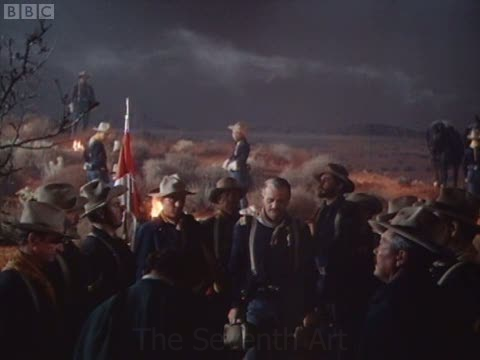
Fort Apache (1948), first of the director’s cavalry trilogy, marks a stark shift in tone and attitude for Ford. It is from this film onwards that Ford’s view of the west becomes progressively unromantic. For one, the central protagonist, Colonel Thursday (Henry Fonda), is gradually alienated from us. His actions seem increasingly misguided and the only force of sanity comes in the form of captain York (John Wayne) who acts as our mouthpiece in the film. Colonel Thursday is a prisoner of his own position in the army. He’s the first of Ford’s many men to show loyalty to external ideologies than to his conscience (“Tell them they’re not talking to me, but to the United States government” says Thursday). These men abandon what is essentially human for some vaguely defined concepts of glory and martyrdom (One can imagine how much Ford would have admired Stanley Kubrick’s first masterpiece). These are also invariably the men who believe in establishing hierarchies and locking people into rigidly defined categories that could systematically be manipulated and deployed (Ford’s reaction to such men would move from fascination to ambivalence to utter contempt, as is evident in his last Western). Consequently, the film, like most of Ford’s subsequent works, is full of petty rituals – ball room dances (compare this mechanical waltz with the divine dance sequence in The Grapes of Wrath), coldly worded field orders, automated salutations and bookish sentences. Ford would take a decade and a half to convert the cynicism of this film to a monumental tragedy.
3 Godfathers (1948)
To borrow Manny Farber’s terminology, 3 Godfathers (1948) is a very powerful termite that gradually grows into a giant white elephant (Compare John Wayne’s blue moon laughter in the first scene with his laboured theatrics towards the end). Yet another remake of a story filmed multiple times before, 3 Godfathers is the kind of movie that can pass off as a Sunday school lesson. Technically, Ford is at the top of his game here, walking through the film with ease, conjuring up one larger-than-life image after the other. But the film feels more like a showcase of Ford’s directorial skills than a coherent work driven by a vision. One also gets the feeling that Ford made this film more as an obligation and as a tribute to his one-time collaborator Harry Carey Sr. who starred in the film Three Godfathers (1916), which Ford himself remade three years later. Hence, the film seems more like a launching vehicle for Harry Carey Jr. that Ford was able to slip in between his cavalry trilogy. Complaints aside, it should also be noted how Ford manages to leave his fingerprints all over the film. At least, the first half hour is a complete throwback to Ford’s prewar Westerns. Glorious landscapes all over and even more glorious men cutting through them, mutually respecting lawmen and bandits of very high moral standards and the psychological tug-of-war they indulge in – one would think that the film just can’t go wrong from here. Sadly, it does. The last half hour is Ford sleepwalking though his material.
She Wore A Yellow Ribbon (1949)
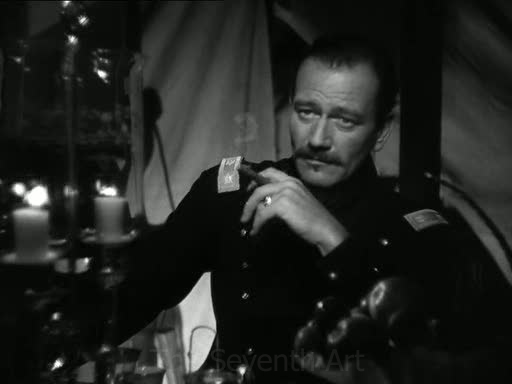
She Wore A Yellow Ribbon (1949) is the best film in the director’s cavalry trilogy and, with the probable exception of The Quiet Man (1952), has to be his most personal work as well. Here we have John Wayne playing the old Captain Brittles, who’s just about John Ford’s age, ready to retire from the army in a few days. Like Ford, he’s a man who throws his weight around just to show how rough and demanding he is and within, he is a child. He’s like Colonel Thursday of Fort Apache on the outside (“I’m ordering you to volunteer” he says – a phrase that would recur in Ford’s later films) and Colonel Marlowe of The Horse Soldiers on the inside. Like Kane of High Noon (1952), he’s a man who feels responsible for the lives of his men even though he’ll become a complete stranger to them in a few hours. Moreover, the film is also about ageing, about giving up one’s game. Captain Brittles is a man who’s seen enough bloodshed in his life. His fervent wish is to save his men from sure death rather than to achieve glory or exhibit heroism (“Old men should stop wars” he says to the old Indian chief who wants to stay indifferent). One can’t help but think Ford might have intended this film to be a swansong of some sort. The most significant scenes in the film are shot at (artificial, accentuated) twilight that so directly registers the dread of being left alone. Brittles speaking to his deceased wife at her grave might be more than a sign of affection. It might be of desperation.
Rio Grande (1950)
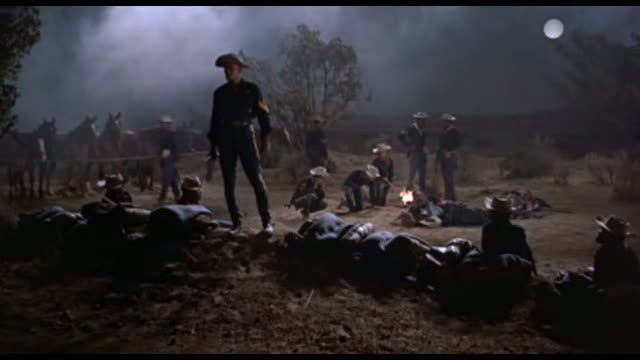
The extremely eloquent and moving Rio Grande (1950) is evidently a thematic extension of the previous couple of films in the trilogy. If professional authority blinded Colonel Thursday of conscience and protected Captain Brittles from baring it, it prevents Colonel Kirby Yorke (John Wayne, perhaps reprising his role from Fort Apache) from bonding with his son. But there is also a sense of inevitability that permeates Rio Grande. Colonel York burns down his wife’s nursery as a part of his duty and pays the price for it. He also stays aloof from his son for he is his supervising officer. He keeps demoralizing his son and tries to siphon off any pride that the boy may have in his new profession. The question here is if one could really break such a barrier, giving in to emotionality or humanism. This idea of free will being overridden by man-made hierarchies echoes throughout in the film. Soldiers exhibit comradeship and honor among themselves whereas they stand stiff and unresponsive while dealing with higher officials (“I refuse to answer sir… respectfully” goes the reply, as it would elsewhere in Ford’s films). Rio Grande is gloriously lit and photographed and each of its images looks like a painting, a moment frozen in time. In this film too, it appears as if Ford is expressing something that is utmost personal in purely generic terms. And Wayne brings such honesty to the character that, when he comes in all white, for once, with a bouquet in his hand, you wish the film ends right there.
Wagon Master (1950)
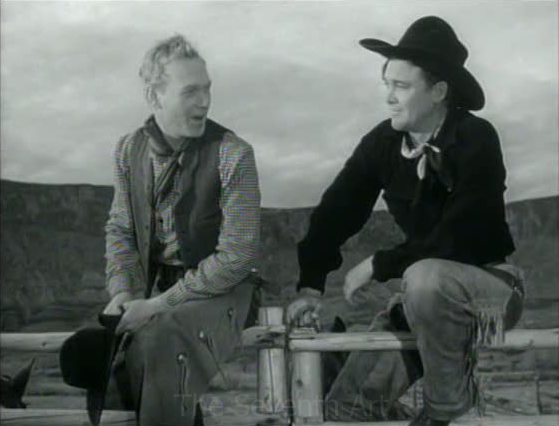
Wagon Master is what one might call a “minor Ford” (shot in black and white with no stars), but that doesn’t do any justice to this superb Western. Less a story and more a journey, the film follows a pair of ranchers (Ben Johnson and Harry Carey Jr.) who agree to escort a community of Mormons on their way to establish a new settlement. The crew on the road entirely consists of people relegated to live on the fringes of the society, the latter being just an arbitrary, prejudiced crowd anyway in most of Ford’s westerns. Ford’s most optimistic film, Wagon Master can be seen as the director’s vision of an ideal West – a place where all races and religions can coexist peacefully, a place where real joy comes from not amassing wealth, but by building a healthy and closely-knit community and a place where the only gold to be found is in the fertility of the soil. Ford counterpoints this vision of utopia by introducing the Cleggs family (which is sort of carried over from My Darling Clementine) that embodies everything that is lamentable about the frontier – racism, hooliganism and intolerance. Watching Wagon Master, one gets the feeling that Ford would have made some very great films (as if he hasn’t already!) had he taken to documentaries. Ford builds the film upon moments of commonplace magic, dwelling considerably on the everyday activities of the Mormons and upon shots of people travelling, moving ahead against nature’s odds and exhibiting a sheer desire to live.
The Searchers (1956)
Everything significant about The Searchers (1956) is off-screen, in its untold passages, unfilmed spaces and undiscussed possibilities. It is as if Ford was commenting upon the genre, and on his own brand of cinema, without ever breaking it down, as if he was repudiating the racist falsities hitherto bestowed upon the Indians by showing how much the white community shares those traits with them and as if normalizing the “demonic” acts of the Natives by presenting them as justified if done by the whites. The Searchers is a film with a mass of unresolvable tensions at the core, each of which threatens to take the film apart. “He’s got to kill me”, says Ethan (John Wayne) about Scar (Henry Brandon). He knows as much about Scar as he does about himself. What are Scar and Ethan are but the same person born on either side of the frontier? Both are old timers who prefer revenge over justice and who believe that each of them has complete justification to kill the other. When they look at each other in the eye, what they are staring at is, in fact, the abyss within each of them. It’s not just Ethan and Martin who are the titular searchers, it is Scar too. That’s why The Searchers is, at heart, a tragedy. Somehow, Ethan seems to know his condition and that his choice of an artificial racist ideology over his conscience (unlike Martin) has done him more harm than good. Consequently, the journey, like the film itself, becomes a quest to define, once and for all, what Ethan is.
The Horse Soldiers (1959)
The Horse Soldiers (1959) is set during the American Civil War and unfolds primarily from the point of view of Colonel Marlowe (John Wayne), an officer in the union army who plans to blow up a key railway line to disrupt supplies to the Confederate forces. Locating the story within civil war helps Ford to comment on the war without taking sides, unlike the earlier films. Also in Colonel Marlowe’s cavalry is surgeon Kendall (William Holden), whose mere presence irritates Marlowe to no end, and a prisoner Miss Hunter (Constance Towers). As in My Darling Clementine, the Fordian male bonding is between a doctor and an army man. Hunter sees the doctor’s profession as one that saves lives and the army man’s as one that kills. Marlowe, on the other hand, considers doctors as parasites who want people to be sick and, perhaps, his kind as those who want then to be healthy. It is only towards the end of the film that Marlowe comes to realize that his grief of losing his wife after a failed operation is no more sorrowful than the doctor’s angst of not being able to save a patient who has come to him for help. This sense of empathizing with the ‘other’ forms the backbone of the morally complex work that is The Horse Soldiers. When the confederate army is, actually, made of school kids and old men, it’s hard not to see the futility of a war that is fought just for the sake of wiping out one side.
Sergeant Rutledge (1960)
If The Horse Soldiers was Ford empathizing with the Tories and Cheyenne Autumn would be him empathizing with the Native Americans, Sergeant Rutledge (1960) is Ford making amends for the under-representation of the African-Americans in his Westerns (This near total absence of African-Americans is startling given that Ford has made more than one film dealing with the Civil War). Basically a courtroom drama uniformed as a Western, but also historically particularized, Sergeant Rutledge is Ford tackling the issue of racism head on. The film unfolds piecewise, moving from one incomplete perspective to another while keeping the truth at an arm’s distance, so that the audience is never completely allowed to vindicate and sympathize with protagonist Rutledge (Woody Strode, ironically given the 4th place in the title credits!). It is interesting to imagine how the audience would have reacted to this kind of a narrative structure in the pre-PC era in which the film was made, especially given that the central drama involves a young black man and a white adolescent woman – arguably the most scandalizing combination of them all. Despite the fact that the film has some pointed writing (“What does it all add up to, sir?” Rutledge asks an edgy Tom Cantrell (Jeffery Hunter), who is not entirely free of racial prejudices and acts himself as one might be led to believe, coldly exposing the latter’s disbelief in him), Sergeant Rutledge suffers from Ford’s heavy-handed direction. Ford attempts earnestly to develop a mythical African-American hero in Rutledge, but the effort seems more like calculated posturing than genuine legend building.
Two Rode Together (1961)
Two Rode Together (1961) could be seen as an unequivocally liberalist reworking of The Searchers that resolves the irreconcilable tensions of the earlier film and takes a clear cut political stand. One could say that this is the film The Searchers would have been had there been no man called Ethan Edwards. Ford makes this clear by resorting to a plot that resembles that of the previous work (There is much intertextuality in the film, with characters, actors and lines being directly borrowed from the previous film) and commenting very strongly on the racist tendency espoused by some people of the white community at the frontier. A white boy who was captured and raised by Indians is traded back for some weapons by corrupt antihero sheriff Guthrie “Guth” MacCabe (James Stewart). The white community is asked to identify the boy and claim him back. The scenario has all the uneasy trappings of a slave market and that may just be the point of the film. And the sharp character arc that Guthrie undergoes could well apply for the whole of Ford’s cinema. Despite its occasional flourishes of melodrama, there is much left unanswered in the film and its take on mob mentality, fear of miscegenation and domestic racism leaves one very agitated. And yes, Two Rode Together has the greatest dialogues in all of Ford’s Westerns that are delivered with such panache that the film feels almost Hawksian. The conversation between Stewart and Widmark at the riverbank, spanning several minutes, is a sheer joy to watch.
How The West Was Won (1962)
An omnibus film directed by John Ford, Henry Hathaway and George Marshall and starring just about every living actor that you would associate with Westerns, How The West Was Won (1962) is the kind of film that cries out: “Look at me. I’m epic. Worship me”. Indeed. Made for Cinerama and shot in such spectacular fashion (that it might have well set the trend for present day epic cinema), I can imagine how viscerally enthralling it would have been to see it in its original projection. John Ford apparently directed the segment on civil war that comes halfway into the film. With the trappings of an episode from late Kurosawa, Ford’s segment is an uninspired piece of filmmaking starring John Wayne, who could easily have been replaced by a John Wayne impersonator here. The film, likewise, could have been titled “How the Western Was Won” for the work seems more like a reverent pastiche of great Westerns through the ages than a conglomeration of myths about the Wild West. Conservative to the point of being laughable (and this might have really turned off Ford, given the kind of films he was making at that time), the film has two well made segments that hold it together. The first is the charming interlude involving Gregory Peck and Debbie Raynolds which is actually a romance dressed up as a Western. The second redeeming section is the strikingly directed final half hour, which plays out in a High Noon-esque, traditional fashion that infuses the film with a spirit that is missing in the first two hours.
The Man Who Shot Liberty Valance (1962)
The proper place for John Ford’s greatest Western, The Man Who Shot Liberty Valance (1962), is not among Ford’s other westerns but among films like The Diary of a Country Priest (1951), Ordet (1955) and Winter Light (1962), for it is a spiritual work of the highest order. By the time the film ends, you almost get the feeling that all that you saw was a pair of eyes piercing the pristine screen. In the film, Ford examines what essentially comprise the soul the Western – Law and Morality – through three different embodiments of these entities – the good legal Ransom (James Stewart), the bad illegal Valance (Lee Marvin) and the good illegal Doniphon (John Wayne, a Farber termite, delivers the performance of a lifetime). The Fordian dialectic between tradition and modernity is at its most intense here, with Ransom’s civilization making way for Doniphon’s way of the gun. The Man Who Shot Liberty Valance is a textbook for genre filmmakers on how to light, stage, shoot and cut a film. Every second of the film, you feel you are there, in the midst of the action, living with the characters. The film is like a stretched rubber band, ready to snap any moment, with every character pulling the film’s moral center towards himself/herself. A tragedy of monumental proportions (It is from this film that The Dark Knight (2008) borrows heavily from), The Man Who Shot Liberty Valance is perhaps the one film that Ford should be remembered by. “When the legend becomes a fact, print the legend” says a newsman in the film. His voice might just be of John Ford.
Cheyenne Autumn (1964)
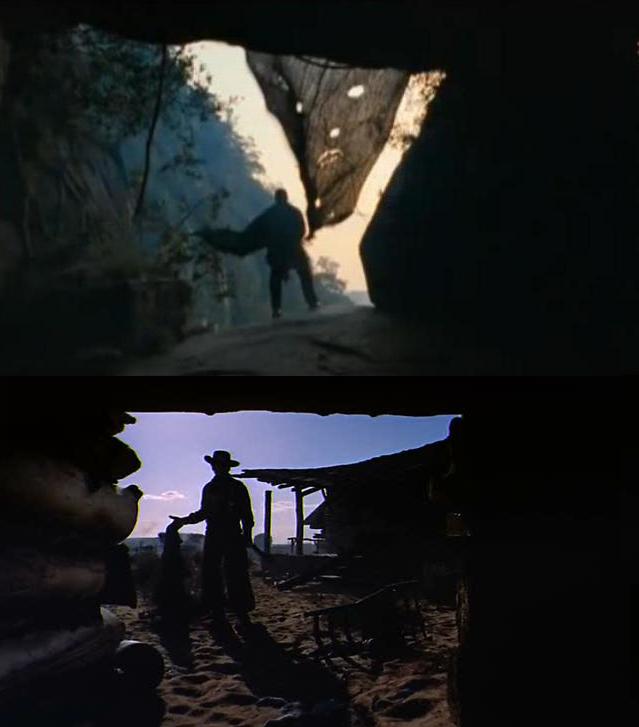
Cheyenne Autumn (1964) has widely been labeled as Ford’s official apology letter to the Native Americans for having usually cast them as bloodthirsty savages. If one follows all of Ford’s Westerns from The Searchers onwards, one would see that the film is also a logical conclusion of a trajectory. Cheyenne Autumn is a highly liberalist film, but it does not present a primitivist’s view of the Native Americans. Sure, it portrays them as a proud and peace-loving race, but Ford is more interested in treating them as a group of individuals who may or may not conform to stereotypes and perceived cultural truisms (“He is your blood, but he is not you” says the new clan leader). Actually, Ford endorses individualism more than ever in this film. He underscores the need for individual decision making and the need to act according to conscience. Elegiac in tone, as if mourning national and cinematic mistakes of the past, the film is almost entirely defined by its harsh, godforsaken landscapes. The central comical segment with Stewart as Earp should be disregarded for that’s how the director’s cut of this film would have turned out to be, even if it serves both as a throwback to pre-war Ford and as a hilarious critique of the racist tendency commonplace at the frontier townships. From Americans hiding in a hut from an Indian onslaught in Straight Shooting to Indians being imprisoned in a barn by the Americans in Cheyenne Autumn, Ford’s Westerns, spanning nearly half a century, seal the filmmaker’s position as a chronicler of both the history of America and the history of American cinema. Rife with, well, Fordian compositions, Cheyenne Autumn is a fitting, if not the ideal, farewell to Westerns for Ford and to Ford for Westerns.
Maine-born John Ford (born Sean Aloysius O’Fearna) originally went to Hollywood in the shadow of his older brother, Francis, an actor/writer/director who had worked on Broadway. Originally a laborer, propman’s assistant, and occasional stuntman for his brother, he rose to became an assistant director and supporting actor before turning to directing in 1917. Ford became best known for his Westerns, of which he made dozens through the1920s, but he didn’t achieve status as a major director until the mid-’30s, when his films for RKO (The Lost Patrol [1934], The Informer [1935]), 20th Century Fox (Young Mr. Lincoln [1939], The Grapes of Wrath [1940]), and Walter Wanger (Stagecoach [1939]), won over the public, the critics, and earned various Oscars and Academy nominations. His 1940s films included one military-produced documentary co-directed by Ford and cinematographer Gregg Toland, December 7th (1943), which creaks badly today (especially compared with Frank Capra’s Why We Fight series); a major war film (They Were Expendable [1945]); the historically-based drama My Darling Clementine (1946); and the “cavalry trilogy” of Fort Apache (1948), She Wore a Yellow Ribbon (1949), and Rio Grande (1950), each of which starred John Wayne. My Darling Clementine and the cavalry trilogy contain some of the most powerful images of the American West ever shot, and are considered definitive examples of the Western. Ford was the recipient of the first Life Achievement Award bestowed by the American Film Institute, and was the subject of Peter Bogdanovich’s documentary, Directed by John Ford (1971). He died in 1973. [Bio Courtesy: All Movie Guide, Image Courtesy: Star Pulse]
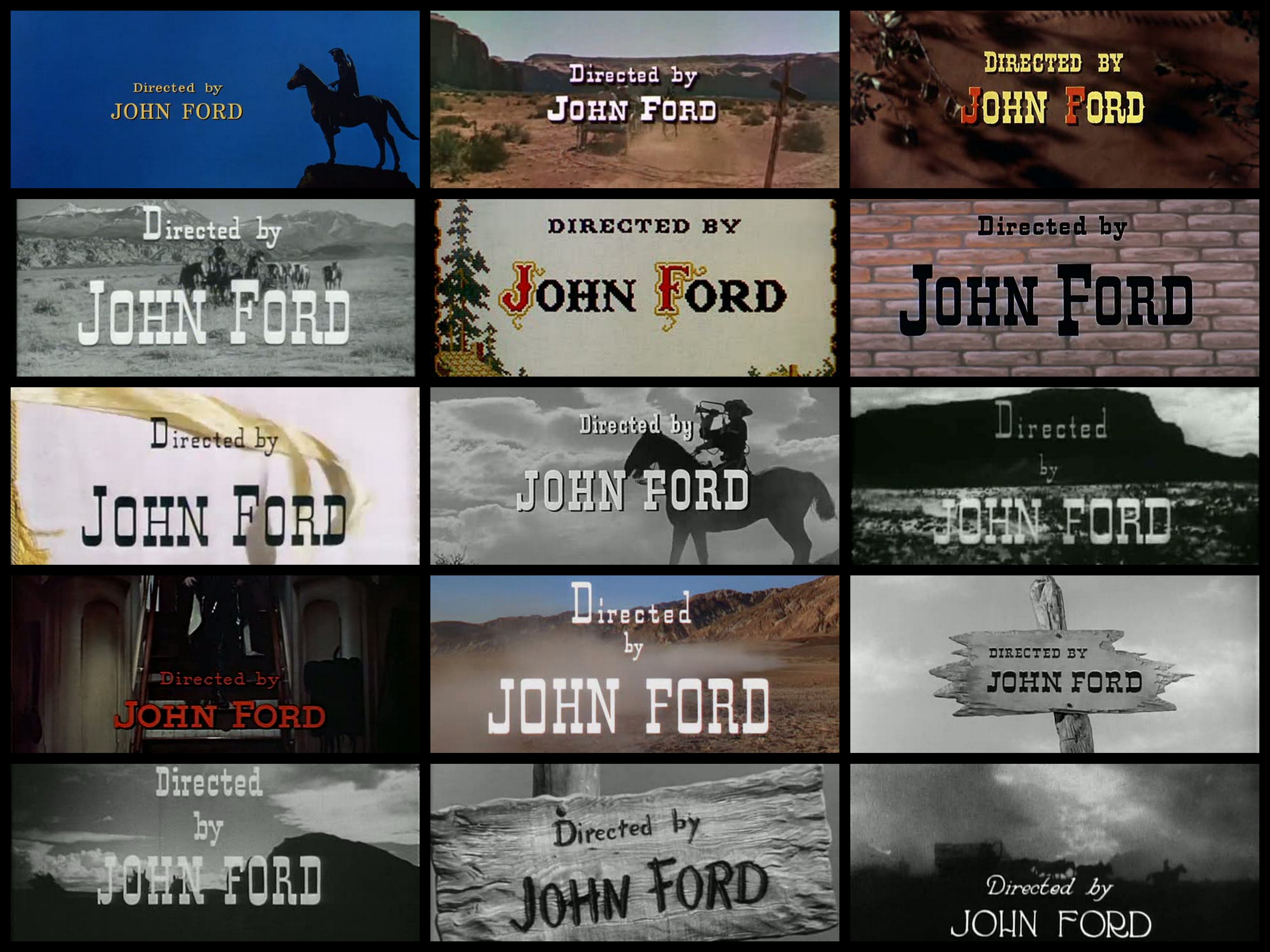
Mythmaker extraordinaire John Ford made over a hundred films in his career that now spans half of cinema’s lifetime. Even though these works cover a number of genres, Ford’s name has become synonymous with the Western. The Western as a genre originally had a specific historical context, but, as Bazin elaborates, it went on to become a narrative template, with its own clichés, conventions and myths – a form that needed content. Interestingly, Ford’s Westerns are a mixture of both kinds. The events in his films are historically particularized while the emotions that drive them are universal. Likewise, Ford himself is a historian and a humanist, a documentarian and a poet, a reporter and a raconteur. His cinema is an encyclopedia of American history, but it is also a treatise on human goodness. The eternal conversation between the human and the political dimensions in Ford’s Westerns is ingrained in the director’s aesthetic itself, where human drama is often juxtaposed with historical events (The latter may have given birth to the director’s semi-static compositions that serve the purpose of both establishing a scene and letting an action unfold in the same shot). Furthermore, Ford’s Westerns are documents about the evolution of the genre itself. No other director apart from John Ford can claim to have witnessed the evolution of the Western in its entirety. Each of his films carries within itself the spirit of its age, its cultural norms and the ever changing ambitions of the genre (In one early silent Western, the word “damn” is graphically censored while the word “chink” is retained. In fact, the self-censorship – or a lack of it – in Ford’s films helps trace out the general outlook of Hollywood towards many social issues).
Godard once remarked that it is only in Hitchcock’s films that the viewer remembers specific objects in the story more than the story itself. Similarly, Ford’s is a cinema which consists of a number of gestures and glances and, in the most brilliant instances, is made of just those. In the best of such moments, these gestures attain such clarity, individuality and grace that a comparison to Bresson shouldn’t invite surprise at all (Here’s Glenn Kenny on transcendental style in the films of Ford. Go figure.). To borrow what Donald Richie said about the director’s protégé Kurosawa, the battle in a Ford film is always spiritual and is won even before the actual fight starts. There is also something implicitly Bressonian about the way Ford uses his actors. It is a known fact that Ford casts the same set of actors very often in his films. The reason might be purely logistical, but the effect is startling, to say the least. By having the same actors play similar kind of roles over and over again (a technique that stands in direct opposition to Bresson’s, but nonetheless achieves the same effect, amusingly), he converts them from Method actors to icons, from White Elephants to busy termites and from the “signified” to the “signifiers” (to open a new can of worms). Beyond a few films, John Wayne didn’t have to convince people that he was a man from the West. The very image of him prompts the audience to take that as a given and to expect the only variation possible from him through his gestures, quips and postures, which is what Ford’s cinema is all about. This effect is compounded by Ford’s occasional tendency to be intertextual and to refer to his previous films through repeated characters, lines and situations.
Kumar Shahani once commented that it was just impossible not to think of the Odessa Steps or Eisenstein while shooting scenes involving a mass of people. Likewise, it is near impossible not to think of Ford while shooting vast horizons, especially when they are adorned by people moving in a file (Bergman’s Dance of Death is one of the very few shots that could emulate its inspiration). The horizon, along with the dusty skies, misty atmospheres and imposing silhouettes, helped Ford create some of the most iconic images and awe-inspiring heroes that cinema has ever seen. Even if the films themselves aren’t entirely successful, there are frames, shots and scenes in them that stay with you forever. Ford uses his musical score to multiply, rather than manipulate, the effect that an image has. His camera always seems to be placed in a position where the audience feels the maximum impact of a particular shot. But apart from these static compositions, what is remarkable in Ford’s films is his dynamic use of screen space that clearly shows Ford’s preoccupation with the material nature of the medium. His choreography and blocking of actors and deployment of action on multiple planes are two practices that elucidate Ford’s incisive knowledge about the representation of three dimensional spaces. If Tati made great silent films in sound, Ford’s early films reveal that he made great “talkies” before the advent of the technology (Ford is not unlike Tati in his judicious use of the screen area). One could go on about Ford’s genius and influence, but I think it is best to end this brief summary here – on the topic of silent cinema and talkies – for Ford’s cinema, like Chaplin’s, could well be just about the dialectic between “the image” and “the word”. The image in Ford’s films serves to mystify, creating larger-than-life beings who are worthy of worship. The word demystifies them, bringing them back to ground to reveal that these demigods are merely humans, living among us.
[Note: Many of Ford’s numerous Westerns are either partially or completely lost. By my calculation, less than two dozen survive and are in circulation. The following couple of posts deal with all the “complete” Ford Westerns that I could get my hands on]
Straight Shooting (1917)
Straight Shooting (1917), John Ford’s first feature length work, is a terrific Western that would rank among his best works. A number of things that would much later be deemed “Fordian” seem to have had their roots in this very film. The doorway shots and horse-rear compositions, which would eventually open and close a multitude of scenes in the director’s future works, are all present here in their utmost glory. The directness and economy of expression and the lived-in authenticity of the film (The acting in the film is strikingly naturalistic, revealing the schism between realist and theatrical filmmaking and even before the advent of sound) would later turn out to be features that define Ford’s cinema. Shooting outdoors sure does limit Ford’s depth of field, but the director already seems to be attempting to employ deep focus so that large chunks of action can unfold with their spatial tension intact. At the heart of the narrative is the trademark love triangle of Ford’s and, from here, he would only go on refining the relationships between its participants. The absence of multiplicative music is nearly compensated by visual underscoring techniques such as circles and ellipses that highlight the key moments of the film (this was probably the general studio trend). There are scenes taking place during a heavy downpour that could pass off as Kurosawa but for the costumes. But the icing of the film is surely the close-up shot-reverse shot of the hero and the villain before the showdown. Ford has already cracked the code: The secret’s in their eyes.
Bucking Broadway (1917)
Bucking Broadway (1917) is really a screwball comedy masquerading as a Western (The film appears to have been written entirely around its climactic action set piece!). Primarily a reworking of the country rat-city rat tale, Bucking Broadway follows a young ranch hand’s journey to the city of New York and his subsequent attempts to win back his girlfriend from a fraudster in the city. This film might be seen as Ford’s petition for a cinema with sound and the film virtually cries out for a voice (Ford actually throws in a scene with a piano in the film). However, most of the humour here is slapstick and some of the indoor sets look straight from a Sennett production. There is no real tension between the characters or within plot points and one always knows where the film is heading (the film itself has its tongue planted firmly in its cheek). But it is probably here that Ford is on his most experimental ground. For one, he dabbles in hypnotic chiaroscuro lighting, which he would only rarely use in the future (not considering the tinge of expressionism that graces his films now and then). Then there are the glorious horizons, that Ford frames off-center (almost always at the top of the frame here, as if pressing the characters down), as he would do very frequently in his Westerns. Finally and most importantly, there is the remarkably judicious use of all the three planes of the film image (The final brawl scene at Columbia Hotel toys with the focus of your eyes and presages the breakfast scene in The Searchers by about four decades).
Just Pals (1920)
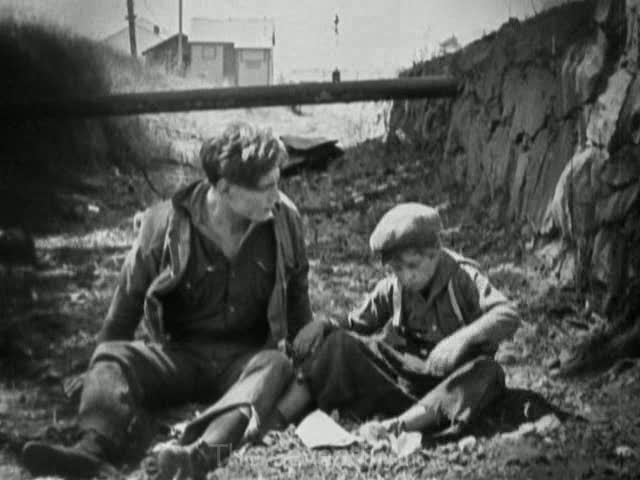
Just Pals (1920) was apparently the first film Ford made for Fox Studios and the change is palpable. While the earlier couple of Westerns were transparent about their motives, with their trump cards being grand action set pieces, Just Pals leans more towards the sentimentalism and innocence epitomized by the films of Chaplin. In fact, Just Pals has a striking resemblance to The Kid (1921), where too a happy-go-lucky tramp is deeply transformed after he takes in an orphan – a scenario that would recur in many Ford films. As a result, the film is closer to the works of Capra than of Ford, with a preference for disarming emotionality over awe-inspiring grandeur. Given that the film plays hardly for an hour, it is commendable how much drama is packed into these precious minutes (There are at least three major concurrent conflicts in the film). Also noteworthy is how the film is more in line with the aesthetics of silent cinema than with those that Ford had developed so far. There are probably more close-ups than Ford would have liked. However, what both of them have in common is the strong sense of morality that would become the calling card for both Ford’s cinema and silent cinema at large. The film is fairly liberal and as inclusive as it can be. The love and contempt that Ford respectively has for socially marginal characters and the coterie that shuns it would echo in almost all of Ford’s Westerns that follow, where the conflict is translated to one between conscience and the law.
The Iron Horse (1924)
Self-proclaimed chronicle of the construction of railroad in the heartlands of America, The Iron Horse (1924) is a film that wears its epic nature on its sleeve. This is perhaps the film that the famed poetry of John Ford comes to the fore for the first time. This is perhaps also the first John Ford Western to recognize the often conflicting relationship between personal and national histories. An old man dies at a makeshift camp, two labourers dig his grave as the old man’s daughter stands mourning, the train carrying the rest of the company begins to leave, the two men quit working and join the train (“The old soak’s deep enough”), the girl watches on. The film contains many such instances of juxtaposition of personal anxieties with national ambitions – a theme that would permeate every substructure of the director’s Westerns. Other would-be Fordian elements that are present in this film are vignettes depicting camaraderie among the working class and sequences of barroom humour that implicitly comment on what law and order mean in these ever expanding, never clearly defined frontiers. The Iron Horse takes a sharp detour from the politics of the previous film with its text book conservatism and plausible xenophobia. Immigrant workers from Asia and Europe are the cause of most of the problems but they eventually unite when there’s a raid by the savage Indians! And all’s rosy once the national objective is accomplished. Ford would take a few decades to fully grow out of this world view.
3 Bad Men (1926)
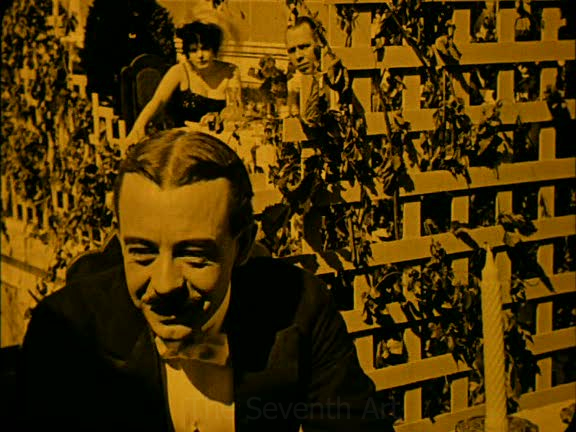
I’m going to go out on a limb and proclaim that 3 Bad Men (1926) is Ford’s first Western masterpiece. Here’s where Ford the filmmaker truly meets Ford the epic poet and Ford the painter. Set during a gold rush in Dakota, in the lands previously belonging to the Sioux, the film charts the attempts of the three titular bandits to escort the daughter of the decently deceased mayor across the plains and away from the scheming mind of the local Sheriff. Hilarious, eloquent, tragic, grand and moving all at once, 3 Bad Men is a fitting farewell to silent Westerns for Ford (sadly, it bombed at the box office) that embodies both the innocence of silent cinema and the splendour of Ford’s brand of filmmaking. One could almost swear that this film was a talkie, for the dialogue (much deadpan comedy and lots of sarcasm!) and acting here is highly naturalistic and it seems as if the director was all set for the sound revolution. But then, being silent is also the best part of the film because it prevents it from flaunting its biblical overtones and its themes of sin and redemption – a temptation that a few of the director’s talkies give in to. Rife with iconic shots, including one stunning two-way dolly that could sit alongside the legendary tracking shot that Murnau would pull off next year, and backed by a terrific 2007 score by Dana Kaproff, 3 Bad Men is Ford at his mythmaking best.
Drums Along The Mohawk (1939)
Drums Along The Mohawk (1939), the first talking Western by Ford and the first of the director’s Westerns to be shot in Technicolor, is also arguably the first failure for the director in this genre. The failure is especially pronounced given the fact that the film was made during Ford’s most fertile period. The film is set during the American War of Independence (earliest time frame of all the director’s films) and follows the life of a newly wed couple (Claudette Colbert and Henry Fonda) that’s expecting a child. With all its flaws and flourishes, Drums Along The Mohawk serves to demonstrate why Clint Eastwood is the most Fordian of all directors working in Hollywood today (followed by Spielberg who has been consistently revealing his indebtedness to Ford in his movies). One of Ford’s most cherished beliefs, as is apparently Eastwood’s and Spielberg’s as well, is the idea that the United States is a nation built upon great sacrifices and heroic acts of its founding fathers. That might explain why there are so many father figures (and, to a lesser extent, pregnant women and mother figures) in Ford’s films. However, here, the spiritual center of the film – the most critical component of Ford’s filmmaking – is almost completely hollow and the characters, somehow, seem to be sacrificed to uphold a vague, romantic ideology. But it is the Native American community that gets the rawest deal of them all, having been portrayed as unreasonable barbarians and regressive patriarchs. The shot of a bunch of women rejoicing, while pouring boiling water over an invading group of Indians, marks the nadir for Ford’s cinema.
Stagecoach (1939)
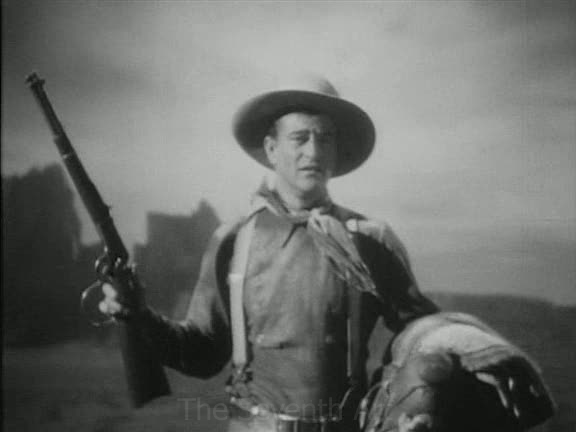
To say that Stagecoach (1939) makes up for the folly called Drums Along The Mohawk would be a gross understatement. It is one of Ford’s finest films and some might even call it the director’s greatest Western. It has been said that Stagecoach changed the way Westerns were made. I don’t know about that, but the film sure does take both the genre and the director to the next evolutionary level. An incisive sociocultural examination of frontier settlements, Stagecoach unfolds as a study of a bunch of characters, each of which would go on to become a genre cliché and the sum of which embodies a whole society. The motley crew is a mixture of marginalized people and bourgeoisie (a la Just Pals) the most striking of whom is a negatively shaded banker – a move that exemplifies Ford’s admiration for FDR and which presages the socialist spirit of The Grapes of Wrath (1940). Ford apparently told Wayne once that the actor just needs to stare at infinity and that the audience, equipped with full knowledge about the character he is playing, would fill in the emotions themselves. That idea is manifest in this very film. We know nothing about this utterly fascinating, almost otherworldly, being played by John Wayne. But, along the film, we also have this feeling of having known him for a long time. It is perhaps for the first time that a Ford Western utilizes what lies beyond its narrative to enrich its story – a technique that would be taken to the extreme in the films to come.
My Darling Clementine (1946)
My Darling Clementine (1946) was made after the end of the Second World War and at a time when Hollywood was bitten by the Film Noir bug. As a result, My Darling Clementine is the first of Ford’s Westerns to go beyond the boundaries of a traditional Western to embrace other genres. Victor Mature’s Doc Holliday is a character straight out of film noir. It is revealed to us that he is a surgeon disillusioned by the uncertainty and brutality that marks his profession. He assumes a false identity, that of a rugged gun wielding gambler (!), to escape this existential angst and resorts to chronic drinking to forget his past (Kurosawa, influenced by Ford as ever, would resolve this duality into two separate characters in Drunken Angel (1948)). Wyatt Earp (Henry Fonda) himself is the quintessential existential hero, taking up the role of the judge, the jury and the executioner upon realizing that there is neither an established law to provide justice not a divine force to punish his brother’s killers (This character would be resolved into two by Ford himself, in his greatest Western). When Earp throws the drunken Indian out of the bar, he may have been acting out a historical truth, but it is also his way of imposing order upon a world that seems to have gone astray like his cattle. That is, of course, till he meets Clementine Carter (Cathy Downs), who is the film’s binding force and its sole symbol of moral purity and progress.
Men On The Verge Of A Nervous Breakdown (Image courtesy: Raavan Official Site)
Towards the end of Mani Ratnam’s long-awaited Raavan (2010), one of the characters looks at the camera and says “You shouldn’t have turned back”. He might well have been talking to the person behind the camera. Raavan is a visual and narrative mess, with lots going for it and even more going against it. What seems to be a major hammering on a minor flash of brilliance has taken over three years to make. There is nothing much about the plot of Raavan that you already haven’t read in your schoolbooks and seen in your televisions. I suggest you read the Wikipedia entry on Ramayana and plug in the actors’ names beside the characters’ yourself. You wouldn’t be very wrong. There are, however, two major changes to the text that writer-director Mani Ratnam has done. One; the back story of Ram has been removed altogether and a new back story for Raavan has been added which attempts to put things in his perspective and to justify his acts. The second and the more important change is that Raavan has been relegated from a higher caste to a lower one. The second change opens up a number of new possibilities given the setting of the film.
Throughout his career, with a few exceptions, Mani Ratnam has been interested in writing stories in which personal drama plays out along and against national affairs and topical issues. Almost all these ‘issues’ that he deals with could be traced to newspaper articles or cover stories (communal riots in the city of Bombay, cross border terrorism in the far east and north, student protests down south, the LTTE, business scams etc.). It is true that there is seldom any rigor in these analyses, but where Mani really scores is in the other layer of these stories, in which he deals with people who are stuck in (or, less frequently, who help create) these social and political upheavals. He seems to be more interested in the lives of these ‘individuals’, without the trappings of any ideology, and the relationship between them. More often than not, these issues have been a pretext for exploring the fears, apprehensions and hopes of these individuals, who seem to be suddenly thrust into these agitations. As a result, the issues themselves stick out like a sore thumb even when they are handled with solemnity (Compare one of these with a film like Alaipayuthey (2000) where he completely de-politicizes the drama to break down the tale to human levels. The result is a completely bourgeois film, but also arguably the director’s most honest work to date).
Another facet of Mani Ratnam’s writing is his fascination with people working on the wrong side of the law. Right from Velu Nayakar, through Deva, Liaqat, Meghna, Inba/Lallan, Gurukanth Desai and up to Beera, all of Mani Ratnam’s central characters have been exploiting legal loopholes and even defying the legal system. All of them have a moral justification for their deeds and, with the probable exception of Inba (one of the director’s best characters, for he is the product of both an ideology and his free will), all these characters have their own definitions of what is objectively good and what is not. And this moral relativism is what they seem to consider as their redemption and it is what redeems them in the audience’s eyes (What makes the character of Velu Nayakar profound is his inability to morally assess this feature of his). Throughout, Mani’s attempt has always been to, if not construct a holistic and unbiased view of the world, recognize the ‘other’ as human and empathize with their situation. A fan might say that Mani is a silent rebel. But the truth remains that Mani Ratnam has always been an armchair liberal. In nearly every one of the cases above, he leaves the issues unresolved, as if they never existed in his film, and the audience unquestioned. He involves himself deep enough so as to raise questions and make us reflect about the state of the nation temporarily, but keeps himself aloof enough to avoid assuming or giving us responsibility.
But that is not to say that he should be resolving these issues and should propose a direction (which would be too much to ask and which runs the risk of making the films propagandistic – a fatal move for a director who works within the establishment), but the least he could do is test our own moral standings and elicit a complex response from us, as did the last Tarantino movie. Mani is a master of bad endings and even he can’t object to that complaint. Everywhere, he has resorted to either indifference or populist didacticism to restore the film to conventional pop-cinema trajectories. A special note must be made for the ending of Yuva/Aayitha Ezhuthu (2004), despite its crudeness, where, for once, the director throws away the armchair and retains the liberalism. That brings us back to Raavan, which sure does imbibe all these traits above. The villagers in the film are obviously based on the Maoist settlements of central and south-eastern India and their leader Beera is a resistance fighter combating the police and armed forces. The plot points are heavily inspired by Operation Green Hunt, but the region of interest for the director, predictably, remains the triangle of characters at its heart. Oh, but there’s also something going on in the background of these characters. For the second time, after his reworking of the Mahabharata in Thalapathy (1991), Mani Ratnam resorts to an existing mythological text for a template.
[Raavan (2010) Trailer]
Mani Ratnam could have been faithful to the text, playing it out in its entirety and stressing and modulating key sections of it to reveal its inherent sexism and chauvinism and, subsequently, investigate how such a flawed text governs our behaviour. Or he could have stuck, as was his style so far, to the Maoist issue alone and examined the tensions underneath. Instead, Mani relocates the Ramayana into this politically charged narrative, making a few key changes for the sake of authenticity, and compromises both possibilities. Many of the characters in Raavan don’t exist for their own sake, but only to play other characters and to complete an existing narrative framework. Now, this isn’t the film’s biggest problem, but for viewers familiar with the text, it goes on to become monotonous and self-parodying. It is also a bit appalling to see a director like Mani Ratnam going for such banal character mapping. The film’s biggest problem is, however, its viewpoint. Now, the point that the film tries to be making is that there is a Ram and Raavan in every one and that it’s only a matter of context that one becomes the hero and the other the villain. But the whole film shows otherwise. There is not one virtue bestowed upon Dev or one vice assigned to Beera (Being an officer in the police force is the only positive thing about Dev, but Ratnam drains that position of any goodness). It’s all still black and white. The film never moves on to the grey area that it claims it is in. This lack of a moral complexity denies the film any real resonance. It is made clear from the very beginning that Beera is the one the audience needs to root for and Dev is the one to be cursed (The casting only worsens the problem, with Abhishek Bachchan being less easier to hate than the newcomer Vikram). Mani does not balance the sides, as is required, he merely swaps them.
However, the film’s redeeming factor lies in the way it sketches these decidedly good and decidedly bad characters. Dev (Vikram) is the icon of a perfect male god. He is macho, sporting a neatly trimmed moustache, well-built, determined and self-assured. But he also seems to be overconfident of his seemingly infallible masculinity to the point of being sexist. His egocentricity defines the world with respect to himself (the camera gyrates around him quite a few times). He considers his wife and his gun to be fairly interchangeable objects which could be used to demonstrate his power. Mani Ratnam floods the mise en scène with phallic symbols when dealing with Dev. Wielding razors, pistols, sunglasses and cigarettes throughout, Dev is the ultimate patriarch who can control the people around him at will. Or so he thinks. This vanity is his biggest vice. And the disillusionment of that masculine vanity is the cause of his fall. Dev seems to be more interested in killing the man who kidnapped his wife than rescuing her or finishing the mission he is assigned. It is the thought that his wife may have found a better man – that his wife’s fantasies might have outgrown his capacities – that frustrates him more than the fact that she is kidnapped. In that respect, Dev has a lot of counterparts in Hollywood including Dr. Harford of Eyes Wide Shut (1999). What Dev is fighting for is, then, his own potency that has been snatched away by this sociopolitical outcast. He can only do this by killing off any man whom his wife may have considered better. And that is what he sets out to do.
Beera (Abhishek Bachchan), on the other hand, lies exactly at the moral and physical midpoint between Ragini and Dev. He is a man who’s more self-aware and empathetic. He has already realized his own limitations as a ‘man’ the moment his sister was snatched away by the police force some time ago (“It was my fault” he says). Unlike Dev, he is a very progressively thinking person and believes in equality. And unlike that Ram, who can not see anything but lies on Ragini’s face, this Raavan trusts her with his life (and his phallic gun, if you will!). But he is also a man on the verge. He could flip over to the other moral side any time soon. His “jealousy” could turn out to be an obsession. Why, he teeters on the boundary between life and death every day. Each one of his ten imaginary heads might be saying a different thing every time. His temptation of avenging his sister by reciprocally violating Ragini is undone by the fact that both Ragini and his sister are merely variations of each other (This implicit aversion towards “miscegenation” in Raavan is but one of the very many narrative, visual and thematic elements that the film shares with The Searchers (1956), a film that is also set at the native frontier and the film that Raavan wants to emulate). These two people who leapt towards death without fear are the only persons who could stand up to Beera and speak. They are the only ones who prevent him from becoming a Dev. This idea of living on the edge is continually underscored by the film’s visual strategy that employs highly expressionistic landscapes. Beera is usually located on a dark cliff beyond which there are only the white waters of death (and redemption?). He is regularly seen straddling dark geographical structures and the white mist-like atmosphere. Even when he is a mysterious, dark, fearful figure, he is associated with harsh light. Samir Chanda’s production design is noteworthy in this regard. Beera’s idea of redemption is a very subjective one and his vindication seems to be in making Dev realize how morally integral he is, despite his caste, and how unethical Dev is, despite his social and legal standing. Of course, for this he throws his political objective to the wind, as does Mani Ratnam.
Ragini (Aishwarya Rai Bachchan) is the symbol of moral strength purity in the film. She’s the only character in the film who could safely be called “objectively good” (for one, Aishwarya Rai is significantly fairer than the other two men in the film. Politically incorrect? May be. Cliché? Definitely). In some ways, she is the mirror image of Dev, and surely the better half, and repudiates all that he stands for. She’s the only person in the film who gets to see the full picture. She acts fairly rationally and, unlike the men, knows no class, creed or ideology (Amusingly, she almost exclusively moves vertically within the frame throughout the film – plummeting and ascending, skidding and rising amidst the rocky mountains – as if transcending the rigid ‘horizontal’ notions of class). She knows no fear in front of Beera, for she has nothing to be afraid of, unlike Dev and his entourage. Beera is just an arbitrary terror for her. And this independence of hers is what brings Beera to earth from his demigod status. These are very interesting characters, no doubt, but our response to them remains highly one-dimensional. As a result, the film turns out to be as one-dimensional and biased as the text it wants to deconstruct. And yes, the film that Raavan wants to be has already been made ten years ago. And how!
Ethiopian-born Haile Gerima, who was a part of the UCLA rebellion alongside the likes of Charles Burnett and Julie Dash, made Bush Mama (1976) as a part of his coursework at the university. The film follows a thirty-ish African-American woman named Dorothy (Barbara O. Jones) living with her daughter Luann (Susan Williams) and her new partner and Vietnam veteran T.C. (Johnny Weathers). Dorothy is unemployed, pregnant with T.C.’s child and lives on funds from a national welfare scheme intended for unemployed parents. T.C. is arrested one day on his way to a job interview and is imprisoned for a crime he apparently did not commit. Devastated, Dorothy vainly haunts the reception hall of the employment office. Meanwhile, the officials from the welfare department exhort Dorothy to abort her unborn in order to avoid giving her more funds. Decidedly, this is not what Hollywood, or any of the mainstream media, is willing to show us. For one, the protagonist is an African-American, a woman and a pauper, arguably the last combination the mainstream looks at. Then there is the plethora of volatile topics that the film alludes to or even confronts including Nixon, the Vietnam War, AFDC, Malcom X, the Watts riots and the legalization of abortion. Bush Mama’s function is to show that we sure might have seen all that in our mass media, but through the wrong words, wrong sounds and wrong images.
There is that very rare feeling of witnessing history being recorded as it is being made while watching Bush Mama. All the things it says and shows – all so detailed and so lived-in – seem so strongly hinged to the reality within which the film was made. You can sense how the welfare scheme was perceived by some sections as one of the causes of increase in crime rate, whereas Gerima’s film shows that the scheme was merely namesake and inconsequential (The echoes are felt even now when certain parties distort “from the rich to the poor” to “from those who earn to those who don’t”). Bush Mama clinically analyzes how the choices presented to this community of African-Americans (and also to other minorities, as Dorothy’s visit to the clinic indicates) are not really choices at all, exposing why the legalization of abortion and sterilization plans go hand-in-hand with the welfare scheme. Gerima adorns with film with all types of black people. People who believe that white folks have nothing to do with their problems and all the trouble is due to the blacks not behaving properly. There are those who think that it’s better to go on as it is. There are those who pretend that nothing’s wrong at all (There’s a sidesplitting vignette with a man whose experience limits his imagination). Then there are those, like T.C., who want to bring in a whole new order.
Bush Mama marries two distinct styles of filmmaking through its two narrative threads. The first section, which mostly follows Dorothy and her travail, is shot in text book cinema vérité format and is especially redolent of the early social films of Béla Tarr, which too deal with clear-cut issues like the national housing policy, unemployment and growing urban population. Like the Hungarian wunderkind, Gerima relies heavily on improvisation, draining the film of all theatricality and infusing each moment with utter spontaneity. He embraces ambient noise of the city and its streets, uses copious amount of handheld shots and effectively blurs the line between documentary and fiction (the ‘fiction’ here is only a thin veil over the truth anyway). If this first narrative thread hinges itself to melodramatic tradition, the second one flips it over, operating in a purely agitprop mode (a la early Makavejev and post-New Wave Godard) that attempts to drag back the film from the defeatism of the other segment towards activism. Characters talk to the camera, as if addressing the audience and provoking them to reassess and expand their sociopolitical view of the world. In a way, this dialectic between the two threads of the film – between passive acceptance and active resistance, between fatalism and existentialism – is the whole point of the film. Likewise, Dorothy herself stands somewhere between Joan of Arc and the militant African-American woman in the poster on her bedroom wall (During the final minutes, Gerima rhythmically cuts between the pregnant Dorothy, a masked Jesus Christ and the black man shot by the LAPD).
Gerima maintains a very dynamic aesthetic throughout in which the camera is rarely static, tracking, zooming and panning all the way (Burnett is credited as one of the DoPs). The director employs a range of camera angles and frame rates, cutting between them in a staccato fashion (also resembling Makavejev) that both reflects the protagonist’s kafkaesque view of events and provides a sense of immediacy to the proceedings. Gerima periodically cuts from reality to alternate reality, from objectivity to subjectivity, from the real to the surreal and from plot point to dead time. Shots of Dorothy wandering the bustling streets of the city (of which there are quite a few) are first shown in negative and only then are developed back to normal monochrome as if playfully flipping racial constructs and then drastically bringing the protagonist back to brutal reality. The production design accentuates the black and white colours of the mise en scène and the grainy 16mm stock provides a newsreel authenticity to the fiction that unfolds. But what is really striking about the visual design of the film is the director’s minimalist use of off-screen space in all the scenes. Be it scenes of comic relief, slice-of-life sequences in the African-American neighbourhood, dramatic episodes or sequences full of pathos, Gerima almost always fixates his camera on Dorothy’s face, capturing every gesture, contour and emotion on it. And through it, Gerima provides a comprehensive sketch of the African-American way of life.
The film’s real forte lies in its sound design. Gerima uses a potpourri of sounds, noise and music for his soundtrack that goes well with the collage-like nature of the film’s visuals. Right from the first minute of the film, certain sounds and lines dominate the soundtrack. One of them is the voice of a woman reading out the terms and conditions of the welfare scheme and the seemingly endless number of questions to be answered to be eligible for it. “Do you understand? Do you agree?” they voices keep asking, as if the answer is going to make any difference at all. As the film proceeds, we share Dorothy’s frustration at these irritating sounds that seem to be floating everywhere in the air. In fact, these are indeed TV and radio waves. Bush Mama also touches upon the representation of African-American culture in popular media (the older women in the film seem to believe in the authority of television). The music, mostly jazz, that supplements this clutter of voices is rendered commendably by Onaje Kareem Kenyatta and the lyrics, too, serve either to supplement the narrative or to comment on the sociopolitical situation. Speaking of music, Bush Mama could be considered as the cinematic equivalent of a certain genre of hip-hop music as far as its basic aesthetic and cultural conventions are concerned. Actions and gestures that are improvised, the rhythmic editing, the recycled shots and the depiction of racial and economic discrimination could be mapped to their direct counterparts in rap and hip-hop.
The prime motif of the film is, quite clearly, that of the prison. One of Gerima’s targets in the film is the police’s seemingly baseless and systematic imprisonment of African-American men. In fact, the film’s most impressive sequence is shot in the jail T.C. is put in. The extended monologue begins with T.C. talking to the camera about the injustice towards black men by the city’s police. Shortly afterwards, the camera tracks over the adjacent prison cells where, too, black prisoners are held. One of the cells contains what looks like just the shadow of a man. It is only after a while that we see that it is in fact a person in flesh and blood standing deep inside the cell. It’s a bravura sequence, with a power and honesty seldom seen in propagandist cinema. Dorothy, on the other hand, is put in a whole different form of social prison. She has to act as the welfare officers say or she’ll go nowhere. They decide if she can have her baby or not. The police can put her in jail on whim and rape her daughter in her house. In parallel, Gerima imprisons Dorothy in visual (through his use of décor, the frustratingly chopped framing, restrictive mise en scène and suffocating close-ups) and aural (the white noise of the soundtrack that she can’t seem to get rid of) prisons. In all the cases, the characters seem to be in jail for a deed they did not commit or for a reason they do not understand.
Bush Mama fits well as a companion film to the most acclaimed work of the movement, Charles Burnett’s Killer of Sheep (1977). While poetry oozed out from the edges of Burnett’s film, it is anger that emanates from the rough seams of Bush Mama. If that film was about conscious perseverance and the need to stick to one’s morality in the most troublesome times, this one is about doing away with such difficulties altogether. In other words, if Killer of Sheep was a romantic mini-spectacle about the indomitable nature of the human spirit, Bush Mama is the harsh behind-the-scenes making of that spectacle. Not that one is more inspiring or effective than the other. Dorothy speaking to T.C. at the end of Gerima’s film is as moving and affirmative as Stan waltzing with his wife in silence. Both are films that profess, albeit through radically different channels, that one can go on despite the adversities. However, unlike Killer of Sheep, Gerima’s film seriously questions if it could be done without a militant revolution and hence its agitprop mode of discourse. Consequently, the film ends with a call for revolution, explaining the need for “calculation” (perhaps a term which has found new meaning after 1968) and the necessity for the revolution to reach the grass roots. As Dorothy says: “I know you’re in jail, T.C., and angry. But most of the time I don’t understand your letters. Talk to me easy, T.C., coz I wanna understand.”
Born in Buenos Aires in 1975, Lisandro Alonso studied at the Universidad del Cine (FUC) and co-directed in 1995 with Catriel Vildosola his first short film Dos en la Vereda (1995). After working as assistant sound engineer in many short films and a few features and as assistant director of Nicolas Sarquis for his film Sobre la Tierra, Lisandro Alonso returned to directing, making his first feature. In 2003 he founded 4L, a production company based in Buenos Aires, to produce his own films. Lisandro Alonso’s first feature La Libertad (2001) was chosen for the Festival de Cannes (Un Certain Regard). His most recent productions, Los Muertos (2004) and Fantasma (2006), were also invited to Cannes, premiering in the Director’s Fortnight. (Image Courtesy: The Evening Class; Bio Courtesy: MUBI)
It is sort of funny to write about the works of Lisandro Alonso after writing about the films of Lav Diaz whose one film runs for longer than the entire filmography of this Argentine director. That just goes to show how different filmmakers, even when working towards similar goals, have different perspectives about the length of their films. Diaz and Alonso share a lot in common as far as their aesthetic choices are concerned. Just that Diaz’s narrative tends to be much more expansive than the latter’s. It is highly interesting that, despite this striking disparity, these filmmakers are two of the most important discoveries of last decade. However, one could argue that, unlike the very “Filipino” Diaz, Alonso is not a very “Argentine” filmmaker and that he is not even remotely interested in the national politics of his country. Even his films would testify that he is not overtly concerned with politics of any kind. Alonso instead seems to take the sociopolitical situation of his country as a given (a la late Tarkovsky and Bresson) and delves into something that is more abstract (as in what connects all of humanity) and more immediate. Most of the director’s films don’t even have societies, just wandering singletons. His characters are ones that live not even on the fringes of society, but beyond its edges. One might compare them to the people in Tsai Ming-Liang’s films, but Alonso’s characters seem to long for and work towards, in addition to the warmth of Tsai’s human connection, freedom and self-sufficiency.
However, despite the differences, Alonso, like Diaz, is a realist too, probably the most realistic of all directors working today. Like most of the filmmakers in Contemporary Contemplative Cinema canon, he mostly works in deep focus mise en scène, allowing the action to unfold at its own pace. He cuts sparely and allows each shot to breathe and develop its own rhythm. In fact, the whole of Alonso’s cinema is built on rhythms and melodies of everyday work. Consequently, he blends both documentary and fiction in his films. His actors may be playing themselves but they do that under slightly altered circumstances and scenarios. This way, the final trace of artificial professionalism in these “actors” is eliminated and what is uniquely theirs emanates. This refusal to dramatize through actors is only one of the many ways in which Alonso resembles Bresson. For one, the remarkable sound design in his films, which exercises an economy of expression and a tendency to nudge to viewers to complete the film’s world, is justifiably comparable to the French master’s (Ironically, Alonso’s films are bracketed by heavy metal soundtracks playing over the credits, as if placing the films into some sort of an aural vacuum in between). The director’s films also betray his keen eye for landscapes and architectures, which is only befitting of a director whose whole filmography studies man’s position in his universe, both in the literal and the metaphysical sense.
La Libertad (2001)
With La Libertad (2001), Alonso comes close to realizing the Italian neo-realists’ dream of recording 90 minutes of a man’s life, without obstruction. Although such documentary observation seldom leads us to uncover higher truths, Alonso’s film provides much space and time for contemplation. La Libertad is a plotless film that chronicles one day in the life of a woodcutter named Misael Saavedra (played by himself) as he goes about chopping trees, shaping the timber, loading them onto a jeep, dumping them at a wholesale shop, returning to the woods in the evening and hunting down an armadillo for dinner. Misael seems entirely cut off from ‘culture’ save for the odd conversation with his friend from whom he borrows the vehicle. He is almost completely self-sufficient in the sense that he derives both his income and his basic needs from nature itself. One could argue that his way of life is devoid of any form of economical exploitation. The ‘freedom’ of the title takes up multiple meanings in this regard. Misael seems altogether independent of the sociopolitical structures of the world that surrounds him. He achieves what the characters in Bartas’ Freedom(2000) and Weerasethakul’s Blissfully Yours (2002) wish for – to depoliticize the world they live in and lead a life that they want, in peace. Alonso’s independence, on the other hand, is from the equally suffocating restrictions of generic cinema such as psychological realism, causal narratives and novelistic drama. Finally, it is also the audience that is free to make sense of what it sees, hears and feels in this evocatively rendered pseudo-documentary.
Los Muertos (2004)
If not the best film made by Lisandro Alonso, Los Muertos (2004) comes very close to it. The first great work by the Argentine, Los Muertos follows the Cain-like Vargas, a man in his fifties who is released from prison and who sets off to meet his daughter. Vargas is portrayed by Argentino Vargas himself, but, unlike in La Libertad, he is not entirely the character he plays. In a way, Los Muertos is both an explanation for the befuddling mysteries and a thematically and aesthetically enriched version of the director’s previous film. The prison that Vargas comes out of might well have been the prison called society. His subsequent journey, then, becomes one where he sheds (sometimes literally) the artificial social constructions that ties him down and one where he returns to the nascent human state – a transition from the calculated propriety of the ego to the unbridled irrationality of the id (In that sense, Vargas is like Aguirre too, descending slowly into the darkest corners of his own psyche as he proceeds deeper and deeper into the jungle). It seems like Alonso wants us to relate Vargas’ murder of his brothers and his clinical slaughtering of the stray goat. Alonso’s point might just be derived from Freud’s theory that man is bestial by his very nature and morality, society and civilization are constructs to keep him from exercising his impulses. But Alonso’s film is far from a systematic psychoanalytical illustration. It is deeply human and hence infinitely complex. When, in the heartbreaking final shot, Vargas sits outside his grandson’s makeshift home on the verge of an existential breakdown, it isn’t only him who reassesses his life so far.
Fantasma (2006)
A work that links La Libertad and Los Muertos, Fantasma (2006) is a one-hour treasure that marks a new high for the Argentine filmmaker. Set in a multiplex in Buenos Aires, Fantasma ports Vargas and Misael, this time devoid of any fictional trappings, from the lush, impenetrable greenery of the South American forests to restricted, deceptive and equally alien interiors of this concrete jungle. However, the human yearning for locating oneself within the world around remains as intense as ever. The four or five characters that we see in the film wander the empty corridors of the building like ghosts that have haunted an abandoned cinema hall. They are rarely seen in the same frame and, unlike the earlier films where they seemed to conquer new areas, keep covering the same set of spaces, taking turns (in a humorously Tati-esque fashion). Alonso isolates them from each other, boxing them out within this human grocery store with his (oft-repeated) compositions. But this sense of urban alienation and lack of communication is only the surface aspect of Fantasma. Two or three of the characters watching Los Muertos on screen in that near-seedy theatre is a grand symphony of cultural uprooting that resonates on multiple levels. In a way, the film’s closest cousin would be Tsai’s Goodbye, Dragon Inn (2003), where too the pathetic human condition was reflected and distilled in the dilapidating condition of the cinemas of yesteryear. Alonso’s film takes an equally nostalgic, elegiac and optimistic look at a world lost and an art rendered irrelevant.
Liverpool (2008)
Alonso’s most acclaimed film, the puzzlingly titled Liverpool (2008) is his most impregnable yet most affecting work to date. The film’s protagonist Ferrel (Juan Fernández) is a worker in a ship that anchors at Tierra del Fuego for a few days. The scenes on the ship are arguably the greatest that Alonso has ever lit and shot in his career. The detached, unfocused figure of Farrel in the opening scene fittingly sums up his condition. The out-of-focus lights of the city far off would remain emotionally out-of-focus for Ferrel even till the end. The warmth of his cluttered cabin is about to give way to a cold, open world that he’s not sure he prefers. One wishes that these scenes would play for eternity. Ferrel decides to take this time off to meet his ailing mother. It is after this that Ferrel progressively resembles Vargas of Los Muertos as he tries, possibly for one last time, to find his footing and perhaps regain his responsibility as a son and, more importantly, as a father that he seems to have disregarded. Alonso cuts his shots in such a way that Ferrel enters the frame after the shot has begun and leaves before it ends. This pattern also reflects the key idea of the film – the world Ferrel enters and exits remains as it was irrespective of his (failed) attempts to integrate himself into it. If Alonso indeed has a knack for finding profundity in the banal, it is in the final quarter hour of Liverpool that he is top form. Before his daughter (and the audience) bids adieu to Ferrel, he gives her a knick knack from his backpack instinctively. It doesn’t absolve him from his guilt, it does not establish a relationship (his daughter is mentally ill to boot) and it does not mean that he has fulfilled his duties as a father. It is a gesture – nothing more, nothing less – and a profoundly human one at that.
Director Priyanandan’s National Award winning Pulijanmam (2006) charts the efforts of a middle-aged, true-blue communist playwright Prakash (the recently deceased Murali Nair) who is about to stage a play based on a folk legend about a highly-skilled man, Kari, of the lower caste who defies god and enters the dark woods, assuming a tiger incarnation, to bring back tiger mane in order to cure the madness of the ruler. “Every generation takes what it wants from a story” says Prakash early on. For one, he sees himself as a reincarnation of Kari and the play as some sort of a self-portrait. History and mythology merge as Prakash finds his campaign against religion and against the ruling communist party’s decision to allow corporations to build resorts over farm lands to be increasingly similar to Kari’s inhuman crusade. Writers N. Prabhakaran’s and N. Sasidharan’s ambition to chronicle the fall of communism in one of the nation’s two most left-leaning states is palpable, but Priyanandan’s methods hurt the film beyond recovery. The director resorts to too much cross cutting, trying to thrust the parallel between the two stories down our throats and destroying the intrigue built up by the film’s first half-hour. The cinematography and composition is purely functional, with some flashes of brilliance to hold attention. Then there’s also the script’s tendency to cover too much ground and make a few social observations too many that stick out like a sore thumb. I must say it’s a tad disappointing to see this film being given the Indian National Award for best film over Goutam Ghose’s ideologically kindred and infinitely superior Yatra (2006).
“Your brother’s going away hasn’t changed him a bit. Such pride! Even your leaving will not shame him. He is as he was.”
Kumar Shahani remains one of the directors in that rarely seen and even more rarely discussed group of filmmakers that includes names such as Mani Kaul and M. S. Sathyu. Unfortunately, neither are there home video releases for most of their works nor are there widespread public screenings or film fest retrospectives within the country to generate interest. Heck, they don’t even make their way into the world of file sharing and peer to peer networks. We are now at a point where even the original negatives of the films face the risk of extinction. One can only hope that institutions like the World Cinema Foundation will do something about it. Kumar Shahani’s Maya Darpan (1972) is a seminal work in Indian Parallel Cinema not just because it canvasses critical social issues (a facet that, more or less, in hindsight, has become a characteristic of the movement) but also because it attempts to seek out a new aesthetic, which does not try to straddle mainstream cinema and art cinema, to do that. The very title, Maya Darpan (literally “Illusory Mirror”), aptly sums up both the film’s social (imprisonment by one’s own “image”, as defined by the class system) and formal (Maya Darpan could well be a sobriquet for cinema itself, encompassing both its illusive and realistic properties at once) concerns at once.
Shahani’s film is set in a provincial town in Northern India, at a time following the nation’s independence in 1947 (The film could well have been set in 1972, just after the worldwide leftist revolution had been put down, and there wouldn’t be much change to the script) when India was yet to be completely integrated as a political entity and when Nehruvian socialism was about to take on the existing feudal hierarchy. Taran (Aditi) is the daughter of a wealthy landlord (Anil Pandya) and lives with her father and her widowed aunt (Kanta Vyas) in their ancestral mansion (which goes on to represent the whole of upper class in the film). The town is witnessing protests by newly formed labour unions which are partly being politically educated by the local railroad engineer (Iqbalnath Kaul), who seems to have an unspoken romantic relationship with Taran. Taran’s unseen brother, who had, to the chagrin of their father, renounced his class privileges and gone off to an Assamese tea estate, asks Taran to join him. Stuck in a stifling patriarchal order, with pressure to get married to an upper class groom mounting, Taran decides to talk to her father about her plans. Actually, much less goes on in the film than what I’ve described and the film is more interested in assessing the formal possibilities of the medium than in following a seamless opportunity-conflict-resolution trajectory. Taran’s character does not arc in the traditional manner (she seems to have already entered the third act) although she eventually manages to switch roles with her lover.
Maya Darpan is a film about transition and transformation – from the bondage of regressive social structures to a progressive state of liberty and equality, from a setup where people have to assume rigid roles irrespective of free will to one where a individual can free himself of inherited roles and think for himself/herself (Taran recites a poem – “I’m called to birth again” – that recalls the legend of the phoenix, as she washes her hands). In other words, it is about the process of breaking the cycle of repression and exploitation into a zone of freedom (Shahani even inserts newsreels depicting World War 2 battle sequences and Gandhian protests during the British rule of India, perhaps to suggest all forms of oppression and subjugation). Shahani finds the cinematic idiom to express this cycle in the form of duplicated shots, redundant compositions and repeated actions and dialog. There are many shots that depict characters moving from the right edge of the screen to the left that are so schematic and mundane to the point of being humorous and self-parodying (One of Taran’s daily routines is to dust the set of chairs – presumably the symbols of power and authority in the film – that her father and other landlords use during their teatime. Fittingly, they are left scattered and disowned by her towards the end of the film). This transgression of social boundaries is also depicted by having characters cut through boundaries and cross railway tracks regularly. Consequently, Maya Darpan plays out like a piece of complex musical composition with many minute variations on a few primary motifs (The film’s unexpected coda itself is a set of classically choreographed tableaus that, I believe, presents the class conflict in dance/martial art form).
Shahani apparently assisted Robert Bresson on A Gentle Woman (1969) and the influence of the French director on Shahani’s style is obvious (especially the extraordinary opening sequence of that particular film, which is echoed at multiple places in Maya Darpan). Like Bresson, Shahani’s shot division has a tendency to break down sequences into their most basic components. Images of hands and feet, isolated in action, often punctuate the narrative. Also Bressonian is the use of sound in the film. Shahani employs tremendous amount of off-screen noise to complement the imagery rather than reinforce it (This divorce between image and sound is alluded to in the very first scene of the film – the nomadic camera, at first, seems to be searching for the voice on the soundtrack and eventually settles down near a sleeping character. The voice turns out to be non-diegetic). The presence of trains, automobiles, oxcarts and taps are all established by the soundtrack. In fact, the camera is never made privy to any sensational action. These actions are either relegated to the space off-screen or they are only provided to us through words. But the influence of Bresson is most palpable in Shahani’s use of his actors. He asks the actors, all non-professionals, to have no expression whatsoever on their faces when spouting their lines monotonically, without any modulation. The effect is all the more unsettling given how vehemently it goes against the natural speech pattern of the country.
As a result, Maya Darpan could be described as a film in which the sociopolitical concerns of Shyam Benegal and John Abraham are distilled through the minimalist aesthetics of Bresson (with a dollop of Resnais, Antonioni and Pasolini to boot). However, it should not be assumed that Shahani’s style is entirely derivative. Shahani’s Bresson influence is just the base upon which he works out his own ways. For instance, in Bresson’s films, conflicts would largely be kept internal and would very occasionally manifest in the characters’ physical actions. In either case, Bresson thoroughly remains a realist of space and time. Shahani, on the other hand, doesn’t hesitate to slip in the borderline-surreal elements. Large stretches of poetry and prose are recited by the characters on the soundtrack, which touch upon their psychology but abstain from analysis, while we see them wandering the barren, debris-filled streets of the town. Furthermore, Bresson’s characters have to go through a process of suffering before they can attain deterministic grace and happiness whereas Shahani’s protagonist is an active entity who chooses to change her life through conscious effort. Even the handful of comments online about the film mentions its innovative use of colour, which I find to be the least important aspect of the work. Shahani does this through the costume and production design of the film, which doesn’t exactly seem to succeed throughout.
Satyajit Ray once commented about Maya Darpan, along with other acclaimed works of the period (almost all of which he was critical of!), in his collection of essays Our Films, Their Films. I’ll type it down here:
Shahani’s other allegiance [in addition to Ritwik Ghatak] is to Bresson with whom he had worked on a film. The legacy of that lesson is to be seen in the girl in the centre of Mayadarpan [sic]. She, too, like Mouchette, suffers inwardly and wordlessly. No quarrel with that. But we are concerned with what happens outwardly. And here, I am afraid, Bresson evaporates. Does Shahani seriously believe that the major outward manifestation of such suffering is a slow, rigid ambulation up and down verandas repeated every five minutes or so throughout the film? Film language would be threatened with extinction if this were really so. To me Mayadarpan seems a combination of poor psychology and poorer stylization. Even the sophisticated response to colour goes for nothing in a film that is so gauche in its handling of the human element. Even more than [Mani] Kaul, Shahani seems to forget that when one imposes a rigid style on the actor without a thorough working out of its expressive possibilities, it becomes indistinguishable from bad acting. The method becomes, extremely risky in a story with an urban background, where the nature of life and work severely limits the expressive gestures. The only possible approach here is the psychological one, for which Shahani seems to have no use.
While I would not be so harsh and unforgiving about Shahani’s film, I do believe Ray makes some fine points there. Shahani sure does seem to be on an experimental ground, trying to figure out the most effective means to get his points across. Not all his flourishes work and there are a number of rough edges to the film. Some shots seem o serve no purpose except perhaps to further disengage us from the already alien narrative. But it would be a tad unfair to say that Shahani eschews psychological exploration altogether. True that he does not work towards psychological realism through the conventional means of writing, acting and scoring. His psychological examination is, akin to Michelangelo Antonioni, carried out through actor choreography, his compositions and his mise en scène (and, to a minor extent, through the poetry-driven non-sequiturs that brace the narrative). Taran is almost always composed against the mansion’s walls and amidst the imposing interiors of the building. She is arrested and suffocated by the endless amount of doorways and pillars in the mansion. During the course of the film, it’s as if the monstrous structure assumes a life of its own, consuming Taran into the void within. This is starkly contrasted with the lush and open spaces of Assam and of the working class section of the village. The bottom line is that, if not anything else, films such as Maya Darpan are of considerable interest to the native viewer since they repudiate accepted norms of psychological realism in a country whose cinema has always thrived on those norms.
 The director’s cut of Butterflies Have No Memories (2009) is something of a misnomer. For one, Diaz had to shoot and cut the film so that it didn’t run for a minute more than the one-hour mark. As a result, it feels as if Diaz had one eye on his film and the other on his watch. There are shots that are abruptly drained off their life and some that feel perfunctory. But the film also seems to mark a turning point in Diaz’s outlook towards the Filipino people. Perhaps for the first time, Diaz portrays the common folk (and perhaps a particular social class) as being almost completely responsible for their misery. In Butterflies, an ex-Chief Security Officer at the mines, Mang Pedring (Dante Perez), blames the mining company, which has withdrawn production after protests by the church and activist organizations, for the economic abyss he and his friends are living in. But it is also starkly pointed out to us that, while they were getting benefited by the mining company, these folks did nothing to set up alternate ways of business and earning and, as a result, find themselves foolishly hoping for a past to return, even when such a regression is harmful it is to the collective living on the island. Mang misguidedly plans to reverse time and reinstall the factory by kidnapping the daughter of the owner of the mining company (Lois Goff), who has returned to the island after several years and who calls Mang her second-father. What Mang tries to do overrides personal memory and disregards the fact that it is he who has lived like a moth, inside a cocoon. As, in the final shot, Mang and his friends stand wearing those Morione masks (which bring in the ideas of guilt, remembrance, conscience and redemption – so key to the film), they realize that they’ve gone way too far back in time than they would have liked – right into the moral morass of Ancient Rome.