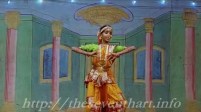
Agraharathil Kazhuthai (1978) (aka Donkey In The Elite Colony)
John Abraham
Tamil
“I felt a living thing had come to me for love and affection. I hadn’t the heart to drive it out.”
 John Abraham’s Donkey in the Elite Colony (1978) begins before its imagery does, with the narrator passionately reciting a fiery poem by Subramanya Bharathi, in praise of fire, during the credits. The first visual of the film follows up the verbal worship of fire in the poem with an extended shot of a sunrise. The tone is set for a leftist kind of film with revolutionary overtones. The seventies was a notorious decade in Indian cinema – both parallel and mainstream – as the permissiveness of American cinema had started showing its influence. And fortunately, it was also the period when cinema was taken most seriously and for the good. Malayalam film director John Abraham’s second film, and his only film made in Tamil, is a controversial film from the era and continues to be rated as one of the most important non-mainstream movies from the country.
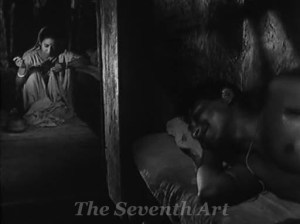
Professor of philosophy, Narayanaswamy (M. B. Sreenivasan) returns home one day to find a little donkey at his doorstep. He comes to know upon enquiry that its mother has been killed by a mindless mob and decides to provide refuge to the animal. But staunch opposition from college officials and his students forces him to transport Chinna (that’s what he has named his pet) to his native village, only to trigger a chain of apocalyptic events. The neighbourhood is an agraharam, the settlement of Brahmins (considered one of the higher social classes in ancient India), where the mere notion of a donkey (an icon of the working class) replacing the sacred cow as a domestic animal breeds hostility. Narayanaswamy is single and has a brother who is married but childless. Chinna is taken care of by the mute Uma (Swathi), who is as devoid of the notions of class and caste as Chinna is and whose fate clearly mirrors the donkey’s.
 Director John Abraham and scriptwriter Venkat Swaminathan evidently draw inspiration from Bresson’s Au Hasard Balthazar (1966, even overtly referenced early in this film), where too the protagonist’s fate was tied up with the donkey’s. I say fate because none of the central characters (the women and the animals) seem to be able to affect the direction of their lives. Both Chinna and Uma are mute creatures who end up being victims of insecurities and questionable intentions of certain individuals who take refuge under the cover of their social standing. But Abraham is far from being a Jansenist (that Bresson is often claimed to be). He is more interested in doing away with the oppressive forces than in contemplating about the harrowing state of affairs as his opening and closing sequences testify. Towards the end of the film, when the professor finally searches out the whereabouts of Uma, he finds her sitting listless among the ruins of a temple, amidst abandoned idols, subtly raising an intriguing question – Has God forsaken his subjects or is it the other way round?
It is so good to see an Indian film, after a long time, which respects the cinematic form and not just its scenario. Venkat Swaminathan’s script would have been just a hard hitting short story if not for what John Abraham does with it. Although Abraham’s style does become showy at places and the film feels like an uneven student film, the director’s conviction that form underscores and enhances content overwhelms. He draws inspiration from Eisenstein (montage is used regularly in the film), the neo-realists (location shoot and use of non-professionals) and, more extensively, Bresson (lot of detail is conveyed through off screen speech while the camera lingers on the characters’ actions). It is enough to witness just the opening few minutes of the film to see the formalist urge of the film. Following the prolonged shot of the sunrise, using simple cross cutting between the professor and the little donkey, Abraham starts presaging the intrusive and iconoclastic nature of both of them, which will be elaborated upon later in the film.
 But most interesting is the central piece of the film, where Abraham achieves a unique effect through repetition and montage. It is a sequence where Narayanaswamy’s father is recounting the villager’s complaints about the donkey. Each scene of complaint begins with a villager shouting out his gripe, after which, Abraham cuts to what actually happened. It is revealed to us that in none of the cases, is the donkey guilty of what the villagers are accusing it for. In contrast to the verbose ranting of the villagers, these flashbacks are completely devoid of words, with only a soundtrack playing throughout each one of them, as if stressing the inherent dubiousness in human words. At the end of each scene, we see Chinna and Uma walking past the father-son pair almost in the same fashion every time. This is followed by a section that shows a working class man taking advantage of Uma’s condition, much like the villagers making use of the donkey’s inability to object. The whole sequence of events repeats three or four times and constantly calls attention to itself, making it a bit of an overkill by today’s standards.
Donkey in the Elite Colony has been called an attack on the Brahmin hegemony in rural Tamil Nadu. But Abraham’s film is much more than a simple tirade against a particular caste or class. It, in fact, talks against any system that tries to imitate itself for a reason it can’t understand and imposes upon itself, laws and practices that are either irrelevant to the present or plainly irrational (In one scene, Narayanaswamy tries drinking coffee without sipping – a practice considered a characteristic of the Brahmin household – in front of his mother, only to fail). Donkey in the Elite Colony presents one such social system which blindly attempts to sustain its oppressive structures like class, caste and family and goes any distance to weed out anomalies that may harm the setup. The class divide is as much perpetuated by the submissiveness of the working class as it is by the domination of the elite. The fact that Narayanaswamy is single and his brother’s family is childless seems to be a big taboo. Status quo is restored only when his brother’s wife bears a child. Even the college where Narayanswamy works insists that he get rid of his pet since it is “demoralizing” for the institution.
 The final act of Donkey in the Elite Colony begins on an ambiguous note, which, in a way, feels like a weak link. We are first shown Brahmins who are repenting for their actions, haunted by the implications of their sins, and then the workers rising to revolt. Is Abraham suggesting that a change has to come from within, rather than through an organized movement (This is a plausible explanation, for Narayanaswamy himself is one of the Brahmins)? Or is he of the opinion that a revolution is the only way for progress? The climactic act, at times seeming indecisive, is brought to a final resolution with the help of another Subramanya Bharathi poem – Dance of Death. The penultimate image in the film is that of burning houses, rendering closure to the film’s first sequence (the opening poem is recited in the soundtrack once more) and providing us with a clear solution rather than an introspective question. Abraham’s leftist tendency overwhelms, taking the film with it into an agitprop mode reminiscent of the Soviet cinema of the twenties. The film closes with a shot of the setting sun – a rather unusual metaphor for a propagandist showdown, for the revolution has just begun.
 If one is asked to describe briefly what Kamal Swaroop’s Om Darbadar (1988) is, some of the answers could be: carefully constructed non-sense, endless dream of a cinephile, a satire on everything, full stop to Indian parallel cinema, random footage, extremely challenging piece of filmmaking, the great Indian LSD trip, landmark Indian film that aims big. With all the ingredients required to make a cult classic, Om Darbadar is the kind of movie that can easily polarize critics and audiences alike. It is, in fact, surprising that the National Film Development Corporation consented to produce this film. Using image, sound and montage to the maximum extent (and often gratuitously) and dialog that seem like knitted from parts of different sentences, almost always making no meaning (written by Kuku, also the lyricist and the art director of the film), Swaroop’s film is an antithesis to whatever is recognized globally as Indian cinema – a reason good enough to make Om Darbadar a must-see movie.

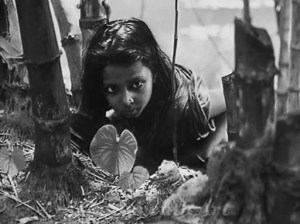 Based on a book by Bibhutibhushan Bandopadhyay, Pather Panchali is a series of loosely knit episodes in a poor Brahmin family in rural Bengal. Harihar (Kanu Banerjee) is a priest who also dabbles in play writing. His wife, Sarbojaya (Karuna Banerjee) manages the household and her two children Durga (Uma Das Gupta) and Apu (Subir Banerjee). There is also their old “aunt” Indir (Chunibala Devi) who loves eating the fruits given to her by Durga. Then there are their neighbours, the well-off Mukherjees, who share a love-hate relationship with their family. Mrs. Mukherjee helps out when Durga falls sick almost as her surrogate mother (as Ray hints early in his mise en scène) and Sarbojaya does the cooking in Mrs. Mukherjee’s daughter’s wedding. It’s a warm and isolated little world of theirs.
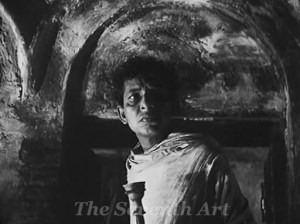 The neo-realists strongly emphasized that the neo-realist filmmaker be just a passive observer of reality without imposing his interpretations on it. That whatever the situation of their characters, – glory or misery – the filmmaker must maintain objectivity, always subordinating reason to action. Although many of the staunch neo-realists themselves couldn’t achieve this complete objectivity, they did attempt to do so in theory. However, in Pather Panchali, Ray never claims to be a mere observer. It is true that he does not comment on the characters’ actions and situation or throw hints to the audience so as to tell them what to feel. But that does not mean Ray does not take a stance (or a neutral stance for that matter). Ray is biased for sure, but not towards his characters but towards life itself. He takes immense joy in infusing life on to the screen and providing a channel of hope to his protagonists. Quite in contention with the neo-realist theory, Ray does not hesitate using Pt. Ravi Shankar’s soundtrack generously (but not without much caution) or in concocting sequences with a tinge of humour.
 Like La Strada (another victim of the neo-realist baptism), that was as much away from its purely neo-realist contemporaries as it was close to them, Ray marries the neo-realist objectivity that avoids hyperbole and his own subjective view of life producing what may be, like Fellini’s film, called “neo-realism with a heart”. But again, Ray absorbs and deviates. Where, like many a film of later years, La Strada compares a road trip to life, Pather Panchali compares life to a road trip. Ray treats life as an inevitable journey which should go on no matter how shattering its events are. He punctuates his film with images of little roads through the woods and of characters arriving or departing from the village. In other words, Satyajit Ray presents life as a train journey where passengers may come and passengers may go, but the train itself never stops. Ray wasn’t kidding when he put that train in Pather Panchali – a train that Durga never manages to get on and one that Apu would, in Aparajito (1957), my favorite film of the trilogy.
 Mrs. Mukherjee confiscates the family’s grove as a penalty for the failure of repayment of loan. Later, the people of the village persuade Harihar to stay and tell him that this place is their ancestral land. It is as if the people of the village have assumed the land to be theirs despite of the fact that it was already there much before them. Ray touches upon the conflict between man and nature that has been dear to so many filmmakers before and after him. And this is where Pather Panchali gets deeper than meets the eye. Exactly like Herzog would do in
  I have hardly seen Satyajit Ray’s films and was apprehensive about taking up this book. I was afraid that it would require a prior introduction to films he talks about and especially to his own films. But as it turned out, I was completely wrong. Shubhajit